Comic Strip Conversations for autism and social understanding
|
June 13, 2026
Discover how to implement Comic Strip Conversations in your classroom. Learn the cognitive mechanisms, co-construction techniques, and NHS-aligned non-judgmental prompts to help autistic learners map spoken words, thoughts, and feelings without enforcing rigid behavioural compliance.
Comic Strip Conversations are visual, co-constructed communication maps that help learners externalise invisible social information, rather than rigid compliance scripts designed to enforce obedience.
The intervention supports perspective-taking and Theory of Mind by drawing stick figures to represent people, using speech bubbles for spoken words, thought bubbles for internal thoughts, and systematic colour-coding for underlying emotions.
Official NHS clinical guidelines state that these visual tools must remain strictly non-judgmental, collaborative, and focused on shared meaning-making, rather than being used to judge past behaviour or dictate future actions.
Emerging evidence from clinical evaluations highlights that while visual supports are effective for structuring communication in inclusive settings, school staff must monitor whether learners generalise these social concepts beyond one-off therapeutic sessions.
What is a Comic Strip Conversation?
Comic Strip Conversations are structured, visual communication tools that use simple drawings, stick figures, symbols, and colours to illustrate social interactions. Developed originally by Carol Gray, this intervention is designed to help autistic learners and those with social communication difficulties make sense of the rapid, complex, and often overwhelming nature of human communication. By drawing an interaction as it occurs or after it has taken place, the teacher and the learner make abstract, transient social information visible and permanent.
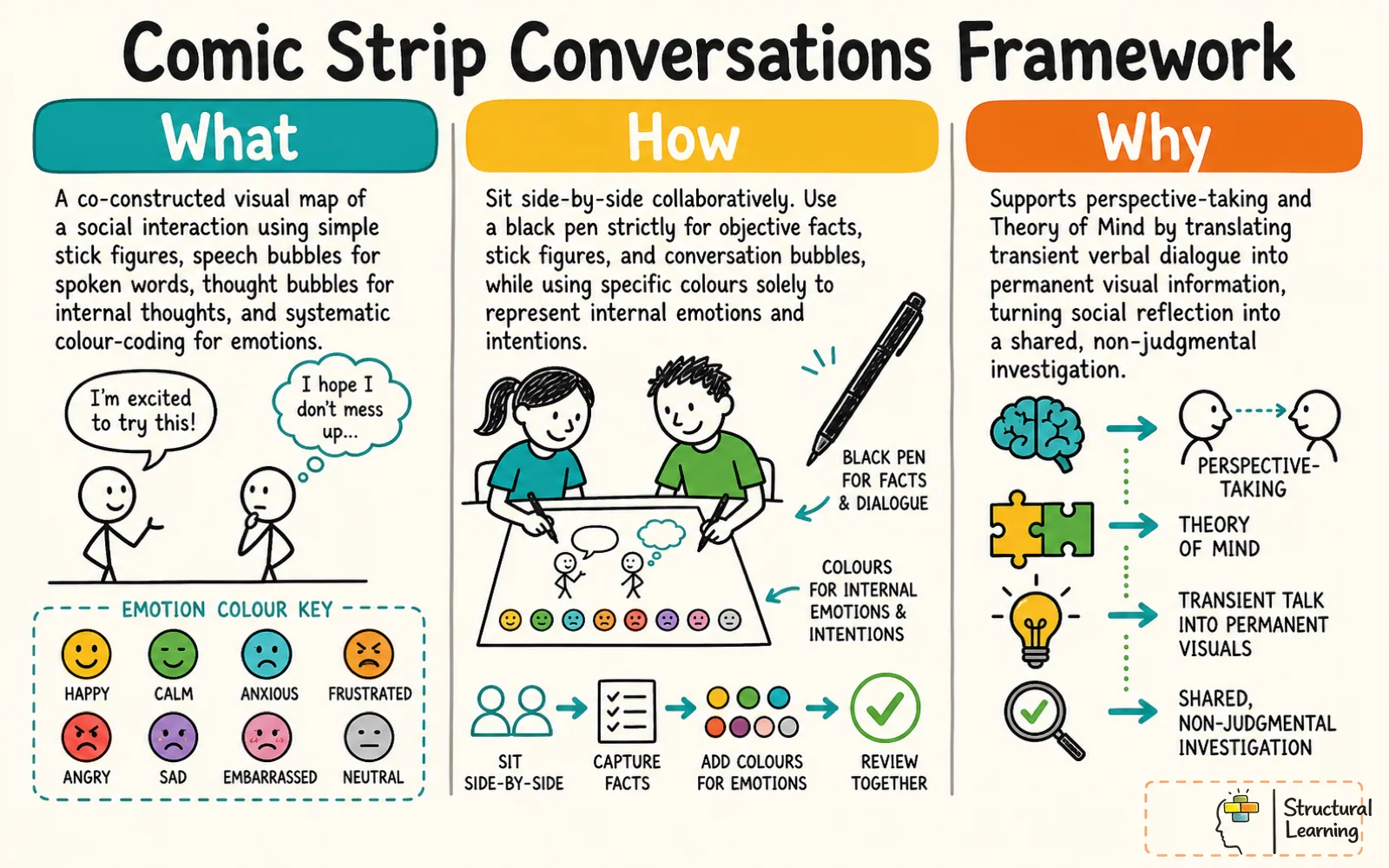
Comic Strip Conversations Framework
At its core, the technique involves drawing stick figures to represent different people in a situation, with speech bubbles showing what was said aloud, thought bubbles showing what was silently thought, and specific colours illustrating the feelings or intentions behind the words. Sitting quietly side by side, the educator and the learner co-construct the drawing on paper. This physical act of drawing alongside talking shifts the interaction from a verbal, potentially confrontational interrogation to a shared, collaborative investigation of a social event.
Classroom Decision Rule: Selecting Materials for a Session
Before starting a session, the educator must establish a predictable setup. Sit side by side rather than face to face, as sitting opposite a learner can increase cognitive pressure and make the dialogue feel like an interrogation. Use a large, clean sheet of paper (preferably A3 to allow plenty of space for multiple comic panels) and a set of coloured pens or pencils that correspond to established emotional associations. Keep a black pen strictly reserved for drawing the objective facts, such as the environment, stick figures, and conversation bubbles, while using colours solely for representing internal emotions and motivations.
Who is this Intervention For (and Who is It Not For)?
Comic Strip Conversations are highly effective for learners who experience difficulties with social communication, narrative processing, and perspective-taking. This group includes autistic learners, individuals with developmental language disorder (DLD), those with moderate learning difficulties, and learners who experience social vulnerability during unstructured school times such as breaktimes or lunchtimes. By translating verbal dialogue into a visual format, the intervention provides an essential cognitive scaffold for learners who struggle to process rapid auditory information or who find it difficult to identify the emotional states of others.
The intervention is not suitable for learners who are in a state of high emotional arousal or crisis. When a learner is highly dysregulated, their working memory is severely compromised, and any attempt to engage them in drawing or reflecting will likely increase their distress. Similarly, the approach is less effective for learners who lack basic symbolic representation skills, such as matching a stick figure to a person, though these skills can be taught beforehand. For highly anxious learners who associate drawing with academic failure or perfectionism, the teacher may need to use pre-printed symbols or digital blocks rather than demanding hand-drawn figures.
Classroom Example: Assessing Readiness for a Comic Strip Session
Consider a Year 7 learner named Callum who has just entered the support base after a physical conflict on the playground. He is breathing rapidly, refusing to sit down, and throwing his bag across the room. The specialist assistant does not attempt to initiate a Comic Strip Conversation at this stage. Instead, the assistant applies a co-regulation strategy: providing a quiet space, offering a sensory object, and waiting twenty minutes until Callum’s physical signs of stress have completely subsided. Only when Callum is sitting calmly and has initiated quiet conversation does the assistant introduce the drawing materials to map out the playground event.
The Cognitive and Language Mechanisms
To understand why Comic Strip Conversations support social processing, teachers must look at the underlying cognitive and language mechanisms. Typical social interactions demand rapid processing of auditory language, non-verbal gestures, facial expressions, vocal tone, and contextual cues. For autistic learners, this high-speed stream of social data can easily cause cognitive overload, leading to frustration, withdrawal, or behavioural distress (Sweller, 1988). The intervention addresses this by slowing down the interaction, dividing it into discrete chronological steps, and capturing it permanently on paper, which reduces the load on working memory and allows the learner to process the information at their own pace.
Furthermore, the intervention targets difficulties with Theory of Mind, which is the cognitive capacity to attribute mental states, such as beliefs, intents, desires, emotions, and knowledge, to oneself and others (Riddiford et al., 2022). Autistic learners often find it challenging to mentalize, meaning they may not automatically infer what another person is thinking or feeling during a fast-paced conversation. By representing unobservable thoughts as physical thought bubbles and separating them from spoken words in speech bubbles, the comic strip makes mentalizing concrete and accessible.
◆ Structural Learning
Comic Strip Conversations Study Notes
Study notesOne-page revision sheet
Download a one-page study note for Comic Strip Conversations, with the key ideas, limitations and classroom links in one place.
According to guidelines from Whittington Health NHS Trust (2025), visual perception in individuals with autism can vary, showcasing both unique strengths and challenges. Using structured, static drawings plays directly to strong visual-spatial processing abilities, using concrete representation to bridge gaps in abstract language comprehension.
Classroom Example: Explaining Bubbles to a Primary Learner
When introducing a Year 4 learner to the difference between a speech bubble and a thought bubble, the teacher can use a clear, physical analogy. The teacher draws a round bubble with a solid tail pointing directly to a stick figure's mouth and says: "This is a speech bubble; it holds the exact words that came out of your mouth, like water coming out of a tap; anyone standing nearby could hear these words." Next, the teacher draws a cloud-like bubble with small, separate circles leading up to the figure's head and says: "This is a thought bubble; it is like a quiet secret inside your brain; nobody can hear these words unless we choose to draw them here."
The Co-Constructed Map It Approach vs. Compliance Scripts
A common error among school staff is using Comic Strip Conversations as a corrective, teacher-led compliance tool. When an educator uses the drawing to illustrate what the learner did wrong and then draws what the learner must do next time to conform, they violate the core therapeutic intent of the approach. As official guidelines from Whittington Health NHS Trust (2025) emphasize, Comic Strip Conversations must never be used to judge behaviour or direct a child to behave in a specific way. Instead, they must function as a collaborative, non-judgmental problem-solving support that values the learner's perspective as much as the perspectives of others.
When the process is co-constructed, the teacher and the learner are equal partners in mapping the event. The teacher does not impose their own version of events; instead, they use open, factual questions to guide the learner's hand. This collaborative approach ensures that the learner feels safe, listened to, and active in the problem-solving process. If the drawing is used to lecture the child, it quickly triggers anxiety, defensiveness, and resistance, leading the learner to reject the intervention entirely.
Research into social interventions highlights that unilateral approaches, where the adult directs the child, are far less successful than shared meaning-making frameworks that treat relationships as the primary context (Lewandowski et al., 2016).
When mapping a difficult situation, the teacher must strictly avoid accusatory questions such as "Why did you push her?" or "Why didn't you follow the rules?" Instead, use factual, phenomenological prompts: "Where were you standing?", "What did you say?", "What did you see them do?", and "What was inside your thought bubble when that happened?" This maintains the drawing as an objective, shared map of the interaction rather than a record of guilt.
To implement a Comic Strip Conversation effectively, the educator must follow a structured, predictable sequence. This ensures that the session remains calm, logical, and highly supportive.
Step 1: Set the Scene and Establish a Safe Space
Choose a quiet area of the school, free from noise and visual distractions. Sit side by side with the learner, with the drawing paper positioned equally between you. Clearly state that the purpose of the session is to map out an event to understand it together, and emphasize that there are no bad drawings or wrong answers.
Step 2: Draw the Context and the People
Begin by using a black pen to draw the physical setting, such as a playground fence, a classroom table, or a school corridor. Draw simple stick figures for the people involved. Label each stick figure clearly with their name to anchor the representation.
Step 3: Map the Chronological Order
Draw a series of boxes, similar to a comic strip, to establish the sequence of events. Ask the learner what happened first, second, and third. Mapping the chronology prevents the learner from becoming overwhelmed by trying to process the entire conflict at once.
Step 4: Record Spoken Words
Ask the learner what was said aloud by each person. Write these exact words inside solid speech bubbles drawn in black ink. If the learner cannot recall the exact words, help them approximate, or use a placeholder symbol such as a question mark to indicate spoken words that were unclear or missed.
Step 5: Unpack Silent Thoughts
Draw cloud-like thought bubbles above the stick figures. Prompt the learner to consider what each person might have been thinking at that precise moment. If mapping a conflict, this is where the teacher can gently introduce alternative perspectives: "What do you think was inside Sarah's thought bubble when you closed the book?"
Step 6: Apply the Emotional Colour Code
Invite the learner to colour the thoughts, words, or figures using the emotional colour system. For example, if the learner felt scared, they might colour their stick figure blue; if another person was perceived as angry, their words might be coloured red. This step makes abstract emotional states visible and connects them directly to specific points in the conversation.
Step 7: Identify Misunderstandings and Co-design Solutions
Review the completed comic strip together. Identify any points where there was a gap between what someone said and what they actually thought, or where one person misunderstood another person's actions. Collaboratively brainstorm what could be put into the speech or thought bubbles in a future, similar situation to prevent the misunderstanding.
Sequence Stage
Teacher Focus
Learner Action
Cognitive Goal
1. Context
Set up quiet environment, sit side by side.
Positions paper and selects drawing tools.
Reduce environmental load and anxiety.
2. Chronology
Prompt for physical actions and positions.
Draws simple stick figures and setting in black.
Establish objective facts and sequence.
3. Speech
Ask: "What did you hear them say aloud?"
Writes spoken words in solid round bubbles.
Separate spoken verbal output from internal states.
4. Thoughts
Ask: "What was hidden inside their mind?"
Draws cloud bubbles containing internal thoughts.
Support mentalizing and perspective-taking.
5. Emotions
Guide colour application based on feelings.
Colours bubbles or figures to show emotional states.
Connect feelings to specific social triggers.
6. Resolution
Co-design alternative bubbles for next time.
Draws a final panel showing an alternative pathway.
Build cognitive alternatives and agency.
Classroom Example: Resolving the Science Lesson Conflict
In a Year 6 classroom, a learner named Thomas became highly distressed during a group science activity when a classmate, Olivia, closed their shared Chromebook. Thomas shouted, pushed his chair back, and ran out of the room. Once Thomas is calm, the teacher sits side by side with him in a quiet intervention room to co-construct a comic strip conversation.
Panel 1 (The Context): The teacher draws a table, a Chromebook, and two stick figures labelled Thomas and Olivia. The teacher asks: "Where were you standing just before the Chromebook closed?" Thomas draws his stick figure standing close to the table.
Panel 2 (The Action and Speech): The teacher draws Olivia's arm reaching toward the Chromebook. Inside Olivia's solid speech bubble, Thomas writes nothing, because Olivia closed the screen in silence. Inside Thomas's speech bubble, Thomas writes his spoken words: "Hey! Why are you ruining my work?"
Panel 3 (The Unspoken Thoughts): The teacher draws a cloud-shaped thought bubble above Thomas's figure. Thomas writes: "She is closing my screen because she hates my slides and wants me to fail." The teacher then draws a thought bubble above Olivia's figure and says: "Let's think about Olivia. Just before this, the teacher had clapped their hands and said 'screens down, eyes front' to the whole class. What might have been inside Olivia's thought bubble?" Thomas pauses, looks at the teacher, and says: "Maybe she thought we were supposed to close it because the teacher said so." Inside Olivia's thought bubble, they write: "I must follow the teacher's instruction and close the screen quickly."
Panel 4 (The Emotional Colouring): Thomas selects a red pencil (for anger) and colours his own thoughts in Panel 3. He then selects a green pencil (for calm or friendly) and colours Olivia's thought bubble, realising her intention was to follow class rules rather than to attack his work.
Panel 5 (The Solution): Together, they draw an alternative pathway panel. In this panel, Olivia says aloud: "The teacher said screens down now," before closing the screen. Thomas’s thought bubble is coloured green, containing the thought: "She is just following the class rule, not trying to ruin my slide." Thomas’s speech bubble says: "Okay, I will save this first."
Through this visual sequence, Thomas experiences a cognitive shift. He transitions from attributing a hostile motive to Olivia to understanding that her action was driven by a classroom instruction, significantly reducing his distress and preparing him for future group tasks.
Visual Symbols and Colour Coding Reference
Carol Gray's established framework uses a consistent visual vocabulary to represent different forms of communication and emotional states. Introducing these symbols systematically helps learners build a reliable toolkit for social problem-solving.
To prevent cognitive overload, particularly for younger learners or those with more complex communication needs, educators should simplify the colour palette. Focus on four or five primary colours that represent distinct emotional categories.
Colour
Standard Emotional Association
Classroom Prompt / Diagnostic Meaning
Black
Objective Facts, Truth, and Settings
"What is the absolute truth about what happened?"
Green
Calm, Friendly, Safe, and Comfortable
"How can we make this speech bubble feel safe?"
Red
Angry, Aggressive, and Dangerous
"Which thoughts were making your heart beat fast?"
Blue
Sad, Scared, Hurt, or Uncomfortable
"What made you feel small or worried in this box?"
Yellow
Confused, Uncertain, or Distressed
"Where did the conversation start to feel muddy?"
Classroom Decision Rule: Adapting the Palette for Distracted Learners
If a learner is highly distracted by selecting colours or experiences fine motor difficulties, restrict the materials to just a black fine-liner for drawing the comic panels and two highlighter pens: green for comfortable thoughts or words, and blue or red for uncomfortable thoughts or words. This simple binary division keeps the cognitive focus on perspective-taking rather than on aesthetic choices or complex categorisation.
Evidence, Limitations, and Critiques
While Comic Strip Conversations are widely used in UK specialist and mainstream schools, educators must evaluate the intervention with professional objectivity, recognizing both its clinical utility and the boundaries of its evidence base.
In a local search of 8 studies examining visual supports and social understanding, the overall evidence for comic-strip style approaches is emerging and highly dependent on implementation quality. A systematic review by Joanna Page (2016) noted that while educators increasingly seek diverse interventions to support autistic pupils in inclusive mainstream environments, the effectiveness of Comic Strip Conversations varies significantly based on individual learner profiles and how consistently school staff deliver the sessions.
Furthermore, a systematic review and meta-analysis of preschool interventions by Hinz et al. (2024) indicated that visual attention toward social and non-social stimuli in autism is complex and highly individualised, meaning some learners may require much more explicit scaffolding to engage with abstract drawing conventions than others. Watkins et al. (2019) emphasize that while inclusive education has increased the presence of autistic learners in regular classrooms, visual social supports must be actively integrated into daily routines rather than treated as isolated, weekly pull-out sessions if they are to have any lasting impact.
Scholarly Critiques and Key Classroom Limitations:
The Generalisation Gap: Research consistently shows that while an autistic learner can successfully complete a comic strip conversation in a quiet room with a familiar adult, transferring this social understanding to the noisy, unpredictable playground or classroom transition remains highly inconsistent (McConnell et al., 2024).
Cognitive and Symbolic Demands: Learners who struggle with abstract symbolic representation may find it difficult to understand how a stick figure with a cloud bubble represents their classmate's internal mind. This requires explicit teaching of the symbolic code before attempting conflict resolution.
Anxiety and Resistance: For some learners, drawing out a social breakdown can feel like rehashing a failure, which can trigger defensiveness. If the teacher focuses on what went wrong rather than co-constructing a neutral map, the learner may refuse to draw or actively scribble over the paper.
Adult Delivery Variance: The effectiveness of the intervention is highly vulnerable to adult bias. When delivered by untrained school assistants, the comic strip often degenerates into a task where the adult draws and instructs the learner on how they should have behaved, completely undermining the co-construction principle.
To check if a learner is generalising the skills learned during comic strip sessions, the SENCO should establish a structured observation during transitions. If a learner has mapped out a turn-taking conflict in a comic session, an assistant should observe them during the next three playground sessions, recording whether the learner uses any of the verbal or physical strategies co-designed in their comic. If no generalisation is observed after four weeks, the team should adjust the intervention, perhaps moving the drawing session directly onto a clipboard on the playground immediately after play has finished.
Comparing Comic Strip Conversations with Similar Interventions
To select the most appropriate support for a learner, educators must understand how Comic Strip Conversations compare to other common visual and narrative interventions used in schools.
1. Social Stories
Also developed by Carol Gray, Social Stories are short, personalised written scripts that describe a specific social situation, skill, or concept in a highly structured, predictable format. Unlike Comic Strip Conversations, which are reactive and co-constructed after an event to resolve confusion, Social Stories are typically proactive, written entirely by the adult, and read to the learner beforehand to prepare them for a transition or routine.
2. Video Modelling / Video-Based Interventions
These approaches involve the learner watching a short video clip of a peer, an adult, or themselves performing a target social behaviour successfully, then imitating that behaviour (McConnell et al., 2024). While video modelling is excellent for teaching concrete, observable motor actions (such as lining up or washing hands), it is less effective than Comic Strip Conversations for unpacking unobservable, internal cognitive thoughts and emotional motivations.
3. Social Use of Language Programme (SULP)
This is a highly structured, curriculum-based speech and language intervention that uses physical group games, role-play, and explicit verbal rules to teach pragmatic language skills. While SULP is brilliant for building systematic group conversational skills, Comic Strip Conversations are far more individualised and responsive to immediate, real-life classroom conflicts.
Intervention Type
Primary Visual Focus
Child Participation Level
Ideal Classroom Scenario
Comic Strip Conversation
Co-constructed drawing of stick figures, speech, and thought bubbles.
High: Co-creates the drawing and emotional colour coding.
Unpacking a specific playground conflict or peer misunderstanding.
Social Story
Text-based narrative with minimal, static visual supports.
Low: Primarily listens to or reads the story.
Preparing for an upcoming transition, such as an assembly or school trip.
Video Modelling
Video recordings of target behaviours.
Medium: Watches and then actively replicates the action.
Learning a new physical classroom routine, such as using science equipment.
SULP
Physical role-play, structured games, and visual cue cards.
High: Participates in group games and verbal practice.
Developing peer-to-peer conversational turn-taking across a whole class.
Classroom Decision Rule: Social Story or Comic Strip Conversation?
Use a Social Story when the goal is preparation for a future, structured event where the rules are fixed: "Next week we are going to a museum; this is where we will walk, and this is how we will ask questions." Use a Comic Strip Conversation when the goal is reflection and resolving confusion after an unstructured event where multiple perspectives clashed: "Two boys ran past me at breaktime, and I thought they were laughing at my game."
The Structural Learning Link: Graphic Organisers as Social Maps
Within the Structural Learning framework, Comic Strip Conversations are best understood as cognitive Map It tools for invisible, complex social information. Just as a physical block diagram or a graphic organiser allows a learner to lay out and categorise their thoughts before writing an essay, a comic strip allows a learner to externalise and organise complex social interactions. Both tools operate on the same cognitive principle: transferring ideas from a crowded working memory onto a physical canvas where they can be manipulated, sorted, and evaluated.
When we use graphic organisers in the classroom, we help learners build a visible structure for academic concepts (graphic-organizer-templates-a-teachers-guide). By extending this practice to social interactions, we teach neurodivergent learners that social situations are not unpredictable, chaotic events, but structured systems that can be mapped, analyzed, and understood (metacognition-send-neurodivergent-students). This structural approach supports oracy and critical thinking by giving the learner a concrete scaffold to discuss, debate, and negotiate meaning with their peers and teachers (oracy-and-critical-thinking-hub).
Classroom Example: Setting up a Group Work "Social Map"
Before starting a collaborative design and technology project in a Year 5 class, the teacher uses a simple, shared graphic organiser with three blank stick figures drawn on it. The teacher says to the group: "Before we build our model, let's map out our group talk. We have three roles: the Builder, the Supplier, and the Recorder. Let's write down what should be inside each person's speech bubble if we need to borrow a tool, and what should be inside our thought bubbles to keep our group feeling calm and respected." By mapping these communicative expectations on a shared canvas first, the group establishes an explicit social framework, dramatically reducing the likelihood of collaborative breakdowns.
The SENCO and Teacher Implementation Checklist
For school-wide coordination and to guarantee that support staff deliver Comic Strip Conversations with high therapeutic fidelity, the SENCO should use the following structured checklist.
Pre-Intervention Suitability
Has the learner’s current emotional regulation state been assessed? (Ensure they are calm, regulated, and not in active crisis before starting).
Does the learner possess basic symbolic representation skills? (Can they associate a stick figure with a physical person?).
Have the appropriate drawing materials been prepared? (A3 paper, a black fine-liner for facts, and a set of coloured pens for emotions).
Is the intervention space quiet, neutral, and free from peer distraction?
During-Intervention Fidelity
Are the educator and the learner sitting side by side, looking at the paper together, rather than face to face?
Is the black pen being used strictly for objective physical facts, stick figures, and bubble outlines?
Are spoken words clearly separated from unspoken thoughts using solid speech bubbles and cloud thought bubbles respectively?
Is the educator using open, factual, phenomenological prompts rather than accusatory or corrective questions?
Is the emotional colour code being applied systematically by the learner to represent internal feelings, rather than used randomly for decoration?
Is the session co-constructed, with the learner actively drawing or directing the content, rather than the adult drawing and lecturing?
Post-Intervention Tracking and Generalisation
Has a copy of the completed comic strip been saved securely in the learner's support folder for longitudinal progress tracking?
Has the co-designed solution or alternative pathway been shared with the class teacher and regular playground assistants?
Is there a structured observation plan in place to monitor whether the learner applies the targeted social skill during natural school transitions?
Has the emotional colour palette remained consistent across different school staff members delivering the intervention to avoid cognitive confusion?
What is the evidence for visual supports and comic-strip style approaches for autistic learners social understanding?
Limited support: The Consensus search found relevant papers, but the evidence should be treated as emerging and checked carefully against the article claims.
50% Yes from 8 studiesstrong evidence
431
Yes50%
Possibly0%
Mixed38%
No13%
Teacher takeaway
Use the approach as a structured support, not a guarantee: identify the target skill, teach it explicitly, and monitor whether it transfers into classroom language, reading or writing.
Video-based interventions (VBIs) are an approach that can be used to promote social behavioural skills for autistic children and young people. Despite an abundance of literature in this area, previous evidence syntheses are limited by their exclusive search strategies and eligibility criteria. Therefore, there is a lack of comprehensive evidence syntheses to provide insight on whether these interventions work, for whom, and in what circumstances. Evidence and Gap Maps (EGMs) are used to collate vast literature on a broad topic area such as this, highlighting areas for synthesis, and identifying gaps for future research. To identify, map and synthesise existing primary research on VBIs promoting social behavioural skills for autistic children and young people, creating a live, searchable and publicly available EGM. Searches were conducted in electronic databases ( = 8), web search engines, and other repositories including published papers and grey literature. The search strategy was developed around two concepts including (1) terms related to autism, and (2) terms related to VBIs. Searches were conducted in May 2021. All primary studies evaluating the effectiveness of VBIs in promoting social behaviours for autistic children and young people aged 3-18 were included in the EGM. Search results were imported into Eppi-Reviewer where duplicates of identical studies were removed. Titles and abstracts were then screened by two independent reviewers. Potentially eligible full texts were located and also screened by two reviewers. Data were then extracted on study design, participant characteristics, type of intervention, type of outcome, and country of study, by one of three reviewers. EPPI-Mapper was used to create the interactive EGM. The current EGM contains 438 studies reporting on 394 single subject research designs, 25 randomised controlled trials, 15 non-randomised group designs, and 8 pretest-posttest designs. Included studies evaluated VBIs in all male ( = 238), mixed gender ( = 172) or all female ( = 17) samples. VBIs employed included video modelling ( = 273), video self-modelling ( = 82), point-of-view modelling ( = 61), video prompting ( = 57), video feedback ( = 12) and computer-based video instruction ( = 4). The most frequently used models were adults ( = 191) and peers ( = 135). In relation to social outcomes, almost half evaluated social engagement ( = 199) with limited studies looking at safety ( = 9) and community ( = 7) skills. This EGM provides a valuable resource for policy-makers, practitioners, researchers, funders and members of the public to access evidence on VBIs promoting social behavioural skills in autistic children and young people. The map has identified areas of sufficient research where evidence can undergo synthesis. In addition, important gaps in the evidence were highlighted and suggest further research is warranted in all female samples and less frequently evaluated types of VBIs and social outcomes. Evidence included in this EGM will be further explored via systematic review and meta-analysis on control group designs.
Classroom implication: Use this as a caution: check learner fit, delivery quality and progress data before treating the approach as settled practice.
Educational provision for children with autism is increasingly being made within mainstream settings and a range of intervention strategies to cater for the diverse needs of this heterogeneous population are needed (Ali & Frederickson, 2006). This research presents an evaluation of ‘Comic Strip Conversations’ (CSCs) (Gray, 1994b) for addressing the target social behaviours of five primary-aged pupils with autism in mainstream schools. CSCs are a story-based intervention which use visual systems designed to support understanding of situations and encourage more appropriate social behaviours in individuals with autism. A systematic review of existing research into the effectiveness of CSCs highlights the limited evidence base that currently exists.
Classroom implication: Use this as a caution: check learner fit, delivery quality and progress data before treating the approach as settled practice.
Autism spectrum disorder (ASD) is characterized by significant social functioning impairments, including (but not limited to) emotion recognition, mentalizing, and joint attention. Despite extensive investigation into the correlates of social functioning in ASD, only recently has there been focus on the role of low-level sensory input, particularly visual processing. Extensive gaze deficits have been described in ASD, from basic saccadic function through to social attention and the processing of complex biological motion. Given that social functioning often relies on accurately processing visual information, inefficient visual processing may contribute to the emergence and sustainment of social functioning difficulties in ASD. To explore the association between measures of gaze and social functioning in ASD, a systematic review and meta-analysis was conducted. A total of 95 studies were identified from a search of CINAHL Plus, Embase, OVID Medline, and psycINFO databases in July 2021. Findings support associations between increased gaze to the face/head and eye regions with improved social functioning and reduced autism symptom severity. However, gaze allocation to the mouth appears dependent on social and emotional content of scenes and the cognitive profile of participants. This review supports the investigation of gaze variables as potential biomarkers of ASD, although future longitudinal studies are required to investigate the developmental progression of this relationship and to explore the influence of heterogeneity in ASD clinical characteristics. LAY SUMMARY: This review explored how eye gaze (e.g., where a person looks when watching a movie) is associated with social functioning in autism spectrum disorder (ASD). We found evidence that better social functioning in ASD was associated with increased eye gaze toward faces/head and eye regions. Individual characteristics (e.g., intelligence) and the complexity of the social scene also influenced eye gaze. Future research including large longitudinal studies and studies investigating the influence of differing presentations of ASD are recommended.
Classroom implication: Translate the finding into explicit modelling, guided practice and progress monitoring rather than relying on one-off exposure.
Relatively little is known about social cognition in people with intellectual disability (ID), and how this may support understanding of co-occurring autism. A limitation of previous research is that traditional social-cognitive tasks place a demand on domain-general cognition and language abilities. These tasks are not suitable for people with ID and lack the sensitivity to detect subtle social-cognitive processes. In autism research, eye-tracking technology has offered an effective method of evaluating social cognition-indicating associations between visual social attention and autism characteristics. The present systematic review synthesised research which has used eye-tracking technology to study social cognition in ID. A meta-analysis was used to explore whether visual attention on socially salient regions (SSRs) of stimuli during these tasks correlated with degree of autism characteristics presented on clinical assessment tools. Searches were conducted using four databases, research mailing lists, and citation tracking. Following in-depth screening and exclusion of studies with low methodological quality, 49 articles were included in the review. A correlational meta-analysis was run on Pearson's r values obtained from twelve studies, reporting the relationship between visual attention on SSRs and autism characteristics. Eye-tracking technology was used to measure different social-cognitive abilities across a range of syndromic and non-syndromic ID groups. Restricted scan paths and eye-region avoidance appeared to impact people's ability to make explicit inferences about mental states and social cues. Readiness to attend to social stimuli also varied depending on social content and degree of familiarity. A meta-analysis using a random effects model revealed a significant negative correlation (r = -.28, [95% CI -.47, -.08]) between visual attention on SSRs and autism characteristics across ID groups. Together, these findings highlight how eye-tracking can be used as an accessible tool to measure more subtle social-cognitive processes, which appear to reflect variability in observable behaviour. Further research is needed to be able to explore additional covariates (e.g. ID severity, ADHD, anxiety) which may be related to visual attention on SSRs, to different degrees within syndromic and non-syndromic ID groups, in order to determine the specificity of the association with autism characteristics.
Classroom implication: Translate the finding into explicit modelling, guided practice and progress monitoring rather than relying on one-off exposure.
Students with autism spectrum disorder (ASD) are increasingly educated alongside typically developing peers in regular education environments. These students have impairments that may hinder their success in inclusive school settings and require individualized supports to improve outcomes. The purpose of this meta-analysis and best-evidence synthesis is to examine the characteristics of interventions for students with ASD in inclusive settings, offer quantitative analysis of intervention effects, examine potential moderating variables that influence outcomes, analyze the social validity of these interventions, and provide recommendations for practice and future research. The 28 included studies met the What Works Clearinghouse standards for group design and single-case design research. Studies focused mostly on social communication skills, produced moderate to large effects, and were generally found to be socially valid. Function-based interventions, visual supports, self-monitoring strategies, and peer-mediated interventions resulted in mostly large effects, and teacher delivered interventions produced the largest overall effects. More high-quality studies for students with ASD in inclusive school settings are needed to advance evidence-based practice for this population. (PsycINFO Database Record (c) 2019 APA, all rights reserved).
Classroom implication: Translate the finding into explicit modelling, guided practice and progress monitoring rather than relying on one-off exposure.
Research on attention towards non-social stimuli in preschoolers with autism spectrum disorder (ASD) has increased over the past decade; however, findings have been inconsistent. It has been suggested that stimuli relating to common circumscribed interests (CIs) elicit more attention than non-CI related stimuli. This meta-analysis synthesizes results from 31 studies that compared attention towards non-social stimuli in children with ASD under the age of five with typically developing (TD) controls using eye-tracking. Additional subgroup analysis comparing studies that employed non-social stimuli related to CIs frequently reported in adults with ASD to studies using non-CI related stimuli were conducted. Meta-regressions with age, sex, stimulus dimension, nonverbal DQ, and symptom severity were conducted. Results show small (g = 0.39) but significantly higher attention towards non-social stimuli for the ASD group. However, when studies were split based on stimulus type no significant differences for non-CI related stimuli was found. Meanwhile studies employing CI related stimuli reported significant large effects on attention allocation (g = 0.69). None of the conducted regressions reached significance. The findings show increased non-social attention in children with ASD is driven by CI related content rather than a general non-social attentional bias. The findings and future research directions are discussed.
Classroom implication: Use this as a caution: check learner fit, delivery quality and progress data before treating the approach as settled practice.
Background: Visual perception in individuals with autism spectrum disorder (ASD) can vary, often showcasing both strengths and challenges. Many individuals with ASD excel in detail-oriented processing, allowing them to focus on fine details rather than the overall picture, which can be advantageous in tasks requiring attention to small details, such as visual search and pattern recognition. Understanding these unique aspects of visual perception in ASD is crucial for developing tailored interventions and support strategies to enhance visual processing abilities and overall social functioning.
Classroom implication: Translate the finding into explicit modelling, guided practice and progress monitoring rather than relying on one-off exposure.
This study presents the findings of a systematic review of empirical research on the use of augmented reality (AR), virtual reality (VR), mixed reality (MR), and extended reality (XR) to present social skill instruction to school-age students with autism spectrum disorder (ASD). Forty-one articles met the inclusion criteria. Studies targeted relationship skills, emotion recognition, social awareness, cooperation, and executive functioning. The intervention caused statistical improvement in 15 of the 41 studies (37%). Practitioners, parents, and researchers reported significant improvement of social skills in 32 studies (83%). We suggest modifications to the technology and interventions within the technology which may increase statistical gains for students. We conclude with recommendations for researchers and practitioners implementing AR and VR delivered social skill interventions.
Classroom implication: Use this as a caution: check learner fit, delivery quality and progress data before treating the approach as settled practice.
What should I do if a learner refuses to draw or has poor fine-motor skills?
If a learner is highly resistant to drawing or experiences significant fine-motor difficulties, the educator should completely remove the demand to draw. Use pre-cut visual blocks, laminated stick-figure cards, or printed speech and thought bubbles that the learner can simply position on a blank page. The educator can write the learner's dictated words inside the bubbles. Alternatively, use simple digital analogs on a tablet where the learner can drag and drop icons, maintaining the co-constructed mapping process without physical writing barriers.
How do I handle a situation where the learner draws a completely inaccurate or untruthful version of the event?
When a learner presents a version of events that contradicts the observations of school staff, the educator must not accuse the learner of lying or argue with them. Draw their version of events exactly as they describe it in one panel. Then, draw a parallel panel representing the alternative perspective or the adult's observation. Say: "This is what you saw and felt in your box. Let's draw what Mrs. Davis saw from the other side of the playground in this box so we can look at both maps together." This visually validates the learner's personal experience while introducing alternative perspectives without creating a defensive power struggle.
Can Comic Strip Conversations be used with non-verbal or minimally verbal learners?
Yes. For learners with limited spoken language, the intervention must rely heavily on simple, highly concrete visual symbols rather than written text. Use simplified line drawings of specific, highly recognizable school objects (such as a swing, a ball, or a lunch tray). Represent speech using simplified visual symbols or photographs inside the speech bubbles, and use clear emotional colour-coding or basic facial expression icons (such as a happy or sad face) to represent the thoughts and feelings. This makes the cognitive sequence of the interaction accessible without requiring complex spoken narrative skills.
How long should a typical Comic Strip Conversation session take?
A standard session should take between ten and twenty minutes. Keeping the session short and highly focused prevents cognitive fatigue and ensures that the learner remains engaged. If a social situation is highly complex and requires more time, break the event down into separate, smaller episodes and map only one episode per session.

Next-Lesson Action
Next lesson, when a minor social misunderstanding or group work conflict occurs in your classroom, resist the urge to resolve it purely through verbal discussion. Instead, sit side by side with the learner, take a plain sheet of paper and a black pen, and draw two stick figures with solid speech bubbles and cloud-like thought bubbles to map out exactly what was said aloud versus what was silently thought.
Research sources
Further reading from peer-reviewed research
These 5 studies give source context for the classroom guidance in this article on Comic Strip Conversations for autism and social understanding. They are included as starting points for deeper reading, not as a substitute for local professional judgement.
Systematic Review60 citationslink.springer.com
Immersive Technology to Teach Social Skills to Students with Autism Spectrum Disorder: a Literature Review
Maggie A. Mosher et al. (2021) | Review Journal of Autism and Developmental Disorders
Use this as a caution: check learner fit, delivery quality and progress data before treating the approach as settled practice.
An evaluation of the effectiveness of 'comic strip conversations' for addressing the target social behaviours of primary-aged pupils on the autistic spectrum
Page (2016) | Journal of Behavior Analysis and Support
Use this as a caution: check learner fit, delivery quality and progress data before treating the approach as settled practice.
Paul Main is an educator and metacognition researcher who founded Structural Learning in 2002. With a psychology degree from the University of Sunderland and 22+ years helping schools embed thinking skills, he bridges the gap between educational research and classroom practice. Fellow of the RSA and Chartered College of Teaching, with 128+ Google Scholar citations.