How to Write and Use Social Stories to Reduce Anxiety and Build Independence
|
June 13, 2026
An evidence-informed guide for UK teachers and SENDCOs on writing and implementing Carol Gray's Social Stories™ to support autistic learners, without turning them into compliance scripts.
Social Stories™ are a specific, evidence-informed intervention created by Carol Gray to share social information with autistic learners, not to force behavioural compliance.
The core purpose is to increase understanding and predictability, which can reduce anxiety in social situations. They describe more than they direct.
An effective Social Story follows a strict formula, using more descriptive and perspective sentences than directive or coaching sentences.
Recent UK-based research (Wright et al., 2024) shows that while they may not improve a learner's global social skills, they are a valued, low-burden tool for achieving specific, personalised socio-emotional goals.
Avoid common pitfalls like using overly directive language, generic templates, or introducing the story when a learner is already distressed. The process must be personalised, patient, and respectful.
What Are Social Stories?
Social Stories are a specific learning tool designed to help autistic learners understand social situations. Developed by Carol Gray in the 1990s, their primary goal is to share accurate information about the context of a situation, the perspectives of others, and common responses. This is not a behaviour management strategy. A Social Story describes a situation, skill, or concept in terms of relevant social cues, perspectives, and common responses.
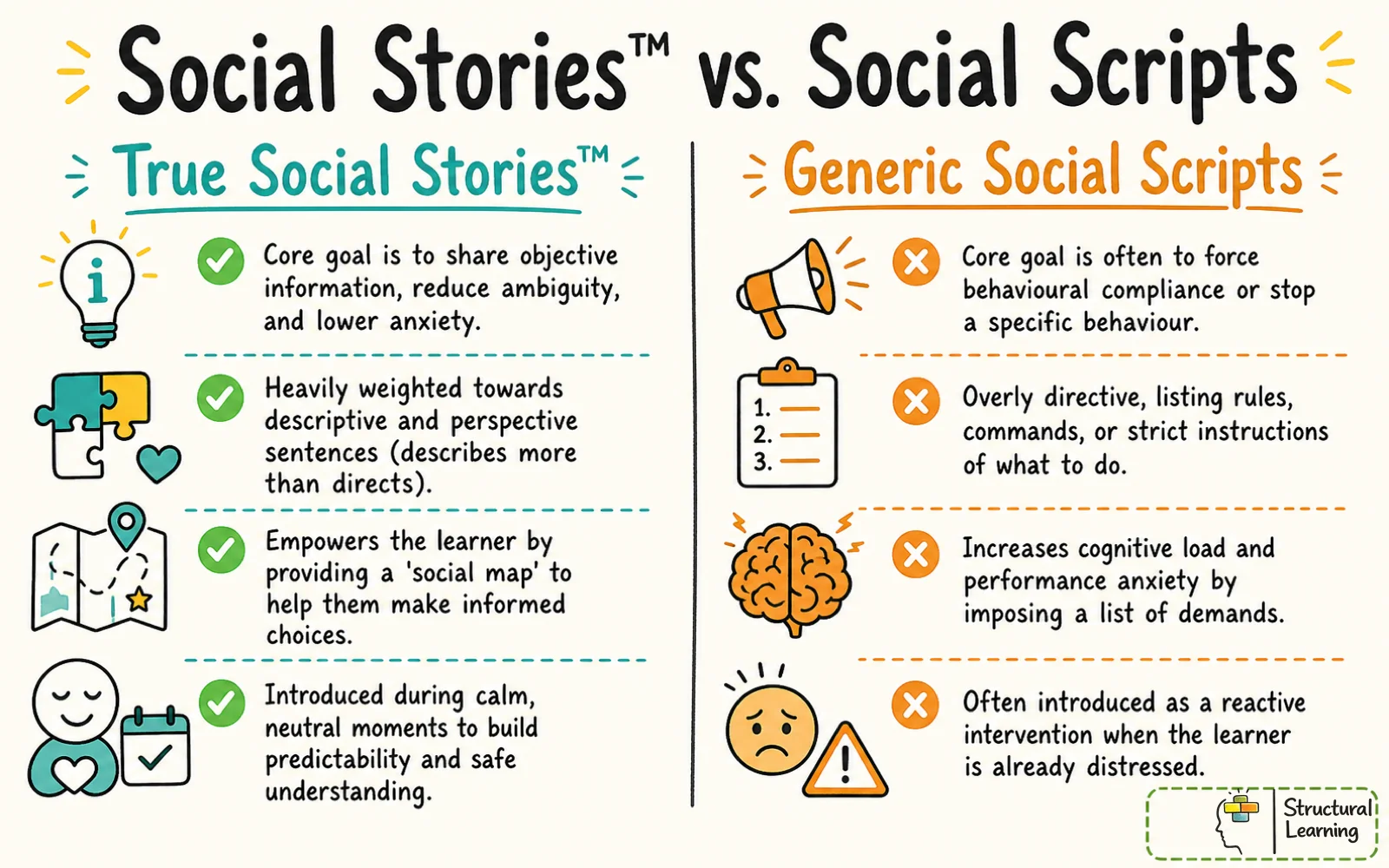
Social Stories™ vs. Social Scripts
The fundamental principle is that providing clear, objective information reduces ambiguity. For many autistic learners, social uncertainty is a primary source of anxiety. When they don't have the "social map" for a situation, their cognitive load increases, often leading to distress. A Social Story offers that map. It provides a clear, patient, and safe way to understand what might happen in a situation and why.
It is crucial to distinguish Carol Gray's Social Stories™ from generic 'social scripts'. A true Social Story follows a defined set of ten criteria, ensuring the tone is respectful, descriptive, and supportive. It is not a list of rules for the learner to follow. Instead, it aims to support the learner with information, allowing them to make more informed choices.
The Philosophy: Information Over Direction
The core philosophy of Social Stories is to share information, not to control behaviour. Carol Gray's approach is founded on empathy and respect for the autistic perspective. The goal is to help the learner understand the social world, not to force them to conform to it.
This means a well-written story is heavily weighted towards descriptive sentences that paint a picture of the situation. It includes 'perspective sentences' that explore the thoughts and feelings of others, helping the learner develop social cognition. Only after establishing this descriptive context does a story include a limited number of 'coaching' or 'directive' sentences that gently suggest a possible response.
This focus on description over direction is what makes the strategy effective for its intended purpose: building understanding and reducing anxiety. A story that is too directive risks becoming just another list of demands, which can increase pressure and anxiety for the learner.
The Psychology Behind the Strategy
Social Stories work by addressing some of the core cognitive challenges associated with autism, particularly around social understanding and executive function. By making the implicit rules of social situations explicit, they reduce cognitive load and increase predictability.
Reducing Cognitive Load in Unfamiliar Situations
Many social situations are second nature for neurotypical individuals, but for an autistic learner, they can be a complex and overwhelming puzzle. A busy school assembly, a change in routine, or a noisy playground all contain hundreds of unwritten social cues. Trying to process these cues in real-time can overwhelm a learner's working memory.
Cognitive Load Theory (Sweller, 1988) suggests that our working memory has a limited capacity. When it is overloaded with new, complex information, our ability to learn and function effectively diminishes. A Social Story acts as a cognitive scaffold. By presenting the social information in a clear, sequential, and storable format before the situation occurs, it frees up the learner's working memory. They enter the situation with a mental model already in place, reducing the cognitive effort required to navigate it.
Predictability, Routine, and Anxiety Reduction
For many autistic learners, a lack of predictability is a significant source of anxiety. The world can feel like a chaotic and unpredictable place. Routines and clear structures provide a sense of safety and control.
A Social Story provides this predictability for a specific social context. It lays out what is likely to happen, in what order, and why. For a learner anxious about fire drills, a story explaining the sound of the alarm, the reason for lining up, and the process of walking to the assembly point can transform a terrifying event into a manageable routine. This knowledge supports the learner, replacing fear of the unknown with the confidence of knowing what to expect.
The landmark UK-based ASSSIST-2 trial found that while Social Stories had no measurable impact on a learner's global mental health, they were highly valued by teachers and parents for helping learners achieve specific, personalised socio-emotional goals (Wright et al., 2024). This suggests their power lies in targeting a single, well-defined point of anxiety.
Core Components of an Effective Social Story
To be effective, a Social Story must adhere to the specific structure and sentence ratio developed by Carol Gray. This is not simply a narrative; it is a carefully constructed tool where every sentence has a purpose.
There are seven types of sentences used in Social Stories, but three are most critical for teachers to understand: Descriptive, Perspective, and Coaching (previously called Directive).
The Key Sentence Types
Descriptive Sentences: These are the foundation of the story. They are objective statements of fact that describe the situation. They answer the 'wh' questions: where the situation occurs, who is involved, what they are doing, and why. They are free of opinion or judgment.
Example: "At my school, we have assembly on Friday morning."
Example: "All the learners from Key Stage 2 go to the main hall."
Perspective Sentences: These sentences describe the internal state of other people, their thoughts, feelings, knowledge, or motivations. This is a crucial element, as it helps the learner understand the social context from another person's point of view.
Example: "My teacher enjoys it when everyone listens during assembly."
Example: "Some learners feel excited when they see their friends in the hall."
Coaching Sentences: These sentences gently guide the learner towards a possible response or choice. They should always be framed positively and offer a suggestion, not a command. They often follow the format "I can try to..." or "It is helpful if I...".
Example: "I can try to walk quietly into the hall."
Example: "I will work on sitting calmly next to my friend."
The Social Story Formula
The effectiveness of a Social Story hinges on its sentence ratio. Carol Gray's formula mandates that for every one coaching sentence, there must be at least two (and up to five) descriptive or perspective sentences.
Formula: 2 to 5 Descriptive/Perspective Sentences for every 1 Coaching Sentence.
This ratio ensures the story's primary function is to inform and describe, not to direct or demand. A story that is heavy on coaching sentences ceases to be a Social Story and becomes a behaviour script, which is less likely to be effective and may even increase a learner's anxiety.
Sentence Type
Purpose
Example
Descriptive
States facts; sets the scene.
"Sometimes, the fire alarm rings at school."
Perspective
Describes others' feelings or thoughts.
"The loud noise can surprise some learners."
Coaching
Gently suggests a response for the learner.
"I can try to cover my ears if the noise is too loud."
Step-by-Step: How to Write a Social Story
Writing a personalised and effective Social Story is a thoughtful process. It requires observation, empathy, and collaboration. Generic, downloaded templates are rarely effective because they miss the specific nuances of the learner's situation.
Step 1: Identify the Target Situation
Begin by identifying a single, specific situation that causes the learner difficulty or anxiety. Don't try to address multiple issues at once. The more focused the story, the more effective it will be. Good targets are often transitions, new routines, or events with unclear social rules.
Classroom Example: A Year 5 learner becomes very agitated during group work. The teacher observes that the agitation begins when other learners start talking at the same time. The target situation is not 'group work' in general, but specifically 'managing multiple conversations during group work'.
Step 2: Gather Information and Learner Perspectives
Observe the situation from the learner's point of view. What do they see, hear, and experience? What are the key social cues they might be missing? If possible and appropriate, involve the learner in the process. Ask them what they find tricky about the situation. Collaborate with parents, carers, and the SENDCO to build a complete picture.
Classroom Example: The teacher asks the learner, "What feels the hardest when we work in groups?" The learner might say, "Everyone talks at once and I don't know who to listen to." This insight is vital. The story needs to address the challenge of multiple voices, not just the task of working together.
Step 3: Drafting with the Formula
Now, write the story using the sentence types and the ratio.
Title: Give the story a clear, simple title.
Introduction: Start with a descriptive sentence that introduces the topic.
Body: Build the story with a mix of descriptive and perspective sentences. Explain the sequence of events, the environment, and how others might be feeling or thinking.
Coaching: Add one or two gentle coaching sentences. Frame them as suggestions or strategies the learner can try.
Conclusion: End with a positive and reassuring descriptive sentence.
Draft Example: "Our Turn to Talk in a Group"
(Title) Our Turn to Talk in a Group
(Introduction - Descriptive) In our class, we sometimes work in groups to share ideas.
(Body - Descriptive) Four learners sit together at one table.
(Body - Descriptive) Sometimes, my friends have lots of ideas and want to share them.
(Body - Perspective) It can be exciting to share ideas, and sometimes people talk at the same time because they are excited.
(Body - Perspective) My teacher, Mrs. Evans, knows it can be tricky to listen when more than one person is talking.
(Body - Coaching) I can try to listen to the person who is holding the talking stick.
(Body - Descriptive) When they are finished, they will pass the stick to someone else.
(Body - Coaching) I can wait for my turn with the stick to share my idea.
(Conclusion - Descriptive) Sharing ideas in a group helps us learn from each other.
How to Use a Social Story Effectively
Writing the story is only half the process. How it is presented and used is just as important for its success.
Presentation and Format
The format should be tailored to the learner's age, interests, and reading ability.
Text: Use a clear, simple font. Keep sentences short and use plenty of white space.
Visuals: Use photographs or simple, clear drawings to support the text. Real photos of the actual environment (e.g., the school hall, the specific classroom) are often more effective than generic clip art.
Personalisation: Use the learner's name and the names of relevant adults (like their teacher or TA).
Format: Present the story in a simple book format, on individual cards, or as a digital presentation. The physical object should be durable and accessible to the learner.
Introducing and Reviewing the Story
Timing: Introduce the story at a calm, quiet time when the learner is relaxed and receptive. Never use it as a reactive tool during a moment of distress; this can make the story a source of anxiety itself.
Location: Find a quiet, comfortable space free from distractions.
Tone: Read the story in a patient, reassuring, and objective tone. It is an information-sharing activity, not a lecture.
Frequency: Review the story regularly, especially just before the target situation is due to occur. The goal is for the learner to internalise the information, so repetition is key.
Fading: As the learner becomes more comfortable and successful in the situation, the need for the story will decrease. You can gradually reduce how often you read it. Eventually, the story can be put away, but kept available in case the learner wants to revisit it.
Evidence and Limitations
The evidence for Social Stories is mixed but offers important insights for teachers. While systematic reviews have struggled to classify it as a standalone 'evidence-based practice' due to inconsistencies in how it is studied (Kokina & Kokina, 2010; Chen et al., 2020), it remains a widely used and valued intervention.
The most significant recent UK study is the ASSSIST-2 randomised controlled trial (Wright et al., 2024). This large-scale trial in UK primary schools found that Social Stories did not have a clinically significant effect on children's overall social responsiveness or mental health.
However, the same study found that the intervention was highly valued by schools and parents. It was seen as a low-cost, low-burden tool that was effective for achieving specific, individualised goals. This suggests the power of Social Stories lies not in transforming a child's overall social ability, but in providing just enough information to make a single, challenging situation more manageable.
◆ Structural Learning
Social Stories Study Notes
Study notesOne-page revision sheet
Download a one-page study note for Social Stories, with the key ideas, limitations and classroom links in one place.
Therefore, teachers should use Social Stories as a targeted tool, not a universal solution. They are most likely to be effective when written for a specific learner to address a specific point of anxiety.
Social Story Checklist for Teachers and SENDCOs
Use this checklist to ensure your Social Stories are high quality and adhere to Carol Gray's model.
1. Goal is Informative: Is the primary goal to share information and improve understanding, not to change behaviour?
2. One Specific Situation: Does the story focus on a single, clearly defined situation or skill?
3. Learner's Perspective: Is the story written from a first or third-person perspective that is respectful of the learner?
4. Positive & Patient Tone: Is the language positive, patient, and non-judgmental?
5. Follows the Formula: Are there at least two descriptive/perspective sentences for every one coaching sentence?
6. Answers 'Wh' Questions: Does the story clearly describe where the situation happens, who is there, what happens, and why?
7. Personalised Content: Does it use the learner's name and specific details from their environment (e.g., real names, real locations)?
8. Accessible Format: Is the font clear, and are visuals (if used) simple and relevant to the learner?
9. Introduced Calmly: Is the story introduced and reviewed in a calm, quiet, and positive setting?
10. Plan for Fading: Is there a plan to review the story's effectiveness and fade its use as the learner gains confidence?
What is the evidence for Social Stories and social narratives for autistic learners in educational settings?
Promising support: The Consensus search found relevant papers, but the evidence should be treated as emerging and checked carefully against the article claims.
63% Yes from 8 studiesstrong evidence
53
Yes63%
Possibly0%
Mixed38%
No0%
Teacher takeaway
Use the approach as an explicit routine: model the target skill, give guided practice, build in repetition, and check whether pupils can use it beyond the intervention session.
Autism spectrum disorder (ASD) is a common neurodevelopmental disorder, which lacks specific medical treatment. Intervention is the key point of rehabilitation training for ASD. Social stories (SS) are a commonly used intervention practice in individuals with ASD. However, there is mixed evidence on the effectiveness of SS. Thus, the objective of this systematic review and meta-analysis is to assess studies of the effects of SS for children and adolescents with ASD. To identify relevant studies, we will search PubMed, EMBASE, Cochrane Library, Web of Science, Google Scholar and trials registers (the World Health Organization International Clinical Trial Registration Platform, ClinicalTrials.gov, and Chinese Clinical Trial Register) from inception to May 2020. In addition, we will also perform handsearching of grey literature, such as conference proceedings and academic degree dissertations. Only the randomized control trials will be accepted, no matter what the languages they were reported. We will first focus on the effectiveness of the intervention on the behavior of the targets. Then we will do further analysis of the study design, including the length and intensity of intervention, the characteristics of participants and interveners, the methods of assessment, the place, the medium, and the economic feasibility. Two independent reviewers will carry out literature identification, data collection, and study quality assessment. Discrepancies will be resolved by a third reviewer. The Cochrane Risk of Bias Tool will be used to evaluate the risk of bias of the randomized controlled trials. Data analysis will be calculated using the STATA 13.0 software. This study will offer new evidence whether the SS is an appropriate intervention of benefiting the children and adolescents with ASD, and to determine which factors affect the effectiveness of SS. The conclusion drawn from this systematic review will benefit the children and adolescents with ASD.
Classroom implication: Use this as a caution: check learner fit, delivery quality and progress data before treating the approach as settled practice.
Social stories is a widely used intervention for children on the autism spectrum, particularly within an educational context. To date, systematic reviews and meta analyses of the research evaluating social stories has produced mixed results, often due to a lack of methodological rigour and variability in the development and delivery of the social stories. To address the gap in methodological rigour, a pilot Randomised Control Trial (RCT) was conducted, incorporating a social stories intervention group (n = 9 children on the autism spectrum) and an attentional control group who received a poem (n = 6 children on the autism spectrum) using a digital platform to address variability. Digitally-mediated social stories were found to be effective in producing beneficial changes in behaviour outcomes, which were sustained at a six-week follow up.
Classroom implication: Use this as a caution: check learner fit, delivery quality and progress data before treating the approach as settled practice.
A meta-analysis of single-subject research was conducted, examining the use of Social Stories and the role of a comprehensive set of moderator variables (intervention and participant characteristics) on intervention outcomes. While Social Stories had low to questionable overall effectiveness, they were more effective when addressing inappropriate behaviors than when teaching social skills. Social Stories also seemed to be associated with improved outcomes when used in general education settings and with target children as their own intervention agents. The role of other variables of interest, such as participants' age, diagnosis, and skill development, the format of Social Stories, the length of the intervention, and the use of assessment (e.g., comprehension checks) also was explored.
Classroom implication: Translate the finding into explicit modelling, guided practice and progress monitoring rather than relying on one-off exposure.
Over the past 20 years a variety of treatments have been developed to remediate deficits associated with autism. Since the early 1990 s, Social Stories ™ have been suggested to positively affect the social development of children with autism spectrum disorder (ASD). Despite much research, there remains uncertainty regarding the effectiveness of this modality. We conducted a systematic review of the literature using pre-defined, rigorous methods. Studies were considered eligible if they were controlled trials evaluating Social Stories ™ among persons with ASD. Two reviewers independently screened articles for inclusion, applied eligibility criteria, extracted data, and assessed methodological quality. A qualitative analysis was conducted on six eligible controlled trials. Five of the six trials showed statistically significant benefits for a variety of outcomes related to social interaction. This review underscores the need for further rigorous research and highlights some outstanding questions regarding maintenance and generalization of the benefits of Social Stories ™.
Classroom implication: Translate the finding into explicit modelling, guided practice and progress monitoring rather than relying on one-off exposure.
A Social Story™ (Carol Gray) is a child-friendly intervention that is used to give children with autism spectrum disorders (ASDs) social information in situations where they have social difficulties. Limited evidence mainly using single-case designs suggests that they can reduce anxiety and challenging behaviour. The objectives were to conduct a systematic review, use this to develop a manualised intervention and run a feasibility trial to inform a fully powered randomised controlled trial (RCT) on their clinical effectiveness and cost-effectiveness in schools. This is a three-stage study following the Medical Research Council framework for complex interventions. Specifically, it involved a theoretical phase, a qualitative stage and a feasibility trial stage. Qualitative interviews and focus groups took place in Child and Adolescent Mental Health Service and primary care settings. The feasibility study took place in 37 local mainstream schools. Fifty children (aged 5-15 years) in mainstream school settings with a diagnosis of ASD were entered into the trial. For each child, an associated teacher and parent was also recruited. The intervention was a goal-setting session followed by a manualised toolkit (including a training session) for creating Social Stories™ for use with school-aged children. The comparator treatment was a goal-setting session followed by an attention control. Both arms received treatment as usual. Outcomes tested as part of the feasibility study included child- and proxy-completed questionnaires for mental health, quality of life and goal-based outcome measures. Adults additionally completed behaviour diaries and the parental stress index. The review found that the research into social stories is predominantly based in the USA, carried out in under-12-year-olds and using single-case designs. Most studies either did not follow established Social Story criteria or did not report if they did. The assessment of effectiveness presents a largely positive picture but is limited by methodological issues. There were no adequate RCTs and insufficient information to assess a number of important sources of potential bias in most studies. A manualised intervention was produced using an iterative process between user focus groups and a writing team, and assessed in the feasibility study. All 50 participant groups were recruited within the study time frame. Two outcome measures, the Social Responsiveness Scale-2 and the custom-made goal-based measure, showed high levels of completion rates and appeared to be capturing social and behaviour skills targeted by the use of Social Stories. Detailed recommendations for a full trial are provided. Blinding of participants was not feasible. Treatment fidelity was not assessed because of low levels of story return rates. The study showed that a fully powered RCT is feasible with an extended geographical footprint. A large amount of data and information has helped to inform the design of this RCT, which will be the subject of a future research grant application. Future work could focus on developing an appropriate blinded outcome measure for this population. This study is registered as PROSPERO CRD42011001440. Current Controlled Trials ISRCTN96286707. This project was funded by the NIHR Health Technology Assessment programme and will be published in full in Health Technology Assessment; Vol. 20, No. 6. See the NIHR Journals Library website for further project information.
Classroom implication: Use this as a caution: check learner fit, delivery quality and progress data before treating the approach as settled practice.
Social Stories (SS) is a widely used intervention for children on the autism spectrum. A search of databases (CINAH EBSCO, A+Eductaion, ERIC, Education Source, PsyINFO, PubMed, Science Direct, Scopus, Web of Science, and ABI Inform Global) identified that, since its development over 25 years ago, the research exploring SS has been reviewed 17 times. These reviews include synthesis of literature; systematic reviews, meta-analyses; comparative reviews; and descriptive reviews. A scoping review of these 17 literature reviews identified 5 major themes: (1) research design of SS studies, (2) effectiveness of SS, (3) factors influencing outcomes of SSs, (4) social validity of SS interventions, and (5) maintenance and generalisation of SS outcomes. Future recommendations related to SS research were also identified.
Classroom implication: Translate the finding into explicit modelling, guided practice and progress monitoring rather than relying on one-off exposure.
Differences in the way autistic children experience the world can contribute to anxiety and stress. Carol Gray's Social Stories™ are a highly personalised intervention to support children by providing social information about specific situations in an individual story. This randomised controlled trial aimed to establish whether Social Stories are clinically effective and cost-effective in improving social responsiveness and social and emotional health in children on the autism spectrum in schools. A multisite pragmatic cluster randomised controlled trial comparing Social Stories with care as usual. Eighty-seven schools (clusters) across Yorkshire and the Humber. Two hundred and forty-nine children were randomised via a bespoke system hosted at York Trials Unit (129 Social Stories and 120 care as usual). Recruitment was completed in May 2021. Participants were children aged 4-11 years with a diagnosis of autism, alongside teachers, interventionists and caregivers. Recruitment was via schools, NHS trusts, support groups and local publicity. The intervention included training for educational professionals and caregivers covering psychoeducation and implementation of Social Stories. Stories were written around contextualised goals around the child's need for social information. Interventionists read the Social Story™ with the child at least six times over 4 weeks during school. The primary outcome was the Social Responsiveness Scale-2 completed by teachers at 6 months (the primary end point), which measures social awareness, cognition, communication and behaviour. Data were collected from caregivers and educational professionals at 6 weeks and 6 months through questionnaires. Blinding of participants was not possible. At 6 months, the estimated difference in expected teacher-reported Social Responsiveness Scale-2 T-score (the primary end point) was -1.61 (95% confidence interval -4.18 to 0.96, = 0.220), slightly favouring the intervention group. The estimated differences for the parent-reported secondary outcomes at 6 months were small and generally favoured the control group except the measure of children's quality-adjusted life-year (+ 0.001, 95% confidence interval -0.032 to 0.035) and parental stress (-1.49, 95% confidence interval -5.43 to 2.46, = 0.460), which favoured the intervention group. Children in the intervention group met their individual goals more frequently than children who received usual care alone (0.97 confidence interval 0.21 to 1.73, = 0.012). The intervention is likely to save small costs (-£191 per child, 95% confidence interval -767.7 to 337.7) and maintain a similar quality of life compared to usual care. The probability of Social Stories being a preferred option is 75% if the society is willing to pay £20,000 per quality-adjusted life-year gained. Limitations include considerable disruptions during the coronavirus disease 2019 pandemic. Social Stories are used in schools and represent a low-cost intervention. There is no clinically evident impact on social responsiveness, anxiety and/or depression, parental stress or general health. Benefits were observed for specific behavioural goals as assessed by the teacher, and Social Stories may serve as a useful tool for facilitating dialogue between children and school staff to address specific behavioural challenges. Usage should be at the school's discretion. Given the uncertainty of the results in light of coronavirus disease 2019, further work to establish the impact of Social Stories is merited. This trial is registered as ISRCTN11634810. This award was funded by the National Institute for Health and Care Research (NIHR) Health Technology Assessment programme (NIHR award ref: 16/111/91) and is published in full in; Vol. 28, No. 39. See the NIHR Funding and Awards website for further award information.
Classroom implication: Keep the intervention routine structured and measurable so classroom use can be compared with baseline performance.
Autistic children can experience mental health, social and emotional difficulties. Carol Gray's Social Stories™ are a highly personalised intervention that provide social information in a short individually tailored story. A multi-site pragmatic cluster randomised controlled trial to evaluate the clinical and cost-effectiveness of Social Stories™ alongside care as usual in autistic children aged 4-11 years. The primary outcome was the Social Responsiveness Scale-2 completed by teachers 6 months post-randomisation, analysed on an intention-to-treat basis. ISRCTN11634810. Eighty-seven schools, including 249 children, were randomised (intervention 44 schools with 129 children, and usual care 43 schools with 120 children). After 6 months, a reduction of 1.61 points was found on the Social Responsiveness Scale-2 in the intervention group (95% CI -4.18 to 0.96, p = .220) and for those who attended at least six sessions a reduction of 3.37 points (CACE 95% CI -6.65 to -0.10, p = .043). Children in the intervention group met their individual socio-emotional goal more frequently than children receiving usual care alone and this was statistically significant. No statistically significant differences were found in other secondary outcomes including anxiety, depression, general health or parental stress. Social Stories™ represent a low-cost, low-burden intervention. Benefits are seen in individual socio-emotional goals but without clinically evident impact on social responsiveness, anxiety, depression, parental stress or general health.
Classroom implication: Keep the intervention routine structured and measurable so classroom use can be compared with baseline performance.
1. What is the difference between a Social Story and a social script?
A Social Story, as defined by Carol Gray, is a descriptive tool that follows a specific 10-point criteria and sentence-type ratio. Its primary goal is to share information. A 'social script' is a more generic term, and often refers to a list of directive sentences telling a learner what to say or do, without the descriptive and perspective context that is essential to a true Social Story.
2. How long should a Social Story be?
The length depends entirely on the learner and the situation. It should be long enough to provide the necessary information but short enough to maintain the learner's attention. For a young learner, this might be just a few pages with one sentence and one picture per page.
3. Can I use Social Stories for non-autistic learners?
Yes. While developed for autistic learners, the principle of making social expectations clear and predictable can benefit many learners, including those with other special educational needs or those who are simply anxious about a new situation. The key is that the situation is causing distress due to a lack of information.
4. Where can I find examples of Social Stories?
Carol Gray's official website is the best source for authentic examples and training. While many examples can be found online, be critical. Many resources labelled 'Social Stories' do not follow the correct formula and are actually behaviour scripts. Always check them against the checklist above.
The most powerful way to begin using this approach is to shift your perspective. When you see a learner struggling in a social situation, ask yourself: "What information might they be missing?" rather than "How can I stop that behaviour?". By focusing on providing the missing information, you move from managing behaviour to building genuine understanding and independence.

Research sources
Further reading from peer-reviewed research
These 5 studies give source context for the classroom guidance in this article on How to Write and Use Social Stories to Reduce Anxiety and Build Independence. They are included as starting points for deeper reading, not as a substitute for local professional judgement.
Systematic Review41 citationslink.springer.com
A Pilot Randomised Control Trial of Digitally-Mediated Social Stories for Children on the Autism Spectrum
R. Hanrahan et al. (2020) | Journal of Autism and Developmental Disorders
Use this as a caution: check learner fit, delivery quality and progress data before treating the approach as settled practice.
Social Stories™ to alleviate challenging behaviour and social difficulties exhibited by children with autism spectrum disorder in mainstream schools: design of a manualised training toolkit and feasibility study for a cluster randomised controlled trial with nested qualitative and cost-effectiveness
B. Wright et al. (2016) | Health Technology Assessment
Use this as a caution: check learner fit, delivery quality and progress data before treating the approach as settled practice.
Autism Spectrum Social Stories in Schools Trial 2 (ASSSIST‐2): a pragmatic randomised controlled trial of the Social Stories™ intervention to address the social and emotional health of autistic children in UK primary schools
Barry Wright et al. (2024) | Child and Adolescent Mental Health
Keep the intervention routine structured and measurable so classroom use can be compared with baseline performance.
Paul Main is an educator and metacognition researcher who founded Structural Learning in 2002. With a psychology degree from the University of Sunderland and 22+ years helping schools embed thinking skills, he bridges the gap between educational research and classroom practice. Fellow of the RSA and Chartered College of Teaching, with 128+ Google Scholar citations.