Language for Behaviour and Emotions: A Teacher's GuideLanguage for Behaviour and Emotions: A Teacher's Guide: practical strategies for teachers

Updated on  

June 13, 2026

Language for Behaviour and Emotions: A Teacher's Guide

|

June 13, 2026

A practical guide for teachers on using language-based strategies to support learners with social, emotional, and mental health (SEMH) needs by addressing underlying communication difficulties.

Key Takeaways

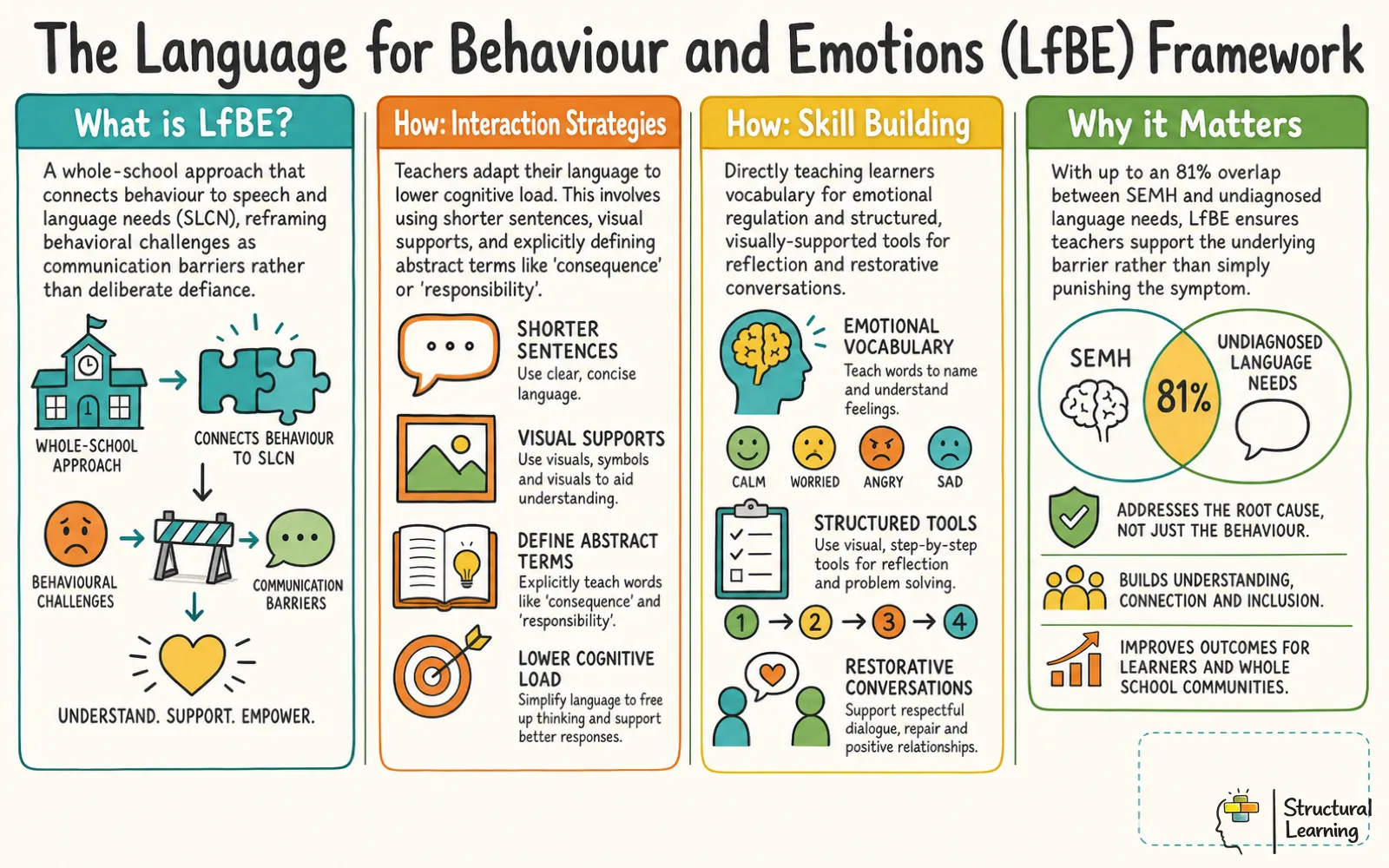
  • Many learners with Social, Emotional, and Mental Health (SEMH) difficulties have undiagnosed Speech, Language, and Communication Needs (SLCN). Research suggests the overlap could be as high as 81% (Westrupp et al., 2020).
  • Behavioural challenges often mask a learner's inability to understand complex classroom language, abstract vocabulary (e.g., 'consequence', 'responsibility'), or multi-step instructions.
  • Teachers can mistakenly interpret a language processing difficulty as defiance, poor attention, or a lack of motivation.
  • Language for Behaviour and Emotions (LfBE) is not a separate programme but a whole-school approach. It involves explicitly teaching emotional vocabulary and using structured, visually supported language for reflection and restorative conversations.
  • Effective practice involves lowering the language load during stressful moments and building a learner's capacity to understand and use language to regulate their emotions and behaviour over time.

What is Language for Behaviour and Emotions?

Language for Behaviour and Emotions (LfBE) is an approach that equips educators to recognise and support the hidden language and communication needs that often underpin social, emotional, and mental health (SEMH) difficulties. It provides a framework for understanding that how a learner behaves is profoundly linked to how well they can understand and use language, particularly during times of stress, confusion, or conflict.

LfBE framework infographic showing how to support SEMH learners by addressing hidden language needs.
The Language for Behaviour and Emotions (LfBE) Framework

The core of the LfBE approach, detailed by practitioners like Anna Branagan, Melanie Cross, and Stephen Parsons (2021), is a shift in perspective. Instead of viewing behaviour solely as a choice, teachers learn to see it as a form of communication that may signal a breakdown in language processing. A learner who struggles to follow instructions, manage friendships, or reflect on their actions may not be defiant; they may lack the specific language skills required for these tasks.

This approach involves two parallel strands:

  1. Interaction Strategies: Teachers adapt their own language to be more accessible. This includes using shorter sentences, explicitly defining abstract terms, using visual supports, and allowing extra processing time.
  2. Skill Building: Learners are explicitly taught the language skills they need for emotional regulation, social interaction, and problem-solving. This includes building emotional vocabulary, understanding cause and effect, and learning how to negotiate.

Ultimately, LfBE is about creating a communicatively supportive environment where learners are equipped with the linguistic tools to navigate the social and emotional demands of school life.

Who is this Approach For?

The LfBE approach is designed primarily for learners who present with SEMH needs but may also have underlying and often unidentified Speech, Language, and Communication Needs (SLCN).

It is particularly effective for learners who:

  • Are often described as having poor attention or being 'argumentative'.
  • Struggle to follow multi-step instructions, especially in whole-class settings.
  • Appear to have 'lost' information or forgotten instructions quickly.
  • Give a delayed response or a blank look when asked a question.
  • Find it difficult to explain what happened during an incident or blame others.
  • Have frequent disagreements with peers that they cannot resolve.
  • Use silence, avoidance, or disruptive behaviour to mask a lack of understanding.

Correcting a Common Misconception

A significant challenge for teachers is identifying SLCN in verbally fluent learners. Many learners with SEMH difficulties are talkative and may even use sophisticated vocabulary. This "camouflage" can lead adults to assume their language comprehension is equally strong.

However, these learners may use language to mask their difficulties, copying phrases from peers or using conversational scripts without fully grasping the meaning. They might possess a strong 'surface' vocabulary but lack the deeper semantic understanding required to discuss feelings, negotiate, or comprehend abstract concepts like 'fairness' or 'respect'. The LfBE framework helps teachers look beyond verbal fluency to assess a learner's functional language skills in real-world social contexts.

How Language for Behaviour and Emotions Works

The LfBE approach is grounded in the understanding that language skills are the foundation for higher-order thinking and emotional regulation. When a learner lacks the words to identify, understand, and express their feelings, they are more likely to communicate through challenging behaviour. The approach works by systematically building these foundational language skills while reducing the cognitive load of social interactions.

The Cognitive Mechanism

  1. Reducing Cognitive Load: During a behavioural incident, a learner's working memory is often overloaded with emotion. Complex language from an adult adds to this load, making it almost impossible for the learner to process instructions or reflect. LfBE advocates for simplifying language, using visuals, and breaking down information to free up cognitive resources for self-regulation.
  2. Making Abstract Concepts Concrete: Words central to behaviour management like 'consequence', 'choice', and 'respect' are abstract and difficult to process. The LfBE approach makes these concepts concrete through explicit teaching, visual aids, and scenario-based learning.
  3. Building Schemas for Social Situations: By explicitly teaching the language for specific social situations (e.g., how to join a game, how to disagree respectfully), the approach helps learners build mental models (schemas) they can draw upon. This reduces the cognitive effort required in social moments and increases the likelihood of a positive outcome.

Connecting to Structural Learning

The principles of LfBE align closely with the core thinking skills of Structural Learning. The goal is to move learners from reacting emotionally to thinking linguistically.
  • Identify: Before learners can manage an emotion, they must be able to identify and name it. LfBE focuses on explicitly teaching a wide 'emotional vocabulary', moving beyond simple terms like 'sad' or 'angry' to more nuanced words like 'frustrated', 'anxious', or 'disappointed'.
  • Explain: Once an emotion is identified, the learner needs the language to explain why they feel that way. This involves teaching cause-and-effect language (e.g., "I feel angry because...") and helping learners connect events to their internal states.
  • Connect: LfBE helps learners connect their feelings and actions to the impact they have on others. This involves perspective-taking language, such as "How do you think they felt when you...?" and "What might they be thinking?".
  • Reflect: Restorative conversations are a form of guided reflection. The structured, low-language-demand questioning used in LfBE helps learners to reflect on incidents and generate alternative strategies for the future, moving them towards independent problem-solving.

A Classroom Implementation Sequence

Implementing LfBE is a gradual process of shifting whole-school practice. It is not a time-limited intervention but a continuous, responsive approach.

Phase 1: Adapt Your Interaction Style (The Teacher)

  1. Prioritise Calm: In the heat of the moment, reduce your own language. Use simple, clear, and calm non-verbal cues.
  2. Use Short, Simple Sentences: Break down instructions into single clauses. Instead of "Go and get your book, find the right page, and start question one," say: "Get your book." (Pause). "Open it at page 34." (Pause). "Start with question one."
  3. Allow Processing Time: After giving an instruction or asking a question, silently count to ten. This gives the learner vital time to process the language.
  4. Use Visuals: Support verbal language with gestures, symbols, or quick drawings. A simple stick figure drawing can make an abstract social situation concrete and understandable.
  5. Check for Understanding: Avoid asking "Do you understand?". Instead, ask the learner to show you or tell you what they need to do. For example, "Tell me in your own words what happens next."

Phase 2: Build the Learner's Skills (The Learner)

  1. Explicitly Teach Emotional Vocabulary: Use emotion cards, stories, and scenarios to build a rich vocabulary for feelings. Categorise words into 'emotion families' (e.g., different types of 'angry').
  2. Use 'Thinking and Feeling' Language: Model your own thought processes and emotions out loud. "I'm feeling a bit frustrated because the computer is slow. I'm going to take a deep breath."
  3. Scaffold Problem-Solving: Use visual frameworks like a 'Problem-Solving Scale' or a comic strip conversation to help learners break down a social problem, consider different perspectives, and plan a solution.
  4. Practise through Role-Play: Create opportunities for learners to practise using their new language skills in low-stakes, supportive role-play scenarios before they need to use them in a real-life situation.

Evidence and Limitations

The evidence base for directly targeting language skills to improve behaviour and emotional outcomes is emerging but positive. Meta-analyses of universal school-based social and emotional learning (SEL) programmes, which often include a language component, show significant benefits for learners (Cipriano et al., 2023).

More specifically, systematic reviews have found that pragmatic language interventions can be effective for children with communication needs, including those with Autism Spectrum Disorder (Parsons et al., 2017). The key finding is that explicitly teaching the 'how' of social communication leads to better outcomes than simply expecting learners to absorb these skills.

However, there are important limitations:

  • Complexity of SEMH: Language intervention is a crucial piece of the puzzle, but it is not a cure-all. Severe SEMH difficulties often require multi-faceted support from mental health professionals (Meister et al., 2026).
  • Difficulty Improving Receptive Language: Improving a learner's understanding of spoken language (receptive language) is known to be challenging. The most effective interventions are often delivered by highly trained specialists, highlighting the need for collaboration between teachers and speech and language therapists.
  • The 'Knowing-Doing' Gap: Training teachers in communication strategies does not always translate to changes in classroom practice. Sustained coaching and feedback are often necessary to embed new habits.

The consensus from 5 out of 8 relevant studies suggests that language-focused interventions can support social and emotional outcomes. However, educators should treat this as an emerging field and apply the principles with careful monitoring of individual learner progress.

Comparison with Similar Approaches

Approach Focus Key Difference from LfBE
Language for Behaviour and Emotions (LfBE) The hidden language needs underpinning behaviour. Adapting adult language and explicitly teaching social-emotional vocabulary. Prioritises the language and communication component above all else. Sees behaviour as a symptom of a language need.
Emotion Coaching Validating a learner's feelings before guiding them to a solution. A relational, in-the-moment approach. LfBE is broader, incorporating the explicit teaching of vocabulary and comprehension skills outside of the incident, as well as interaction strategies during it.
Restorative Practice Repairing harm and relationships after an incident through structured dialogue. Focuses on community and accountability. LfBE provides the linguistic 'scaffolding' needed for a learner to successfully participate in a restorative conversation, which can be very language-demanding.
Positive Behaviour Support (PBS) A functional, data-driven approach to understanding the purpose of a behaviour and proactively teaching replacement skills. PBS focuses on the function of behaviour, while LfBE focuses on the language processing demands of the environment and the learner's linguistic capabilities. The two are highly compatible.

Classroom Example: A Restorative Conversation

Scenario: Jamie, a Year 8 learner with known SEMH needs, has become angry in class, refusing to work and muttering under his breath after being told to put his phone away.

Traditional Approach (High Language Demand): "Jamie, your behaviour is unacceptable. We've talked about phone use. Why did you make that choice? You've left me with no option but to give you a detention. Do you understand the consequences?"

This approach is abstract, confrontational, and places a high load on Jamie's language processing and working memory, likely leading to further escalation or shutdown.

Language for Behaviour and Emotions Study Notes preview
◆ Structural Learning
Language for Behaviour and Emotions Study Notes
Study notesOne-page revision sheet

Download a one-page study note for Language for Behaviour and Emotions, with the key ideas, limitations and classroom links in one place.

Something went wrong - please try again.

LfBE Approach (Low Language Demand): The teacher waits for a calm moment and finds a quiet space to talk with Jamie. They use a simple, visual problem-solving frame on a mini-whiteboard.

Teacher: (In a calm, neutral tone) "Jamie, let's draw what happened." (Draws a stick figure of Jamie with his phone and a stick figure of the teacher). "I said, 'Put your phone away'." (Pause). "You looked down at the floor." (Pause). "I wondered if you were feeling angry, or maybe frustrated." (Uses an 'emotion card' with faces to support this).

Jamie: (Points to the 'frustrated' face) "Just... everyone else was on theirs."

Teacher: "Ah, so you were thinking it wasn't fair. That makes sense." (Validates the feeling). "Let's think about my head." (Draws a thought bubble above the teacher stick figure). "When I saw the phone, I was thinking about our school rule. And I felt worried you would miss the instructions."

Intended Learning Gain: This approach lowers the emotional temperature and the language load. It makes the abstract situation concrete and visual. By labelling the emotion ('frustrated') and modelling perspective-taking ("I was thinking..."), the teacher is explicitly teaching the language skills Jamie needs for reflection. The focus shifts from confrontation to co-regulation and problem-solving, building Jamie's capacity to handle similar situations in the future.


Teacher and SENCO Checklist

Use this checklist to assess whether a learner might benefit from an LfBE approach.

Observation Area Look For... Yes/No
Following Instructions Does the learner struggle with multi-step or whole-class instructions? Do they often seem to miss the last part of an instruction?
Understanding Language Do they frequently say "I don't know" or "I can't remember"? Do they misunderstand abstract words (e.g., 'before', 'after', 'fair')?
Expressive Language Do they find it hard to explain events in sequence? Do they struggle to find the right words to express their feelings? Is their storytelling disorganised?
Social Interaction Do they misread social cues? Do they have frequent fallouts with peers? Do they struggle to initiate or maintain conversations?
Response to Support Does their behaviour worsen when you try to talk to them about it? Do they respond better to visual aids, gestures, and short sentences?
Camouflage Behaviours Are they very talkative but struggle to answer specific questions? Do they copy what peers are doing to get by?

If you answer 'Yes' to several of these questions, it is highly likely that the learner has underlying communication needs that are impacting their behaviour.

Research Evidence Check

Evidence Synthesis

What is the evidence that emotional vocabulary and pragmatic language intervention supports behaviour reflection and social emotional outcomes?

Promising support: The Consensus search found relevant papers, but the evidence should be treated as emerging and checked carefully against the article claims.

63% Yes from 8 studiesstrong evidence
  • Yes63%
  • Possibly25%
  • Mixed0%
  • No13%
Teacher takeaway

Use the approach as an explicit routine: model the target skill, give guided practice, build in repetition, and check whether pupils can use it beyond the intervention session.

View the evidence behind this answer8 studies
1The state of evidence for social and emotional learning: A contemporary meta-analysis of universal school-based SEL interventions.Christina Cipriano et al. (2023) · Child Development
meta analysisyes2023410 citations

This article provides a systematic review and meta-analysis of the current evidence for universal school-based (USB) social and emotional learning (SEL) interventions for students in kindergarten through 12th grade available from 2008 through 2020. The sample includes 424 studies from 53 countries, reflecting 252 discrete USB SEL interventions, involving 575,361 students. Results endorsed that, compared to control conditions, students who participate in USB SEL interventions experienced significantly improved skills, attitudes, behaviors, school climate and safety, peer relationships, school functioning, and academic achievement. Significant heterogeneity in USB SEL content, intervention features, context, and implementation quality moderated student experiences and outcomes. Strengths and limitations of this evidence and implications for future USB SEL research, policy, and practice are discussed.

Classroom implication: Translate the finding into explicit modelling, guided practice and progress monitoring rather than relying on one-off exposure.

2A systematic review of pragmatic language interventions for children with autism spectrum disorderLauren Parsons et al. (2017) · PLOS ONE
meta analysisyes2017136 citations

There is a need for evidence based interventions for children with autism spectrum disorder (ASD) to limit the life-long, psychosocial impact of pragmatic language impairments. This systematic review identified 22 studies reporting on 20 pragmatic language interventions for children with ASD aged 0-18 years. The characteristics of each study, components of the interventions, and the methodological quality of each study were reviewed. Meta-analysis was conducted to assess the effectiveness of 15 interventions. Results revealed some promising approaches, indicating that active inclusion of the child and parent in the intervention was a significant mediator of intervention effect. Participant age, therapy setting or modality were not significant mediators between the interventions and measures of pragmatic language. The long-term effects of these interventions and the generalisation of learning to new contexts is largely unknown. Implications for clinical practice and directions for future research are discussed.

Classroom implication: Translate the finding into explicit modelling, guided practice and progress monitoring rather than relying on one-off exposure.

3The effects of parent-implemented language interventions on child linguistic outcomes: A meta-analysisJodi K. Heidlage et al. (2019) · Early Childhood Research Quarterly
meta analysispossibly2019200 citations

Abstract Intervening early is important to minimize persistent difficulties in language and related domains in young children with or at-risk for language impairment (LI; Rescorla, 2009). Because language is first learned in caregiver–child interactions, parent-implemented interventions are potentially an important early intervention for children with or at-risk for LI. Previous meta-analyses have examined outcomes of parent-implemented interventions for children with primary and secondary LI, but have not included children at-risk for LI due to low SES. A systematic review of the literature identified 25 randomized controlled trials of parent-implemented language interventions examining linguistic outcomes for young children. Studies included 1734 participants (M = 3.7 years) with or at-risk for LI due to low SES. Results of these meta-analyses indicated modest improvements in expressive vocabulary and small improvements in expressive language for children with or at-risk for LI. The effect size for expressive vocabulary outcomes was significant for shared book reading interventions (g = 0.37, 95% CI [0.15–0.59]) and interventions implemented in play and/or routines (g = 0.50, 95% CI [0.05–0.95]). The effect size for expressive language was significant (g = 0.42, 95% CI [0.19–0.65]), but not for receptive language (g = 0.07, ns), and the effect size for receptive vocabulary was not significant (g = 0.18, ns). Sub-group analyses for expressive vocabulary and expressive language indicated moderate to large significant effects for children with or at-risk for primary LI and smaller, non-significant effects for children with Autism Spectrum Disorder. Findings are generally consistent with a previous meta-analysis (Roberts & Kaiser, 2011), indicating parent-implemented language interventions may have positive effects on linguistic outcomes for young children with or at-risk for LI. Limited measures of parent training procedures and varied measures of parent outcomes limited the analysis of how child outcomes were achieved.

Classroom implication: Translate the finding into explicit modelling, guided practice and progress monitoring rather than relying on one-off exposure.

4Systematic Review and Meta-Analysis of Classroom-Wide Social–Emotional Interventions for Preschool ChildrenLi Luo et al. (2020) · Topics in Early Childhood Special Education
meta analysisyes202069 citations

All children benefit from intentional interactions and instruction to become socially and emotionally competent. Over the past 30 years, evidence-based intervention tactics and strategies have been integrated to establish comprehensive, multitiered, or hierarchical systems of support frameworks to guide social–emotional interventions for young children. In this study, the authors reviewed systematically the efficacy of classroom-wide social–emotional interventions for improving the social, emotional, and behavioral outcomes of preschool children and used meta-analytic techniques to identify critical study characteristics associated with obtained effect sizes. Four electronic databases (i.e., Academic Search Premier, Educational Resource Information Center, PsycINFO, and Education Full Text) were systematically searched in December 2015 and updated in January 2018. “Snowball methods” were used to locate additional relevant studies. Effect size estimates were pooled using random-effects meta-analyses for three child outcomes, and moderator analyses were conducted. Thirty-nine studies involving 10,646 child participants met the inclusion criteria and were included in this systematic review, with 33 studies included in the meta-analyses. Random-effects meta-analyses showed (a) improvements in social competence and emotional competence, and (b) decreases in challenging behavior. For social competence and challenging behavior, moderator analyses suggested interventions with a family component had statistically significant and larger effect sizes than those without a family component. Studies in which classroom teachers served as the intervention agent produced statistically significant but smaller effect sizes than when researchers or others implemented the intervention for challenging behavior. This systematic review and meta-analysis support using comprehensive social–emotional interventions for all children in a preschool classroom to improve their social–emotional competence and reduce challenging behavior.

Classroom implication: Translate the finding into explicit modelling, guided practice and progress monitoring rather than relying on one-off exposure.

5School-based interventions to improve emotional regulation skills in adolescent students: A systematic review.L. Pedrini et al. (2022) · Journal of Adolescence
systematic reviewpossibly202247 citations

Emotional regulation (ER) is a core variable involved in the onset and maintenance of mental health disorders; therefore, interventions targeting ER in adolescence represent a promising preventive action. The current systematic review provides a synthesis of the evidence on school-based interventions on ER in adolescent students. Six electronic databases (Medline, Psychology Database, Embase, Scopus, Psychinfo, and Web of Science) were searched. The methodological quality of the included studies was assessed by the Methodological Index for Nonrandomized Studies. A total of 36 studies were identified. The interventions were based on different theoretic frameworks and focused on different components of ER. There were universal interventions that addressed the entire class, as well as interventions for a selected population of at-risk students. Only one-third of the studies were based on manualized programs. Small to moderate effect sizes were found for mental health and ER skills. Only a few studies assessed risky behaviors, and these studies showed a reduction with moderate to large effect size. Studies conducted on high-risk populations showed medium-high effect sizes on ER skills. In contrast, studies conducted on unselected samples of students showed greater variability in the outcome estimates. Acceptability analysis and attendance rates suggested that the interventions were well received by students. The lack of follow-up assessments and the absence of sample-size calculation were the most frequent methodological weaknesses. The content of the present review could be useful for professionals involved in the planning of school psychological services. Overall, the findings of the current review support the applicability and beneficial effect of school-based intervention for adolescents. Moreover, the results clearly point out the utility of a multitiered model to structure coordinated and integrated preventive interventions and to optimize resources.

Classroom implication: Translate the finding into explicit modelling, guided practice and progress monitoring rather than relying on one-off exposure.

6Expressive pragmatic language in mood and psychotic disorders: a systematic review and meta-analysisFiona Meister et al. (2026) · Schizophrenia
meta analysisno2026

Pragmatic language impairments-difficulties using language effectively in social contexts-are common in adults suffering from severe mental illnesses (SMIs) such as schizophrenia spectrum disorders (SSD), major depressive disorder (MDD), and bipolar disorder (BD). These impairments hinder social functioning and recovery but have been explored most widely using comprehension tasks, with pragmatic production being poorly described. We undertook a systematic review and meta-analysis of studies assessing expressive pragmatic language in adults with SMIs versus healthy controls. 18 items were tested, including Coherence, Cohesion, Gricean maxims, figurative language, Prosody, and Turn-Taking. The searches were PRISMA-compliant and were conducted in PubMed and Scopus. 51 studies were included; 28 were meta-analyzed. Results showed significant impairments in Cooperativity, Anaphora and Cohesion, moderate impairments in Coherence, and low impairments in Metaphor. No significant moderator was detected. Our results emphasize the need for standardized pragmatic testing and intervention for language production in clinical settings.

Classroom implication: Use this as a caution: check learner fit, delivery quality and progress data before treating the approach as settled practice.

7Efficacy, model of delivery, intensity and targets of pragmatic interventions for children with developmental language disorder: A systematic reviewKristine M. Jensen de López et al. (2022) · International Journal of Language & Communication Disorders
systematic reviewyes202219 citations

It is widely acknowledged that children with developmental language disorder (DLD) predominantly have difficulties in the areas of grammar and vocabulary, with preserved pragmatic skills. Consequently, few studies focus on the pragmatic skills of children with DLD, and there is a distinct lack of studies examining the effectiveness of pragmatic interventions. To carry out a systematic review of the literature on pragmatic interventions for children with DLD. This systematic review was registered with PROSPERO (ID = CRD42017067239). A systematic search in seven databases yielded 1031 papers, of which 11 met our inclusion criteria. The included papers focused on interventions for children with DLD (mean = 3-18 years), enhancing oral language pragmatic skills, published between January 2006 and May 2020, and were based on a group-study design such as randomized control trial or pre-post-testing. Study participants were monolingual speakers. The quality of papers was appraised using the Cochrane Risk of bias tool for randomized controlled trials. There was a high degree of variability between the included intervention studies, especially regarding intensity, intervention targets and outcomes. The evidence suggested that pragmatic intervention is feasible for all models of delivery (individual, small and large group) and that interventions for pragmatic language are mostly focused on encouragement of conversation and narrative skills observed through parent-child interaction or shared book-reading activities. This study highlights the importance of promoting and explicitly teaching pragmatic skills to children with DLD in structured interventions. A narrative synthesis of the included studies revealed that in addition to direct intervention, indirect intervention can also contribute to improving oral pragmatic skills of children with DLD. What is already known on the subject? An increasing number of studies have shown that difficulties in acquiring pragmatic language is not only present in children with autism. What this study adds to existing knowledge? Interventions for pragmatic language in children with DLD are mostly focused on encouragement of conversation and narrative skills, very often through parent-child interaction or shared book-reading activities. Interventions that target language pragmatic are feasible for all models of delivery (individual, small and large group). What are the potential or actual clinical implications of this work? The efficacy of the existing studies varies, and it is difficult to give recommendations regarding the intensity and duration of the specific intervention. In addition to offering pragmatic intervention directly from a specialist, pragmatic interventions can also be carried out indirectly if the intervention is under the continuous supervision of a specialist.

Classroom implication: Translate the finding into explicit modelling, guided practice and progress monitoring rather than relying on one-off exposure.

8Peer's pragmatic language outcomes following a peer-mediated intervention for children with autism: A randomised controlled trial.Lauren Parsons et al. (2020) · Research in Developmental Disabilities
randomised controlled trialyes20209 citations

Peer-mediated pragmatic language interventions can be of benefit to children with autism as they simultaneously target an individual child's pragmatic language skills and contextual factors related to social interactions. However, little is known about peer outcomes following peer-mediated interventions. This study evaluated the pragmatic language outcomes for typically-developing (TD) playmates who participated in a peer-mediated intervention for children with autism. Dyads (child with autism and TD-playmate; n = 71) were randomised to a treatment-first or waitlisted-first comparison group. Dyads attended 10 clinic play-sessions with a therapist and parents mediated home-practice. The Pragmatics Observational Measure 2nd edition (POM-2), and Social Emotional Evaluation (SEE) evaluated pragmatics before, after and 3-months following the intervention. Changes in both outcomes measures were equivalent for intervention-first and waitlisted TD-playmates, but all TD-playmates made significant gains in pragmatics following the intervention. Treatment effects maintained for 3-months (p < 0.001-0.014, d = 0.22-0.63), were equivalent in different environments (clinic and home). Peer relationship type and therapist profession mediated POM-2 scores across the study, while expressive language ability moderated SEE scores. This peer-mediated intervention had a positive impact on TD-playmate's pragmatic language capacity and performance.

Classroom implication: Keep the intervention routine structured and measurable so classroom use can be compared with baseline performance.

Frequently Asked Questions

1. Is this just about having a bigger vocabulary for emotions? No. While building emotional vocabulary is a part of it, the LfBE approach is more comprehensive. It focuses on how language is used and understood in social contexts, including receptive language (understanding), expressive language (speaking), and pragmatic language (social use of language).

2. How is this different from just being a patient and understanding teacher? Patience and empathy are essential, but LfBE provides a more diagnostic framework. It helps teachers understand the why behind a learner's behaviour by viewing it through a language and communication lens. It offers specific, evidence-informed strategies rather than relying solely on intuition.

3. Do I need to be a speech and language therapist to use this approach? No. The principles of LfBE are designed to be implemented by classroom teachers as part of high-quality universal provision. However, for learners with more significant needs, collaboration with a speech and language therapist is crucial for targeted assessment and intervention.

4. My learner is very quiet and withdrawn, not disruptive. Is this still relevant? Absolutely. Quiet withdrawal and avoidance are common "camouflage" techniques used by learners who feel overwhelmed by the linguistic demands of the classroom. They may be struggling to process language just as much as a more outwardly disruptive learner.


A Next-Lesson Action

Next lesson, when you give a multi-step instruction to the class, find one learner you suspect struggles with language processing. Go to them afterwards and quietly re-state the instruction using short, simple sentences, with a deliberate pause between each step. Observe if this small adaptation improves their ability to start the task independently.

Research sources

Further reading from peer-reviewed research

These 5 studies give source context for the classroom guidance in this article on Language for Behaviour and Emotions: A Teacher's Guide. They are included as starting points for deeper reading, not as a substitute for local professional judgement.

Meta Analysis 69 citations journals.sagepub.com

Systematic Review and Meta-Analysis of Classroom-Wide Social–Emotional Interventions for Preschool Children

Li Luo et al. (2020) | Topics in Early Childhood Special Education

Translate the finding into explicit modelling, guided practice and progress monitoring rather than relying on one-off exposure.

View study

Meta Analysis 410 citations academic.oup.com

The state of evidence for social and emotional learning: A contemporary meta-analysis of universal school-based SEL interventions.

Christina Cipriano et al. (2023) | Child Development

Translate the finding into explicit modelling, guided practice and progress monitoring rather than relying on one-off exposure.

View study

Meta Analysis 200 citations linkinghub.elsevier.com

The effects of parent-implemented language interventions on child linguistic outcomes: A meta-analysis

Jodi K. Heidlage et al. (2019) | Early Childhood Research Quarterly

Translate the finding into explicit modelling, guided practice and progress monitoring rather than relying on one-off exposure.

View study

Meta Analysis 136 citations journals.plos.org

A systematic review of pragmatic language interventions for children with autism spectrum disorder

Lauren Parsons et al. (2017) | PLOS ONE

Translate the finding into explicit modelling, guided practice and progress monitoring rather than relying on one-off exposure.

View study

Systematic Review 19 citations onlinelibrary.wiley.com

Efficacy, model of delivery, intensity and targets of pragmatic interventions for children with developmental language disorder: A systematic review

Kristine M. Jensen de López et al. (2022) | International Journal of Language &amp; Communication Disorders

Translate the finding into explicit modelling, guided practice and progress monitoring rather than relying on one-off exposure.

View study

Paul Main, Founder of Structural Learning
About the Author
Paul Main
Founder & Metacognition Researcher

Paul Main is an educator and metacognition researcher who founded Structural Learning in 2002. With a psychology degree from the University of Sunderland and 22+ years helping schools embed thinking skills, he bridges the gap between educational research and classroom practice. Fellow of the RSA and Chartered College of Teaching, with 128+ Google Scholar citations.

More →

SEND

Back to Blog