Updated on
September 24, 2026
Transfer of Learning Examples: Near and Far Transfer
Near and far transfer of learning with classroom examples from KS2 to KS4, why transfer fails, teachers' objections answered and a printable routine table.

Updated on
September 24, 2026
Near and far transfer of learning with classroom examples from KS2 to KS4, why transfer fails, teachers' objections answered and a printable routine table.
What is transfer of learning?
Transfer of learning is the ability to apply knowledge, skills, or strategies learned in one context to a new task or setting, such as using fraction knowledge to adjust a recipe. It is the real goal of education but does not happen automatically. For teachers, it means teaching for transfer explicitly, with varied examples and abstraction.
Transfer of learning happens when learners take knowledge, skills or strategies from one context and use them on a new task or in a new setting. Picture a Year 5 maths lesson. The teacher teaches column addition with three-digit numbers, then hands out a shopping receipt with four items and asks pairs to check the total.
Learners who can do the sum on the receipt have transferred. Those who cannot have learned the worksheet, not the method. Other examples include a Year 6 learner using fraction knowledge to adjust a food technology recipe, or a GCSE learner using biology evidence rules to judge a newspaper claim.
Thorndike (1911) showed why overlap between tasks matters. Later reviews warn that far transfer rarely appears without deliberate teaching. The term describes a structured process for turning evidence into a classroom decision, not a label on its own.
For teachers, the key question is whether learning lasts beyond the lesson. A learner may perform well during guided practice but fail later when the cues change. Strong transfer learning therefore needs varied examples, retrieval practice, metacognitive prompts and curriculum links that make the underlying structure visible.
Transfer of learning describes the process by which knowledge, skills or strategies acquired in one situation influence performance in another. In education, transfer learning means learners using prior knowledge in a new learning context. In machine learning, the same phrase is used by Keras, PyTorch documentation and Amazon Web Services (AWS) for reusing a trained model on a related task, but this article focuses on human learning transfer.
When a learner writes persuasive essays in English and then applies argumentation in history, transfer has occurred. When a child uses addition facts to understand multiplication, transfer is at work.
The concept goes back to Edward Thorndike's learning theory (Thorndike, 1911) and Robert Woodworth's research in 1901. Their work challenged earlier ideas about formal discipline. Before this, many educators believed that hard subjects such as Latin or geometry trained the mind and helped learning transfer widely to other domains. Thorndike and Woodworth argued that transfer depends on how much two situations share common elements.
This identical elements account says that overlap matters. The more the learning setting looks like the setting where the skill is used, the more likely transfer is to happen with ease.
Perkins and Salomon's research added to this understanding. They described "low road" transfer as one cognitive process. They also found that "high road" transfer exists and uses another cognitive process.
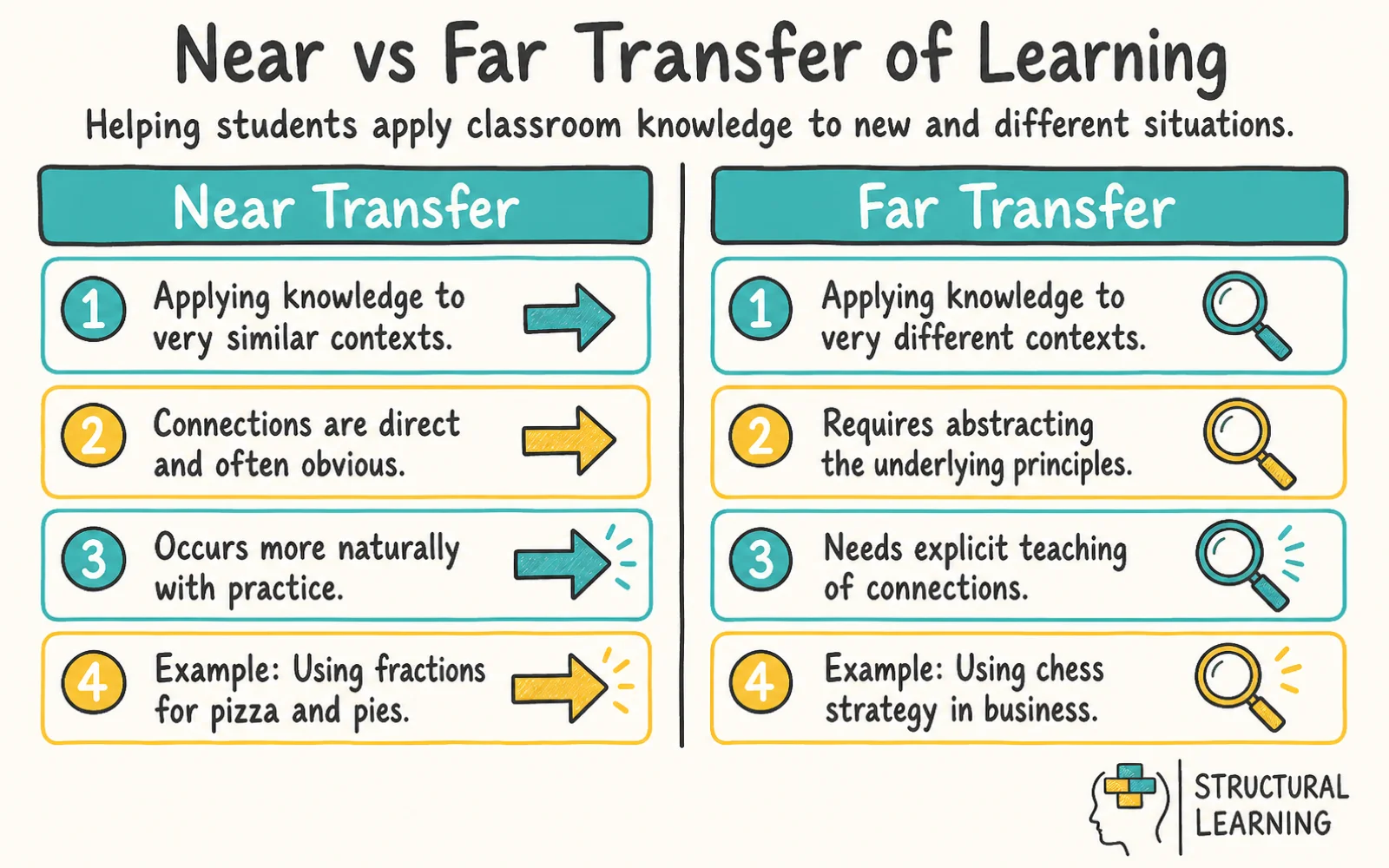
Near transfer means learners use what they learned in a setting much like the first one. A child who learned fractions with pizzas then solves a problem about pies. Far transfer means learners use knowledge in a very different setting, such as using the scientific method from biology to judge claims in a news article. Near transfer tends to happen on its own, but far transfer needs teachers to teach the links and the big ideas directly.
| Transfer Type | Description | Example | Teaching Approach |
|---|---|---|---|
| Near transfer | Similar contexts | Fractions to decimals | Highlight similarities |
| Far transfer | Different contexts | Chess to strategic planning | Explicit bridging |
| Positive transfer | Prior learning helps | Spanish helps Italian | Build on foundations |
| Negative transfer | Prior learning hinders | Driving abroad | Address interference |
| Vertical transfer | Basic to complex | Addition to multiplication | Scaffold progression |
Research from Barnett and Ceci (2002) shows near transfer works better than far transfer. Knowing this helps teachers understand why some learning applications feel easy. Other learning applications can frustrate learners (Perkins and Salomon, 1992).
Near transfer happens when the learning task and the new task are alike. Learners show this when they move from solving two-digit sums to three-digit sums (Singley & Anderson, 1989). The features are similar, and the procedures link directly. Automatic car skills also transfer easily between models (Haskell, 2001; Barnett & Ceci, 2002).
Far transfer means using learning in settings that look quite different at first. For example, a learner might use strategic thinking from chess to inform business decision-making. They might also use classroom mathematics to analyse real-world economic data. The links are not obvious, and the context is very different.
Research consistently shows that near transfer happens more easily than far transfer. Broad claims about far transfer from chess, music or working memory training are weak when studies use stronger controls (Sala & Gobet, 2017). This does not mean far transfer is impossible. It means teachers should design learning transfer around shared structure, so a spatial reasoning task may support geometry if the representations, vocabulary and transfer tasks overlap, while generic brain training is unlikely to raise attainment across subjects.
Recent work on varied retrieval and worked examples points the same way. When learners have to work out an underlying rule for themselves, variety in the examples helps them apply it more widely (Cao & Carvalho, 2026).
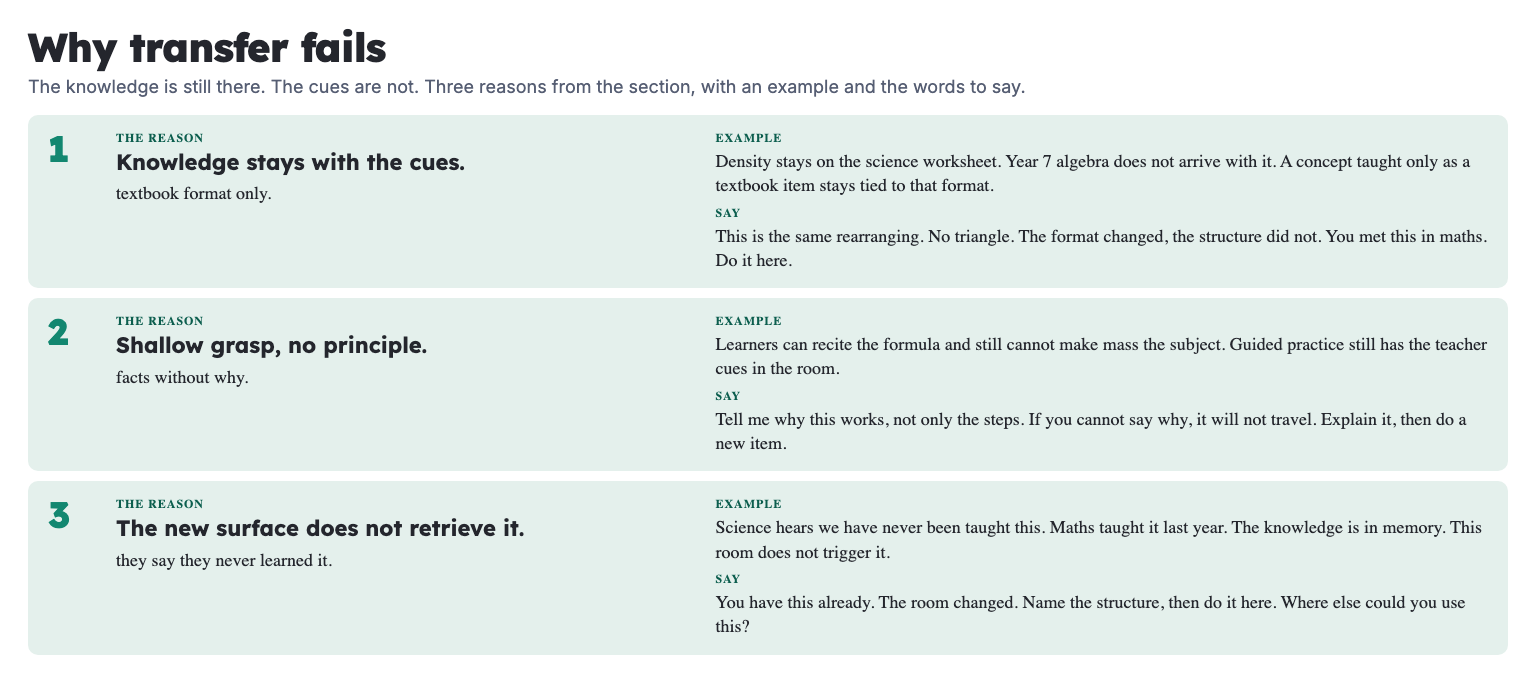
Several factors explain why learners often struggle to apply what they have learned to new contexts. Three causes account for most of it: knowledge stays tied to the context it was learned in, understanding is shallow, and the new situation offers no cue that brings the old learning to mind.
When learners meet information in one setting, that knowledge often becomes tied to the cues, examples and routines present during teaching. A concept introduced only through textbook problems may remain linked to those exact formats. When learners meet the same concept in a different guise, they may fail to recognise it.
Encoding specificity, a key idea, links learning conditions to memory (Tulving & Thomson, 1973). Learners remember best when tested in the same context as they learned. Varying teaching helps learners apply knowledge outside the initial setting (Godden & Baddeley, 1975).
Researchers John Seely Brown, Allan Collins, and Paul Duguid (1989) found that learners sometimes memorise facts without grasping concepts. Learners may recall information for tests but struggle to apply knowledge flexibly because they have not understood the core principles (Bransford et al., 2000).
In cognitive science, understanding is not the same as doing well in one lesson. A learner may perform well during guided practice because the cues, examples and teacher prompts are still there. Learning is the more lasting change that supports later recall and use.
Deep understanding means learners can explain what a concept is, why it works, when it applies and how it links to related knowledge (Bransford et al., 2000). Without this depth, learners hold knowledge they cannot adapt to new tasks. This links directly to metacognition, because learners need to notice what they know and when a strategy fits a new task.
Even when learners possess transferable knowledge, they may not retrieve it at the appropriate moment. The new situation doesn't activate the relevant prior learning because the surface features differ too much from the original learning context.
This retrieval failure explains why learners may say they "never learned" something they studied in depth. The knowledge is still in memory, but the current context does not trigger retrieval. Retrieval practice in varied contexts can help address this problem.
Thorndike's original theory proposed that transfer depends on the degree to which two situations share identical elements. The more overlap in specific skills, knowledge, or procedures, the more transfer should occur. This explains near transfer well but offers limited guidance for promoting far transfer.
Building on earlier work, generalisation theory suggests that transfer depends on learners drawing general principles from specific examples. When learners find the deeper rules, patterns, or schemas, they can use these ideas in new situations. This can happen even when the surface features look different.
Researchers, like Gick and Holyoak (1983), suggest learners must find deeper similarities. Schema building then helps learners with knowledge transfer. Follow-up work by Gentner (1983) supports this further.
Perkins and Salomon built a widely used model of transfer. It says transfer works in two ways:
Low road transfer is automatic. A skill practised to fluency fires on its own when a new situation looks like the old one, which is why it mostly produces near transfer (Perkins & Salomon, 1992). A KS1 learner who has practised counting in twos with cubes will count a row of socks in twos without being told to.
High road transfer is deliberate. The learner pulls out the principle, holds it in mind and looks for where else it applies, and that abstraction has to be taught (Perkins & Salomon, 1992). In a Year 8 science lesson the teacher asks, after a fair-test practical, "What did we keep the same, and where else would you need to keep things the same?" Learners suggest a PE fitness test and a food technology taste test, and write the principle in one sentence at the top of their write-up.
Hugging means making the practice task look as much like the target task as possible, so the practised response fires on its own. Bridging means teaching the principle explicitly and asking learners where else it applies, so they carry it deliberately into new ground. Both terms come from Perkins and Salomon (1992), and most units need both.
Hugging in a Year 11 science class: learners practise the six-mark extended answer in the exact format and timing the exam paper uses, and the teacher marks it against the real mark scheme. Bridging in a Year 7 maths class: after teaching ratio, the teacher asks, "Where else does two things scaling together turn up?" and collects answers on the board; learners offer map scales from geography and scaling a recipe from food technology, then write one example of their own.
Learners need conceptual understanding to transfer knowledge. This means they need to grasp the main ideas, not just memorise facts (Bransford et al., 2000). Teachers can help by exploring principles, relationships, and reasoning (Donovan et al., 1999). When learners truly understand, they can apply knowledge in new situations (Anderson & Krathwohl, 2001).
Ask learners to explain why, not just what. Use questioning strategies that move beyond recall into analysis and application. Encourage learners to explain the reasoning behind a method, instead of just following steps by habit.
Gick and Holyoak (1983) found varied examples boost transfer better than one alone. Learners grasp concepts when examples share structure, say Gentner et al (2003). Surface details should differ across examples, according to Bransford et al (2000).
Learners understand concepts better when they see varied examples (Bruner, 1966). If all examples of persuasive writing are political, learners may think it only applies there. Varied examples help learners grasp principles they can transfer to new tasks (Gick & Holyoak, 1983).
Don't assume learners will spontaneously recognise when previously learned knowledge applies. Explicitly point out connections between current learning and prior knowledge. Show how concepts from one subject area apply in another.
Teachers can model how to spot chances for transfer. When introducing new content, bring up useful prior knowledge by asking "What do you already know that might help here?" or "Where have we seen something similar before?" This supports metacognitive development, as learners think about their own learning.
The context in which learners practise retrieving knowledge matters for transfer. Karpicke (2008) showed that retrieval practice supports learning because learners strengthen access to knowledge by bringing it to mind, not only by re-reading it. If all practice happens in identical conditions, knowledge can still become bound to those conditions. Varying the contexts in which learners retrieve knowledge promotes more flexible transferable learning.
Set homework, classwork, and assessments that use familiar ideas in new formats or real tasks. Mix problem types, instead of practising one topic at a time. These interleaving strategies may feel harder, but they help learning transfer to new situations.
Learners grasp abstract ideas easier than specific routines. Teaching the 'why' with 'how' helps learners see principles working. This boosts transferability, according to research by Gick and Holyoak (1983) and others.
Take ratio. Teach the principle (two quantities that scale together) beside its uses: a recipe scaled for thirty, a map scale, a speed calculation. Learners who can name the principle spot it in the next context; learners who only learned the recipe do not.
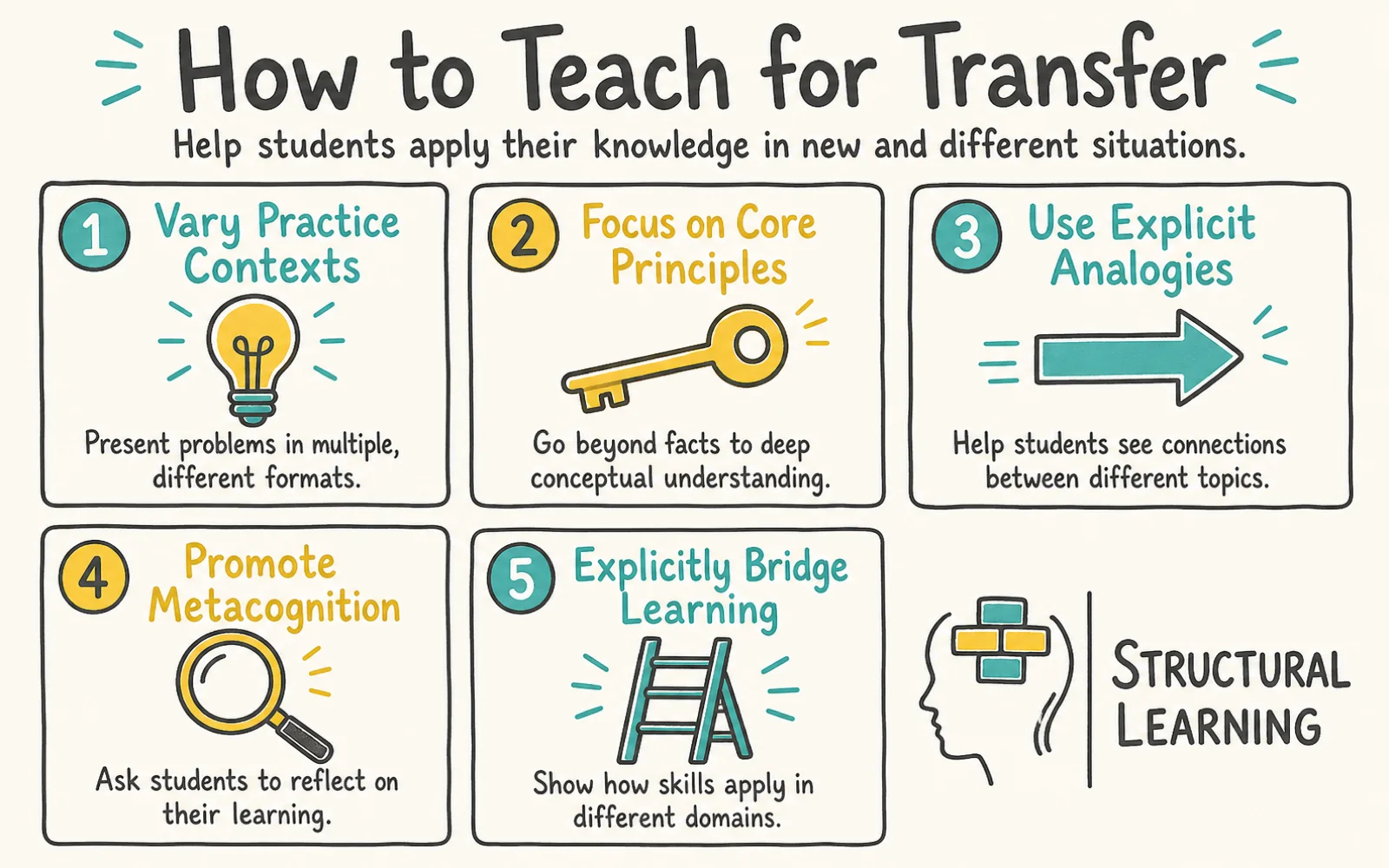
Ann Brown (1987) linked metacognition with executive control and self-regulation: learners need to plan, monitor and evaluate when a strategy fits a task. Teachers can support learner transfer by naming how transfer works, asking learners to look for possible applications, and returning to questions such as "Where else might this apply?" (Barnett & Ceci, 2002; Perkins & Salomon, 1992).
Explicitly discuss the challenge of applying learning to new situations. Help learners develop habits of mind that include asking "Where else might this apply?" Encourage reflection on when and how to use various strategies and approaches.
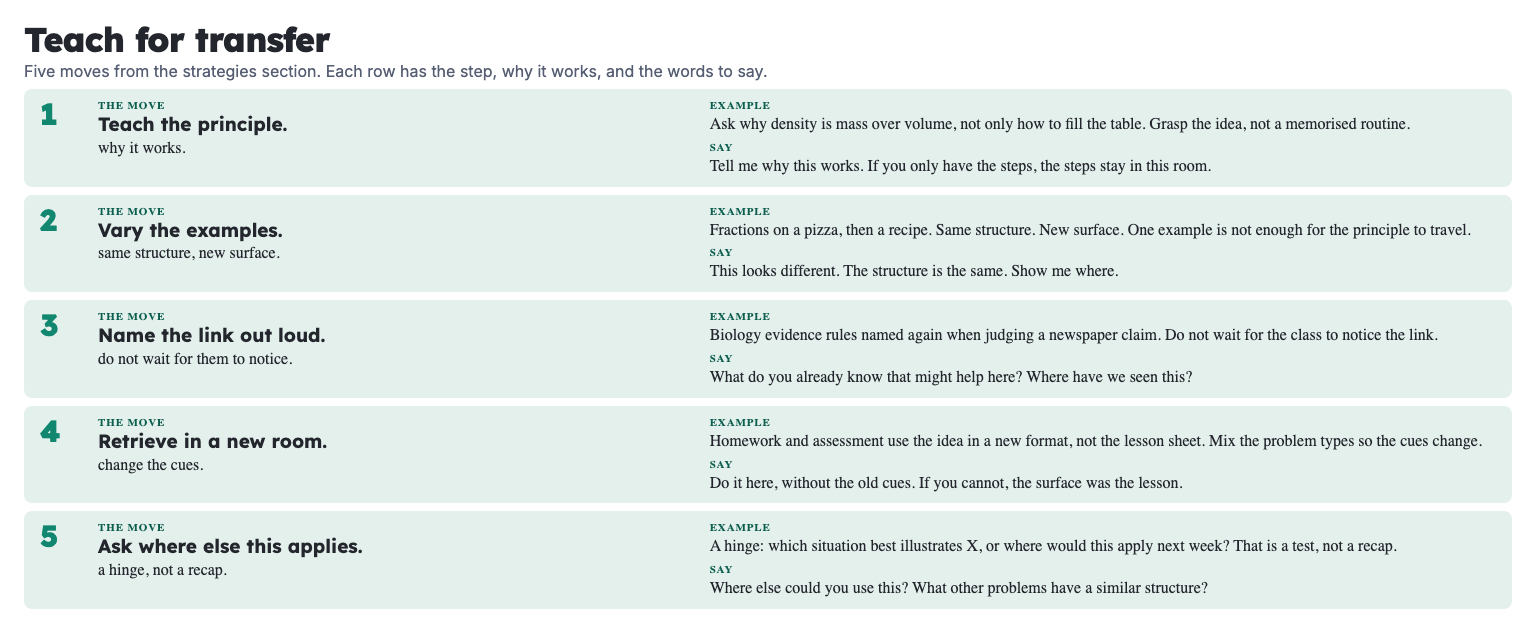
Three examples run through this section. The first is fractions from maths into food technology. The second is the scientific method from science into history source work. The third is phonics from Reception into KS1 spelling.
Researchers (Bransford & Schwartz, 1999) found that learners need help to see links between subjects. So point out shared ideas, such as proportional reasoning in maths and scale drawings in geography. Transfer across the curriculum works when teachers plan together and focus on the same concepts in each subject (Barnett & Ceci, 2002).
Each subject gives learners different chances to transfer learning. Each subject also brings its own challenges.
Research shows learners struggle applying maths outside the classroom. Mathematical ideas are abstract, so they ought to travel, yet learners often cannot use them outside the lesson where they met them. Whitehead (1929) called this inert knowledge, and Boaler (1993) found the same pattern in classrooms.
Researchers have shown connections aid learning. Connect maths to relevant situations to help learners understand (Bransford et al., 2000). Use real world maths problems to boost reasoning (Willingham, 2009). The concrete pictorial abstract method helps learners bridge theory and practice (Bruner, 1966).
Researchers (e.g., Cromley & Azevedo, 2007) found that reading strategies, such as summarising, can work across subjects. For transfer to happen, teachers need to teach comprehension as a general skill, not only as part of subject content. McKeown et al. (2009) agree that explicit instruction helps learners use strategies well.
Teach reading comprehension strategies as tools that can transfer. Practise using the same strategies with different text types and subjects. Make it clear that the summarising strategy used in English also helps when reading science textbooks or historical documents.
Writing skills can transfer well because the basic elements of clear communication apply in many contexts. However, each genre and subject has its own conventions. Learners still need extra teaching to use those conventions well.
Teach writing's key principles directly. These involve audience awareness, clear structure, and evidence, say Flower and Hayes (1981). Beaufort (1999) and Prior (1998) note genre specifics. Learners gain skills that transfer and adapt.
Researchers (Klaczynski, 2017; Kuhn, 2005) found that learners must connect scientific thinking to daily life. This link helps them use scientific reasoning when they make real-world decisions. Teach the link directly to improve transfer.
Researchers Kuhn (1993) and Zimmerman (2000) say scientific reasoning helps learners assess media claims. They add that this helps with personal decisions and understanding events. Encourage learners to use scientific thinking outside the lab setting.
What teaching for transfer looks like when a post names the year, grade or phase. UK cells stay UK. US band names and US-only variants sit in the last column, never mixed into a UK cell.
| Phase | What the teacher does | What you would notice | The trap at that age |
|---|---|---|---|
| KS2 ages 7 to 11 |
No UK post named this band. US: when they taught 4th, multiplying fractions without the facts; 3rd grade PLC keeps step-by-step charts in view. | A class stuck on 6 times 3 while the page has moved on to fractions. A chart still pointed to in a later lesson. | Treating the new procedure as new knowledge when the missing piece is an earlier fact. |
| KS3 ages 11 to 14 US: grades 6 to 8 |
Agree with maths that rearranging is a Year 7 skill, then refuse the formula triangle in science. In history, run Year 8 Frayer models and guided reading as subject literacy. Rewrite KS3 science so working-scientifically skills are taught, then interleaved toward GCSE.
|
Year 7 algebra reused in science, not a new mnemonic. Year 8 history sheets. A KS3 scheme that names interleaving, not a one-off lesson. | Science reteaches rearranging because the two departments never spoke. A generic literacy strategy that is supposed to travel, against the research-school line that literacy sits inside the subject. |
| KS4 ages 14 to 16 |
In mock season, squeeze density, mass and volume into a short lesson, organise it with a table, and still use a formula triangle with that group. | GCSE density tables. A triangle still on the board. The Year 7 algebra agreement from KS3 has not reached this room. | Southall (2016, p. 52) names GCSE trigonometry as the place a triangle is applied to the wrong equation. The shortcut becomes the only method the class has. |
Teachers can assess transfer by giving problems in new contexts. These problems should use the same underlying principles as practice examples, but with different surface features. Assessment design must also check whether the new context asks for new knowledge work or simply tests cultural familiarity.
A learner who has never cooked with ounces, visited a theatre or seen a mortgage statement may seem to show weak learning transfer, when the barrier is background knowledge rather than cognition. Use several transfer tasks, ask learners to explain their reasoning, and separate the principle being tested from unnecessary cultural assumptions (National Academies of Sciences, Engineering, and Medicine, 2018).
Assessments often miss transfer because they use familiar content (Bransford & Schwartz, 1999). If transfer matters, include transfer tasks in assessments (Barnett & Ceci, 2002). This helps learners apply knowledge to new situations (Mayer & Wittrock, 1996).
Include assessment items that place familiar concepts in unfamiliar contexts or formats. Ask learners to apply their learning to new problems they have not met during instruction. These assessments show whether learners can use their knowledge flexibly.
Performance assessments ask learners to complete authentic tasks. They often give better evidence of transfer than traditional tests. When learners apply knowledge to solve genuine problems, produce real products, or show skills in context, they reveal their capacity for transfer.
Ask learners not just to demonstrate skills but to explain when and why to use them. Can they identify contexts where particular strategies or concepts apply? Can they articulate the reasoning behind procedures? These responses reveal depth of understanding that predicts transfer.
Weinstein et al. (2018) show that directly teaching general skills will not always improve learner performance in every setting. Some strategies do transfer, but expertise is still mostly tied to the subject being taught (Willingham, 2009; Kirschner, 2017).
This does not mean teachers should abandon thinking skills. It means schools should stop treating critical thinking as a skill that floats free of subject knowledge. In history, critical thinking depends on source knowledge, chronology and evidential rules; in science, it depends on models, measurement and causal explanation. Learners need domain knowledge first, then repeated chances to apply reasoning within and across subjects (Willingham, 2007; Sala & Gobet, 2017).
Researchers Bransford and Schwartz (1999) found that practice alone does not ensure learning transfer. Bjork and Bjork (1992) argue that repeating the same problem types mainly builds recall. It does not create adaptable learners who can use knowledge in flexible ways (Anderson, Reder, & Simon, 1996).
Some people assume that if learners truly understand something, they will transfer that understanding on their own. Deep understanding supports transfer, but it does not guarantee it. Learners may understand a concept well and still fail to see when it matters in a new situation.
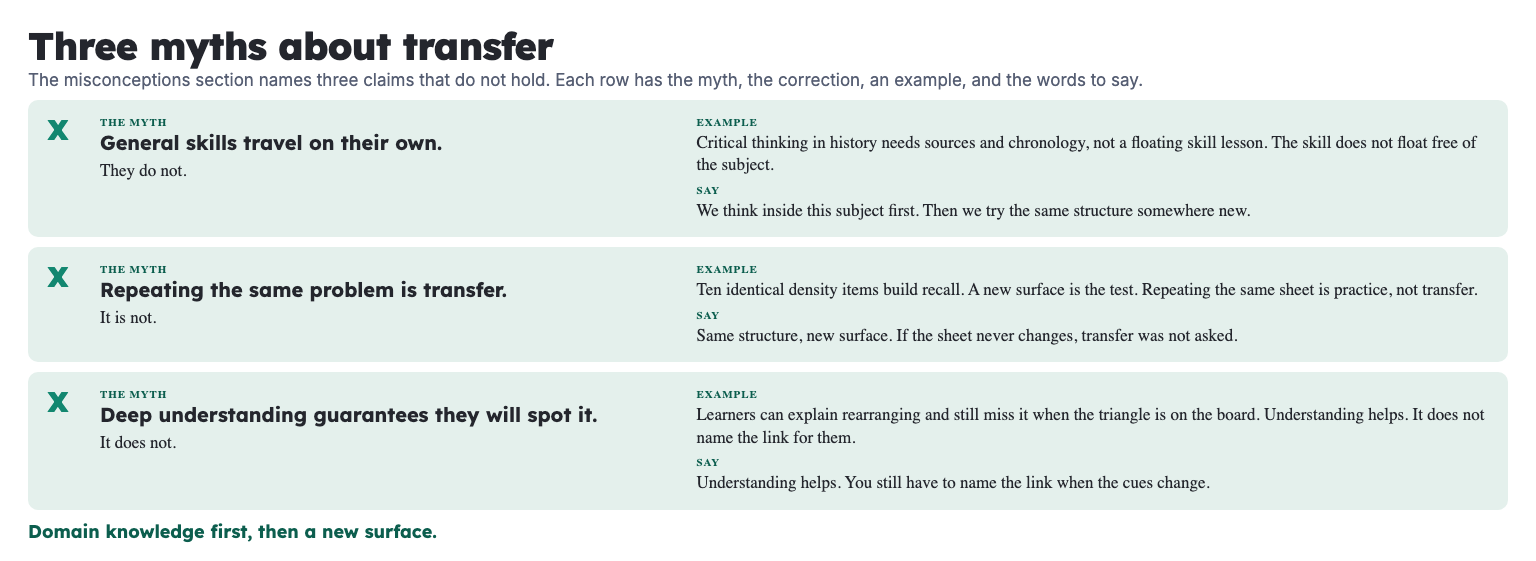
Use the questions and evidence below to decide when to vary surface features and when to teach more subject knowledge.
Question
“I dont think its an important concept when planning for learning (except to exclude it, I.e. I am not planning for transfer)”
What the replies and the evidence say. The post is a reply to @oliviajune82, who had said transfer had been “zero help”
for instructional design. Perkins and Salomon (1988, fetched) still split hugging (make the task like the target) from bridging (name the abstraction). The disagreement is the finding: Boxer is refusing far-transfer as a planning goal, not refusing to change the surface of a science problem.
Question
“I'd prefer it if they criminalised formula triangles. Much bigger fish that needs frying”
What the replies and the evidence say. @jamiewebb800: after speaking with maths, rearranging is Year 7, so the triangle is forbidden. @gcsemathstutor, still uses one for density. Southall (2016, p. 52, fetched) answers the ban question with no: useful once the algebra is understood, not as the first move. The live split is department agreement, not a research verdict.
Question
“What is the most persistent myth, the one that is hardest to kill, and the one that has biggest implications outside education? Transferable skills.”
What the replies and the evidence say. @Keith_Turvey: everyday problem solving is not the same claim as switching professions. @TomPMarshall: after teaching critical appraisal of trials, people distinguish biased from unbiased studies, and asks whether that is critical thinking. Willingham (2007), American Educator: thinking is not a skill like riding a bike; it needs domain knowledge. The replies do not all agree, and Marshall’s example is already inside a domain.
Question
“There's a difference between saying "skill-centered learning is ineffective" (true) and "skills don't transfer." The latter is vague, depends on what you mean by "skill" and "transfer" and is, imo, generally inaccurate.”
What the replies and the evidence say. @rpondiscio: “Skills don’t transfer.”
@Map_Addict · not a US classroom: “they can transfer that skill to another map once learned.”
The honest split is near transfer of a taught procedure versus far transfer of a content-free skill. Both can be true at once.
Question
“Spiral review station: 3 kids complete the spiral review. 5 kids don’t even start it, they sat and talked.”
What the replies and the evidence say. The same post names the room: “8th grade Jennifer math teacher”
, class sizes of 30 to 35. Interleaving can support discrimination (@C_Hendrick), but only if the class actually retrieves. A station that five learners do not start is not a transfer mechanism. No reply in the posts we read offered a 30-to-35 design that fixed it.
Question
“High-order thinking depends on a strong foundation of knowledge. Without this foundation, there’s nothing to critically think about. That is why teaching “21st century skills” and “critical thinking” in isolation does not work.”
What the replies and the evidence say. This is the US form of Daisy’s UK question. Willingham (2007, fetched) is the paper teachers are being pointed at, even when they do not name him. @CalvinFJohnson: without background knowledge, project work is going through the motions. Admin still asking for skills without knowledge is the pressure, not a finding from a trial.
Bridging analogies link new ideas to known ones. Comparison charts show principles in different contexts. Ask learners, "Where else does this apply?" 'Hugging' makes the practice task look like the real use, so low road transfer fires. 'Bridging' teaches the principle and asks learners where else it applies, so high road transfer can happen.
Both terms are Perkins and Salomon's (1992). Vary practice problems, keeping structures constant (Schmidt & Bjork, 1992).
Teachers who want more transfer in their classrooms can draw on the research. It points to several practical strategies.
Create opportunities for learners to meet the same concepts across different contexts throughout the year. Transfer learning is strongest when curriculum sequencing makes the connections visible before the lesson starts. Senior leaders can map shared structures across departments, such as proportion in maths, science graphs and geography scale, so knowledge transfer is not left to isolated lesson plans. Use graphic organisers to make these links visible for learners.
Set homework that asks learners to find uses for classroom learning in their own lives. In 2026, you can bring in generative AI, but do it with care. Ask learners to prompt a tool for two possible analogies. Then ask them to judge which one keeps the underlying structure and which one only matches surface features.
Used this way, AI is a temporary support for transfer, not a stand-in for thinking. The hard work of judging, explaining and monitoring their own thinking stays with the learner (Shum, 2024; Atchley et al., 2024).
This cross-subject (interdisciplinary) approach helps learners see how ideas link across subjects. Teachers can support it by planning together across subject areas. When learners spot these links, they can recognise knowledge that transfers (Bransford et al., 2000). This strengthens their understanding in several areas (Hmelo-Silver et al., 2007).
Research by Gentner (1983) shows that analogies help learners. Comparing a new idea with a familiar one supports understanding (Gentner & Holyoak, 1997). Asking learners to create their own analogies helps build transferable knowledge (Duit, 1991).
Revisit concepts throughout the year rather than teaching them once and moving on. Each revisit offers an opportunity to encounter the concept in a new context, building the varied experience that promotes transfer.
Compare eight routines for linking subjects, varying examples and helping learners recognise when prior knowledge applies.
| Routine, as teachers describe it | What you would notice | What the evidence says |
|---|---|---|
| Ban the triangle after talking to maths Check with the maths department. If rearranging is already taught in Year 7, do not offer a formula triangle in science. Keep the algebra. |
No triangle on the science board. Density, speed or v = u + at written as make-x-the-subject, the same move as last year’s maths. | Southall (2016), School Science Review 97(360), 49 to 53, Huddersfield eprints, fetched: the triangle “should not be the first port of call”. He does not ban it. This row is a department agreement, not a trial. |
| Density triangle still on the board In mock season, teach density, mass and volume with a table, and still use a formula triangle with that group. |
A GCSE density table and a triangle in the same lesson. The two departments have not agreed. | The disagreement with the row above is the finding. Southall (2016, p. 52, fetched): useful once the algebra is understood; not a first move. |
| Year 8 Frayer as history literacy Use Frayer models and guided reading inside history, then ask the class to write like historians. Do not sell a travelling comprehension strategy. |
Year 8 sheets labelled as subject literacy, not as a generic reading skill that will reappear in science unaided. | Newcastle Research School, 23 Feb 2026 (@NcleRSN): this is not general literacy skills; reading sits inside doing the subject. EEF Metacognition guidance, second edition, 13 Nov 2025, Recommendation 2: strategies are best taught with specific content and tasks. Reported, not trialled. |
| Do not plan for transfer objection Keep transfer off the planner except as something to exclude. Teach the science. Do not write a far-transfer objective. |
No “apply in another subject” box on the scheme. The triangle fight still sits next door, unplanned. | Teachers split on whether planning for near transfer is useful or transfer should be excluded from lesson objectives. Perkins and Salomon (1988), hugging and bridging (Harvard ALPS page, fetched via archive), are the article’s counter: you can plan near transfer by changing the surface. Boxer is arguing you cannot plan far transfer. Neither side ran a classroom trial. |
| Ask where this would apply In retrieval, do not only ask what X is. Also ask which situation best illustrates X, or where this would apply.
|
A hinge question that names a new context, not a definition restated in the same sentence stem. | Corral and Carpenter (2025), Learning and Instruction 100, 102219, DOI 10.1016/j.learninstruc.2025.102219 (Crossref plus published abstract): three rounds of retrieval helped application questions in a college research-methods sample. One round did not. Hendrick’s wording is his gloss, not the paper’s. Not a UK classroom trial. |
| Bridge Practice Teach the pattern in one context, then give new examples that keep the structure and change the surface. The poster photographed a behaviour-or-environment sheet; we redrew the idea, we did not reprint the photo. |
New items (qanats, sea walls, terraces) that still ask the same discrimination. The label is Bridge Practice, not hugging and bridging. | This is hugging then bridging without the academic names. Perkins and Salomon (1988, fetched): hugging makes the task like the target; bridging asks for the abstraction. The photos stay off the page. A US classroom claim, not a trial. |
| Spiral station that nobody starts Put mixed review in a station as the daily transfer mechanism. Then watch who actually does it in a class of 30 to 35. |
Three finishers. Five talking. The interleaved warm-up is on the table and unused. | A classroom claim about completion, not a trial of interleaving. @C_Hendrick: interleaving helps when discrimination is needed. A station learners ignore cannot do that work. US 8th grade maths, named in the post. |
| One teacher, every subject US elementary: keep every subject with one teacher so a geography fact can sit inside an imperative sentence the same morning.
|
The same adult naming the link. | A structural claim about who owns the curriculum, not a transfer trial. No UK primary post in the window showed a comprehension strategy vanishing in history. |
Transfer is planned at the unit level, not the single lesson. Before teaching, work through these five steps and write the answers on the unit plan. Each step takes a few minutes and produces one line on the plan.
Perkins and Salomon (1992) discuss high-road and low-road transfer. Bransford and Schwartz (1999) look at how to prepare learners for future learning. Barnett and Ceci's (2002) taxonomy helps teachers understand transfer. Together, these papers give useful ideas and frameworks for classroom practice.
Research on learning transfer goes back more than a century. It now includes reviews that focus on classrooms. Hajian (2019) is useful for teachers because it links transfer theories with teaching practices such as scaffolding, reflection and situated learning. How People Learn II adds an important caution: culture, context and the structure of learning environments shape knowledge transfer, not only individual memory (National Academies of Sciences, Engineering, and Medicine, 2018).
This key paper set out the difference between low road and high road transfer. That difference still guides research in education today. Perkins and Salomon explain why normal teaching often fails to produce transfer. Their framework gives teachers practical ways to help learners use knowledge beyond the setting where they first learned it.
Barnett and Ceci (2002) offer a framework for describing transfer situations. It looks at five things: content, context, time, function and modality (the form the task takes). It helps teachers think clearly about why transfer works or fails.
Bransford and Schwartz challenge narrow views of transfer that focus only on initial learning. They introduce the idea of "preparation for future learning." On this view, we should judge prior learning by how well it prepares learners to learn new things, not just by whether it transfers directly. This wider view matters a great deal for how we design the curriculum.
Retrieval practice with varied examples improves learner transfer (Kornell et al., 2011). This research links testing effect studies with transfer work. Practice testing can boost adaptable learning (Butler, 2010).
The report pulls together research on how people learn, including transfer. It shows that transfer rests on three things: real understanding, well organised knowledge, and metacognition (learners thinking about their own thinking).
It also gives principles for teaching that supports transfer. The report has had a significant influence on educational policy and practice (Bransford et al., 2000; National Research Council, 2000).
Note: The landmark "How People Learn" (2000) was updated in 2018 with "How People Learn II: Learners, Contexts, and Cultures" (National Academies Press). The update included additional research on cultural and contextual factors in learning transfer.
The original stays on social media. The useful bit is lifted into our type, in their words, so a teacher can print it and pin it.
And yes… this group do use a formula triangle Anyone else use this method?
@@gcsemathstutor, 2025-11-10
The useful bit is the D, M, V table for density of a mixture.
Work out the density of liquid Z. Give your answer correct to 2 decimal places.
| Liquid X | Liquid Y | Liquid Z | |
|---|---|---|---|
| D | |||
| M | |||
| V |
Density is mass over volume. Keep the table. Do not reach for a triangle first.
Year 8 students have been using frayer models and guided reading to strengthen subject-specific literacy in history.
@@StCuthbertsHis, 2025-05-01
The useful bit is the four Frayer labels around the history word.
Word
transfer does not occur naturally. Students first need to develop deep knowledge of the underlying structures and patterns within one context
@@SoLInTheWild, 2026-09-10
The useful bit is the prompt: circle the pattern each new scenario best illustrates.
Circle the pattern each NEW scenario best illustrates.
Same four patterns. New stories. That is the transfer move.
Each of the fifteen is a planning move rather than a lesson activity: it changes how the unit is sequenced, what the examples look like, or what the assessment asks, so that the principle travels beyond the lesson it was taught in.
Transfer of learning is useful in practice, but several critiques matter. First, the evidence for broad far transfer is weak. The claim to hold on to is that transfer happens when it is designed for, not that it happens on its own.
Three sources make this point. Thorndike argued that transfer needs shared elements (Thorndike, 1911). Detterman's sceptical review reached a similar view (Detterman, 1993).
Sala and Gobet pooled the studies on chess, music and working memory training (Sala & Gobet, 2017). All three warn that general mental training does not lead to better attainment.
Second, transfer is often measured through narrow laboratory tasks. A learner may fail a test because the task uses unfamiliar wording, tools or social cues, not because knowledge transfer is absent. Barnett and Ceci (2002) showed that content, timing, modality and social setting all change what counts as far transfer. This makes simple claims that transfer has occurred hard to interpret.
Third, cultural context matters. Situated cognition theorists argued that knowledge is tied to the activity and setting in which it is learned (Brown, Collins, & Duguid, 1989; Lave & Wenger, 1991). How People Learn II also stresses that culture shapes how people learn, reason and are assessed (National Academies of Sciences, Engineering, and Medicine, 2018).
This has a practical consequence. A test of transfer may reward middle-class cultural capital rather than flexible thinking (Bourdieu, 1986).
These limits do not make learning transfer irrelevant. They make it more precise. Teachers should plan for transfer through subject knowledge, varied examples, retrieval, metacognition and fair assessment. Used with care, the theory is still a useful guide to curriculum and classroom practice.
Most taxonomies name three pairs: near and far, positive and negative, and high road and low road. Barnett and Ceci (2002) add content, context, time, function and modality, but these are dimensions along which transfer distance varies rather than separate types. For planning, the three pairs are enough.
Near transfer is a skill moving to a task that looks almost the same. Three classroom examples: a Year 3 learner who can add two-digit numbers adding three-digit ones; a Year 9 learner using the persuasive paragraph structure practised in English to argue a point in history; a Year 6 learner who drew bar charts in maths drawing one from their own data in science.
Near transfer means learners use skills in similar situations (Barnett & Ceci, 2002). Think fractions with pizzas, then pies. Far transfer means learners use knowledge in different contexts (Perkins & Salomon, 1992).
Biology's scientific method helps evaluate news articles. Teachers must explicitly teach links for far transfer to happen.
Transfer often fails for three main reasons. Knowledge may stay tied to the context where it was learnt, learners may gain only a shallow understanding of the underlying principles, or they may not recall relevant knowledge in new situations. For example, when learners learn only through textbook problems, their knowledge becomes mentally linked to those exact formats. As a result, they may not recognise the same concept in different contexts.
Research shows teaching for transfer builds understanding, not just memory. Use different examples and help learners apply knowledge (Barnett & Ceci, 2002). Support learners in finding general rules (Anderson, 1983). Practise retrieval in various situations to improve access (Bransford et al., 1999).
Learners may use English skills in history (Perkins & Salomon, 1992). Addition helps learners grasp multiplication (Thorndike & Woodworth, 1901). Chess training does not reliably improve maths, despite the claim (Sala & Gobet, 2017). Learners apply science skills across subjects (Bransford & Schwartz, 1999), but need guidance for transfer.
Lots of practice builds automatic, low road transfer (Singley & Anderson, 1989). This helps learners move between similar tasks. High road transfer needs learners to spot a principle and apply it (Perkins & Salomon, 1992). Explicit teaching helps learners make the links they need for far transfer (Barnett & Ceci, 2002).
Vary examples, problems, and situations when teaching. Avoid just using textbooks (Bransford & Schwartz, 1999). Discuss how principles apply across contexts. This helps learners spot patterns and use knowledge flexibly (Bjork & Bjork, 2011; Brown et al., 1989).
Brown, A. (1987). Metacognition, executive control, self-regulation, and other more mysterious mechanisms.
Karpicke, J. (2008). The critical importance of retrieval for learning.
Thorndike, E. (1911). Animal intelligence.
Vygotsky, L. (1978). Mind in society: The development of higher psychological processes.
These peer-reviewed studies provide the research foundation for the strategies discussed in this article:
Designing Teaching for Transfer in English for Academic Purposes View study ↗
4 citations
Heon Jeon (2022)
Researchers found multilingual learners struggle to transfer writing skills (Andrews, 2017). Teachers should actively develop transfer thinking habits in learners. Explicit instruction connecting classroom learning to real tasks is critical (Baker et al., 2021).
Transfer of Learning and Teaching: A Review of Transfer Theories and Effective Instructional Practices View study ↗
90 citations
Shiva Hajian (2019)
Learners struggle to use knowledge in new situations. This review explores why, pinpointing effective teaching strategies. The research, (Bransford & Schwartz, 1999; Engle, 2006), provides guidance for knowledge transfer. Teachers can use these insights, (Barnett & Ceci, 2002; Lobato, 2006), to design meaningful instruction.
Teaching for transfer of second language learning View study ↗
12 citations
M. James (2018)
Learners transfer skills between contexts, like musicians do (Bransford & Schwartz, 1999). Teachers can use evidence-based strategies to aid skill application outside lessons (Barnett & Ceci, 2002). Language educators can structure lessons for real transfer, not isolated grammar, as suggested by researchers like Salomon and Perkins (1989).