Whole Class Reading: A Teacher's GuideWhole Class Reading: A Teacher's Guide: practical strategies and classroom examples for teachers

Updated on  

March 3, 2026

Whole Class Reading: A Teacher's Guide

|

March 2, 2026

Ready to transform your reading lessons but unsure where to start with whole class reading? This comprehensive guide walks you through every step of...

Ready to transform your reading lessons but unsure where to start with whole class reading? This comprehensive guide walks you through every step of implementation, from your very first lesson to mastering advanced questioning techniques that engage every student. You'll discover practical lesson structures, tried-and-tested activities, and troubleshooting solutions that work in real classrooms. Whether you're completely new to whole class reading or looking to refine your approach, these actionable strategies will help you create dynamic lessons where no child is left behind.

Key Takeaways

  1. Teacher Time Equity Problem: Traditional guided reading reaches only 20% of students daily while others complete low-demand tasks, creating classroom inequity.
  2. 30-Minute Lesson Structure: A proven framework combining vocabulary pre-teaching, teacher-led reading, structured questioning, and written responses for maximum impact.
  3. VIPERS Questioning Framework: Strategic question stems covering Vocabulary, Inference, Prediction, Explanation, Retrieval, and Summary to deepen comprehension for all students.
  4. Cold Calling Strategy: Move beyond volunteers by distributing questions across the entire class, ensuring every student engages with challenging texts.

The shift towards whole class reading in UK primary and secondary schools accelerated after the 2019 Ofsted framework emphasised the importance of reading at the heart of the curriculum. Schools recognised that the guided reading carousel created an equity problem: the teacher's best teaching only reached six students at a time, while the remaining 24 worked independently on tasks that often lacked challenge or purpose.

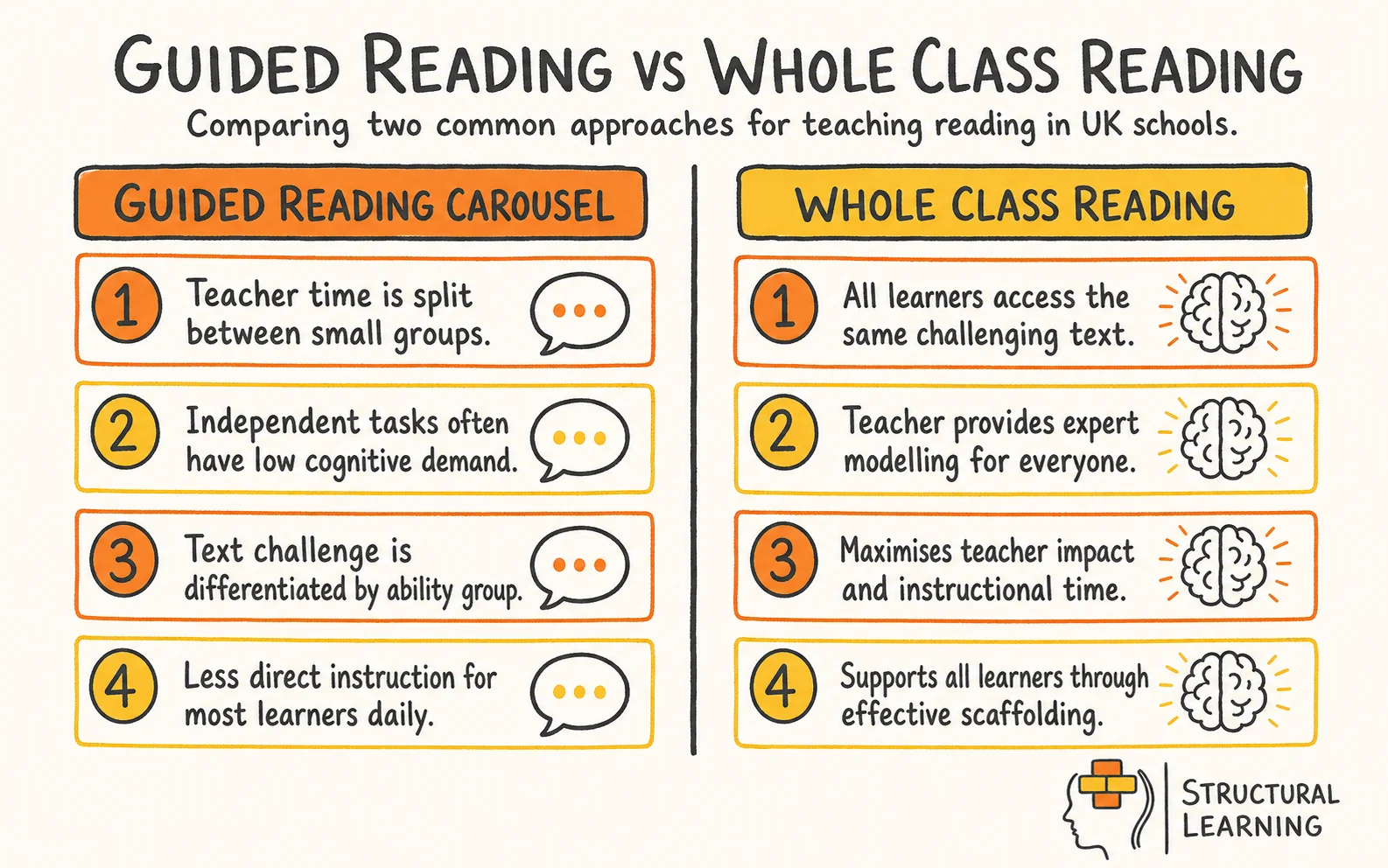
Guided Reading Carousel vs Whole Class Reading infographic for teachers
Guided Reading Carousel vs Whole Class Reading

Why Schools Are Switching to Whole Class Reading

The Problem with Guided Reading Carousels

In a typical guided reading carousel, the teacher spends 15-20 minutes with one group while four other groups rotate through independent activities: comprehension worksheets, reading journals, word games, or free reading. The structural problem is that the teacher, the most valuable resource in the room, only teaches reading to 20% of the class on any given day.

Cognitive load theory identifies another issue. The independent activities in a carousel must be self-sustaining, which means they default to low cognitive demand. Students who most need teacher support in reading often receive it least frequently, precisely because the carousel rations teacher time.

What Whole Class Reading Solves

With whole class reading, every student accesses the same challenging text with the teacher's support. The teacher models reading strategies, teaches vocabulary explicitly, and asks questions that probe comprehension in real time. No student waits three days for their turn.

| Feature | Guided Reading Carousel | Whole Class Reading |

|---------|----------------------|-------------------|

| Teacher input per student | 15-20 mins per week (one group/day) | 30+ mins per week (every lesson) |

| Text challenge level | Differentiated by ability | One challenging text for all |

| Independent work quality | Variable (often low demand) | Eliminated or purposeful |

| Vocabulary instruction | Incidental | Explicit and systematic |

| Assessment opportunities | One group per lesson | Every student every lesson |

| SEND access | Depends on group placement | Supported through scaffolding |
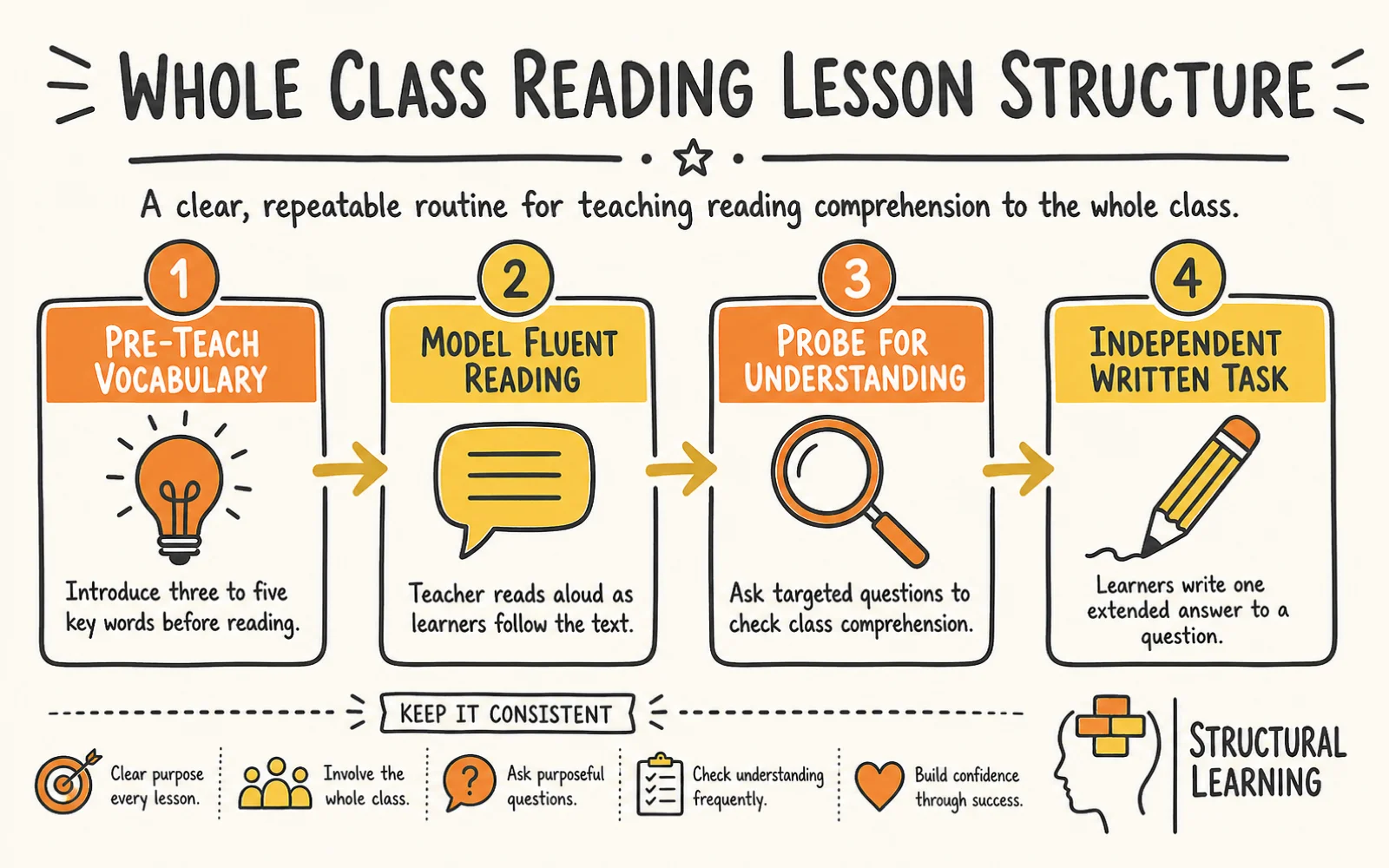
How to Structure a Whole Class Reading Lesson

Structuring Your 30-Minute Reading Session

A whole class reading session typically runs for 25-30 minutes. The following structure works across KS2 and KS3.

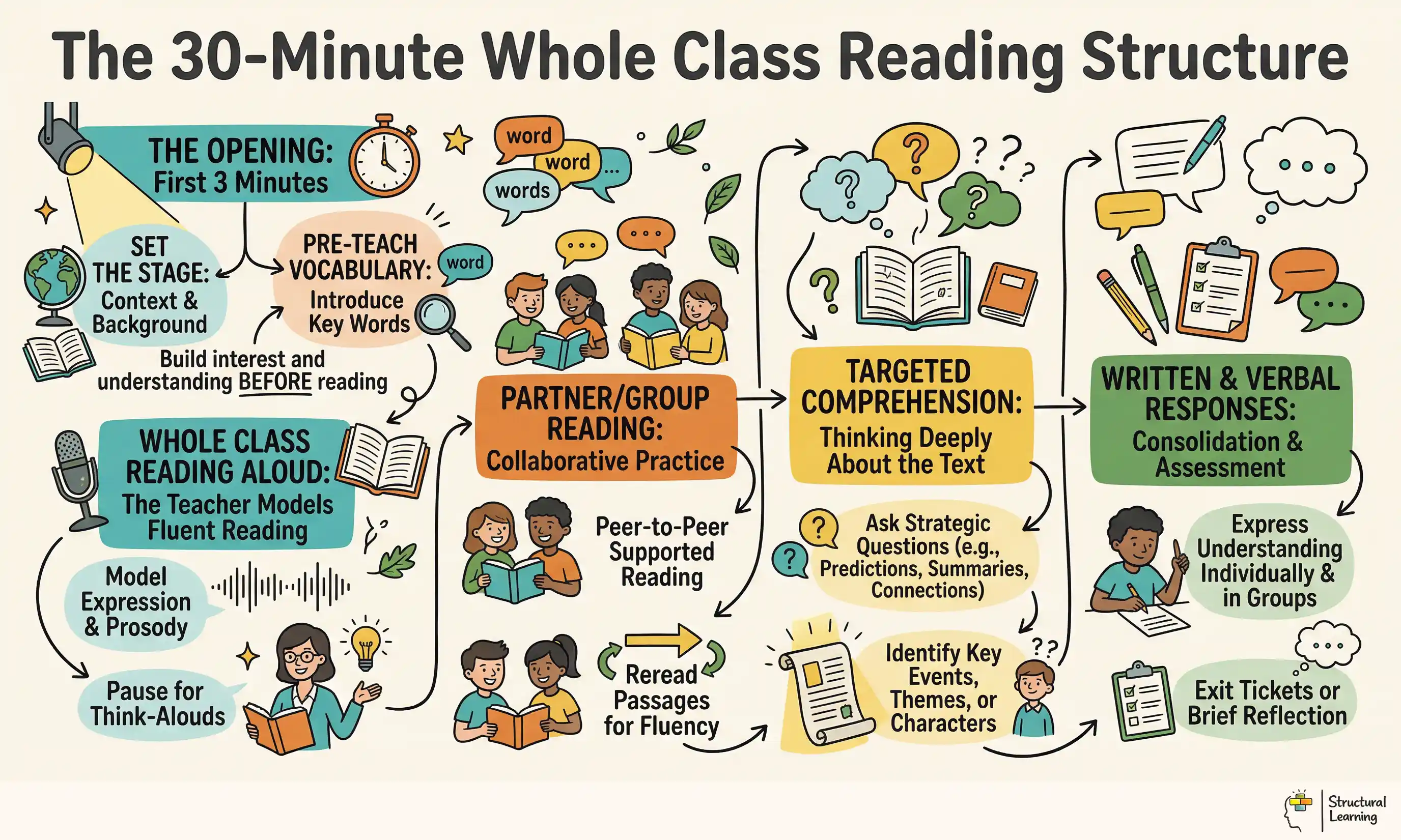
Opening (3 minutes): Context and vocabulary pre-teaching. Before students read a word, the teacher introduces 3-5 key Tier 2 vocabulary words that will appear in the text. A Year 5 teacher about to read a chapter from "Holes" by Louis Sachar might pre-teach: "desolate," "shrivelled," and "presumably." Students write definitions on mini whiteboards and the teacher checks understanding before proceeding.

Reading (10 minutes): Teacher reads, students follow. The teacher reads the text aloud while students follow in their own copy. This ensures pace, models prosody, and removes the bottleneck of decoding for weaker readers. At strategic points, the teacher pauses for brief comprehension checks: "What has just happened? Show me on your boards."

Some teachers use a mixed approach: teacher reads a paragraph, then a confident student reads the next, then the teacher resumes. Avoid round-robin reading where students read aloud in turn. Research consistently shows this is inefficient: students either read ahead, zone out waiting for their turn, or experience anxiety about reading aloud (Ash, 2005).

Questioning (10 minutes): Structured discussion. The teacher asks a sequence of questions moving through Bloom's Taxonomy: retrieval, inference, vocabulary, language analysis, and evaluation.

A Year 4 class reading "The Iron Man" by Ted Hughes:

  • Retrieval: "Where was the Iron Man standing at the start of this chapter?"
  • Inference: "Why do you think the Iron Man did not react when the boy approached?"
  • Vocabulary: "The text says the cliff was 'crumbling.' What does this tell us about the cliff?"
  • Language: "Hughes writes 'his eyes, like headlamps.' Why is this simile effective?"
  • Evaluation: "Do you feel sympathy for the Iron Man at this point? Why or why not?"

Use cold calling to distribute questions across the class, not just to volunteers.

Written response (7 minutes): Extended answer. Students write a response to one key question. This might be a VIPERS-style inference question, a vocabulary exploration, or a personal response. The written element builds stamina and provides the teacher with assessment for learning evidence.

VIPERS: A Questioning Framework

Many schools use VIPERS (Vocabulary, Inference, Prediction, Explanation, Retrieval, Summary/Sequence) to structure whole class reading questions. Each lesson targets 2-3 VIPERS domains.

| VIPERS Element | Question Stem | Example |

|---------------|--------------|---------|

| V ocabulary | What does the word _____ mean in this context? | "What does 'reluctantly' suggest about how the character feels?" |

| I nference | What can you infer from...? | "What do we learn about the character from their actions here?" |

| P rediction | What might happen next? Why? | "Based on what we know about the villain, what might they do?" |

| E xplanation | Why did the author choose to...? | "Why does the author start this chapter with a question?" |

| R etrieval | Find and copy a phrase that shows... | "Find two words that describe the setting as dangerous." |

Educational comparison diagram showing guided reading carousel versus whole class reading methods
Side-by-side comparison diagram: Guided Reading Carousel vs Whole Class Reading Teaching Methods

| S ummary | Summarise what has happened in... | "In three sentences, summarise the key events of this chapter." |

The Structural Learning Thinking Framework aligns naturally with VIPERS. The green "Extract" card maps to Retrieval. The blue "Compare" card supports inference by examining character differences. The orange "Target" vocabulary card prompts systematic word exploration. Teachers who use the Thinking Framework alongside whole class reading report that students develop stronger metacognitive awareness of their reading processes.

Selecting Appropriate Texts for Success

Text Selection Principles

Choose texts above independent reading level. The point of whole class reading is that the teacher's support enables access to texts students could not read alone. A Year 5 class reading at an average age-related level should read a text pitched for confident Year 6 readers. The teacher bridges the gap through modelling, vocabulary instruction, and questioning.

This connects directly to Vygotsky's Zone of Proximal Development: students learn most when working just beyond their current ability with expert support.

Prioritise rich, challenging vocabulary. Texts should contain Tier 2 academic vocabulary that transfers across subjects. A well-chosen novel teaches far more vocabulary than a graded reader designed to match reading level.

Include diverse voices and perspectives. Text choices should reflect the diversity of the classroom and the wider world. This is both a moral imperative and a practical one: students engage more deeply with texts where they see themselves or encounter genuinely new perspectives.

Balance fiction and non-fiction. Many whole class reading programmes over-rely on novels. Include high-quality non-fiction: newspaper articles, scientific reports, historical sources, and speeches. This builds the reading skills students need across the curriculum.

Recommended Text Progression

| Year Group | Example Texts | Vocabulary Richness |

|-----------|--------------|-------------------|

| Year 3-4 | The Iron Man (Hughes), Varjak Paw (Said), The Explorer (Rundell) | Moderate Tier 2 |

| Year 5-6 | Holes (Sachar), Skellig (Almond), Wonder (Palacio) | Strong Tier 2 + Tier 3 |

| Year 7-8 | A Monster Calls (Ness), Noughts and Crosses (Blackman), The Bone Sparrow (Fraillon) | Rich Tier 2, figurative language |

| Year 9 | Of Mice and Men (Steinbeck), Animal Farm (Orwell), The Hate U Give (Thomas) | Complex vocabulary, social themes |
The 30-Minute Whole Class Reading Structure infographic for teachers
The 30-Minute Whole Class Reading Structure

Differentiation in Whole Class Reading

Supporting Weaker Readers

The teacher reading aloud removes the decoding barrier, which is the single most powerful differentiation strategy in whole class reading. Beyond this:

  • Pre-reading: Give struggling readers the first paragraph to read independently before the lesson. This builds familiarity with the text and reduces cognitive load during the main session.
  • Visual anchors: Provide a graphic organiser where students note key events, characters, or vocabulary as the lesson progresses. The Structural Learning Map It approach gives students a visual structure that makes abstract comprehension concrete.
  • Sentence stems for responses: "I think the character feels _____ because the text says _____." This scaffolds inference without lowering the thinking demand.
  • Audio support: Some teachers provide an audio recording of the text so students with special educational needs can listen again at home.

Stretching Strong Readers

  • Use "Author's Craft" questions: "What effect does the writer create by using short sentences here?"
  • Ask for cross-text connections: "How does this character compare to one from our previous book?"
  • Set extension writing that requires synthesis: "Write a diary entry from the antagonist's perspective."
  • Challenge vocabulary work: "Find three words in this passage that could be replaced with more precise alternatives."

Common Mistakes in Whole Class Reading

Mistake 1: Turning it into round-robin reading. Round-robin reading (students take turns reading aloud) creates anxiety, wastes time, and teaches nothing about comprehension. The teacher should do most of the reading aloud.

Mistake 2: Only asking retrieval questions. If every question is "What happened next?" students never develop inference, evaluation, or analytical skills. Use a progression through Bloom's levels or VIPERS domains.

Mistake 3: Choosing texts that are too easy. If students can read the text independently without difficulty, whole class reading adds no value. The text must provide genuine challenge that requires teacher support.

Mistake 4: Neglecting vocabulary instruction. Vocabulary does not teach itself. Pre-teach key words explicitly. Return to them during reading. Test students on them the following week using retrieval practise starters.

Mistake 5: Skipping the written response. Without a written element, whole class reading becomes a passive listening exercise. The written response forces students to consolidate their understanding and provides assessment data.

Why Whole Class Reading Works Better infographic for teachers
Why Whole Class Reading Works Better

AI-Enhanced Whole Class Reading Lessons

Artificial intelligence tools are transforming whole class reading by providing teachers with instant access to adaptive questioning and real-time analytics that would be impossible to generate manually during lessons. Educational technology platforms like Century AI now analyse student responses to comprehension questions in real time, identifying misconceptions and suggesting follow-up questions that target specific reading skills. The Department for Education's 2024 guidance on AI in education explicitly supports these applications, recognising that AI tools can enhance rather than replace teacher expertise in reading instruction.

Prompt engineering has become a practical skill for reading teachers using ChatGPT or Claude to generate differentiated questions during whole class sessions. A Year 5 teacher reading "The Explorer" by Katherine Rundell might input the prompt: "Generate three comprehension questions about character motivation in Chapter 2, suitable for mixed-ability class including EAL learners." Within seconds, the AI produces questions ranging from literal recall to inference, allowing the teacher to select appropriate challenges for different pupils without breaking the flow of the lesson.

Digital differentiation through AI addresses the traditional weakness of whole class reading: ensuring every pupil accesses appropriately challenging content. Research by Luckin and Cukurova (2019) demonstrates that AI-powered adaptive systems can adjust question complexity in real time based on individual student performance patterns. During a whole class reading of "Holes," pupils might receive the same core question about Stanley's character development, but AI tools can automatically provide scaffolding prompts for struggling readers or extension challenges for advanced pupils.

The most significant advantage lies in AI's capacity to analyse reading behaviours across the entire class simultaneously, something impossible in traditional guided reading carousels. Teachers can identify which pupils need additional vocabulary support or struggle with inference skills, using this data to plan targeted interventions while maintaining the whole class structure that ensures equity of access to expert teaching.

Research Evidence Supporting Whole Class Reading

Whole class reading draws on multiple research traditions:

The Reading Rope (Scarborough, 2001): Reading comprehension requires the interweaving of word recognition and language comprehension. Whole class reading strengthens the language comprehension strand by exposing students to complex texts with expert teacher mediation.

Knowledge-Rich Curriculum (Hirsch, 2003): Background knowledge is the strongest predictor of reading comprehension. Whole class reading using carefully sequenced texts builds the knowledge base that enables further reading, creating a virtuous cycle.

Reciprocal Reading (Palincsar and Brown, 1984): The questioning techniques in whole class reading, particularly prediction, clarification, summarisation, and questioning, draw directly from the reciprocal teaching model. Whole class reading scales these strategies to the full class.

Direct Instruction (Rosenshine, 2012): The teacher-led model of whole class reading aligns with Rosenshine's principles: present new material in small steps, ask many questions, check understanding frequently, and provide models of worked examples.

Next lesson, choose a passage 200 words above your class's comfortable reading level. Read it aloud while they follow. Ask five questions moving from retrieval to evaluation. Notice how every student engages when the text is challenging and the teacher is the guide.

Further Reading: Key Research Papers

These peer-reviewed studies provide the research foundation for the strategies discussed in this article:

Teaching Strategies and Their Effects on Reading Comprehension Performance of Junior High School Students in Inclusive Classroom Setting View study ↗
8 citations

Reynaldo V. Moral & Maricel D. Villarente (2024)

This study demonstrates that explicit reading strategy instruction significantly improves comprehension outcomes for middle school students in inclusive classrooms. The research provides valuable evidence that structured reading strategies work effectively for diverse learners, including students with special needs. Teachers will find this particularly useful for creating reading interventions that support all students while maintaining whole class instruction.

Pre-Service Teachers' Perceptions about the Effectiveness of the TOON Comic Books in Their Guided Reading Instruction View study ↗
7 citations

Ewa McGrail et al. (2017)

Future teachers report that using comic books during guided reading sessions significantly engages students and supports comprehension development. The study shows that graphic texts like TOON comics meet the needs of today's visual learners while maintaining rigorous reading instruction. This research gives teachers confidence to incorporate comics and graphic novels into their reading programmes as legitimate educational tools rather than just entertainment.

A Culturally Adapted Modified Guided Reading Programme for K-1 Students in India View study ↗

P. M. Juddoo et al. (2025)

Researchers developed a guided reading programme using culturally relevant books and mobile technology that accelerated early literacy skills for young students in rural India. The programme's success demonstrates how adapting reading materials to reflect students' cultural experiences dramatically improves learning outcomes. Teachers working with diverse populations can apply these principles by selecting texts that mirror their students' backgrounds and incorporating familiar cultural references into reading instruction.

Loading audit...

Ready to transform your reading lessons but unsure where to start with whole class reading? This comprehensive guide walks you through every step of implementation, from your very first lesson to mastering advanced questioning techniques that engage every student. You'll discover practical lesson structures, tried-and-tested activities, and troubleshooting solutions that work in real classrooms. Whether you're completely new to whole class reading or looking to refine your approach, these actionable strategies will help you create dynamic lessons where no child is left behind.

Key Takeaways

  1. Teacher Time Equity Problem: Traditional guided reading reaches only 20% of students daily while others complete low-demand tasks, creating classroom inequity.
  2. 30-Minute Lesson Structure: A proven framework combining vocabulary pre-teaching, teacher-led reading, structured questioning, and written responses for maximum impact.
  3. VIPERS Questioning Framework: Strategic question stems covering Vocabulary, Inference, Prediction, Explanation, Retrieval, and Summary to deepen comprehension for all students.
  4. Cold Calling Strategy: Move beyond volunteers by distributing questions across the entire class, ensuring every student engages with challenging texts.

The shift towards whole class reading in UK primary and secondary schools accelerated after the 2019 Ofsted framework emphasised the importance of reading at the heart of the curriculum. Schools recognised that the guided reading carousel created an equity problem: the teacher's best teaching only reached six students at a time, while the remaining 24 worked independently on tasks that often lacked challenge or purpose.

Guided Reading Carousel vs Whole Class Reading infographic for teachers
Guided Reading Carousel vs Whole Class Reading

Why Schools Are Switching to Whole Class Reading

The Problem with Guided Reading Carousels

In a typical guided reading carousel, the teacher spends 15-20 minutes with one group while four other groups rotate through independent activities: comprehension worksheets, reading journals, word games, or free reading. The structural problem is that the teacher, the most valuable resource in the room, only teaches reading to 20% of the class on any given day.

Cognitive load theory identifies another issue. The independent activities in a carousel must be self-sustaining, which means they default to low cognitive demand. Students who most need teacher support in reading often receive it least frequently, precisely because the carousel rations teacher time.

What Whole Class Reading Solves

With whole class reading, every student accesses the same challenging text with the teacher's support. The teacher models reading strategies, teaches vocabulary explicitly, and asks questions that probe comprehension in real time. No student waits three days for their turn.

| Feature | Guided Reading Carousel | Whole Class Reading |

|---------|----------------------|-------------------|

| Teacher input per student | 15-20 mins per week (one group/day) | 30+ mins per week (every lesson) |

| Text challenge level | Differentiated by ability | One challenging text for all |

| Independent work quality | Variable (often low demand) | Eliminated or purposeful |

| Vocabulary instruction | Incidental | Explicit and systematic |

| Assessment opportunities | One group per lesson | Every student every lesson |

| SEND access | Depends on group placement | Supported through scaffolding |

How to Structure a Whole Class Reading Lesson

Structuring Your 30-Minute Reading Session

A whole class reading session typically runs for 25-30 minutes. The following structure works across KS2 and KS3.

Opening (3 minutes): Context and vocabulary pre-teaching. Before students read a word, the teacher introduces 3-5 key Tier 2 vocabulary words that will appear in the text. A Year 5 teacher about to read a chapter from "Holes" by Louis Sachar might pre-teach: "desolate," "shrivelled," and "presumably." Students write definitions on mini whiteboards and the teacher checks understanding before proceeding.

Reading (10 minutes): Teacher reads, students follow. The teacher reads the text aloud while students follow in their own copy. This ensures pace, models prosody, and removes the bottleneck of decoding for weaker readers. At strategic points, the teacher pauses for brief comprehension checks: "What has just happened? Show me on your boards."

Some teachers use a mixed approach: teacher reads a paragraph, then a confident student reads the next, then the teacher resumes. Avoid round-robin reading where students read aloud in turn. Research consistently shows this is inefficient: students either read ahead, zone out waiting for their turn, or experience anxiety about reading aloud (Ash, 2005).

Questioning (10 minutes): Structured discussion. The teacher asks a sequence of questions moving through Bloom's Taxonomy: retrieval, inference, vocabulary, language analysis, and evaluation.

A Year 4 class reading "The Iron Man" by Ted Hughes:

  • Retrieval: "Where was the Iron Man standing at the start of this chapter?"
  • Inference: "Why do you think the Iron Man did not react when the boy approached?"
  • Vocabulary: "The text says the cliff was 'crumbling.' What does this tell us about the cliff?"
  • Language: "Hughes writes 'his eyes, like headlamps.' Why is this simile effective?"
  • Evaluation: "Do you feel sympathy for the Iron Man at this point? Why or why not?"

Use cold calling to distribute questions across the class, not just to volunteers.

Written response (7 minutes): Extended answer. Students write a response to one key question. This might be a VIPERS-style inference question, a vocabulary exploration, or a personal response. The written element builds stamina and provides the teacher with assessment for learning evidence.

VIPERS: A Questioning Framework

Many schools use VIPERS (Vocabulary, Inference, Prediction, Explanation, Retrieval, Summary/Sequence) to structure whole class reading questions. Each lesson targets 2-3 VIPERS domains.

| VIPERS Element | Question Stem | Example |

|---------------|--------------|---------|

| V ocabulary | What does the word _____ mean in this context? | "What does 'reluctantly' suggest about how the character feels?" |

| I nference | What can you infer from...? | "What do we learn about the character from their actions here?" |

| P rediction | What might happen next? Why? | "Based on what we know about the villain, what might they do?" |

| E xplanation | Why did the author choose to...? | "Why does the author start this chapter with a question?" |

| R etrieval | Find and copy a phrase that shows... | "Find two words that describe the setting as dangerous." |

Educational comparison diagram showing guided reading carousel versus whole class reading methods
Side-by-side comparison diagram: Guided Reading Carousel vs Whole Class Reading Teaching Methods

| S ummary | Summarise what has happened in... | "In three sentences, summarise the key events of this chapter." |

The Structural Learning Thinking Framework aligns naturally with VIPERS. The green "Extract" card maps to Retrieval. The blue "Compare" card supports inference by examining character differences. The orange "Target" vocabulary card prompts systematic word exploration. Teachers who use the Thinking Framework alongside whole class reading report that students develop stronger metacognitive awareness of their reading processes.

Selecting Appropriate Texts for Success

Text Selection Principles

Choose texts above independent reading level. The point of whole class reading is that the teacher's support enables access to texts students could not read alone. A Year 5 class reading at an average age-related level should read a text pitched for confident Year 6 readers. The teacher bridges the gap through modelling, vocabulary instruction, and questioning.

This connects directly to Vygotsky's Zone of Proximal Development: students learn most when working just beyond their current ability with expert support.

Prioritise rich, challenging vocabulary. Texts should contain Tier 2 academic vocabulary that transfers across subjects. A well-chosen novel teaches far more vocabulary than a graded reader designed to match reading level.

Include diverse voices and perspectives. Text choices should reflect the diversity of the classroom and the wider world. This is both a moral imperative and a practical one: students engage more deeply with texts where they see themselves or encounter genuinely new perspectives.

Balance fiction and non-fiction. Many whole class reading programmes over-rely on novels. Include high-quality non-fiction: newspaper articles, scientific reports, historical sources, and speeches. This builds the reading skills students need across the curriculum.

Recommended Text Progression

| Year Group | Example Texts | Vocabulary Richness |

|-----------|--------------|-------------------|

| Year 3-4 | The Iron Man (Hughes), Varjak Paw (Said), The Explorer (Rundell) | Moderate Tier 2 |

| Year 5-6 | Holes (Sachar), Skellig (Almond), Wonder (Palacio) | Strong Tier 2 + Tier 3 |

| Year 7-8 | A Monster Calls (Ness), Noughts and Crosses (Blackman), The Bone Sparrow (Fraillon) | Rich Tier 2, figurative language |

| Year 9 | Of Mice and Men (Steinbeck), Animal Farm (Orwell), The Hate U Give (Thomas) | Complex vocabulary, social themes |

The 30-Minute Whole Class Reading Structure infographic for teachers
The 30-Minute Whole Class Reading Structure

Differentiation in Whole Class Reading

Supporting Weaker Readers

The teacher reading aloud removes the decoding barrier, which is the single most powerful differentiation strategy in whole class reading. Beyond this:

  • Pre-reading: Give struggling readers the first paragraph to read independently before the lesson. This builds familiarity with the text and reduces cognitive load during the main session.
  • Visual anchors: Provide a graphic organiser where students note key events, characters, or vocabulary as the lesson progresses. The Structural Learning Map It approach gives students a visual structure that makes abstract comprehension concrete.
  • Sentence stems for responses: "I think the character feels _____ because the text says _____." This scaffolds inference without lowering the thinking demand.
  • Audio support: Some teachers provide an audio recording of the text so students with special educational needs can listen again at home.

Stretching Strong Readers

  • Use "Author's Craft" questions: "What effect does the writer create by using short sentences here?"
  • Ask for cross-text connections: "How does this character compare to one from our previous book?"
  • Set extension writing that requires synthesis: "Write a diary entry from the antagonist's perspective."
  • Challenge vocabulary work: "Find three words in this passage that could be replaced with more precise alternatives."

Common Mistakes in Whole Class Reading

Mistake 1: Turning it into round-robin reading. Round-robin reading (students take turns reading aloud) creates anxiety, wastes time, and teaches nothing about comprehension. The teacher should do most of the reading aloud.

Mistake 2: Only asking retrieval questions. If every question is "What happened next?" students never develop inference, evaluation, or analytical skills. Use a progression through Bloom's levels or VIPERS domains.

Mistake 3: Choosing texts that are too easy. If students can read the text independently without difficulty, whole class reading adds no value. The text must provide genuine challenge that requires teacher support.

Mistake 4: Neglecting vocabulary instruction. Vocabulary does not teach itself. Pre-teach key words explicitly. Return to them during reading. Test students on them the following week using retrieval practise starters.

Mistake 5: Skipping the written response. Without a written element, whole class reading becomes a passive listening exercise. The written response forces students to consolidate their understanding and provides assessment data.

Why Whole Class Reading Works Better infographic for teachers
Why Whole Class Reading Works Better

AI-Enhanced Whole Class Reading Lessons

Artificial intelligence tools are transforming whole class reading by providing teachers with instant access to adaptive questioning and real-time analytics that would be impossible to generate manually during lessons. Educational technology platforms like Century AI now analyse student responses to comprehension questions in real time, identifying misconceptions and suggesting follow-up questions that target specific reading skills. The Department for Education's 2024 guidance on AI in education explicitly supports these applications, recognising that AI tools can enhance rather than replace teacher expertise in reading instruction.

Prompt engineering has become a practical skill for reading teachers using ChatGPT or Claude to generate differentiated questions during whole class sessions. A Year 5 teacher reading "The Explorer" by Katherine Rundell might input the prompt: "Generate three comprehension questions about character motivation in Chapter 2, suitable for mixed-ability class including EAL learners." Within seconds, the AI produces questions ranging from literal recall to inference, allowing the teacher to select appropriate challenges for different pupils without breaking the flow of the lesson.

Digital differentiation through AI addresses the traditional weakness of whole class reading: ensuring every pupil accesses appropriately challenging content. Research by Luckin and Cukurova (2019) demonstrates that AI-powered adaptive systems can adjust question complexity in real time based on individual student performance patterns. During a whole class reading of "Holes," pupils might receive the same core question about Stanley's character development, but AI tools can automatically provide scaffolding prompts for struggling readers or extension challenges for advanced pupils.

The most significant advantage lies in AI's capacity to analyse reading behaviours across the entire class simultaneously, something impossible in traditional guided reading carousels. Teachers can identify which pupils need additional vocabulary support or struggle with inference skills, using this data to plan targeted interventions while maintaining the whole class structure that ensures equity of access to expert teaching.

Research Evidence Supporting Whole Class Reading

Whole class reading draws on multiple research traditions:

The Reading Rope (Scarborough, 2001): Reading comprehension requires the interweaving of word recognition and language comprehension. Whole class reading strengthens the language comprehension strand by exposing students to complex texts with expert teacher mediation.

Knowledge-Rich Curriculum (Hirsch, 2003): Background knowledge is the strongest predictor of reading comprehension. Whole class reading using carefully sequenced texts builds the knowledge base that enables further reading, creating a virtuous cycle.

Reciprocal Reading (Palincsar and Brown, 1984): The questioning techniques in whole class reading, particularly prediction, clarification, summarisation, and questioning, draw directly from the reciprocal teaching model. Whole class reading scales these strategies to the full class.

Direct Instruction (Rosenshine, 2012): The teacher-led model of whole class reading aligns with Rosenshine's principles: present new material in small steps, ask many questions, check understanding frequently, and provide models of worked examples.

Next lesson, choose a passage 200 words above your class's comfortable reading level. Read it aloud while they follow. Ask five questions moving from retrieval to evaluation. Notice how every student engages when the text is challenging and the teacher is the guide.

Further Reading: Key Research Papers

These peer-reviewed studies provide the research foundation for the strategies discussed in this article:

Teaching Strategies and Their Effects on Reading Comprehension Performance of Junior High School Students in Inclusive Classroom Setting View study ↗
8 citations

Reynaldo V. Moral & Maricel D. Villarente (2024)

This study demonstrates that explicit reading strategy instruction significantly improves comprehension outcomes for middle school students in inclusive classrooms. The research provides valuable evidence that structured reading strategies work effectively for diverse learners, including students with special needs. Teachers will find this particularly useful for creating reading interventions that support all students while maintaining whole class instruction.

Pre-Service Teachers' Perceptions about the Effectiveness of the TOON Comic Books in Their Guided Reading Instruction View study ↗
7 citations

Ewa McGrail et al. (2017)

Future teachers report that using comic books during guided reading sessions significantly engages students and supports comprehension development. The study shows that graphic texts like TOON comics meet the needs of today's visual learners while maintaining rigorous reading instruction. This research gives teachers confidence to incorporate comics and graphic novels into their reading programmes as legitimate educational tools rather than just entertainment.

A Culturally Adapted Modified Guided Reading Programme for K-1 Students in India View study ↗

P. M. Juddoo et al. (2025)

Researchers developed a guided reading programme using culturally relevant books and mobile technology that accelerated early literacy skills for young students in rural India. The programme's success demonstrates how adapting reading materials to reflect students' cultural experiences dramatically improves learning outcomes. Teachers working with diverse populations can apply these principles by selecting texts that mirror their students' backgrounds and incorporating familiar cultural references into reading instruction.

Educational Technology

Back to Blog

<script type="application/ld+json">{"@context":"https://schema.org","@graph":[{"@type":"Article","@id":"https://www.structural-learning.com/post/whole-class-reading-teachers-guide#article","headline":"Whole Class Reading: A Teacher's Guide","description":"Ready to transform your reading lessons but unsure where to start with whole class reading? This comprehensive guide walks you through every step of...","datePublished":"2026-03-02T16:32:15.058Z","dateModified":"2026-03-02T16:39:12.887Z","author":{"@type":"Person","name":"Paul Main","url":"https://www.structural-learning.com/team/paulmain","jobTitle":"Founder & Educational Consultant"},"publisher":{"@type":"Organization","name":"Structural Learning","url":"https://www.structural-learning.com","logo":{"@type":"ImageObject","url":"https://cdn.prod.website-files.com/5b69a01ba2e409e5d5e055c6/6040bf0426cb415ba2fc7882_newlogoblue.svg"}},"mainEntityOfPage":{"@type":"WebPage","@id":"https://www.structural-learning.com/post/whole-class-reading-teachers-guide"},"image":"https://cdn.prod.website-files.com/5b69a01ba2e409501de055d1/69a5bb8e58533842dc4fd40f_69a5bb22399c15d5e7ab6e87_whole-class-reading-guided-reading-carousel-vs-infographic.webp","wordCount":2563},{"@type":"BreadcrumbList","@id":"https://www.structural-learning.com/post/whole-class-reading-teachers-guide#breadcrumb","itemListElement":[{"@type":"ListItem","position":1,"name":"Home","item":"https://www.structural-learning.com/"},{"@type":"ListItem","position":2,"name":"Blog","item":"https://www.structural-learning.com/blog"},{"@type":"ListItem","position":3,"name":"Whole Class Reading: A Teacher's Guide","item":"https://www.structural-learning.com/post/whole-class-reading-teachers-guide"}]}]}</script>