Updated on
September 23, 2026
Critical AI Use: A Teacher's Guide
Master critical AI use metacognition digital self-regulation in your classroom. Move from passive consumption to active cognitive mirror strategies.


Updated on
September 23, 2026
Master critical AI use metacognition digital self-regulation in your classroom. Move from passive consumption to active cognitive mirror strategies.
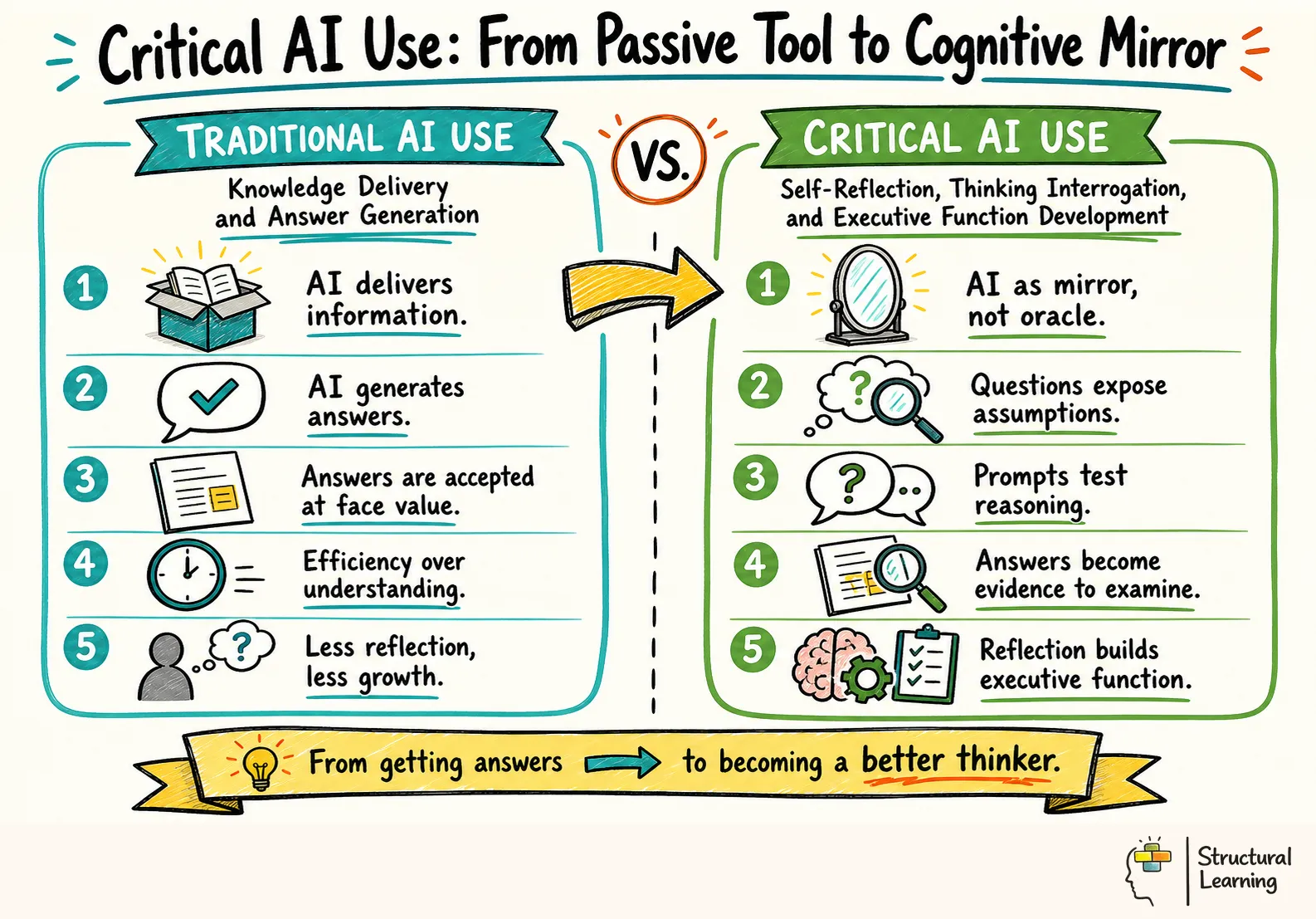
Critical AI use means treating generative tools as provisional thinking partners, not answer machines, so learners question the prompt, the output and their own reasoning before accepting any response. In the classroom, this means asking learners to plan a prompt, predict what a useful answer should include, compare the AI response with subject knowledge, and annotate where it is accurate, vague or misleading. That routine matters because AI can reduce effort if it writes for learners, but it can strengthen self-regulation when teachers make learners monitor their thinking, justify revisions and explain why they accepted or rejected a suggestion (Flavell, 1979). Use AI to make reasoning visible: learners produce prompt maps, critique tables, improved drafts, alternative explanations and short reflections that show how judgement, evidence and disciplinary vocabulary have changed.
Critical AI use metacognition digital self-regulation is the practice of using generative algorithms to monitor, direct and evaluate thinking processes. It moves beyond basic prompt engineering. Learners use artificial intelligence not to bypass work but to interrogate their own understanding. This approach actively recruits executive function skills rather than outsourcing them to a machine For the broader teaching sequence, see our guide on how to develop metacognition.
The concept originates from the need to address passive consumption in digital learning environments. Early research treated technology as a knowledge delivery system (Salomon, 2016). Current models frame it as a adaptable cognitive partner. Researchers like Xu (2025) argue that without guided self-regulation, generative algorithms weaken working memory by removing productive struggle.
The core purpose is maintaining human agency while interacting with complex information systems. Teachers apply this by designing tasks where the AI challenges learner assumptions. For example, a history teacher might instruct learners to write a thesis statement on the causes of the Industrial Revolution. Instead of asking a chatbot to write the essay, the learner asks it to spot logical flaws in their thesis. The learner then produces a revised thesis statement based on their evaluation of the machine's feedback.
Handing learners instant answers removes the cognitive friction required for long term memory retention. Cognitive offloading occurs when learners use external tools to reduce mental effort (Risko & Gilbert, 2016). While helpful for rote tasks, offloading analytical thinking degrades learning. Critical AI use metacognition digital self-regulation ensures that the machine does the processing while the learner does the thinking.
Research highlights the danger of treating algorithms as omniscient tutors. Dahri et al. (2024) demonstrated that learners who accept AI output without critique show significant declines in comprehension. They become passive recipients rather than active meaning makers. Conversely, when teachers require learners to grade or correct AI generated text, retention rates increase.
Shared Metacognition (SMC) between peers collaborating with AI tools provides another layer of value. Groups using AI as a conversational sparring partner tend to develop stronger argumentative skills. The tool acts as a catalyst for peer to peer debate. In practice, a teacher groups learners in pairs and provides an AI generated argument defending a specific climate policy. The learners must work together to dissect the algorithm's logic and produce a joint critique outlining its weaknesses.
Transitioning from theoretical metacognition to daily teaching requires structured protocols. Teachers must control the interaction boundaries. Generative tools naturally default to providing complete solutions. You must design constraints that force the algorithm to withhold answers and instead prompt learner reflection.
The following strategies prevent passive consumption and activate higher order thinking. They shift the locus of control back to the learner. Each protocol requires specific instructional design and clear rules of engagement.
The Naive Peer protocol forces learners to explain concepts to a deliberately confused algorithm. The teacher instructs the class to open an AI chat and command it to act as an eight year old child. The AI must ask follow up questions and request simpler analogies. The learner cannot progress until the AI confirms it understands the core concept.
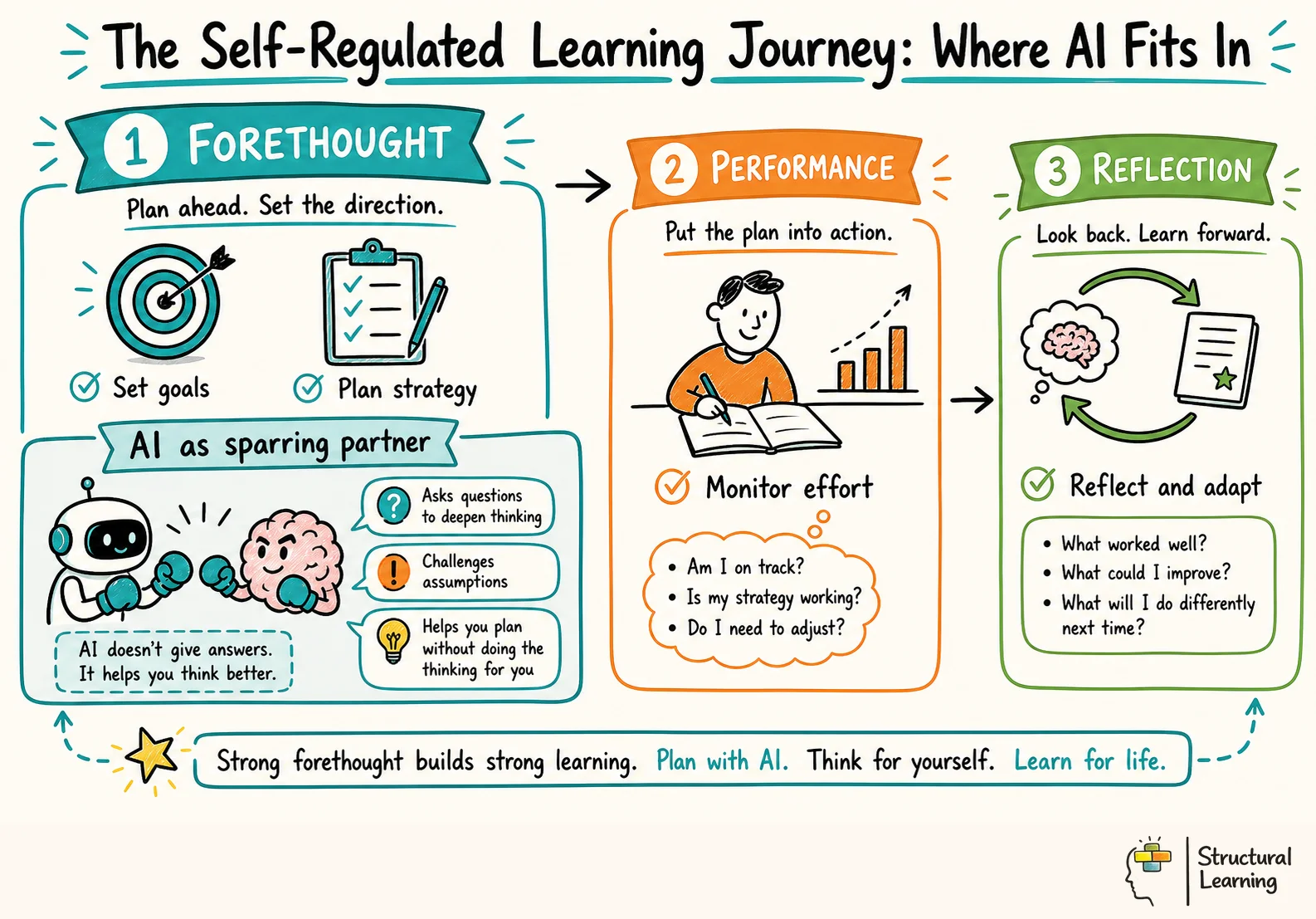
Learners must articulate their knowledge with extreme clarity. If a learner is explaining photosynthesis, they must break down chloroplasts and light energy without using jargon. When the AI expresses confusion, the learner must monitor their own explanatory depth and adjust their language. This recruits the self-reflection phase of Zimmerman's (2000) self-regulated learning model.
In a science lesson, the teacher says, "Instruct your chatbot to act as a naive peer who has never heard of gravity." The learners write explanations and read the AI responses. One learner notes that the AI asked why balloons float. The learner must then produce a refined explanation that includes mass and atmospheric density, making their thinking explicitly visible.
The Pre-Mortem Prompt addresses the planning stage of complex tasks. Before writing an essay or conducting an experiment, learners outline their intended approach. The teacher then directs them to feed this outline into an AI tool. The specific prompt must ask the algorithm to identify three distinct ways the plan will fail.
Learners review the algorithmic critique and adjust their strategy. This directly targets the forethought phase of self-regulated learning. It forces learners to anticipate obstacles before committing to a course of action. Evaluating the machine's predictions requires them to operate at Depth of Knowledge Level 3 (Strategic Thinking).
In a history class, learners plan an essay on the causes of World War One. A learner feeds their paragraph outline to the AI and asks for potential failures. The AI points out that the outline ignores economic tensions. The learner evaluates this critique, agrees with the gap, and produces a modified plan that includes trade rivalries.
The Rate My Reasoning strategy focuses on the execution phase of a task. Learners write a draft paragraph or solve a multi step problem independently. They then input their work into the AI with strict constraints. The prompt must command the AI to assess logical flow and transition vocabulary without rewriting the text.
Learners receive analytical feedback rather than a finished product. They must decide which pieces of advice to accept and which to discard. This builds digital self-regulation as they learn to treat machine feedback as a suggestion rather than a mandate. The teacher monitors how learners implement these specific structural changes.
During an English lesson, a learner struggles with paragraph transitions. They submit their text and prompt the AI to highlight abrupt subject changes. The AI identifies a jump between two sentences. The learner then produces a manually rewritten bridging sentence, retaining complete ownership of the final output while benefiting from targeted structural feedback.
This strategy uses voice to text features to practice exploratory talk before any writing occurs. The teacher sets up the AI to act as a contrarian debating partner. Learners must verbally argue their position on a given topic. The AI responds with counterarguments, forcing the learner to defend their stance on the spot.
Learners must think on their feet and organise their verbal reasoning. This bridges the gap between scattered thoughts and structured arguments. Defending a thesis against a persistent algorithm forces learners to clarify their logic. The teacher listens to these verbal exchanges and steps in to highlight strong points.
In a geography lesson about urban planning, a learner argues for expanding public transport. The AI counters by citing high infrastructure costs. The learner verbally responds by arguing long term environmental savings. This verbal sparring refines their mental model before they begin producing their written report.
A persistent misconception is that AI inherently saves time by doing the work for the learner. This assumes the goal of education is merely producing a finished essay or worksheet. True learning requires cognitive friction (Bjork, 1994). Bypassing that friction through uncritical AI use degrades knowledge acquisition and creates an illusion of competence.
Many educators believe AI literacy means simply teaching learners how to write good prompts. While prompt engineering is useful, it focuses entirely on the output. Critical AI use metacognition digital self-regulation demands that we teach learners how to evaluate the machine's reasoning. Prompting is only valuable if the learner can critically assess the resulting information.
Another flawed belief is that AI should act as an omniscient tutor providing personalised answers. This model trains learners to seek definitive truths from a black box algorithm. The cognitive mirror framework flips this adaptable. In a typical lesson addressing these misconceptions, the teacher tasks learners with fact checking a generated article about the solar system. The learners produce an annotated document highlighting the AI's hallucinations and logical errors, shifting the cognitive load back to the human.
Implementing this framework requires deliberate scaffolding. You cannot simply give learners access to generative tools and expect them to self regulate. You must establish strict boundaries and model the exact behaviours you want to see. The Map It, Say It, Build It framework provides an excellent structure for this transition.
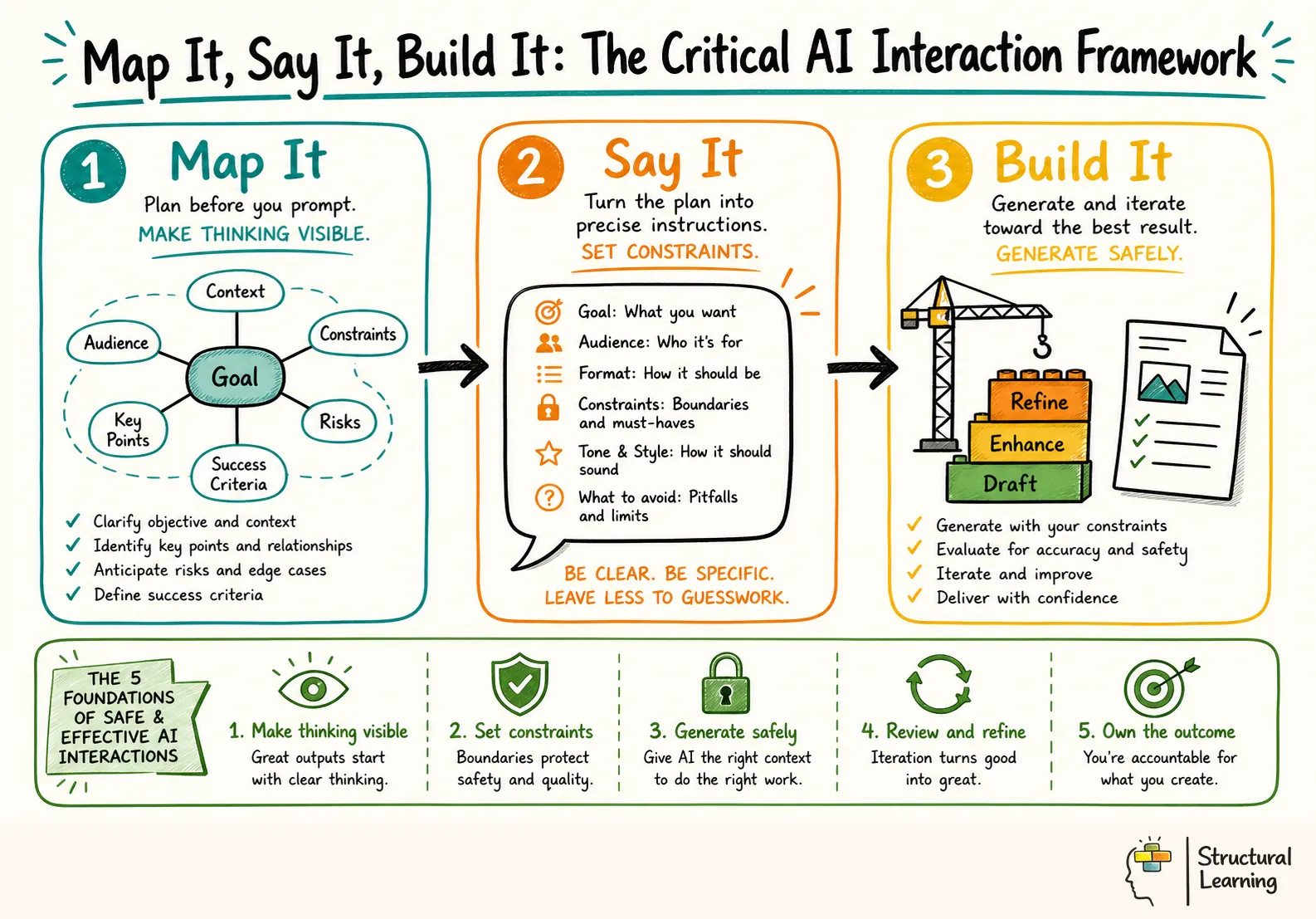
Step one is the Map It phase, focusing on visualising knowledge. Before opening any digital tool, learners use physical graphic organisers to structure their initial thoughts. If they are comparing two historical figures, they complete a paper Venn diagram. This physical mapping creates a baseline of independent thought that the AI cannot contaminate.
Step two is the Say It phase, which introduces the algorithm as a conversational partner. Learners take their physical map and use voice prompting to discuss their ideas with the AI. The teacher instructs them to use a specific constraint prompt. For example, "Ask me three questions about my comparison of these historical figures."
Step three is the Build It phase, where learners construct their final response. They use the insights gained from the physical map and the algorithmic conversation to write their piece. The AI is completely closed during this drafting stage. The teacher ensures that the final product is entirely the learner's own work, enriched by the metacognitive process.
Consider a practical example in a religious education lesson. The class is exploring ethical theories. In the Map It stage, the teacher provides a blank concept map, and learners produce a structured breakdown of utilitarianism. In the Say It stage, they prompt the AI to argue against their map from a deontological perspective. In the Build It stage, they close the laptops and produce a final essay comparing the two viewpoints.
Applying these strategies varies across disciplines. The underlying principle remains the same: the tool must provoke thought, not replace it. Subject specific constraints ensure that the AI targets the exact cognitive skills required by the curriculum. You must adapt the prompts to suit the precise demands of your syllabus.
In Maths, the focus shifts to process evaluation over final answers. A teacher gives learners a complex, multi step algebra problem that has been solved incorrectly by an AI. The learners act as the teacher and grade the algorithm's work. They produce a marked up version of the problem, identifying exactly where the logical sequence broke down and explaining why the machine failed.
In English Literature, the focus is on analytical depth. A teacher provides a basic, generic AI summary of a Shakespearean scene. Learners rewrite the summary to include high level character motivation and thematic analysis. The teacher monitors this process, and learners produce a final text that aggressively critiques and expands upon the generic baseline.
In Science, the focus lies in experimental design and hypothesis testing. Learners draft a methodology for testing water purity. They feed this methodology into the AI and prompt it to identify uncontrolled variables. The learners evaluate the AI's suggestions, decide which variables are actually relevant, and produce a refined experimental design.
The evidence base is still thin for classroom use. Many studies test short tasks, older learners, or laboratory settings, so teachers should not assume that a prompt routine which works in one lesson will raise writing quality, recall or reasoning across a term. Risko and Gilbert (2016) show that offloading can save effort, but they do not prove where the safe line sits for Year 5 science, GCSE history or sixth form essays.
Second, critical AI use takes time. Teachers need to model questioning, check prompts and read revised work, which is hard in large classes or under exam pressure. Third, learners with weak subject knowledge may struggle to judge a confident but wrong answer. Willingham (2009) reminds us that thinking depends on what is held in memory, so AI critique should follow direct teaching, worked examples and retrieval practice, not replace them.
Shift your assessment strategy from final products to process tracking. Grade the planning stages, the physical graphic organisers, and the specific prompt histories. If the assessment requires in class drafting without digital access, you eliminate the opportunity for wholesale cheating.
You must explicitly write constraints into the initial prompts. Instruct your learners to start every session by pasting a rule set. A strong opening prompt is: "You are a coach. Never provide the final answer. Only ask questions that help me find the answer myself."
Initially, teaching digital self-regulation requires dedicated lesson time. However, once learners internalise the routines, it accelerates their independent learning. They become better at diagnosing their own misunderstandings, which reduces the time you spend remediating basic errors.
Data privacy and age restrictions are critical factors. Always use school approved, walled garden platforms that do not use learner data for training models. Focus on teacher led whole class demonstrations for younger groups, rather than individual unstructured access.
The cognitive mirror approach is highly adaptable. For learners with working memory difficulties, AI can break complex tasks into single manageable steps. Voice to text debating removes writing barriers, allowing dyslexic learners to focus purely on argument construction and verbal reasoning.
Begin with a low stakes critique task. Generate a completely mediocre paragraph about your current topic using an AI tool. Print it out on paper. Ask your learners to take red pens and correct its factual errors, improve its vocabulary, and fix its structure.
Equip your learners to control their digital environment rather than being controlled by it. Choose one lesson next week to introduce the Naive Peer protocol and watch how it transforms their explanatory depth.
These peer-reviewed studies provide the evidence base for the strategies discussed above.
Gonsalves (2024)
This study reveals that 74% of students failed to declare their AI usage despite mandatory requirements, highlighting the urgent need for teachers to develop clearer policies and better communication strategies around AI transparency in academic work.
Holman et al. (2024)
This research provides guidance for teacher educators on implementing AI-powered personalised learning tools in special education settings, offering practical frameworks for preparing future teachers to effectively use AI technology to support students with disabilities.
Alqarni (2025)
Researchers developed and validated a specific scale to measure teachers' ability to integrate AI tools whilst enhancing critical thinking skills in their classrooms, providing educators with evidence-based methods for effective AI-enhanced pedagogy.
Navigating Educational Frontiers in the AI Era: A Teacher's Autoethnography on AI-Infused Education
Kuka et al. (2024)
A teacher's personal account of integrating generative AI into educational practice offers authentic insights into the challenges and opportunities of AI-infused education, providing practical perspectives for educators considering similar implementations.
For the wider picture, explore our AI and EdTech tools hub, our home for evidence-based AI guidance across policy, lesson planning, and classroom practice.