Oracy in the classroom: a teacher's guide
Discover the vital role of oracy in language development and how enhancing speaking skills in the classroom can boost students' learning and confidence.

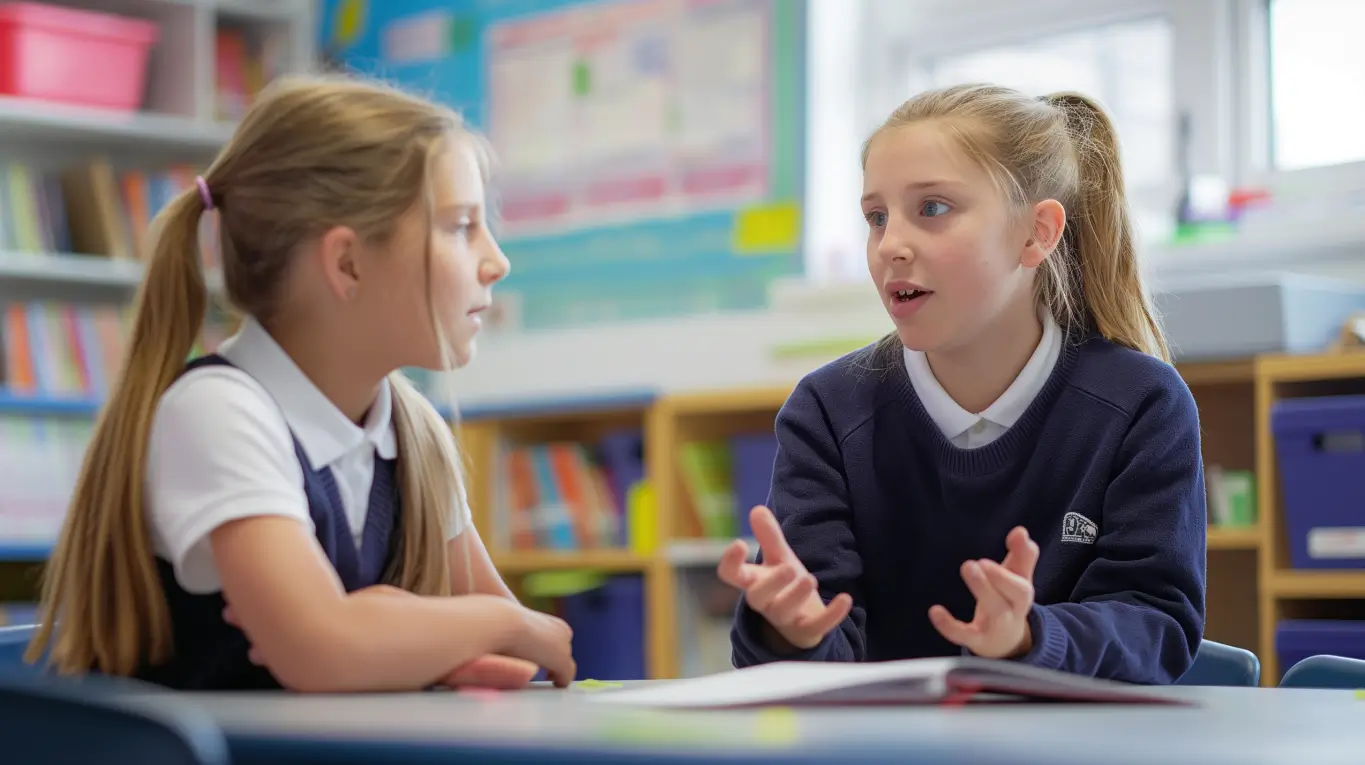
Discover the vital role of oracy in language development and how enhancing speaking skills in the classroom can boost students' learning and confidence.
Here, we explore ways of developing a strong culture of language use in the classroom. The importance of oracy in language development cannot be emphasised enough. Discussion is central to all aspects of the curriculum including areas such as grammar development. If the conditions are set up correctly with the right sort of tools, children can have purposeful discussions about the possibilities, effects and meaning of the curriculum through active questioning.
For a comprehensive exploration of this approach in practice, see our talk-based learning strategies guide.
Oracy can be described as learning to talk and learning through talk. This article focuses on the latter, we are particularly interested in how using active discussions can form the foundation for learners understanding of curriculum content.
Enabling children to understand the different types of discussion roles available to them broadens their repertoire of classroom dialogue. Structured discussion techniques and dialogic teaching provide clear frameworks for these interactions. As well as being a tool of commun ication, effective oracy skills enable learners to participate in deep learning activities where they can exchange ideas, engage in exploratory talk, and challenge assumptions.
This area of pedagogy has particular significance for disadvantaged or low-attaining learners, especially those with sen. Withbelow and the rest of the website you will find examples of how classroom talk can be used for knowledge acquisition and the development of spoken language development skills. Oracy is the art of speaking eloquently and persuasively. When someone speaks in a persuasive manner, they try to convince others of their point of view. While this type of communication is common in everyday life, it's also a fundamental part of the curriculum.
Speaking is one of the most basic skills that humans possess. We learn to talk early in life, and our ability to communicate continues to develop throughout adulthood. Regardless of whether someone speaks fluently or struggles to express themselves, learning to speak is the foundational building block of literacy. Learning to read and write is much easier when you understand the basics of spoken communication.
For example, knowing how to pronounce certain letters and sounds allows children to recognise letter patterns and build vocabulary. When kids grow into adults, they continue to rely on their knowledge of pronunciation to decode written text. It's no surprise then that mastering the art of speech is a critical part of developing literacy. People who lack proficiency in speaking tend to fall behind academically, especially with reading comprehension. Organisations such as Voice 21 I've been promoting effective oracy skills acr oss schools in the UK, it is clear that providing children with the tool of communication sets them up for a lifetime of success.
Oracy is to communicate what literacy is to reading and writing; and numeracy to mathematics. The term 'oracy' was first used by Andrew Wilkinsonin the 1960s. Andrew believed that oracy, one's ability to express themself with fluency in speech, must get equal status to math performance and literacy in school curriculums.
Andrew Wilkinson coined the term "oracy" in 1965 at the University of Birmingham, defining it as "the ability to express oneself coherently and to communicate freely with others by word of mouth." He argued that oracy was as fundamental as literacy and numeracy, describing it as "the forgotten R." Wilkinson's advocacy led to the National Oracy Project (1987-1993), which demonstrated that structured talk improved attainment across all subjects. His foundational insight remains: schools that treat spoken language as a skill to be explicitly taught, rather than something learners simply pick up, see measurable gains in both oracy and literacy.
In its simplest form, oracy is to be able to express oneself well. It relates to having a broad range of vocabulary to say what one needs to say and the proficiency to structure thoughts so that the person makes sense to others.
More recently, oracy has become even more important. This is because, education in schools is predominantly provided in English (in the UK), but many children lack spoken communication skills because they speak another language at home. Once schools begun reopening after the initial pandemic lockdown, many educators reported a dip in oracy skills particularly in children from disadvantaged backgrounds.
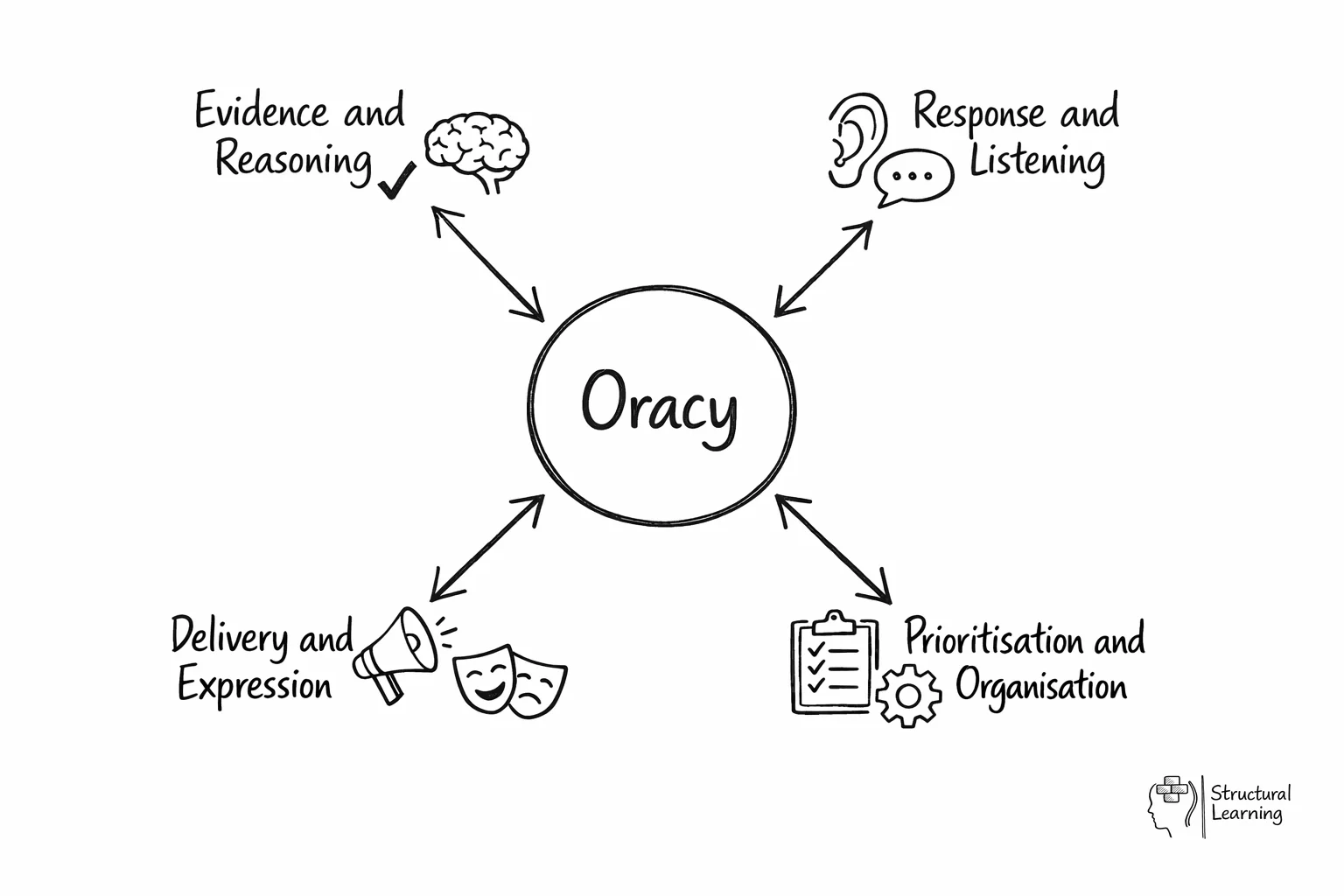
Many studies have discussed the potential role of teachers and schools in building Oracy skills in students. In recent times, online learning has made serious negative impacts on students such as social isolation, and poor communication skills. After opening, the majority of schools can reduce the negative impact of online education through different competitions, programmes and resources based upon 4 key oracy skillsets: evidence and reasoning; response and listening; delivery and expression; and prioritisation and organisation. Schools must teach and develop students' proficiency in these skillsets just like literacy and numeracy through explicit instruction and scaffolding. For further guidance, see our article on Rosenshine's principles of instruction.
The Education Endowment Foundation rates oral language interventions at +6 months additional progress, placing it among the highest-impact strategies in the Teaching and Learning Toolkit (EEF, 2021). The evidence base is strong and the cost is low, yet oracy remains systematically under-taught in most schools. The EEF recommends structured approaches rather than simply "more talk": explicit teaching of discussion skills, modelled use of academic language, and deliberate practice of extended verbal responses. Unstructured talk without scaffolding produces limited gains.
To measure oracy skills schools can use a range of assessment tools. These include observation checklists, self and peer assessment, and structured discussions. Teachers can also use formative assessment techniques, such as think-pair-share, to gauge students' understanding and spea king skills in real-time. By using a variety of assessment methods, teachers can gain a comprehensive understanding of students' oracy skills and identify areas where they need additional support.
Research by Hattie and Timperley (2007) identifies effective feedback as having one of the highest effect sizes in education, while Dylan Wiliam (2011) provides practical frameworks for embedding formative assessment.
Here are some practical strategies that teachers can use to develop oracy in the classroom:
Vygotsky (1978) argued that all higher mental functions originate in social interaction. Thought does not simply find expression in speech; thought is completed in speech. Inner speech, the private verbal thinking we use to plan and self-regulate, develops from external dialogue between child and adult. This means oracy is not a peripheral communication skill but the foundational mechanism through which higher-order thinking develops. When a teacher asks a learner to explain their reasoning aloud, they are not merely checking understanding: they are building the internal dialogue the learner will later use to think independently. Mercer (2000) calls this "interthinking," where collaborative talk creates shared understanding that neither participant could reach alone. For Vygotsky's broader theory, see Vygotsky's theory of cognitive development.
Measuring oracy development requires a different approach to traditional literacy assessment. Unlike written work, spoken language assessment happens in real-time and involves multiple dimensions of communication. Teachers need practical tools that capture both the content and quality of learner contributions without interrupting the flow of discussion.
The most effective oracy assessment combines observation with learner self-reflection. Create simple rubrics that focus on key speaking skills: clarity of explanation, use of subject-specific vocabulary, ability to build on others' ideas, and appropriate register for different audiences. These rubrics work best when learners understand them and can use them for peer assessment during group work.
Digital oracy portfolios offer a powerful way to track progress over time. Using tablets or classroom computers, learners can record short speaking tasks once per half-term. These might include explaining a mathematical concept, presenting a science investigation, or debating a historical perspective. The recordings provide concrete evidence of vocabulary development, sentence complexity, and growing confidence. They also serve as valuable formative assessment tools, allowing learners to listen back and identify areas for improvement.
For younger learners or those with special educational needs, visual progress trackers work particularly well. Create a classroom display showing different oracy skills as stepping stones: from 'I can speak clearly' to 'I can explain my reasoning using because'. Learners move their name along the path as they demonstrate each skill, providing immediate recognition of progress whilst identifying next steps.
Oracy activities must match learners' developmental stages whilst challenging them to extend their verbal reasoning skills. Foundation Stage and Key Stage 1 learners benefit from structured talk partners and role-play scenarios that develop basic conversational skills. Activities like 'Barrier Games', where one learner describes a picture for their partner to recreate, build precise descriptive language whilst maintaining engagement.
As learners move through Key Stage 2, introduce more sophisticated discussion formats. 'Philosophy for Children' sessions work exceptionally well for Years 3 and 4, encouraging learners to explore abstract concepts through structured dialogue. By Years 5 and 6, learners should engage in formal debates, panel discussions, and 'Expert Groups' where they research and teach specific topics to their peers.
Secondary learners require oracy activities that mirror real-world communication demands. Mock interviews, podcast creation, and formal presentations prepare them for future academic and professional contexts. Subject-specific oracy becomes crucial: scientific explanations require different language structures than historical arguments. Teachers should explicitly teach these disciplinary differences, helping learners code-switch between different academic registers.
For EAL learners, structured oracy activities provide essential scaffolding for language acquisition. Unlike written tasks, speaking allows immediate feedback and natural repetition of key vocabulary. Collaborative talk activities reduce anxiety by distributing the communicative load across multiple speakers, allowing EAL learners to participate at their current language level whilst accessing more complex content.
Pre-teaching vocabulary through oracy games significantly improves EAL learners' curriculum access. Activities like 'Word Tennis', where learners rapidly exchange words within a semantic field, build fluency whilst reinforcing subject vocabulary. 'Sentence Builders', where groups collaboratively construct increasingly complex sentences, explicitly teach English syntax through playful exploration rather than formal grammar instruction.
Mixed-ability talk groups particularly benefit EAL learners when structured appropriately. Assign specific roles that match language proficiency: newer English speakers might act as 'vocabulary collectors' or 'question askers', whilst more confident speakers take 'summariser' or 'challenger' roles. This differentiation ensures all learners contribute meaningfully whilst developing their linguistic repertoire through exposure to peer language models.
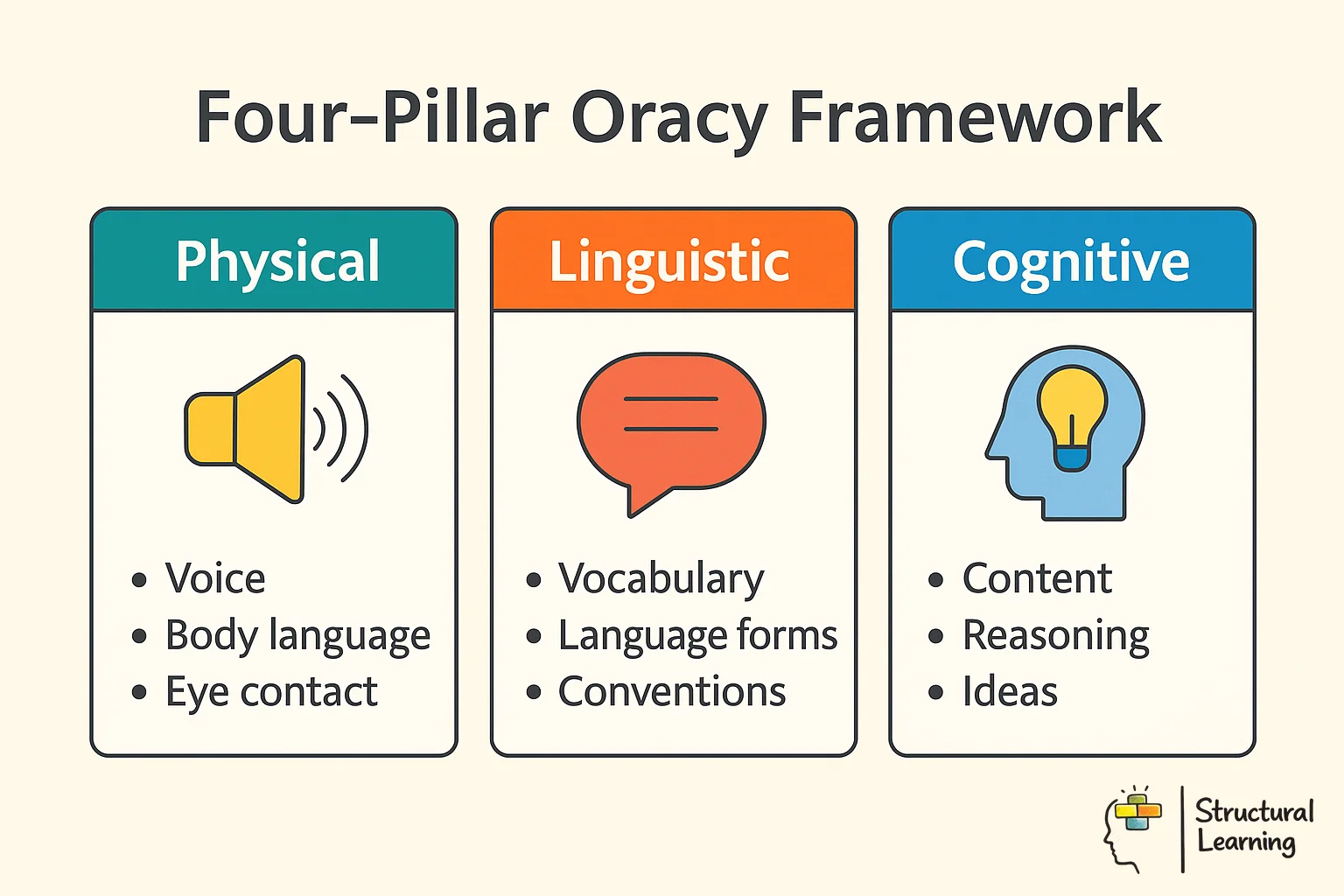
The Voice 21 Oracy Framework, developed in collaboration with Cambridge University, provides teachers with a structured, evidence-based approach to teaching spoken language explicitly. Rather than hoping students will develop communication skills incidentally, the framework breaks oracy down into four distinct, teachable, and assessable strands that map directly to classroom practice. This framework is now the benchmark for oracy instruction across UK schools and underpins the work of hundreds of schools embedding oracy into their curriculum.
Physical Strand: How we use our voice and body
This strand encompasses fluency, pace, tonal variation, clarity of pronunciation, voice projection, body language, and eye contact. In the classroom, the physical strand is where students become aware that how they communicate is as important as what they say. Teachers can establish explicit "Talk Rules" that include physical expectations—for instance, tracking the speaker with your eyes, projecting your voice to the back of the room, and maintaining an open posture during group discussions. Activities like structured debates, formal presentations, or "Traverse Board" discussions provide deliberate opportunities for learners to practise modulating their physical presence and receiving feedback from peers.
Linguistic Strand: The words and structures we use
The linguistic strand focuses on vocabulary choices, register (formal versus informal speech), grammar, rhetorical devices, and how ideas are structured in speech. Many learners, particularly those from disadvantaged backgrounds, have narrower vocabulary for explaining complex ideas aloud. Teachers strengthen this strand by providing "Talk Frames"—sentence stems that scaffold speech (e.g., "Building on what X said, I would argue..." or "The evidence suggests..."). Explicitly teaching Tier 2 and Tier 3 vocabulary and requiring learners to use it in spoken answers before committing it to writing ensures the linguistic strand develops hand-in-hand with literacy development.
Cognitive Strand: The thought processes behind the talk
The cognitive strand addresses the reasoning and critical thinking embedded in speech. It involves choosing appropriate content, structuring arguments, reasoning aloud, summarizing what others have said, seeking clarification, and critically evaluating alternative views. Teachers can develop this strand by using "Think-Pair-Share" strategically to give learners processing time before they speak. Assigning distinct talk roles in group work—such as the Summariser (whose job is to recap what has been said), the Challenger (who asks critical questions), or the Clarifier (who ensures everyone understands)—forces students to engage with the mechanics of dialogue and strengthens their reasoning abilities.
Social & Emotional Strand: How we interact with others
The final strand encompasses active listening, responding to audience cues, turn-taking, confidence in speaking, and respecting alternative viewpoints. This is where oracy overlaps with social-emotional development. Teachers develop this strand by teaching the distinction between listening to reply and listening to understand—a subtle but transformative shift. Using discussion formats like Harkness tables or Socratic seminars, where learners are assessed on how well they draw quieter peers into conversation rather than on how much they speak, cultivates both confidence and inclusivity.
The Voice 21 Oracy Assessment Toolkit, also developed with Cambridge University, moves assessment away from subjective impressions of "good speaking" and provides a robust, task-based system. Teachers use a series of standardized assessment tasks—such as structured group problem-solving activities, formal debates, or paired reasoning exercises—that deliberately elicit oracy skills across all four strands. The toolkit includes progression rubrics that allow teachers to track learner development from Early Years Foundation Stage through to Key Stage 4, identifying specific strengths and areas for growth.
Crucially, the toolkit enables diagnostic assessment rather than just summative grading. A teacher might discover, for example, that a learner has strong Cognitive skills (generating good ideas) but requires support in the Social-Emotional strand (perhaps dominating conversations rather than building on peers' contributions). This diagnostic clarity enables targeted, evidence-based intervention.
Embedding Voice 21 into daily teaching does not require reinventing your curriculum; it requires being intentional about the talk that happens in your classroom. Begin by identifying which strands are most relevant to your lesson objective. If you are teaching a history lesson on Tudor court politics, for instance, the cognitive strand (reasoning about cause and consequence) and the linguistic strand (using subject terminology with precision) might be primary. Plan talk activities that develop these strands: perhaps a structured debate where learners must provide evidence-based reasoning, or a "Fishbowl" discussion where half the class observes the other half and provides feedback on how well they justified their arguments.
Next, be explicit about expectations. Rather than saying "discuss in pairs," say: "In your pair, one person will explain your theory about why Henry VIII broke with Rome, and the other will ask clarifying questions using the sentence stem 'Can you explain what you mean by...?' You will then swap roles." This clarity transforms talk from incidental interaction into deliberate skill-building. Finally, allocate time for reflection. After a discussion activity, ask learners: "Which strand did we focus on today? Which was hardest? What will you do differently next time?" This metacognitive awareness embeds oracy as a taught skill, not a talent some learners are born with.
Research by Alexander (2020) and Mercer, Wegerif and Dawes (1999) demonstrates that when teachers use dialogic approaches and teach learners the ground rules for exploratory talk—where ideas are tested constructively and reasoning is made visible—learners' critical thinking and problem-solving abilities improve significantly across all subjects.
The All-Party Parliamentary Group (APPG) on Oracy has emerged as the primary vehicle driving systemic change in how the UK recognises and prioritises spoken language development. Through its landmark 2021 "Speak for Change" inquiry and subsequent work, the APPG has placed oracy at the centre of national educational policy conversations, with profound implications for schools and teachers.
The APPG's 2021 inquiry revealed a stark reality: oral language skills are one of the strongest predictors of future life chances, yet oracy remains marginalised in UK schools. The inquiry documented a severe "language gap," exacerbated by school closures during the pandemic, where many learners—particularly those from disadvantaged backgrounds—fell further behind in their ability to articulate complex ideas, engage in sustained dialogue, and demonstrate reasoning aloud. Perhaps most concerning, less than half of primary school teachers and only a quarter of secondary school teachers felt confident delivering the spoken language requirements of the National Curriculum. This confidence gap reveals a systemic problem: teachers have not been trained to teach oracy explicitly, and many schools lack the frameworks and resources to do so.
The APPG attributed this gap not to lack of evidence (the research base is robust), but to a crowded curriculum, high-stakes written accountability measures, and the historic perception that oracy is a "nice-to-have" rather than a core skill like reading and numeracy.
The APPG's central recommendation is unequivocal: oracy must be elevated to the same status as literacy and numeracy in the National Curriculum. This is not a call for separate "speech" or "drama" lessons, but for oracy to be integrated into the pedagogy of every subject. In a maths classroom, this means reasoning aloud about problem-solving strategies. In a history lesson, it means structured debate about historical causation. In a science class, it means collaborative discussion to make thinking visible and test hypotheses.
The inquiry also highlighted the urgent need for teacher training. The APPG recommended that Initial Teacher Training (ITT) programmes must include explicit training in how to teach *through* dialogue and teach *for* oracy. The Early Career Framework (ECF) should support new teachers in developing oracy pedagogy as a core competency, not an optional extension. This systemic investment in teacher knowledge is essential to shift classroom practice at scale.
Schools across the UK are already responding to the APPG's momentum. Leading schools have appointed an "Oracy Lead"—often a senior teacher responsible for developing whole-school oracy strategy, training colleagues, and embedding spoken language progression across all key stages. This role reflects recognition that oracy is not the responsibility of English teachers alone, but a whole-school priority.
Schools are also beginning to explicitly map oracy progression alongside literacy and numeracy progression, ensuring that learners develop communication skills systematically. This mapping helps schools prepare for what many believe is inevitable: oracy becoming a more prominent focus in Ofsted inspections and future iterations of the National Curriculum. Schools that have proactively embraced oracy frameworks—particularly Voice 21—are positioned to demonstrate this provision confidently when accountability demands shift.
The APPG's work signals that investment in oracy is not optional or aspirational; it is a policy imperative. For classroom teachers, this means support is increasingly available (through frameworks like Voice 21, training networks, and specialist resources), but it also means expectations are rising. The question facing schools is no longer "Should we teach oracy?" but "How will we teach oracy systematically and hold ourselves accountable for learner progress?"
Oracy refers to the ability to express oneself fluently and grammatically in speech. It involve learning to talk and learning through talk to improve understanding across the school curriculum. In its simplest form, oracy is the verbal equivalent of literacy and numeracy.
Teachers can use structured discussion techniques such as think, pair, share and dialogic teaching to create purposeful talk. Scaffolding tools like sentence stems and assigned discussion roles help learners structure their thoughts and respond to others. Explicit instruction in specific oracy skillsets ensures children know how to reason, listen, and organise their ideas effectively.
Spoken language is the foundational building block for reading and writing. Developing oral proficiency allows children to recognise letter patterns, build a broad vocabulary, and improve reading comprehension. Mastering these skills early provides a base for all future academic success and cognitive development.
Research suggests that high quality classroom talk significantly improves outcomes for all learners. Studies indicate that structured talk helps learners move beyond simple recall toward deeper strategic thinking and better problem solving. Evidence shows that explicit oracy instruction is particularly effective at reducing the communication gap for disadvantaged pupils.
A frequent error is assuming that any classroom talk is the same as oracy. Without structure and explicit instruction, talk can become unproductive or dominated by only a few voices. Teachers should ensure they focus on the cognitive aspects of speaking rather than simply allowing learners to chat without a clear purpose.
Oracy provides a vital bridge for learners with additional needs to access the curriculum without the immediate pressure of writing. It allows them to practise their thoughts verbally and build confidence through structured interactions. Using a clear framework helps these learners participate in deep learning activities and challenge assumptions alongside their peers.
Oracy is a fundamental skill that underpins all areas of learning. By creating a classroom culture that values talk, providing structured opportunities for discussion, and explicitly teaching communication skills, teachers can helps students to become confident and articulate communicators. This, in turn, will have a profound impact on their academic achievement and their ability to participate fully in society.
Investing in oracy is an investment in our students' future. By prioritising the development of spoken language skills, we can equip them with the tools they need to succeed in education, employment, and life. Let's make oracy a cornerstone of our teaching practice and reveal the full potential of every student.
Generate a progressive oracy implementation plan with talk protocols, sentence stems, and assessment checkpoints for your key stage.
Download this free Oracy, Dialogic Teaching & Classroom Dialogue resource pack for your classroom and staff room. Includes printable posters, desk cards, and CPD materials.
4 evidence-informed resources to boost student voice and purposeful discussion in your classroom.
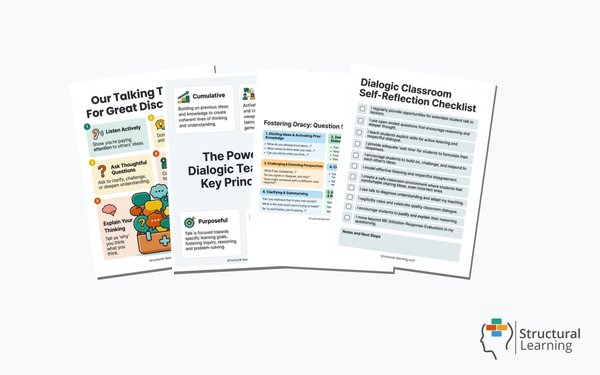
Fill in your details below and we'll send the resource pack straight to your inbox.
We've also sent a copy to your email. Check your inbox.
Philosophy for Children, developed by Matthew Lipman in the 1970s, uses philosophical enquiry to develop reasoning through structured dialogue. In a P4C session, learners sit in a circle, share a stimulus such as a picture book, news story, or unusual object, then generate philosophical questions. The class votes on the most interesting question and discusses it using stems like "I agree with X because..." and "I want to challenge that because..." The EEF trial of P4C showed +2 months additional progress in reading and maths, with larger gains for disadvantaged pupils. P4C works because it requires learners to listen, build on others' ideas, and justify their reasoning, all transferable oracy skills. For critical thinking strategies, see our guide to critical thinking.
Jonathan Neelands' dramatic conventions framework provides structured approaches to learning through drama that develop spoken language in context. Techniques like hot-seating (learners answer questions in character), conscience alley (classmates voice arguments for and against a character's decision), and freeze-frame (groups create a still image of a key moment) all require purposeful, extended speech. Drama is oracy with stakes: learners rehearse register, persuasion, and narrative voice through role, which transfers directly to writing and formal speaking. A Year 5 class studying the Tudors might hot-seat Henry VIII, requiring learners to ask historically informed questions and the "king" to justify decisions using period-appropriate reasoning.
Here, we explore ways of developing a strong culture of language use in the classroom. The importance of oracy in language development cannot be emphasised enough. Discussion is central to all aspects of the curriculum including areas such as grammar development. If the conditions are set up correctly with the right sort of tools, children can have purposeful discussions about the possibilities, effects and meaning of the curriculum through active questioning.
For a comprehensive exploration of this approach in practice, see our talk-based learning strategies guide.
Oracy can be described as learning to talk and learning through talk. This article focuses on the latter, we are particularly interested in how using active discussions can form the foundation for learners understanding of curriculum content.
Enabling children to understand the different types of discussion roles available to them broadens their repertoire of classroom dialogue. Structured discussion techniques and dialogic teaching provide clear frameworks for these interactions. As well as being a tool of commun ication, effective oracy skills enable learners to participate in deep learning activities where they can exchange ideas, engage in exploratory talk, and challenge assumptions.
This area of pedagogy has particular significance for disadvantaged or low-attaining learners, especially those with sen. Withbelow and the rest of the website you will find examples of how classroom talk can be used for knowledge acquisition and the development of spoken language development skills. Oracy is the art of speaking eloquently and persuasively. When someone speaks in a persuasive manner, they try to convince others of their point of view. While this type of communication is common in everyday life, it's also a fundamental part of the curriculum.
Speaking is one of the most basic skills that humans possess. We learn to talk early in life, and our ability to communicate continues to develop throughout adulthood. Regardless of whether someone speaks fluently or struggles to express themselves, learning to speak is the foundational building block of literacy. Learning to read and write is much easier when you understand the basics of spoken communication.
For example, knowing how to pronounce certain letters and sounds allows children to recognise letter patterns and build vocabulary. When kids grow into adults, they continue to rely on their knowledge of pronunciation to decode written text. It's no surprise then that mastering the art of speech is a critical part of developing literacy. People who lack proficiency in speaking tend to fall behind academically, especially with reading comprehension. Organisations such as Voice 21 I've been promoting effective oracy skills acr oss schools in the UK, it is clear that providing children with the tool of communication sets them up for a lifetime of success.
Oracy is to communicate what literacy is to reading and writing; and numeracy to mathematics. The term 'oracy' was first used by Andrew Wilkinsonin the 1960s. Andrew believed that oracy, one's ability to express themself with fluency in speech, must get equal status to math performance and literacy in school curriculums.
Andrew Wilkinson coined the term "oracy" in 1965 at the University of Birmingham, defining it as "the ability to express oneself coherently and to communicate freely with others by word of mouth." He argued that oracy was as fundamental as literacy and numeracy, describing it as "the forgotten R." Wilkinson's advocacy led to the National Oracy Project (1987-1993), which demonstrated that structured talk improved attainment across all subjects. His foundational insight remains: schools that treat spoken language as a skill to be explicitly taught, rather than something learners simply pick up, see measurable gains in both oracy and literacy.
In its simplest form, oracy is to be able to express oneself well. It relates to having a broad range of vocabulary to say what one needs to say and the proficiency to structure thoughts so that the person makes sense to others.
More recently, oracy has become even more important. This is because, education in schools is predominantly provided in English (in the UK), but many children lack spoken communication skills because they speak another language at home. Once schools begun reopening after the initial pandemic lockdown, many educators reported a dip in oracy skills particularly in children from disadvantaged backgrounds.
Many studies have discussed the potential role of teachers and schools in building Oracy skills in students. In recent times, online learning has made serious negative impacts on students such as social isolation, and poor communication skills. After opening, the majority of schools can reduce the negative impact of online education through different competitions, programmes and resources based upon 4 key oracy skillsets: evidence and reasoning; response and listening; delivery and expression; and prioritisation and organisation. Schools must teach and develop students' proficiency in these skillsets just like literacy and numeracy through explicit instruction and scaffolding. For further guidance, see our article on Rosenshine's principles of instruction.
The Education Endowment Foundation rates oral language interventions at +6 months additional progress, placing it among the highest-impact strategies in the Teaching and Learning Toolkit (EEF, 2021). The evidence base is strong and the cost is low, yet oracy remains systematically under-taught in most schools. The EEF recommends structured approaches rather than simply "more talk": explicit teaching of discussion skills, modelled use of academic language, and deliberate practice of extended verbal responses. Unstructured talk without scaffolding produces limited gains.
To measure oracy skills schools can use a range of assessment tools. These include observation checklists, self and peer assessment, and structured discussions. Teachers can also use formative assessment techniques, such as think-pair-share, to gauge students' understanding and spea king skills in real-time. By using a variety of assessment methods, teachers can gain a comprehensive understanding of students' oracy skills and identify areas where they need additional support.
Research by Hattie and Timperley (2007) identifies effective feedback as having one of the highest effect sizes in education, while Dylan Wiliam (2011) provides practical frameworks for embedding formative assessment.
Here are some practical strategies that teachers can use to develop oracy in the classroom:
Vygotsky (1978) argued that all higher mental functions originate in social interaction. Thought does not simply find expression in speech; thought is completed in speech. Inner speech, the private verbal thinking we use to plan and self-regulate, develops from external dialogue between child and adult. This means oracy is not a peripheral communication skill but the foundational mechanism through which higher-order thinking develops. When a teacher asks a learner to explain their reasoning aloud, they are not merely checking understanding: they are building the internal dialogue the learner will later use to think independently. Mercer (2000) calls this "interthinking," where collaborative talk creates shared understanding that neither participant could reach alone. For Vygotsky's broader theory, see Vygotsky's theory of cognitive development.
Measuring oracy development requires a different approach to traditional literacy assessment. Unlike written work, spoken language assessment happens in real-time and involves multiple dimensions of communication. Teachers need practical tools that capture both the content and quality of learner contributions without interrupting the flow of discussion.
The most effective oracy assessment combines observation with learner self-reflection. Create simple rubrics that focus on key speaking skills: clarity of explanation, use of subject-specific vocabulary, ability to build on others' ideas, and appropriate register for different audiences. These rubrics work best when learners understand them and can use them for peer assessment during group work.
Digital oracy portfolios offer a powerful way to track progress over time. Using tablets or classroom computers, learners can record short speaking tasks once per half-term. These might include explaining a mathematical concept, presenting a science investigation, or debating a historical perspective. The recordings provide concrete evidence of vocabulary development, sentence complexity, and growing confidence. They also serve as valuable formative assessment tools, allowing learners to listen back and identify areas for improvement.
For younger learners or those with special educational needs, visual progress trackers work particularly well. Create a classroom display showing different oracy skills as stepping stones: from 'I can speak clearly' to 'I can explain my reasoning using because'. Learners move their name along the path as they demonstrate each skill, providing immediate recognition of progress whilst identifying next steps.
Oracy activities must match learners' developmental stages whilst challenging them to extend their verbal reasoning skills. Foundation Stage and Key Stage 1 learners benefit from structured talk partners and role-play scenarios that develop basic conversational skills. Activities like 'Barrier Games', where one learner describes a picture for their partner to recreate, build precise descriptive language whilst maintaining engagement.
As learners move through Key Stage 2, introduce more sophisticated discussion formats. 'Philosophy for Children' sessions work exceptionally well for Years 3 and 4, encouraging learners to explore abstract concepts through structured dialogue. By Years 5 and 6, learners should engage in formal debates, panel discussions, and 'Expert Groups' where they research and teach specific topics to their peers.
Secondary learners require oracy activities that mirror real-world communication demands. Mock interviews, podcast creation, and formal presentations prepare them for future academic and professional contexts. Subject-specific oracy becomes crucial: scientific explanations require different language structures than historical arguments. Teachers should explicitly teach these disciplinary differences, helping learners code-switch between different academic registers.
For EAL learners, structured oracy activities provide essential scaffolding for language acquisition. Unlike written tasks, speaking allows immediate feedback and natural repetition of key vocabulary. Collaborative talk activities reduce anxiety by distributing the communicative load across multiple speakers, allowing EAL learners to participate at their current language level whilst accessing more complex content.
Pre-teaching vocabulary through oracy games significantly improves EAL learners' curriculum access. Activities like 'Word Tennis', where learners rapidly exchange words within a semantic field, build fluency whilst reinforcing subject vocabulary. 'Sentence Builders', where groups collaboratively construct increasingly complex sentences, explicitly teach English syntax through playful exploration rather than formal grammar instruction.
Mixed-ability talk groups particularly benefit EAL learners when structured appropriately. Assign specific roles that match language proficiency: newer English speakers might act as 'vocabulary collectors' or 'question askers', whilst more confident speakers take 'summariser' or 'challenger' roles. This differentiation ensures all learners contribute meaningfully whilst developing their linguistic repertoire through exposure to peer language models.
The Voice 21 Oracy Framework, developed in collaboration with Cambridge University, provides teachers with a structured, evidence-based approach to teaching spoken language explicitly. Rather than hoping students will develop communication skills incidentally, the framework breaks oracy down into four distinct, teachable, and assessable strands that map directly to classroom practice. This framework is now the benchmark for oracy instruction across UK schools and underpins the work of hundreds of schools embedding oracy into their curriculum.
Physical Strand: How we use our voice and body
This strand encompasses fluency, pace, tonal variation, clarity of pronunciation, voice projection, body language, and eye contact. In the classroom, the physical strand is where students become aware that how they communicate is as important as what they say. Teachers can establish explicit "Talk Rules" that include physical expectations—for instance, tracking the speaker with your eyes, projecting your voice to the back of the room, and maintaining an open posture during group discussions. Activities like structured debates, formal presentations, or "Traverse Board" discussions provide deliberate opportunities for learners to practise modulating their physical presence and receiving feedback from peers.
Linguistic Strand: The words and structures we use
The linguistic strand focuses on vocabulary choices, register (formal versus informal speech), grammar, rhetorical devices, and how ideas are structured in speech. Many learners, particularly those from disadvantaged backgrounds, have narrower vocabulary for explaining complex ideas aloud. Teachers strengthen this strand by providing "Talk Frames"—sentence stems that scaffold speech (e.g., "Building on what X said, I would argue..." or "The evidence suggests..."). Explicitly teaching Tier 2 and Tier 3 vocabulary and requiring learners to use it in spoken answers before committing it to writing ensures the linguistic strand develops hand-in-hand with literacy development.
Cognitive Strand: The thought processes behind the talk
The cognitive strand addresses the reasoning and critical thinking embedded in speech. It involves choosing appropriate content, structuring arguments, reasoning aloud, summarizing what others have said, seeking clarification, and critically evaluating alternative views. Teachers can develop this strand by using "Think-Pair-Share" strategically to give learners processing time before they speak. Assigning distinct talk roles in group work—such as the Summariser (whose job is to recap what has been said), the Challenger (who asks critical questions), or the Clarifier (who ensures everyone understands)—forces students to engage with the mechanics of dialogue and strengthens their reasoning abilities.
Social & Emotional Strand: How we interact with others
The final strand encompasses active listening, responding to audience cues, turn-taking, confidence in speaking, and respecting alternative viewpoints. This is where oracy overlaps with social-emotional development. Teachers develop this strand by teaching the distinction between listening to reply and listening to understand—a subtle but transformative shift. Using discussion formats like Harkness tables or Socratic seminars, where learners are assessed on how well they draw quieter peers into conversation rather than on how much they speak, cultivates both confidence and inclusivity.
The Voice 21 Oracy Assessment Toolkit, also developed with Cambridge University, moves assessment away from subjective impressions of "good speaking" and provides a robust, task-based system. Teachers use a series of standardized assessment tasks—such as structured group problem-solving activities, formal debates, or paired reasoning exercises—that deliberately elicit oracy skills across all four strands. The toolkit includes progression rubrics that allow teachers to track learner development from Early Years Foundation Stage through to Key Stage 4, identifying specific strengths and areas for growth.
Crucially, the toolkit enables diagnostic assessment rather than just summative grading. A teacher might discover, for example, that a learner has strong Cognitive skills (generating good ideas) but requires support in the Social-Emotional strand (perhaps dominating conversations rather than building on peers' contributions). This diagnostic clarity enables targeted, evidence-based intervention.
Embedding Voice 21 into daily teaching does not require reinventing your curriculum; it requires being intentional about the talk that happens in your classroom. Begin by identifying which strands are most relevant to your lesson objective. If you are teaching a history lesson on Tudor court politics, for instance, the cognitive strand (reasoning about cause and consequence) and the linguistic strand (using subject terminology with precision) might be primary. Plan talk activities that develop these strands: perhaps a structured debate where learners must provide evidence-based reasoning, or a "Fishbowl" discussion where half the class observes the other half and provides feedback on how well they justified their arguments.
Next, be explicit about expectations. Rather than saying "discuss in pairs," say: "In your pair, one person will explain your theory about why Henry VIII broke with Rome, and the other will ask clarifying questions using the sentence stem 'Can you explain what you mean by...?' You will then swap roles." This clarity transforms talk from incidental interaction into deliberate skill-building. Finally, allocate time for reflection. After a discussion activity, ask learners: "Which strand did we focus on today? Which was hardest? What will you do differently next time?" This metacognitive awareness embeds oracy as a taught skill, not a talent some learners are born with.
Research by Alexander (2020) and Mercer, Wegerif and Dawes (1999) demonstrates that when teachers use dialogic approaches and teach learners the ground rules for exploratory talk—where ideas are tested constructively and reasoning is made visible—learners' critical thinking and problem-solving abilities improve significantly across all subjects.
The All-Party Parliamentary Group (APPG) on Oracy has emerged as the primary vehicle driving systemic change in how the UK recognises and prioritises spoken language development. Through its landmark 2021 "Speak for Change" inquiry and subsequent work, the APPG has placed oracy at the centre of national educational policy conversations, with profound implications for schools and teachers.
The APPG's 2021 inquiry revealed a stark reality: oral language skills are one of the strongest predictors of future life chances, yet oracy remains marginalised in UK schools. The inquiry documented a severe "language gap," exacerbated by school closures during the pandemic, where many learners—particularly those from disadvantaged backgrounds—fell further behind in their ability to articulate complex ideas, engage in sustained dialogue, and demonstrate reasoning aloud. Perhaps most concerning, less than half of primary school teachers and only a quarter of secondary school teachers felt confident delivering the spoken language requirements of the National Curriculum. This confidence gap reveals a systemic problem: teachers have not been trained to teach oracy explicitly, and many schools lack the frameworks and resources to do so.
The APPG attributed this gap not to lack of evidence (the research base is robust), but to a crowded curriculum, high-stakes written accountability measures, and the historic perception that oracy is a "nice-to-have" rather than a core skill like reading and numeracy.
The APPG's central recommendation is unequivocal: oracy must be elevated to the same status as literacy and numeracy in the National Curriculum. This is not a call for separate "speech" or "drama" lessons, but for oracy to be integrated into the pedagogy of every subject. In a maths classroom, this means reasoning aloud about problem-solving strategies. In a history lesson, it means structured debate about historical causation. In a science class, it means collaborative discussion to make thinking visible and test hypotheses.
The inquiry also highlighted the urgent need for teacher training. The APPG recommended that Initial Teacher Training (ITT) programmes must include explicit training in how to teach *through* dialogue and teach *for* oracy. The Early Career Framework (ECF) should support new teachers in developing oracy pedagogy as a core competency, not an optional extension. This systemic investment in teacher knowledge is essential to shift classroom practice at scale.
Schools across the UK are already responding to the APPG's momentum. Leading schools have appointed an "Oracy Lead"—often a senior teacher responsible for developing whole-school oracy strategy, training colleagues, and embedding spoken language progression across all key stages. This role reflects recognition that oracy is not the responsibility of English teachers alone, but a whole-school priority.
Schools are also beginning to explicitly map oracy progression alongside literacy and numeracy progression, ensuring that learners develop communication skills systematically. This mapping helps schools prepare for what many believe is inevitable: oracy becoming a more prominent focus in Ofsted inspections and future iterations of the National Curriculum. Schools that have proactively embraced oracy frameworks—particularly Voice 21—are positioned to demonstrate this provision confidently when accountability demands shift.
The APPG's work signals that investment in oracy is not optional or aspirational; it is a policy imperative. For classroom teachers, this means support is increasingly available (through frameworks like Voice 21, training networks, and specialist resources), but it also means expectations are rising. The question facing schools is no longer "Should we teach oracy?" but "How will we teach oracy systematically and hold ourselves accountable for learner progress?"
Oracy refers to the ability to express oneself fluently and grammatically in speech. It involve learning to talk and learning through talk to improve understanding across the school curriculum. In its simplest form, oracy is the verbal equivalent of literacy and numeracy.
Teachers can use structured discussion techniques such as think, pair, share and dialogic teaching to create purposeful talk. Scaffolding tools like sentence stems and assigned discussion roles help learners structure their thoughts and respond to others. Explicit instruction in specific oracy skillsets ensures children know how to reason, listen, and organise their ideas effectively.
Spoken language is the foundational building block for reading and writing. Developing oral proficiency allows children to recognise letter patterns, build a broad vocabulary, and improve reading comprehension. Mastering these skills early provides a base for all future academic success and cognitive development.
Research suggests that high quality classroom talk significantly improves outcomes for all learners. Studies indicate that structured talk helps learners move beyond simple recall toward deeper strategic thinking and better problem solving. Evidence shows that explicit oracy instruction is particularly effective at reducing the communication gap for disadvantaged pupils.
A frequent error is assuming that any classroom talk is the same as oracy. Without structure and explicit instruction, talk can become unproductive or dominated by only a few voices. Teachers should ensure they focus on the cognitive aspects of speaking rather than simply allowing learners to chat without a clear purpose.
Oracy provides a vital bridge for learners with additional needs to access the curriculum without the immediate pressure of writing. It allows them to practise their thoughts verbally and build confidence through structured interactions. Using a clear framework helps these learners participate in deep learning activities and challenge assumptions alongside their peers.
Oracy is a fundamental skill that underpins all areas of learning. By creating a classroom culture that values talk, providing structured opportunities for discussion, and explicitly teaching communication skills, teachers can helps students to become confident and articulate communicators. This, in turn, will have a profound impact on their academic achievement and their ability to participate fully in society.
Investing in oracy is an investment in our students' future. By prioritising the development of spoken language skills, we can equip them with the tools they need to succeed in education, employment, and life. Let's make oracy a cornerstone of our teaching practice and reveal the full potential of every student.
Generate a progressive oracy implementation plan with talk protocols, sentence stems, and assessment checkpoints for your key stage.
Download this free Oracy, Dialogic Teaching & Classroom Dialogue resource pack for your classroom and staff room. Includes printable posters, desk cards, and CPD materials.
4 evidence-informed resources to boost student voice and purposeful discussion in your classroom.
Fill in your details below and we'll send the resource pack straight to your inbox.
We've also sent a copy to your email. Check your inbox.
Philosophy for Children, developed by Matthew Lipman in the 1970s, uses philosophical enquiry to develop reasoning through structured dialogue. In a P4C session, learners sit in a circle, share a stimulus such as a picture book, news story, or unusual object, then generate philosophical questions. The class votes on the most interesting question and discusses it using stems like "I agree with X because..." and "I want to challenge that because..." The EEF trial of P4C showed +2 months additional progress in reading and maths, with larger gains for disadvantaged pupils. P4C works because it requires learners to listen, build on others' ideas, and justify their reasoning, all transferable oracy skills. For critical thinking strategies, see our guide to critical thinking.
Jonathan Neelands' dramatic conventions framework provides structured approaches to learning through drama that develop spoken language in context. Techniques like hot-seating (learners answer questions in character), conscience alley (classmates voice arguments for and against a character's decision), and freeze-frame (groups create a still image of a key moment) all require purposeful, extended speech. Drama is oracy with stakes: learners rehearse register, persuasion, and narrative voice through role, which transfers directly to writing and formal speaking. A Year 5 class studying the Tudors might hot-seat Henry VIII, requiring learners to ask historically informed questions and the "king" to justify decisions using period-appropriate reasoning.
{"@context":"https://schema.org","@graph":[{"@type":"Article","@id":"https://www.structural-learning.com/post/the-importance-of-oracy-in-language-development#article","headline":"Oracy in the classroom: a teacher's guide","description":"Discover the vital role of oracy in language development and how enhancing speaking skills in the classroom can boost students' learning and confidence.","datePublished":"2021-05-13T12:20:42.228Z","dateModified":"2026-02-24T13:16:40.613Z","author":{"@type":"Person","name":"Paul Main","url":"https://www.structural-learning.com/team/paulmain","jobTitle":"Founder & Educational Consultant"},"publisher":{"@type":"Organization","name":"Structural Learning","url":"https://www.structural-learning.com","logo":{"@type":"ImageObject","url":"https://cdn.prod.website-files.com/5b69a01ba2e409e5d5e055c6/6040bf0426cb415ba2fc7882_newlogoblue.svg"}},"mainEntityOfPage":{"@type":"WebPage","@id":"https://www.structural-learning.com/post/the-importance-of-oracy-in-language-development"},"image":"https://cdn.prod.website-files.com/5b69a01ba2e409501de055d1/696a306c1e83a6b21be76a4a_696a306a55f8914d2783ecce_the-importance-of-oracy-in-language-development-infographic.webp","wordCount":5558},{"@type":"BreadcrumbList","@id":"https://www.structural-learning.com/post/the-importance-of-oracy-in-language-development#breadcrumb","itemListElement":[{"@type":"ListItem","position":1,"name":"Home","item":"https://www.structural-learning.com/"},{"@type":"ListItem","position":2,"name":"Blog","item":"https://www.structural-learning.com/blog"},{"@type":"ListItem","position":3,"name":"Oracy in the classroom: a teacher's guide","item":"https://www.structural-learning.com/post/the-importance-of-oracy-in-language-development"}]}]}