Updated on
September 24, 2026
Metacognition in Mathematics: Strategies for Teachers
Metacognition in maths: the IMPROVE framework and targeted strategies for mathematical thinking, with worked examples for primary and secondary.

Updated on
September 24, 2026
Metacognition in maths: the IMPROVE framework and targeted strategies for mathematical thinking, with worked examples for primary and secondary.
Metacognition in mathematics means a learner choosing a method on purpose, watching each step, and testing the answer against the question. Learners often know a procedure but not when to use it; think-alouds, error analysis, the IMPROVE questions and self-explained worked examples teach that choice.
Metacognition in mathematics is the habit of learners directing their own mathematical thinking: planning a method, monitoring each step, and checking whether the result fits the problem (Flavell, 1979). It matters because errors often come from weak choices, not weak effort. A teacher makes this visible by asking learners to state what they know, choose a representation, justify a method, and write what changed when a strategy failed.
Learners then produce more than an answer; they show a trace of decision-making, such as a labelled diagram, a rejected method, a check using inverse operations, or a sentence explaining why an estimate is reasonable. Over time, this builds a classroom culture where reasoning, error analysis, worked examples, think-aloud modelling, and explicit strategy instruction become part of normal mathematical work.
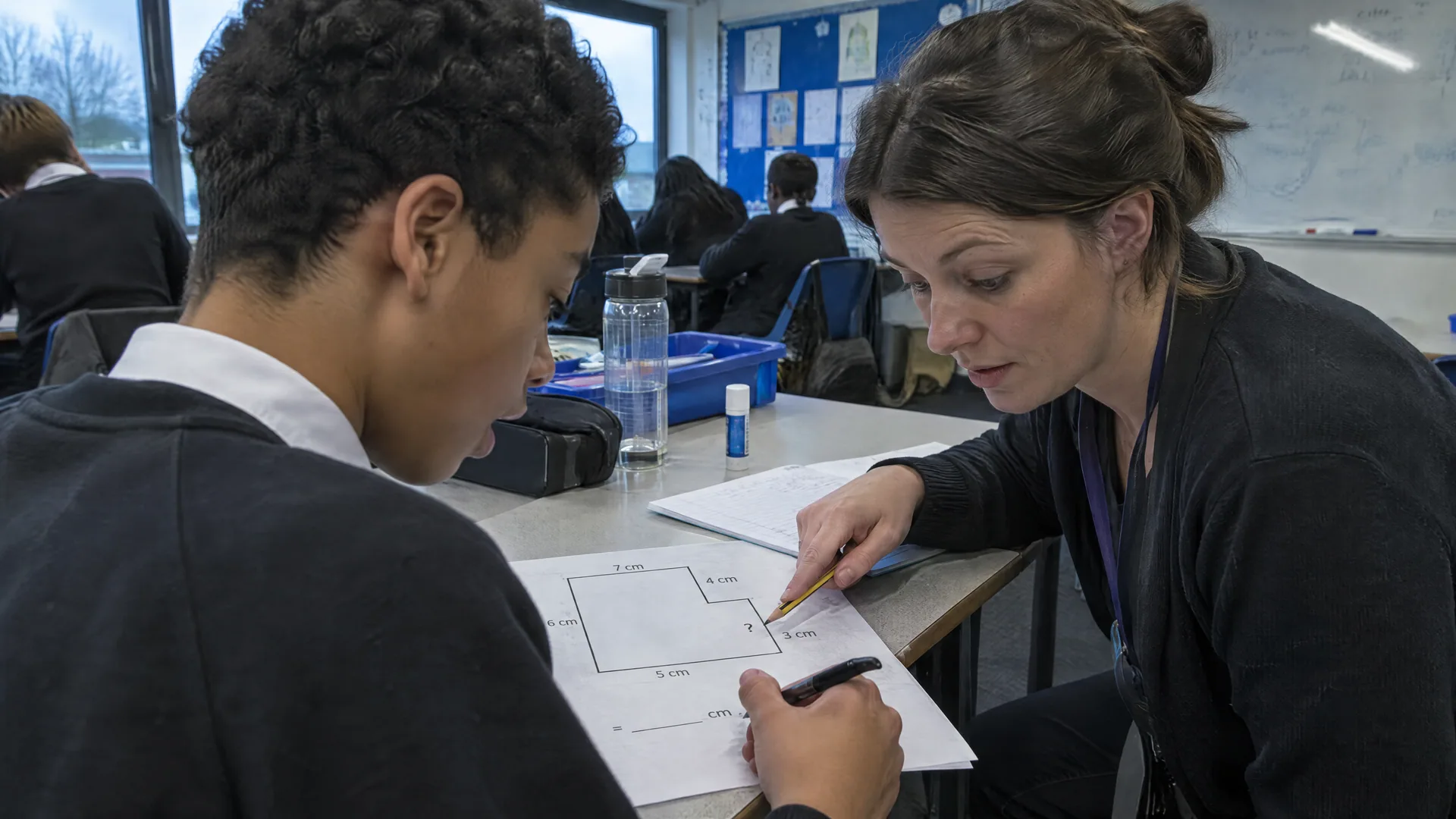
Metacognition in mathematics means teaching learners to plan a route through a problem. They keep an eye on whether the strategy is working, and check whether the answer makes sense. For the general definition, see what metacognition is and how it differs from cognition.
In practice, this might mean a learner pausing before they calculate. It might mean choosing how to show the problem, explaining why a method fits, or switching strategy when the first one fails. The thinking is mathematical: number sense, reasoning, representation and proof.
This matters because many learners know a procedure but not when to use it. Strong routines for thinking help them move from following rules to choosing a method on purpose. That matters most when a question is new or confidence drops.
Learners often memorise maths procedures, then practise and repeat them. They show success through correct answers. However, research (e.g. Hiebert & Lefevre, 1986; Baroody, 2003) suggests procedures alone don't build maths skills.
The problem shows itself when learners meet a question they have not seen before. For more on this, see Developing learner metacognition. Without this awareness, learners often reach for the last method they were taught, whether or not it fits. They cannot tell when an approach is failing, or when they have misread the question.
Learners must know their strengths and weaknesses. They also need to plan: choose methods and consider options (Schoenfeld, 1985). Finally, learners must check work and change tactics as needed (Flavell, 1979).
Schoenfeld (1985) found that expert mathematicians plan with care, while novices start calculating at once. Teaching learners to think about their thinking closes this gap. It helps them work more like experts.
Research by Veenman, Van Hout-Wolters, & Afflerbach (2006) showed that thinking aloud helps maths learners. Teachers model their thinking so that solving a problem is clear to learners. Learners then see what to do, like skilled mathematicians (Schoenfeld, 1985).

A good think-aloud includes moments of doubt. Don't present a polished solution; show the messy reality of solving a problem. "I'm not sure how to start this. Let me read it again and work out what I've been given and what I need to find."
Model the metacognitive questions that guide problem-solving: "What type of problem is this? What strategies have worked for similar problems? Does my answer seem reasonable? How can I check this?"
After the modelling, learners practise think-alouds in pairs. One learner solves a problem and says their thoughts out loud. The other listens, notes the strategies, and asks questions to make things clear. This builds the language of thinking. It also shows that maths means asking yourself questions all the time (Veenman et al., 2006).
Recording a think-aloud lets learners go back over their thinking. Some teachers use audio recordings that learners write out and annotate. Learners then mark the moments where they made a good choice, or where a quick check would have caught an error.
A judgment of learning (JOL) is a learner's guess at how well they will remember something in a future test. Nelson and Narens (1990) found that a delayed JOL, made after a short gap rather than straight away, is far more accurate. It also helps learners put their revision effort in the right place.
Borasi (1994) and others argue that errors show how a learner is thinking. Working through errors builds the habit of self-checking, as Nesher (1987) argued. Those habits help learners avoid the same mistakes later, according to Black et al. (2003).
Error analysis helps learners, researchers found. Conceptual errors mean the idea was not grasped (Cox, 1975). Procedural errors mean the sums went wrong (Ashlock, 2002).
Strategic errors mean the wrong method was picked (Schoenfeld, 1985). Reading errors mean the question was misread (Newman, 1977). Each type needs its own support, they noted.
Use "error journals" where learners record mistakes and work out what went wrong. They also explain how they would tackle a similar problem next time. The act of writing forces metacognitive reflection that a mental run-through often misses.
Use "favourite mistakes" as a classroom routine. Select interesting errors (without identifying learners) and discuss them as a class. "This learner wrote that 3/4 + 1/2 = 4/6. What might they have been thinking? How could they have caught this error?"
Learners come to see mistakes as chances to learn, not as personal failings (Bandura, 1977). Error analysis becomes useful to the learner (Hattie & Timperley, 2007).
Mevarech and Kramarski's IMPROVE (1997) is a way to teach maths through metacognition. The letters stand for its steps: Introducing concepts, Metacognitive questions, Practising skills and Reviewing work. Learners then obtain mastery, verify their solutions and extend what they understand.
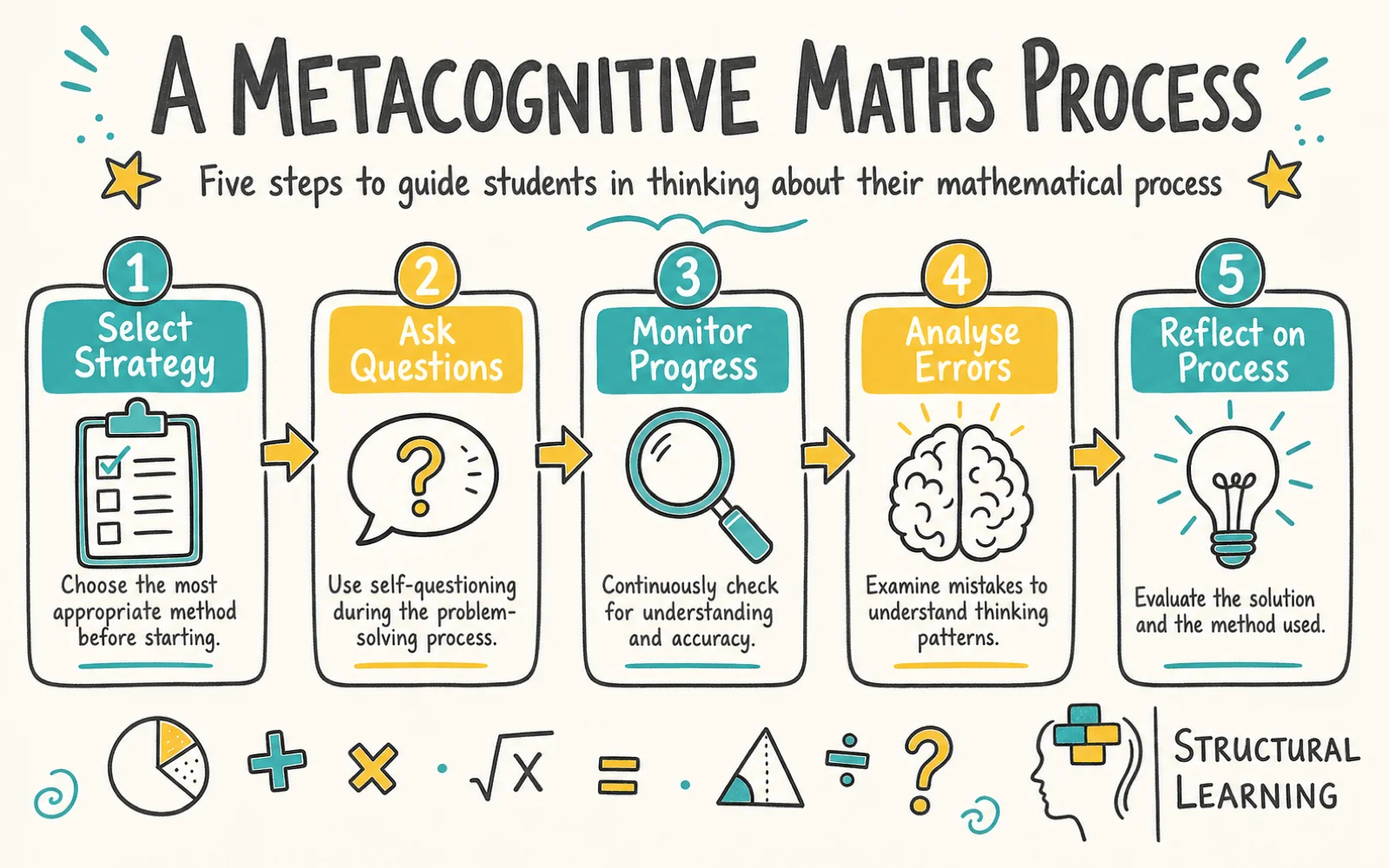
| Strategy | Description | When to Use | Example Prompt |
|---|---|---|---|
| Self-Questioning | Ask questions while solving | During problem-solving | "What do I know? What do I need?" |
| Error Analysis | Examine and learn from mistakes | After completing work | "Why did I make this error?" |
| Strategy Selection | Choose appropriate methods | Before starting | "What approach works best here?" |
| Progress Monitoring | Check understanding continuously | Throughout task | "Is this making sense?" |
| Reflection | Evaluate solution process | After completion | "What would I do differently?" |
The metacognitive questions are the heart of IMPROVE. Learners learn to ask themselves four kinds of question:
Comprehension questions: What is this problem actually asking? What information do I have? What am I trying to find? Connection questions: How is this similar to problems I have solved before? What mathematical concepts or procedures might be relevant? Strategic questions: What strategies could I use? Why would this strategy be appropriate? What steps should I follow? Reflection questions: Does my solution make sense? How can I verify my answer? Is there a more efficient approach?IMPROVE comes from Mevarech and Kramarski's research on teaching maths through metacognition. Their 1997 study in American Educational Research Journal tested the method with seventh-grade maths classes. Those classes made gains against comparison groups.
Research by Chi et al. (1989) shows learners gain from explaining worked examples to themselves. Self-explanation, as Atkinson et al. (2000) found, keeps them active. Learners should not just read a solution and move on.
Self-explanation means learners say why each step in a solution works. "This step multiplies by 2 because we need a common denominator. That is allowed because we are multiplying by 2/2, which equals 1."
Encourage learners to explain examples to themselves, to a partner, or in writing. Prompt them with questions: "What is the goal of this step? Where does this number come from? Why is this operation valid?"
Give learners partly worked examples. They fill in the missing steps and explain their reasoning. This pairs the benefits of worked examples with active problem-solving.
Training learners to explain their own working helps in maths. Explaining an idea makes it stick and shows up any gaps. It also builds problem-solving skills.
Eight routines teachers described on social media.
| Routine, as teachers describe it | What you would notice | What the evidence says |
|---|---|---|
| Short board check, then independent work Set four or five minutes of independent work. Do one mini-whiteboard check before answers or a progress discussion. Keep the check shorter than two minutes.
|
A clock on the independent burst. Boards up once, then books. UK secondary maths. The same thread argues that a board up is not understanding. | EEF guidance (2nd ed., 13 Nov 2025): teach learners to plan, monitor and evaluate in the subject. The replies in this thread disagree about whether the check is real. |
| Graph-paper wallets as mini whiteboards Put a graph insert in a plastic wallet. Every learner draws on the same axes. Scan the wallets in initial teaching and in a check.
|
The same grid in every hand. Working, not a single boxed answer. | A standardised format shows the method, which a single number on a board does not. That is a teacher report, not a trial. EEF recommendation 2 is explicit strategy teaching in the subject, not a mandate to hold boards up. |
| Boards up as a magical check objection Treat a whole-class board-up of an answer as proof that 30 learners understand.
|
Answers on boards, copying easier than thinking, and a lead practitioner circulating over books instead. UK secondary maths. | A held-up answer is performance in the moment. Chi, Bassok, Lewis, Reimann and Glaser (1989) found that learners who monitored their own misunderstanding while studying examples later needed the examples less. A board-up of a final number does not show that monitoring. |
| Faded examples stay in the schema Keep faded examples as scaffolding even when a new paper arrives. Hand over one step at a time, do not bin the worked example.
@MathsWithMsB |
A full example, then a greyed step, then a blank. UK classroom teacher, not a vendor worksheet. | Atkinson, Renkl and Merrill (2003): fading worked steps plus self-explanation prompts beat fading alone on near and far transfer. Renkl and Atkinson (2003): backward fading beat example-problem pairs on near transfer. If the example stays a permanent crutch, the fade did not happen (@ninja_maths, outside the UK). |
| Hints versus prompts on a fade On a backward-fade sequence, mark struck-through steps as hints and questions as prompts, so the prompt is what makes the learner explain the missing step.
|
A CPD board with hints and prompts labelled. Deputy head, primary maths, sharing with colleagues. | EEF 2025 recommendation 5: least help first (prompt, clue, then model). Chi et al. (1989): self-explanations while studying examples are the monitoring. The board is one teacher's account of Dave Taylor's TDaPE session, not a trial of that board. |
| Step-and-check (US) Learners complete one operation. Boards go up. The teacher scans and reteaches before the next step. Errors are caught before they compound.
|
Boards up mid-problem, not at the answer. US fifth grade. | This is the method-right, answer-wrong catch, labelled United States. Chi et al. (1989): accurate monitoring of misunderstanding is what separated the learners who later solved without the example. Not a UK classroom diary. |
| Pair find-the-error (US) After a test, pair one learner who got the item right with one who did not. They decide who is right and name the mistake.
|
A named item, two papers, a conversation about the error. US junior high, Room 109. | Mevarech and Kramarski (1997, IMPROVE): seventh-grade mathematics with metacognitive questions plus peer interaction outperformed controls. That is IMPROVE, not this pairing card. The card is a school's own account. |
| Number talks that eat the practice objection Grouped desks, number talks and explain-your-thinking as the daily structure, then send a child home unfinished.
|
A long share. Unfinished independent work. US elementary. UK posts almost never made this complaint about maths talk. | The live US objection is minutes stolen from practice, not that talk is only for advanced learners. EEF metacognition guidance: strategies are taught in the subject, on curriculum tasks, not as a carpet performance of talk. |
Metacognition in primary maths is a child saying what they will do before they do it. Then they check the answer against the question afterwards. Explain it to a Year 4 class in one sentence. "Good mathematicians talk to themselves while they work, and today we are going to hear it." That is the whole idea, and it is enough.
Here is a routine that takes ten minutes at the start of a problem-solving lesson. Put one word problem on the board, at the level the class met last week rather than something new. Before anyone picks up a pencil, every learner writes two things on a whiteboard: what the question is asking for, and the method they will try. Take three boards and read them out without judging them.
Then solve it together, slowly, with the IMPROVE questions on the wall. Comprehension: what do we know and what do we need? Connection: what does this look like that we have done before? Strategy: which method, and why that one? Ask the class to stop you at each question and answer it aloud before you continue.
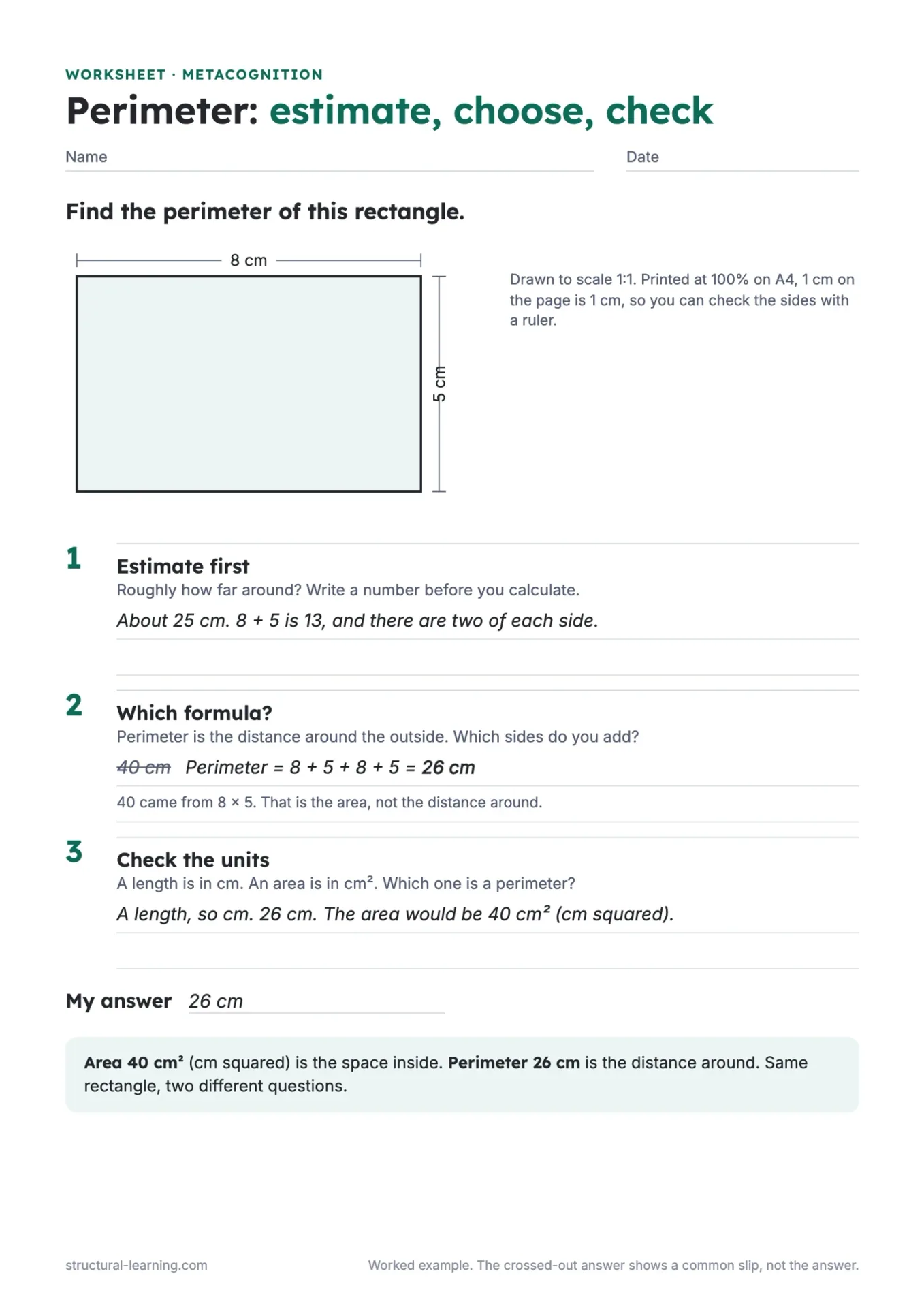
Finish with the reflection question: does the answer make sense against the question? A Year 4 learner who has found a perimeter of 40 cm for a rectangle of 8 cm by 5 cm should be able to say "that is the area" without being told. Next time, ask for an estimate before the calculation, because an estimate is the cheapest check there is.

Two mistakes are worth knowing before you start. The first is running the routine on brand new content: a learner cannot monitor a method they do not yet have, so use it on maths they have already met. The second is using every prompt every time. Four questions on a wall is a tool; four questions on every problem is a queue, and fluency practice needs pace, not commentary.
By Year 6 the boards can go and the same questions live in the margin of the book: a plan line at the top, a check line at the bottom. When a learner writes "I used the bar model because there were two amounts to compare", the routine has done its job. That sentence is the evidence of metacognition, and it is worth more than another page of answers.
Metacognition is not a one-time lesson; it's a continuous practice woven into the fabric of the classroom. Build a room where thinking about thinking is valued and expected.
Ask questions about thinking as you teach: "What strategies are you weighing up? Why did you choose this one? How sure are you of your answer? What could you do differently next time?"
Use formative assessment to help learners check their own work. Give feedback on how they thought, not just on the answer. "Your planning was excellent; you clearly looked at several approaches before choosing one."
Ask learners to say what they are aiming for and how far they have got. "At the start of this unit, I wanted to get better at fractions. Now I can add and subtract fractions with unlike denominators, and I'm sure of it."
Create a "mistake-friendly" classroom where errors are seen as chances to grow. Celebrate the thinking and the learning, not just the right answer.
Teachers must structure maths so learners think deliberately (Schoenfeld, 1985). Reasoning strategies build these skills when teachers model them clearly (Montague, 2008). Bar modelling, popular in UK schools, shows metacognition at work.
When learners face word problems, ask: "What do we know? What do we seek? How to show this?" This makes problem-solving strategic (Polya, 1945). It fits the National Curriculum's focus on reasoning.
Talk moves and maths talk build metacognition, because learners have to explain their thinking. Research by Chapin and O'Connor shows that specific talk moves can develop maths reasoning alongside communication skills.
Two prompts work well. Can you restate that method in your own words? Do you agree or disagree with that strategy, and why? In Year 6, a learner might explain that 10% of 240 is 24, so 5% is 12, and 15% is 36.
When the teacher follows up with "What made you choose that strategy?", learners start to watch their own decisions. That self-awareness is what sits under stronger reasoning in maths.
Polya's problem-solving framework still gives teachers a clear route into metacognition in maths. It has four steps: understand the problem, make a plan, carry out the plan, and look back to evaluate.

Teachers can adapt the same structure across year groups. Year 2 learners might use picture cards for each phase. Year 11 learners can use the same sequence with algebraic or multi-step problems.
The value for thinking lies in slowing down the planning and the looking back. Learners have to choose a strategy, justify it, check whether it worked, and decide whether another route would have been better.
Mastery teaching links with metacognition, focusing on deep understanding before moving on. "Small steps, big goals" means learners constantly check their grasp of the work. They decide if they truly grasp a concept or just memorised the steps.
Teachers use well planned questions to show thinking (e.g. equivalent fractions in Year 5). Learners ask: "Do I understand why, or just follow rules?" Teachers model this, building reflection.
Metacognitive journals in mathematics work best with precise prompts, not general reflection. Research by Mevarech and Kramarski links structured reflection in maths with stronger problem-solving.
Three prompts work well. What strategy did I use today, and why did it fit this problem? What mistake did I make, and what does it tell me about my thinking? How does today's learning connect to what I already know?
Teachers can adapt the routine by age. Reception children might use picture sheets to reflect. Year 3 learners can finish sentence starters. Year 10 learners can pick apart algebraic reasoning in more detail. The routine works when it is consistent, specific and tied to the maths being taught.
Metacognitive knowledge has three parts: declarative (knowing what), procedural (knowing how) and conditional knowledge (knowing when and why to use a strategy). Research by Paris and colleagues (1983) shows that conditional knowledge is the hardest to teach. It is also the most powerful for transfer across subjects.
Use the questions below to decide whether each mathematics routine reveals reasoning or only displays an answer.
question
“I'm not against whiteboards but their current standing as a magical tool that allows you to assess understanding is massively exaggerated.”
What the replies and the evidence say. In the same thread he asks whether we can judge 30 learners from a held-up answer, and says six months of mandated boards picked up two or three misconceptions. @Maths_Devon replies that a short check before answers is useful if it is not two minutes long. Teachers split two ways: keep a short, standardised check that shows working, or circulate over books. Do not sell the board-up as understanding.
question
“Just high quality modelling and lots of practice from the students pretty much. Everything else is just faffing.”
What the replies and the evidence say. This is the live UK pushback, not “no time for metacognition” as a slogan. Modelling and practice are the metacognition if the model is a think-aloud that asks whether the result makes sense, as Bradford Research School scripts. EEF 2025 still says teach the strategies in the subject, on the usual curriculum tasks, not as an add-on ritual.
question
“Hard no on this, especially as a maths teacher, worked examples or key notes, formulas etc”
What the replies and the evidence say. He is refusing the idea that copying from the board is wasted time, specifically for worked examples and formulae. The objection that learners only copy examples came from outside UK classrooms. Fade the support (Atkinson, Renkl and Merrill, 2003). Do not bin the example.
question
““number talks” & “explain your thinking” ad nauseum and then send a kid home w “I didn’t finish I was talking too much”?”
What the replies and the evidence say. The live US objection is minutes stolen from doing the maths, not that talk is only for advanced learners. UK maths posts almost never made this complaint. Keep the share short, then the independent burst @Maths_Devon timed in the UK thread.
question
“The teacher kept saying, “That’s just the rule.””
What the replies and the evidence say. A learner in Algebra II asked why negative exponents become fractions and was told it was the rule. The public endpoint then reads: “After a few more “but why?” attempts, he opened a new tab on his Chromebook, googled”. Replies treat “just because” as the reason people hated school; @BH_Chronicles answered by example, keep dividing by 2. A worked example that states the principle in one line beats a rule card. The scene is one viral claim, not a census of Algebra II rooms.
question
“I spend WAY more time correcting their spelling and punctuation than I do correcting their conceptual understanding.”
What the replies and the evidence say. This is an 8 to 9th grade teacher doing more error-analysis items. A page that demands a complete written sentence as the proof of thinking will fail the learners it is meant to help. Speak the error first (the US pair card), then write. @Mr_JonesMath, separately, says auto-grading has removed sight of the reasoning. That is one teacher’s account.
Schoenfeld (1985) and others suggest metacognition helps learners become confident mathematicians.
Getting good at this takes time, for teachers and for learners. Try things out, reflect on your own teaching, and keep looking for ways to make learners more aware of their maths thinking. The rewards are worth it. Learners who bring this awareness to maths are not just learning to solve problems; they are learning to learn.
If the talk dries up, shorten the window. Ask for one sentence only: what did you try first, and what told you it was wrong. Learners who cannot narrate a whole method can almost always name the first decision, and that is the part worth hearing. Build from one sentence to two over a fortnight, and keep the same prompts running across lessons so the routine becomes familiar rather than one more thing to learn.
Try the plan line tomorrow. Before your class starts a word problem, ask every learner to write one sentence at the top of the page: what the question wants and which method they will use. Read five of them while they work. Those five sentences will tell you more about the maths in the room than the five answers underneath them.
Teachers may see early behaviour changes when learners start using metacognitive prompts. Learners may ask better questions about their thinking and notice when they are stuck. Treat habit formation as a gradual process that needs regular modelling, practice and feedback rather than a fixed number of weeks.
Metacognition helps learners, but some resist reflecting on their maths. They may rush even when a strategy is not working, or lack the mathematical vocabulary needed to explain their thinking. Start with short reflection tasks, sentence stems and teacher modelling, then gradually build learner confidence with mathematical discussion.
Younger learners (Years 1-3) benefit from visual thinking tools like emoji cards to show how confident they feel about their work. Middle primary learners (Years 4-5) can handle simple sentence starters for reflection, whilst upper primary (Year 6) learners can engage in peer discussions about problem-solving strategies. The key is matching the complexity of metacognitive language to learners' developmental stage.
When learners learn to recognise early signs of confusion and have specific strategies to respond, they feel more in control. Teaching learners that struggle is normal and productive, rather than a sign of failure, helps build resilience and reduces anxiety over time.
Focus on observing changes in learner behaviour rather than testing metacognitive knowledge directly. Look for evidence like learners asking themselves planning questions, choosing appropriate strategies without prompting, and explaining why they changed approach mid-problem. Simple reflection journals or exit tickets asking 'What did you find challenging today and how did you handle it?' provide valuable insight into their metacognitive growth.
Ashlock, R. B. (2002). Error Patterns in Computation: Using Error Patterns to Improve Instruction (8th edition). Merrill Prentice Hall.
Baroody, A. J. (2003). The development of adaptive expertise and flexibility: The integration of conceptual and procedural knowledge. In A. J. Baroody and A. Dowker (eds), The Development of Arithmetic Concepts and Skills: Constructing Adaptive Expertise. Erlbaum. ISBN 9780805831559.
Atkinson, R. K., Derry, S. J., Renkl, A. and Wortham, D. (2000). Learning from examples: Instructional principles from the worked examples research. Review of Educational Research, 70(2), 181 to 214.
Atkinson, R. K., Renkl, A. and Merrill, M. M. (2003). Transitioning from studying examples to solving problems: Effects of self-explanation prompts and fading worked-out steps. Journal of Educational Psychology, 95(4), 774 to 783.
Bandura, A. (1977). Self-efficacy: Toward a unifying theory of behavioral change. Psychological Review, 84(2), 191 to 215.
Black, P., Harrison, C., Lee, C., Marshall, B. and Wiliam, D. (2003). Assessment for Learning: Putting It into Practice. Open University Press.
Borasi, R. (1994). Capitalizing on errors as "springboards for inquiry": A teaching experiment. Journal for Research in Mathematics Education, 25(2), 166 to 208.
Chi, M. T. H., Bassok, M., Lewis, M. W., Reimann, P. and Glaser, R. (1989). Self-explanations: How students study and use examples in learning to solve problems. Cognitive Science, 13(2), 145 to 182.
Cox, L. S. (1975). Using research in teaching: Diagnosing and remediating systematic errors in addition and subtraction computations. The Arithmetic Teacher, 22(2), 151 to 157.
Dewey, J. (1933). How We Think: A Restatement of the Relation of Reflective Thinking to the Educative Process. D. C. Heath.
Dweck, C. S. (2006). Mindset: The New Psychology of Success. Random House.
Flavell, J. H. (1979). Metacognition and cognitive monitoring: A new area of cognitive-developmental inquiry. American Psychologist, 34(10), 906 to 911.
Hattie, J. and Timperley, H. (2007). The power of feedback. Review of Educational Research, 77(1), 81 to 112.
Hiebert, J. and Lefevre, P. (1986). Conceptual and procedural knowledge in mathematics: An introductory analysis. In J. Hiebert (ed.), Conceptual and Procedural Knowledge: The Case of Mathematics. Erlbaum. ISBN 9780898595567.
Mevarech, Z. R. and Kramarski, B. (1997). IMPROVE: A multidimensional method for teaching mathematics in heterogeneous classrooms. American Educational Research Journal, 34(2), 365 to 394.
Montague, M. (2008). Self-regulation strategies to improve mathematical problem solving for students with learning disabilities. Learning Disability Quarterly, 31(1), 37 to 44.
Nelson, T. O. and Narens, L. (1990). Metamemory: A theoretical framework and new findings. Psychology of Learning and Motivation, 26, 125 to 173.
Nesher, P. (1987). Towards an instructional theory: The role of students' misconceptions. For the Learning of Mathematics, 7(3), 33 to 40.
Newman, M. A. (1977). An analysis of sixth-grade pupils' errors on written mathematical tasks. Victorian Institute for Educational Research Bulletin, 39, 31 to 43.
Paris, S. G., Lipson, M. Y. and Wixson, K. K. (1983). Becoming a strategic reader. Contemporary Educational Psychology, 8(3), 293 to 316.
Polya, G. (1945). How to Solve It: A New Aspect of Mathematical Method. Princeton University Press.
Renkl, A. and Atkinson, R. K. (2003). Structuring the transition from example study to problem solving in cognitive skill acquisition: A cognitive load perspective. Educational Psychologist, 38(1), 15 to 22.
Schoenfeld, A. H. (1985). Mathematical Problem Solving. Academic Press.
Veenman, M. V. J., Van Hout-Wolters, B. H. A. M. and Afflerbach, P. (2006). Metacognition and learning: conceptual and methodological considerations. Metacognition and Learning, 1(1), 3 to 14.
Vygotsky, L. S. (1978). Mind in Society: The Development of Higher Psychological Processes. Harvard University Press.
Weinstein, C. E., Husman, J. and Dierking, D. R. (2000). Self-regulation interventions with a focus on learning strategies. In M. Boekaerts, P. R. Pintrich and M. Zeidner (eds), Handbook of Self-Regulation (pp. 727 to 747). Academic Press.