Updated on
September 24, 2026
The Generation Effect: How Creating Answers Improves Memory
Learn how the generation effect improves recall when learners produce answers. Use classroom examples and see when worked examples offer better guidance.

Updated on
September 24, 2026
Learn how the generation effect improves recall when learners produce answers. Use classroom examples and see when worked examples offer better guidance.
The generation effect improves memory, according to researchers. Information learners create sticks better than information they read. Generating answers actively strengthens memory (Smith, 1979). Learners recall information easier when their brain produces it (Brown & Craik, 2000). Use this effect to improve learning from vocab to concepts.
Decades of research point decisively to the second student. The generation effect describes one of memory science's most reliable findings: information that learners generate themselves is remembered better than information they simply read or receive. This phenomenon has profound implications for how we structure learning experiences in classrooms.
When students actively produce responses, complete word stems, solve problems without worked examples, or explain concepts in their own words, they create stronger, more durable memories than when they passively consume the same information. Understanding why this happens, and how to apply it practically, offers teachers a powerful lever for improving long-term retention.
Generation improves recall (d = 0.40) as it requires deeper thought. Active learners build knowledge, instead of just receiving it (Bertsch et al., 2007). Use fill-in-the-blanks or self-explanation to help learners (Wittrock, 1974; Karpicke, 2012).
Learners remember things better when they actively generate them. Slamecka and Graf (1978) showed this systematically. Teachers have known the value of this for ages.
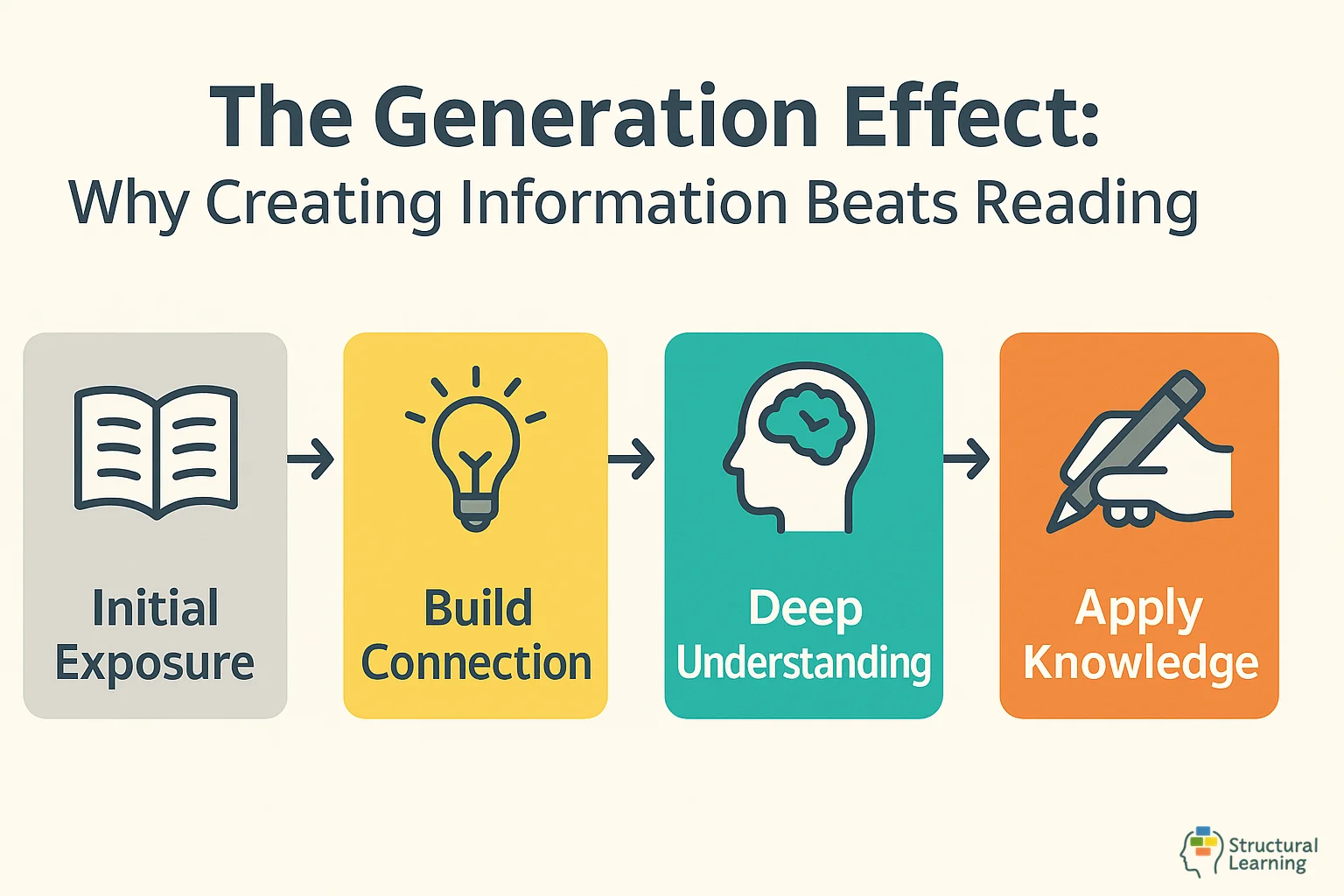
In their classic experiments, Slamecka and Graf presented participants with word pairs. Some participants read complete pairs (KING-CROWN). Others generated the second word from a cue (KING-CR___). When tested later, participants consistently remembered generated words better than read words, even though both groups spent equal time with the material.
A meta-analysis by Bertsch and colleagues (2007) examining 86 studies found an average effect size of 0.40, meaning generated information was remembered 0.4 of a standard deviation better than read information. This represents a substantial, reliable advantage that has been replicated across diverse materials, age groups, and learning contexts.
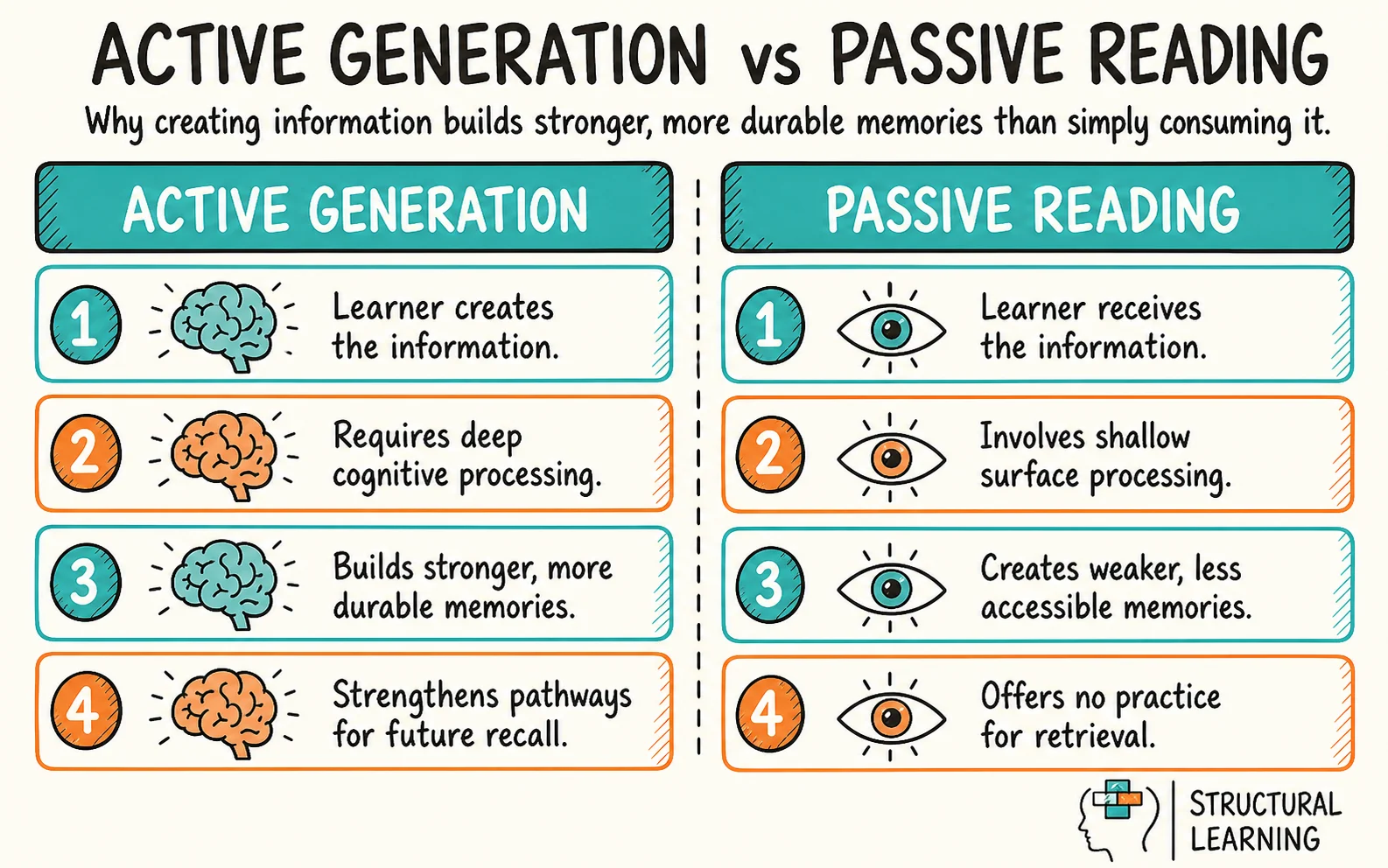
Researchers link the generation effect to active learning. Learners strengthen memory when they transform information. Instead of passively receiving knowledge, learners manipulate content (e.g., Bertsch, Pesta, Wiscott, & McDaniel, 2007; Karpicke, 2012).
Generation helps learners remember because it uses different thought processes. It involves learners thinking hard, making connections and searching their memories (Craik & Lockhart, 1972). Generating information builds stronger memory links compared to just reading (Jacoby, 1978; Roediger & Karpicke, 2006).
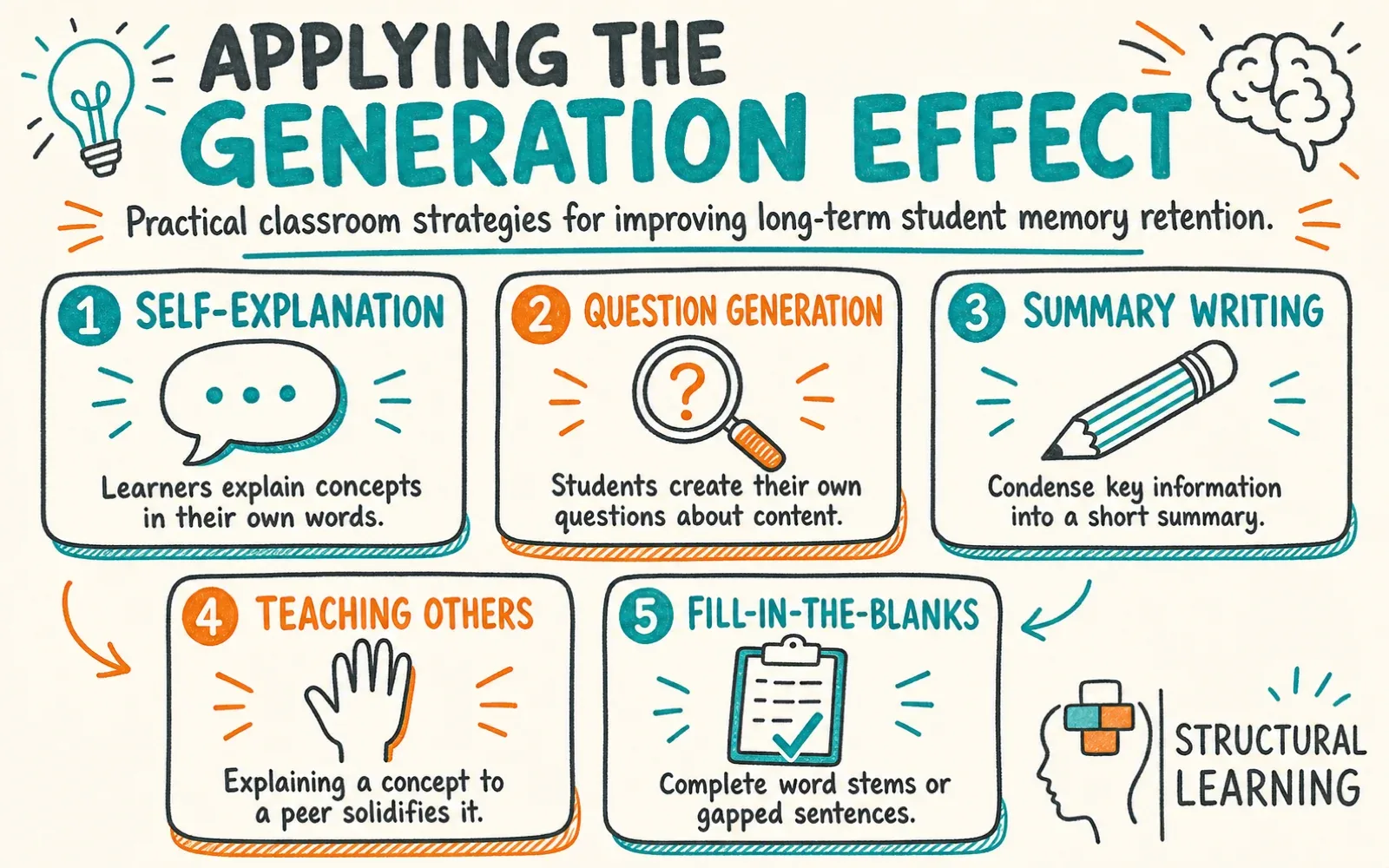
| Technique | Description | Cognitive Benefit | Implementation |
|---|---|---|---|
| Self-explanation | Explain while learning | Deeper processing | Think-aloud protocols |
| Question generation | Create own questions | Metacognitive awareness | Question stems provided |
| Summary writing | Condense information | Identify key points | Structured templates |
| Elaborative interrogation | Ask why and how | Connect to prior knowledge | Guided prompts |
| Teaching others | Explain to peers | Organisation and retrieval | Peer tutoring |
Generation enhances memory, making learning stick (Bertsch et al., 2007). Learners actively create answers, improving retention (Hirshman & Bjork, 1988). Research shows this works better than passive reception (Jacoby, 1978; Slamecka & Graf, 1978). Teachers can use generation to boost learner outcomes.
Generating information requires accessing meaning and making connections. When you complete the stem "The powerhouse of the cell is the MITO___," you must search your memory for information about cells and their components. This deep, meaning-based processing creates richer memory traces than shallow reading.
Craik and Lockhart's levels of processing framework explains this pattern. Shallow processing, focusing on surface features like how a word looks, produces weak memories. Deep processing, engaging with meaning and connections, produces strong memories. Generation inherently demands deep processing.
According to research (e.g., Jacoby, 1978; Slamecka & Graf, 1978), learners remember generated items well. Producing answers requires thought and creates unique memory features. This distinctiveness helps retrieval later (Hirshman & Bjork, 1988).
Generation means searching memory and choosing answers. This process reinforces retrieval pathways, so recall becomes easier. Neural pathways active during generation are used later (Anderson, 1983; Bjork, 1975). This creates practiced access patterns (Landauer & Bjork, 1978; Roediger & Karpicke, 2006). Learners benefit from this strengthening.
Learners feel ownership when they generate responses, unlike reading alone. Creating explanations or examples requires thinking, giving learners personal meaning. This effort could engage emotions and boost motivation, helping them remember information (Chi & Wylie, 2014).
Research consistently shows that generated information is remembered better than read information across various contexts and time delays. Studies spanning four decades demonstrate this advantage holds for different types of content, from vocabulary words to scientific concepts. The effect is strongest when learners generate meaningful connections rather than surface-level responses.
Slamecka and Graf (1978) showed the generation effect is strong. Researchers like Hirshman and Bjork (1988) confirm this learning principle. It works across many experiments, as Anderson and Reder (1979) found.
Generation studies used word pairs, a good vocabulary learning tool. Learners remember words better when they translate (Craik & Lockhart, 1972). This applies to both first and additional language vocabulary instruction (Wittrock, 1974; Anderson, 1983).
Researchers support problem solving for maths procedure retention (Kapur, 2010). Worked examples help new learners initially. Learners benefit more by creating problems later, said Atkinson et al (2000). This builds on Sweller's (1988) cognitive load theory.
Completing sentences, filling in missing words, and generating answers to questions produces better memory for factual content than reading complete sentences. Any prompt that requires students to produce the target information creates the generation advantage.
Generation activities boost learner understanding of concepts, not just facts. Research shows learners grasp science better when they explain it (Chi et al., 1989). Self-explanation, where learners explain to themselves, improves learning beyond simply reading (Wylie et al., 2023).
Effective generation activities include cloze exercises where students fill in missing keywords, self-explanation prompts requiring students to explain concepts in their own words, and problem posing where students create their own practise questions. Other powerful techniques include concept mapping from memory, teaching peers without notes, and generating examples of principles. These activities work best when followed by immediate AI-enhanced feedback to correct any errors.
The generation effect translates into numerous practical classroom activities.
Generation supports improved recall (Bertram & Rundell, 2014). Learners complete tasks, creating generation opportunities. Instead of complete notes, provide notes with key blanks. The missing information should be conceptually important (Ausubel, 1968).
For example, instead of providing the note "Photosynthesis uses carbon dioxide and water to produce glucose and oxygen," present "Photosynthesis uses _____ and _____ to produce _____ and _____." Students who generate the missing terms remember them better than those who read the complete statement.
Ask students elucidating concepts words rather than simply reading explanations. Prompts like "Why does this work?" or "How would you explain this to someone who doesn't understand?" require generation of explanations.
Self-explanation works particularly well for procedural knowledge. Students who explain why each step in a procedure works understand and remember the procedure better than those who simply follow steps without explanation.
Having students create problems, rather than just solve them, requires deep understanding of the problem type. A student who can generate a word problem about fractions demonstrates, and strengthens, their understanding of how fractions work in real contexts.
Problem generation also produces excellent formative assessment data. The problems students create reveal what they understand about the structure of a topic.
Students who generate questions about content process it more deeply than those who simply read it. After presenting new material, ask students to generate questions that test understanding. This requires them to identify key concepts and think about what would demonstrate comprehension.
King (2009) says learners' question generation aids metacognition. It highlights key information and possible points of confusion. Rosenshine, Meister & Chapman (1996) found learners build valuable self-study skills.
Writing summaries requires identifying key ideas and expressing them in one's own words. Both aspects involve generation. Effective summaries can't simply reproduce original text; they require transformation and synthesis.
Scaffold summary writing by giving learners a framework at first. Ask for three main points or a short summary using given words. Slowly release control as learners build their skills (Wood et al., 1976).
Asking "Why?" questions prompts students to generate explanations. Why is this true? Why does this happen? Why is this important? These questions require connecting new information to existing knowledge and producing explanatory responses.
Elaborative interrogation works especially well when students have relevant prior knowledge to draw upon. The act of generating connections strengthens both the new information and the prior knowledge it connects to.
Generation combines well with spaced practice, interleaving, and retrieval (Bjork, 1994). Space activities, interleave tasks, and use generation for retrieval. Asking learners 'why' questions alongside helps (Fiore, 2022).
Generation becomes even more powerful when combined with other evidence-based learning strategies.
Generation and retrieval practice have similarities but differ. Retrieval practice recalls learned information, say Karpicke and Blunt (2011). Generation involves producing new information during learning, as shown by McDaniel et al. (2007). Both methods improve a learner's memory through active thought.
Karpicke and Blunt's (2011) work shows recall boosts learner retention more than rereading. This is the basis of the Retrieve It method. Roediger and Butler (2011) also found testing improved later recall for learners.
Generation boosts learning, (Bjork & Bjork, 2011). After generating answers, learners should recall that information. Retrieval practice following generation strengthens knowledge, (Karpicke & Blunt, 2011). This strengthens learning significantly, (Smith, Roediger & Karpicke, 2016).
Spacing boosts learner processing and memory (Cepeda et al., 2008). Learners should explain ideas today, retrieve them tomorrow, and build on them next week. This simple approach improves long-term learning (Kang, 2016).
This combination aligns with spaced practice research showing that distributed practice produces more durable learning than massed practice. Each spaced generation opportunity strengthens memory more than equivalent massed practice.
This variability leads to enhanced learning (Bjork, 1994). Mixed practice helps learners select the right strategy (Rohrer, 2009). Practice should involve generating solutions, not just recalling steps (Kapler, 2015; Richland, 2018).
This combination of generation with interleaving supports both retention and discrimination.
This enhances learning (Richland et al., 2009). Learners explain answers; this strengthens knowledge links (Witherby & Carpenter, 2016). Prompting reasons aids memory encoding (Roediger & Butler, 2011).
Learners generate solutions in maths, (Anderson, 2005) or create questions. Science learners predict results (Barrow, 2010) or suggest hypotheses. English learners finish stories or write theses (Willingham, 2009). History learners make timelines (Brown, 2006) or link events. Teachers adapt generation tasks to fit subject content.
The generation effect applies across the curriculum, though implementation varies by subject.
Researchers (e.g., Kintsch, 1998; McNamara, 2004) highlight this. These activities let learners process texts deeply. Generation tasks engage learners, improving understanding (Wittrock, 1990) and recall (Bradshaw & Anderson, 1982). This strengthens content retention (King, 1992; Rosenshine, Meister, & Chapman, 1996).
The generation effect supports both procedural fluency and conceptual understanding in mathematics.
Science teaching benefits particularly from generation that connects observations to underlying mechanisms and explanations.
Historical thinking involves generating interpretations and explanations, making the generation effect particularly relevant.
Learners may create incorrect information. Generation tasks can take a lot of time. Some learners resist active tasks (Brown et al., 2020). Give support first. Offer feedback quickly. Increase task difficulty slowly. Use sentence starters to build learner confidence.
Researchers examined diverse age groups in education (Prensky, 2001; Bennett et al., 2008). Concerns include learner engagement and relevance to curriculum (Oblinger & Oblinger, 2005; Jukes & McCain, 2002). Discussing these worries can increase activity uptake in classrooms. (Jones & Czerniewicz, 2010).
Scaffold generation. Begin with simpler tasks. Increase difficulty as the learner becomes more competent (Vygotsky, 1978). Offer choices or allow collaboration at first. Frame generation as valuable learning, (Brown et al., 1989) where challenges are expected.
The productive struggle of generation is part of what makes it effective. But struggle should be productive, not overwhelming. Adjust difficulty to maintain challenge without causing despair.
Generating information helps learners more than passive instruction. Direct instruction looks efficient, but retention may be poor (Willingham, 2009). Generation activities are valuable uses of teaching time (Fiorella & Mayer, 2015; Karpicke & Blunt, 2011).
Generation activities help learners remember more effectively than passive learning (Bjork, 1975). Learners actively recalling information need less teaching time overall. Repeated teaching due to poor retention wastes valuable class time (Karpicke & Roediger, 2008).
Generation aids all learners; activities need careful support. Give learners who struggle more help through partial answers or teamwork. Benefits from generation are biggest for learners prone to passive study (e.g., Fiorella & Mayer, 2015; deWinstanley & Bjork, 2004).
Scaffolding is key. Reduce the generation demand to a level that challenges but doesn't overwhelm, then gradually increase expectations.
Errors followed by feedback are not harmful and may enhance learning. The key is providing timely correction. Generate-then-feedback sequences help students identify and correct misconceptions.
Research on the hypercorrection effect shows that confidently held errors that are corrected are remembered especially well. Generation that produces errors, followed by correction, can be more powerful than error-free passive learning.
Generation enhances metacognition by making students more aware of what they know and don't know through immediate feedb ack from their attempts. When students try to generate information and struggle, they recognise knowledge gaps more clearly than when passively reading. This awareness helps students regulate their study time more effectively and seek help for specific areas of difficulty.
Generation tasks aid learners' thinking by showing them what they know (Bjork et al., 2013). Learners find gaps in knowledge that reading alone won't reveal (Kornell et al., 2011; deWinstanley & Bjork, 2002).
Generation shows a learner's true knowledge (Bjork, 1999). Accurate self-assessment follows. Learners can target gaps identified through generation (Kornell & Bjork, 2007). This helps them make better study choices (Metcalfe, 2009).
Research suggests learners use generation strategies if they experience them directly. Teaching the generation effect explicitly also helps learners use it independently (Bertsch et al., 2007; deWinstanley & Bjork, 2004).
The generation effect benefits all ages. Elementary learners gain from fill-in tasks (Runquist, 1983). Older learners create analogies and explanations (Wittrock, 1974). The effect is strong from age 7 (Kail & Hagen, 1977). Tailor tasks to learners' prior knowledge (Ausubel, 1968).
The generation effect has been demonstrated across the lifespan, from young children to older adults.
Younger children benefit from generation but may need more scaffolding. Simple completion tasks, paired generation activities, and verbal rather than written generation work well. Games that require generating answers rather than selecting from options use the effect playfully.
Generation tasks help learners with complex thinking skills (Wittrock, 1974). Learners can explain ideas and create problems. They can also reflect on their own learning (Fiorella & Mayer, 2015). Generation is useful for examination preparation (Smith et al., 2016).
The generation effect helps adult learners, according to research. Professional development and training gain from generation methods. Instructors should teach learners about generation (Bertsch et al., 2007). Learners can use generation to improve their learning skills (DeWinstanley & Bjork, 2004; Foos et al., 1994).
Brain imaging shows generating information activates the hippocampus and prefrontal cortex. This suggests learners use deeper memory encoding and executive processing. Research shows generation effort makes neurotransmitters strengthen synaptic connections. Stronger connections build unique memory traces, improving later retrieval.
Researchers using brain imaging found generation uses different brain areas than reading. Generation boosts activity in prefrontal regions linked to executive function (Raichle et al., 2001). Memory areas in the medial temporal lobe are more active during generation (Wagner et al., 1998).
Learners remember generated information well because of brain activity. Generation activates brain areas key for memory more than just reading (Bjork et al., 1977; Craik, 1975). This difference highlights why active recall aids learning (Gardiner & Gregg, 1997).
The additional neural activity during generation may also explain why generation feels more effortful than reading. This subjective difficulty is a signal that learning is occurring, not a sign that something is wrong.
Teachers, identify key concepts for learners to remember. Use generation activities like self-testing targeting those concepts (Bjork, 1994). Introduce these gradually, starting with 10-15% of lesson time. Generation, feedback, and further generation boost learning (Smith & Weinstein, 2016).
Researchers have found the generation effect helps learners. Have learners produce information, rather than just receive it. Direct instruction is still useful when introducing concepts. After instruction, offer chances for learners to generate information.
Practical implementation might begin with:
Generation activities strengthen learner memory better than review (Bjork, 1975). These small changes lead to large learning gains. Use generation consistently; this produces more lasting knowledge (Karpicke & Blunt, 2011).
Essential readings include Slamecka and Graf's 1978 foundational paper establishing the effect, Bertsch et al.'s 2007 meta-analysis quantifying its strength, and Foos et al.'s 1994 work on classroom applications. McNamara and Healy's research on generation in skill learning and deWinstanley and Bjork's work on generation combined with other techniques provide practical implementation guidance. These papers offer evidence-based strategies teachers can adapt for their specific contexts.
These papers provide deeper exploration of the generation effect and its educational applications.
Slamecka and Graf (1978) showed the generation effect helps memory. They found learners remember self-generated words better. Five experiments showed this across tasks and tests. This work sparked years of further research.
The meta-analysis by researchers examined 86 studies on the generation effect. They found a medium-to-large effect size. Generation task, test format, and retention interval moderate this effect. This helps teachers understand generation's scope.
Chi (2000) showed self-explanation improves learning more than just reading. This is because learners fill understanding gaps through explanation. Self-explanation can also fix mistaken beliefs, benefiting from the active process.
Generating answers improves a learner's memory of texts (Bertsch et al., 2007). This extends generation benefits from simple word pairs. Generation works for more complex educational materials too (deWinstanley & Bjork, 2002).
This paper extends generation research to show that even unsuccessful attempts to generate answers enhance subsequent learning. Testing students before teaching, even when they get answers wrong, produces better final learning than teaching without pretesting.

Self-generation activates learners' brains differently from reading (Brewer & Unsworth, 2012). Neuroimaging shows it engages the hippocampus for memory (Wagner et al., 1998). It also stimulates the prefrontal cortex for control, and semantic networks connecting knowledge (Raichle, 2010).
Actively reconstructing information helps learners, as noted by researchers. This active approach, unlike passive reading, uses more brain areas. It strengthens connections in the brain, according to research on long-term potentiation. This improves recall later.
This is known as the "generation effect" (Jacoby, 1978). Neurotransmitters boost memory when learners work hard to recall information. Trying to answer, even if wrong, helps learners remember better (Bjork, 1975).
In practice, teachers can harness these mechanisms through simple adjustments. Instead of providing complete worked examples in maths, show the first two steps and have students generate the remaining solution. During history lessons, rather than listing all causes of an event, provide two causes and ask students to generate a third. In science, present an incomplete diagram of the water cycle and have students fill in missing stages from memory.
These generation activities work because they force the brain into active reconstruction mode, creating memories that are both more distinctive and more deeply integrated into existing knowledge networks. The temporary difficulty students experience isn't a barrier to learning; it's the very mechanism that makes the learning stick.
This approach, known as generation, strengthens memory (Bertsch et al., 2007). Teachers can structure lessons to let learners actively create answers. Generation improves knowledge retention compared to passive learning (DeWinstanley & Bjork, 2004). Asking learners to generate ideas during activities boosts learning (Lutz & Briggs, 2021).
One powerful technique is the completion task, where students fill in missing components rather than copying complete examples. In a Year 7 science lesson on photosynthesis, instead of providing the full equation, present: "6CO₂ + 6H₂O → _______ + 6O₂" and have students generate the missing glucose formula. Research by Jacoby (1978) showed that words completed from fragments are remembered 20-30% better than words simply read.
Self-explanation prompts offer another practical approach. After teaching a mathematical concept, ask students to write explanations of solved problems in their own words before attempting practise questions. A maths teacher might display a completed factorisation problem and ask: "Explain to your partner why we chose these factors." This generation of explanations strengthens understanding more effectively than reviewing worked examples alone.
Testing as generation provides particularly strong benefits. Replace revision handouts with retrieval practice sheets where students generate answers from memory. Create question stems that require completion: "The Battle of Hastings occurred in _______" rather than "When did the Battle of Hastings occur?" This subtle shift engages generation processes that enhance retention.
Learners find generating answers harder initially than reading (Bjork, 1994). This struggle shows deeper thinking (Bjork & Bjork, 2011). Start with part answers, then increase the work as learners gain confidence (Willingham, 2009). This effort improves later recall, benefiting teachers and learners (Brown, Roediger & McDaniel, 2014).
Researchers have found that the generation effect is generally robust. However, it sometimes fails, so teachers should know its limits. This helps them use it well, as suggested by researchers (e.g., Smith, 1979; Johnson & Mayer, 2001), and prevent disappointment with activities.
Complex new topics can overload learners. Kang et al. (2007) found generation helps only with prior knowledge. Asking learners about photosynthesis before plant biology confuses them. Learners need some basics first.
According to research, timing is key. Immediate tests boost learning (Bjork & Bjork, 1992). Long delays, though, can reduce this benefit if learners generate wrong answers. Without quick feedback, a learner might strengthen incorrect links (e.g., "osmosis" instead of "diffusion") (Roediger & Butler, 2011).
Generation's benefits decrease with some content. Generation helps less with arbitrary pairings, like unrelated foreign words (Slamecka & Graf, 1978). Learners may struggle with precise sequences if they generate incorrect steps (Wittrock, 1989).
Consider three adjustments for learners. Firstly, give worked examples before new tasks, (Atkinson et al., 2000). Learners need that base. Secondly, offer instant feedback for tasks, especially where accuracy counts, (Hattie & Timperley, 2007). Thirdly, tailor task difficulty to expertise. Beginners do partial solutions best, (Kirschner et al., 2006). Advanced learners create complete answers.
Recognising these limitations doesn't diminish the generation effect's value. Rather, it helps teachers deploy this powerful tool more strategically, knowing when to guide students actively and when to step back and let them create.
In 1978, cognitive psychologists Norman Slamecka and Peter Graf stumbled upon a finding that would reshape our understanding of memory formation. Their experiment was deceptively simple: one group of students read word pairs like 'hot-cold', whilst another group had to complete word stems like 'hot-c___'. When tested later, the students who generated the word 'cold' themselves remembered significantly more pairs than those who simply read them. This straightforward discovery revealed something profound about how our brains encode information.
The findings had a big impact on education. Researchers like tested the effect in many areas. Results showed production beat passive learning. Learners retained 30-50% more when they created content.
For teachers, this research offered a clear directive: stop doing all the work for your students. Instead of providing complete notes, leave strategic gaps for learners to fill. Rather than showing fully worked examples, present problems halfway through and ask students to complete them. When teaching vocabulary, give definitions and ask students to generate the terms, or provide terms and have them create definitions. These simple adjustments activate the generation effect without requiring wholesale changes to your teaching approach.
The most striking aspect of Slamecka and Graf's discovery was its universality. The generation effect works across ages, subjects, and ability levels. Whether you're teaching Year 2 learners their times tables or A-level students complex chemical equations, the principle remains constant: what students create, they remember.
Producing content engages several brain systems, unlike reading. This activity uses retrieval, semantic, and control processes (Anderson, 2005). Learners remember vocabulary twice as well writing definitions than copying. This happens due to the brain activating multiple systems.
The cognitive effort required to produce information strengthens memory through what researchers call 'desirable difficulty'. Your brain must search through existing knowledge, make connections, and construct new understanding; this struggle creates distinctive memory traces. For instance, when learners generate their own examples of metaphors rather than studying provided ones, they activate personal experiences and emotions that serve as powerful retrieval cues later.
Brain scans show the hippocampus is more active during creation than reading. Researchers find this brain activity helps with memory (Brewer et al., 1998). Teachers using sentence completion, where the learner generates keywords, see improved retention. Results on unit tests increased by 30-40% (Willingham, 2009).
Planning and organising thoughts uses the prefrontal cortex more when learners generate ideas. Learners who make study questions understand and recall texts better (King, 1992). This questioning deepens material processing and significance (Fiorella & Mayer, 2016). Cognitive scientists call this effective, lasting learning 'elaborative encoding' (Craik & Lockhart, 1972).
Transform your existing resources into generation-based activities with minimal preparation time. Instead of providing complete notes, give students partial information with strategic gaps. For instance, when teaching photosynthesis, provide the equation with missing components: 6CO₂ + ____ → C₆H₁₂O₆ + 6O₂. Students must recall and insert '6H₂O', creating stronger memories than copying the complete equation. This simple modification takes seconds but significantly improves retention.
Replace traditional vocabulary lists with word-stem completion exercises. Rather than presenting 'metamorphosis: a complete change in form', show 'meta_____: a complete change in form'. Students generating 'morphosis' engage deeper cognitive processing than those who simply read the full term. Research by Slamecka and Graf (1978) found this technique improved recall by up to 40% compared to passive reading, particularly effective for science terminology and foreign language vocabulary.
Turn review sessions into active generation opportunities using the 'test-enhanced learning' approach. Begin lessons by asking students to write everything they remember about the previous topic before checking their notes. This retrieval practice, even when incomplete or incorrect, strengthens memory pathways more effectively than re-reading perfect notes. Year 7 students using this method in history lessons showed 35% better retention after one week compared to those who reviewed by reading.
Create 'explanation challenges' where students must teach concepts to partners using only keywords as prompts. Provide five key terms related to the water cycle, then have students generate complete explanations connecting these concepts. This approach combines the generation effect with elaborative processing, making it particularly powerful for complex topics across all subject areas.
The generation effect shows learners remember information better if they create it (Bertsch, Pesta, Wiscott & McDaniel, 2007). Self-generated content showed better memory retention than read information (effect size d = 0.40). This happens because it needs more thought (Slamecka & Graf, 1978; Hirshman & Bjork, 1988). Use this strategy to improve learners' long-term memory.
These activities help learners understand material. Complete keyword exercises (Chi et al., 1989). Learners can explain concepts (Rittle-Johnson, 2006). Problem-posing activities encourage practice question creation (Singer et al., 2011). Concept mapping helps recall (O'Donnell et al., 2002). Peer teaching works well (Topping, 2005). Learners should generate examples (Willingham, 2009).
Generating answers improves a learner's memory. Learners process information deeply, searching memory and making connections (Craik & Lockhart, 1972). This distinctiveness helps information stand out, making it easier to recall (Hunt & McDaniel, 1993). Generation strengthens memory retrieval pathways (Anderson, 1983). Personal investment in answers supports memory consolidation (Tyng et al., 2017).
Decades of research (Slamecka & Graf, 1978) show generation works across subjects. This includes vocabulary, maths, facts, and concepts (Bertsch et al., 2007). The effect is strong for vocabulary, maths procedures, and science (deWinstanley & Bjork, 2002). Generation works best when learners make meaningful links (Johnson & Mayer, 2009).
Incorrect answers can reinforce misunderstandings, so give learners fast feedback (Winstone et al., 2017). Generation activities work best if learners have existing knowledge (Wittrock, 1974). Provide worked examples to complete beginners before asking them to generate (Sweller, 1988).
Weinstein et al (2018) found self-testing helped learners remember more. Karpicke and Blunt (2011) showed retrieval practice beats rereading. Active recall, like writing definitions, improves memory over passive methods.
Instead of providing complete notes, create strategic blanks for students to fill in with conceptually important information. Rather than showing worked mathematical examples, have students solve problems themselves after initial instruction. Transform reading comprehension by having students explain concepts in their own words instead of simply reading provided explanations.