Updated on
September 24, 2026
Memory Consolidation: How the Brain Transforms Learning
How sleep, spacing and retrieval turn fragile short-term memories into lasting knowledge. Evidence-based strategies for teachers to support consolidation.


Updated on
September 24, 2026
How sleep, spacing and retrieval turn fragile short-term memories into lasting knowledge. Evidence-based strategies for teachers to support consolidation.
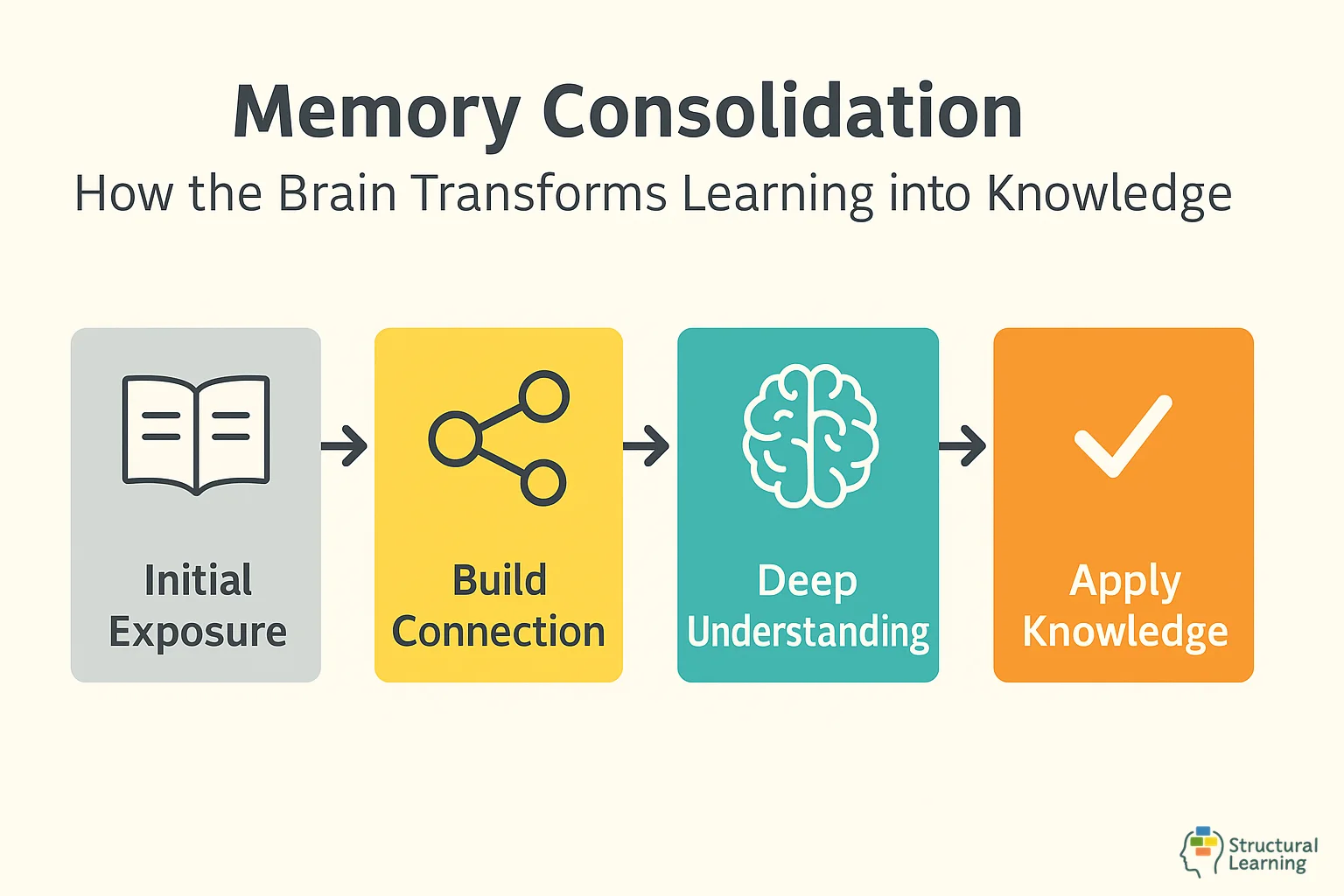
Memory consolidation is the remarkable neurobiological process that transforms fragile, newly acquired information into stable, long-term memories your brain can retrieve years later. This intricate mechanism occurs when neural pathways strengthen and reorganise, shifting memories from temporary storage in the hippocampus to permanent networks distributed across the cortex. Without consolidation, every lesson learnt, skill practised, and experience gained would fade within hours or days. Understanding how your brain accomplishes this transformation holds the key to making any learning truly stick.
Memory consolidation is the biological process through which new information becomes more stable over time (McGaugh, 2000; Squire, 1992). Without consolidation and later retrieval, learning can remain fragile. Teachers can support durable learning through spacing, retrieval practice and manageable cognitive load.
Research over the past two decades has revealed that consolidation isn't passive. Specific brain processes during and after learning actively strengthen memory traces and integrate new information with existing knowledge. Teachers who understand these processes can structure instruction, practise, and even homework timing alongside evidence-based memory strategiesto support more durable learning.
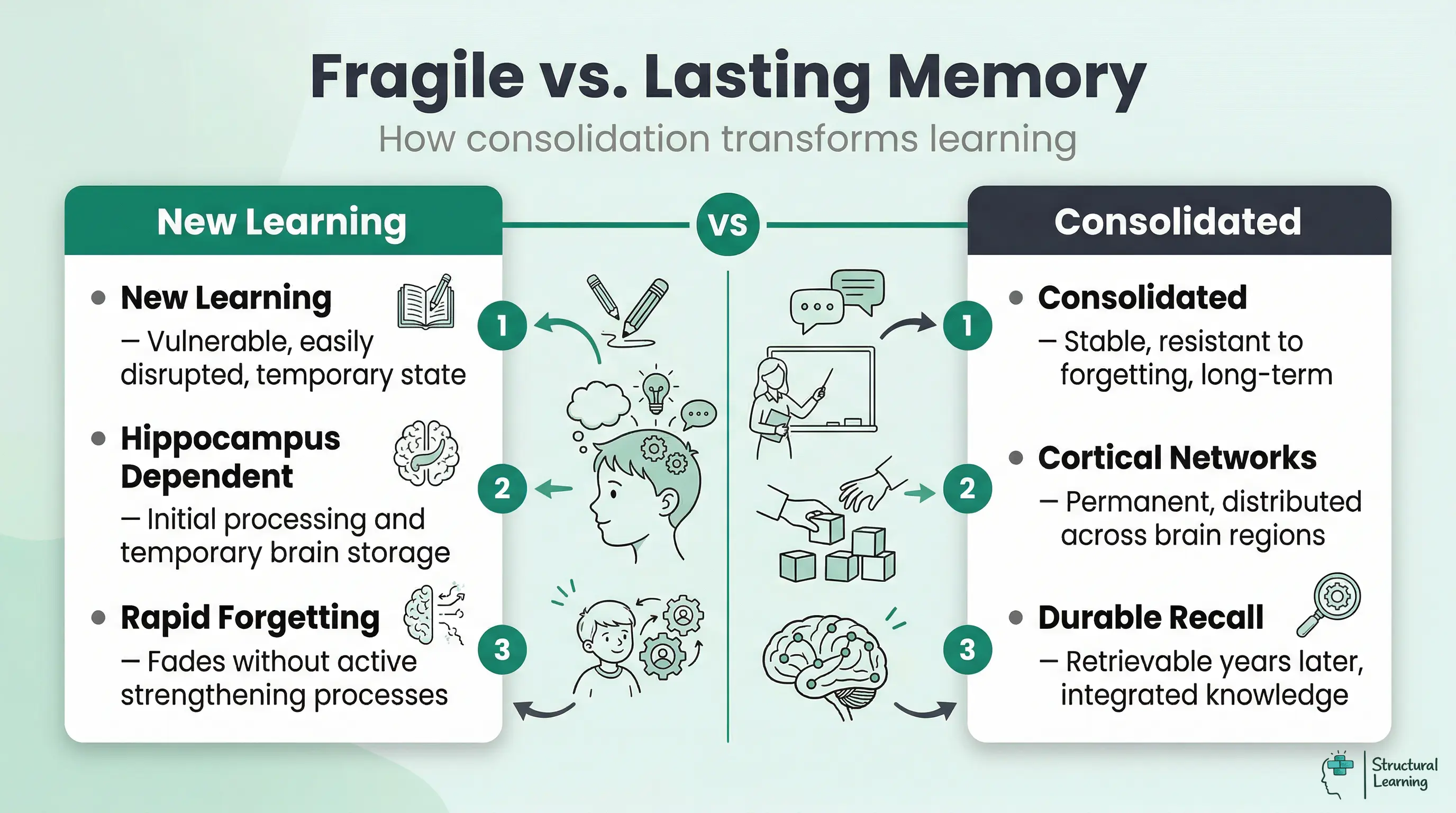
Memory consolidation stabilises new memories, resisting forgetting. Initially, new learning is vulnerable and held temporarily (Dudai, 2004). Consolidation steadily changes this fragile memory into a stable one (McGaugh, 2000; Wixted, 2004). This process benefits every learner.
| Process | Timeframe | Brain Activity | Teaching Implications |
|---|---|---|---|
| Encoding | Immediate | Hippocampus activation | Multi-sensory input, attention focus |
| Synaptic consolidation | Minutes to hours | Protein synthesis | Spaced practice, avoid interference |
| Systems consolidation | Days to weeks | Hippocampus to cortex transfer | Regular review, sleep importance |
| Reconsolidation | Upon retrieval | Memory updating | Retrieval practice, error correction |
| Long-term storage | Months to years | Distributed cortical networks | Interleaving, varied contexts |
The process occurs across two timescales.
Researchers discovered that synaptic consolidation occurs quickly after learning (Bailey et al., 2015). New protein synthesis strengthens neuron connections encoding memory (Kandel, 2012). This cellular stabilisation process starts straight away and lasts a few hours (Martin et al., 2000).
Systems consolidation unfolds over days to weeks. Memories initially dependent on the hippocampus gradually become represented in neocortical networks. This redistribution creates more stable, long-term storage for declarative memory, the explicit knowledge and facts that students need to retain. This process integrated representations that can exist independently of the hippocampus.
For teachers, the practical implication is clear: learning doesn't end when the lesson finishes. The brain continues processing and strengthening memories long after students leave the classroom.
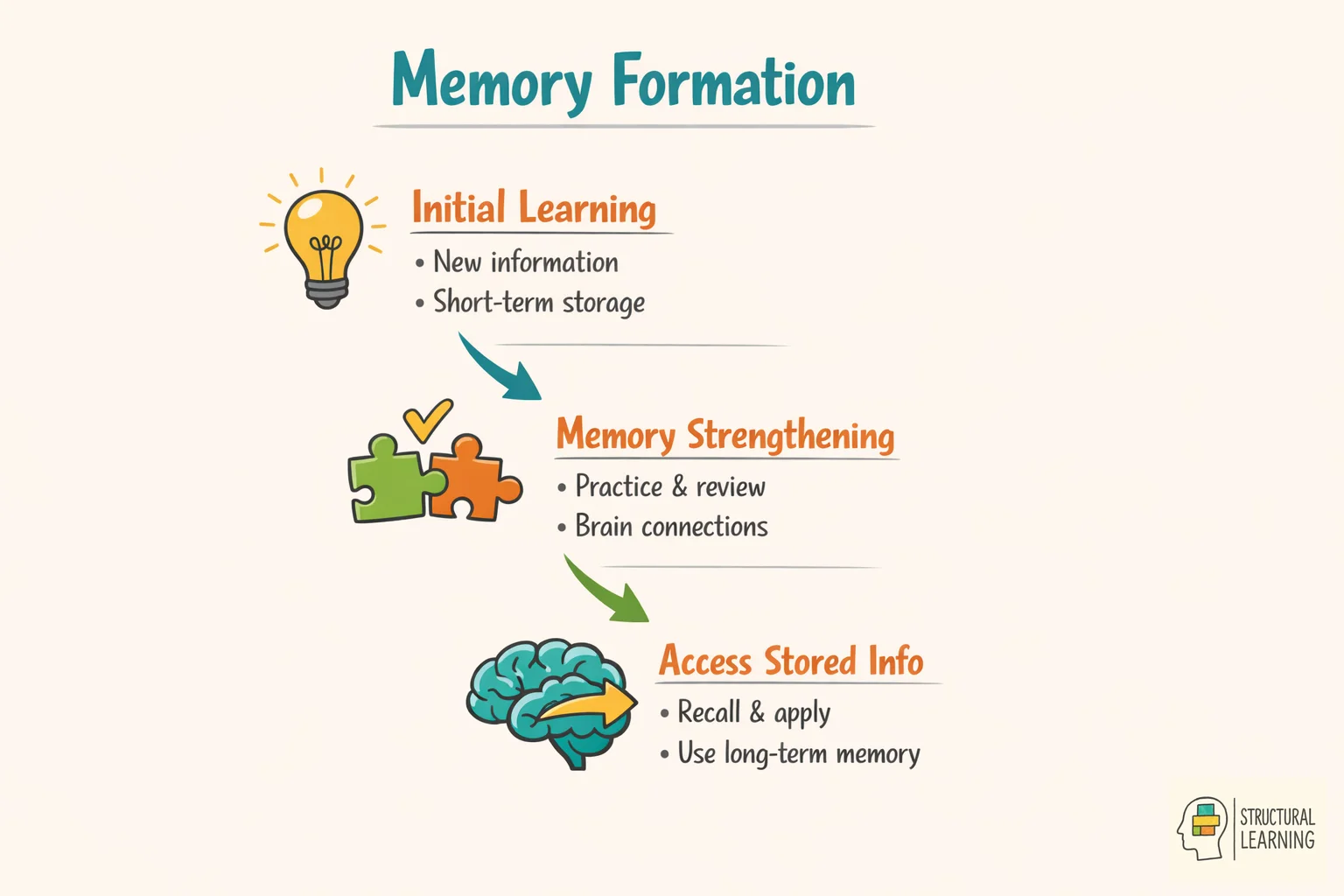
Encoding, consolidation, and retrieval are the three learning stages. Encoding initially creates a temporary memory (Baddeley, 1992). Consolidation then strengthens memories for long-term storage over time (McGaugh, 2003). Finally, retrieval accesses this stored information for the learner (Tulving, 1983).
Encoding initially transforms experiences into a usable format (Tulving, 1983). Storage then maintains this encoded information over time (Squire, 1992). Finally, retrieval allows learners to access and use stored memories (Baddeley, 2007).
Encoding initially registers information. Sensory experiences become neural representations (Baddeley, 1990). Good encoding determines what information reaches consolidation (Cowan, 2010; Ranganath, 2020).
Effective encoding requires attention, meaningful processing, and connection to existing knowledge. Research on working memory highlights how encoding depends on limited cognitive resources that can be improved through instructional design.
Consolidation follows encoding, stabilising and strengthening memory traces. This process can be enhanced or impaired by various factors including sleep, stress, and subsequent learning experiences.
Memory consolidation is complex; memories aren't just copies (Dudai, 2004). The brain reorganises memories during this process (McGaugh, 2000). It integrates them with a learner's prior knowledge and abstracts patterns (Bartlett, 1932).
Retrieval is the process of accessing stored information. Successfully retrieving a memory doesn't just demonstrate learning; it further strengthens the memory trace through a process called reconsolidation.
This explains why retrieval practice is such a powerful learning strategy. Each successful retrieval triggers reconsolidation, making the memory even more stable.
Sleep plays an essential role in memory consolidation by allowing the brain to replay and strengthen neural connections formed during learning. Both REM and non-REM sleep stages contribute to consolidating different types of memories, with slow-wave sleep particularly important for declarative knowledge. Students who get adequate sleep after learning show significantly better retention compared to those who are sleep-deprived.
Perhaps no finding in memory research has more practical importance than the role of sleep in consolidation. Sleep isn't merely the absence of interference; it actively strengthens and reorganises memories.
Different sleep stages support consolidation of different memory types.
This process, described by McClelland et al. (1995), aids long-term retention. Stickgold and Walker (2005) found that slow-wave sleep boosts declarative memory consolidation. Gais et al. (2006) showed that sleep soon after learning improved later retention of declarative memories; evidence for hippocampal replay during sleep is better attributed to Wilson & McNaughton (1994) and later replay/reactivation research. This slowly moves information to the neocortex for lasting memory, (Rasch & Born, 2013).
Research update: this general pattern is supported by sleep and memory research, but the relationship is more complex than a simple one-to-one mapping between a sleep stage and a memory type. Both slow-wave sleep and REM sleep appear to contribute to different aspects of consolidation, and the precise mechanisms continue to be refined (Diekelmann & Born, 2010; Klinzing et al., 2019).
REM sleep supports consolidation of procedural memories, including motor skills and implicit learning. Students learning physical skills, musical instruments, or procedures benefit from REM sleep following practise.
Both SWS and REM sleep contribute to memory consolidation, though their relative importance depends on what type of material is being learned.
The timing of sleep relative to learning affects consolidation. Research by Gais and colleagues found that sleep within three hours of learning produces better retention than sleep delayed by ten hours. This suggests that studying new material in the evening, followed by a full night's sleep, may be more effective than morning study followed by an active day.
Practical implications for homework timing emerge from this research. New or challenging material assigned as evening homework may benefit from overnight consolidation before the next lesson. Review of previously learned material might be better suited to morning assignments.
Teenagers face a particular challenge: their biological clocks shift towards later sleep and wake times just as school schedules demand early starts. This mismatch between biological rhythms and school timing means many adolescents experience chronic sleep restriction that impairs memory consolidation.
Teachers cannot solve this structural problem, but understanding it helps explain why some students struggle with retention despite apparent understanding during lessons. Supporting students in understanding the importance of sleep for learning may encourage better sleep habits.
Research by Active Systems Consolidation states sleep actively reorganizes memories. The hippocampus and neocortex work together (Born & Wilhelm, 2012). During sleep, the hippocampus replays the day's memories, moving them to the cortex (Diekelmann & Born, 2010). This strengthens memory and links it to prior learning (Rasch & Born, 2013).
This framework posits that memories move from the hippocampus to the neocortex over time (Born et al., various dates). During sleep, the hippocampus replays recent experiences, strengthening cortical connections (Born et al., various dates). This process supports long term memory storage and frees up hippocampal resources (Born et al., various dates). Researchers like Born examine how sleep helps the learner consolidate memories.
Diekelmann and Born's (2010) theory says the hippocampus replays memories during sleep. Reactivation strengthens the cortex and lessens hippocampal reliance. Memories eventually shift to the cortex, becoming integrated (Buzsáki, 1989; McClelland et al., 1995).
Brain imaging studies support this account. Regions active during learning are reactivated during subsequent sleep. The degree of reactivation predicts later memory strength. This isn't passive maintenance; it's active processing that transforms and strengthens memories.
For teachers, this theory reinforces the importance of creating meaningful initial learning experiences. Memories that are strongly encoded and connected to existing knowledge will be preferentially consolidated during sleep.
Retrieving memories makes them briefly unstable; they need reconsolidation (Nader et al., 2000). This window lets you update memories with learning or practise. Use retrieval practice so learners can strengthen their understanding (Roediger & Karpicke, 2006).
Nader (2003) showed retrieved memories briefly become unstable. Dudai (2004) explained reconsolidation is important for learner understanding. Alberini (2005) explores how this knowledge applies to education.
Each retrieval event triggers reconsolidation, which can strengthen the memory. This explains part of why retrieval practice is so effective: it doesn't just measure memory but actively modifies and strengthens it through reconsolidation.
Correcting misconceptions during retrieval can help learners update what they know, but reconsolidation evidence should be used cautiously in classroom advice. Trigger the misconception, give clear corrective feedback, and ask learners to explain the corrected idea so the new account is practised.
Retrieval of misconceptions can help learners correct them when feedback is immediate and explicit. Instead of only giving the correct answer, first surface the incorrect belief, then guide learners to compare it with the accurate explanation and practise the corrected version.
High cognitive load during initial learning can impair memory consolidation by overwhelming working memory capacity and preventing effective encoding. When students process too much information at once, their brains struggle to form strong initial memory traces that can be consolidated. Teachers should manage cognitive load by breaking complex topics into smaller chunks and providing adequate processing time between new concepts.
Cognitive load theory focuses primarily on encoding, but consolidation considerations extend its implications.
Researchers have found that effective consolidation needs effective encoding. High cognitive load harms encoding (Sweller, 1988). With limited working memory capacity, learners struggle. Good cognitive load management during teaching helps improve later consolidation (Clark, Nguyen, & Sweller, 2006).
(Anderson, 2000) discovered mentally rehearsing new material helps consolidation. Learners strengthen recall by thinking about recent learning (Ericsson, 2003). Brief reflection supports knowledge consolidation (Newell & Simon, 1972).
Sleep deprivation impairs both encoding through reduced attention and consolidation through insufficient sleep-dependent memory processing. Students who are sleep deprived face a double challenge in learning.
Effective strategiesinclude spaced practice sessions, interleaving different topics, and incorporating retrieval practice through low-stakes quizzing.. Teachers should also time homework to allow for sleep-based consolidation and avoid introducing similar content that might cause interference. Building in reflection time at the end of lessons helps initiate the consolidation process before students leave class.
Understanding consolidation suggests several practical classroom strategies.
Assign new or challenging material as evening homework when possible. This positions new learning close to sleep, maximising the opportunity for overnight consolidation.
Begin lessons with review of previously learned material. This retrieval practice strengthens those memories through reconsolidation while activating relevant schemas that support encoding of new content.
Include brief pauses after presenting new concepts. These moments allow initial synaptic consolidation to begin and give students opportunity to make connections with existing knowledge.
Help students understand the connection between sleep and learning. This is particularly important for older students who may undervalue sleep in favour of late-night studying.
This reduces cognitive overload and improves long-term retention (Rohrer, 2012). Spaced practice helps learners differentiate similar ideas effectively (Kang, 2016). Learners benefit from interleaving different topics to boost learning (Brown et al., 2014).
Rather than testing only recent content, include material from earlier in the course. This requires retrieval of previously consolidated material, strengthening it further.
Help students plan revision that distributes practise over time rather than cramming. Connect this to their understanding of how consolidation works.
Declarative memories consolidate during slow-wave sleep (Rasch, Born, & Gais, 2006). These memories use hippocampal-neocortical interactions. Procedural memories consolidate during REM sleep (Walker, Brakefield, Hobson, & Stickgold, 2002). Motor cortex and striatum are involved in these memories. Teachers, schedule practise considering these memory differences (Robertson, 2009). Review conceptual material quickly. Use distributed practice for skills.
Different types of learning may consolidate through somewhat different mechanisms.
Researchers show sleep helps memory (Walker, 2008). Declarative memory, like facts, needs sleep consolidation. School learning needs this process, given the focus on declarative knowledge (Stickgold, 2005; Gais et al., 2006).
Skills and procedures (procedural memory) consolidate through repetition and practise, with sleep, particularly REM sleep, playing a role in offline gains. Students learning procedures should expect improvement after sleep, even without additional practise.
Research shows sleep helps learners consolidate perceptual distinctions (Diekelmann & Born, 2010). Learners remember patterns, sounds, and scientific specimens better after sleep. Musical intervals and language sounds also improve with overnight consolidation (Fenn et al., 2003; Dumay & Gaskell, 2007).
Sleep, stress, prior knowledge and biology affect memory. Learners with better sleep and lower stress are often better placed to consolidate memories. Use varied teaching approaches, spaced review and retrieval practice so learners have repeated opportunities to stabilise and use knowledge.
Students vary in their consolidation efficiency, affecting learning outcomes.
Children show strong sleep-dependent memory consolidation, often even stronger than adults. However, they require more sleep overall. Adolescents face the challenge of shifted biological clocks combined with early school starts.
Students with sleep disorders, inconsistent sleep schedules, or insufficient sleep quantity show impaired consolidation. These students may understand material in class but show poor retention.
Students with more relevant prior knowledge consolidate new information faster because they have existing schemas to integrate it with. This creates cumulative advantages for students who build strong knowledge foundations.
Emotional arousal helps learners remember due to stress hormones and the amygdala (McGaugh, 2004). Moderate positive emotion aids memory. High stress or negative feelings hinder it (Tyng et al., 2017). Teachers can create engaging, supportive environments to improve learning (Immordino-Yang & Damasio, 2007).
Research by Christianson (1992) and Cahill et al (1996) shows this. Emotionally charged experiences consolidate differently than neutral ones. Moderate emotional arousal improves memory consolidation. However, extreme stress can hinder the learner's ability to remember (Diamond et al, 2007).
Affect impacts learning, as suggested by Tyng et al. (2017). Bored learners encode less, while stressed learners struggle (Pekrun, 2006). A suitable challenge helps learners, according to Bjork and Bjork (2011).
Research shows chronic stress harms memory (Kim & Diamond, 2002). Anxious learners may find recall difficult (Schwabe et al., 2012). Even with lesson understanding, stress impacts retention (Vogel & Schwabe, 2016).
Researchers like Atkinson & Shiffrin (1968) show frequent review helps struggling learners. Visual organisers and mnemonic devices aid encoding (Baddeley, 1994). Clear lessons and routines reduce cognitive load, supporting consolidation (Sweller, 1988).
Some students may show particular difficulties with memory consolidation.
Students reporting sleep difficulties may need support in improving sleep habits. For some, referral to health services may be appropriate. Teachers can accommodate by providing more distributed practice opportunities and reducing reliance on single learning episodes.
Research from Cowan (1995) and Morey (2018) shows attention impacts memory. Learners with attention issues may struggle to encode information initially. Therefore, support for attention during teaching can help learners consolidate knowledge.
Students with working memory difficulties may struggle with the initial encoding that precedes consolidation. Breaking content into smaller chunks and providing external supports, such as notes or graphic organisers, helps ensure adequate encoding.
Researchers (Cepeda et al., 2008) show spaced practice helps memory by strengthening learning links. Reviews encourage reconsolidation, boosting memory long term (Karpicke & Roediger, 2007). Massed practice stops memory consolidation, creating weaker, short term gains (Rohrer & Pashler, 2007).
The benefits of spaced practice can be partly understood through consolidation. When practise is distributed over time, consolidation occurs between sessions. Each subsequent practise session retrieves and reconsolidates the partially consolidated memory, strengthening it further.
Massed practice, by contrast, doesn't allow consolidation between repetitions. The memory remains in an unstable state throughout the practise session and only begins consolidating when practise ends.
This explains why the same total practise time produces better retention when distributed rather than massed. Spacing allows the consolidation processes that strengthen memories and protect them from forgetting.
Teachers structure lessons with consolidation time, review during consolidation windows, and teach learners about memory. Lessons end with summaries. Reflective homework before sleep and next-day warm-ups reactivate learning. This knowledge informs timing and sequencing (Brown, Roediger & McDaniel, 2014).
Research by neuroscientists like Dudai (2004) explains memory consolidation. Teachers can't control brain processes, but should understand this. Knowledge of consolidation, like in studies by Wixted (2004), explains effective practices. Consider timing and structure when teaching (Rawson & Dunlosky, 2011) to support each learner.
The key insight is that learning continues after lessons end. The period following instruction, particularly sleep, plays an active role in converting understanding into lasting knowledge. Teachers who structure instruction, practise, and assessment with consolidation in mind create conditions for more durable learning.
Spacing practise boosts learner recall, (Dunlosky et al., 2013). Prioritise sleep consolidation for new information, (Wilhelm et al., 2011). Integrate retrieval practice regularly, (Karpicke, 2016). Explain memory processes to learners, (Bjork et al., 2013).
Dudai reviewed consolidation theory. Rasch and Born studied sleep and memory. Roediger researched retrieval practice and consolidation. These works explain consolidation mechanisms and teaching implications. Teachers can find guides translating neuroscience to classrooms.
The following papers provide deeper exploration of memory consolidation and its educational implications.
Research shows sleep helps learners consolidate memories. Studies by behavioural scientists, brain imagers, and neurophysiologists show this. They argue sleep actively processes memories, not just blocking distractions. Teachers should understand how sleep aids learning.
The process is crucial for long-term retention (Dudai, 2004; Frankland & Bontempi, 2005). Converging evidence suggests sleep actively reorganises memories (Diekelmann & Born, 2010). This strengthens crucial recall processes for learners.
Consolidation research informs learning advice. The author discusses sleep timing and napping. This review shows how consolidation knowledge can boost learners' study skills (Wixted, 2004; Diekelmann & Born, 2010; Stickgold & Walker, 2005).
Nader's (2003) reconsolidation shows retrieved memories become changeable. Updating memories and fixing errors are possible. This process, studied by Dudai (2004), helps address misconceptions in learning. Kandel's (2012) work suggests practical classroom applications.
This study demonstrates sleep-dependent consolidation in a learning context relevant to education. Participants showed improved speech recognition after sleep but not after equivalent time awake, illustrating the active role of sleep in perceptual learning.
Systems consolidation is a longer process (McGaugh, 2000). It gradually transfers memories to the neocortex. Synaptic consolidation happens quickly (Dudai, 2004). Proteins build connections for stronger neuron links. Immediate lesson revision works best. Pathways stay active, reinforcing learning (Robertson, 2009).
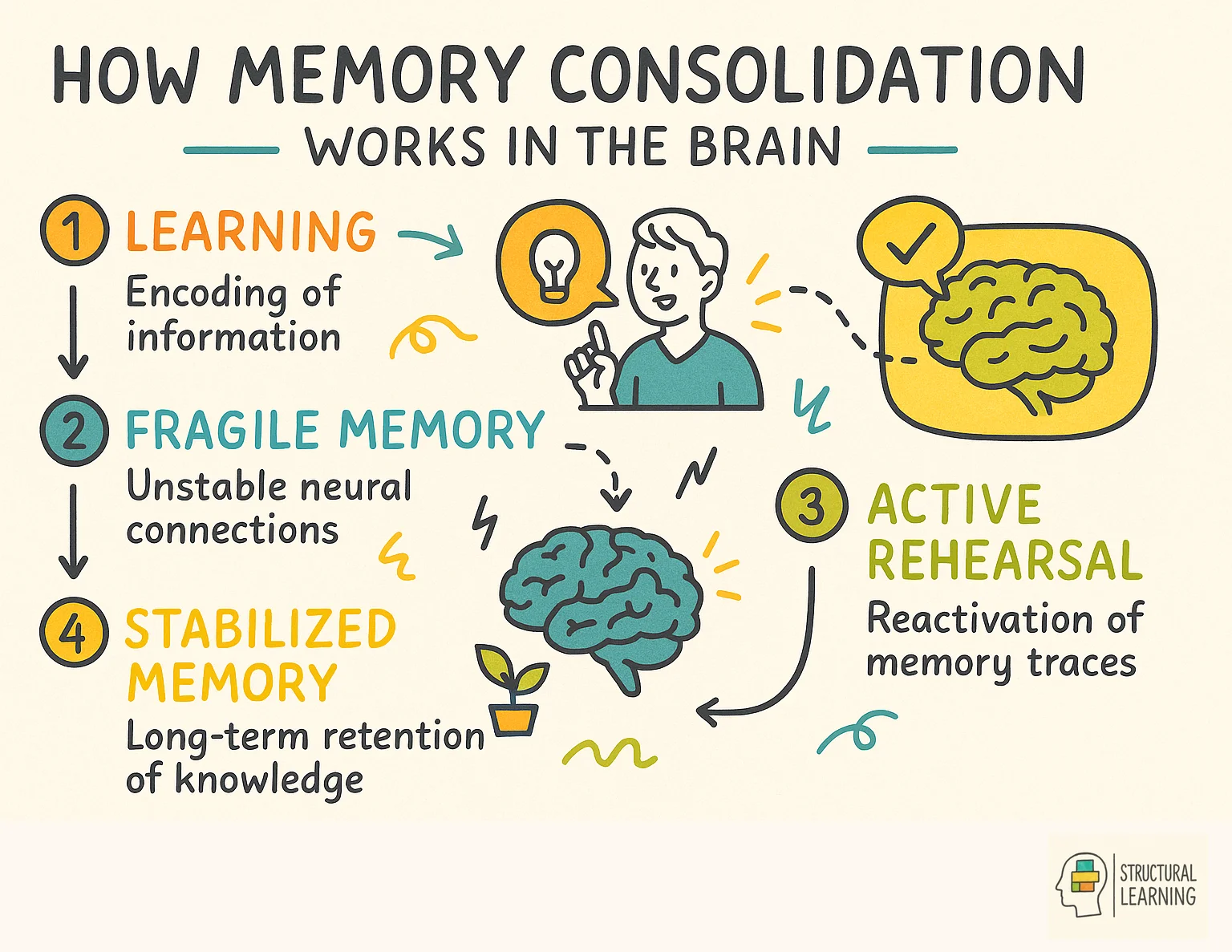
Systems consolidation moves memories from the hippocampus to the neocortex over time. This process integrates memories with existing knowledge networks for richer understanding. Brain scans show that consolidated memories activate more brain areas (Squire and Alvarez, 1995; Dudai, 2004; Frankland and Bontempi, 2005).
Instructional design can help learners' brains. Spaced practice works with memory consolidation (Cermak, 1979). Review vocabulary Monday, Wednesday, and Friday. This strengthens memory traces (Wickelgren, 1974; Squire, 1992).
Sleep plays a crucial role in both consolidation stages. During slow-wave sleep, the hippocampus replays learning experiences, strengthening synaptic connections. REM sleep then integrates these memories with existing knowledge. This research validates homework timing; assignments completed earlier in the evening allow proper sleep consolidation, whilst late-night cramming disrupts these essential processes.
Research on sleep, retrieval and consolidation can inform curriculum pacing, homework and revision routines (Diekelmann & Born, 2010; Rasch & Born, 2013; Roediger & Karpicke, 2006). Use this evidence to plan spaced review and retrieval practice, while avoiding over-precise claims about exactly when every learner consolidates a memory.
Synaptic consolidation and systems consolidation are memory processes. These processes link, so understanding them helps teachers. This knowledge allows educators to design learning experiences (Dudai, 2004; Kandel, 2012). These learning plans support learners' natural information storage (McGaugh, 2000; Squire, 1992).
Synaptic consolidation happens first, typically within minutes to hours after learning. During this process, connections between neurons strengthen through repeated activation and protein synthesis. This explains why immediate review activities are so powerful; when students revisit new material within the same lesson or shortly afterwards, they're supporting these cellular-level changes. For instance, ending a maths lesson with a quick problem-solving session reinforces the synaptic changes initiated during instruction.
Systems consolidation unfolds over weeks, months, or even years. Here, memories gradually reorganise, shifting from temporary storage in the hippocampus to more permanent residence across the cortex. This process explains why spaced practice works so effectively. When students encounter previously learnt material after days or weeks, they're not just reviewing; they're facilitating the brain's natural tendency to redistribute and strengthen memory networks.
Teachers can support both processes through strategic planning. For synaptic consolidation, incorporate brief retrieval practice within lessons, such as having students explain a concept to a partner immediately after teaching it. For systems consolidation, design curriculum spirals that revisit key concepts at increasing intervals. A science teacher might introduce photosynthesis in September, return to it when teaching ecosystems in November, and connect it to carbon cycles in February.
Dudai (2004) and Frankland & Bontempi (2005) show respecting consolidation timescales boosts retention. Teachers who align methods with these biological processes help learners access knowledge later.
Sleep isn't just rest for tired bodies; it's when your brain actively transforms the day's learning into lasting memories. During sleep, particularly deep slow-wave sleep and REM phases, the brain replays and reorganises information acquired during waking hours. This nocturnal processing strengthens neural connections, transfers memories from temporary to permanent storage, and integrates new knowledge with existing understanding.
Research by Walker and Stickgold (2006) demonstrates that students who sleep after learning perform significantly better on tests than those who stay awake, even when total study time remains identical. The hippocampus, which temporarily stores new memories, communicates with the cortex during sleep, gradually shifting information into long-term storage networks. Without adequate sleep, this transfer process falters, leaving memories vulnerable to decay.
Teachers can harness sleep's power through strategic planning. Schedule challenging new concepts early in the school day, allowing maximum time for consolidation before students sleep. When teaching complex procedures or problem-solving methods, encourage students to review notes briefly before bedtime; this 'sleep to remember' strategy enhances overnight consolidation. For revision periods, advise students to spread learning across multiple days rather than cramming, ensuring each study session benefits from sleep-dependent consolidation.
Consider adjusting homework patterns too. Rather than assigning heavy practise immediately after teaching, introduce new concepts, provide light initial practise, then assign deeper practise the following day after consolidation has begun. This approach respects the brain's natural learning rhythms and produces more durable understanding. Even a 20-minute classroom nap after intensive learning can boost memory retention, though this remains impractical in most school settings.
AI-driven spacing systems now analyse individual student responses to determine optimal review intervals automatically, moving beyond the static spacing schedules teachers have traditionally used. These adaptive algorithms track each learner's recall success rates, response times, and error patterns to create personalised repetition schedules that adjust in real-time based on performance data.
When Mrs Thompson's Year 8 mathematics class uses an AI-powered platform for algebra revision, the system monitors how quickly Sarah recalls quadratic equations versus how Tom struggles with factorisation. The computational memory optimisation adjusts Sarah's next algebra review to occur in five days, while scheduling Tom's factorisation practise for tomorrow morning. Each student receives intelligent spacing intervals calibrated to their individual forgetting curves.
Settles and Meeder (2016) developed half-life regression as a model for estimating review timing in online language learning. Use this as evidence that adaptive systems can help estimate spaced review, not as a guaranteed percentage improvement over teacher-determined schedules.
However, successful implementation requires teachers to understand that adaptive educational technology supplements rather than replaces pedagogical judgement. Teachers must still design meaningful learning experiences and interpret the algorithmic recommendations within broader classroom contexts, ensuring that personalised spacing serves genuine understanding rather than mechanical repetition.
Sleep plays a critical role in converting the day's learning into permanent memories. During sleep, particularly during slow-wave and REM stages, the brain replays and reorganises information acquired during waking hours. This nocturnal activity strengthens neural connections and transfers memories from temporary storage in the hippocampus to more stable cortical networks, a process that research suggests is essential for long-term retention (Diekelmann & Born, 2010).
Teachers can harness this knowledge to enhance student learning outcomes. Scheduling challenging new content earlier in the day, rather than late afternoon, gives students more waking hours to process information before sleep consolidation begins. Consider introducing complex mathematical concepts or new vocabulary during morning lessons, then providing lighter review activities later. This timing allows students' brains to engage with difficult material when most alert, whilst ensuring adequate processing time before sleep.
Homework timing also matters for memory consolidation. Rather than assigning extensive practise immediately after teaching new content, consider a brief review task for that evening, followed by more substantial practise the next day. This approach allows sleep-dependent consolidation to occur before students attempt complex applications. For instance, after teaching photosynthesis, assign students to create simple diagrams that evening, then tackle problem-solving questions the following day.
Educational research consistently shows that sleep-deprived students struggle with memory formation and recall. Teachers can support healthy sleep habits by avoiding excessive homework loads and educating students about sleep's role in learning. Explaining how their brains actively process information during sleep often motivates adolescents to prioritise rest, transforming sleep from perceived time-wasting into recognised study time.
Memory consolidation stabilises new information (McGaugh, 2000). Learners forget things quickly; understanding this process is crucial. Teachers can time lessons and practise better, supporting lasting learning (Wixted, 2004; Karpicke, 2012).
Synaptic consolidation strengthens neural connections within hours (McGaugh, 2000). Systems consolidation transfers memories to the cortex over weeks (Squire & Alvarez, 1995). Therefore, the brain strengthens memories long after the learner leaves (Dudai, 2004).
Research suggests that new or challenging material should be assigned as evening homework, as sleep within three hours of learning produces better retention than delayed sleep. Review of previously learned material might be better suited to morning assignments, allowing students to benefit from overnight memory consolidation before tackling new concepts.
During sleep, particularly slow-wave sleep, the hippocampus actively 'replays' recent learning experiences and gradually transfers them to cortical networks for long-term storage. Students who get adequate sleep after learning show significantly better retention compared to sleep-deprived students, as both REM and non-REM sleep stages contribute to consolidating different types of memories.
Teenagers' biological clocks naturally shift towards later sleep and wake times, but early school schedules create chronic sleep restriction that impairs memory consolidation. Whilst teachers cannot solve this structural problem, they can help students understand the importance of sleep for learning and potentially adjust homework timing to work with rather than against natural sleep patterns.
Retrieval strengthens memory by triggering reconsolidation after successful recall. This helps learners remember things better (Bjork, 1975). Testing and quizzing are powerful learning strategies because retrieval boosts memory traces (Karpicke & Roediger, 2008).
Teachers should recognise that learning doesn't end when lessons finish, as consolidation continues for hours and days afterwards. This means structuring instruction to support encoding through attention and meaningful connections, timing practise and homework to align with consolidation processes, and using retrieval practice to strengthen memories through reconsolidation.
These sources draw on work directly relevant to memory consolidation, sleep, retrieval and spacing.