Updated on
September 25, 2026
Colourful Semantics Worksheets
Colour-coded sentence-building worksheets help learners build and write sentences step by step. A free printable pack for primary classrooms.


Updated on
September 25, 2026
Colour-coded sentence-building worksheets help learners build and write sentences step by step. A free printable pack for primary classrooms.
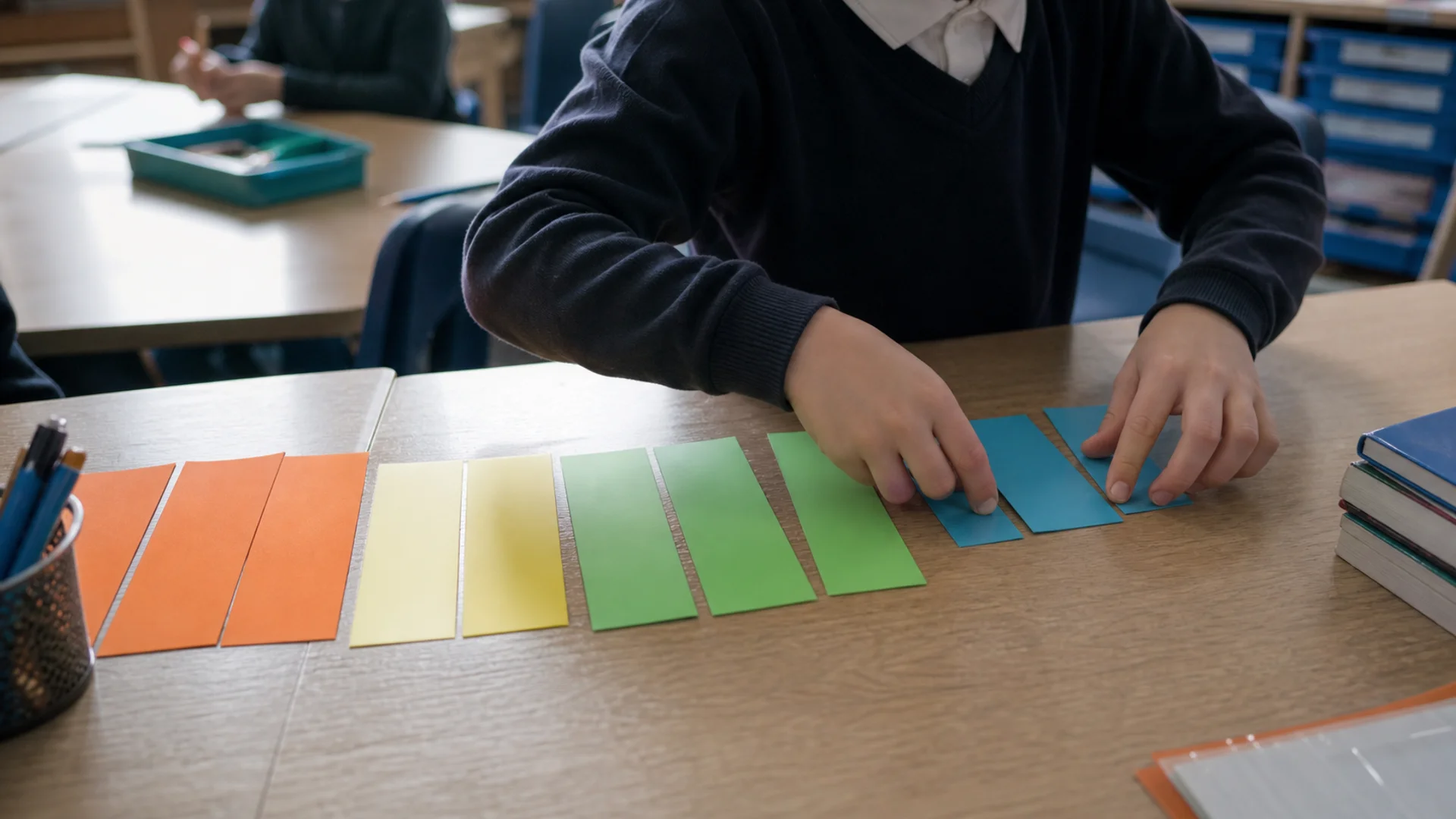
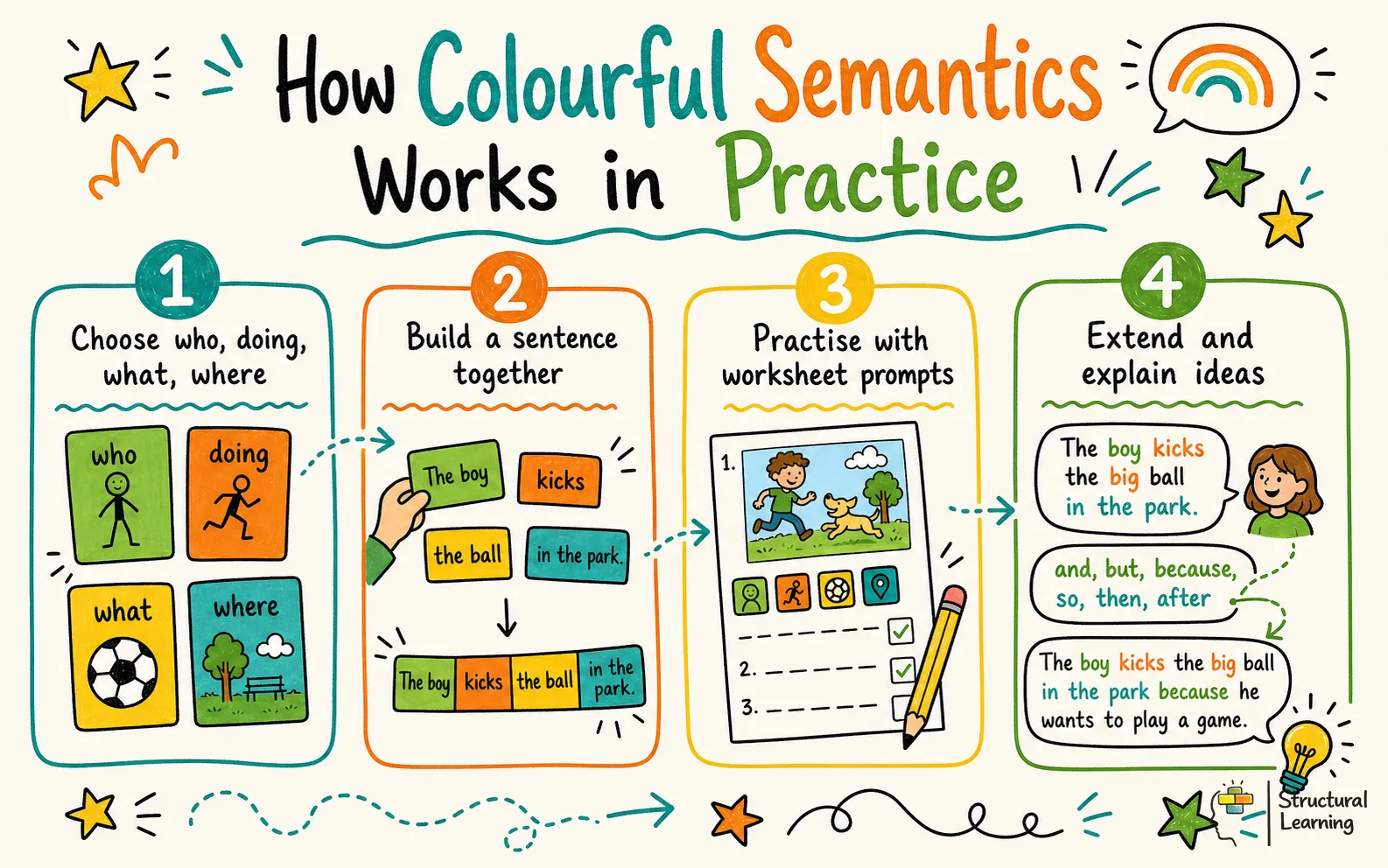
Colourful Semantics worksheets are printable sentence-building sheets that give each part of a sentence a colour: orange for who, yellow for what doing, green for what, and blue for where. A learner reads or draws each colour box, says the sentence, then writes it. Used after a spoken routine, colour-coded sentence tasks have improved sentence construction and word order in primary learners (Rambe et al., 2025; Li, 2017).
This page gives you a free worksheet pack and shows you how to use it well. The sheets are a scaffold, not the lesson, so the order you use them in matters more than the sheet itself. For the full method and the thinking behind the colour code, see our complete guide to Colourful Semantics.
Pick a topic and a level, then generate a colour-coded sentence to read aloud and build. Orange = who, yellow = what doing, green = what, blue = where, pink = when.
1. Choose a topic
2. Choose a level
Tip: say the sentence aloud together before writing it, then fade the colours as learners gain confidence.
A printable A4 pack: blank sentence-building strips at four levels, a worked example and a teacher quick-reference card. Colour-coded to the Colourful Semantics method (orange = who, yellow = what doing, green = what, blue = where), developed by Alison Bryan (1997).
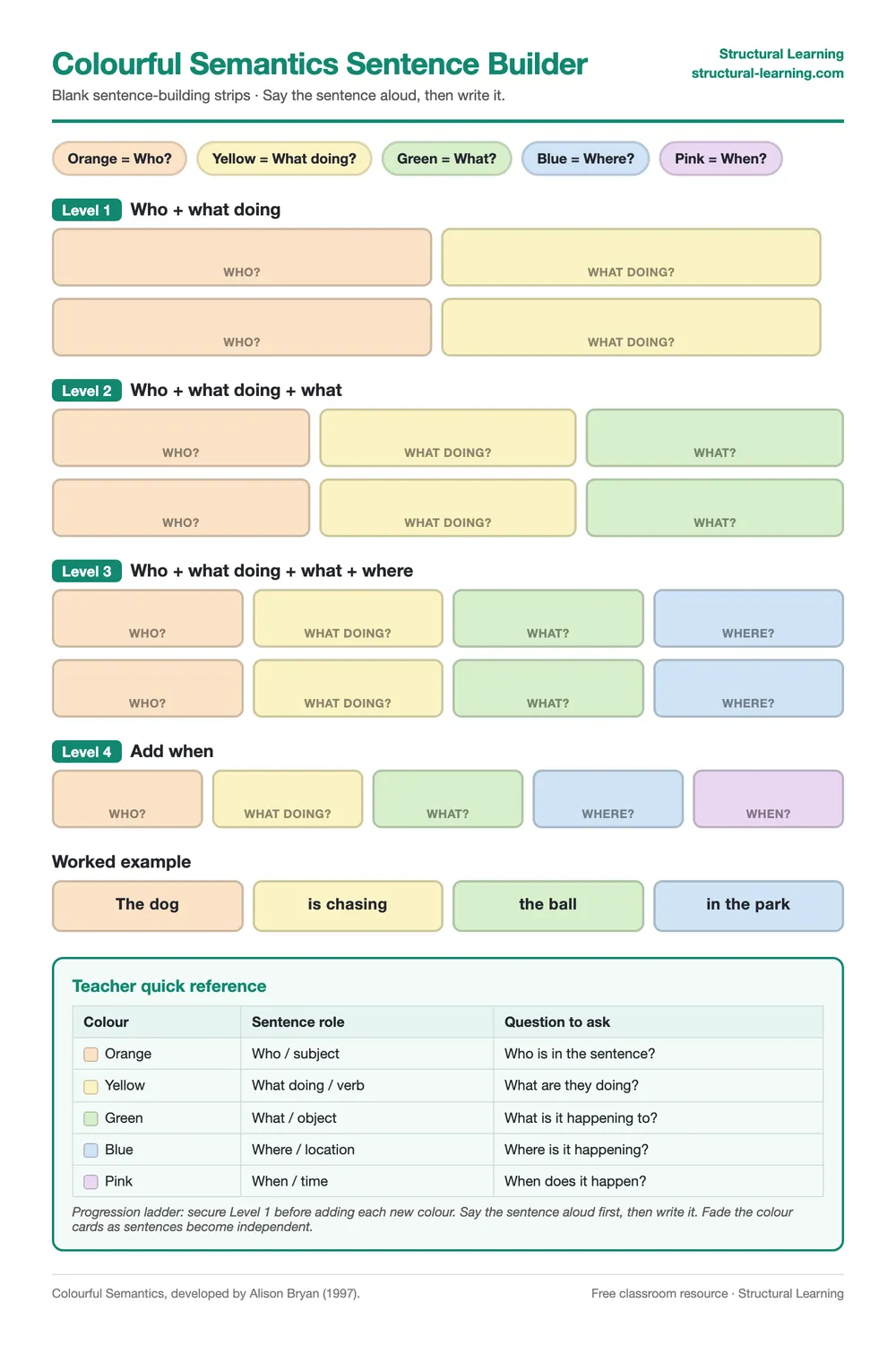
The pack below contains blank colour-coded sentence strips at three levels, a teacher quick-reference card, a worked example and a progression ladder. Print the level your learners are working at and keep the reference card on your desk.
The strips are deliberately plain so you can pair them with your own pictures or photographs. Laminate a set for reuse with a whiteboard pen, and keep a paper set for learners to stick finished sentences into a book.
You do not need every sheet at once. Start with the two-part strip and add levels only as learners are ready.
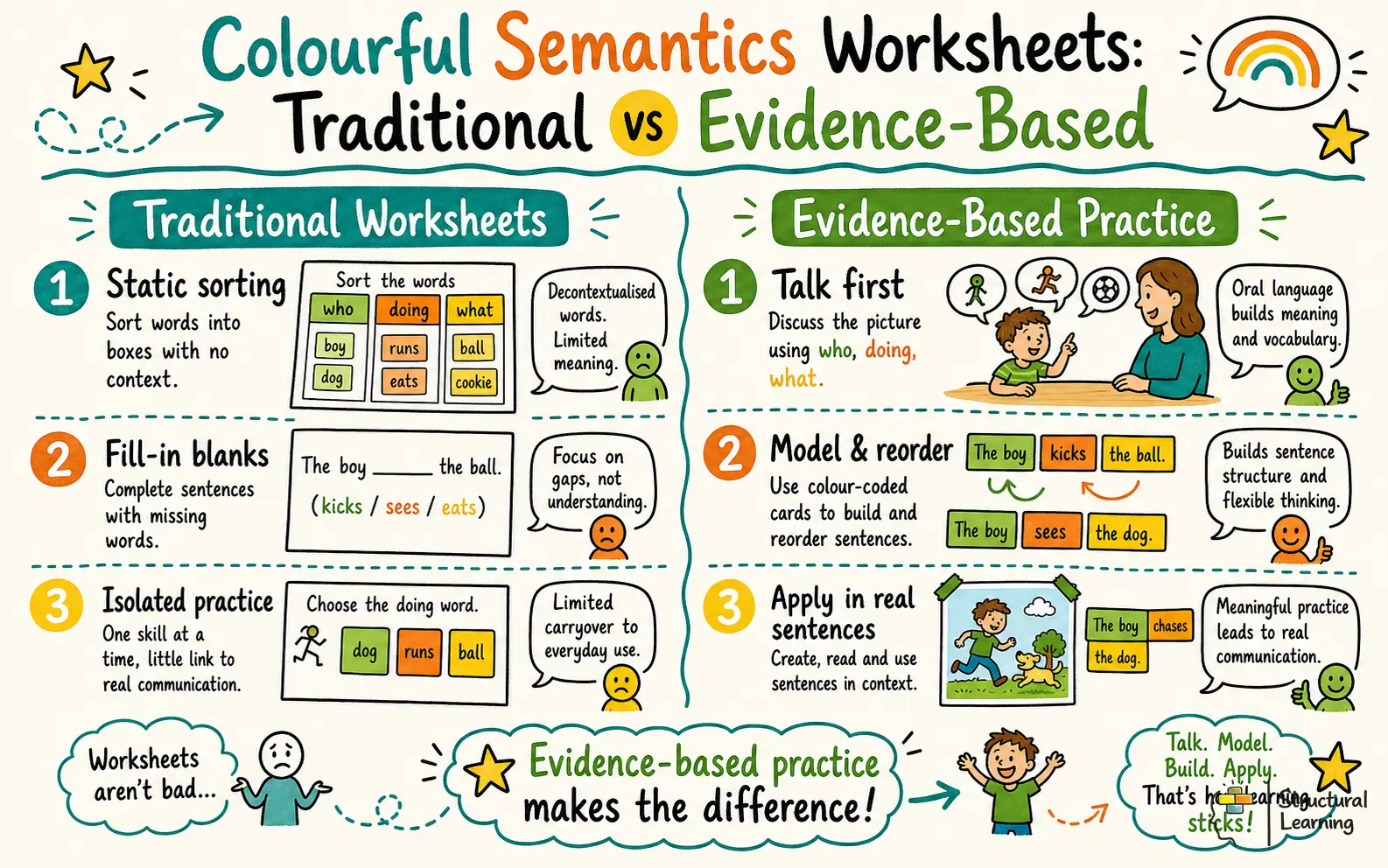
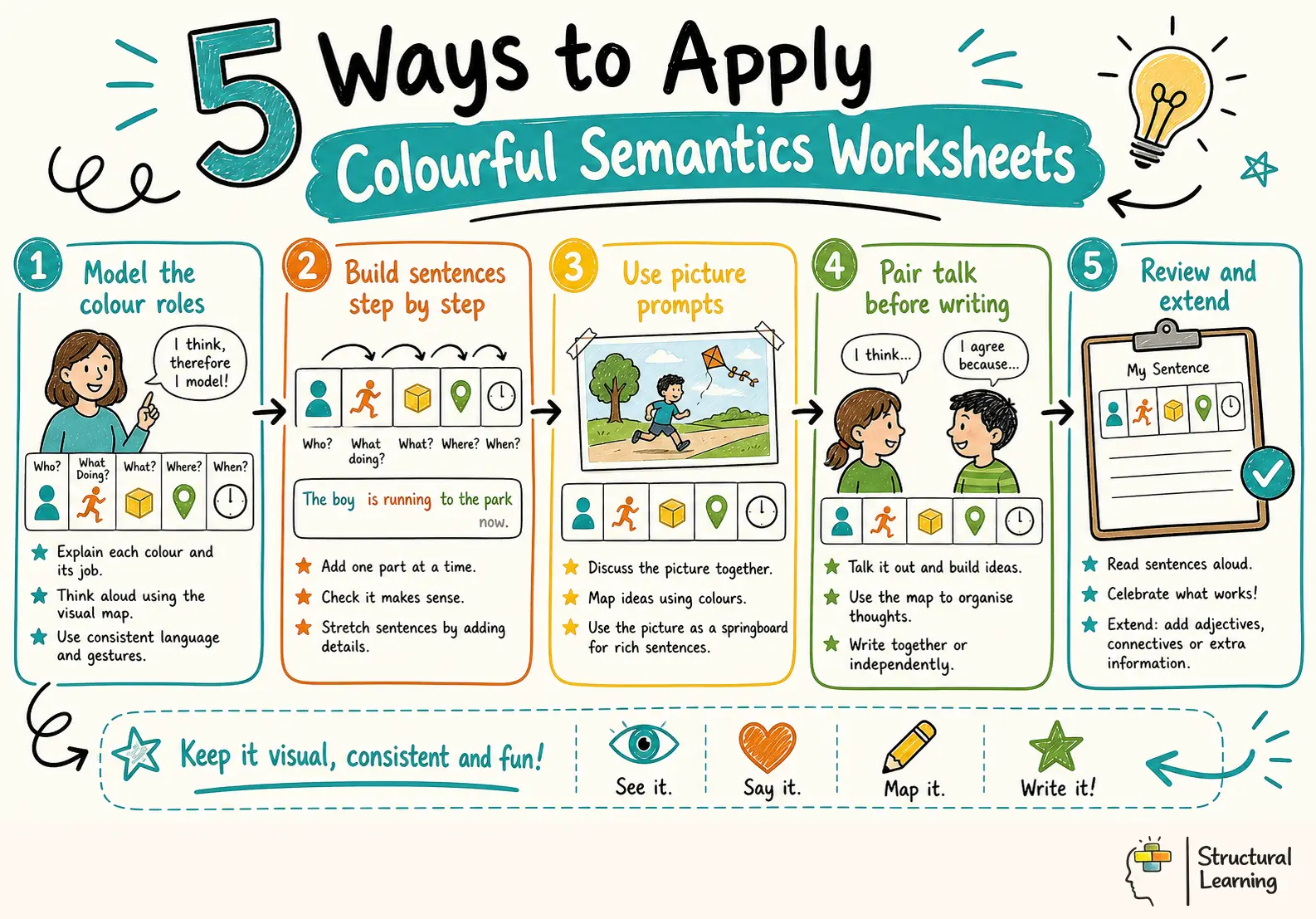
First, say the sentence before you write it. The worksheet supports a Say It routine: the learner builds and speaks the sentence with the colour prompts, then records it on the sheet. Skipping the spoken step is the most common reason worksheets fail.
Second, match the sheet to the sentence level. A learner who cannot yet join who and what doing should use the two-part strip, not the five-part one. Move up only when the current level is secure.
Third, fade the support. Begin with full colour blocks, move to coloured dots under blank lines, then to a plain line. Because the colour cue holds the structure, the worksheet frees the learner's working memory to choose words (Yee et al., 2024), and fading it transfers that structure to independent writing.

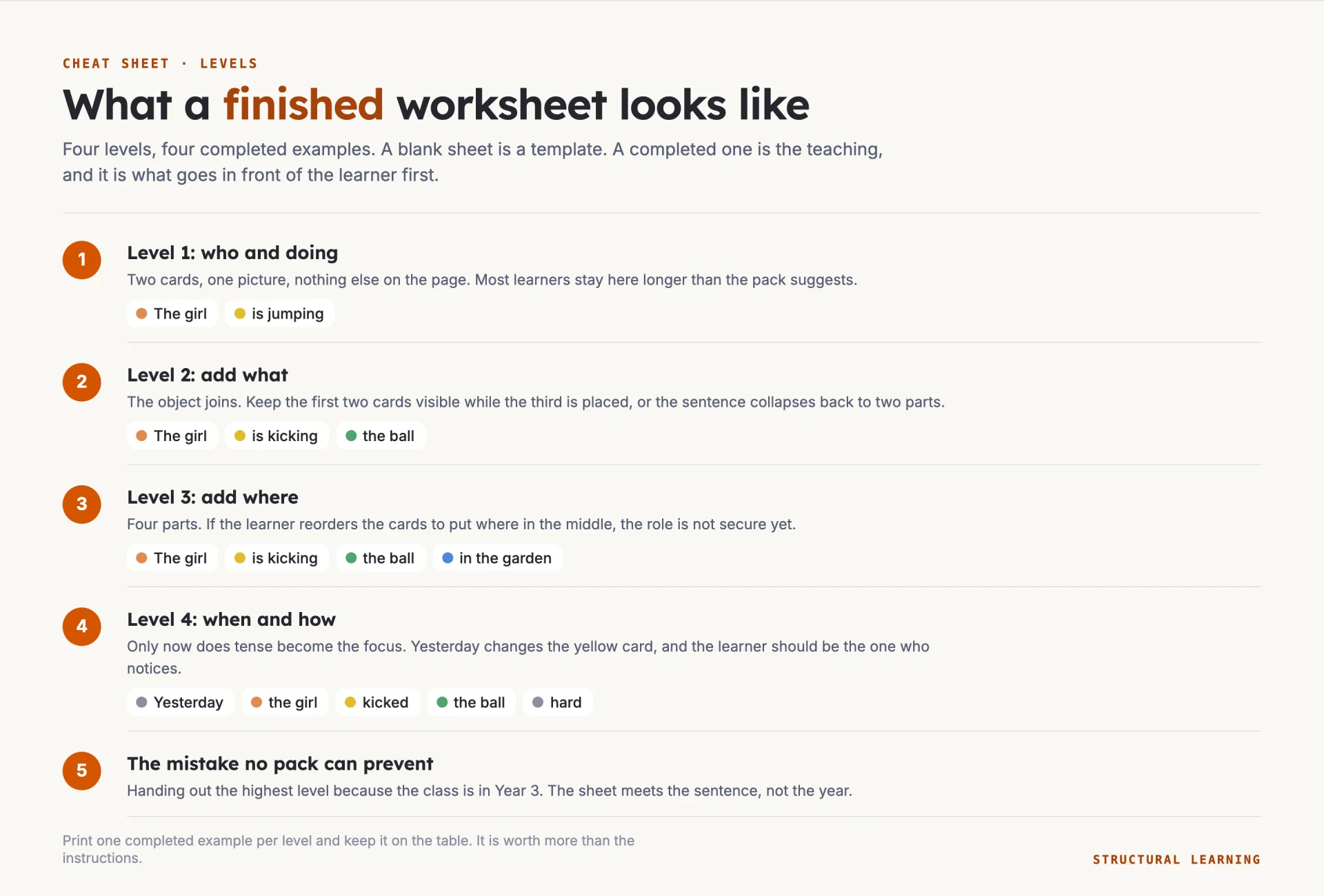
The pack is organised by how many roles the sentence contains, so you can place a learner precisely.
The two-part strip covers who and what doing ("The dog is barking"). The three-part strip adds the green "what" ("The dog is chasing the cat"). The four- and five-part strips add blue "where" and then a "when" or describing word ("The dog is chasing the cat in the garden this morning").
Use the same colour order on every sheet. Consistency is what let four weeks of colour-coded sentence work shift Year 4 learners' sentence construction in classroom studies (Li, 2017).
For learners with developmental language disorder, reduce the number of boxes and stay at one sentence level until it is secure. Practicing a single structure across many sheets is what helps it transfer to new sentences.
For learners with English as an additional language, pair each colour box with a picture so the sheet teaches the word and its place in the sentence at the same time. For pre-readers and EYFS children, add Widgit symbols under each colour so a non-reader can complete the sheet from images alone.
A worksheet is a form of writing frame, so the same rules apply: model it first, use it as a temporary support, and plan its removal.

The first mistake is handing out the sheet cold. Without the spoken routine first, a worksheet becomes a copying task and the structure is not learned.
The second is leaving the colour support in place too long. If a learner still needs full colour blocks after weeks, the support has become a crutch rather than a scaffold; step down to dots and then to a plain line.
The third is judging the sheets by the wrong measure. Gains from school-delivered Colourful Semantics show up more reliably on sentence-level measures than on standardised tests (Atwell, 2024), so look at the learner's sentences over time rather than waiting for a test score to jump.
Worksheets are one step in building better sentences, not the whole journey. They follow spoken sentence work and lead into independent writing, so plan them as the bridge between the two.
Pair them with oral games and small-group work for the talking practice, and with wider reading and vocabulary teaching so learners have something to write about. The sheet structures the sentence; the rest of your teaching supplies the meaning.
For more in this series, see the Colourful Semantics activity bank and how to use the approach in EYFS and KS1.
They are printable sentence-building sheets that colour-code each part of a sentence, so learners arrange who, what doing, what and where in order before writing. They turn the spoken colour-coded routine into a written task.
Yes. The pack on this page is free and includes blank strips at three sentence levels, a teacher reference card, a worked example and a progression ladder. Print and laminate as many as you need.
The usual order is orange (who), yellow (what doing), green (what), then blue (where), with later additions for when and describing words. Keep the order identical across sheets so learners internalise the structure.
The strips work from Reception through Key Stage 2, because you choose the sentence level rather than the age. Classroom studies show gains from Year 1 sentence writing up to Year 4 (Yee et al., 2024; Li, 2017).
Yes. Colour-coding makes English word order explicit without grammatical jargon, which helps EAL learners, and pairing each box with a picture supports both EAL and SLCN learners. Match the sentence level to the learner rather than the label.
Print the two-part strip from the pack and use it after a five-minute spoken sentence game in your next lesson, then move a learner up a level only once they can say and write that sentence without the colour blocks.
These peer-reviewed studies provide the evidence base for the strategies discussed above.
Using colourful semantic approaches as a group intervention within primary schools to improve language development: A mixed methods design
K. (2024)
This study demonstrates that school staff can successfully deliver Colourful Semantics in small groups. Teachers can use this intervention to improve young learners' sentence structure and sentence length, supporting early language development directly within mainstream classrooms.
Colourful semantics: A clinical investigation
33 citations
Bolderson et al. (2011)
Providing strong evidence for targeted support, this research shows that Colourful Semantics significantly improves grammar and sentence length. Teachers can confidently implement this structured visual framework to scaffold speech and language progress for struggling five- and six-year-old learners.
Enhancing Students' Linguistic by Using Colourful Semantics Game
Rambe et al. (2025)
This research proves that using a sequenced Colourful Semantics game helps primary learners master word order. Teachers can utilize the 'who, what doing, what, where' sequence as an active classroom game to boost learners' confidence and sentence construction skills.
The Use of Colourful Semantics in Improving Sentence Writing Skills among Level One Pupils
Yee et al. (2024)
Grounded in cognitive load theory, this paper explains how visual colour-coding scaffolds early writing. Teachers can use these worksheets to reduce learning anxiety, help learners with limited vocabulary, and systematically build grammar proficiency through clear visual cues.
The Use of Colourful Semantics to Improve Sentence Construction in Writing Sentences among Year Four Pupils
K. (2017)
Showing rapid progress over just four weeks, this study highlights significant gains in learners' sentence construction. Teachers of older primary learners can use this structured sequence to correct word order errors and elevate independent writing standards.