Updated on
September 25, 2026
Colourful Semantics in EYFS and KS1
Colourful Semantics in EYFS and KS1 uses colour to show children how sentences work. Learn when to introduce colours and move from spoken to written.


Updated on
September 25, 2026
Colourful Semantics in EYFS and KS1 uses colour to show children how sentences work. Learn when to introduce colours and move from spoken to written.
Colourful Semantics in EYFS and KS1 uses a colour for each part of a sentence so young children can see how meaning fits together. Orange is who, yellow is what doing, green is what, and blue is where. A child picks a card for each colour, says the sentence aloud, then, in Key Stage 1, writes it. The approach has its clearest early-years evidence with 5- and 6-year-olds, where colour-coded sentence building improved grammar and mean sentence length under controlled conditions (Bolderson et al., 2011).
This guide is for Reception, Year 1 and Year 2 teachers and early-years practitioners. It covers which colour to introduce first, what a session looks like, how to support pre-readers and learners with English as an additional language, and how to move from spoken sentences to early writing. For the colour system and its origins, read our complete guide to Colourful Semantics; this page is the early-years application.
Pick a topic and a level, then generate a colour-coded sentence to read aloud and build. Orange = who, yellow = what doing, green = what, blue = where, pink = when.
1. Choose a topic
2. Choose a level
Tip: say the sentence aloud together before writing it, then fade the colours as learners gain confidence.
Young children learn the meaning of a sentence before they learn its grammar. Colourful Semantics matches that order. Created by Alison Bryan in 1997, it asks children to think about who is in the sentence and what they are doing, not about nouns and verbs (Bryan, 2008).
The colour does the heavy lifting. Because the structure sits in a visible cue, the child's working memory is freed to choose words, which is why the approach draws on cognitive load and scaffolding theory (Yee et al., 2024). For a four-year-old, "orange, then yellow" is a manageable task in a way that "subject, then verb" is not.
Keep it spoken first. In the early years the cards are a talking routine: the child says the whole sentence aloud, with the colour prompts, before any mark is made on paper.
Colourful Semantics maps onto the statutory frameworks you already plan from. In the EYFS, it supports the Communication and Language early learning goal, where children are expected to express themselves in well-formed sentences. In Key Stage 1, it supports the English programme of study for sentence construction and the use of simple clause structures.
Use it to make a planning link explicit. If your Reception focus is talking in full sentences during continuous provision, the colour cards give adults a shared prompt to use at the sand tray or the role-play area.
This grounding in early language development matters because the approach is not an add-on. It is a way of teaching what the curriculum already asks for.
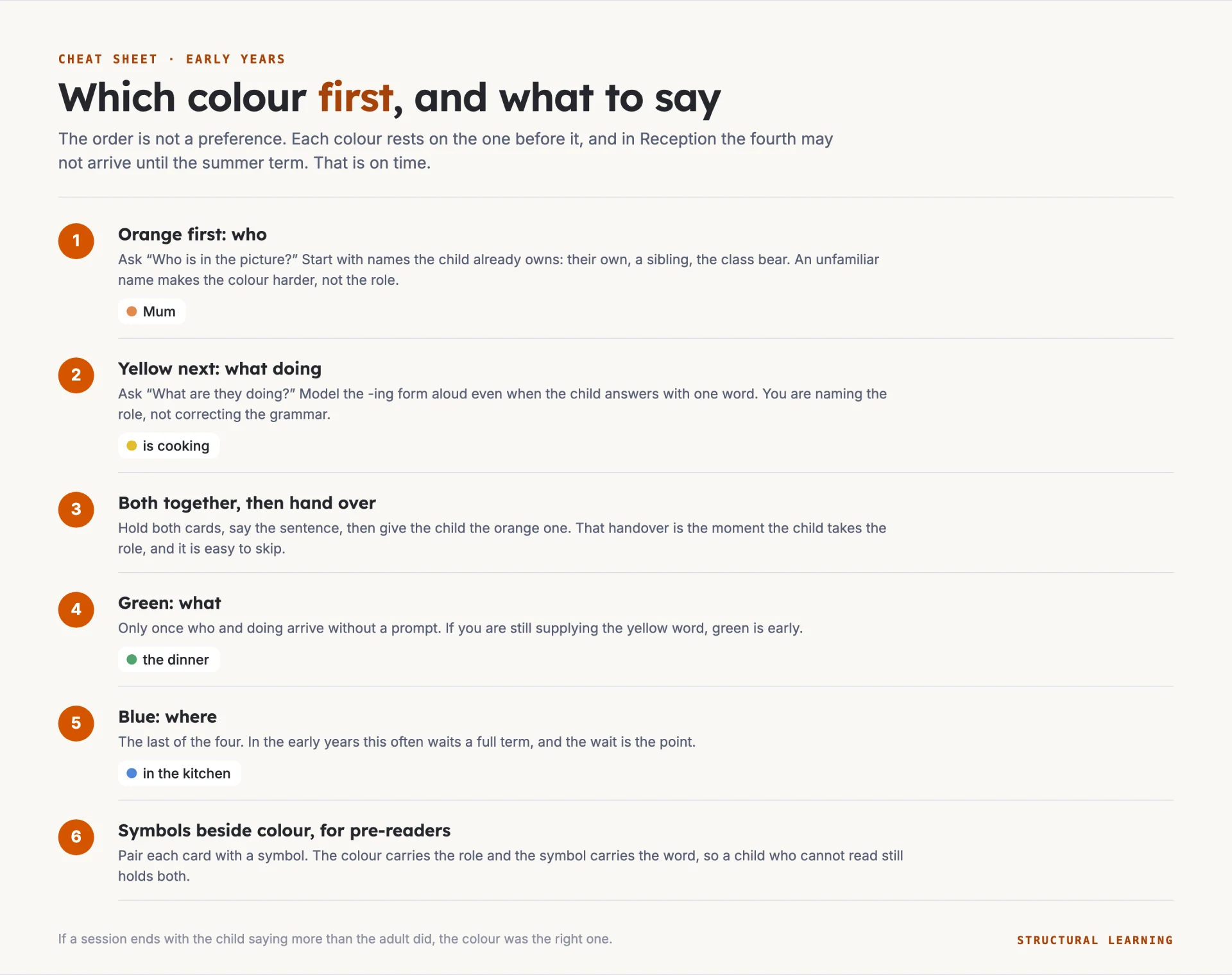
Start with orange (who) and yellow (what doing). These two roles make the smallest complete sentence a child can say, such as "The dog is barking." Introducing both colours together gives an immediate sense of a whole idea.
Spend real time here before adding green. A child who can reliably join who and what doing across many pictures is ready for the object; a child who cannot is not. Add green (what), then blue (where), one at a time.
In practice, show a picture of a cat sleeping, hold up orange and ask "Who?", then yellow and ask "What are they doing?" The child answers each colour, then says the sentence. Keep the wh-question wording identical every time so the routine itself is never the obstacle.
A strong early-years session is short, visual and repeated. Here is a five-minute structure you can run daily.
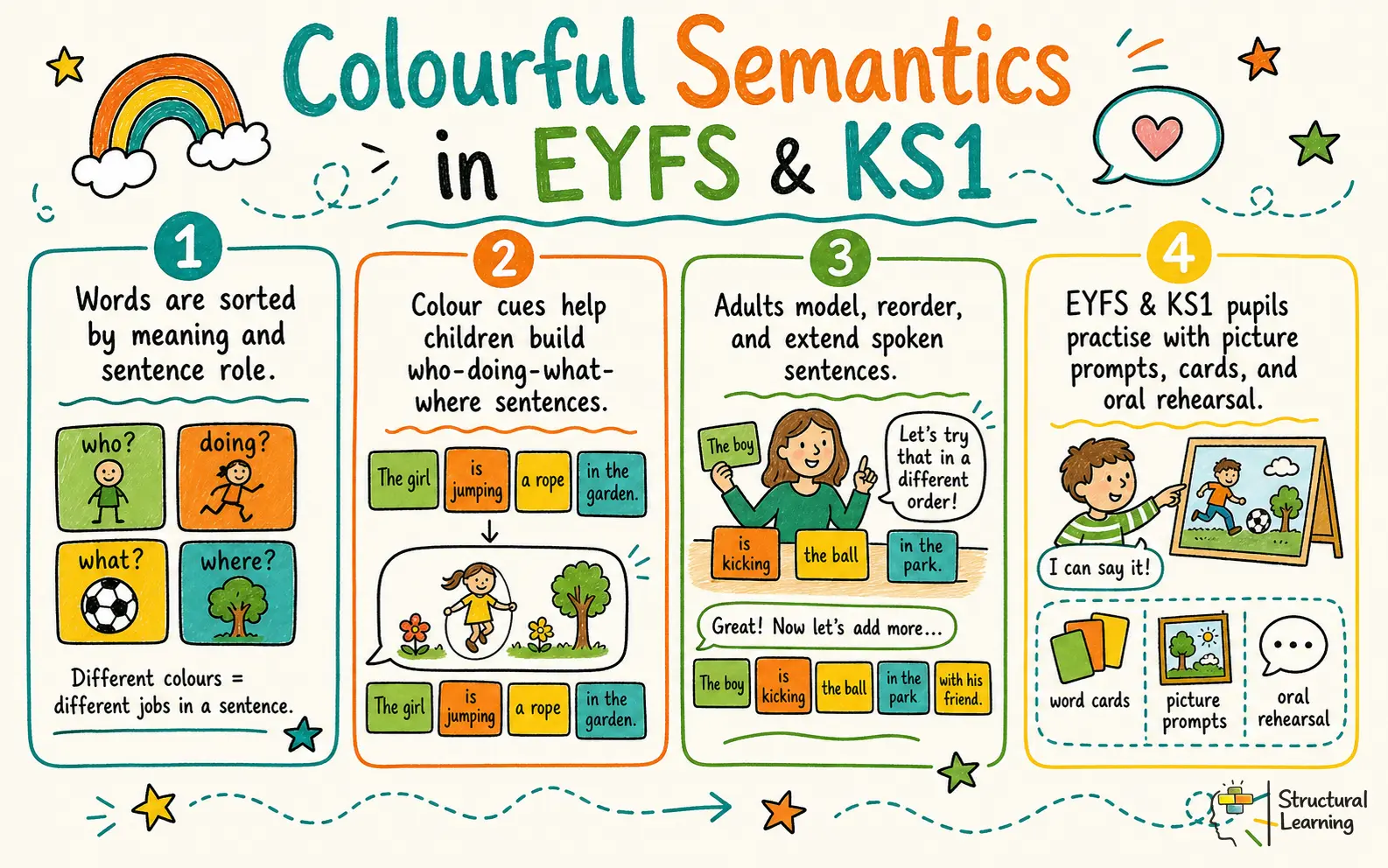
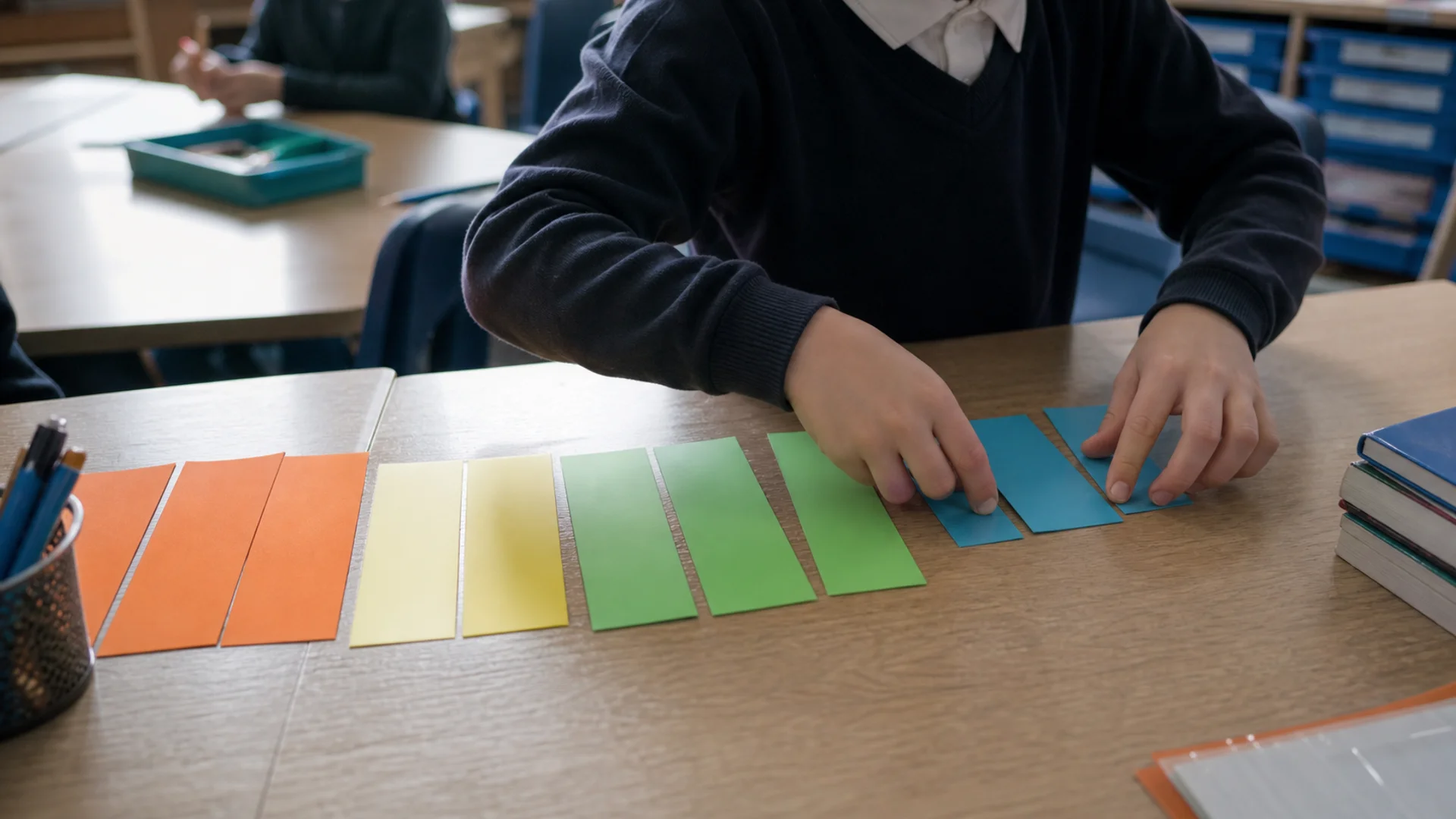
First, model one sentence yourself, placing each colour card and thinking aloud. Second, build a sentence together as a group from a shared picture, with children supplying each colour. Third, give individuals or pairs a picture and their own colour cards to build and say a sentence. Fourth, ask two or three children to say their sentence to the group.
The cadence matters more than the length. The clinical evidence with 5- and 6-year-olds came from twice-weekly sessions over several weeks (Bolderson et al., 2011), so build it into the timetable rather than using it occasionally.
Many EYFS and KS1 children cannot yet read the words on a card. Pair each colour card with a picture and, where helpful, a symbol so the colour, image and symbol all carry the same meaning. A non-reader can then build a sentence entirely from pictures and colours.
This also opens the activity to learners with English as an additional language. The colour code makes English word order visible without relying on grammatical labels, and pairing each new word with a picture teaches the word and its place in the sentence at the same time.
For an EAL child new to English, start with concrete, high-frequency vocabulary and let the picture carry meaning while the colour carries structure.
The aim in Key Stage 1 is independent writing, so plan the handover from speaking to writing in steps. Once a child says a sentence reliably on a colour mat, give them a writing line with faint colour blocks, one word group per block, so the structure they have rehearsed transfers to the page.
Next, replace the blocks with coloured dots under blank lines, then with a plain line. Each step removes a little support while keeping the word order intact. This staged fade is what helps children build sentences without prompts.
Keep modelling the spoken sentence first even as writing begins. The writing improves because the sentence was said aloud, not because the colour appeared on the page.
Colourful Semantics began as a therapy for children with speech and language needs, so it adapts well for SEND in the early years. For a child with developmental language disorder, choose one sentence structure and practice it across many pictures before adding the next role.

Reduce the load where needed. Fewer colours in play, a predictable routine and the same wh-question wording each time make the task accessible for autistic children and those with additional needs.
Visual scaffolding within a child's Zone of Proximal Development supports exactly this kind of progress, and the evidence stresses withdrawing the support gradually rather than leaving it in place (Xiao et al., 2025). Pairing the spoken sentence with physical cards is the verbal-plus-nonverbal combination that the early-years evidence favours most (Pesco & Gagne, 2017).
The first mistake is moving too fast. Adding green and blue before who and what doing are secure leaves children juggling four colours and producing nothing. Stay at two colours until they hold.
The second is letting the cards become permanent. They are a temporary scaffold, so plan from the start how you will fade them, in line with the gradual-withdrawal principle (Xiao et al., 2025).
The third is treating it as a withdrawal-only intervention. It works as a whole-class and continuous-provision routine, not just a group taken out of the room. Be realistic about results, too: gains show more clearly on sentence-level measures than on standardised tests, and the school-delivered evidence is still developing (Atwell, 2024).
For more in this series, see the full Colourful Semantics activity bank and the printable Colourful Semantics worksheets.
You can introduce the first two colours in Reception, and the approach has direct evidence with 5- and 6-year-olds (Bolderson et al., 2011). For younger children in Nursery, use it as an adult-led talking game with pictures rather than expecting independent sentence building.
Teach orange (who) and yellow (what doing) first, because together they make the smallest complete sentence a child can say. Only add green (what) and then blue (where) once the first two roles are secure.
It gives children a visible structure for speaking in full sentences, which is what the Communication and Language early learning goal asks for. The colour prompts let adults model and reinforce well-formed sentences across continuous provision.
Yes. Pair each colour card with a picture and a symbol so non-readers and EAL learners build sentences from images and colours rather than text. The colour code makes English word order explicit without grammatical jargon.
Fade the support in steps: colour-coded writing strips, then coloured dots under blank lines, then a plain line. Keep modelling the spoken sentence first, since the structure is learned through talk before it reaches the page.

Choose one picture, introduce orange and yellow as a five-minute talking game in your next session, and only add the green card once every child can say a two-part sentence with confidence.
These peer-reviewed studies provide the evidence base for the strategies discussed above.
Using colourful semantic approaches as a group intervention within primary schools to improve language development: A mixed methods design
K. (2024)
This evaluation shows that small-group colourful semantics interventions significantly boost sentence structure and speech length. Teachers can confidently utilise this approach in primary classrooms to enhance early language development, particularly for learners needing targeted support.
Colourful semantics: A clinical investigation
33 citations
S. (2011)
This clinical study demonstrates how colour-coded cues help young learners structure sentences. Teachers can implement these visual prompts in early years settings to support expressive language, helping learners construct grammatically complete thoughts more independently.
Scaffolding Narrative Skills: A Meta-Analysis of Instruction in Early Childhood Settings
86 citations
A. (2017)
This meta-analysis highlights that pairing verbal scaffolds with non-verbal prompts enhances children's narrative expression and comprehension. Teachers can apply this by combining spoken language cues with visual aids, like colour-coded templates, to improve classroom storytelling.
The Use of Colourful Semantics in Improving Sentence Writing Skills among Level One Pupils
Yee et al. (2024)
This paper outlines how colourful semantics reduces cognitive load for early primary writers. By visual scaffolding, teachers can help young learners with limited vocabulary organise ideas and successfully construct their first sentences.
Colourful Semantics: Thematic Role Therapy
23 citations
A. (2008)
Bryan's foundational work explains how colour-coding sentences by meaning (who, what doing, where) helps children grasp structure. Teachers can use this thematic approach to bypass confusing grammatical labels, making sentence construction highly accessible for young learners.