Updated on
September 25, 2026
Colourful Semantics Activities: A Classroom Activity Bank
Colourful Semantics turns sentence building into a colour-coded game. Get ready-to-use activities for building three, four and five-part sentences.

Updated on
September 25, 2026
Colourful Semantics turns sentence building into a colour-coded game. Get ready-to-use activities for building three, four and five-part sentences.
Colourful Semantics activities turn a colour code into spoken and written sentences. Each role in a sentence has a colour: orange for who, yellow for what doing, green for what, and blue for where. Learners build a sentence by choosing a card for each colour, saying it aloud, then writing it. This page is the activity bank. If you need the method first, read our complete guide to Colourful Semantics, which explains the colour code and the thinking behind it.
The activities below are graded by sentence level and grouped by how you will use them: warm-ups, whole-class games, small-group intervention, cross-curricular tasks, and the bridge to independent writing. Pick the level your learners are working at, run the activity as a short oral routine, then fade the cards once the structure holds.
Pick a topic and a level, then generate a colour-coded sentence to read aloud and build. Orange = who, yellow = what doing, green = what, blue = where, pink = when.
1. Choose a topic
2. Choose a level
Tip: say the sentence aloud together before writing it, then fade the colours as learners gain confidence.
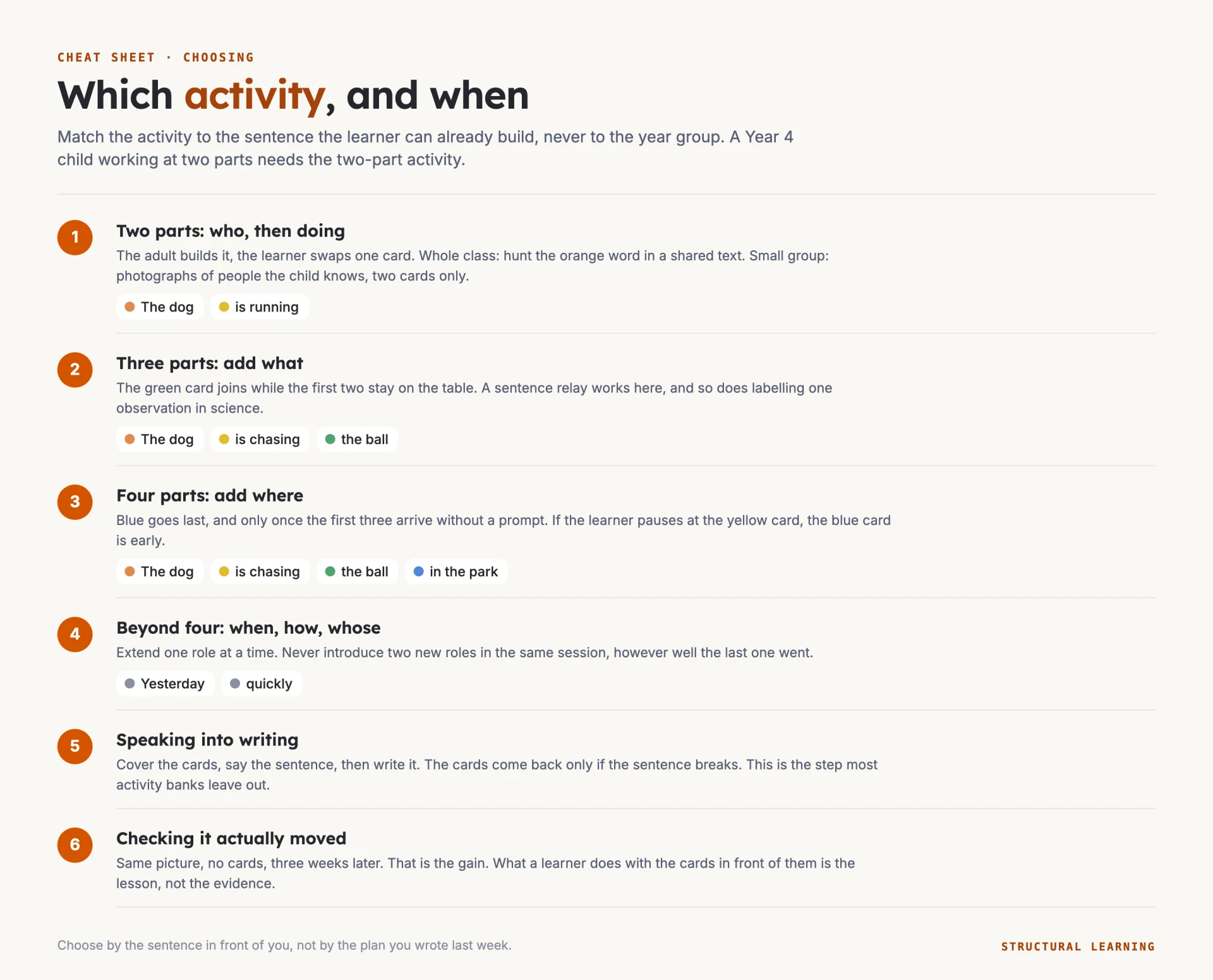
Start with the sentence level, not the activity. A learner who cannot yet join who and what doing should not be set a four-part task. Use the colour sequence as your map: orange and yellow first, then add green, then blue, then extend.
Keep each session short and frequent. Hettiarachchi (2016) found that class teachers running Colourful Semantics twice a week for six weeks improved both the content and the structure of children's narratives. Ten focused minutes beats one long session.
Say it before you write it. The colour cards are a Say It routine first: the learner speaks the full sentence, then commits it to paper. This rehearsal is where the structure is learned.
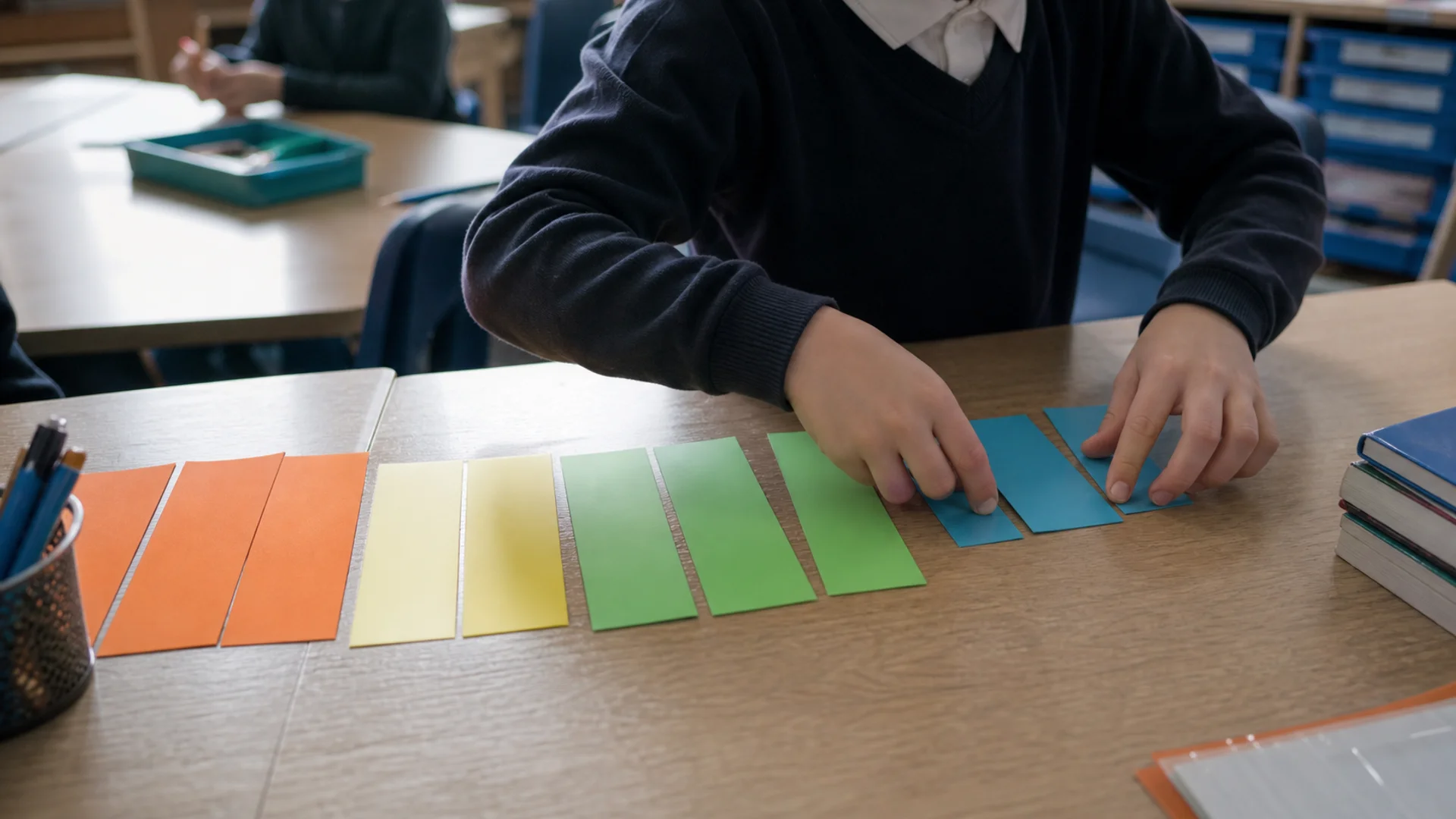
Begin with quick modelling so the colour code is visible before learners produce anything. Hold up an orange card and a picture of a child, then a yellow card and a picture of running, and say "The girl is running." Think aloud as you place each card so the class hears the sentence being assembled.
A useful warm-up is "colour, then word." You name a colour, a learner gives a word of that type: orange, "the dog"; yellow, "is barking." This primes the roles without the pressure of a full sentence and works as a thirty-second starter at any point in the day.
For a learner who omits verbs, model the yellow card on its own repeatedly across the day. Naming the missing role explicitly is the point of the approach, and explicit, structured practice of a target structure is what transfers to new sentences (Delage et al., 2024).
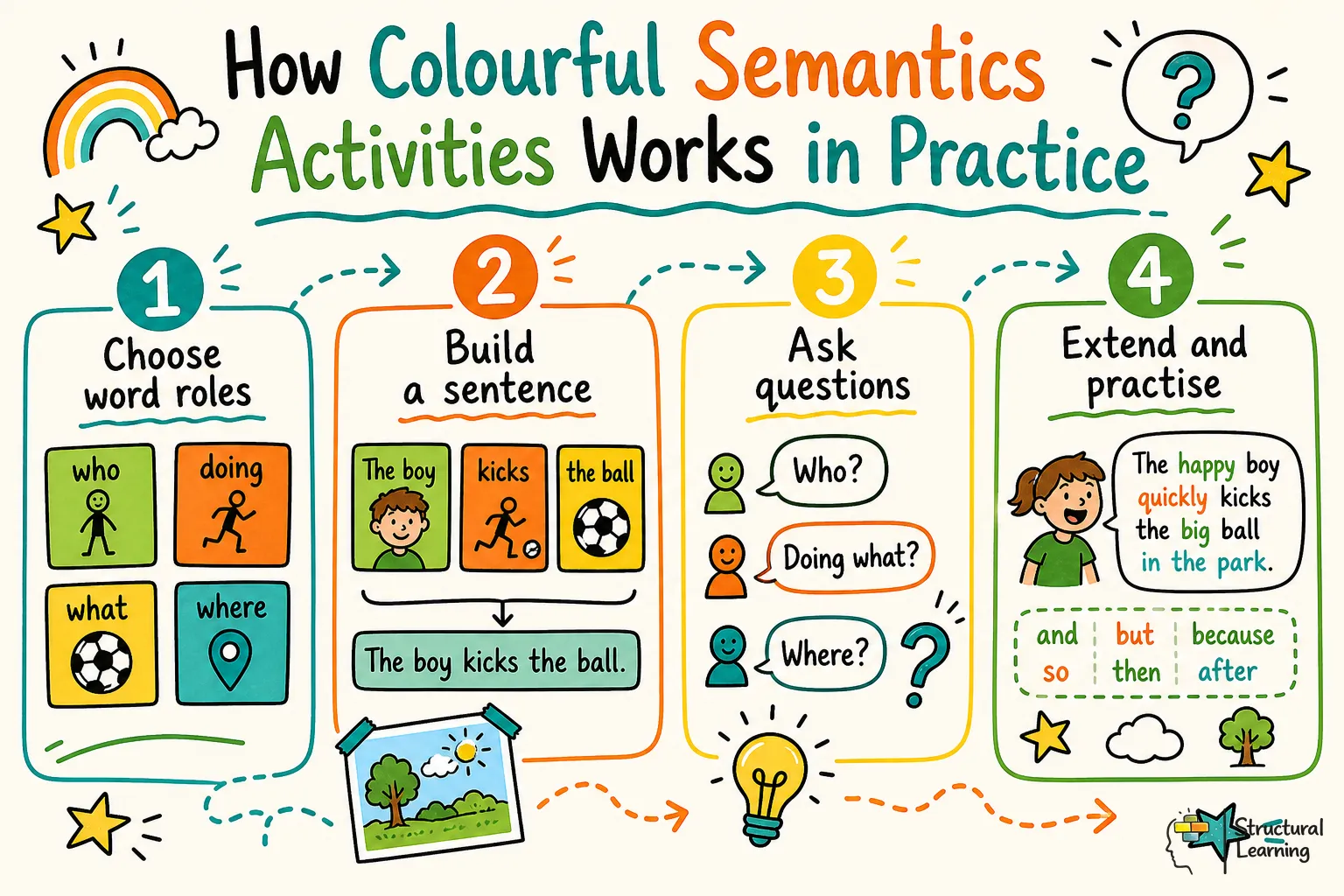
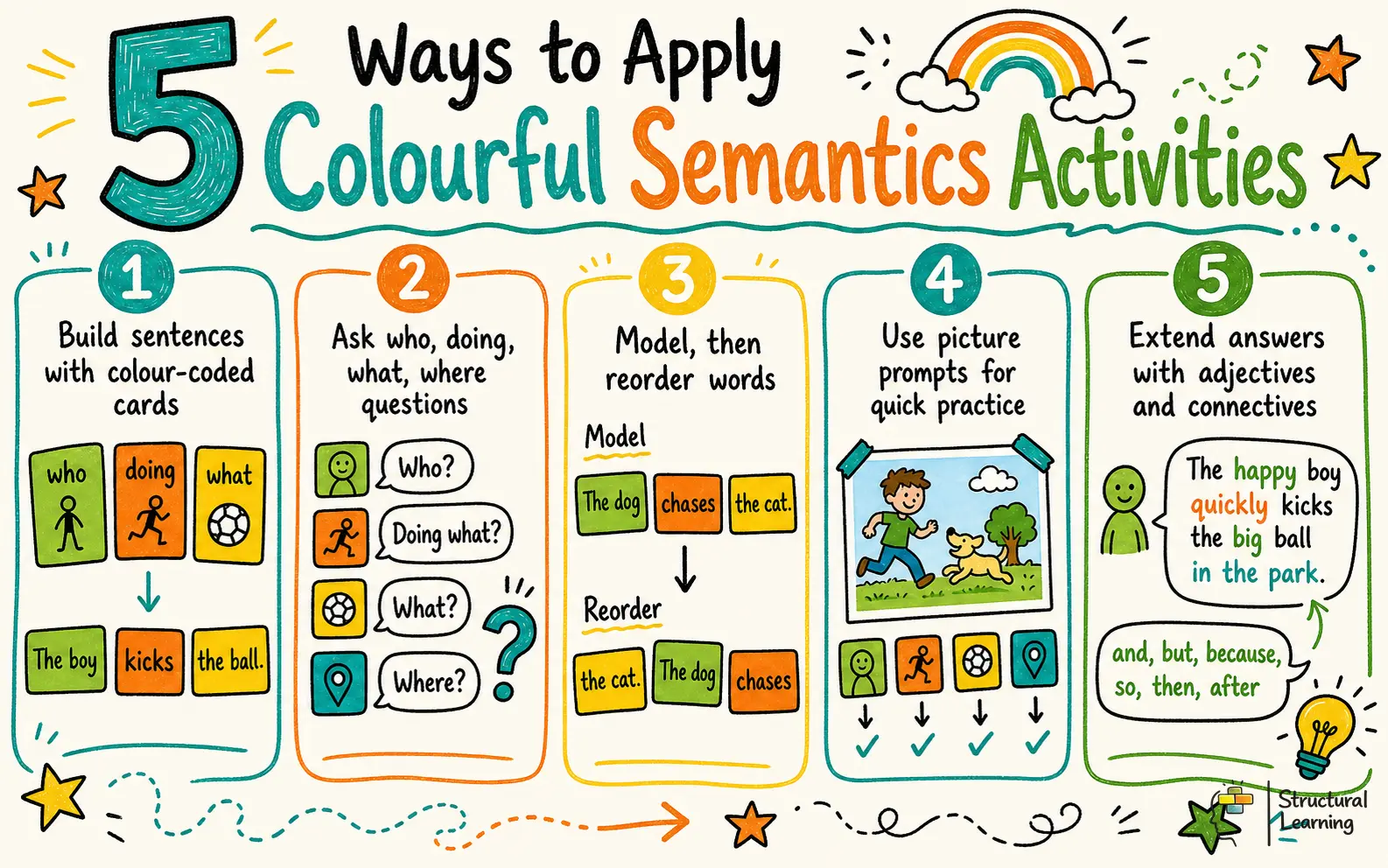
Once who and what doing are secure, add the green "what" card, then the blue "where" card. Use a picture and ask the wh-questions in colour order: "Who? What are they doing? What? Where?" The learner answers each, then says the whole sentence: "The boy is kicking the ball in the park."
Run this as a "grow the sentence" task. Start with "The boy is kicking," then add green ("the ball"), then blue ("in the park"). Learners hear the sentence get longer and feel each colour add meaning.
Papakyritsis et al. (2024) reported that a child moved from producing full sentences for 2 of 16 pictures to almost all of them after two short colour-coded sessions, and still used full clauses without the cards at follow-up. The cards are a temporary support, so plan to remove them.
Colourful Semantics works as a whole-class routine, not only a withdrawal group. Hettiarachchi et al. (2019) used it as a whole-class enrichment programme and found significant gains in how children understood and used wh-question forms.
Try "sentence race." Split the class into colour teams. Show a picture; each team supplies its colour's word in order to build the sentence fastest and correctly. It rewards accuracy, not just speed, because the sentence has to make sense.
"Silly sentences" is a favourite for engagement. Mix cards from different pictures so learners build "The teacher is eating a football in the swimming pool." The humour comes from the structure working even when the meaning is absurd, which shows learners the grammar is doing the job.
For targeted groups, run a tighter cycle. Atwell (2024) found that support staff delivering Colourful Semantics in small primary groups improved sentence structure, semantic understanding and mean length of utterance. Keep the group to a single sentence level so every learner is working at the right point.
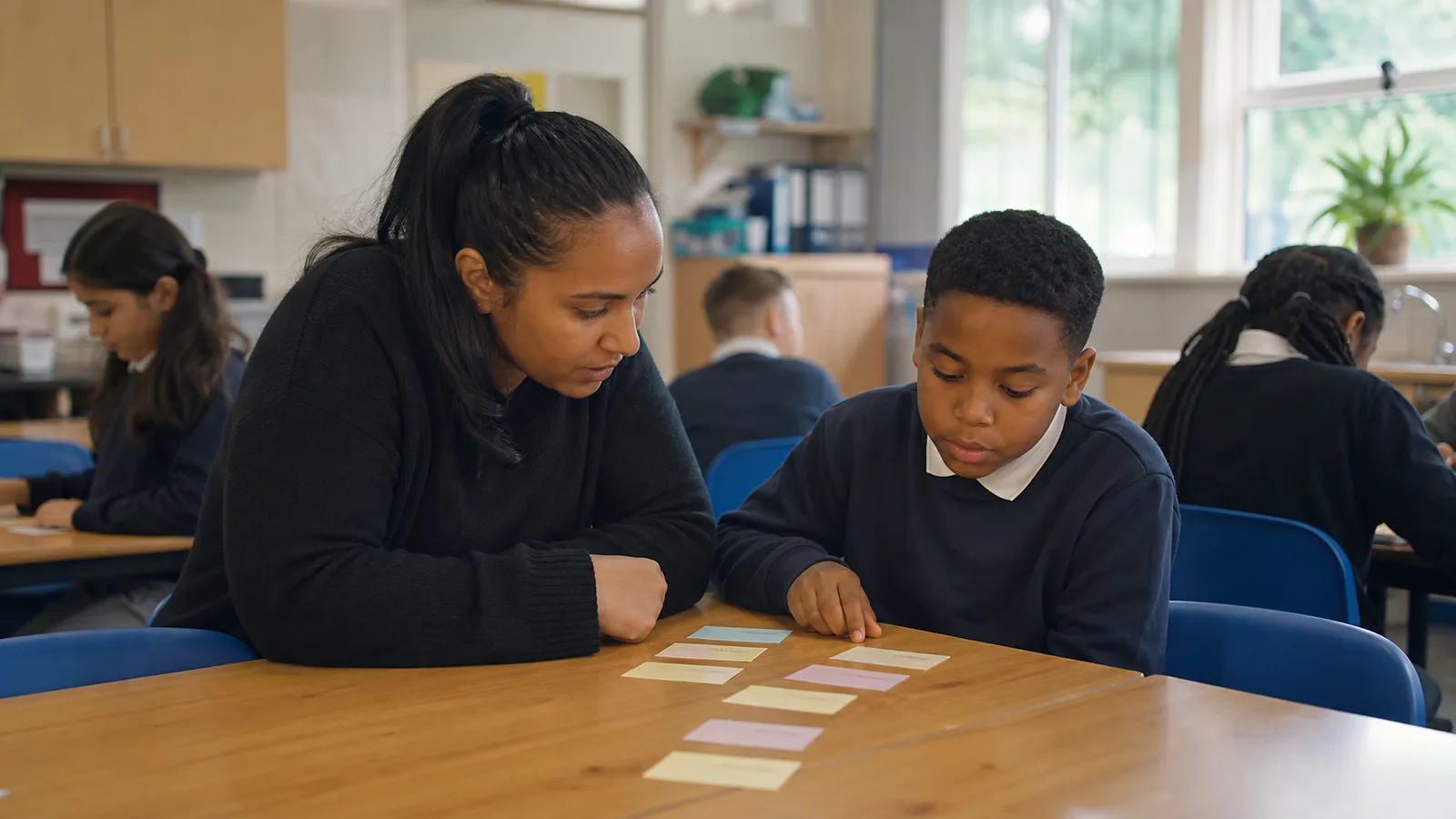
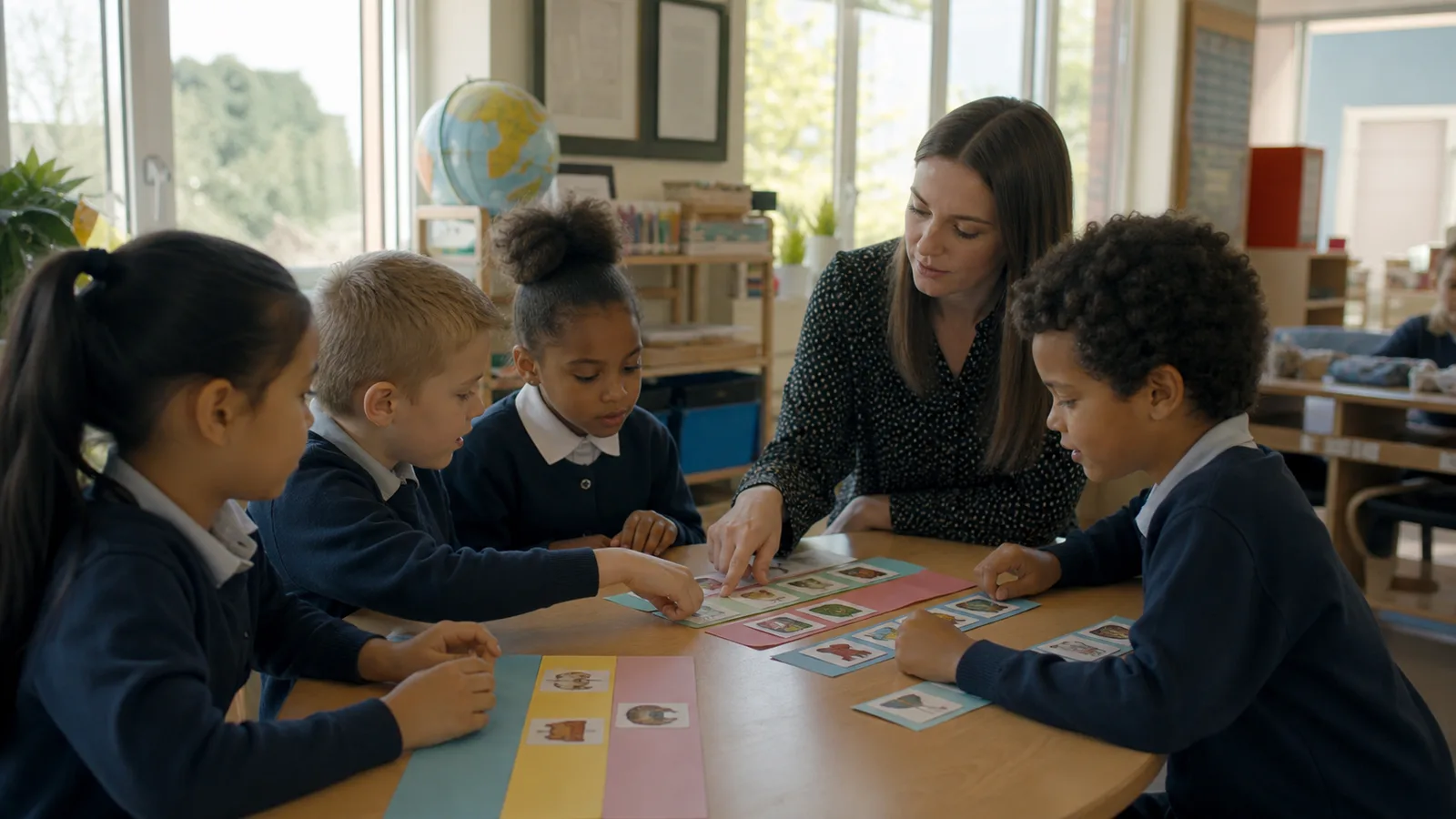
Use a personal colour mat per learner, with picture cards face down. The learner turns a card, builds the sentence aloud on the mat, then records it. The adult prompts only with the wh-question for the missing colour, never the word itself.
This is a scaffolding sequence: heavy support at first (cards plus prompts), then prompts alone, then the learner self-checks against the colour order. Grade and fade the support deliberately rather than leaving the cards in place forever.
Take the colour code into other subjects so the structure generalises. In science, describe an observation: orange "the ice," yellow "is melting," blue "on the windowsill." In history, narrate an event: "The soldiers marched to the castle."
In PE, use it orally before or after a task: "The team is passing the ball down the pitch." Spoken sentences in context give the structure a reason to exist beyond the literacy lesson.
Cross-curricular use also builds better sentences in extended writing. When a learner can frame a clear who-doing-what-where sentence, they have the spine of a science explanation or a recount.
Make the colours physical. Lay large colour hoops or floor mats on the carpet and have learners stand on each colour as they say their part of the sentence. Walking the sentence left to right helps word order stick for learners who find seated tasks hard.
Use coloured objects, not only cards: an orange beanbag for who, a yellow one for what doing. Passing the object as each learner adds their role turns sentence building into a circle game.
For emerging communicators, pair colour cards with symbol support so the picture, symbol and colour all carry the same meaning. This gives a non-speaking or pre-verbal learner a way into the same activity.
The aim is independent writing, so plan the handover. Once a learner builds a sentence reliably on the mat, give them a colour-coded writing line: a strip with faint colour blocks they write into, one word group per block.
Next, switch to coloured dots under blank lines, then to a plain line. Each step removes a little support while keeping the sentence order the learner has internalised.
Keep modelling the spoken sentence first even at this stage. The writing improves because the structure was rehearsed aloud, not because the colour was on the page.
Track the right things. Atwell (2024) found gains showed up more reliably on bespoke sentence measures than on standardised language tests, so do not wait for a standardised score to move before you judge the routine is working.
Record three simple measures over time: mean length of utterance (how many words in a typical sentence), which wh-elements the learner includes without prompting, and how much support they needed (cards, prompts, or independent). A quick weekly note is enough.
Photograph or jot a learner's sentence at the start of a unit and again at the end. The shift from "dog run" to "The dog is running in the garden" is the evidence that matters to you and to parents.
For learners with English as an additional language, the colour code makes English word order explicit without relying on grammatical labels. Keep vocabulary concrete and pair each new word with a picture so meaning and structure are taught together.
For learners with developmental language disorder, choose one target structure and practice it across many pictures before adding the next. Explicit practice of a single structure is what generalises to untrained sentences of the same type (Delage et al., 2024).
For autistic learners and those with additional needs, reduce the number of colours in play, keep the routine predictable, and use the same wh-question wording every time so the task itself is not the barrier.
Be honest about what Colourful Semantics activities can and cannot do. The strongest evidence is for sentence structure, semantic role use, narrative content and mean length of utterance, shown in single-case and small-group school studies (Papakyritsis et al., 2024; Atwell, 2024; Hettiarachchi, 2016).
The weaker spots are real. Effects appear more consistently on tailored sentence measures than on standardised tests, and the evidence for school-staff-delivered groups is still developing (Atwell, 2024). Treat the approach as one structured support among several, not a guaranteed fix.
That balance should shape how you use the bank: run the routine consistently, measure sentence-level change, and combine it with wider reading, talk and vocabulary work.
For more in this series, see our guide to Colourful Semantics in EYFS and KS1 and the printable Colourful Semantics worksheets.
Whole-class games like "sentence race" and "silly sentences" work well because every learner contributes a colour and the sentence has to make sense. Used as a whole-class routine, Colourful Semantics has improved children's understanding and use of wh-questions (Hettiarachchi et al., 2019).
Assign each learner or team a colour and build a sentence from a shared picture, scoring for accuracy rather than speed. Mixing cards from different pictures to make "silly sentences" keeps engagement high while still practicing correct word order.
Activities that pair each colour card with a concrete picture work best, because they make English word order explicit without grammatical jargon. Keep vocabulary visual and teach the word and its sentence role at the same time.
Fade the support in steps: colour-coded writing strips, then coloured dots under blank lines, then a plain line. Keep modelling the spoken sentence first, since the structure is learned through oral rehearsal before it reaches the page.
Small-group and single-case school studies show gains in sentence structure, semantic understanding and mean length of utterance (Atwell, 2024; Papakyritsis et al., 2024). Gains are clearer on bespoke sentence measures than on standardised tests, so track sentence-level progress rather than waiting for a standardised score to move.
Pick one sentence level, choose three activities from the bank above, and run them as a ten-minute oral routine in your next three lessons.
These peer-reviewed studies provide the evidence base for the strategies discussed above.
Using colourful semantic approaches as a group intervention within primary schools to improve language development: A mixed methods design
K. (2024)
This study shows that school practitioners can successfully run colourful semantics in primary schools as a small-group intervention. Teachers can expect significant improvements in children's sentence structure, semantic understanding and overall speech length.
Using the Colourful Semantics approach to support language development with children who are deaf or hard-of-hearing
Hettiarachchi et al. (2019)
This research highlights colourful semantics as a highly effective, universal whole-class routine. For teachers, implementing this approach daily supports all learners, particularly those who are deaf or hard-of-hearing, to master key question forms and sentence building.
The effectiveness of a sentence-building treatment protocol based on Colourful Semantics
al. (2024)
This paper demonstrates that visual colour-coding of subjects, verbs and objects dramatically boosts sentence-building skills. Teachers can use these targeted visual prompts during picture-description activities to help learners structure complete sentences independently.
The efficiency of an explicit approach to improve complex syntax in French-speaking children with DLD
al. (2024)
This study confirms that explicit, visually-coded syntax training supports children with developmental language disorders. Teachers can use these visual frameworks to help learners generalise sentence structures across different classroom tasks.
The effectiveness of Colourful Semantics on narrative skills in children with intellectual disabilities in Sri Lanka
S. (2016)
This study shows that teachers delivering colourful semantics twice weekly can significantly boost the narrative skills of children with intellectual disabilities. It provides classroom educators with a practical, high-impact tool to improve both story content and grammar.