Updated on
November 1, 2026
Relative Clauses KS2: Examples and Printable Practice
Relative clauses for KS2: 16 paired examples, the comma decision, when to drop who or which, a lesson sequence and free printable practice with answers.

Updated on
November 1, 2026
Relative clauses for KS2: 16 paired examples, the comma decision, when to drop who or which, a lesson sequence and free printable practice with answers.
What is a relative clause?
A relative clause is a subordinate clause that refers back to a noun and adds information about it. It usually begins with who, which, that, whose, where or when. Some relative clauses identify which person or thing is meant and take no commas; others add extra information about something already identified and sit between commas.
A relative clause is a subordinate clause that refers back to a noun and adds information about it. It usually begins with who, which, that, whose, where or when. Some relative clauses identify which person or thing is meant and take no commas; others add extra information about something already identified and sit between commas.
This resource gives 16 paired examples, a relative-word reference, an omission rule, a lesson sequence and printable practice with answers. For how relative clauses sit among other subordinate clauses, see our complex sentences guide. We do not repeat that wider taxonomy here.
At a glance
The commas change what the writer assumes the reader already knows. Without commas, the clause identifies which noun is meant, so removing it loses essential meaning. With paired commas, the noun is already identified and the clause adds extra information that could be removed without changing who or what the sentence is about.
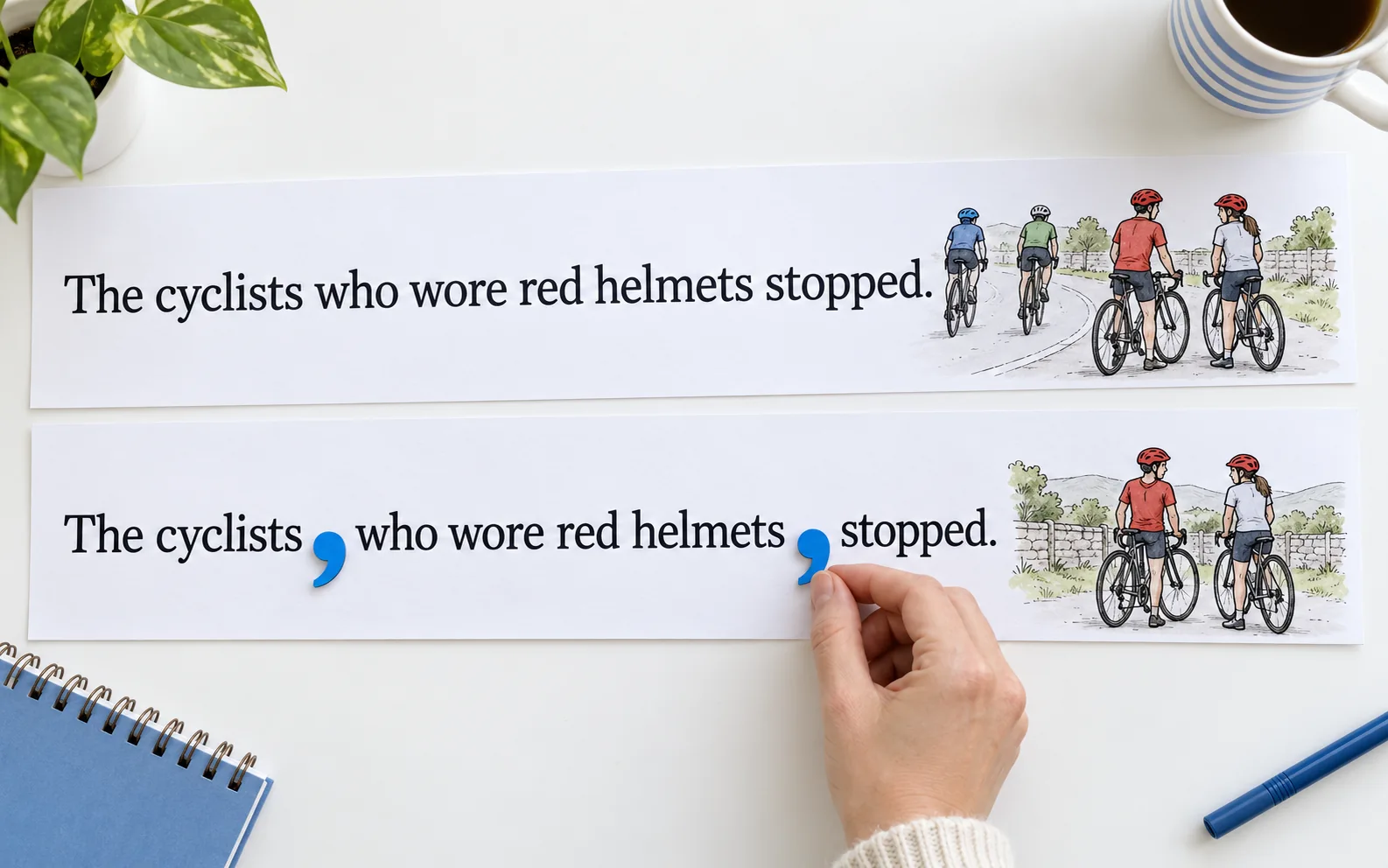
Identifying: The cyclists who wore red helmets waited at the gate.
Extra information: The cyclists, who wore red helmets, waited at the gate.
In the first line, only the cyclists in red helmets waited; others may have gone ahead. In the second, every cyclist waited and all of them wore red helmets. Ask a reading question before a writing one: how many cyclists waited? Grammar references say defining and non-defining; US materials often say restrictive and nonrestrictive. We use identifying and extra information because the labels name the reader's job.
One sentence is built in five stages. 1: The dancers. 2: the relative clause who wore red scarves is added. 3: with no commas, The dancers who wore red scarves opened the show identifies which dancers. 4: with commas, The dancers, who wore red scarves, opened the show adds extra detail about dancers already known. 5: reading without the clause tests whether the commas fit. This shows the standard grammar contrast, not measured data.
Start with the noun, The dancers. On its own the reader may still ask which dancers are meant.
A relative clause, who wore red scarves, is a subordinate clause that refers back to the noun.
With no commas, the defining relative clause identifies which dancers: only the ones in red scarves opened the show.
With a comma pair, the non-defining clause adds extra information about dancers the reader already knows about.
Remove the clause. If the sentence still says what you meant, the commas fit; if meaning changes, leave them out.
Relative clauses examples on one sentence: the comma pair marks extra information, no commas marks which ones. Authored illustration of the standard grammar contrast. Authored illustration of the standard grammar contrast; not measured data. Structural Learning, structural-learning.com/post/relative-clauses-examples.
Authored teaching guidance. Definition of a relative clause from the DfE Glossary for the programmes of study for English (2013); the defining and non-defining contrast follows standard grammar as described in British Council learner guidance, which is not research evidence. No measured classroom effect is claimed.
The explainer traces the same decision on a sentence about dancers. Once the choice is secure, extend it through building better sentences. Keep the clause distinct from fronted adverbials, which open a sentence with time, place or manner rather than describing a noun.
Each row pairs an identifying sentence with its extra-information twin. Read across and ask what the reader knows in each version. Learners who need colour-coded prompts can start with colourful semantics routines; some may need support with high frequency words inside the clause.
Scroll sideways to see all columns.
| Identifying (no commas) | Extra information (commas) |
|---|---|
| The pupils who finished early read quietly. | The pupils, who had all finished early, read quietly. |
| The book that Sam borrowed was torn. | Sam's library book, which he borrowed on Monday, was torn. |
| The dog which barked all night belongs next door. | Our dog, which barked all night, needs a walk. |
| The town where my gran lives has a market. | Whitby, where my gran lives, has a market. |
| The girl whose bag was lost went to the office. | Amira, whose bag was lost, went to the office. |
| The day when the trip happened was sunny. | Friday, when the trip happened, was sunny. |
| Plants that get no light turn yellow. | The cress, which got no light, turned yellow. |
| We thanked the coach who ran the club. | We thanked Mr Ali, who ran the club. |
Takeaway: names and possessives (Whitby, Amira, our dog) usually signal that the noun is already identified, so the clause adds extra information.
Choose the relative word by the noun it refers back to and the job it does. Use who for people, which for things and animals, whose for possession, where for places and when for times. That suits people or things in identifying clauses, but not in extra-information clauses.
Scroll sideways to see all columns.
| Word | Refers back to | Useful starting choice | Reminder |
|---|---|---|---|
| who | people | The scientist who tested the water... | Not for objects |
| which | things, animals | The bridge, which opened in 1890,... | Common after a comma |
| that | people or things | The rule that we learned... | Identifying clauses only |
| whose | possession | The tree whose leaves fell... | Not who's (who is) |
| where | places | The room where we eat... | Needs a place noun |
| when | times | The week when it snowed... | Needs a time noun |
Clause choice varies with subject purpose, a core idea in disciplinary literacy. When a clause is thin, route learners to Tier 2 and Tier 3 vocabulary work.
Learners often punctuate a word rather than the whole clause. Bracket the clause first, then decide.
Common slip: the closing comma goes missing, as in 'The cyclists, who wore red helmets waited.'
Choose a fixed example and a clause type, then press Check. The app explains what the reader now knows and suggests one next teaching move. Nothing you choose is saved or sent.
A two-choice comparison tool. For each of eight examples, the identifying version has no commas and tells the reader which ones are meant; the extra-information version uses a pair of commas and means all of the noun, adding a detail. Each result gives one concrete teaching move.
Choose an example and a clause type, then select Check comparison.
Did every dancer win, or only the ones who practised? The comma decides.
Which books were damaged: only those on the top shelf, or all of them?
An identifying clause picks out the lost bag; with my bag, the clause adds a detail.
Does the clause pick out one path, or add a fact about the only path?
Only the paints mixed yesterday, or all the paints with an extra detail?
A relative clause about time: which morning, or more about the morning?
An object relative pronoun that can be dropped in the identifying version only.
A subject relative pronoun that cannot be dropped in either version.
Pick an example and a clause type to see the sentence, what the reader knows, and one next move for defining and non-defining relative clauses.
Authored practice aid built on the standard grammar contrast between defining and non-defining relative clauses (British Council learner reference; DfE Glossary and English Appendix 2, 2013). Not validated research evidence or an assessment of attainment.
In the basic identifying patterns on this page, who, which or that can be left out when it is the object of the clause, because another subject follows it. It cannot be left out when it is the subject, because the clause would then have no subject of its own.
Scroll sideways to see all columns.
| Role | Full clause | Shortened | Test |
|---|---|---|---|
| Object | The book that Sam borrowed was torn. | The book Sam borrowed was torn. | Sam follows that |
| Object | The coach who we thanked ran the club. | The coach we thanked ran the club. | We follows who |
| Subject | The pupils who finished early read quietly. | Not possible | Who does the finishing |
| Subject | Plants that get no light turn yellow. | Not possible | That does the getting |
Keep the rule bounded. It does not cover:
Relative clauses are introduced in Year 5 in England; US learners of a similar age are usually in Grade 4, so check your own state standards. The sequence fits the modelled, shared, guided and independent writing cycle. It is a teaching proposal, not a tested programme.
Use one of your picture prompts for writing: a dance group where a few dancers wear red ribbons. Model 'The dancers who wore red ribbons stepped forward.' Switch to a picture where every dancer wears ribbons and model 'The dancers, who wore red ribbons, stepped forward.' Learners write a pair and label which picture each describes, then find the clauses in a WAGOLL exemplar.
After a germination practical, learners write 'The seeds that were kept in the dark grew pale shoots' (only some seeds) and 'The control tray, which stayed on the windowsill, grew green shoots' (extra information). Ask which sentence would mislead if its commas changed. The same precision matters in nonfiction explanation writing and longer written answers in biology.
For current national guidance, see our DfE Writing Framework 2025 guide and the KS2 writing moderation 2027 guide.
Diagnose before correcting. Each error has a different cause.
Scroll sideways to see all columns.
| Error | Example | Repair |
|---|---|---|
| Missing closing comma | The cyclists, who wore red helmets waited. | Bracket the clause; add the pair |
| Commas around an identifying clause | The pupils, who finished early, got stickers (only some did). | Ask how many; remove commas |
| That after a comma | Whitby, that has a market,... | Change to which |
| Wrong word for the noun | The tree who fell... | Check the noun; use which |
| Who's for whose | The girl who's bag was lost... | Expand to who is; use whose |
| Subject pronoun dropped | The pupils finished early read quietly. | Restore who; check its role |
Use checking for understanding prompts to find the common error, and treat the response as one of your formative assessment strategies: a next step, not a score.
These posts show what the accounts wrote, not evidence of effect.
What the sources support: the DfE glossary describes a relative clause as a subordinate clause that refers back to a noun, and English Appendix 2 places first teaching in Year 5. The British Council pages describe the standard defining and non-defining contrast; they are learner guidance, not evidence that a particular KS2 lesson improves writing.
What is not claimed: no attainment effect, no months of progress and no evidence that this bank outperforms a worksheet. You may choose to apply general retrieval practice (writing pairs without the bank) and spaced practice (returning across weeks), but neither was measured for this topic here. Clause knowledge also sits within wider reading comprehension strategies.
These examples are written for clarity; real texts are messier, and some sentences can be read either way. Teach the meaning question, then accept reasoned choices. The omission rule covers only the basic identifying patterns above. Colour-coded pairs and picture stimuli can help learners who need visual prompts, including some with EAL or SEND, but no label decides who finds this hard. Use the independent check, not an assumption.
The A4 set contains the 16-pair bank, the relative-word reference, a practice page and answers. No email is required: download the relative clauses sentence bank, practice and answers (PDF).
Pairing each marked sentence with a colour cue draws on dual coding. Use the sheet as a daily sentence bank, narrower than unit-level knowledge organisers.
Want more classroom-ready resources? Sign up to Structural Learning for free teaching guides and printable tools.
No. A relative clause usually sits straight after the noun it describes, wherever that noun appears. If the noun is the subject, the clause often falls mid-sentence; if the noun ends the sentence, so does the clause, as in 'We thanked Mr Ali, who ran the club.' An extra-information clause at the end needs only one comma.
Only extra-information clauses do. If the clause adds detail about a noun the reader can already identify, mark it off with commas, a pair mid-sentence or one before a final clause. If the clause tells the reader which noun is meant, leave the commas out, because the clause is part of the noun's identity.
Sometimes. A quick classroom test: cover the relative word and check whether a new subject still follows, as in 'the book Sam borrowed'. If it does, the word was an object and can go in basic identifying clauses. If the sentence breaks, keep it. Never drop it in an extra-information clause.
Because the comma choice is a decision about what the reader already knows. Learners who memorise 'put commas around who or which' can end up punctuating clauses that should identify. Asking 'how many cyclists waited?' makes them check meaning first. This is our teaching rationale, drawn from the grammar itself, not a finding from a measured classroom trial.
The national curriculum introduces relative clauses in Year 5, when most learners are nine or ten, through English Appendix 2. That is first teaching, not an expectation of mastery. Plan to revisit them in Year 6 writing and again at secondary, where subjects such as science and history need precise noun descriptions.
In identifying clauses about things, both are accepted in British English, so 'the book that Sam borrowed' and 'the book which Sam borrowed' are both correct. In extra-information clauses, use which, never that. A simple classroom habit: if you have just written the clause's opening comma, the relative word for a thing is which.