Updated on
October 7, 2026
Fronted Adverbials KS2: Examples, Word Mat and Activities
Teach fronted adverbials with 24 examples, a sentence mover and a two-page A4 word mat. Model meaning, comma placement and choices in independent writing.

Updated on
October 7, 2026
Teach fronted adverbials with 24 examples, a sentence mover and a two-page A4 word mat. Model meaning, comma placement and choices in independent writing.
What are fronted adverbials?
Fronted adverbials are words, phrases or clauses placed before a main clause to add detail about its event. They can tell the reader when, where, how or why something happens. For example: “After lunch, we checked the seedlings.” In this KS2 pattern, a comma follows the whole opening.
Start with a sentence your class understands, then move one useful detail to the front. Ask learners what that opening helps the reader picture. This keeps the lesson focused on meaning while you teach the grammar and punctuation.
Try this tomorrow
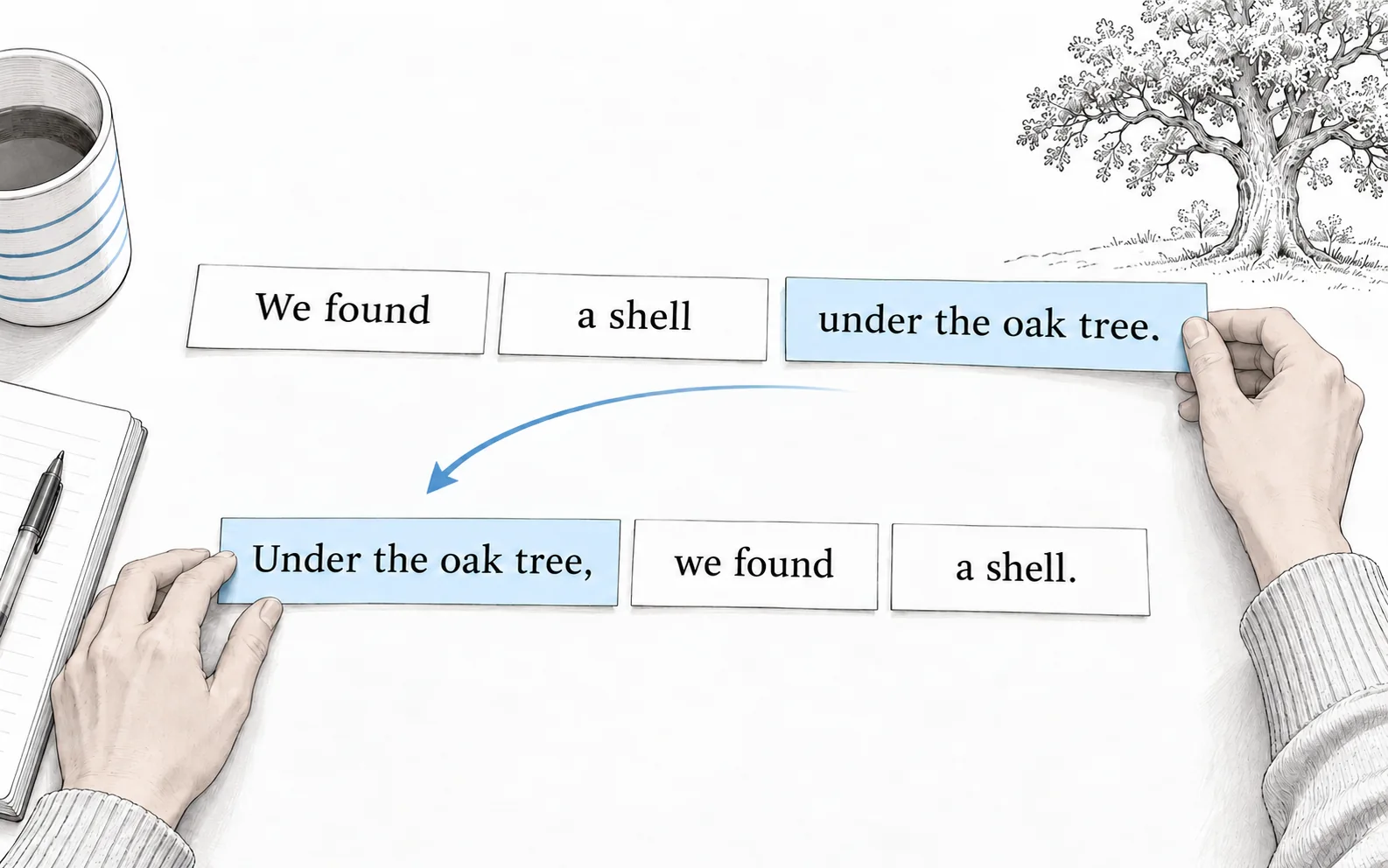
Year 4 English, ten minutes. Write “We found a shell under the oak tree.” Cut the place phrase from the end and move it to the front. Learners explain what the phrase tells us, adjust the capital letters and place the comma.
Look for: a complete main clause, an opening that adds a relevant detail, and an explanation of that detail. Finish with a new sentence written without the strips.
Key takeaways
Ask two questions: “What happened?” and “What does the opening tell us about it?” In “After lunch, we checked the seedlings”, the main clause tells us what happened. The opening tells us when it happened.
The Department for Education glossary distinguishes an adverb, which is a word class, from an adverbial, which is a function. Its examples include adverbs, preposition phrases and subordinate clauses serving that function. This distinction helps explain why a fronted adverbial can contain several words. [DfE glossary, adverbial]
Move the place detail
Bring the setting forward
The event and place stay the same. The second version introduces the setting first.
A useful check is to cover the opening and read what remains. “We found a shell” is a complete main clause. Then reveal the opening and ask what information it contributes.
Use the cover-and-read check with clear introductory examples. Later, discuss less straightforward sentences rather than treating one classroom check as a complete test of every grammatical structure. Our guide to building better sentences provides a wider route into sentence construction.
Choose an example that fits the event in the main clause. Time, place, manner and reason give you four useful starting groups. The examples below are original teaching material, so you can discuss and adapt them to the text your class is writing.
Time, when?
After lunch, we checked the seedlings.
At sunrise, the campsite grew busy.
A moment later, the door opened.
Before the match, the team warmed up.
When the bell rang, we packed our bags.
As the light faded, the walkers reached the hut.
Place, where?
Under the oak tree, we found a shell.
Beyond the gate, the path became narrow.
Near the library, we left our bikes.
Inside the museum, the group drew three objects.
On the top shelf, the old clock stood silent.
Across the field, a fox crossed the track.
Manner, how?
Carefully, the class measured the water.
Without a sound, the fox crossed the path.
With great care, the keeper lifted the bowl.
With a steady hand, the artist drew the line.
In a clear voice, the guide explained the route.
Slowly, the boat approached the harbour.
Reason, why?
Because the path was muddy, we chose a different route.
As the bridge was closed, we used the footpath.
Since the soil was dry, the gardener watered it.
Because the room was full, we waited outside.
As the battery was flat, the torch stayed dark.
Since the rain had stopped, the match could begin.
“Carefully” is one word. “With great care” is a phrase. “Because the path was muddy” is a clause with its own subject and verb. Teach this difference with familiar vocabulary before asking learners to analyse an unfamiliar passage.
A word mat is a starting point for a choice. Ask the writer to explain which detail the reader needs, then select or compose a fitting opening. If the choice changes the facts, revise the opening or the main clause.
Use the sentence mover to compare an opening with the same detail at the end. It offers nine controlled examples, including words, phrases and clauses. The sentences update their capitals and punctuation when you change position.
Sentence comparison
Choose a worked example and compare the detail at the front or the end. This mover uses nine fixed examples.
Read both versions aloud and discuss which better suits the surrounding text. A place opening might establish a setting before an event. A time opening might help a reader follow a sequence.
Then ask learners to write a different sentence using the same kind of detail. That final step shows you whether they can make the choice beyond the controlled examples. Keep the new sentence for a short conference or a whole-class comparison.
For the KS2 pattern taught here, put the comma after the complete fronted adverbial. Mark the whole unit first, then place the comma at its boundary. This prevents the common error of placing a comma after the opening's first word.
Find the whole opening
“After the final whistle” is one opening phrase. The comma follows “whistle”.
The national curriculum lists fronted adverbials and commas after them in lower KS2. Appendix 2 introduces both in Year 4. It also explains that introducing a feature in a particular year does not mean every learner has fully understood it. [DfE English programme; Appendix 2, pages 1 and 4]
Compare the punctuation when the phrase moves back to the end: “The crowd cheered after the final whistle.” In this example, the final time phrase joins directly to the main clause. Learners should read the whole sentence rather than carry its opening comma to the end.
Use this suggested sequence within your existing English unit. It moves from one model to a choice in the learner's own writing. Adjust the pace after the first explanation check. Make the short explanation check part of a consistent classroom routine. Choose a precise learning objective before selecting the sentences.
During shared writing, say the decision aloud: “My reader needs to know where we are before this happens.” During guided practice, ask the learner to supply that reasoning. Our guide to modelled, shared, guided and independent writing explains that wider teaching sequence.
Purpose: establish a setting in a short adventure scene. The first draft reads, “We found a shell under the oak tree.” The teacher asks whether the reader should picture the place before discovering the object.
The revised sentence reads, “Under the oak tree, we found a shell.” The learner explains that the opening tells us where the discovery happened. The teacher checks the whole phrase and its comma, then asks for a new discovery sentence without the model.
What to assess: whether the new opening describes the event's setting. A sentence starting “The tall oak tree” would introduce a noun phrase, so ask what job it does before awarding credit for a fronted adverbial.
Purpose: make the order of a method clear. The first draft reads, “We recorded the temperature after two minutes.” The writer decides to foreground the time at which the reading was taken.
The revised sentence reads, “After two minutes, we recorded the temperature.” The learner identifies the time phrase and checks that the method still reports the same measurement. A follow-up sentence names the next reading and its time.
What to assess: whether the time detail agrees with the actual method. These are suggested teaching examples, rather than accounts of a classroom trial. They connect a grammar choice with a subject-specific writing purpose.
| What you see | What to check | A useful correction |
|---|---|---|
| “The enormous dragon” labelled as a fronted adverbial | Does it name the subject or describe the event? | Compare “The enormous dragon slept” with “Inside the cave, the dragon slept”. |
| “After, the final whistle the crowd cheered” | Where does the whole opening end? | Underline “After the final whistle”, then add its comma. |
| “Suddenly” counted wherever it appears | Is this adverb serving as an opening? | Compare “Suddenly, the door opened” with “The door suddenly opened”. |
| “Before breakfast, under the stairs, quietly” | Is there a complete main clause? | Add the event: “Before breakfast, we found the bag”. |
| The same opening copied into every sentence | What does the reader need to know here? | Compare one fronted version with one direct version and explain the better choice. |
Choose the correction that matches the error. A missing comma calls for a boundary check. A missing main clause calls for work on sentence completeness. Use a focused deliberate practice task for the feature that needs attention.
For learners who confuse clause types, return to short spoken examples and a clear event. Our complex sentences guide can support the next stage when you introduce clause openings. A picture prompt can provide a shared setting for the sentence you model.
The X posts below are self-reported practices or opinions. They show the questions teachers and writers raise about this grammar feature. They provide context for a lesson choice, rather than evidence of an effect on attainment.
Match the claim to its source
Grammar and curriculum: the DfE programme, glossary and Appendix 2 support the terminology and English curriculum placement used here.
Professional views: the four linked X posts support the specific reported opinions or activities attributed to those accounts.
Teaching material: the examples, lesson sequence, sentence mover and printable are original suggested resources. Their classroom impact has not been measured in this article.
The examples here isolate one feature so that learners can see and discuss it. A finished text also needs accurate content, clear sentences and choices suited to its audience. Assess a fronted adverbial within that wider purpose.
Use the statutory curriculum references for England. Other jurisdictions may use different terminology or introduce the grammar at another stage. Year 4 is the point of introduction in Appendix 2, rather than a guarantee of secure understanding for every learner.
The four X posts offer different kinds of information. A school's description of a lesson does not establish the quality of every learner's writing. A writer's objection is a professional view, rather than a controlled comparison of teaching approaches.
The sentence mover uses a small set of controlled examples. Its punctuation follows those examples and the KS2 pattern taught on this page. It is not a grammar checker for any sentence a learner might compose.
The two-page A4 download contains a word mat with model sentences, followed by a move-and-write practice sheet and teacher answers. Print at actual size. The practice asks learners to move a phrase, mark its boundary and explain the information it adds.
Download the fronted adverbials word mat and practice sheet (PDF, two A4 pages)
No email is required for this download.
Use the word mat during supported practice, then cover it for the independent check. Keep a completed sentence and its explanation as your short assessment record. A later Do Now lesson starter can check whether the choice remains secure. Discuss the result before deciding whether the learner needs another model or a new writing task.
Plan the explanation, practice and check together. Build your next lesson around a clear learning goal.
In “Suddenly, the door opened”, it functions as a fronted adverbial. In “The door suddenly opened”, it is an adverb within the sentence. Use its position and job in the whole sentence to explain the difference.
Yes, as in “When the bell rang, we packed our bags”. The opening clause gives the time of the main event. It has its own subject and verb, while the main clause completes the sentence.
The lower-KS2 English programme covers Years 3 and 4 together. Appendix 2 places the introduction of fronted adverbials and commas after them in Year 4. Continue practice in later writing where the feature serves a useful purpose.
Choose an opening because it helps the reader follow the event, setting or sequence. Compare it with a direct version and discuss the effect. A text can use varied sentence openings without adding this feature to every sentence.
Department for Education (2014). National curriculum in England: English programmes of study.
Department for Education (2013). English glossary. Entries: adverbial and fronting.
Department for Education (2013). English Appendix 2: Vocabulary, grammar and punctuation. Pages 1 and 4.
Professional and school X posts are linked beside their attributed views and applications above. Original-source text was checked on 5 October 2026.