Updated on
October 8, 2026
DfE Writing Framework 2025: A Practical Teacher Guide
Use England’s DfE Writing Framework 2025 to plan purposeful writing, connect sentence choices and review Year 3 and Year 5/6 examples.


Updated on
October 8, 2026
Use England’s DfE Writing Framework 2025 to plan purposeful writing, connect sentence choices and review Year 3 and Year 5/6 examples.
What is the DfE Writing Framework 2025?
The Department for Education’s (DfE) Writing Framework is non-statutory guidance for primary schools in England, published in July 2025. It covers Reception, key stage 1 (Years 1–2) and key stage 2 (Years 3–6). It links handwriting, spelling, sentence teaching and composition. Use it to choose one writing focus and model how a sentence serves its reader.
Start with a sentence problem you can see in current writing. Keep the intended message in view while you model a change. The framework offers a way to review foundations and composition together, then choose a precise next teaching step.
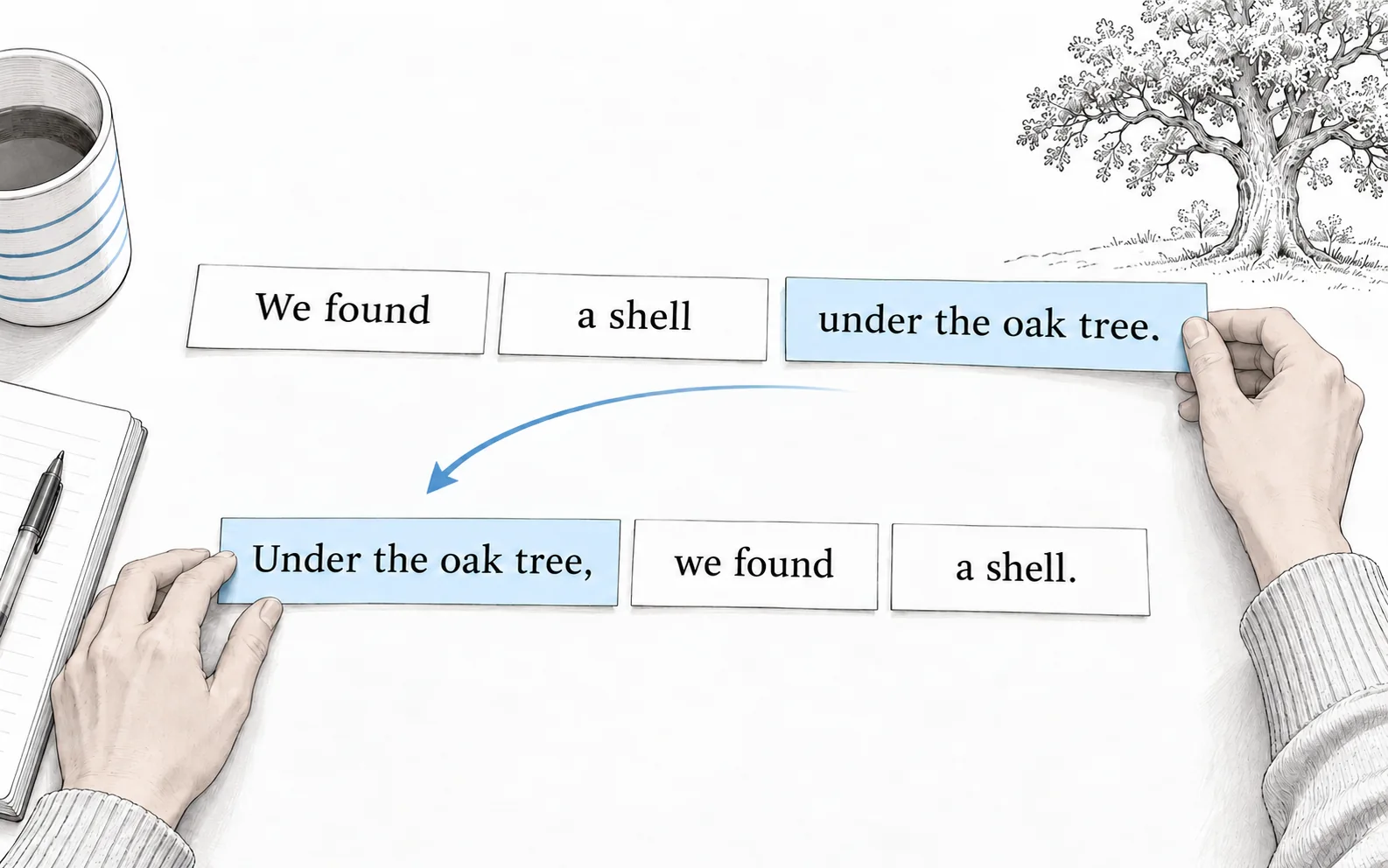
Year 3, English: explaining a decision. Present the fictional facts below. Compare a sentence using because with one using after, then ask which explains the decision to a reader.
Look for: learners explaining the relationship each sentence makes, then writing their own explanation with a clear reason.
Use the guide for one clear writing focus.
The Department for Education (DfE) published this guide on 8 July 2025. Its publication page was updated on 10 July. The PDF cover says July 2025. It gives non-statutory guidance for primary schools in England. Reception and both primary key stages are in scope. DfE publication details.
Use the guide alongside your curriculum. It offers advice on teaching writing. Curriculum content and end-of-key-stage assessment have their own rules and roles.
For a wider look at classroom literacy work, browse teaching reading and writing together.
Writing has two jobs. Transcription means recording words through handwriting and spelling. Composition means forming and organising a message. Spoken rehearsal can help learners keep their message in mind while they practise recording it.
The official writing summary says spoken language can still be useful once learners write words with ease. Ask a learner to say the sentence they want to write. Then read the written version together. Keep spelling and handwriting teaching in view too.
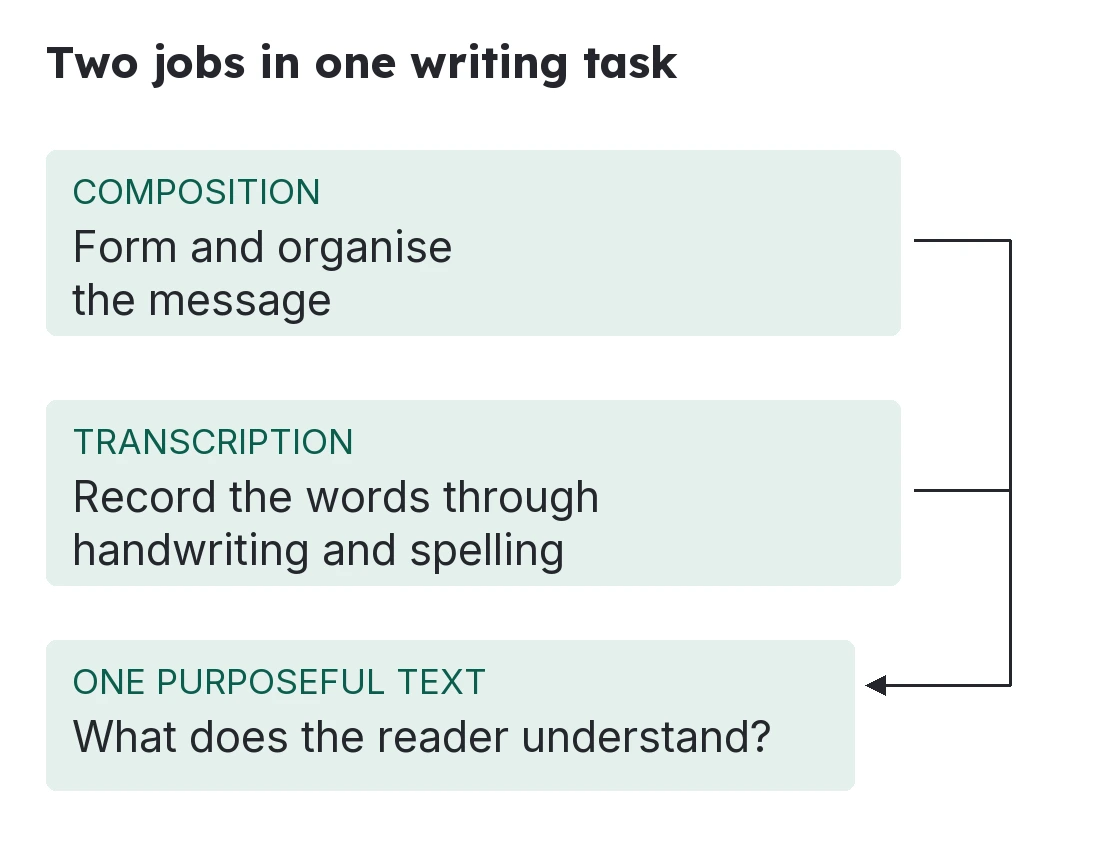
Form and organise
the message
Record the words through
handwriting and spelling
What does the reader understand?
If the current focus is where an event happens, use fronted adverbial examples to discuss which detail the reader needs.
The framework recommends explicit sentence teaching. It places grammar in writing so learners can control sentences and convey meaning. Its sentence-construction discussion includes oral models, appropriate scaffolds, sentence combining and revision. These are recommendations, rather than a measured effect for the lesson below. See sentence teaching in the framework, printed pages 48–52.
Authored Year 3 example: a short account for families.
Fictional facts: rain had stopped, the field was still wet, and the class stayed indoors. The reader wants to know why.
Rain had stopped before break. The class stayed indoors because the field was still wet. We played word games in the classroom instead. Later, we went outside.
Ask: “Which words explain the decision?” Use the checks below with a fresh sentence. These authored prompts focus on what a reader understands.
| Intended relationship | Question for a fresh sentence | What to listen for |
|---|---|---|
| Reason | Why did this happen? | The learner names a cause that the sentence actually states. |
| Time | When did it happen? | The learner explains the order or endpoint, rather than guessing a cause. |
| Contrast | What expected outcome is being challenged? | The learner can explain both ideas and the contrast between them. |
The teacher can model a choice aloud: “Our reader asks why. Because connects the decision to its reason. I will keep that connection clear, then check how the sentence fits the paragraph.” The teaching focus is what the sentence communicates.
For an independent response, offer a new fictional pair of facts: the book display in the hall was ready and the class invited another class to see it after lunch. Ask learners to write the invitation and explain one sentence choice. Read for a clear message, then choose what to revisit. This example is authored for this guide, rather than copied from DfE or tested as an intervention.
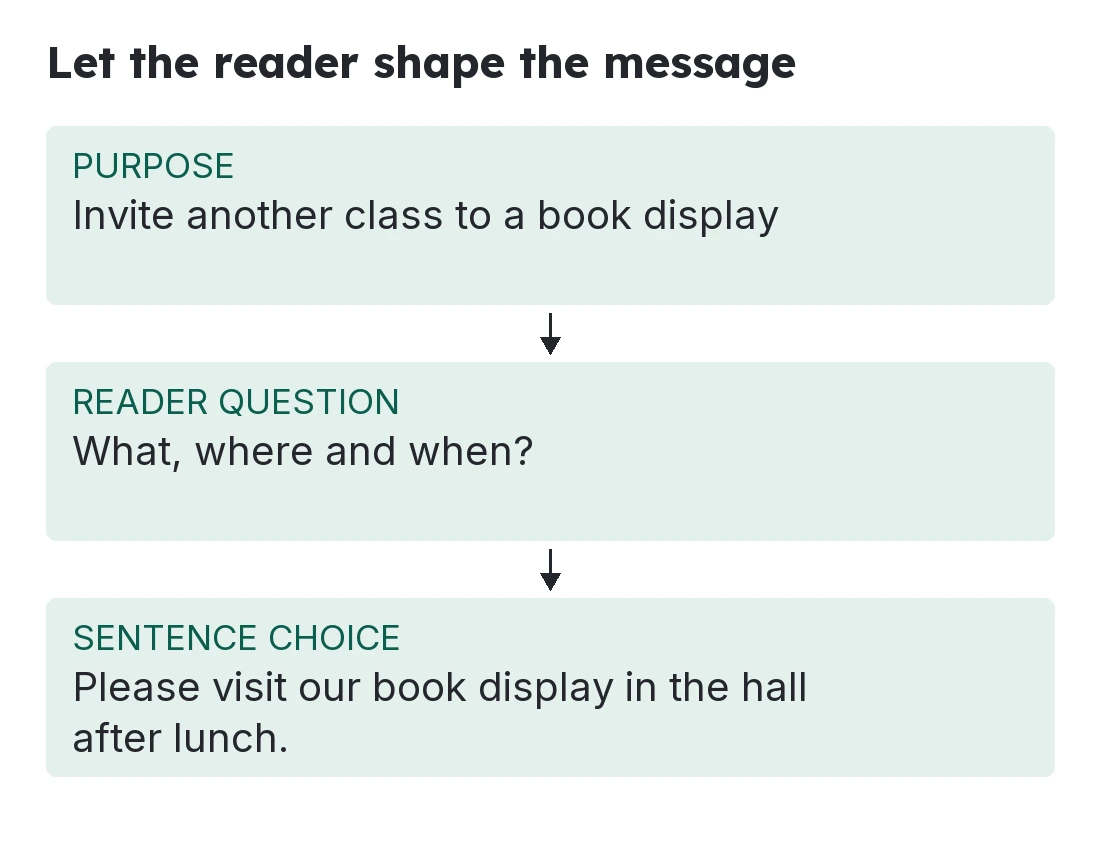
Invite another class to a book display
What, where and when?
Please visit our book display in the hall after lunch.
For more sentence choices, see working with complex sentences. Choose a structure for the message, rather than a feature quota.
English, a formal request. In this fictional task, a book display is in the hall. Year 2 will visit on Thursday. The writer wants the library team to leave the display in place until Friday.
Authored model
Dear library team,
Please could our book display remain in the hall until Friday? Year 2 will visit on Thursday, so keeping it there would give them time to read our recommendations.
Thank you for considering our request.
Model the choice aloud: “The library team needs a clear request and a reason. I will name the display, place and end date. Then I will explain who benefits. So links that reason to the request.” The tone suits this reader without adding complex words for their own sake.
For a fresh response, change the fictional purpose: invite another class to the display. Ask learners to choose the information that the visitors need. Then ask them to explain one change in wording. Read for a clear request or invitation, a useful reason and choices that suit the reader.
This is an authored illustration. The framework links writing choices with audience and purpose (printed page 65). Upper primary composition also links grammar and vocabulary choices with meaning. The example gives a different phase and task from the Year 3 account.
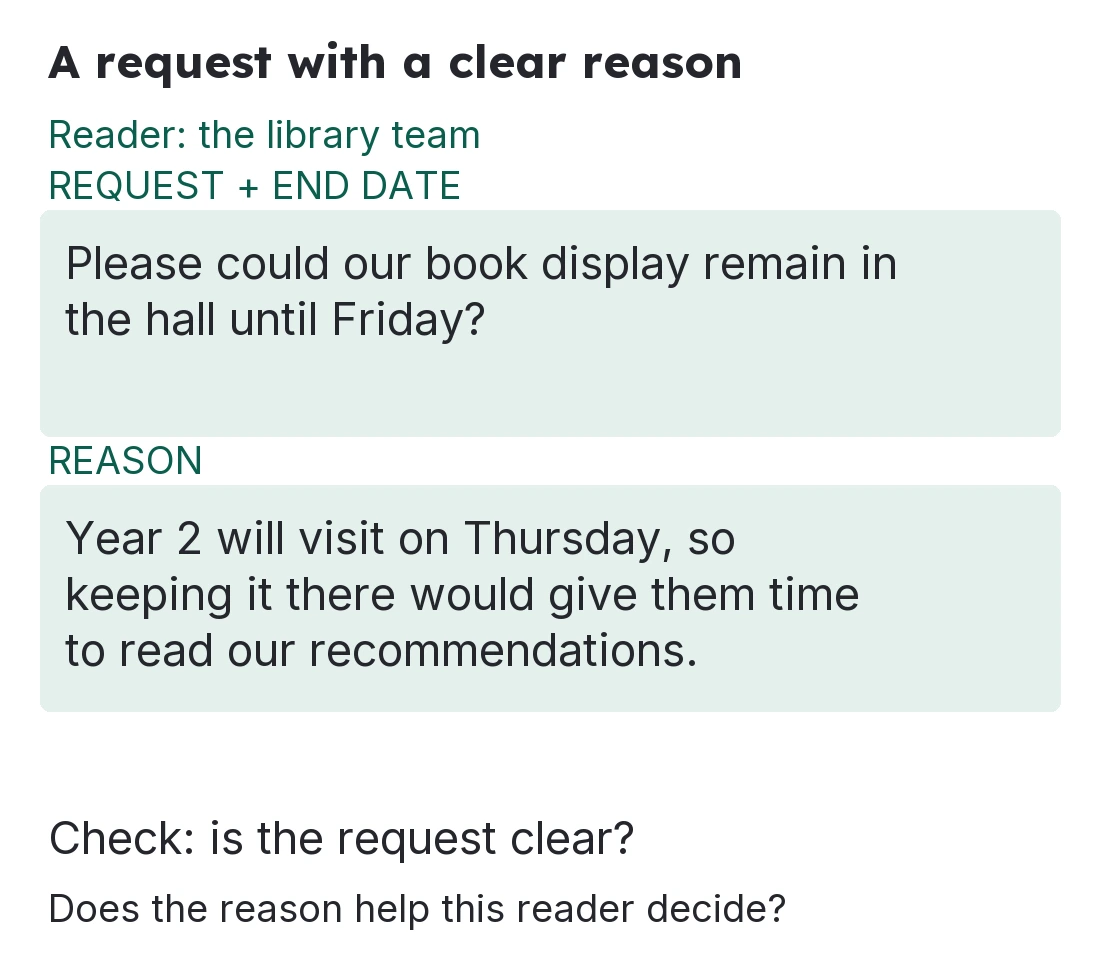
REQUEST + END DATE
Please could our book display remain in the hall until Friday?
REASON
Year 2 will visit on Thursday, so keeping it there would give them time to read our recommendations.
Check: is the request clear? Does the reason help this reader decide?
Change the relationship below to see which part of the same fictional situation becomes prominent. Use the result to explain a choice before trying it in your own paragraph.
The point is to make meaning clear. The framework shows why a writer might choose a short sentence. It also says teachers should keep beginners free to try sentences with more than one clause.
The summary puts quality before length. Give learners time to practise a key skill, then use it in a message with a purpose. A longer piece can follow when the task and current writing call for it.
| Choice | Possible effect |
|---|---|
| We waited. Nobody came. | The separation makes the pause conspicuous. |
| We waited for a long time, but nobody came. | The conjunction makes the contrast explicit. |
Question: is this advice, a curriculum requirement or a tested lesson?
The DfE framework gives teaching guidance. Its summary outlines the same guidance, so it is not a second research study. The English programme is a separate source for curriculum content. Our examples and planning prompts are authored ways to explore those ideas.
| Source | What it supports here | Limit |
|---|---|---|
| DfE writing framework | Guidance on foundations, sentences and writing for a reader. | Advice, not a trial of our routine. |
| Official summary | A short account of the same guidance. | Same source family, not an independent study. |
| English programmes | Key-stage writing content and separately marked notes. | Keep the status of each passage clear. |
Teams reviewing lessons across subjects can compare the practical tasks in classroom literacy routines.
A sentence scaffold earns its place when it helps with a specific problem. Begin with the intended meaning, model the relationship, and ask learners to explain or adapt the choice. Return the sentence to a text with a reader and a purpose.
If every response follows one stem, try an alternative and ask what changes. The difference gives a useful discussion about meaning, rather than a requirement to insert named features.
| Stem | What the writer must supply |
|---|---|
| We waited because… | A reason for waiting. |
| We waited until… | The endpoint of the wait. |
The framework also cautions against heavy test preparation and using assessment frameworks as day-to-day teaching criteria. Keep assessment information in its proper role. For further teaching approaches, see modelled, shared and guided writing and using writing frames purposefully.
Writing planning note (one-page PDF)
Record the reader, your writing focus, the model and a fresh learner response. Use the final space to choose what needs another model or a chance to revise.
For spoken preparation, browse speaking and listening prompts before the writing task.
This is an authored planning prompt. Use it with your existing planning resources and the relevant section of the framework. For sentence tasks beyond this example, browse classroom sentence-building strategies. Choose one paragraph from the next writing task and make its intended meaning the focus of your model.
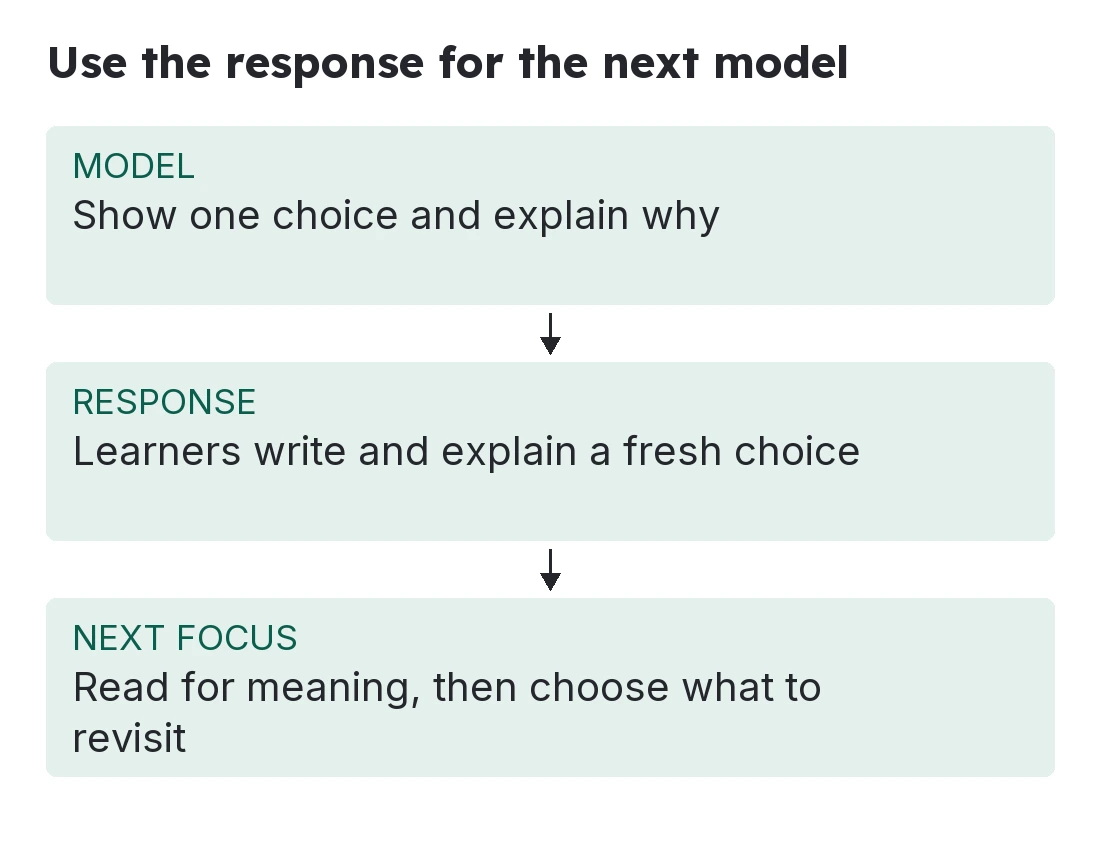
Show one choice and explain why
Learners write and explain a fresh choice
Read for meaning, then choose what to revisit
Verbatim excerpts from all verified posts supplied for this topic, limited to 25 words per source. These are opinions and reported experiences, not research evidence. Themes are editorial labels.
Pushback
Children in the EYFS and KS1 can write short whole texts and focus at the sentence-level.
Themes are our labels.
| Theme | What teachers said | Who and when |
|---|---|---|
| Interpreting guidance in classrooms | This shows how much gets lost in translation, from one government document to the next & then into classrooms. | @BarbaraBleimanPublic opinion excerpt2 June 2026 (UTC)Original post |
| Consultation critique | Many of those with the greatest expertise & knowledge were ‘consulted’ but not on the panel & not heeded, | @BarbaraBleimanPublic opinion excerpt28 September 2025 (UTC)Original post |
| Selective interpretation critique | they seem to be ignoring key messages from the non statutory writing framework and cherry picking to suit their agenda | @SwailesRuthPublic opinion excerpt28 January 2026 (UTC)Original post |
| Questioning a single teaching approach | One misconception is that there is a one-size-fits-all way to teach writing. | @rosBIGWRITINGPublic opinion excerpt1 September 2025 (UTC)Original post |
| Start with oral composition | Schools need to build the foundations for writing right from the start, starting with oral composition | @PieCorbettPublic opinion excerpt9 August 2025 (UTC)Original post |
| Useful on transcription, handwriting and SEND | The #DfE Writing Framework is out & it looks to be a useful tool for #English leaders. | @MulhernCPublic opinion excerpt8 July 2025 (UTC)Original post |
| Teach grammar in context | Great and now we know we have to teach it in context…thank you Debra Myhill | @janeconsidinePublic opinion excerpt1 October 2025 (UTC)Original post |
| Reception handwriting still needs a book | Post New Writing Framework, I’m on hunt for the perfect handwriting practice books for Reception class. Any ideas? | @MadeUpTeacher1Public opinion excerpt11 December 2025 (UTC)Original post |
| Adapted, and still early | we’re really at the beginning of our journey with it | @mrmarchayesPublic opinion excerpt12 September 2026 (UTC)Original post |
| Useful beside the Ofsted English report | The Ofsted report on English and the DfE writing framework will be helpful to look at. | @greeborunnerPublic opinion excerpt2 October 2026 (UTC)Original post |
This page explains selected writing guidance. It is not a review of every part of the 150-page framework or a trial of a teaching programme. The DfE summary and full guide belong to one source family. We have not treated them as two independent studies.
The worked examples use invented classroom situations. They show choices a teacher can discuss. They do not prove an attainment gain, set a fixed lesson dose or define a readiness score. Use the actual writing task and the response you see to choose the next focus.
Individual access, assessment and particular-weakness decisions need their relevant guidance and professional processes. This article does not make those decisions or create a new school policy.
The document calls itself non-statutory guidance for primary schools in England. Keep it separate from curriculum and assessment rules.
Reception, key stage 1 and key stage 2 are its main teaching scope.
The guide connects a grammar rule with the meaning it makes in a writing task.
England English programmes of study set out writing content. Their marked non-statutory notes keep that status.
This authored example shows sentence choices. It has not been tested as an intervention.
Plan your next writing lesson
Take one sentence focus, a model and a fresh writing task into your next plan.
Open the lesson planner