Now and Next Boards: The Complete Visual Support Guide for Autism and SEND
|
January 20, 2026
Master Now and Next boards for autism and SEND students. Comprehensive guide covering implementation, progression to visual timetables, troubleshooting, and PDA-specific adaptations.
<p>Main, P. (2026, January 20). Now and Next Boards: The Complete Visual Support Guide for Autism and SEND. Retrieved from <a href="https://www.structural-learning.com/post/now-next-boards-complete-visual-support">https://www.structural-learning.com/post/now-next-boards-complete-visual-support</a></p>
Now and Next boards are one of the most effective visual support tools for children with autism, ADHD, and communication difficulties. By breaking activities into two simple steps, these boards reduce anxiety, support transitions, and help children understand what is expected of them. This guide provides everything teachers, teaching assistants, and parents need to implement Now and Next boards effectively.
Visual supports work because they play to the strengths of many children with autism and other special educational needs. While spoken instructions disappear the moment they are said, visual information persists, giving children time to process and refer back to what they need to do. Now and Next boards represent the simplest form of visual timetable, making them an ideal starting point for children new to visual supports.
Why Now and Next Boards Work: Key Benefits for Children with Autism & SEND
Key Takeaways
Reduce anxiety through predictability: Now and Next boards help children with autism understand what is happening and what comes next, significantly reducing anxiety around transitions and unexpected changes
Start simple, build complexity gradually: Begin with Now and Next before progressing to First-Then boards, Now-Next-Then sequences, and eventually full visual timetables based on the child's needs
Individualise the format: Some children respond better to photographs, others to symbols (Widgit, Boardmaker), and some to written words. Match the format to the child's processing strengths
Use consistently across settings: For maximum effectiveness, the same visual support system should be used at home, in school, and in other settings, with all adults using consistent language
What Are Now and Next Boards?
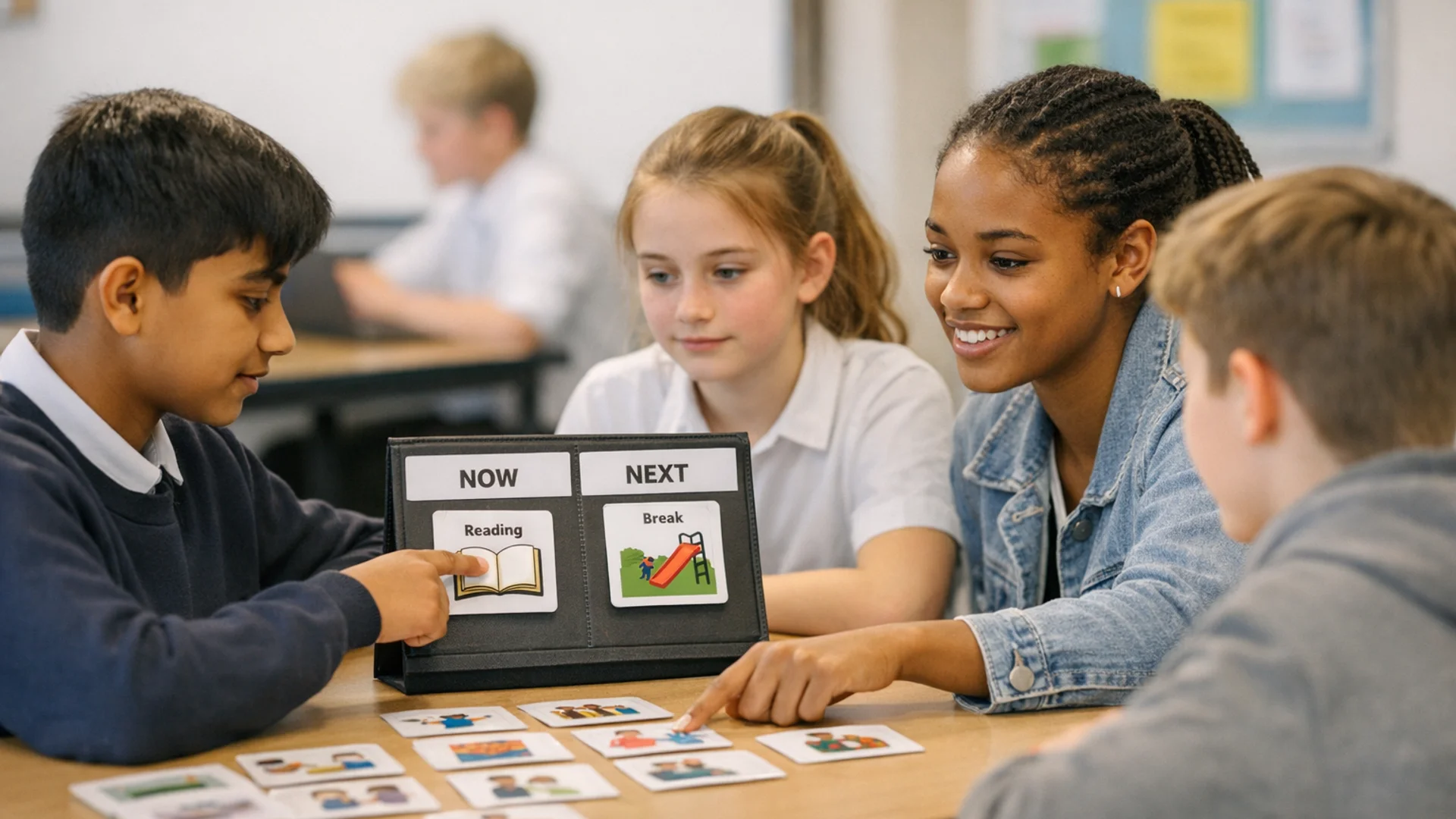
A Now and Next board is a simple two-part visual display showing a child what they are doing right now and what will happen next. The board typically has two sections labelled "Now" and "Next", each containing an image, symbol, or word representing the current and upcoming activity.
The power of Now and Next boards lies in their simplicity. Unlike full visual timetables that show an entire day or session, these boards focus attention on just two pieces of information. This reduces cognitive load and makes the system accessible even for children with significant learning difficulties.
For children with autism, the board addresses a core challenge: difficulty processing verbal instructions and understanding the sequence of events. When a teacher says "finish your writing and then you can go to the computer", a child with autism might only hear "computer" and become fixated on that activity. The Now and Next board makes the sequence concrete and visible.
The boards also support working memory difficulties common in ADHD. Children who struggle to hold multiple instructions in mind can glance at the board repeatedly to remind themselves what they should be doing and what comes next.
Who Benefits from Now and Next Boards?
Now and Next boards were originally developed for children with autism but benefit a much wider range of learners. Understanding who benefits helps teachers implement the strategy appropriately.
Children with autism spectrum condition often experience difficulty with transitions, unexpected changes, and processing verbal instructions. Now and Next boards provide the predictability and visual clarity that reduces anxiety and supports independence. Research consistently shows that visual supports improve outcomes for autistic children across multiple domains.
Children with ADHD frequently struggle with task initiation, sustained attention, and following multi-step instructions. The board serves as an external reminder, reducing the working memory load and helping children stay on task. The visual "next" element can also provide motivation when a preferred activity follows a less preferred one.
Children with communication difficulties, including those with developmental language disorder or English as an additional language, benefit because visual supports reduce reliance on verbal comprehension. The consistent visual format builds familiarity even when the child cannot fully understand spoken instructions.
Children with learning difficulties often process information more slowly and may need multiple exposures to understand expectations. The permanent nature of visual supports allows children to reference the board repeatedly, building understanding gradually.
Children experiencing anxiety find comfort in predictability. Knowing what comes next reduces the uncertainty that triggers anxious responses. Many mainstream children without diagnosed conditions also benefit from visual structure, particularly during periods of stress or change.
Types of Now and Next Boards
Now and Next boards come in various formats, and choosing the right type depends on the child's developmental level, visual processing abilities, and practical considerations.
Photograph boards use real photographs of activities, places, or objects. These work well for children at early developmental stages or those who struggle to generalise from symbols to real-world activities. Photographs are particularly effective for showing specific locations or equipment the child will use.
Symbol boards use standardised picture symbols such as Widgit, Boardmaker, or PECS images. Symbols are more abstract than photographs but offer consistency. Once a child learns that a particular symbol means "reading", they can recognise that symbol across different settings and materials.
Written word boards suit children who can read and process written language. These are less visually prominent but integrate well into mainstream classroom environments where other children might question picture-based systems.
Object boards use actual objects or miniature representations attached to a board. These support children at the earliest developmental stages who are not yet able to understand that a picture represents a real activity. A child might have a small paintbrush velcroed to the "now" section when it is time for art.
Combination boards use multiple formats together. For example, a symbol paired with a written word supports literacy development while maintaining visual accessibility. The choice should be guided by assessment of the individual child's needs rather than assumptions about what "level" they should be at.
Setting Up Your Now and Next Board
Effective implementation requires thoughtful setup. The physical format, positioning, and introduction of the board all influence whether it will become a helpful tool or gather dust in a corner.
Board format: The board itself can be as simple as a laminated piece of card with two boxes drawn on it, or a commercially produced product with velcro strips. What matters is that images can be easily attached and removed, and that the "Now" and "Next" sections are clearly distinguished. Some boards use different coloured backgrounds for each section.
Image preparation: Build a library of images covering all regular activities before introducing the board. Running out of images mid-session undermines the system's reliability. Laminate images and add velcro dots to the back. Organise images in a way that makes them quick to find, perhaps in an envelope attached to the back of the board or in a small ring binder.
Positioning: The board must be easily visible to the child during activities. For individual children, this might mean placing the board on their desk. For whole-class use, position it at child eye level. Some children benefit from portable boards that move with them between activities. Consider whether the board needs to be positioned to minimise distraction for other children.
Finished box or envelope: When an activity is complete, the image moves from "Now" to a "finished" location. This provides closure and makes the transition concrete. The finished box can be as simple as an envelope attached to the side of the board.
How to Use Now and Next Boards Effectively
The mechanics of using Now and Next boards are straightforward, but subtle aspects of implementation significantly affect outcomes.
Introducing the board: Begin when the child is calm, not during a difficult moment. Show the board and explain in simple language what each section means. Demonstrate by placing images and talking through: "Now we are doing reading. Reading goes in the Now box. Next is break time. Break goes in the Next box."
Updating the board: When an activity finishes, involve the child in moving the "Now" image to the finished location and sliding the "Next" image into the "Now" position. Then add a new image to the "Next" section. This ritual reinforces the board's purpose and gives the child agency in managing their day.
Consistent language: Use the same phrases each time: "Let's check our board. Now we are doing... Next is..." Consistency builds familiarity and reduces processing demands. All adults working with the child should use identical language.
Referring to the board: Prompt the child to look at the board frequently, not just during transitions. "Check your board. What are we doing now?" This builds the habit of using visual supports independently and reinforces the connection between the board and daily activities.
Pairing with verbal instructions: The board supports but does not replace verbal communication. Give verbal instructions while pointing to the relevant image. Over time, some children will begin to check the board independently without verbal prompting.
Anatomy of a Now and Next Board: What Makes Them So Effective
Progression from Now-Next to Full Visual Timetables
Now and Next boards are typically the starting point in a progression toward more comprehensive visual schedule systems. Understanding this progression helps teachers plan appropriately for each child's development.
Stage 1 - Now and Next: Two-step boards for children just beginning to understand visual supports or those who become overwhelmed by too much information. Some children remain at this level long-term, which is perfectly appropriate if it meets their needs.
Stage 2 - First-Then boards: Essentially the same as Now and Next, but using "First... Then..." language emphasises that one activity must be completed before another begins. This is particularly useful when a less preferred activity precedes a more preferred one: "First writing, then iPad."
Stage 3 - Now-Next-Then: Three-step boards for children ready to hold more information. This provides slightly more advance notice about upcoming activities while still limiting complexity.
Stage 4 - Morning/Afternoon schedules: Half-day visual timetables showing 4-6 activities. Children at this stage can see a broader overview of their day while still managing information load.
Stage 5 - Full day visual timetables: Complete daily schedules showing all activities. Some children eventually manage without visual supports for routine activities, using timetables only for unusual days or transitions.
Regression and flexibility: Children may move back to simpler systems during periods of stress, illness, or significant change. This is appropriate and should not be seen as failure. The goal is meeting the child's needs, not progressing through levels.
Troubleshooting Common Problems
Even well-implemented Now and Next boards encounter difficulties. Understanding common problems and solutions prevents frustration and abandonment of an otherwise effective strategy.
Child ignores the board: This often indicates the board is not meaningful to the child. Check whether the images are clear and the child understands what they represent. Try using real photographs or objects. Ensure the board is positioned where the child naturally looks. Increase prompting temporarily while rebuilding the habit.
Child becomes fixated on "Next": Some children, particularly those with autism, fixate on the upcoming activity and struggle to engage with the current task. Solutions include covering the "Next" section initially, using a bland symbol for "Next" until the activity approaches, or ensuring "Next" activities are not always highly preferred options that overshadow current tasks.
Child removes or throws the images: This behaviour often communicates something. The child might be protesting an upcoming activity, seeking attention, or finding the board itself aversive. Investigate the function of the behaviour before assuming it is deliberate defiance. Consider whether the child has any choice in activities and whether the board has become associated with demands without rewards.
Inconsistent use by adults: When different adults use the board inconsistently, children learn that the board is not reliable. Establish clear protocols, train all staff, and include the board in handover information. Some schools include visual support requirements on classroom door signs as a reminder.
Board becomes overwhelming: If a child who previously managed a Now-Next-Then board becomes distressed, consider returning to simpler Now and Next format temporarily. External factors like illness, home stress, or school changes can reduce capacity. Reduce demands before building back up.
Cautions for PDA and Demand-Sensitive Children
Pathological Demand Avoidance (PDA) is a profile within the autism spectrum characterised by extreme anxiety-driven avoidance of everyday demands. Children with PDA often require modified approaches to visual supports.
Demand association: If Now and Next boards become associated with demands and compliance, children with PDA may develop avoidance responses to the board itself. The board becomes another adult-imposed structure triggering anxiety.
Modify language: Instead of directive language ("Now you are doing writing"), use more neutral descriptions ("Now is writing time") or even offer choices within the structure. Some practitioners use "Now is" rather than "Now you do" to reduce the sense of demand.
Child-led board use: Allow the child more control over managing their own board. They choose when to check it and move images. This reduces the sense that the board is an adult tool for controlling behaviour.
Flexible implementation: Strict adherence to the visual schedule may backfire with demand-sensitive children. Build flexibility into the system from the start. Having an occasional "choice" or "?" card acknowledges that rigid structure is not always possible or helpful.
Monitor for escalation: If introducing a Now and Next board leads to increased anxiety or avoidant behaviour, pause and reconsider. Some children with PDA do better with visual supports that are available but optional rather than prominently displayed and explicitly referenced.
Integration with Other Strategies
Now and Next boards work best as part of a comprehensive approach to supporting children with SEND, not as an isolated intervention.
Visual timetables and schedules: Now and Next boards complement whole-class visual timetables. The class timetable shows the full day; the individual Now and Next board provides personalised support with more appropriate images or additional detail.
Social stories: Carol Gray's Social Stories can explain why visual supports are helpful and how to use them. A social story about checking your Now and Next board can support initial implementation.
PECS (Picture Exchange Communication System): For children using PECS for communication, Now and Next boards use similar visual formats. Symbols should be consistent between communication and scheduling systems to reduce confusion.
Structured teaching (TEACCH): Now and Next boards align with TEACCH principles of visual structure and predictability. They represent one element of the visual clarity that TEACCH methodology emphasises.
Zones of Regulation: Some practitioners link Now and Next boards with emotional regulation by adding a "check-in" component. The child identifies their zone before beginning the "Now" activity.
Making and Finding Resources
Creating effective Now and Next boards requires appropriate resources. Several options exist depending on budget and needs.
DIY approach: Laminated card with drawn or printed boxes, velcro dots, and printed images costs very little and allows complete customisation. This approach works well when specific photographs are needed or when standard symbols do not cover required activities.
Symbol software: Programmes like Widgit Online, Boardmaker, or the free In Print provide searchable databases of symbols that can be printed and laminated. These offer professional-quality images with consistent style.
Free resources: Websites including Twinkl, Teachers Pay Teachers (search for free items), and the Autism Toolbox provide downloadable Now and Next board templates and symbol sets. Quality varies, so preview before printing.
Commercial products: Ready-made Now and Next boards are available from special needs suppliers. These save time and often include durable boards with high-quality velcro and a starter set of symbols. However, they are more expensive and may not include images for activities specific to your setting.
Apps and digital options: Tablet apps such as Choiceworks, First Then Visual Schedule, and Visual Schedule Planner provide digital Now and Next functionality. These can be helpful for children who engage well with technology or when portability is essential. However, physical boards remain preferable for children who are distracted by screens or who benefit from the tactile experience of moving images.
Implementing Across Home and School
Consistency between home and school significantly improves outcomes for children using visual supports. Coordinated implementation requires communication and shared resources.
Shared symbol systems: Using the same symbols at home and school reduces confusion. If the school uses Widgit symbols, provide families with printed copies or digital access so they can create matching home resources.
Communication about routines: Home-school communication books or apps can include information about how visual supports were used during the day, what activities were challenging, and what strategies helped.
Parent training: Schools can offer brief training sessions showing parents how to create and use Now and Next boards at home. Video demonstrations can support families who cannot attend in-person sessions.
Transition between settings: Some children benefit from a Now and Next board that specifically addresses the transition: "Now: say goodbye to mum. Next: go to classroom." This bridges the gap between home and school routines.
Consistency in language: Agreeing common phrases between home and school ("Let's check your board") helps children generalise the skill. Written guidance for families ensures everyone uses consistent approaches.
Building Your Visual Support Toolkit: From Now-Next to Full Timetables
Further Reading: Key Research Papers
Visual Supports for People with Autism: A Systematic ReviewView study ↗ by Hume, Loftin, and Lantz (2009) provides comprehensive evidence for the effectiveness of visual supports including schedules and organisational supports for individuals with autism. The authors reviewed 18 studies meeting rigorous methodological criteria and found consistent positive outcomes across age groups and settings. This paper establishes the evidence base underlying Now and Next board use.
The Picture Exchange Communication SystemView study ↗ by Bondy and Frost (1994) describes the PECS approach that underpins much visual support practice. While focused on communication rather than scheduling, the principles of visual representation and symbol use directly inform Now and Next board implementation. Understanding PECS helps practitioners maintain consistency across visual support systems.
Structured Teaching: TEACCH ProgramView study ↗ by Mesibov, Shea, and Schopler (2005) explains the theoretical foundations of visual structure for autism. The authors demonstrate how visual organisation, clear physical structure, and visual schedules support independence and reduce anxiety for individuals with autism. Now and Next boards represent one application of these broader principles.
Visual Schedules: A Review of the LiteratureView study ↗ by Knight, Sartini, and Spriggs (2015) examines the evidence specifically for visual schedule interventions. The review found consistent positive effects for individuals with autism spectrum disorder and other developmental disabilities, with effects demonstrated across ages, settings, and activity types. The authors provide practical guidance for implementation alongside their evidence summary.
Pathological Demand Avoidance Syndrome: A Necessary Distinction within the Pervasive Developmental DisordersView study ↗ by Newson, Le Maréchal, and David (2003) describes the PDA profile and its implications for intervention. The authors explain why standard approaches including visual schedules may require modification for demand-sensitive individuals. This paper helps practitioners understand when to adapt Now and Next board implementation.
Now and Next boards are one of the most effective visual support tools for children with autism, ADHD, and communication difficulties. By breaking activities into two simple steps, these boards reduce anxiety, support transitions, and help children understand what is expected of them. This guide provides everything teachers, teaching assistants, and parents need to implement Now and Next boards effectively.
Visual supports work because they play to the strengths of many children with autism and other special educational needs. While spoken instructions disappear the moment they are said, visual information persists, giving children time to process and refer back to what they need to do. Now and Next boards represent the simplest form of visual timetable, making them an ideal starting point for children new to visual supports.
Why Now and Next Boards Work: Key Benefits for Children with Autism & SEND
Key Takeaways
Reduce anxiety through predictability: Now and Next boards help children with autism understand what is happening and what comes next, significantly reducing anxiety around transitions and unexpected changes
Start simple, build complexity gradually: Begin with Now and Next before progressing to First-Then boards, Now-Next-Then sequences, and eventually full visual timetables based on the child's needs
Individualise the format: Some children respond better to photographs, others to symbols (Widgit, Boardmaker), and some to written words. Match the format to the child's processing strengths
Use consistently across settings: For maximum effectiveness, the same visual support system should be used at home, in school, and in other settings, with all adults using consistent language
What Are Now and Next Boards?
A Now and Next board is a simple two-part visual display showing a child what they are doing right now and what will happen next. The board typically has two sections labelled "Now" and "Next", each containing an image, symbol, or word representing the current and upcoming activity.
The power of Now and Next boards lies in their simplicity. Unlike full visual timetables that show an entire day or session, these boards focus attention on just two pieces of information. This reduces cognitive load and makes the system accessible even for children with significant learning difficulties.
For children with autism, the board addresses a core challenge: difficulty processing verbal instructions and understanding the sequence of events. When a teacher says "finish your writing and then you can go to the computer", a child with autism might only hear "computer" and become fixated on that activity. The Now and Next board makes the sequence concrete and visible.
The boards also support working memory difficulties common in ADHD. Children who struggle to hold multiple instructions in mind can glance at the board repeatedly to remind themselves what they should be doing and what comes next.
Who Benefits from Now and Next Boards?
Now and Next boards were originally developed for children with autism but benefit a much wider range of learners. Understanding who benefits helps teachers implement the strategy appropriately.
Children with autism spectrum condition often experience difficulty with transitions, unexpected changes, and processing verbal instructions. Now and Next boards provide the predictability and visual clarity that reduces anxiety and supports independence. Research consistently shows that visual supports improve outcomes for autistic children across multiple domains.
Children with ADHD frequently struggle with task initiation, sustained attention, and following multi-step instructions. The board serves as an external reminder, reducing the working memory load and helping children stay on task. The visual "next" element can also provide motivation when a preferred activity follows a less preferred one.
Children with communication difficulties, including those with developmental language disorder or English as an additional language, benefit because visual supports reduce reliance on verbal comprehension. The consistent visual format builds familiarity even when the child cannot fully understand spoken instructions.
Children with learning difficulties often process information more slowly and may need multiple exposures to understand expectations. The permanent nature of visual supports allows children to reference the board repeatedly, building understanding gradually.
Children experiencing anxiety find comfort in predictability. Knowing what comes next reduces the uncertainty that triggers anxious responses. Many mainstream children without diagnosed conditions also benefit from visual structure, particularly during periods of stress or change.
Types of Now and Next Boards
Now and Next boards come in various formats, and choosing the right type depends on the child's developmental level, visual processing abilities, and practical considerations.
Photograph boards use real photographs of activities, places, or objects. These work well for children at early developmental stages or those who struggle to generalise from symbols to real-world activities. Photographs are particularly effective for showing specific locations or equipment the child will use.
Symbol boards use standardised picture symbols such as Widgit, Boardmaker, or PECS images. Symbols are more abstract than photographs but offer consistency. Once a child learns that a particular symbol means "reading", they can recognise that symbol across different settings and materials.
Written word boards suit children who can read and process written language. These are less visually prominent but integrate well into mainstream classroom environments where other children might question picture-based systems.
Object boards use actual objects or miniature representations attached to a board. These support children at the earliest developmental stages who are not yet able to understand that a picture represents a real activity. A child might have a small paintbrush velcroed to the "now" section when it is time for art.
Combination boards use multiple formats together. For example, a symbol paired with a written word supports literacy development while maintaining visual accessibility. The choice should be guided by assessment of the individual child's needs rather than assumptions about what "level" they should be at.
Setting Up Your Now and Next Board
Effective implementation requires thoughtful setup. The physical format, positioning, and introduction of the board all influence whether it will become a helpful tool or gather dust in a corner.
Board format: The board itself can be as simple as a laminated piece of card with two boxes drawn on it, or a commercially produced product with velcro strips. What matters is that images can be easily attached and removed, and that the "Now" and "Next" sections are clearly distinguished. Some boards use different coloured backgrounds for each section.
Image preparation: Build a library of images covering all regular activities before introducing the board. Running out of images mid-session undermines the system's reliability. Laminate images and add velcro dots to the back. Organise images in a way that makes them quick to find, perhaps in an envelope attached to the back of the board or in a small ring binder.
Positioning: The board must be easily visible to the child during activities. For individual children, this might mean placing the board on their desk. For whole-class use, position it at child eye level. Some children benefit from portable boards that move with them between activities. Consider whether the board needs to be positioned to minimise distraction for other children.
Finished box or envelope: When an activity is complete, the image moves from "Now" to a "finished" location. This provides closure and makes the transition concrete. The finished box can be as simple as an envelope attached to the side of the board.
How to Use Now and Next Boards Effectively
The mechanics of using Now and Next boards are straightforward, but subtle aspects of implementation significantly affect outcomes.
Introducing the board: Begin when the child is calm, not during a difficult moment. Show the board and explain in simple language what each section means. Demonstrate by placing images and talking through: "Now we are doing reading. Reading goes in the Now box. Next is break time. Break goes in the Next box."
Updating the board: When an activity finishes, involve the child in moving the "Now" image to the finished location and sliding the "Next" image into the "Now" position. Then add a new image to the "Next" section. This ritual reinforces the board's purpose and gives the child agency in managing their day.
Consistent language: Use the same phrases each time: "Let's check our board. Now we are doing... Next is..." Consistency builds familiarity and reduces processing demands. All adults working with the child should use identical language.
Referring to the board: Prompt the child to look at the board frequently, not just during transitions. "Check your board. What are we doing now?" This builds the habit of using visual supports independently and reinforces the connection between the board and daily activities.
Pairing with verbal instructions: The board supports but does not replace verbal communication. Give verbal instructions while pointing to the relevant image. Over time, some children will begin to check the board independently without verbal prompting.
Anatomy of a Now and Next Board: What Makes Them So Effective
Progression from Now-Next to Full Visual Timetables
Now and Next boards are typically the starting point in a progression toward more comprehensive visual schedule systems. Understanding this progression helps teachers plan appropriately for each child's development.
Stage 1 - Now and Next: Two-step boards for children just beginning to understand visual supports or those who become overwhelmed by too much information. Some children remain at this level long-term, which is perfectly appropriate if it meets their needs.
Stage 2 - First-Then boards: Essentially the same as Now and Next, but using "First... Then..." language emphasises that one activity must be completed before another begins. This is particularly useful when a less preferred activity precedes a more preferred one: "First writing, then iPad."
Stage 3 - Now-Next-Then: Three-step boards for children ready to hold more information. This provides slightly more advance notice about upcoming activities while still limiting complexity.
Stage 4 - Morning/Afternoon schedules: Half-day visual timetables showing 4-6 activities. Children at this stage can see a broader overview of their day while still managing information load.
Stage 5 - Full day visual timetables: Complete daily schedules showing all activities. Some children eventually manage without visual supports for routine activities, using timetables only for unusual days or transitions.
Regression and flexibility: Children may move back to simpler systems during periods of stress, illness, or significant change. This is appropriate and should not be seen as failure. The goal is meeting the child's needs, not progressing through levels.
Troubleshooting Common Problems
Even well-implemented Now and Next boards encounter difficulties. Understanding common problems and solutions prevents frustration and abandonment of an otherwise effective strategy.
Child ignores the board: This often indicates the board is not meaningful to the child. Check whether the images are clear and the child understands what they represent. Try using real photographs or objects. Ensure the board is positioned where the child naturally looks. Increase prompting temporarily while rebuilding the habit.
Child becomes fixated on "Next": Some children, particularly those with autism, fixate on the upcoming activity and struggle to engage with the current task. Solutions include covering the "Next" section initially, using a bland symbol for "Next" until the activity approaches, or ensuring "Next" activities are not always highly preferred options that overshadow current tasks.
Child removes or throws the images: This behaviour often communicates something. The child might be protesting an upcoming activity, seeking attention, or finding the board itself aversive. Investigate the function of the behaviour before assuming it is deliberate defiance. Consider whether the child has any choice in activities and whether the board has become associated with demands without rewards.
Inconsistent use by adults: When different adults use the board inconsistently, children learn that the board is not reliable. Establish clear protocols, train all staff, and include the board in handover information. Some schools include visual support requirements on classroom door signs as a reminder.
Board becomes overwhelming: If a child who previously managed a Now-Next-Then board becomes distressed, consider returning to simpler Now and Next format temporarily. External factors like illness, home stress, or school changes can reduce capacity. Reduce demands before building back up.
Cautions for PDA and Demand-Sensitive Children
Pathological Demand Avoidance (PDA) is a profile within the autism spectrum characterised by extreme anxiety-driven avoidance of everyday demands. Children with PDA often require modified approaches to visual supports.
Demand association: If Now and Next boards become associated with demands and compliance, children with PDA may develop avoidance responses to the board itself. The board becomes another adult-imposed structure triggering anxiety.
Modify language: Instead of directive language ("Now you are doing writing"), use more neutral descriptions ("Now is writing time") or even offer choices within the structure. Some practitioners use "Now is" rather than "Now you do" to reduce the sense of demand.
Child-led board use: Allow the child more control over managing their own board. They choose when to check it and move images. This reduces the sense that the board is an adult tool for controlling behaviour.
Flexible implementation: Strict adherence to the visual schedule may backfire with demand-sensitive children. Build flexibility into the system from the start. Having an occasional "choice" or "?" card acknowledges that rigid structure is not always possible or helpful.
Monitor for escalation: If introducing a Now and Next board leads to increased anxiety or avoidant behaviour, pause and reconsider. Some children with PDA do better with visual supports that are available but optional rather than prominently displayed and explicitly referenced.
Integration with Other Strategies
Now and Next boards work best as part of a comprehensive approach to supporting children with SEND, not as an isolated intervention.
Visual timetables and schedules: Now and Next boards complement whole-class visual timetables. The class timetable shows the full day; the individual Now and Next board provides personalised support with more appropriate images or additional detail.
Social stories: Carol Gray's Social Stories can explain why visual supports are helpful and how to use them. A social story about checking your Now and Next board can support initial implementation.
PECS (Picture Exchange Communication System): For children using PECS for communication, Now and Next boards use similar visual formats. Symbols should be consistent between communication and scheduling systems to reduce confusion.
Structured teaching (TEACCH): Now and Next boards align with TEACCH principles of visual structure and predictability. They represent one element of the visual clarity that TEACCH methodology emphasises.
Zones of Regulation: Some practitioners link Now and Next boards with emotional regulation by adding a "check-in" component. The child identifies their zone before beginning the "Now" activity.
Making and Finding Resources
Creating effective Now and Next boards requires appropriate resources. Several options exist depending on budget and needs.
DIY approach: Laminated card with drawn or printed boxes, velcro dots, and printed images costs very little and allows complete customisation. This approach works well when specific photographs are needed or when standard symbols do not cover required activities.
Symbol software: Programmes like Widgit Online, Boardmaker, or the free In Print provide searchable databases of symbols that can be printed and laminated. These offer professional-quality images with consistent style.
Free resources: Websites including Twinkl, Teachers Pay Teachers (search for free items), and the Autism Toolbox provide downloadable Now and Next board templates and symbol sets. Quality varies, so preview before printing.
Commercial products: Ready-made Now and Next boards are available from special needs suppliers. These save time and often include durable boards with high-quality velcro and a starter set of symbols. However, they are more expensive and may not include images for activities specific to your setting.
Apps and digital options: Tablet apps such as Choiceworks, First Then Visual Schedule, and Visual Schedule Planner provide digital Now and Next functionality. These can be helpful for children who engage well with technology or when portability is essential. However, physical boards remain preferable for children who are distracted by screens or who benefit from the tactile experience of moving images.
Implementing Across Home and School
Consistency between home and school significantly improves outcomes for children using visual supports. Coordinated implementation requires communication and shared resources.
Shared symbol systems: Using the same symbols at home and school reduces confusion. If the school uses Widgit symbols, provide families with printed copies or digital access so they can create matching home resources.
Communication about routines: Home-school communication books or apps can include information about how visual supports were used during the day, what activities were challenging, and what strategies helped.
Parent training: Schools can offer brief training sessions showing parents how to create and use Now and Next boards at home. Video demonstrations can support families who cannot attend in-person sessions.
Transition between settings: Some children benefit from a Now and Next board that specifically addresses the transition: "Now: say goodbye to mum. Next: go to classroom." This bridges the gap between home and school routines.
Consistency in language: Agreeing common phrases between home and school ("Let's check your board") helps children generalise the skill. Written guidance for families ensures everyone uses consistent approaches.
Building Your Visual Support Toolkit: From Now-Next to Full Timetables
Further Reading: Key Research Papers
Visual Supports for People with Autism: A Systematic ReviewView study ↗ by Hume, Loftin, and Lantz (2009) provides comprehensive evidence for the effectiveness of visual supports including schedules and organisational supports for individuals with autism. The authors reviewed 18 studies meeting rigorous methodological criteria and found consistent positive outcomes across age groups and settings. This paper establishes the evidence base underlying Now and Next board use.
The Picture Exchange Communication SystemView study ↗ by Bondy and Frost (1994) describes the PECS approach that underpins much visual support practice. While focused on communication rather than scheduling, the principles of visual representation and symbol use directly inform Now and Next board implementation. Understanding PECS helps practitioners maintain consistency across visual support systems.
Structured Teaching: TEACCH ProgramView study ↗ by Mesibov, Shea, and Schopler (2005) explains the theoretical foundations of visual structure for autism. The authors demonstrate how visual organisation, clear physical structure, and visual schedules support independence and reduce anxiety for individuals with autism. Now and Next boards represent one application of these broader principles.
Visual Schedules: A Review of the LiteratureView study ↗ by Knight, Sartini, and Spriggs (2015) examines the evidence specifically for visual schedule interventions. The review found consistent positive effects for individuals with autism spectrum disorder and other developmental disabilities, with effects demonstrated across ages, settings, and activity types. The authors provide practical guidance for implementation alongside their evidence summary.
Pathological Demand Avoidance Syndrome: A Necessary Distinction within the Pervasive Developmental DisordersView study ↗ by Newson, Le Maréchal, and David (2003) describes the PDA profile and its implications for intervention. The authors explain why standard approaches including visual schedules may require modification for demand-sensitive individuals. This paper helps practitioners understand when to adapt Now and Next board implementation.