Updated on
April 1, 2026
MTSS and RTI: A Teacher's Guide to Tiered Support
|
February 26, 2026
A fifth-grade student in your class is struggling with reading. You have tried small-group instruction, extra practice with decodable texts.


Updated on
April 1, 2026
|
February 26, 2026
A fifth-grade student in your class is struggling with reading. You have tried small-group instruction, extra practice with decodable texts.
A fifth-grade student in your class is struggling with reading. You have tried small-group instruction, extra practice with decodable texts, and a seating change to reduce distractions. Progress is slow. The student reads 15 words per minute below the benchmark, and the gap is widening. You know something more structured is needed, but what exactly, and who decides? This is the question that Multi-Tiered System of Supports (MTSS) answers. MTSS gives schools a decision-making framework for matching students to the right level of support based on data, not gut feeling. It replaces the old model of waiting for students to fail before acting.
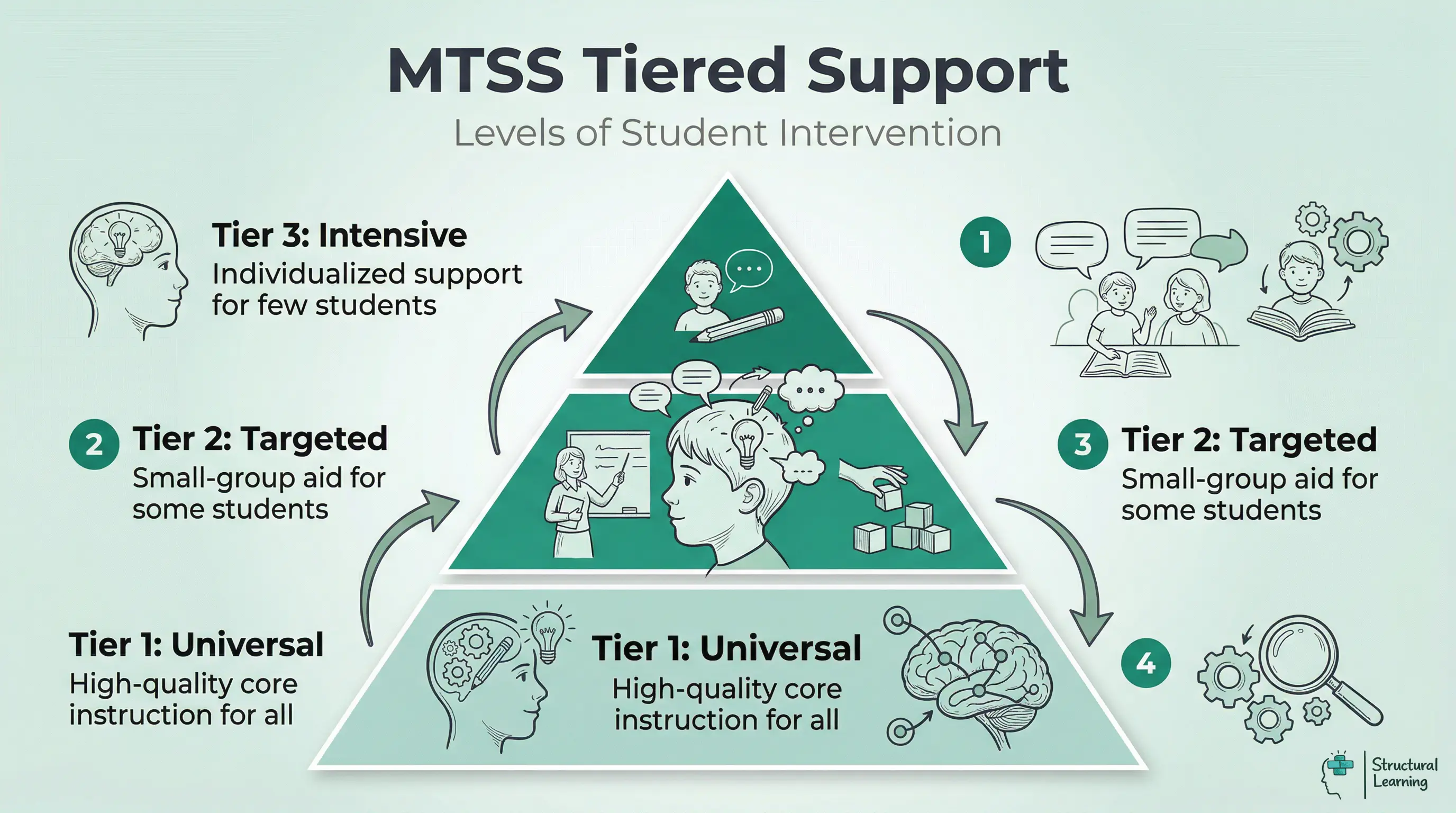

Multi-Tiered System of Supports is a framework for delivering increasing levels of instructional and behavioural support to students based on their response to instruction. The National centre on Response to Intervention defines it as a prevention-oriented approach that organizes evidence-based practices into tiers of increasing intensity. The Every Student Succeeds Act (ESSA, 2015) explicitly references MTSS as a model for allocating resources to support student achievement. See also: Mtss vs rti.
MTSS is not a program you purchase. It is not a curriculum. It is a structure for making decisions about which students need what kind of help and when to change course if the help is not working. Schools that implement MTSS well use data at every decision point: screening data to identify who is at risk, progress monitoring data to track whether interventions are working, and diagnostic data to understand why a student is struggling. See also: Response to intervention rti.
The framework covers academics and behaviour. Older models like Response to Intervention focussed primarily on reading and math. MTSS incorporates Positive behavioural Interventions and Supports (PBIS), social-emotional learning, and attendance. A student who is chronically absent, for example, might receive Tier 2 behavioural support even if their academic screening scores are on track. A student with strong reading skills but persistent difficulty with executive function in the classroom might need targeted support for organisation and self-regulation rather than academic intervention.
The practical result is that MTSS forces a school to ask two questions repeatedly: Is the core instruction working for most students? And for the students it is not working for, what is the most efficient next step? When those questions are answered with data rather than assumptions, schools allocate time and resources more precisely.
Response to Intervention emerged from the reauthorization of the Individuals with Disabilities Education Act (IDEA) in 2004. Before RTI, schools identified learning disabilities primarily through the IQ-discrepancy model: a student had to show a significant gap between their measured intelligence and their academic performance. Critics called this the "wait to fail" approach because students often did not qualify for support until third or fourth grade, by which point the reading gap was already severe (Fletcher et al., 2007).
RTI offered an alternative. Instead of waiting for failure, schools screened all students, provided evidence-based instruction, and identified learning disabilities based on how students responded to that instruction. A student who did not respond to high-quality Tier 1 teaching and targeted Tier 2 intervention was likely to have a specific learning difficulty, not just insufficient instruction.
MTSS expanded RTI in three ways. First, it added behavioural and social-emotional support alongside academics. Second, it emphasized a unified system rather than separate academic and behavioural tracks. Third, it positioned the framework as a whole-school approach to prevention rather than a pathway to special education identification. Many states now use MTSS as the umbrella term, with RTI functioning as the academic component within it.
Feature
RTI
MTSS
Primary focus
Academics (reading, math)
Academics, behaviour, social-emotional, attendance
Origin
IDEA 2004 (LD identification)
ESSA 2015 (whole-school prevention)
behavioural support
Separate from RTI (PBIS ran in parallel)
Integrated within the same tiered system
Primary purpose
Identify students who may have a learning disability
Prevent academic and behavioural failure for all students
Data use
Screening and progress monitoring for academics
Screening, progress monitoring, and diagnostic data across all domains
Relationship
Standalone framework
RTI is a component within MTSS
The tiered model is the structural core of MTSS. Each tier represents a level of instructional intensity. Students move between tiers based on data, not opinion. The percentages below are approximations; they describe what a well-functioning system looks like, not rigid quotas.
Tier 1 is the general education classroom. Every student receives high-quality, evidence-based core instruction delivered by the classroom teacher. In a well-functioning school, Tier 1 instruction meets the needs of roughly 80% of students.
Universal screening happens three times per year: fall, winter, and spring. These brief assessments identify students whose performance falls below grade-level benchmarks. If fewer than 80% of students are meeting benchmarks, the problem is likely with core instruction, not with individual students. This is a critical distinction. Tier 1 is also where differentiation strategies matter most: flexible grouping, varied text levels, strategic use of graphic organizers, and explicit instruction in foundational skills.
A concrete example: A third-grade teacher uses a structured literacy program for all students. Phonics instruction is explicit and systematic. Students practice decoding with connected texts daily. The teacher screens all students in September using DIBELS and identifies six students reading below the 25th percentile. Those six students are flagged for closer monitoring and may move to Tier 2 if they do not respond to differentiated Tier 1 instruction over the next few weeks.
Tier 2 provides small-group instruction in addition to Tier 1. This is not a replacement for core instruction. Students continue receiving Tier 1 teaching and get supplemental support on top of it. Groups are small, typically three to five students, and the intervention follows a standardized, evidence-based protocol.
Progress monitoring increases to every one to two weeks. The intervention typically runs for 8 to 12 weeks before the team reviews whether the student is responding. Tier 2 interventions are targeted: they address a specific skill deficit identified through screening or diagnostic assessment. They are not general tutoring sessions.
A concrete example: A fourth-grade student scores below benchmark on the winter reading fluency screening. She reads 62 words per minute; the benchmark is 90. The MTSS team places her in a Tier 2 group of four students. Three times per week for 30 minutes, a trained interventionist leads repeated reading practice using controlled-difficulty passages. The student's oral reading fluency is measured every two weeks using curriculum-based measurement probes. After eight weeks, the team reviews her progress graph. If she is on track to reach benchmark, the intervention continues. If not, the team discusses intensifying support.
Tier 3 is the most intensive level of support. Students receive one-on-one or very small group instruction (two to three students) at higher frequency and longer duration than Tier 2. Instruction is more explicit, more scaffolded, and often delivered by a specialist. Progress monitoring happens weekly.
If a student does not respond adequately to Tier 3 intervention delivered with fidelity over 8 to 12 weeks, the school may refer the student for a comprehensive special education evaluation. Tier 3 data becomes part of the evidence base for that evaluation.
A concrete example: A second-grade student has received Tier 2 reading intervention for 10 weeks with minimal progress. He still confuses b/d, struggles to blend CVC words, and reads 18 words per minute. The MTSS team moves him to Tier 3. He now receives daily one-on-one Orton-Gillingham instruction with a reading specialist for 45 minutes. His working memory and phonological processing are assessed to better understand the underlying difficulty. Weekly progress monitoring tracks letter-sound fluency and word reading accuracy.
Feature
Tier 1
Tier 2
Tier 3
Students served
All students (~80% meet benchmarks)
~15% of students
~5% of students
Group size
Whole class
Small group (3-5 students)
Individual or very small group (1-3 students)
Instruction type
Evidence-based core instruction with differentiation
Standardized intervention protocol targeting specific skill deficit
Individualized, intensive, explicit instruction
Progress monitoring
Universal screening 3x per year
Every 1-2 weeks
Weekly
Duration before review
Ongoing
8-12 weeks
8-12 weeks
Delivered by
Classroom teacher
Trained interventionist or teacher
Specialist (reading specialist, school psychologist)
Example
Explicit phonics instruction for all students
Small-group repeated reading 3x per week for 30 min
Daily 1:1 Orton-Gillingham tutoring for 45 min
Universal screening is the entry point for every MTSS decision. These are brief, standardized assessments given to all students three times per year: fall, winter, and spring. Their purpose is to identify students who are at risk of academic or behavioural difficulty before they fail.
Common screening tools include DIBELS (Dynamic Indicators of Basic Early Literacy Skills), AIMSweb, MAP Growth, iReady, and Star Assessments. Each tool provides benchmark scores that indicate whether a student is on track, at some risk, or at high risk. A typical cut point is the 25th percentile: students scoring below this threshold are flagged for additional monitoring or Tier 2 support.
Screening is not diagnosis. A student who scores below benchmark on a fall screening has been identified as potentially at risk. The screening does not tell you why the student is struggling. It does not identify a learning disability. It simply raises a flag that says "look more closely at this student." The next step is progress monitoring, not labeling.
A practical example: A school screens all kindergarten students in September using DIBELS Next. The letter naming fluency subtest shows that 22 out of 25 students can name at least 40 letters per minute. Three students name fewer than 20. Those three students are not immediately placed in Tier 2. Instead, the teacher provides targeted letter-name practice within Tier 1 (small-group rotations during literacy block) and monitors their progress weekly for four weeks. Two of the three students respond and reach benchmark. One does not. That student moves to Tier 2.
This screening-first approach prevents two common problems. First, it catches students early, before they fall far enough behind that catching up becomes much harder. Second, it prevents over-identification. Without screening, teachers rely on professional judgment alone, which research shows is less accurate than standardized measures at predicting academic risk (Gersten et al., 2009).
Once a student begins receiving Tier 2 or Tier 3 intervention, progress monitoring replaces universal screening as the primary data source. Progress monitoring uses brief, standardized, repeated measures, typically curriculum-based measurement (CBM), to track a student's rate of improvement over time.
The process works like this. The interventionist administers a one-minute reading probe (or a brief math computation probe) every one to two weeks. Each data point is plotted on a graph. The graph also includes an aimline: a straight line from the student's starting performance to the year-end goal, showing the rate of growth needed to reach benchmark by spring.
The three-data-point rule is a standard decision guideline. If three consecutive data points fall below the aimline, the intervention is not producing sufficient growth and needs adjustment. This might mean changing the intervention, increasing its frequency, reducing the group size, or investigating whether the intervention is being delivered as designed. If three consecutive data points fall above the aimline, the student is responding well and may be ready to step down in support.
Here is a practical example. Marcus, a third-grader, reads 45 words per minute in October. His spring benchmark goal is 90 words per minute. That is a 28-week window, so his aimline requires a gain of roughly 1.6 words per minute per week. After six weeks of Tier 2 intervention, Marcus has gained only 0.5 words per minute per week. His three most recent data points are 47, 48, and 48. All three fall below the aimline, which predicts he should be at 54 by now. The MTSS team meets and decides to increase intervention frequency from three to five sessions per week and to add a phonics component alongside fluency practice.
Rate of improvement (ROI) is the metric that makes this actionable. You calculate ROI by subtracting the baseline score from the most recent score and dividing by the number of weeks. Compare the student's ROI to grade-level peers. If peers are growing at 1.5 words per minute per week and the student is growing at 0.5, the gap is widening. If the student is growing at 2.0 words per minute per week, the gap is closing. This is the kind of data that formative assessment practices support: frequent, low-stakes measurement that directly informs the next instructional decision.
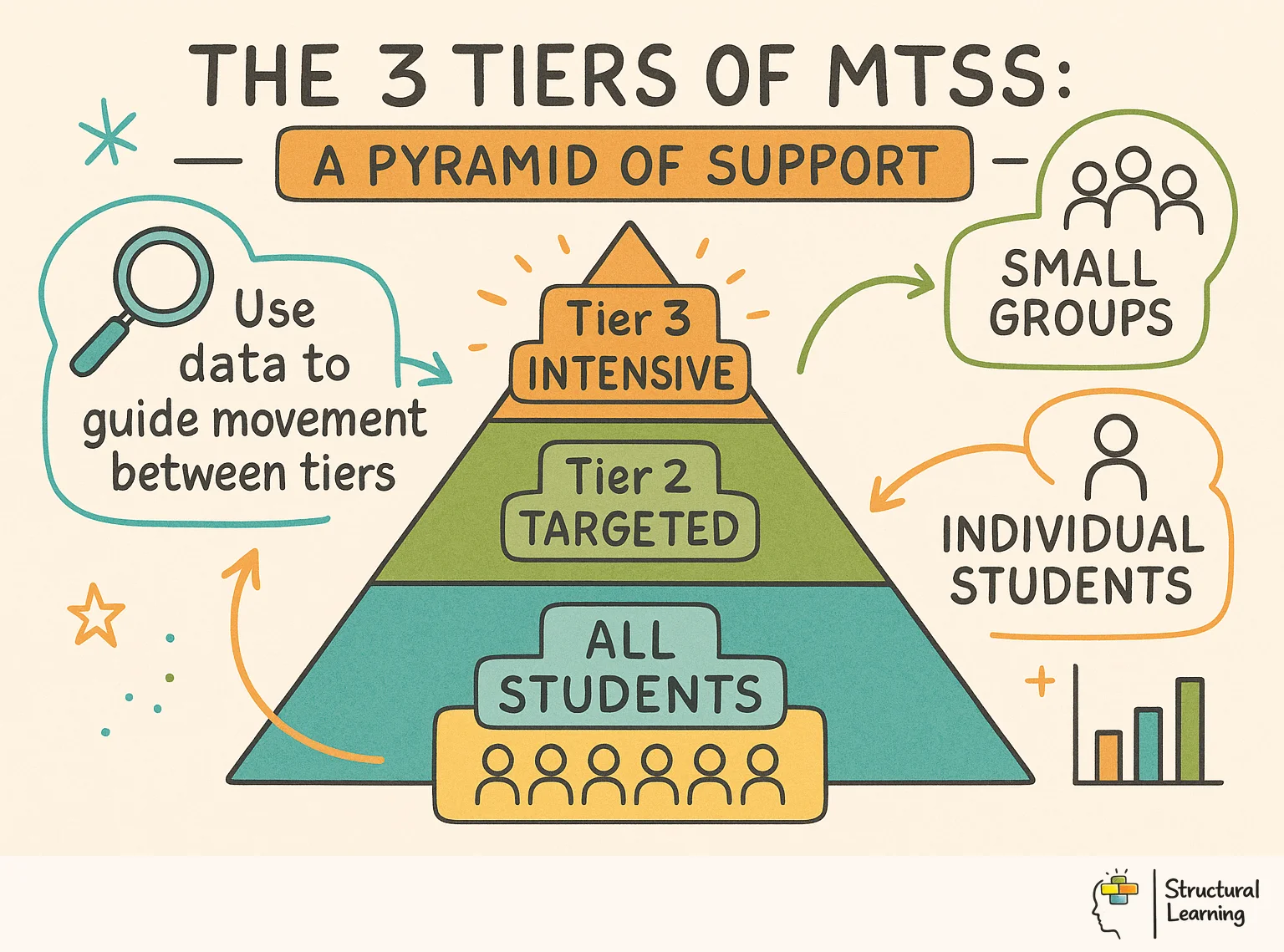
Tier transitions are data-driven decisions, not administrative conveniences. Each transition has specific criteria.
Tier 1 to Tier 2. A student scores below benchmark on universal screening and does not respond to differentiated instruction within Tier 1 over a reasonable period (typically four to six weeks of targeted support within the classroom). The classroom teacher documents what was tried and the student's response. The MTSS team reviews the data and places the student in a Tier 2 intervention group.
Tier 2 to Tier 3. A student has received 8 to 12 weeks of Tier 2 intervention delivered with fidelity, and progress monitoring data shows inadequate growth. Inadequate growth means the student's rate of improvement is not on track to close the gap with grade-level peers. The team considers whether the intervention was appropriate, whether it was delivered as designed, and whether diagnostic assessment is needed to better understand the student's specific difficulties. If the answers point toward more intensive support, the student moves to Tier 3.
Tier 3 to Special Education Referral. A student has received 8 to 12 weeks of intensive Tier 3 intervention delivered with fidelity, and progress monitoring data continues to show insufficient response. The team has documentation of multiple intervention attempts, fidelity data, and progress monitoring graphs. This body of evidence becomes part of the referral for a comprehensive special education evaluation.
One principle governs all transitions: fidelity before movement. Before concluding that a student needs more intensive support, verify that the current intervention was delivered as designed. A student who received Tier 2 intervention only twice per week instead of the prescribed four times has not actually received Tier 2. Checking fidelity prevents moving students up tiers prematurely when the real issue is implementation, not student need.
MTSS data informs but does not replace a comprehensive special education evaluation. IDEA 2004 allows states to use RTI data as part of the evaluation process for identifying specific learning disabilities. In practice, this means that the screening data, intervention logs, and progress monitoring graphs collected during MTSS become part of the evidence reviewed during evaluation.
A critical legal point: a parent can request a special education evaluation at any time. The school cannot use MTSS as a reason to delay or deny evaluation. If a parent submits a written request for evaluation, the school has 60 days (or the timeline specified by state law) to complete the evaluation, regardless of where the student sits in the MTSS framework. The Office of Special Education Programs (OSEP) has clarified this repeatedly. MTSS is a general education framework for all students; it does not gatekeep access to special education.
Students who already have an Individualized Education Program (IEP) still participate in MTSS. Their IEP is, in effect, their Tier 3 plan. The specially designed instruction outlined in the IEP serves as the student's intensive intervention. Progress monitoring for IEP goals functions the same way as MTSS progress monitoring: regular data collection, graphed results, and team review.
For students with dyslexia or ADHD, MTSS documentation is particularly valuable. It shows the school attempted systematic, evidence-based interventions before referring for evaluation. It also shows the student's specific pattern of response: which interventions produced growth and which did not. This information helps the evaluation team determine what type of specially designed instruction the student needs.
Readers outside the United States will recognise many MTSS principles under different names. In the UK, the equivalent framework is the Graduated Approach, outlined in the SEND Code of Practice (2015). The Graduated Approach uses a four-stage cycle: Assess, Plan, Do, Review (APDR). This cycle mirrors the MTSS problem-solving process: assess the student's needs, plan an intervention, deliver the intervention, and review whether it worked.
The tiered structure maps roughly as follows. Tier 1 in MTSS corresponds to Quality First Teaching in the UK: high-quality, differentiated classroom instruction that meets the needs of most learners. Tier 2 maps to SEN Support, where the class teacher and SENCO work together to plan and deliver targeted interventions for students who need additional help. Tier 3 corresponds to the Education, Health and Care Plan (EHCP), the most intensive level of support for students with significant and complex needs.
MTSS Tier
UK Equivalent
Who Is Responsible
Tier 1: Universal instruction
Quality First Teaching (universal provision)
Classroom teacher
Tier 2: Targeted interventions
SEN Support (Assess, Plan, Do, Review)
Class teacher + SENCO
Tier 3: Intensive, individualized support
EHCP (Education, Health and Care Plan)
Multi-agency team (school, health, social care)
The key difference is structural. US schools tend to formalize the tiered system with explicit movement criteria and team-based decision-making at each transition. UK schools use the APDR cycle more fluidly, with the SENCO coordinating support and the class teacher remaining central to delivery. Both systems share the same principle: identify needs early, intervene with evidence-based approaches, monitor progress, and adjust. UK readers may also find the guide to SEND-friendly learning environments useful for Tier 1 classroom design. For a detailed guide to the UK approach, see the Graduated Approach: Assess, Plan, Do, Review and the broader guide to special educational needs.
Even well-intentioned schools make predictable errors when implementing MTSS. recognising these mistakes early prevents wasted time and student frustration.
Using MTSS to delay special education evaluation. This is the most serious mistake and it is illegal under IDEA. A school cannot require a student to complete all three tiers before agreeing to evaluate for special education. If a parent requests evaluation, the school must respond within the legally mandated timeline. MTSS provides useful data for evaluation, but it is not a prerequisite.
Implementing interventions without fidelity checks. A Tier 2 intervention delivered inconsistently, with substituted materials, or by an untrained staff member is not a Tier 2 intervention. Before concluding that a student is not responding, the team must verify that the intervention was delivered as designed. Fidelity checklists, direct observation, and intervention logs are standard tools for this purpose.
Skipping universal screening. Some schools rely on teacher referral instead of screening all students. Research consistently shows that universal screening identifies at-risk students more accurately and earlier than teacher judgment alone (Jenkins et al., 2007). A student who is quiet and compliant may be struggling significantly without drawing attention. This is particularly true for students whose difficulties lie in executive function domains like planning and self-monitoring rather than in visible academic skills. Screening catches these students.
Not graphing progress monitoring data. A number on a spreadsheet is not the same as a graph with an aimline. When data points are plotted visually, trends become obvious. A teacher can see at a glance whether the student's trajectory is pointing toward or away from the goal. Without graphs, teams make decisions based on impressions rather than patterns.
Pulling students from core instruction for intervention. Tier 2 and Tier 3 interventions are supplemental. They happen in addition to Tier 1 core instruction, not instead of it. A student who misses 30 minutes of science every day to attend a reading group is not receiving Tier 1 instruction in science. Schools need to build intervention time into the schedule, often through a dedicated intervention block, so students do not lose access to core content.

Response to Intervention focuses specifically on academic support and identifying learning difficulties. Multi-Tiered System of Supports is a broader framework that includes RTI but also covers student behaviour, social and emotional needs, and attendance. MTSS acts as an umbrella system to prevent failure across all areas of a child's school experience.
Teachers begin by delivering high-quality core instruction to all students in Tier 1. They use regular screening data to identify those who are falling behind expected benchmarks. For students needing more help, teachers provide targeted group interventions in Tier 2 and carefully monitor their progress over time.
A tiered system prevents schools from waiting for a student to fail before providing help. It ensures resources are allocated efficiently based on objective data rather than assumptions. This structured approach helps schools match the correct intensity of intervention to the specific needs of each learner.
Research indicates that RTI significantly reduces the overrepresentation of specific learning disabilities in schools. Studies show that when schools consistently apply evidence-based interventions in early tiers, many academic gaps close quickly. However, the success of the model depends heavily on teachers delivering the interventions exactly as designed.
A frequent mistake is moving a student to a higher tier without checking if the previous intervention was delivered correctly. Another common error is treating MTSS as a specific curriculum to purchase rather than a framework for making decisions. Schools also struggle when they gather screening data but fail to use it to adjust their teaching strategies.
A student should move to Tier 3 only after progress monitoring data shows they have not responded to targeted Tier 2 interventions. Teachers must review at least three data points to confirm the lack of progress. The school must also verify that the Tier 2 support was provided consistently and with high quality before increasing the intensity.
If your school is beginning to implement MTSS or you want to strengthen your role within an existing system, these steps provide a practical starting point.
Next time your MTSS team meets, bring one student's progress monitoring graph with the aimline drawn. Compare the student's actual rate of improvement to the expected rate. That single comparison will tell you more about whether the intervention is working than any narrative summary.
External References: EEF: Teaching and Learning Toolkit | Department for Education (DfE)
A fifth-grade student in your class is struggling with reading. You have tried small-group instruction, extra practice with decodable texts, and a seating change to reduce distractions. Progress is slow. The student reads 15 words per minute below the benchmark, and the gap is widening. You know something more structured is needed, but what exactly, and who decides? This is the question that Multi-Tiered System of Supports (MTSS) answers. MTSS gives schools a decision-making framework for matching students to the right level of support based on data, not gut feeling. It replaces the old model of waiting for students to fail before acting.
Multi-Tiered System of Supports is a framework for delivering increasing levels of instructional and behavioural support to students based on their response to instruction. The National centre on Response to Intervention defines it as a prevention-oriented approach that organizes evidence-based practices into tiers of increasing intensity. The Every Student Succeeds Act (ESSA, 2015) explicitly references MTSS as a model for allocating resources to support student achievement. See also: Mtss vs rti.
MTSS is not a program you purchase. It is not a curriculum. It is a structure for making decisions about which students need what kind of help and when to change course if the help is not working. Schools that implement MTSS well use data at every decision point: screening data to identify who is at risk, progress monitoring data to track whether interventions are working, and diagnostic data to understand why a student is struggling. See also: Response to intervention rti.
The framework covers academics and behaviour. Older models like Response to Intervention focussed primarily on reading and math. MTSS incorporates Positive behavioural Interventions and Supports (PBIS), social-emotional learning, and attendance. A student who is chronically absent, for example, might receive Tier 2 behavioural support even if their academic screening scores are on track. A student with strong reading skills but persistent difficulty with executive function in the classroom might need targeted support for organisation and self-regulation rather than academic intervention.
The practical result is that MTSS forces a school to ask two questions repeatedly: Is the core instruction working for most students? And for the students it is not working for, what is the most efficient next step? When those questions are answered with data rather than assumptions, schools allocate time and resources more precisely.
Response to Intervention emerged from the reauthorization of the Individuals with Disabilities Education Act (IDEA) in 2004. Before RTI, schools identified learning disabilities primarily through the IQ-discrepancy model: a student had to show a significant gap between their measured intelligence and their academic performance. Critics called this the "wait to fail" approach because students often did not qualify for support until third or fourth grade, by which point the reading gap was already severe (Fletcher et al., 2007).
RTI offered an alternative. Instead of waiting for failure, schools screened all students, provided evidence-based instruction, and identified learning disabilities based on how students responded to that instruction. A student who did not respond to high-quality Tier 1 teaching and targeted Tier 2 intervention was likely to have a specific learning difficulty, not just insufficient instruction.
MTSS expanded RTI in three ways. First, it added behavioural and social-emotional support alongside academics. Second, it emphasized a unified system rather than separate academic and behavioural tracks. Third, it positioned the framework as a whole-school approach to prevention rather than a pathway to special education identification. Many states now use MTSS as the umbrella term, with RTI functioning as the academic component within it.
Feature
RTI
MTSS
Primary focus
Academics (reading, math)
Academics, behaviour, social-emotional, attendance
Origin
IDEA 2004 (LD identification)
ESSA 2015 (whole-school prevention)
behavioural support
Separate from RTI (PBIS ran in parallel)
Integrated within the same tiered system
Primary purpose
Identify students who may have a learning disability
Prevent academic and behavioural failure for all students
Data use
Screening and progress monitoring for academics
Screening, progress monitoring, and diagnostic data across all domains
Relationship
Standalone framework
RTI is a component within MTSS
The tiered model is the structural core of MTSS. Each tier represents a level of instructional intensity. Students move between tiers based on data, not opinion. The percentages below are approximations; they describe what a well-functioning system looks like, not rigid quotas.
Tier 1 is the general education classroom. Every student receives high-quality, evidence-based core instruction delivered by the classroom teacher. In a well-functioning school, Tier 1 instruction meets the needs of roughly 80% of students.
Universal screening happens three times per year: fall, winter, and spring. These brief assessments identify students whose performance falls below grade-level benchmarks. If fewer than 80% of students are meeting benchmarks, the problem is likely with core instruction, not with individual students. This is a critical distinction. Tier 1 is also where differentiation strategies matter most: flexible grouping, varied text levels, strategic use of graphic organizers, and explicit instruction in foundational skills.
A concrete example: A third-grade teacher uses a structured literacy program for all students. Phonics instruction is explicit and systematic. Students practice decoding with connected texts daily. The teacher screens all students in September using DIBELS and identifies six students reading below the 25th percentile. Those six students are flagged for closer monitoring and may move to Tier 2 if they do not respond to differentiated Tier 1 instruction over the next few weeks.
Tier 2 provides small-group instruction in addition to Tier 1. This is not a replacement for core instruction. Students continue receiving Tier 1 teaching and get supplemental support on top of it. Groups are small, typically three to five students, and the intervention follows a standardized, evidence-based protocol.
Progress monitoring increases to every one to two weeks. The intervention typically runs for 8 to 12 weeks before the team reviews whether the student is responding. Tier 2 interventions are targeted: they address a specific skill deficit identified through screening or diagnostic assessment. They are not general tutoring sessions.
A concrete example: A fourth-grade student scores below benchmark on the winter reading fluency screening. She reads 62 words per minute; the benchmark is 90. The MTSS team places her in a Tier 2 group of four students. Three times per week for 30 minutes, a trained interventionist leads repeated reading practice using controlled-difficulty passages. The student's oral reading fluency is measured every two weeks using curriculum-based measurement probes. After eight weeks, the team reviews her progress graph. If she is on track to reach benchmark, the intervention continues. If not, the team discusses intensifying support.
Tier 3 is the most intensive level of support. Students receive one-on-one or very small group instruction (two to three students) at higher frequency and longer duration than Tier 2. Instruction is more explicit, more scaffolded, and often delivered by a specialist. Progress monitoring happens weekly.
If a student does not respond adequately to Tier 3 intervention delivered with fidelity over 8 to 12 weeks, the school may refer the student for a comprehensive special education evaluation. Tier 3 data becomes part of the evidence base for that evaluation.
A concrete example: A second-grade student has received Tier 2 reading intervention for 10 weeks with minimal progress. He still confuses b/d, struggles to blend CVC words, and reads 18 words per minute. The MTSS team moves him to Tier 3. He now receives daily one-on-one Orton-Gillingham instruction with a reading specialist for 45 minutes. His working memory and phonological processing are assessed to better understand the underlying difficulty. Weekly progress monitoring tracks letter-sound fluency and word reading accuracy.
Feature
Tier 1
Tier 2
Tier 3
Students served
All students (~80% meet benchmarks)
~15% of students
~5% of students
Group size
Whole class
Small group (3-5 students)
Individual or very small group (1-3 students)
Instruction type
Evidence-based core instruction with differentiation
Standardized intervention protocol targeting specific skill deficit
Individualized, intensive, explicit instruction
Progress monitoring
Universal screening 3x per year
Every 1-2 weeks
Weekly
Duration before review
Ongoing
8-12 weeks
8-12 weeks
Delivered by
Classroom teacher
Trained interventionist or teacher
Specialist (reading specialist, school psychologist)
Example
Explicit phonics instruction for all students
Small-group repeated reading 3x per week for 30 min
Daily 1:1 Orton-Gillingham tutoring for 45 min
Universal screening is the entry point for every MTSS decision. These are brief, standardized assessments given to all students three times per year: fall, winter, and spring. Their purpose is to identify students who are at risk of academic or behavioural difficulty before they fail.
Common screening tools include DIBELS (Dynamic Indicators of Basic Early Literacy Skills), AIMSweb, MAP Growth, iReady, and Star Assessments. Each tool provides benchmark scores that indicate whether a student is on track, at some risk, or at high risk. A typical cut point is the 25th percentile: students scoring below this threshold are flagged for additional monitoring or Tier 2 support.
Screening is not diagnosis. A student who scores below benchmark on a fall screening has been identified as potentially at risk. The screening does not tell you why the student is struggling. It does not identify a learning disability. It simply raises a flag that says "look more closely at this student." The next step is progress monitoring, not labeling.
A practical example: A school screens all kindergarten students in September using DIBELS Next. The letter naming fluency subtest shows that 22 out of 25 students can name at least 40 letters per minute. Three students name fewer than 20. Those three students are not immediately placed in Tier 2. Instead, the teacher provides targeted letter-name practice within Tier 1 (small-group rotations during literacy block) and monitors their progress weekly for four weeks. Two of the three students respond and reach benchmark. One does not. That student moves to Tier 2.
This screening-first approach prevents two common problems. First, it catches students early, before they fall far enough behind that catching up becomes much harder. Second, it prevents over-identification. Without screening, teachers rely on professional judgment alone, which research shows is less accurate than standardized measures at predicting academic risk (Gersten et al., 2009).
Once a student begins receiving Tier 2 or Tier 3 intervention, progress monitoring replaces universal screening as the primary data source. Progress monitoring uses brief, standardized, repeated measures, typically curriculum-based measurement (CBM), to track a student's rate of improvement over time.
The process works like this. The interventionist administers a one-minute reading probe (or a brief math computation probe) every one to two weeks. Each data point is plotted on a graph. The graph also includes an aimline: a straight line from the student's starting performance to the year-end goal, showing the rate of growth needed to reach benchmark by spring.
The three-data-point rule is a standard decision guideline. If three consecutive data points fall below the aimline, the intervention is not producing sufficient growth and needs adjustment. This might mean changing the intervention, increasing its frequency, reducing the group size, or investigating whether the intervention is being delivered as designed. If three consecutive data points fall above the aimline, the student is responding well and may be ready to step down in support.
Here is a practical example. Marcus, a third-grader, reads 45 words per minute in October. His spring benchmark goal is 90 words per minute. That is a 28-week window, so his aimline requires a gain of roughly 1.6 words per minute per week. After six weeks of Tier 2 intervention, Marcus has gained only 0.5 words per minute per week. His three most recent data points are 47, 48, and 48. All three fall below the aimline, which predicts he should be at 54 by now. The MTSS team meets and decides to increase intervention frequency from three to five sessions per week and to add a phonics component alongside fluency practice.
Rate of improvement (ROI) is the metric that makes this actionable. You calculate ROI by subtracting the baseline score from the most recent score and dividing by the number of weeks. Compare the student's ROI to grade-level peers. If peers are growing at 1.5 words per minute per week and the student is growing at 0.5, the gap is widening. If the student is growing at 2.0 words per minute per week, the gap is closing. This is the kind of data that formative assessment practices support: frequent, low-stakes measurement that directly informs the next instructional decision.
Tier transitions are data-driven decisions, not administrative conveniences. Each transition has specific criteria.
Tier 1 to Tier 2. A student scores below benchmark on universal screening and does not respond to differentiated instruction within Tier 1 over a reasonable period (typically four to six weeks of targeted support within the classroom). The classroom teacher documents what was tried and the student's response. The MTSS team reviews the data and places the student in a Tier 2 intervention group.
Tier 2 to Tier 3. A student has received 8 to 12 weeks of Tier 2 intervention delivered with fidelity, and progress monitoring data shows inadequate growth. Inadequate growth means the student's rate of improvement is not on track to close the gap with grade-level peers. The team considers whether the intervention was appropriate, whether it was delivered as designed, and whether diagnostic assessment is needed to better understand the student's specific difficulties. If the answers point toward more intensive support, the student moves to Tier 3.
Tier 3 to Special Education Referral. A student has received 8 to 12 weeks of intensive Tier 3 intervention delivered with fidelity, and progress monitoring data continues to show insufficient response. The team has documentation of multiple intervention attempts, fidelity data, and progress monitoring graphs. This body of evidence becomes part of the referral for a comprehensive special education evaluation.
One principle governs all transitions: fidelity before movement. Before concluding that a student needs more intensive support, verify that the current intervention was delivered as designed. A student who received Tier 2 intervention only twice per week instead of the prescribed four times has not actually received Tier 2. Checking fidelity prevents moving students up tiers prematurely when the real issue is implementation, not student need.
MTSS data informs but does not replace a comprehensive special education evaluation. IDEA 2004 allows states to use RTI data as part of the evaluation process for identifying specific learning disabilities. In practice, this means that the screening data, intervention logs, and progress monitoring graphs collected during MTSS become part of the evidence reviewed during evaluation.
A critical legal point: a parent can request a special education evaluation at any time. The school cannot use MTSS as a reason to delay or deny evaluation. If a parent submits a written request for evaluation, the school has 60 days (or the timeline specified by state law) to complete the evaluation, regardless of where the student sits in the MTSS framework. The Office of Special Education Programs (OSEP) has clarified this repeatedly. MTSS is a general education framework for all students; it does not gatekeep access to special education.
Students who already have an Individualized Education Program (IEP) still participate in MTSS. Their IEP is, in effect, their Tier 3 plan. The specially designed instruction outlined in the IEP serves as the student's intensive intervention. Progress monitoring for IEP goals functions the same way as MTSS progress monitoring: regular data collection, graphed results, and team review.
For students with dyslexia or ADHD, MTSS documentation is particularly valuable. It shows the school attempted systematic, evidence-based interventions before referring for evaluation. It also shows the student's specific pattern of response: which interventions produced growth and which did not. This information helps the evaluation team determine what type of specially designed instruction the student needs.
Readers outside the United States will recognise many MTSS principles under different names. In the UK, the equivalent framework is the Graduated Approach, outlined in the SEND Code of Practice (2015). The Graduated Approach uses a four-stage cycle: Assess, Plan, Do, Review (APDR). This cycle mirrors the MTSS problem-solving process: assess the student's needs, plan an intervention, deliver the intervention, and review whether it worked.
The tiered structure maps roughly as follows. Tier 1 in MTSS corresponds to Quality First Teaching in the UK: high-quality, differentiated classroom instruction that meets the needs of most learners. Tier 2 maps to SEN Support, where the class teacher and SENCO work together to plan and deliver targeted interventions for students who need additional help. Tier 3 corresponds to the Education, Health and Care Plan (EHCP), the most intensive level of support for students with significant and complex needs.
MTSS Tier
UK Equivalent
Who Is Responsible
Tier 1: Universal instruction
Quality First Teaching (universal provision)
Classroom teacher
Tier 2: Targeted interventions
SEN Support (Assess, Plan, Do, Review)
Class teacher + SENCO
Tier 3: Intensive, individualized support
EHCP (Education, Health and Care Plan)
Multi-agency team (school, health, social care)
The key difference is structural. US schools tend to formalize the tiered system with explicit movement criteria and team-based decision-making at each transition. UK schools use the APDR cycle more fluidly, with the SENCO coordinating support and the class teacher remaining central to delivery. Both systems share the same principle: identify needs early, intervene with evidence-based approaches, monitor progress, and adjust. UK readers may also find the guide to SEND-friendly learning environments useful for Tier 1 classroom design. For a detailed guide to the UK approach, see the Graduated Approach: Assess, Plan, Do, Review and the broader guide to special educational needs.
Even well-intentioned schools make predictable errors when implementing MTSS. recognising these mistakes early prevents wasted time and student frustration.
Using MTSS to delay special education evaluation. This is the most serious mistake and it is illegal under IDEA. A school cannot require a student to complete all three tiers before agreeing to evaluate for special education. If a parent requests evaluation, the school must respond within the legally mandated timeline. MTSS provides useful data for evaluation, but it is not a prerequisite.
Implementing interventions without fidelity checks. A Tier 2 intervention delivered inconsistently, with substituted materials, or by an untrained staff member is not a Tier 2 intervention. Before concluding that a student is not responding, the team must verify that the intervention was delivered as designed. Fidelity checklists, direct observation, and intervention logs are standard tools for this purpose.
Skipping universal screening. Some schools rely on teacher referral instead of screening all students. Research consistently shows that universal screening identifies at-risk students more accurately and earlier than teacher judgment alone (Jenkins et al., 2007). A student who is quiet and compliant may be struggling significantly without drawing attention. This is particularly true for students whose difficulties lie in executive function domains like planning and self-monitoring rather than in visible academic skills. Screening catches these students.
Not graphing progress monitoring data. A number on a spreadsheet is not the same as a graph with an aimline. When data points are plotted visually, trends become obvious. A teacher can see at a glance whether the student's trajectory is pointing toward or away from the goal. Without graphs, teams make decisions based on impressions rather than patterns.
Pulling students from core instruction for intervention. Tier 2 and Tier 3 interventions are supplemental. They happen in addition to Tier 1 core instruction, not instead of it. A student who misses 30 minutes of science every day to attend a reading group is not receiving Tier 1 instruction in science. Schools need to build intervention time into the schedule, often through a dedicated intervention block, so students do not lose access to core content.
Response to Intervention focuses specifically on academic support and identifying learning difficulties. Multi-Tiered System of Supports is a broader framework that includes RTI but also covers student behaviour, social and emotional needs, and attendance. MTSS acts as an umbrella system to prevent failure across all areas of a child's school experience.
Teachers begin by delivering high-quality core instruction to all students in Tier 1. They use regular screening data to identify those who are falling behind expected benchmarks. For students needing more help, teachers provide targeted group interventions in Tier 2 and carefully monitor their progress over time.
A tiered system prevents schools from waiting for a student to fail before providing help. It ensures resources are allocated efficiently based on objective data rather than assumptions. This structured approach helps schools match the correct intensity of intervention to the specific needs of each learner.
Research indicates that RTI significantly reduces the overrepresentation of specific learning disabilities in schools. Studies show that when schools consistently apply evidence-based interventions in early tiers, many academic gaps close quickly. However, the success of the model depends heavily on teachers delivering the interventions exactly as designed.
A frequent mistake is moving a student to a higher tier without checking if the previous intervention was delivered correctly. Another common error is treating MTSS as a specific curriculum to purchase rather than a framework for making decisions. Schools also struggle when they gather screening data but fail to use it to adjust their teaching strategies.
A student should move to Tier 3 only after progress monitoring data shows they have not responded to targeted Tier 2 interventions. Teachers must review at least three data points to confirm the lack of progress. The school must also verify that the Tier 2 support was provided consistently and with high quality before increasing the intensity.
If your school is beginning to implement MTSS or you want to strengthen your role within an existing system, these steps provide a practical starting point.
Next time your MTSS team meets, bring one student's progress monitoring graph with the aimline drawn. Compare the student's actual rate of improvement to the expected rate. That single comparison will tell you more about whether the intervention is working than any narrative summary.
External References: EEF: Teaching and Learning Toolkit | Department for Education (DfE)
{"@context":"https://schema.org","@graph":[{"@type":"Article","@id":"https://www.structural-learning.com/post/mtss-rti-teachers-guide-tiered-support-6a895#article","headline":"MTSS and RTI: A Teacher's Guide to Tiered Support","description":"A fifth-grade student in your class is struggling with reading. You have tried small-group instruction, extra practice with decodable texts.","datePublished":"2026-02-26T15:10:18.510Z","dateModified":"2026-03-02T10:44:08.582Z","author":{"@type":"Person","name":"Paul Main","url":"https://www.structural-learning.com/team/paulmain","jobTitle":"Founder & Educational Consultant"},"publisher":{"@type":"Organization","name":"Structural Learning","url":"https://www.structural-learning.com","logo":{"@type":"ImageObject","url":"https://cdn.prod.website-files.com/5b69a01ba2e409e5d5e055c6/6040bf0426cb415ba2fc7882_newlogoblue.svg"}},"mainEntityOfPage":{"@type":"WebPage","@id":"https://www.structural-learning.com/post/mtss-rti-teachers-guide-tiered-support-6a895"},"image":"https://cdn.prod.website-files.com/5b69a01ba2e409501de055d1/69a2d0bc49a78553281d7817_69a2d0b825d968d54f0c9e23_mtss-tiered-support-nb2-infographic.webp","wordCount":3813},{"@type":"BreadcrumbList","@id":"https://www.structural-learning.com/post/mtss-rti-teachers-guide-tiered-support-6a895#breadcrumb","itemListElement":[{"@type":"ListItem","position":1,"name":"Home","item":"https://www.structural-learning.com/"},{"@type":"ListItem","position":2,"name":"Blog","item":"https://www.structural-learning.com/blog"},{"@type":"ListItem","position":3,"name":"MTSS and RTI: A Teacher's Guide to Tiered Support","item":"https://www.structural-learning.com/post/mtss-rti-teachers-guide-tiered-support-6a895"}]}]}