Updated on
March 1, 2026
ADHD Strategies: A Cognitive Science Approach for Teachers
|
March 1, 2026
Use this ADHD strategies guide to understand the cognitive science of attention, executive function and memory, with practical classroom strategies.


ADHD is the most common neurodevelopmental condition in UK classrooms, affecting roughly 5% of school-age children (NICE, 2018). Yet most teacher training covers it in a single session, if at all. The result is a gap between what teachers observe and what they understand about the cognitive mechanisms driving those observations.
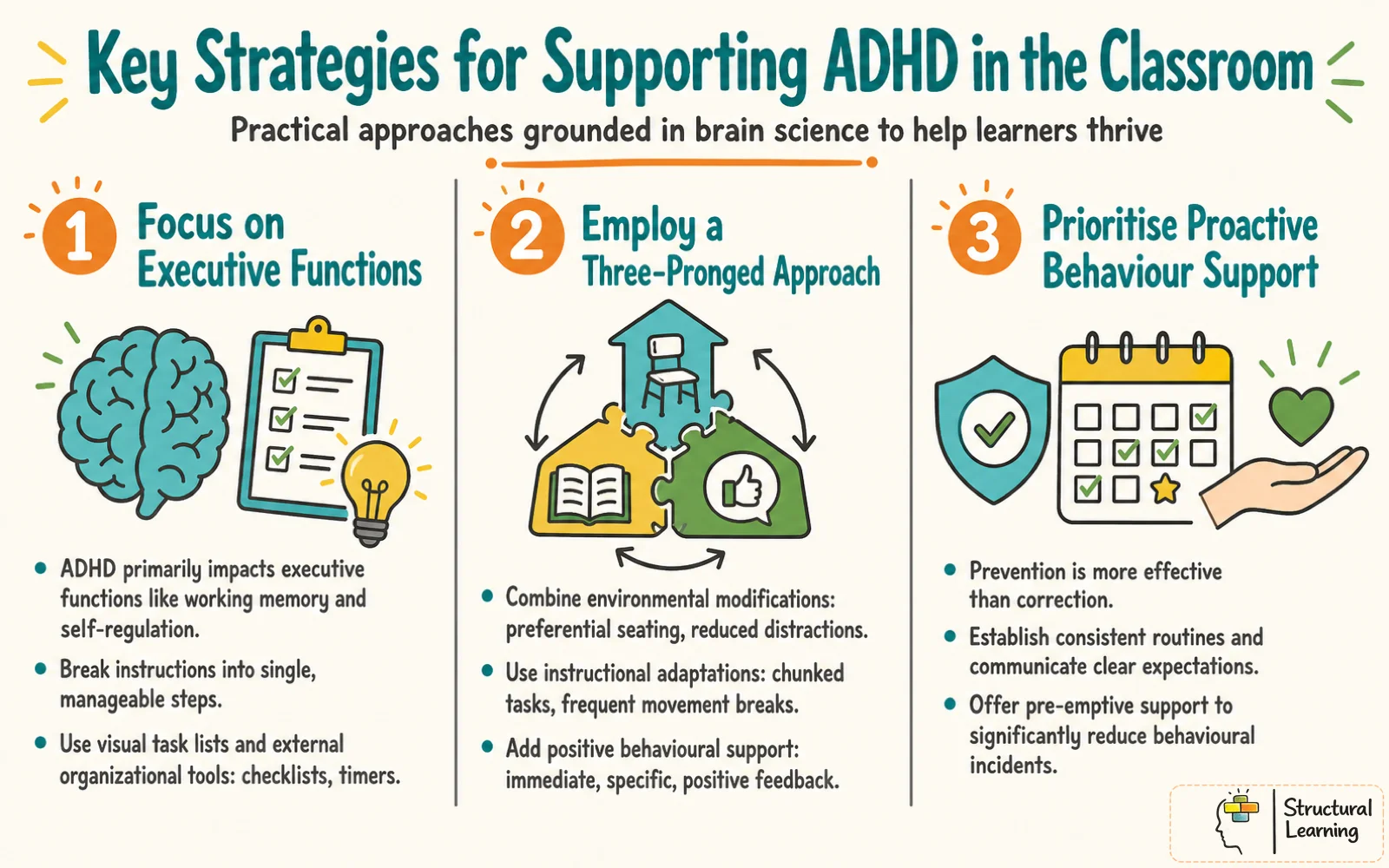
This guide connects the brain science of ADHD directly to classroom practice. Each strategy section explains the underlying cognitive deficit first, then provides specific techniques grounded in that mechanism. You'll also find an interactive pathway finder tool to identify the right starting point for individual pupils.
The name "Attention Deficit Hyperactivity Disorder" is misleading. Russell Barkley's Behavioural Inhibition Model (Barkley, 1997) reframes ADHD not as a deficit of attention, but as a disorder of executive function. The core difficulty isn't that a pupil can't pay attention. It's that their brain's regulatory system struggles to control when and how attention is directed.
This distinction matters practically. Thomas Brown (2017) describes what he calls the "performance gap": pupils with ADHD often understand the content perfectly well, but cannot consistently demonstrate that understanding under standard classroom conditions. A Year 5 pupil who explains photosynthesis brilliantly during a corridor conversation may produce a blank worksheet twenty minutes later. The knowledge exists. The executive systems required to retrieve, organise, and output that knowledge under time pressure and distraction do not function reliably.
When teachers interpret this inconsistency as laziness or defiance, they respond with effort-based interventions: "Try harder," "If you just focused," "You could do it yesterday, so you can do it today." These appeals target motivation. But ADHD is not a motivation problem. It's a self-regulation problem (Barkley, 2015). The brake system is unreliable, regardless of how much the driver wants to stop.
If ADHD is fundamentally an executive function disorder, then effective strategies must target executive function, not willpower. This is the cognitive science principle that underpins every recommendation in this guide. Rather than asking pupils to try harder with a system that doesn't work reliably, we modify the environment, the task structure, or the support scaffolding so that executive demands fall within the pupil's current capacity.
Adele Diamond's influential review of executive function research (Diamond, 2013) identifies three core components: inhibitory control, working memory, and cognitive flexibility. In ADHD, all three are typically affected, but inhibitory control failures are often the most visible in the classroom.
Think of inhibitory control as the brain's braking system. It's the mechanism that allows you to stop yourself from saying the first thing that comes to mind, to wait your turn, to resist reaching for your neighbour's rubber, to suppress an emotional reaction that isn't appropriate for the situation. In most pupils, this system operates automatically and quickly. In pupils with ADHD, the braking system is delayed and inconsistent (Nigg, 2017).
A Year 3 teacher asks the class a question. A pupil with ADHD blurts the answer before anyone else has raised their hand. This isn't rudeness or a deliberate choice to break the rule. The thought-to-speech pathway fires before the inhibitory system can intercept it. The pupil often looks surprised at their own outburst, which is diagnostically revealing. They didn't choose to blurt. Their brake pedal responded too slowly.
Diamond (2013) distinguishes three types of inhibitory control:
Each type produces different observable behaviours, and each requires a different strategy family. A movement break helps with arousal-driven impulsivity but does nothing for a pupil whose primary difficulty is interference control. This is why blanket "ADHD strategies" lists often fail. The strategy must match the specific inhibitory deficit.
While inhibitory control failures are visible and disruptive, working memory deficits in ADHD are silent and devastating. Martinussen et al. (2005) conducted a 26-study meta-analysis confirming that working memory impairment is a core feature of ADHD, not a secondary consequence.
Baddeley's working memory model (Baddeley, 2000) describes a system with limited capacity: the phonological loop holds verbal information, the visuospatial sketchpad holds visual information, and the central executive coordinates them. In ADHD, the central executive is particularly vulnerable. It struggles to maintain information while simultaneously processing new input.
Picture this in practice. A teacher gives three instructions: "Open your textbook to page 42, read the passage silently, then answer questions 1 to 3 in your exercise book." A pupil with working memory deficits may successfully hold "page 42" and "read silently" but lose "questions 1 to 3" before they've even found their textbook. By the time they've completed step one, the remaining instructions have evaporated.
Gathercole and Alloway (2008) found that working memory deficits in ADHD are strongly correlated with classroom attainment difficulties. The implications are straightforward: any task that places heavy demands on working memory will disproportionately disadvantage pupils with ADHD, regardless of their content knowledge.
Multi-step mathematics problems, extended writing tasks with multiple constraints, and lessons that rely heavily on verbal instructions are all high-load activities. Reducing the working memory demand of the task, rather than expecting the pupil to increase their working memory capacity, is the evidence-based approach.
The inattentive presentation of ADHD is characterised by working memory overload and difficulty filtering irrelevant stimuli. These pupils rarely disrupt the class. They're the ones staring out of the window, losing their place in the textbook, and submitting half-finished work that tails off after a strong start. Because they're quiet, they're frequently overlooked.
The hyperactive-impulsive presentation stems primarily from inhibitory control failure and arousal dysregulation. These pupils can't sit still, blurt answers, fidget constantly, and frequently leave their seat. Traditional behaviour management, warnings, sanctions, loss of privileges, treats the symptom while ignoring the cause.
Research by Barkley (2015) identifies emotional dysregulation not as a side effect of ADHD, but as a core feature. The same inhibitory control deficits that produce blurting and impulsivity also affect emotional responses. A pupil who cannot inhibit a motor response also cannot inhibit an emotional reaction.
A Year 4 pupil receives feedback that their story needs more detail. They crumple the paper, push their chair back, and refuse to continue. The intensity of the reaction is disproportionate to the trigger. This isn't poor behaviour. It's an inhibition failure at the emotional level. The prefrontal cortex, which normally dampens amygdala responses, responds too slowly (Gross, 2015).
The instructional sequence matters. You cannot teach self-regulation to a pupil who is still in a state of emotional dysregulation. Co-regulation comes first: the teacher provides the external regulatory support that the pupil's brain cannot yet provide internally. A calm voice, a named emotion ("I can see you're frustrated"), and a brief cool-down period establish safety. Only after the emotional state has been regulated can the pupil begin to reflect on what happened and practise alternative responses.
The Zones of Regulation framework (Kuypers, 2011) provides a shared vocabulary for this process. When a pupil can identify that they're in the "Red Zone," they have the beginnings of metacognitive awareness about their emotional state. Over time, this awareness becomes the foundation for self-regulation.
Beyond inhibition, working memory, and emotional regulation, pupils with ADHD struggle with three further executive function components: task initiation, planning, and time awareness. Barkley (2015) describes "temporal myopia": the brain with ADHD perceives time differently, struggling to estimate how long tasks will take and how much time has passed.
The pupil who "refuses to start work" may actually be experiencing task initiation failure. They understand the task. They know what to do. But the executive system responsible for transitioning from "not working" to "working" doesn't fire reliably. Dawson and Guare (2018) recommend breaking the initiation barrier with a "first step" prompt: "Write your name and today's date" or "Underline the first question." Once the motor sequence begins, subsequent steps follow more easily.
Multi-step projects (research tasks, extended writing, revision plans) require planning skills that depend on working memory and cognitive flexibility. For ADHD pupils, graphic organisers serve as external planning systems. A pre-structured template removes the need to generate the planning framework while simultaneously generating the content. The cognitive load drops to a manageable level.
Visual countdown timers, sand timers on desks, and "time remaining" displays on the interactive whiteboard make the invisible visible. When time is externalised, the pupil's deficient internal time sense is supplemented by an external reference. This is not a crutch. It's an accommodation for a genuine neurological difference, comparable to providing a hearing loop for a pupil with hearing loss.
The presentation types described above each require different starting points. Use this tool to identify the most appropriate support pathway for a specific pupil. Answer four questions about their presentation and the tool will recommend a structured next step.
Effective instructional adaptations for ADHD align closely with evidence-based teaching principles that benefit all learners. Rosenshine's second principle, presenting new material in small steps (Rosenshine, 2012), directly addresses the working memory bottleneck. If the step size exceeds working memory capacity, learning collapses regardless of the pupil's attention.
Instead of teaching a full concept and then checking understanding, break the explanation into two-minute segments with a quick comprehension check after each. "Put your thumb up if you can tell me the first step." This approach reduces the working memory load at any single point and provides the teacher with immediate feedback about whether the pupil is tracking.
Show the thinking process out loud. When demonstrating how to answer an inference question, narrate your decisions: "I'm going to read the question first, then find the relevant paragraph, then think about what the author means." This teacher think-aloud externalises the planning and monitoring steps that ADHD pupils cannot reliably generate internally. The EEF Metacognition Guidance Report (2018) identifies explicit modelling of metacognitive strategies as one of the highest-impact interventions available, with an average effect size of +7 months.
The cognitive load research (Sweller, 1988) is clear: studying a worked example is cognitively less demanding than solving an equivalent problem. For ADHD pupils, this reduction in demand is the difference between productive learning and frustrated shutdown. Present the worked example, discuss each step, then gradually fade the support across subsequent practice items.
The classroom environment imposes a constant cognitive load. For most pupils, this load is manageable. For pupils with ADHD, environmental demands can consume the working memory resources that should be directed at learning.
DuPaul and Stoner (2014) recommend auditing the classroom for sources of extraneous stimulation. Busy displays on every wall, open doors to noisy corridors, chairs that scrape loudly on hard floors: each one adds a small inhibitory demand. Individually trivial, collectively significant. Consider which displays are genuinely supporting learning and which are just visual clutter.
Face-to-face group seating maximises social distractors. For focused independent work, rows or paired desks reduce the number of faces, movements, and conversations competing for the pupil's attention. This doesn't mean abandoning group work. It means intentionally varying the layout to match the cognitive demands of the task.
A reading corner, a standing desk area, or a quiet booth provide legitimate movement between work contexts. The NICE guidelines (2018) recommend environmental modification as a first-line school intervention, before considering medication or external referral for mild-to-moderate presentations.
Pupils with ADHD have metacognitive deficits that compound their executive function difficulties (Reid et al., 2005). Metacognition, thinking about your own thinking, depends on working memory. If working memory is impaired, the capacity to monitor your own performance is reduced.
Rather than expecting ADHD pupils to internally monitor their work, provide external prompts. A self-checking card on the desk ("Did I read the question? Did I answer all parts? Did I check my spelling?") moves the monitoring demand from working memory into the environment. Hacker et al. (2009) found that explicit metacognitive instruction significantly improved academic performance in pupils with attention difficulties.
Pair the pupil with a reliable partner for a two-minute "check and compare" routine after completing a task. The mechanism is social scaffolding: the partner provides the monitoring function that the pupil's own metacognitive system cannot yet sustain independently.
When you model your thinking process out loud ("I'm checking whether my answer actually addresses the question"), you're demonstrating metacognition in action. For ADHD pupils, this explicit demonstration is particularly valuable because their implicit learning of self-monitoring strategies is impaired by the same executive function deficits that affect everything else.
This section addresses a topic that most educational resources avoid entirely. Teachers are not prescribers, but you work with medicated pupils daily, and understanding what medication does and does not do is essential for appropriate classroom expectations.
Stimulant medications (methylphenidate, lisdexamfetamine) increase dopamine and noradrenaline availability in the prefrontal cortex. The effect is improved executive function: better inhibitory control, improved working memory capacity, and more consistent attention deployment (Cortese et al., 2018). Medication doesn't change the pupil's personality, knowledge, or motivation. It makes the brain's regulatory system function more reliably.
Medication does not teach skills. A pupil who has missed years of metacognitive strategy development due to unmanaged ADHD still has gaps in their learning repertoire. Medication creates the conditions for learning, but the teaching still has to happen. NICE CG87 (2018) explicitly states that medication should be used alongside environmental modifications and educational support, not as a standalone intervention.
Teachers are uniquely positioned to observe medication effects across the school day. If a pupil's focus improves markedly in the morning but deteriorates after lunch, that's clinically relevant information for the prescribing doctor. Keep factual notes: "Completed three tasks independently before break. After lunch, returned to baseline: incomplete work, frequent off-task behaviour." Share these observations through the SENCO. Your data contributes to medication optimisation without requiring you to make clinical judgements.
Classroom strategies do not replace clinical assessment. Where presentations are severe or persistent, SENCO referral and GP liaison remain the appropriate route. This guide provides the classroom-level support that complements, but does not substitute for, professional assessment and intervention.
Write to a pupil you're concerned about this week. Note what you observe, not what you interpret. Share it with your SENCO. That single action often starts the process that leads to the right support.
These peer-reviewed studies form the evidence base for understanding ADHD as an executive function disorder and developing effective classroom strategies. Each paper offers practical insights for teachers.
Attention-Deficit Hyperactivity Disorder: A Handbook for Diagnosis and Treatment View study ↗
5,000+ citations
Russell A. Barkley (2015)
This comprehensive handbook presents ADHD as fundamentally a disorder of executive function and self-regulation, not simply attention. It details the Behavioural Inhibition Model and provides evidence-based school interventions that target the cognitive mechanisms underlying ADHD symptoms.
Executive Functions View study ↗
14,000+ citations
Adele Diamond (2013)
This landmark review identifies the three core executive functions (inhibitory control, working memory, and cognitive flexibility) and traces their development from early childhood. For teachers, it provides the theoretical framework that explains why different ADHD presentations require different strategy families.
A Meta-Analysis of Working Memory Impairments in Children with Attention-Deficit/Hyperactivity Disorder View study ↗
900+ citations
Rhonda Martinussen, Jill Hayden, Sheilah Hogg-Johnson, Rosemary Tannock (2005)
This 26-study meta-analysis establishes working memory impairment as a core feature of ADHD rather than a secondary consequence. Teachers can use this evidence to justify working memory accommodations (task cards, written instructions, reduced multi-step demands) as necessary support rather than optional preference.
ADHD in the Schools: Assessment and Intervention Strategies View study ↗
1,500+ citations
George J. DuPaul and Gary Stoner (2014)
This practitioner-focused text translates clinical research into school-based interventions. It provides specific environmental modification strategies, classroom management adaptations, and academic support techniques that teachers can implement immediately without specialist training.
Special Educational Needs in Mainstream Schools: Guidance Report View study ↗
Education Endowment Foundation (2020)
This UK-specific guidance report provides five evidence-based recommendations for supporting pupils with SEND in mainstream classrooms. For ADHD specifically, it emphasises high-quality teaching as the foundation, with scaffolded metacognitive instruction and flexible grouping as targeted interventions.
ADHD is the most common neurodevelopmental condition in UK classrooms, affecting roughly 5% of school-age children (NICE, 2018). Yet most teacher training covers it in a single session, if at all. The result is a gap between what teachers observe and what they understand about the cognitive mechanisms driving those observations.
This guide connects the brain science of ADHD directly to classroom practice. Each strategy section explains the underlying cognitive deficit first, then provides specific techniques grounded in that mechanism. You'll also find an interactive pathway finder tool to identify the right starting point for individual pupils.
The name "Attention Deficit Hyperactivity Disorder" is misleading. Russell Barkley's Behavioural Inhibition Model (Barkley, 1997) reframes ADHD not as a deficit of attention, but as a disorder of executive function. The core difficulty isn't that a pupil can't pay attention. It's that their brain's regulatory system struggles to control when and how attention is directed.
This distinction matters practically. Thomas Brown (2017) describes what he calls the "performance gap": pupils with ADHD often understand the content perfectly well, but cannot consistently demonstrate that understanding under standard classroom conditions. A Year 5 pupil who explains photosynthesis brilliantly during a corridor conversation may produce a blank worksheet twenty minutes later. The knowledge exists. The executive systems required to retrieve, organise, and output that knowledge under time pressure and distraction do not function reliably.
When teachers interpret this inconsistency as laziness or defiance, they respond with effort-based interventions: "Try harder," "If you just focused," "You could do it yesterday, so you can do it today." These appeals target motivation. But ADHD is not a motivation problem. It's a self-regulation problem (Barkley, 2015). The brake system is unreliable, regardless of how much the driver wants to stop.
If ADHD is fundamentally an executive function disorder, then effective strategies must target executive function, not willpower. This is the cognitive science principle that underpins every recommendation in this guide. Rather than asking pupils to try harder with a system that doesn't work reliably, we modify the environment, the task structure, or the support scaffolding so that executive demands fall within the pupil's current capacity.
Adele Diamond's influential review of executive function research (Diamond, 2013) identifies three core components: inhibitory control, working memory, and cognitive flexibility. In ADHD, all three are typically affected, but inhibitory control failures are often the most visible in the classroom.
Think of inhibitory control as the brain's braking system. It's the mechanism that allows you to stop yourself from saying the first thing that comes to mind, to wait your turn, to resist reaching for your neighbour's rubber, to suppress an emotional reaction that isn't appropriate for the situation. In most pupils, this system operates automatically and quickly. In pupils with ADHD, the braking system is delayed and inconsistent (Nigg, 2017).
A Year 3 teacher asks the class a question. A pupil with ADHD blurts the answer before anyone else has raised their hand. This isn't rudeness or a deliberate choice to break the rule. The thought-to-speech pathway fires before the inhibitory system can intercept it. The pupil often looks surprised at their own outburst, which is diagnostically revealing. They didn't choose to blurt. Their brake pedal responded too slowly.
Diamond (2013) distinguishes three types of inhibitory control:
Each type produces different observable behaviours, and each requires a different strategy family. A movement break helps with arousal-driven impulsivity but does nothing for a pupil whose primary difficulty is interference control. This is why blanket "ADHD strategies" lists often fail. The strategy must match the specific inhibitory deficit.
While inhibitory control failures are visible and disruptive, working memory deficits in ADHD are silent and devastating. Martinussen et al. (2005) conducted a 26-study meta-analysis confirming that working memory impairment is a core feature of ADHD, not a secondary consequence.
Baddeley's working memory model (Baddeley, 2000) describes a system with limited capacity: the phonological loop holds verbal information, the visuospatial sketchpad holds visual information, and the central executive coordinates them. In ADHD, the central executive is particularly vulnerable. It struggles to maintain information while simultaneously processing new input.
Picture this in practice. A teacher gives three instructions: "Open your textbook to page 42, read the passage silently, then answer questions 1 to 3 in your exercise book." A pupil with working memory deficits may successfully hold "page 42" and "read silently" but lose "questions 1 to 3" before they've even found their textbook. By the time they've completed step one, the remaining instructions have evaporated.
Gathercole and Alloway (2008) found that working memory deficits in ADHD are strongly correlated with classroom attainment difficulties. The implications are straightforward: any task that places heavy demands on working memory will disproportionately disadvantage pupils with ADHD, regardless of their content knowledge.
Multi-step mathematics problems, extended writing tasks with multiple constraints, and lessons that rely heavily on verbal instructions are all high-load activities. Reducing the working memory demand of the task, rather than expecting the pupil to increase their working memory capacity, is the evidence-based approach.
The inattentive presentation of ADHD is characterised by working memory overload and difficulty filtering irrelevant stimuli. These pupils rarely disrupt the class. They're the ones staring out of the window, losing their place in the textbook, and submitting half-finished work that tails off after a strong start. Because they're quiet, they're frequently overlooked.
The hyperactive-impulsive presentation stems primarily from inhibitory control failure and arousal dysregulation. These pupils can't sit still, blurt answers, fidget constantly, and frequently leave their seat. Traditional behaviour management, warnings, sanctions, loss of privileges, treats the symptom while ignoring the cause.
Research by Barkley (2015) identifies emotional dysregulation not as a side effect of ADHD, but as a core feature. The same inhibitory control deficits that produce blurting and impulsivity also affect emotional responses. A pupil who cannot inhibit a motor response also cannot inhibit an emotional reaction.
A Year 4 pupil receives feedback that their story needs more detail. They crumple the paper, push their chair back, and refuse to continue. The intensity of the reaction is disproportionate to the trigger. This isn't poor behaviour. It's an inhibition failure at the emotional level. The prefrontal cortex, which normally dampens amygdala responses, responds too slowly (Gross, 2015).
The instructional sequence matters. You cannot teach self-regulation to a pupil who is still in a state of emotional dysregulation. Co-regulation comes first: the teacher provides the external regulatory support that the pupil's brain cannot yet provide internally. A calm voice, a named emotion ("I can see you're frustrated"), and a brief cool-down period establish safety. Only after the emotional state has been regulated can the pupil begin to reflect on what happened and practise alternative responses.
The Zones of Regulation framework (Kuypers, 2011) provides a shared vocabulary for this process. When a pupil can identify that they're in the "Red Zone," they have the beginnings of metacognitive awareness about their emotional state. Over time, this awareness becomes the foundation for self-regulation.
Beyond inhibition, working memory, and emotional regulation, pupils with ADHD struggle with three further executive function components: task initiation, planning, and time awareness. Barkley (2015) describes "temporal myopia": the brain with ADHD perceives time differently, struggling to estimate how long tasks will take and how much time has passed.
The pupil who "refuses to start work" may actually be experiencing task initiation failure. They understand the task. They know what to do. But the executive system responsible for transitioning from "not working" to "working" doesn't fire reliably. Dawson and Guare (2018) recommend breaking the initiation barrier with a "first step" prompt: "Write your name and today's date" or "Underline the first question." Once the motor sequence begins, subsequent steps follow more easily.
Multi-step projects (research tasks, extended writing, revision plans) require planning skills that depend on working memory and cognitive flexibility. For ADHD pupils, graphic organisers serve as external planning systems. A pre-structured template removes the need to generate the planning framework while simultaneously generating the content. The cognitive load drops to a manageable level.
Visual countdown timers, sand timers on desks, and "time remaining" displays on the interactive whiteboard make the invisible visible. When time is externalised, the pupil's deficient internal time sense is supplemented by an external reference. This is not a crutch. It's an accommodation for a genuine neurological difference, comparable to providing a hearing loop for a pupil with hearing loss.
The presentation types described above each require different starting points. Use this tool to identify the most appropriate support pathway for a specific pupil. Answer four questions about their presentation and the tool will recommend a structured next step.
Effective instructional adaptations for ADHD align closely with evidence-based teaching principles that benefit all learners. Rosenshine's second principle, presenting new material in small steps (Rosenshine, 2012), directly addresses the working memory bottleneck. If the step size exceeds working memory capacity, learning collapses regardless of the pupil's attention.
Instead of teaching a full concept and then checking understanding, break the explanation into two-minute segments with a quick comprehension check after each. "Put your thumb up if you can tell me the first step." This approach reduces the working memory load at any single point and provides the teacher with immediate feedback about whether the pupil is tracking.
Show the thinking process out loud. When demonstrating how to answer an inference question, narrate your decisions: "I'm going to read the question first, then find the relevant paragraph, then think about what the author means." This teacher think-aloud externalises the planning and monitoring steps that ADHD pupils cannot reliably generate internally. The EEF Metacognition Guidance Report (2018) identifies explicit modelling of metacognitive strategies as one of the highest-impact interventions available, with an average effect size of +7 months.
The cognitive load research (Sweller, 1988) is clear: studying a worked example is cognitively less demanding than solving an equivalent problem. For ADHD pupils, this reduction in demand is the difference between productive learning and frustrated shutdown. Present the worked example, discuss each step, then gradually fade the support across subsequent practice items.
The classroom environment imposes a constant cognitive load. For most pupils, this load is manageable. For pupils with ADHD, environmental demands can consume the working memory resources that should be directed at learning.
DuPaul and Stoner (2014) recommend auditing the classroom for sources of extraneous stimulation. Busy displays on every wall, open doors to noisy corridors, chairs that scrape loudly on hard floors: each one adds a small inhibitory demand. Individually trivial, collectively significant. Consider which displays are genuinely supporting learning and which are just visual clutter.
Face-to-face group seating maximises social distractors. For focused independent work, rows or paired desks reduce the number of faces, movements, and conversations competing for the pupil's attention. This doesn't mean abandoning group work. It means intentionally varying the layout to match the cognitive demands of the task.
A reading corner, a standing desk area, or a quiet booth provide legitimate movement between work contexts. The NICE guidelines (2018) recommend environmental modification as a first-line school intervention, before considering medication or external referral for mild-to-moderate presentations.
Pupils with ADHD have metacognitive deficits that compound their executive function difficulties (Reid et al., 2005). Metacognition, thinking about your own thinking, depends on working memory. If working memory is impaired, the capacity to monitor your own performance is reduced.
Rather than expecting ADHD pupils to internally monitor their work, provide external prompts. A self-checking card on the desk ("Did I read the question? Did I answer all parts? Did I check my spelling?") moves the monitoring demand from working memory into the environment. Hacker et al. (2009) found that explicit metacognitive instruction significantly improved academic performance in pupils with attention difficulties.
Pair the pupil with a reliable partner for a two-minute "check and compare" routine after completing a task. The mechanism is social scaffolding: the partner provides the monitoring function that the pupil's own metacognitive system cannot yet sustain independently.
When you model your thinking process out loud ("I'm checking whether my answer actually addresses the question"), you're demonstrating metacognition in action. For ADHD pupils, this explicit demonstration is particularly valuable because their implicit learning of self-monitoring strategies is impaired by the same executive function deficits that affect everything else.
This section addresses a topic that most educational resources avoid entirely. Teachers are not prescribers, but you work with medicated pupils daily, and understanding what medication does and does not do is essential for appropriate classroom expectations.
Stimulant medications (methylphenidate, lisdexamfetamine) increase dopamine and noradrenaline availability in the prefrontal cortex. The effect is improved executive function: better inhibitory control, improved working memory capacity, and more consistent attention deployment (Cortese et al., 2018). Medication doesn't change the pupil's personality, knowledge, or motivation. It makes the brain's regulatory system function more reliably.
Medication does not teach skills. A pupil who has missed years of metacognitive strategy development due to unmanaged ADHD still has gaps in their learning repertoire. Medication creates the conditions for learning, but the teaching still has to happen. NICE CG87 (2018) explicitly states that medication should be used alongside environmental modifications and educational support, not as a standalone intervention.
Teachers are uniquely positioned to observe medication effects across the school day. If a pupil's focus improves markedly in the morning but deteriorates after lunch, that's clinically relevant information for the prescribing doctor. Keep factual notes: "Completed three tasks independently before break. After lunch, returned to baseline: incomplete work, frequent off-task behaviour." Share these observations through the SENCO. Your data contributes to medication optimisation without requiring you to make clinical judgements.
Classroom strategies do not replace clinical assessment. Where presentations are severe or persistent, SENCO referral and GP liaison remain the appropriate route. This guide provides the classroom-level support that complements, but does not substitute for, professional assessment and intervention.
Write to a pupil you're concerned about this week. Note what you observe, not what you interpret. Share it with your SENCO. That single action often starts the process that leads to the right support.
These peer-reviewed studies form the evidence base for understanding ADHD as an executive function disorder and developing effective classroom strategies. Each paper offers practical insights for teachers.
Attention-Deficit Hyperactivity Disorder: A Handbook for Diagnosis and Treatment View study ↗
5,000+ citations
Russell A. Barkley (2015)
This comprehensive handbook presents ADHD as fundamentally a disorder of executive function and self-regulation, not simply attention. It details the Behavioural Inhibition Model and provides evidence-based school interventions that target the cognitive mechanisms underlying ADHD symptoms.
Executive Functions View study ↗
14,000+ citations
Adele Diamond (2013)
This landmark review identifies the three core executive functions (inhibitory control, working memory, and cognitive flexibility) and traces their development from early childhood. For teachers, it provides the theoretical framework that explains why different ADHD presentations require different strategy families.
A Meta-Analysis of Working Memory Impairments in Children with Attention-Deficit/Hyperactivity Disorder View study ↗
900+ citations
Rhonda Martinussen, Jill Hayden, Sheilah Hogg-Johnson, Rosemary Tannock (2005)
This 26-study meta-analysis establishes working memory impairment as a core feature of ADHD rather than a secondary consequence. Teachers can use this evidence to justify working memory accommodations (task cards, written instructions, reduced multi-step demands) as necessary support rather than optional preference.
ADHD in the Schools: Assessment and Intervention Strategies View study ↗
1,500+ citations
George J. DuPaul and Gary Stoner (2014)
This practitioner-focused text translates clinical research into school-based interventions. It provides specific environmental modification strategies, classroom management adaptations, and academic support techniques that teachers can implement immediately without specialist training.
Special Educational Needs in Mainstream Schools: Guidance Report View study ↗
Education Endowment Foundation (2020)
This UK-specific guidance report provides five evidence-based recommendations for supporting pupils with SEND in mainstream classrooms. For ADHD specifically, it emphasises high-quality teaching as the foundation, with scaffolded metacognitive instruction and flexible grouping as targeted interventions.