Updated on
March 7, 2026
MTSS vs RTI: What Teachers Need to Know
|
March 6, 2026
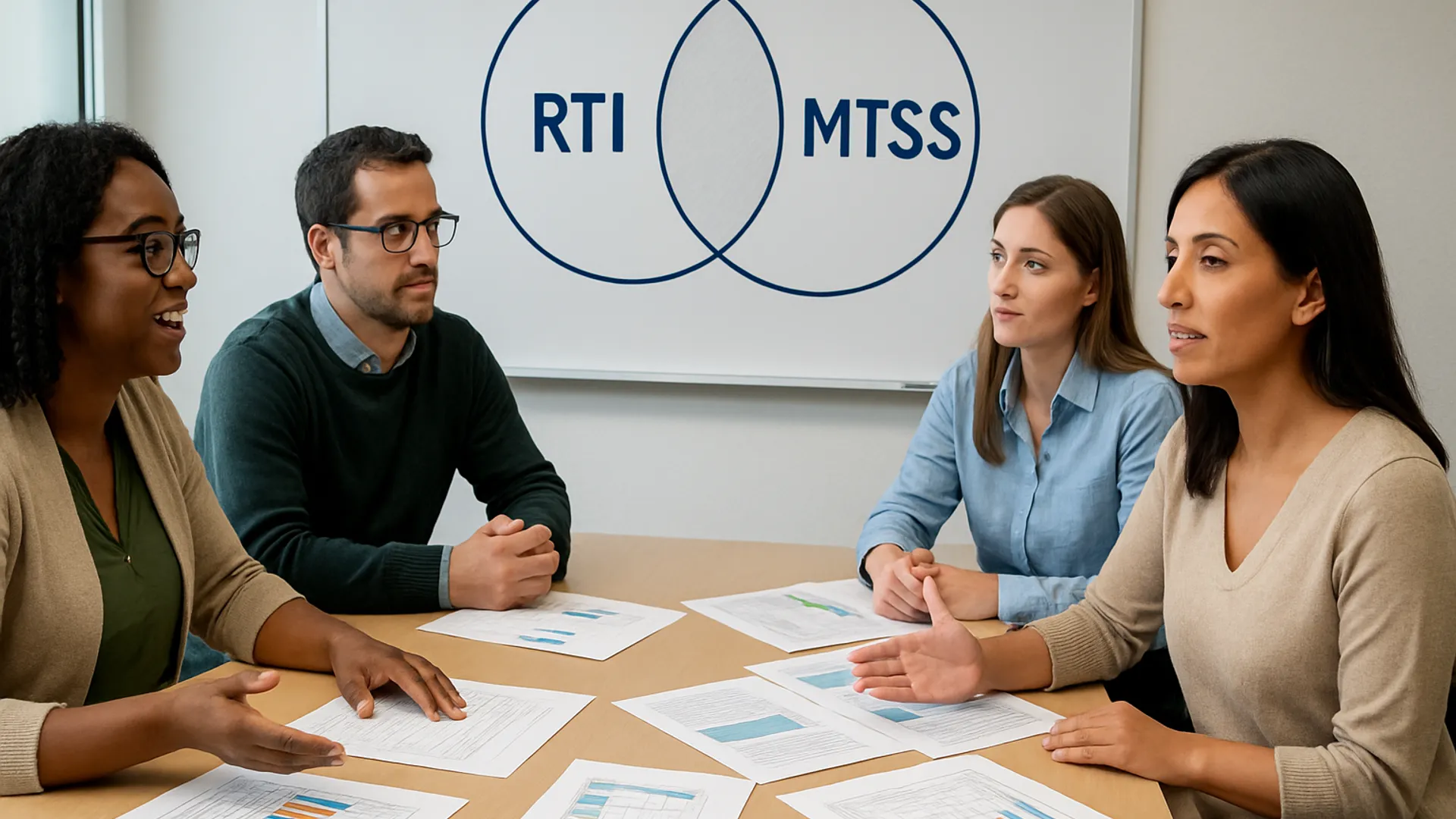
Teachers often hear MTSS and RTI used interchangeably, which creates confusion about what they actually do. The simple answer is that RTI (Response to Intervention) is a framework for academic intervention strategies support, while MTSS (Multi-Tiered Systems of Support) is the broader system that includes RTI, behaviour intervention plans support, and social-emotional learning science all together. Think of RTI as one piece of a much larger puzzle.
Many schools use the term MTSS today because it describes the whole-child approach to support. If your school says "We use MTSS," they are likely running RTI in the academic domain alongside behaviour and social-emotional systems. Understanding both terms helps you navigate school documentation, IEP meetings, and intervention planning more effectively.
RTI is a framework designed to identify and support students who struggle with academic skills, particularly reading and maths. It uses a tiered prevention model: Tier 1 is quality classroom teaching for all students; Tier 2 is targeted small-group intervention for students showing early warning signs; Tier 3 is intensive, individualised intervention for students who do not respond to Tier 2.
Each tier relies on screening, progress monitoring with SMART goals monitoring, and evidence-based interventions. Screening tools like curriculum-based measurement (CBM) help identify which students need support. Progress monitoring tracks whether interventions are working, typically every 1-2 weeks. If a student does not respond to intervention, the school escalates to special education evaluation.
RTI originated in the US around 2004, when the Individuals with Disabilities Education Act (IDEA) allowed schools to use RTI data instead of IQ discrepancy models to identify learning disabilities (Fletcher & Vaughn, 2009). Before RTI, schools waited for students to fall dramatically behind before intervening. RTI shifted the model to catching problems early.
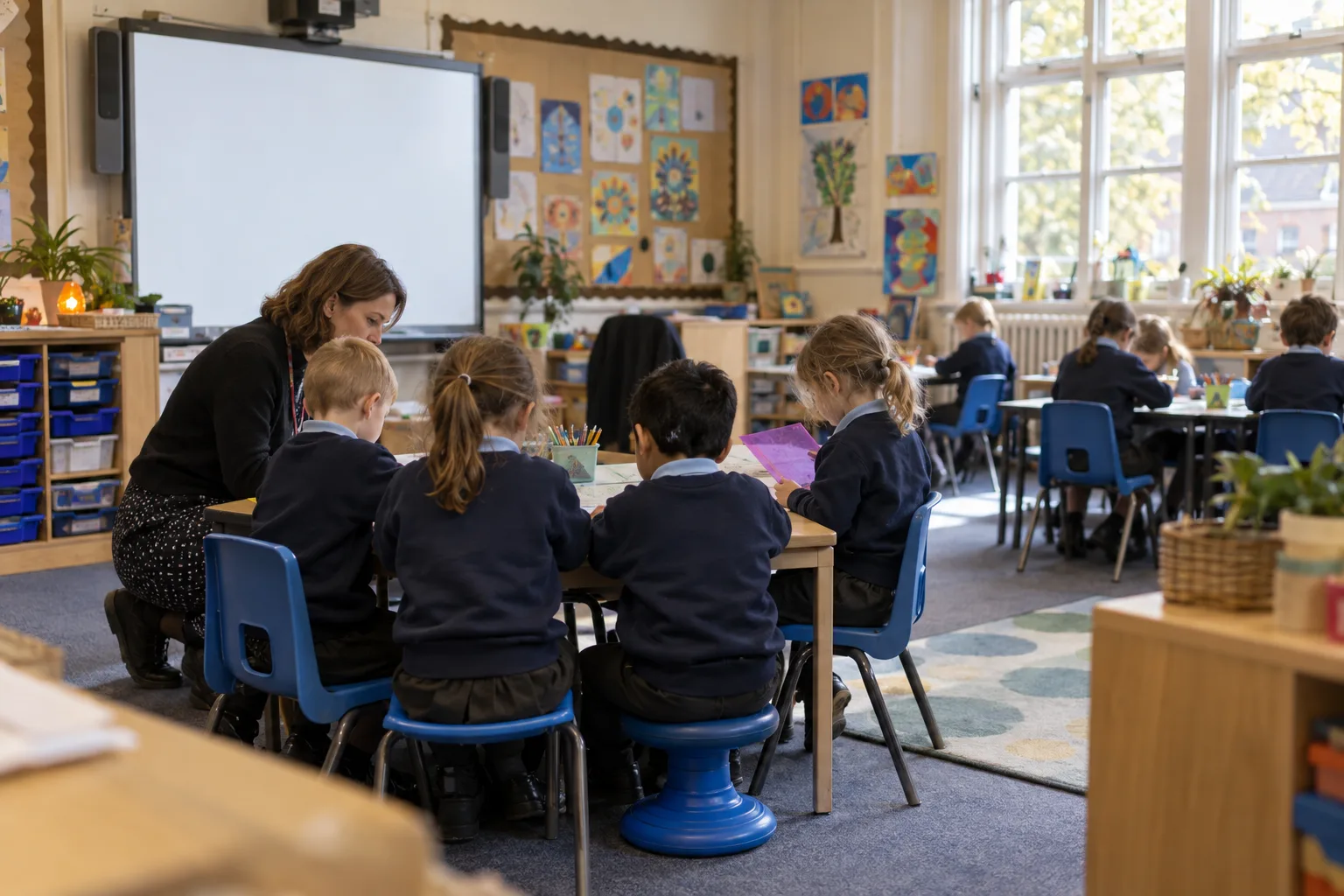
Classroom example: A Year 2 teacher notices that three students are not keeping pace with phonics instructional approaches. Using CBM, she identifies their specific weakness in digraph recognition. She pulls them aside three times weekly for a 15-minute small-group lesson using a structured phonics program. After four weeks, she monitors their progress. If they are catching up, they return to whole-class instruction. If not, the school considers evaluation for special educational needs.
MTSS is the umbrella framework that brings together academic intervention (RTI), behaviour support (PBIS), and social-emotional learning into one coordinated system. MTSS recognises that students need support across multiple domains: literacy, numeracy, behaviour, attendance, and emotional regulation. Rather than running separate programs, schools use MTSS to connect all these efforts.
MTSS also uses a tiered approach across all domains. Tier 1 is universal prevention for all students (classroom rules, quality teaching, character education). Tier 2 is targeted support for students at risk (behaviour contracts, small-group social skills, reading intervention). Tier 3 is intensive support for students in crisis (individual behaviour plans, intensive maths tutoring, mental health referral).
MTSS emerged in the early 2010s as educators recognised that RTI alone did not address the full picture of student need. A student might respond well to reading intervention but still struggle with behaviour and attendance. MTSS puts these systems in dialogue so that classroom teachers see the whole student (O'Neill & Stephenson, 2012).
Classroom example: The same Year 2 teacher is part of her school's MTSS leadership team. When tracking the three students in phonics intervention, she also monitors their behaviour (using school discipline data), attendance, and social skills (using a behaviour checklist). If one student is improving in reading but showing anxiety in group settings, the school offers concurrent social-emotional support. This coordinated approach prevents the student from falling behind in multiple areas.
| Feature | RTI | MTSS |
|---|---|---|
| Scope | Academic skills only (reading, maths, writing) | Whole child (academic, behaviour, SEL, attendance, health) |
| Main Focus | Identifying and remediating reading and maths deficits | Coordinated support across multiple domains |
| Legal Basis | IDEA 2004 (special education identification) | Broader education reform (not a legal mandate) |
| Behaviour Support | Not included (separate from RTI) | Included (via PBIS or equivalent) |
| Data Types | Academic progress monitoring (CBM, assessments) | Academic, behaviour, attendance, social-emotional, discipline |
| Primary Outcome | Reduced disability referrals; earlier intervention | Reduced discipline, improved attendance, fewer referrals |
| Terminology Trend | Less common; still used in specialist literature | Increasingly common term across US schools |
| Teacher Role | Deliver Tier 1 instruction; monitor academic progress | Deliver Tier 1 instruction; monitor multiple domains; collaborate across teams |
RTI was powerful but narrow. A school could run RTI perfectly and still have high suspension rates, chronic absenteeism, and students in crisis. Educators realised that academic progress was only one piece of the student experience. A student cannot learn if they are suspended, anxious, or hungry.
MTSS expanded the framework by adding behaviour (through Positive Behavioural Interventions and Supports, or PBIS) and social-emotional learning (SEL). PBIS applies the same tiered approach to behaviour: teach all students school-wide expectations, support students showing early behaviour problems, and provide intensive support for students with chronic behaviour issues. SEL adds explicit instruction in emotion regulation, relationship skills, and decision-making (Durlak et al., 2011).
The key innovation of MTSS is the integration layer. Rather than having separate "RTI meetings," "PBIS meetings," and "counselling services," MTSS brings data from all domains into one system. A student struggling with reading might also have behaviour referrals and attendance issues. MTSS helps the school see these connections and coordinate support instead of treating them as separate problems.
Classroom example: A Year 5 student is making progress in maths intervention but has three behaviour referrals in the past month and has missed six days of school. Under RTI alone, the school might focus only on maths intervention. Under MTSS, the behaviour specialist, classroom teacher, and attendance officer meet together. They discover the student's behaviour spikes on days he does not receive intervention (showing anxiety about maths). The school adjusts the intervention schedule, adds social-emotional support, and coordinates with the family about attendance. Within six weeks, behaviour improves, attendance rises, and maths progress accelerates.
Behaviour is not included in RTI because RTI focuses specifically on academic intervention. However, behaviour is central to MTSS. Many schools implement PBIS (Positive Behavioural Interventions and Supports) as the behaviour component of MTSS. PBIS teaches expected behaviours, reinforces positive choices, and provides support for students struggling with self-regulation.
PBIS uses the same three-tier model as RTI. Tier 1 is universal behaviour instruction: the school teaches all students the three core values, recognises positive behaviour, and maintains consistent routines. Tier 2 is targeted support: students showing early warning signs (minor discipline referrals, peer conflict, rule-breaking) receive small-group social skills training, behaviour contracts, or check-in/check-out systems. Tier 3 is intensive support: students with chronic behaviour issues receive individual behaviour plans, functional behavioural assessments, and mental health referrals.
In MTSS schools, behaviour data is as central as academic data. Teachers complete behaviour referrals that feed into a central system. The school analyses behaviour patterns (which students, which times, which settings) and adjusts support accordingly. This is sometimes called "data-driven discipline" (Bradshaw et al., 2008).
Classroom example: A primary school uses PBIS as part of MTSS. All staff teach the school value of "Respect" through specific routines (lining up calmly, waiting turns, listening without interrupting). Students who follow these routines earn positive recognition (stickers, notes home, public praise). When a Year 3 student shows early warning signs (two behaviour referrals in one week), the behaviour specialist offers Tier 2 support: weekly check-ins with a trusted adult, a visual schedule in the classroom, and recognition for meeting one specific self-advocacy goals (staying in seat during maths). This Tier 2 support prevents the student from needing a formal behaviour plan.
Both RTI and MTSS rely heavily on data. RTI collects academic data: scores on reading fluency measures, maths facts tests, curriculum-based assessments. Teachers plot these data weekly on progress monitoring graphs. If the line shows improvement, the intervention is working. If the line is flat or declining, the teacher adjusts the intervention and may escalate to special education evaluation.
MTSS uses the same logic but across multiple domains. In addition to academic data, schools collect behaviour data (discipline referrals, suspensions, classroom removals), attendance data (absences, tardies), and SEL data (social skills ratings, emotional regulation surveys). All this data lives in a central dashboard that teachers and administrators access regularly.
Many schools use specific software for MTSS data management: Illuminate, Schoolzilla, or Skyward. These systems allow teachers to enter progress monitoring data, behaviour referrals, and attendance information. The system flags which students need Tier 2 or Tier 3 support and prompts meetings to coordinate care. This is fundamentally different from RTI, where data is often kept in separate folders by each intervention teacher.
Classroom example: A secondary school uses an MTSS data system. Every Friday morning, each teacher enters grades and behaviour observations for students they taught that week. The system automatically identifies students with two or more behaviour referrals or failing grades in two or more classes. The school's MTSS team (principal, counsellor, RTI coordinator, behaviour specialist) reviews these flagged students in a 30-minute meeting. They decide which students need Tier 2 support and coordinate with teachers. By next Tuesday, the student is in a small-group class or has a check-in schedule. This rapid response prevents students from falling deeper into crisis.
If your school mentions RTI, it is focusing on academic intervention specifically. You will likely see RTI meetings focused on reading and maths progress, progress monitoring graphs, and discussions about special education evaluation. RTI schools may or may not have behaviour support systems; behaviour is often managed separately.
If your school mentions MTSS, it is taking a broader, coordinated approach. You will see multiple data sources discussed together, meetings that bring together the teacher, intervention specialist, behaviour specialist, and counsellor, and discussions about behaviour, attendance, and social-emotional needs alongside academics. MTSS schools often explicitly describe this integration as a strength.
Many schools use the term MTSS but run RTI as the academic component. This is increasingly common, especially in districts that have updated their improvement plans. If you are unsure, ask your principal directly: "Are we implementing MTSS or RTI?" The answer tells you a lot about how the school views student support and where to focus your energy as a teacher.
Classroom example: A teacher in an RTI school notices that a student is struggling in reading intervention but receives no other support systems. The teacher refers the student for special education evaluation based on RTI data alone. In contrast, a teacher in an MTSS school notices the same reading struggle but also sees that the student has three behaviour referrals and poor attendance. The MTSS team meets and discovers that the student's parents are going through a separation. The school adds SEL support, a check-in with the counsellor, and a flexible homework plan before pursuing special education. The student may catch up without formal identification.
In RTI, your role is to deliver high-quality Tier 1 instruction using evidence-based methods and monitor student progress. You complete curriculum-based assessments and submit them to the intervention team. You implement the interventions designed by specialists and report back on student response. You attend RTI meetings to discuss whether a student should continue, adjust, or exit intervention. You provide feedback on whether the student seems engaged and ready for intervention.
In MTSS, your role expands to include cross-domain awareness. You still deliver quality Tier 1 instruction, but you also monitor behaviour, attendance, and social skills. You complete behaviour referrals that feed into the central system. You collaborate with the behaviour specialist, counsellor, and intervention teachers. You might deliver Tier 1 PBIS or SEL lessons alongside core academic instruction. You attend MTSS meetings where data from multiple domains is discussed.
MTSS requires more coordination and communication but also provides better information. You are no longer working in silos. If a student is struggling academically, you know immediately if they also have behaviour or attendance issues. This allows you to provide more targeted support and prevents the situation where one part of the school is pushing intervention while another part is managing crisis (Adelman & Taylor, 2007).
Classroom example: An RTI-only teacher enters progress monitoring data into a spreadsheet and attends a monthly RTI meeting. She knows which students are in reading intervention but has no idea that three of them have discipline referrals or chronic absence. In contrast, an MTSS teacher enters the same progress monitoring data into a dashboard alongside behaviour observations. When she enters data, she sees that a student is making progress in reading but has 12 absences. She mentions this in the MTSS weekly check-in. The attendance officer calls home and discovers the student has no transportation. The school arranges bus fare, and attendance improves within two weeks, which then boosts reading progress.
Misconception 1: MTSS means we stop doing RTI. False. MTSS includes RTI. When a school adopts MTSS, the academic intervention system (RTI) continues, but it is now coordinated with behaviour and SEL support. RTI is still used to identify students needing help with reading and maths.
Misconception 2: MTSS is only for students with disabilities. False. Both RTI and MTSS target all students. Tier 1 is universal support for everyone. Students without disabilities benefit from PBIS, academic intervention, and SEL instruction. MTSS prevents disabilities and learning difficulties from becoming worse; it does not replace special education.
Misconception 3: MTSS is a special education thing. False. MTSS is a general education framework. The special education department collaborates with the MTSS team, but MTSS is owned by general education leadership and applies to all students. Some students in MTSS eventually need special education evaluation, but that is determined through the MTSS process, not the other way around.
Misconception 4: MTSS and PBIS are the same thing. False. PBIS is the behaviour component of MTSS. MTSS includes PBIS plus RTI plus SEL. A school can run PBIS without running RTI, but that school is not fully implementing MTSS. Think of PBIS as one piece of the MTSS puzzle.
Misconception 5: Interventions must be delivered by specialists only. False. Classroom teachers deliver most Tier 1 instruction and much Tier 2 support. Specialists help design and monitor interventions, but teachers are the primary delivery mechanism. If teachers do not buy in and implement with fidelity, the whole system fails (Fuchs & Fuchs, 2006).
Misconception 6: More tiers are better. False. RTI and MTSS use three tiers because research shows this is effective. Some schools add a "Tier 0" (prevention before Tier 1) or "Tier 4" (crisis intervention after Tier 3), but the basic three-tier model is the standard. Adding tiers often creates confusion and slows decision-making.
Adelman, H. S., & Taylor, L. (2007). Systemic change toward better school, mental health, and social services. Journal of Educational and Psychological Consultation, 17(2-3), 79-100.
Bradshaw, C. P., Mitchell, M. M., & Leaf, P. J. (2008). Examining the effects of schoolwide positive behavioural interventions and supports on student outcomes. Journal of Positive Behaviour Interventions, 12(3), 133-148.
Durlak, J. A., Weissberg, R. P., Dymnicki, A. B., Taylor, R. D., & Schellinger, K. B. (2011). The impact of enhancing students' social and emotional learning: A meta-analysis of school-based universal interventions. Child Development, 82(1), 405-432.
Fletcher, J. M., & Vaughn, S. (2009). Response to intervention: Preventing and remediating academic difficulties. Child Development Perspectives, 3(1), 30-37.
Fuchs, D., & Fuchs, L. S. (2006). Introduction to response to intervention: What, why, and how valid is it? Reading Research Quarterly, 41(1), 93-99.
O'Neill, S. C., & Stephenson, J. (2012). Evidence-based classroom behaviour management initiatives. Educational Psychology Review, 24(3), 495-510.
Teachers often hear MTSS and RTI used interchangeably, which creates confusion about what they actually do. The simple answer is that RTI (Response to Intervention) is a framework for academic intervention strategies support, while MTSS (Multi-Tiered Systems of Support) is the broader system that includes RTI, behaviour intervention plans support, and social-emotional learning science all together. Think of RTI as one piece of a much larger puzzle.
Many schools use the term MTSS today because it describes the whole-child approach to support. If your school says "We use MTSS," they are likely running RTI in the academic domain alongside behaviour and social-emotional systems. Understanding both terms helps you navigate school documentation, IEP meetings, and intervention planning more effectively.
RTI is a framework designed to identify and support students who struggle with academic skills, particularly reading and maths. It uses a tiered prevention model: Tier 1 is quality classroom teaching for all students; Tier 2 is targeted small-group intervention for students showing early warning signs; Tier 3 is intensive, individualised intervention for students who do not respond to Tier 2.
Each tier relies on screening, progress monitoring with SMART goals monitoring, and evidence-based interventions. Screening tools like curriculum-based measurement (CBM) help identify which students need support. Progress monitoring tracks whether interventions are working, typically every 1-2 weeks. If a student does not respond to intervention, the school escalates to special education evaluation.
RTI originated in the US around 2004, when the Individuals with Disabilities Education Act (IDEA) allowed schools to use RTI data instead of IQ discrepancy models to identify learning disabilities (Fletcher & Vaughn, 2009). Before RTI, schools waited for students to fall dramatically behind before intervening. RTI shifted the model to catching problems early.
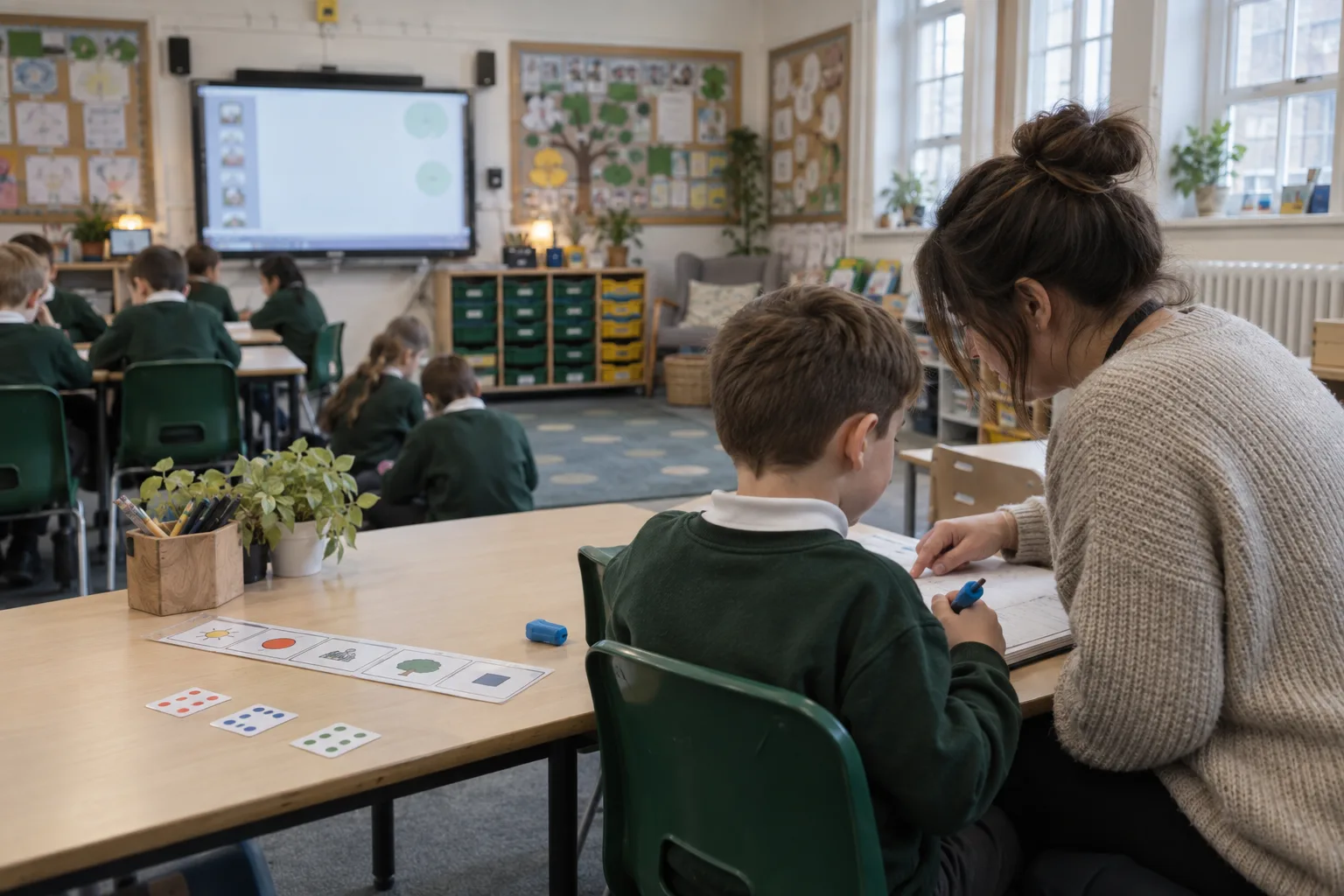
Classroom example: A Year 2 teacher notices that three students are not keeping pace with phonics instructional approaches. Using CBM, she identifies their specific weakness in digraph recognition. She pulls them aside three times weekly for a 15-minute small-group lesson using a structured phonics program. After four weeks, she monitors their progress. If they are catching up, they return to whole-class instruction. If not, the school considers evaluation for special educational needs.
MTSS is the umbrella framework that brings together academic intervention (RTI), behaviour support (PBIS), and social-emotional learning into one coordinated system. MTSS recognises that students need support across multiple domains: literacy, numeracy, behaviour, attendance, and emotional regulation. Rather than running separate programs, schools use MTSS to connect all these efforts.
MTSS also uses a tiered approach across all domains. Tier 1 is universal prevention for all students (classroom rules, quality teaching, character education). Tier 2 is targeted support for students at risk (behaviour contracts, small-group social skills, reading intervention). Tier 3 is intensive support for students in crisis (individual behaviour plans, intensive maths tutoring, mental health referral).
MTSS emerged in the early 2010s as educators recognised that RTI alone did not address the full picture of student need. A student might respond well to reading intervention but still struggle with behaviour and attendance. MTSS puts these systems in dialogue so that classroom teachers see the whole student (O'Neill & Stephenson, 2012).
Classroom example: The same Year 2 teacher is part of her school's MTSS leadership team. When tracking the three students in phonics intervention, she also monitors their behaviour (using school discipline data), attendance, and social skills (using a behaviour checklist). If one student is improving in reading but showing anxiety in group settings, the school offers concurrent social-emotional support. This coordinated approach prevents the student from falling behind in multiple areas.
| Feature | RTI | MTSS |
|---|---|---|
| Scope | Academic skills only (reading, maths, writing) | Whole child (academic, behaviour, SEL, attendance, health) |
| Main Focus | Identifying and remediating reading and maths deficits | Coordinated support across multiple domains |
| Legal Basis | IDEA 2004 (special education identification) | Broader education reform (not a legal mandate) |
| Behaviour Support | Not included (separate from RTI) | Included (via PBIS or equivalent) |
| Data Types | Academic progress monitoring (CBM, assessments) | Academic, behaviour, attendance, social-emotional, discipline |
| Primary Outcome | Reduced disability referrals; earlier intervention | Reduced discipline, improved attendance, fewer referrals |
| Terminology Trend | Less common; still used in specialist literature | Increasingly common term across US schools |
| Teacher Role | Deliver Tier 1 instruction; monitor academic progress | Deliver Tier 1 instruction; monitor multiple domains; collaborate across teams |
RTI was powerful but narrow. A school could run RTI perfectly and still have high suspension rates, chronic absenteeism, and students in crisis. Educators realised that academic progress was only one piece of the student experience. A student cannot learn if they are suspended, anxious, or hungry.
MTSS expanded the framework by adding behaviour (through Positive Behavioural Interventions and Supports, or PBIS) and social-emotional learning (SEL). PBIS applies the same tiered approach to behaviour: teach all students school-wide expectations, support students showing early behaviour problems, and provide intensive support for students with chronic behaviour issues. SEL adds explicit instruction in emotion regulation, relationship skills, and decision-making (Durlak et al., 2011).
The key innovation of MTSS is the integration layer. Rather than having separate "RTI meetings," "PBIS meetings," and "counselling services," MTSS brings data from all domains into one system. A student struggling with reading might also have behaviour referrals and attendance issues. MTSS helps the school see these connections and coordinate support instead of treating them as separate problems.
Classroom example: A Year 5 student is making progress in maths intervention but has three behaviour referrals in the past month and has missed six days of school. Under RTI alone, the school might focus only on maths intervention. Under MTSS, the behaviour specialist, classroom teacher, and attendance officer meet together. They discover the student's behaviour spikes on days he does not receive intervention (showing anxiety about maths). The school adjusts the intervention schedule, adds social-emotional support, and coordinates with the family about attendance. Within six weeks, behaviour improves, attendance rises, and maths progress accelerates.
Behaviour is not included in RTI because RTI focuses specifically on academic intervention. However, behaviour is central to MTSS. Many schools implement PBIS (Positive Behavioural Interventions and Supports) as the behaviour component of MTSS. PBIS teaches expected behaviours, reinforces positive choices, and provides support for students struggling with self-regulation.
PBIS uses the same three-tier model as RTI. Tier 1 is universal behaviour instruction: the school teaches all students the three core values, recognises positive behaviour, and maintains consistent routines. Tier 2 is targeted support: students showing early warning signs (minor discipline referrals, peer conflict, rule-breaking) receive small-group social skills training, behaviour contracts, or check-in/check-out systems. Tier 3 is intensive support: students with chronic behaviour issues receive individual behaviour plans, functional behavioural assessments, and mental health referrals.
In MTSS schools, behaviour data is as central as academic data. Teachers complete behaviour referrals that feed into a central system. The school analyses behaviour patterns (which students, which times, which settings) and adjusts support accordingly. This is sometimes called "data-driven discipline" (Bradshaw et al., 2008).
Classroom example: A primary school uses PBIS as part of MTSS. All staff teach the school value of "Respect" through specific routines (lining up calmly, waiting turns, listening without interrupting). Students who follow these routines earn positive recognition (stickers, notes home, public praise). When a Year 3 student shows early warning signs (two behaviour referrals in one week), the behaviour specialist offers Tier 2 support: weekly check-ins with a trusted adult, a visual schedule in the classroom, and recognition for meeting one specific self-advocacy goals (staying in seat during maths). This Tier 2 support prevents the student from needing a formal behaviour plan.
Both RTI and MTSS rely heavily on data. RTI collects academic data: scores on reading fluency measures, maths facts tests, curriculum-based assessments. Teachers plot these data weekly on progress monitoring graphs. If the line shows improvement, the intervention is working. If the line is flat or declining, the teacher adjusts the intervention and may escalate to special education evaluation.
MTSS uses the same logic but across multiple domains. In addition to academic data, schools collect behaviour data (discipline referrals, suspensions, classroom removals), attendance data (absences, tardies), and SEL data (social skills ratings, emotional regulation surveys). All this data lives in a central dashboard that teachers and administrators access regularly.
Many schools use specific software for MTSS data management: Illuminate, Schoolzilla, or Skyward. These systems allow teachers to enter progress monitoring data, behaviour referrals, and attendance information. The system flags which students need Tier 2 or Tier 3 support and prompts meetings to coordinate care. This is fundamentally different from RTI, where data is often kept in separate folders by each intervention teacher.
Classroom example: A secondary school uses an MTSS data system. Every Friday morning, each teacher enters grades and behaviour observations for students they taught that week. The system automatically identifies students with two or more behaviour referrals or failing grades in two or more classes. The school's MTSS team (principal, counsellor, RTI coordinator, behaviour specialist) reviews these flagged students in a 30-minute meeting. They decide which students need Tier 2 support and coordinate with teachers. By next Tuesday, the student is in a small-group class or has a check-in schedule. This rapid response prevents students from falling deeper into crisis.
If your school mentions RTI, it is focusing on academic intervention specifically. You will likely see RTI meetings focused on reading and maths progress, progress monitoring graphs, and discussions about special education evaluation. RTI schools may or may not have behaviour support systems; behaviour is often managed separately.
If your school mentions MTSS, it is taking a broader, coordinated approach. You will see multiple data sources discussed together, meetings that bring together the teacher, intervention specialist, behaviour specialist, and counsellor, and discussions about behaviour, attendance, and social-emotional needs alongside academics. MTSS schools often explicitly describe this integration as a strength.
Many schools use the term MTSS but run RTI as the academic component. This is increasingly common, especially in districts that have updated their improvement plans. If you are unsure, ask your principal directly: "Are we implementing MTSS or RTI?" The answer tells you a lot about how the school views student support and where to focus your energy as a teacher.
Classroom example: A teacher in an RTI school notices that a student is struggling in reading intervention but receives no other support systems. The teacher refers the student for special education evaluation based on RTI data alone. In contrast, a teacher in an MTSS school notices the same reading struggle but also sees that the student has three behaviour referrals and poor attendance. The MTSS team meets and discovers that the student's parents are going through a separation. The school adds SEL support, a check-in with the counsellor, and a flexible homework plan before pursuing special education. The student may catch up without formal identification.
In RTI, your role is to deliver high-quality Tier 1 instruction using evidence-based methods and monitor student progress. You complete curriculum-based assessments and submit them to the intervention team. You implement the interventions designed by specialists and report back on student response. You attend RTI meetings to discuss whether a student should continue, adjust, or exit intervention. You provide feedback on whether the student seems engaged and ready for intervention.
In MTSS, your role expands to include cross-domain awareness. You still deliver quality Tier 1 instruction, but you also monitor behaviour, attendance, and social skills. You complete behaviour referrals that feed into the central system. You collaborate with the behaviour specialist, counsellor, and intervention teachers. You might deliver Tier 1 PBIS or SEL lessons alongside core academic instruction. You attend MTSS meetings where data from multiple domains is discussed.
MTSS requires more coordination and communication but also provides better information. You are no longer working in silos. If a student is struggling academically, you know immediately if they also have behaviour or attendance issues. This allows you to provide more targeted support and prevents the situation where one part of the school is pushing intervention while another part is managing crisis (Adelman & Taylor, 2007).
Classroom example: An RTI-only teacher enters progress monitoring data into a spreadsheet and attends a monthly RTI meeting. She knows which students are in reading intervention but has no idea that three of them have discipline referrals or chronic absence. In contrast, an MTSS teacher enters the same progress monitoring data into a dashboard alongside behaviour observations. When she enters data, she sees that a student is making progress in reading but has 12 absences. She mentions this in the MTSS weekly check-in. The attendance officer calls home and discovers the student has no transportation. The school arranges bus fare, and attendance improves within two weeks, which then boosts reading progress.
Misconception 1: MTSS means we stop doing RTI. False. MTSS includes RTI. When a school adopts MTSS, the academic intervention system (RTI) continues, but it is now coordinated with behaviour and SEL support. RTI is still used to identify students needing help with reading and maths.
Misconception 2: MTSS is only for students with disabilities. False. Both RTI and MTSS target all students. Tier 1 is universal support for everyone. Students without disabilities benefit from PBIS, academic intervention, and SEL instruction. MTSS prevents disabilities and learning difficulties from becoming worse; it does not replace special education.
Misconception 3: MTSS is a special education thing. False. MTSS is a general education framework. The special education department collaborates with the MTSS team, but MTSS is owned by general education leadership and applies to all students. Some students in MTSS eventually need special education evaluation, but that is determined through the MTSS process, not the other way around.
Misconception 4: MTSS and PBIS are the same thing. False. PBIS is the behaviour component of MTSS. MTSS includes PBIS plus RTI plus SEL. A school can run PBIS without running RTI, but that school is not fully implementing MTSS. Think of PBIS as one piece of the MTSS puzzle.
Misconception 5: Interventions must be delivered by specialists only. False. Classroom teachers deliver most Tier 1 instruction and much Tier 2 support. Specialists help design and monitor interventions, but teachers are the primary delivery mechanism. If teachers do not buy in and implement with fidelity, the whole system fails (Fuchs & Fuchs, 2006).
Misconception 6: More tiers are better. False. RTI and MTSS use three tiers because research shows this is effective. Some schools add a "Tier 0" (prevention before Tier 1) or "Tier 4" (crisis intervention after Tier 3), but the basic three-tier model is the standard. Adding tiers often creates confusion and slows decision-making.
Adelman, H. S., & Taylor, L. (2007). Systemic change toward better school, mental health, and social services. Journal of Educational and Psychological Consultation, 17(2-3), 79-100.
Bradshaw, C. P., Mitchell, M. M., & Leaf, P. J. (2008). Examining the effects of schoolwide positive behavioural interventions and supports on student outcomes. Journal of Positive Behaviour Interventions, 12(3), 133-148.
Durlak, J. A., Weissberg, R. P., Dymnicki, A. B., Taylor, R. D., & Schellinger, K. B. (2011). The impact of enhancing students' social and emotional learning: A meta-analysis of school-based universal interventions. Child Development, 82(1), 405-432.
Fletcher, J. M., & Vaughn, S. (2009). Response to intervention: Preventing and remediating academic difficulties. Child Development Perspectives, 3(1), 30-37.
Fuchs, D., & Fuchs, L. S. (2006). Introduction to response to intervention: What, why, and how valid is it? Reading Research Quarterly, 41(1), 93-99.
O'Neill, S. C., & Stephenson, J. (2012). Evidence-based classroom behaviour management initiatives. Educational Psychology Review, 24(3), 495-510.