Updated on
September 24, 2026
SEND-Friendly Learning Environments: A Classroom Audit
Audit your classroom for SEND accessibility across sensory processing, physical layout, visual supports, communication, and emotional regulation.


Updated on
September 24, 2026
Audit your classroom for SEND accessibility across sensory processing, physical layout, visual supports, communication, and emotional regulation.
Classroom environments affect how well SEND provision works. An Individual Education Plan is harder to use when a room has glare, unpredictable noise or resources that learners cannot access. Many classrooms still suit neurotypical learners first. This means autistic learners, learners with ADHD, sensory processing differences or physical disabilities often spend energy adapting to the room before they can learn (Mostafa, 2008; Ashburner et al., 2010; Moore, 2016).
Quick answer: A SEND-friendly learning environment feels safe in body, senses and emotions. It has low visual noise, clear routines, easy-to-use materials, quiet spaces and adult support matched to each learner's anxiety and communication needs. To create inclusive environments, teachers need practical adjustments, such as visual timetables and accessible resources. They also need relational support, such as calm interactions, movement breaks and emotional regulation coaching.
The audit checklist helps SENCOs and teachers assess learning spaces. It covers sensory processing, layout, visuals, communication, and emotional needs. Each section lists items, SEND impact, and term-time fixes.
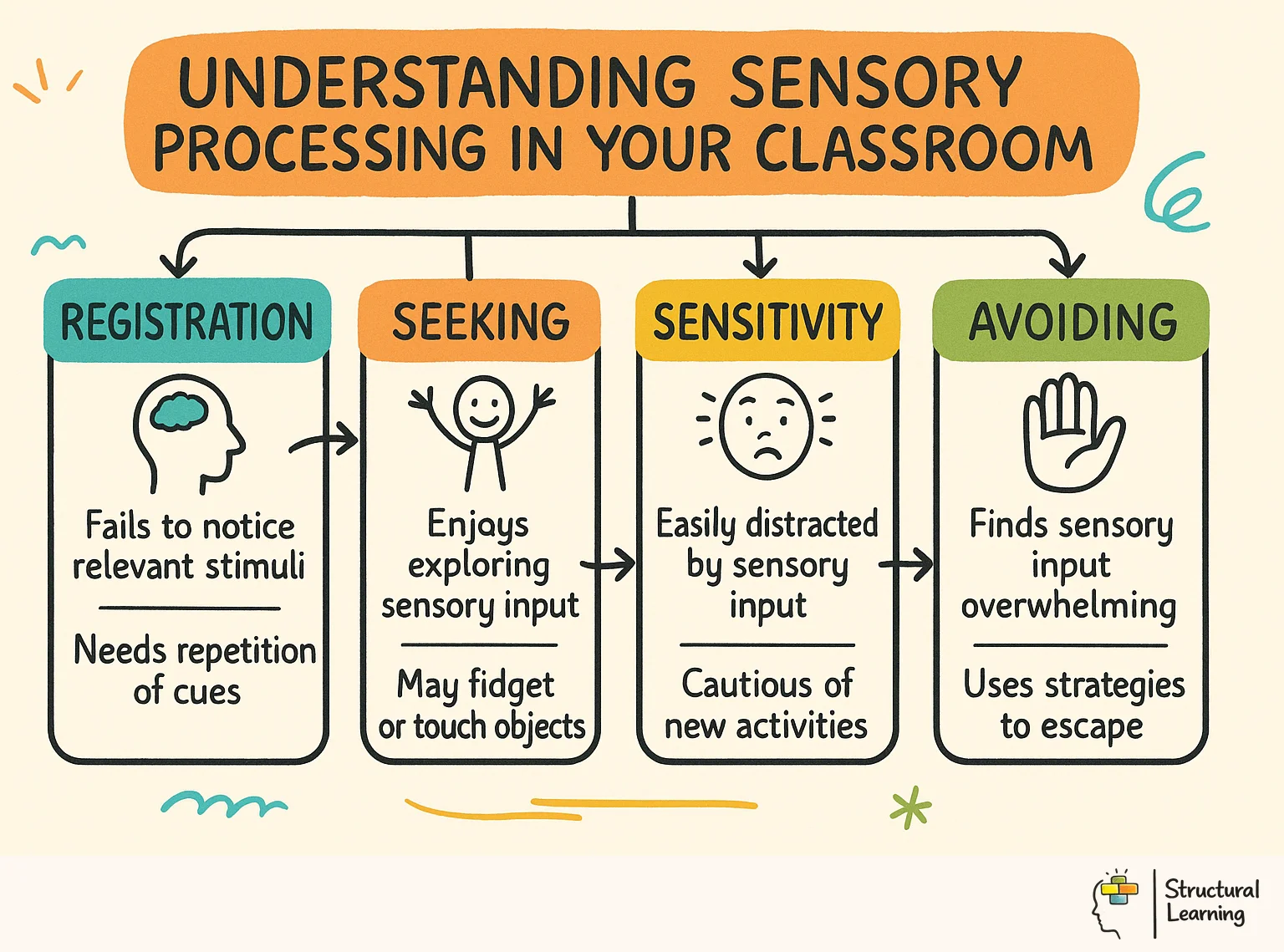
Dunn's updated Sensory Profile 2 framework describes four patterns of sensory processing: registration, seeking, sensitivity and avoiding. A learner may show one pattern for sound, another for touch, movement, smell or visual input. Most classrooms are set up for neurotypical learners first. As a result, autistic learners, learners with ADHD or learners with sensory processing differences can reach overload or withdraw before teaching begins (Dunn, 2014).
Consider lighting. Older fluorescent fittings with magnetic ballasts can flicker at mains-related frequencies. Newer UK school specifications now expect lower-flicker electronic ballasts or LED systems (DfE, 2022). So the audit question is not "are there fluorescent tubes?" but "does any workstation have glare, visible flicker, harsh contrast or screen reflection?"
Research on visual processing in autistic individuals shows that some learners are more vulnerable to visual stress, headaches and difficulty concentrating (Colman et al., 2009). A Year 3 teacher notices that one learner covers his eyes during morning maths under the oldest strip lights. Moving him to a desk near the window reduces the behaviour within a week, without changing the maths task.
Barrett et al. (2015) found that classroom design explained 16% of variation in learning progress in their UK primary sample, not that any single classroom change will raise progress by 16%. Naturalness, individualisation and balanced stimulation had the strongest effects, but the likely benefit depends on the building's starting condition and the learner group. Treat the figure as a reason to audit the room, not as a universal prediction.
Classroom design is part of Universal Design for Learning and trauma-informed practice: plan predictable routes, varied ways to access information and choices for regulation before learners fail (CAST, 2018; Riggs and Landrum, 2023). In England, this also fits the graduated approach of assess, plan, do, review. Assess the barrier in the room, plan a change, try it, then review evidence with the SENCO. This matters for learners whose SEND intersects with EAL, poverty, trauma or unstable attendance, because environmental barriers can be misread as low motivation or defiance.
Sensory audits should now cover six areas: lighting, acoustics, visual environment, temperature, smell and digital load. Treat these as demands that work together, not as separate tick boxes. Autistic learners often experience several inputs at the same time. Sensory research also argues for studying these combined demands, rather than one channel at a time (Cascio et al., 2016).
In 2026 classrooms, 1:1 devices, app notifications, animated slides and interactive whiteboards add extra visual and auditory load. Recent reviews show that neurodivergent learners are often missing from cognitive load research, so schools should test digital routines locally rather than assume screens are neutral (Le Cunff et al., 2024; Forsström et al., 2025).
Lighting is the most frequently overlooked variable. Natural light supports circadian rhythm, concentration, and mood. Fluorescent tubes create glare and invisible flicker. LED panels provide steady, non-flickering light at adjustable colour temperatures.
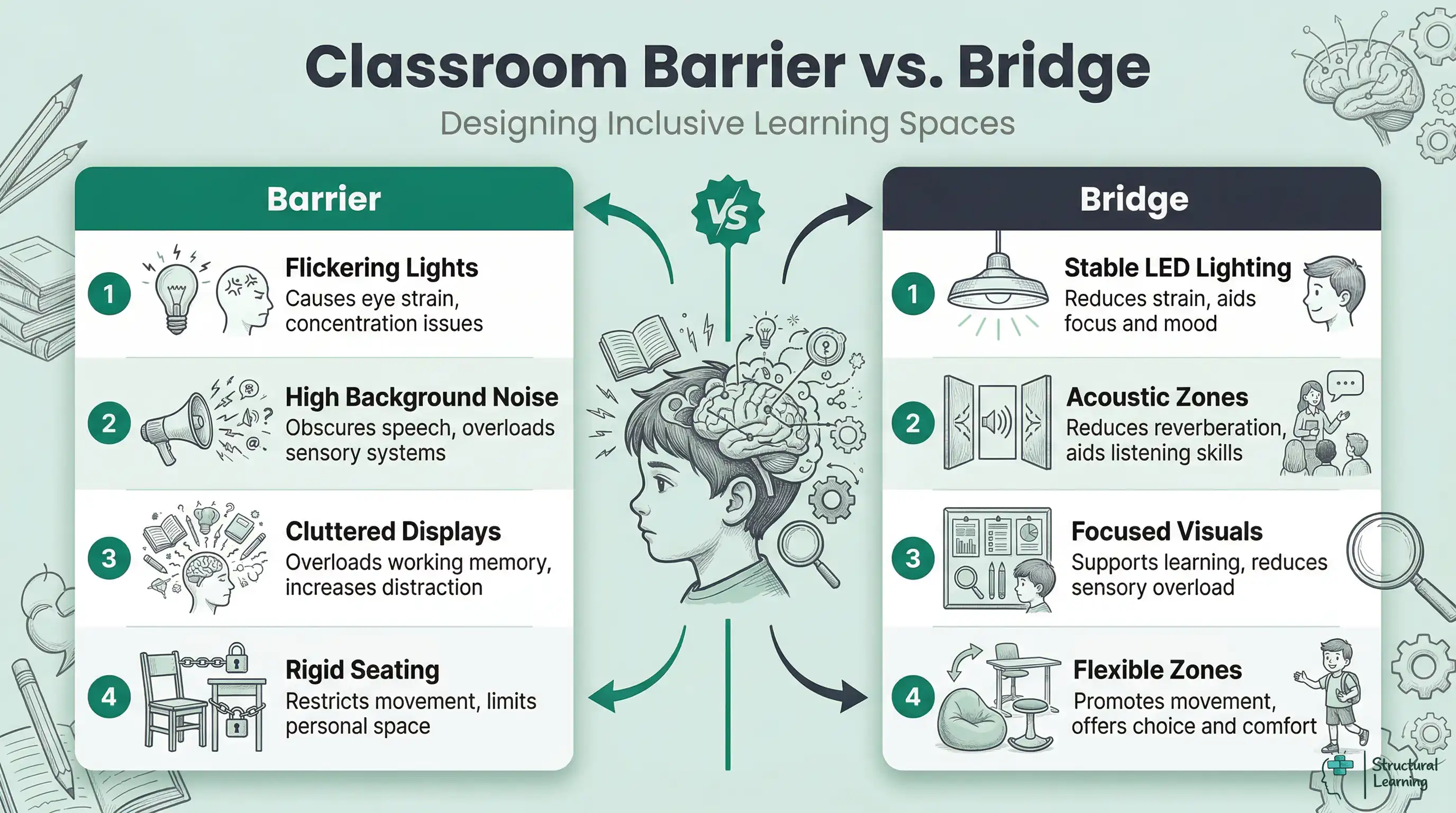
A SENCO conducting an audit should stand at each learner workstation during a lesson and note whether overhead lights create glare on whiteboards or desks, whether any workstations sit in deep shadow, and whether blinds are functional.
Acoustics matter more than most teachers realise. Background noise in a typical primary classroom runs at 55-75 dB, which is comparable to a busy restaurant. For a learner with ADHD who struggles with selective attention, or a learner using hearing aids, this ambient noise makes it physically difficult to isolate the teacher's voice. Acoustic panels on two walls and soft furnishings in one corner can reduce reverberation time by 40% (Shield and Dockrell, 2008).
Visual displays should reduce distraction, but the room should not feel sterile. Fisher et al. (2014) showed that heavy decoration can pull attention away from the taught material. Sweller (1988) explains that irrelevant visual information uses working memory. This does not mean bare walls for every class: sensory-seeking neurodivergent learners often need purposeful colour, texture or movement to regulate attention.
Audit displays by function. Keep the phonics chart, worked example, visual timetable and speaking frame if learners use them during lessons. Remove duplicate posters, old topic boards and hanging materials that compete with the task. From the classroom door, count the display elements learners can see during instruction; if one wall has more than 20 separate items, reduce it or group it into clear zones.
A Year 6 SENCO photographs each wall from a learner's seated eye level, then reviews the images with two autistic learners. Both independently identify the "birthday display" and the overlapping topic boards as the most distracting features. The SENCO removes the birthday display and introduces a single, structured "learning wall" format with clearly bordered sections and a plain background. The class teacher reports improved on-task behaviour during independent writing within the first fortnight.
The arrangement of furniture determines how learners move through the room, who they can see, and how easily they can access resources. For learners with physical disabilities, the layout is a matter of basic access. For learners with ADHD, autism, or SEMH needs, it shapes their capacity to self-regulate.
Desk arrangement should match the task, not stay fixed all term. Rows suit direct instruction and reduce social distraction for learners with attention difficulties. Grouped tables work for collaborative tasks but create constant low-level noise and social demands that overwhelm some autistic learners.
The most inclusive classrooms use a mixed layout: rows or horseshoe for whole-class teaching, grouped tables for collaborative work, and a quiet workstation (facing a blank wall or partition) available at all times. This flexibility is a core feature of differentiated classroom design.
A secondary maths teacher uses three zones. Zone A has paired desks facing the whiteboard for teacher-led instruction. Zone B has a cluster of four tables for group problem-solving. Zone C is a single desk behind a low bookshelf with noise-cancelling headphones available.
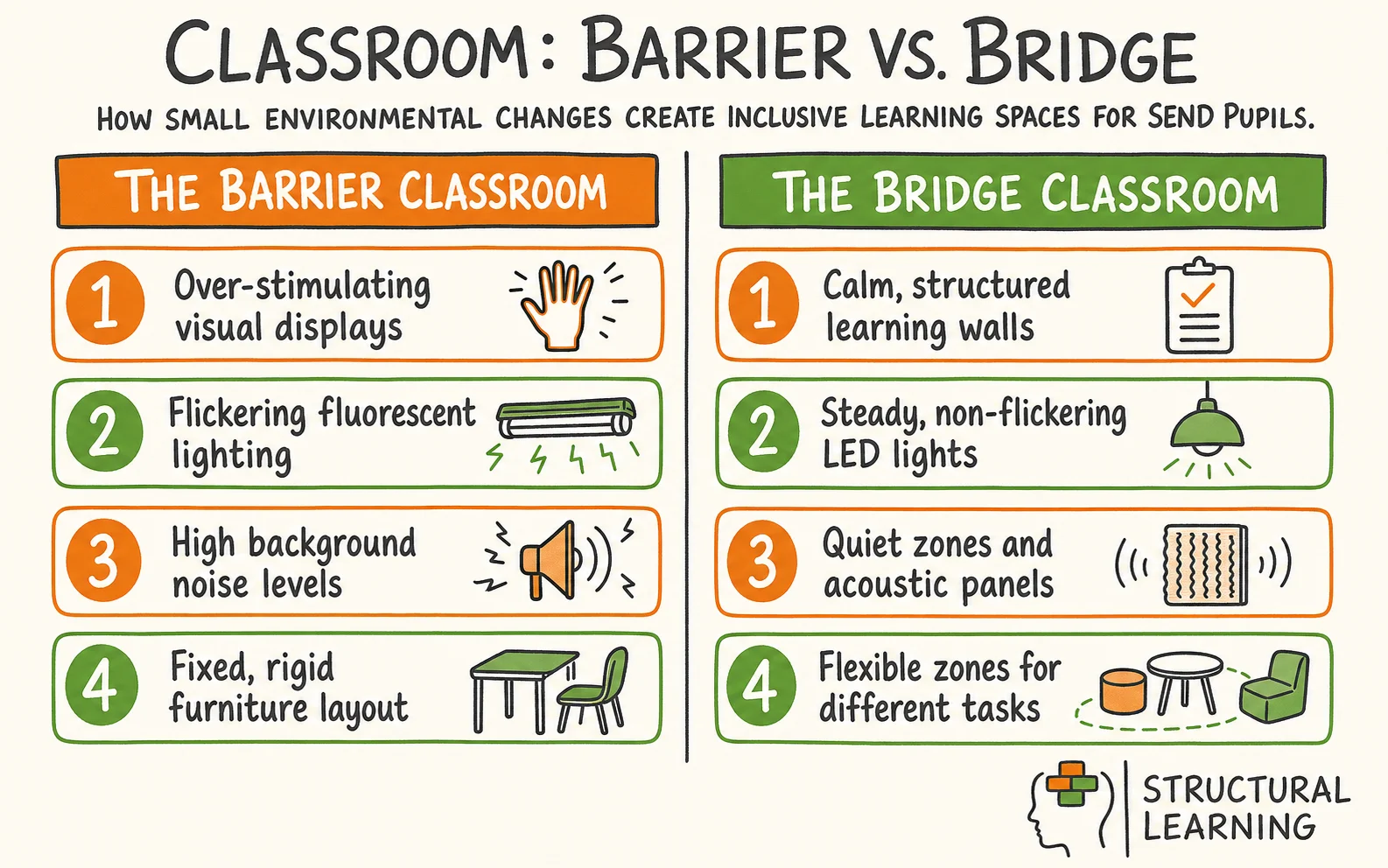
Three learners with identified SEND use Zone C during independent practice by choice, not by instruction. The teacher says: "Choose the zone that helps you think best right now." This normalises the choice for the whole class.
Accessibility for wheelchair users and learners with physical difficulties requires more than a clear path to the door. Check aisle widths (minimum 900mm for wheelchair access), height of resources (coat pegs, bookshelves, sink), and whether the learner can reach the whiteboard or interactive display from their position. Adjustable-height desks cost £80-150 and serve learners who use standing frames or whose wheelchairs do not fit standard desk heights.
Movement break spaces benefit all learners but are essential for those with ADHD and sensory-seeking profiles. A defined area (even a 2m x 2m floor space marked with tape) where a learner can do wall push-ups, use a resistance band, or complete five star jumps provides proprioceptive input that helps regulate arousal levels. This is not a reward or a break from learning; it is a sensory strategy recommended by occupational therapists for maintaining attention (Pfeiffer et al., 2008).
Transitions can be challenging. Corridors overwhelm some autistic learners. Try letting SEND learners leave two minutes early. Visual countdowns and "transition buddies" walking beside learners can also help.
Using visuals cuts down how much thinking learners do with spoken instructions. This helps those with SLCN, autism, and working memory problems. Visuals stay present, while spoken words disappear (Hodgetts et al., 2018).
Now-and-next boards are the simplest and most effective visual support. A two-section board (laminated card, Velcro strips, and symbol cards) shows the current activity and the activity that follows. For a learner with autism who becomes anxious about what happens next, the board answers that question without requiring them to ask. For a learner with ADHD, it breaks the session into two manageable chunks rather than an overwhelming timetable.
A Year 2 teaching assistant creates a now-and-next board for a learner with autism and moderate learning difficulties. During carpet time, she places the "listening" symbol in the "now" slot and the "writing" symbol in the "next" slot. When the learner begins to rock and hum (early signs of anxiety), the TA points to the board and says: "First listening, then writing." The learner glances at the board, settles, and re-engages. The TA has not needed to speak more than five words.
Visual timetables should be displayed at learner eye level, read left to right (or top to bottom for vertical formats), and use consistent symbols. Widgit symbols are the most widely used in UK schools and are recognisable to learners who transfer between settings. A visual timetable is not decorative; it is functional. If learners do not refer to it during the day, it is in the wrong place or uses symbols they do not understand.
Word walls and vocabulary displays support learners with SLCN and EAL needs when they follow clear rules. Limit them to 15-20 words, group words by topic or function (not alphabetically), add an image beside each word, and update them every half term. A vocabulary display that has not changed since September is wallpaper, not a teaching tool.
| Area | What to Check | SEND Impact | Quick Fix |
|---|---|---|---|
| Lighting | Fluorescent flicker, glare on surfaces, access to natural light | Headaches and visual stress for autistic learners; reduced concentration for ADHD | Switch to LED panels (£15 each); use blinds to control glare; seat sensitive learners near windows |
| Noise | Ambient dB level, echo, corridor noise bleed, chair scraping | Difficulty isolating teacher voice for hearing-impaired learners; sensory overload for autism | Tennis balls on chair legs (£5); one acoustic panel (£30); carpet squares in group areas |
| Visual clutter | Number of wall displays, colour density, overlapping materials | Extraneous cognitive load for all learners; disproportionate effect on ADHD and autism | Reduce to 3 structured displays per wall; use borders and neutral backgrounds |
| Temperature | Thermostat settings, radiator proximity, ventilation | Sensory discomfort and dysregulation; difficulty with interoception for some autistic learners | Ensure 18-21°C range; allow flexible clothing; open windows at transition points |
| Smell | Cleaning products, air fresheners, food smells from canteen, marker pens | Nausea and distraction for learners with olfactory sensitivity; anxiety triggers | Switch to unscented products; ventilate before learners arrive; remove plug-in air fresheners |
Colour coding provides an additional organisational structure. Some schools assign colours to subjects (blue for maths, green for English), while others use colour to indicate routine stages (red for "stop and listen," amber for "think," green for "go"). Consistency matters more than the specific system. Once learners learn the code, it reduces the verbal instructions needed.
Kuypers' Zones of Regulation (2011) gives learners language for feelings. These are Blue (low energy), Green (calm), Yellow (anxious), and Red (extreme). Many UK schools teach it, but classrooms must back it up.
A regulation zone is not a punishment area. The distinction between "time-out" and "take-a-break" is fundamental. Time-out removes a learner from the group as a consequence. Take-a-break allows a learner to self-select a regulation strategy before they reach crisis point.
The language matters: "You need to go to time-out" places the decision with the adult and frames the move as punitive. "Would the calm corner help right now?" places the decision with the learner and frames the move as a strategy.
Setting up a calm corner requires a defined space (1.5m x 1.5m is sufficient), a visual boundary (a bookshelf, screen, or curtain), seating (bean bag or floor cushion), and a small selection of regulation tools. The tools should address different sensory needs.
A primary SENCO sets up the following kit, budgeted at under £60:
Break cards give learners a non-verbal way to request access to the calm corner. A learner places a laminated card on the teacher's desk (or holds it up) and moves to the regulation zone without needing to explain or ask aloud. This removes the social barrier that prevents many autistic learners and those with SEMH difficulties from seeking help. The card should specify the maximum break duration (usually five minutes) and include a visual instruction for returning to the group.
A Year 5 learner with a diagnosis of anxiety and selective mutism has never once asked to leave the classroom, despite visible distress during noisy activities. After introducing break cards, she uses one within the first week. She goes to the calm corner, uses the weighted lap pad for three minutes, and returns to her seat. The class teacher notes that the learner's written output in the session after the break is the longest she has produced all term.
Elklan's "Communication Friendly Spaces" approach helps teachers audit communication barriers for learners with SLCN. It looks at four classroom conditions. These are lower background noise, slower adult talk, visual support for spoken language and planned chances to rehearse talk (Elklan Training and The Communication Trust, 2012).
| Visual Support | Primary SEND Benefit | Cost | Setup Time |
|---|---|---|---|
| Now-and-next board | Autism (reduces transition anxiety), ADHD (chunks time) | £5-10 | 30 minutes |
| Visual timetable (Widgit) | Autism, SLCN, moderate learning difficulties | £50 for Widgit licence | 1 hour |
| Colour-coded routine cards | ADHD (reduces verbal instructions), working memory difficulties | £10-15 | 45 minutes |
| Word wall (topic-linked) | SLCN, EAL, vocabulary gaps | £5-10 | 1 hour per update |
| Makaton signs poster | SLCN, Down syndrome, severe learning difficulties | Free (Makaton charity resources) | 20 minutes |
| Task breakdown strips | Executive function difficulties, ADHD, autism | £3-5 | 15 minutes per set |
Speaking walls display sentence stems, key vocabulary, and talk frames at learner eye level. Unlike general display boards, a speaking wall is a live reference tool. During a science lesson on materials, the speaking wall shows: "I think _____ will happen because _____." "This material is _____ (hard/soft/flexible/rigid)." "My evidence is _____." Learners with language difficulties use these frames to participate in discussion without needing to construct sentences from scratch. This is scaffolding at the environmental level.
Talk partners should be assigned, not random. Pairing a learner with SLCN with a patient, articulate peer produces better outcomes than pairing with a dominant speaker who fills silences.
The teacher establishes a talk partner protocol: Partner A speaks for 30 seconds while Partner B listens, then they swap. A sand timer makes the structure visible. This gives learners with slower processing time a guaranteed window to speak.
Quiet work areas serve the opposite function. Some learners with SLCN need silence to process what they have heard. A quiet workstation, equipped with noise-cancelling headphones and a visual task card, allows these learners to consolidate learning after group discussion. The key is that the quiet area is framed as a choice, not a separation. "If you need quiet thinking time, the silent desk is ready" communicates respect for different processing needs.
A secondary English teacher redesigns one corner of the classroom as a "communication station." It includes a speaking wall with sentence stems for the current unit, colourful semantics strips, a charged tablet with speech-to-text, and a simple recording device for learners who prefer to rehearse answers orally before writing. The assistive technology is stored in the station rather than in a locked cupboard, so learners can use it without waiting for adult permission. Three learners with EHCPs for SLCN use the station daily. Their verbal contributions during whole-class discussion increase from an average of one per lesson to three.
Use this checklist to conduct a systematic audit of any classroom. Rate each item as "Yes" (in place), "No" (not in place), or "Partial" (needs improvement). Record the action needed and assign a priority: H (this week), M (this half term), or L (this term).
An audit is only useful if it changes adult practice. Crispel and Kasperski (2021) show that inclusion depends on teacher training as well as positive attitudes, so assign each action to a named adult and review it in planning time. Use a three-tier action plan so staff can separate immediate, medium-term and longer-term changes.
| Item | Sensory Function | Approximate Cost |
|---|---|---|
| Noise-cancelling ear defenders | Reduces auditory input for overloaded learners | £12 |
| Weighted lap pad (1kg) | Proprioceptive calming input | £15 |
| Fidget tools (tangle, putty) | Tactile regulation for anxiety and ADHD | £8 |
| Sand timer (5 minutes) | Visual time boundary for the break | £3 |
| Breathing exercise card (laminated) | Structured regulation technique | £2 |
| Feelings check-in chart (Zones of Regulation) | Self-identification of emotional state | £5 |
| Bean bag or floor cushion | Comfortable seating that differs from task chairs | £15 |
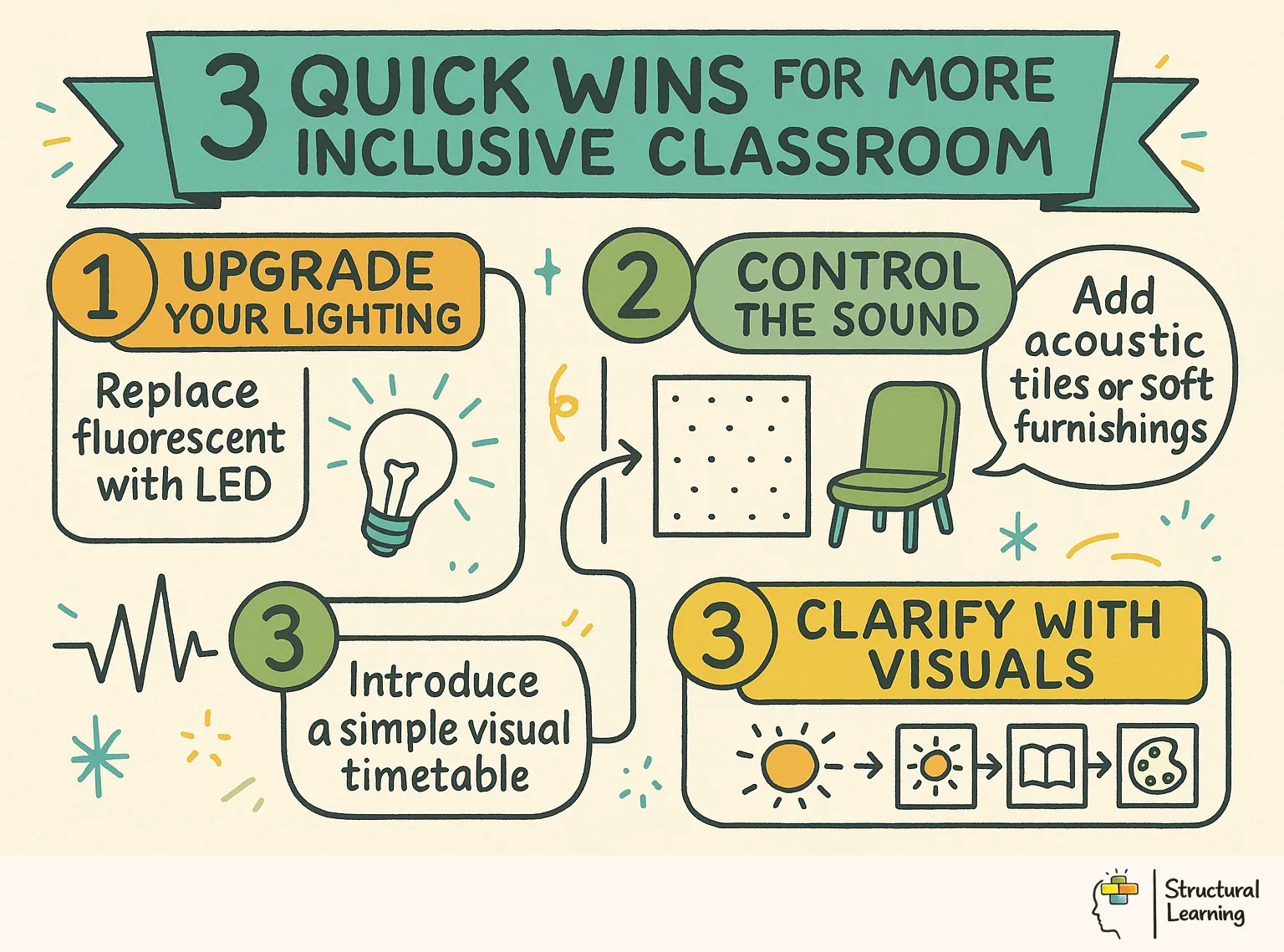
Tier 1: This week (cost: under £50). These are changes a class teacher can make without budget approval or facilities involvement. Examples: rearranging desks to create a quiet workstation, removing one wall display, introducing break cards, adding tennis balls to chair legs, printing and laminating a now-and-next board. A teacher who completes three Tier 1 changes in a single week will see noticeable differences in the behaviour of sensory-sensitive learners.
Tier 2: This half term (cost: £50-300). These require a small budget allocation and possibly SLT approval. Examples: purchasing noise-cancelling ear defenders for the class, installing one set of acoustic panels, buying a Widgit licence, setting up a calm corner with sensory resources.
The SENCO should present the audit findings to the headteacher with specific costings. Schools with a SEND-specific budget line can often fund these from existing allocations.
Tier 3: This term or year (cost: £300+). These are structural changes that require premises involvement. Examples: replacing fluorescent lighting with LED panels across a corridor, installing acoustic ceiling tiles, creating a dedicated Inclusion Base. These changes should be written into the School Improvement Plan and linked to the accessibility plan required under the Equality Act 2010.
Involving learners in the audit process produces better data and builds self-advocacy. Ask learners with SEND: "What in this room makes it harder for you to learn?" Their answers are often specific, practical, and different from what adults predict.
A Year 4 autistic learner told his SENCO that the ticking clock was the most difficult feature in the room. No adult had noticed it. Removing the clock and replacing it with a silent digital display cost nothing and reduced his anxiety-related behaviours during quiet reading time.
When you share audit findings with governors or SLT, present changes to the environment as part of quality first teaching and attendance work. Do not present them as an extra SEND cost. Inclusive settings are linked to learners' school-related wellbeing, but this depends on learners feeling safe, included and able to take part (Goldan et al., 2022). Reducing echo helps every learner hear the teacher, structured displays reduce cognitive load, and a calm corner supports SEMH needs without taking the learner out of the class.
For leaders, the strongest case is strategic: zero-cost audits can remove triggers that feed school distress, EBSA and exclusion risk before behaviour escalates (Gray et al., 2023; Mullally et al., 2023). In a tight funding year, "move the learner away from the glare", "make transitions predictable" and "turn off non-essential notifications" are reasonable first actions while larger premises work is costed.
Print the full audit checklist from the section above and complete it for one classroom this week. Walk the room during a lesson, not when it is empty, because the sensory environment changes when 30 learners are present.
Choose three Tier 1 changes you can make by Friday. Try them for a fortnight, then return to the checklist and select your Tier 2 priorities. Share the audit with your SENCO, or with your headteacher if you are the SENCO, alongside a one-page costed proposal for the top five changes still needed.
Build a Section 504 accommodation plan by condition and need
This tool helps you select appropriate Section 504 accommodations based on the learner's condition and classroom needs. Filter by condition, category, and setting to build a comprehensive accommodation list.
(Section 504 of the Rehabilitation Act, 1973)
Step 1, Select a condition
Selected Accommodations

Inclusive classroom design benefits all learners. Classrooms supporting SEND learners have clear layouts. They also manage lighting and sounds well.
This helps learners control emotions and concentrate. Visual supports are important for structure (Rose & Meyer, 2002).
Review the classroom from a learner's view. Quickly fix flickering lights and use plain display paper. Create a quiet area, and a visual timetable shows the day's routine.
Sensory design affects learners (Tanner, 2000). Over-stimulating classrooms can make learning harder for learners with autism or ADHD (Mostafa, 2008). Classroom layout also matters, as it can affect learning by 16 percent (Barrett et al., 2015).
Researchers have found that decorated classrooms use up learners' working memory. Visuals that do not support the lesson leave less space for learning (Fisher et al., 2014). To lower cognitive load, keep displays focused and use borders (Sweller, 2011).
Visual overload distracts learners. Avoid too much material hanging from ceilings or windows. Fluorescent lights can cause headaches and stress (Wilkins, 1995). Do not assume one sensory environment works for all neurodivergent learners.
Learners with ADHD or hearing loss find it hard to hear the teacher when background noise is high. Schools can add panels or soft furnishings to reduce echoes. These easy changes make speech clearer and help auditory processing (Shield & Dockrell, 2008; Picard & Bradley, 2001).
Barrett et al. (2015).
Cascio et al. (2016).
Colman et al. (2009).
| Domain | Item | Yes / No / Partial | Action Needed | Priority |
|---|---|---|---|---|
| Sensory | Non-flickering lighting (LED or natural light) at all workstations | |||
| Acoustic treatment on at least two surfaces (panels, soft furnishings, carpet) | ||||
| Wall displays limited to 3 structured boards per wall with neutral backgrounds | ||||
| Temperature maintained between 18-21°C with ventilation available | ||||
| No strong-scented cleaning products, air fresheners, or markers in use | ||||
| Physical Layout | Flexible desk arrangement (rows, groups, and quiet workstation available) | |||
| Aisle widths of 900mm minimum for wheelchair access | ||||
| Resources (pegs, shelves, sink) accessible at learner height for all | ||||
| Defined movement break space (minimum 2m x 2m) with proprioceptive resources | ||||
| Transition plan (early release, visual countdown, buddy system) | ||||
| Visual Supports | Now-and-next board visible and updated throughout the day | |||
| Visual timetable at learner eye level using consistent symbols (Widgit or similar) | ||||
| Topic-linked word wall with images (15-20 words, updated half-termly) | ||||
| Colour-coding system consistent across subjects and routines | ||||
| Task breakdown strips available for multi-step activities | ||||
| Emotional Regulation | Calm corner or regulation zone with visual boundary and sensory tools | |||
| Break cards available for non-verbal self-referral | ||||
| Zones of Regulation (or equivalent) display with matching vocabulary used by all adults | ||||
| "Take-a-break" language used consistently (not "time-out") | ||||
| Communication | Speaking wall with sentence stems and talk frames at learner eye level | |||
| Assigned talk partners with structured turn-taking protocol | ||||
| Quiet workstation with headphones for processing time | ||||
| Adults use slow pace, short sentences, and visual cues during verbal instructions |
DfE (2022).
Dunn (2007).
Dunn (2014).
Dunn (1999).
Fisher et al. (2014).
Goldan et al. (2022).
Hartanto et al. (2016).
Hodgetts et al. (2018).
Kuypers (2011).
Mostafa (2008).
Pfeiffer et al. (2008).
Shield and Dockrell (2008).
Sweller (2011).
Tanner (2000).
Wilkins (1995).
Researchers have explored environmental adaptations for learners with SEND (various papers, reports). Their findings directly inform UK classroom practices.
Multiple research strands inform the classroom audit approach in this article (Dockrell & Shield, 2006; Shield & Dockrell, 2008; DfE, 2015). They cover learner sensory processing, classroom design, and emotional regulation. The studies also examine communication-friendly practice and accessibility law.
Sensory Processing in Everyday Life: A Conceptual Model
Highly cited
Dunn, W. (2007)
Dunn's (1999) model has four sensory patterns: registration, seeking, sensitivity, and avoiding. These patterns connect to learner behaviour in class. This helps understand why learners react differently to the same classroom (Dunn, 1999). It also informs the sensory audit checklist items.
Clever Classrooms: Summary Report of the HEAD Project
Landmark study
Barrett, P., Davies, F., Zhang, Y., & Barrett, L. (2015)
The HEAD project (Barrett et al., 2015) assessed 3,766 learners in UK schools. Classroom design explained 16% of academic progress variation. Naturalness, individualisation, and stimulation guide beneficial classroom changes. This is strong evidence that classroom design impacts learning (Barrett et al., 2015).
The Zones of Regulation framework, (Kuypers, 2011), helps learners manage emotions. Learners gain self-control using this curriculum. Research on emotion regulation shows self-regulation boosts learning (Kuypers, 2011). Resources grounded in this work support teachers.
Widely adopted
Kuypers, L. M. (2011)
Kuypers' (2009) Zones of Regulation gives UK schools a shared vocabulary for emotional work. The framework has Blue, Green, Yellow, and Red zones. Environmental changes support self-regulation, says Kuypers (2009). This directly applies to calm corners and break cards used in classroom practice.
Communication Friendly Spaces: Creating Inclusive Learning Environments
Professional standard
Elklan Training / The Communication Trust (2012)
Elklan's approach audits spaces for learners with communication needs. The framework assesses room layout, displays, and noise (Elklan). Adult communication behaviour also gets reviewed within the audit. NHS services across England have adopted this audit (Elklan).
Accessible Schools: Planning to Increase Access to Schools for Disabled Learners
DfE guidance
Department for Education (2015)
Schools must legally improve access for disabled learners, as required by the Equality Act 2010. Accessibility plans are a must. Classroom audits (as per researcher and date of research article) inform this plan. The guidance justifies budget requests for building adaptations.