Updated on
September 24, 2026
Conditional Knowledge: When and Why to Use Strategies
Conditional knowledge teaches learners when and why to use the right strategy. Evidence-based approaches from Flavell and Paris for the classroom.


Updated on
September 24, 2026
Conditional knowledge teaches learners when and why to use the right strategy. Evidence-based approaches from Flavell and Paris for the classroom.
Conditional Knowledge: Teaching the When and Why of Strategy Use describes the learner’s ability to decide when, where and why a strategy should be used, rather than simply knowing what the strategy is or how to carry it out. It sits within metacognition, but it is best taught through subject content, not through generic study-skills slogans. The key distinction was made clear in later work on declarative, procedural and conditional knowledge (Paris, Lipson, & Wixson, 1983), and it matters because learners often perform well in blocked practice but fail when they must choose a method for themselves.
Conditional knowledge is metacognitive knowledge. It means knowing when, where, and why to use a fact, concept, skill, or learning strategy in a certain context.
In a Year 7 maths lesson, a learner may know how to expand brackets and how to solve equations, but conditional knowledge is knowing which method fits the problem in front of them. Teachers build this judgement by modelling the cues, limits and reasons behind strategy choice, then giving learners mixed examples where they must explain why one approach works better than another.
Sarah watches her Year 8 learner Jake attack a maths word problem by highlighting every number in bright yellow. He learned this highlighting strategy in English lessons where it helped him identify key quotations. Now he's applying it mechanically to solve: 'A train travels 120 miles in 2 hours. What is its average speed?' Jake has highlighted '120', '2', and every instance of the word 'hours', but he's no closer to finding the answer.
This scenario illustrates a critical gap in Jake's learning. He possesses procedural knowledge, he knows how to highlight text. But he lacks conditional knowledge: the understanding of when and why to use specific strategies. Conditional knowledge is the metacognitive awareness that helps learners select the right tool for the right job.
Without conditional knowledge, learners collect strategies but do not think strategically. They learn many techniques but cannot judge their fit for different tasks. Jake's highlighting works very well for textual analysis, but it adds cognitive noise when he solves mathematical problems.
The key issue is the difference between knowing how to do something and knowing when to do it. This is one of education's most overlooked challenges. It also links closely to the feeling of knowing, where learners sense they have the answer but cannot fully retrieve it.
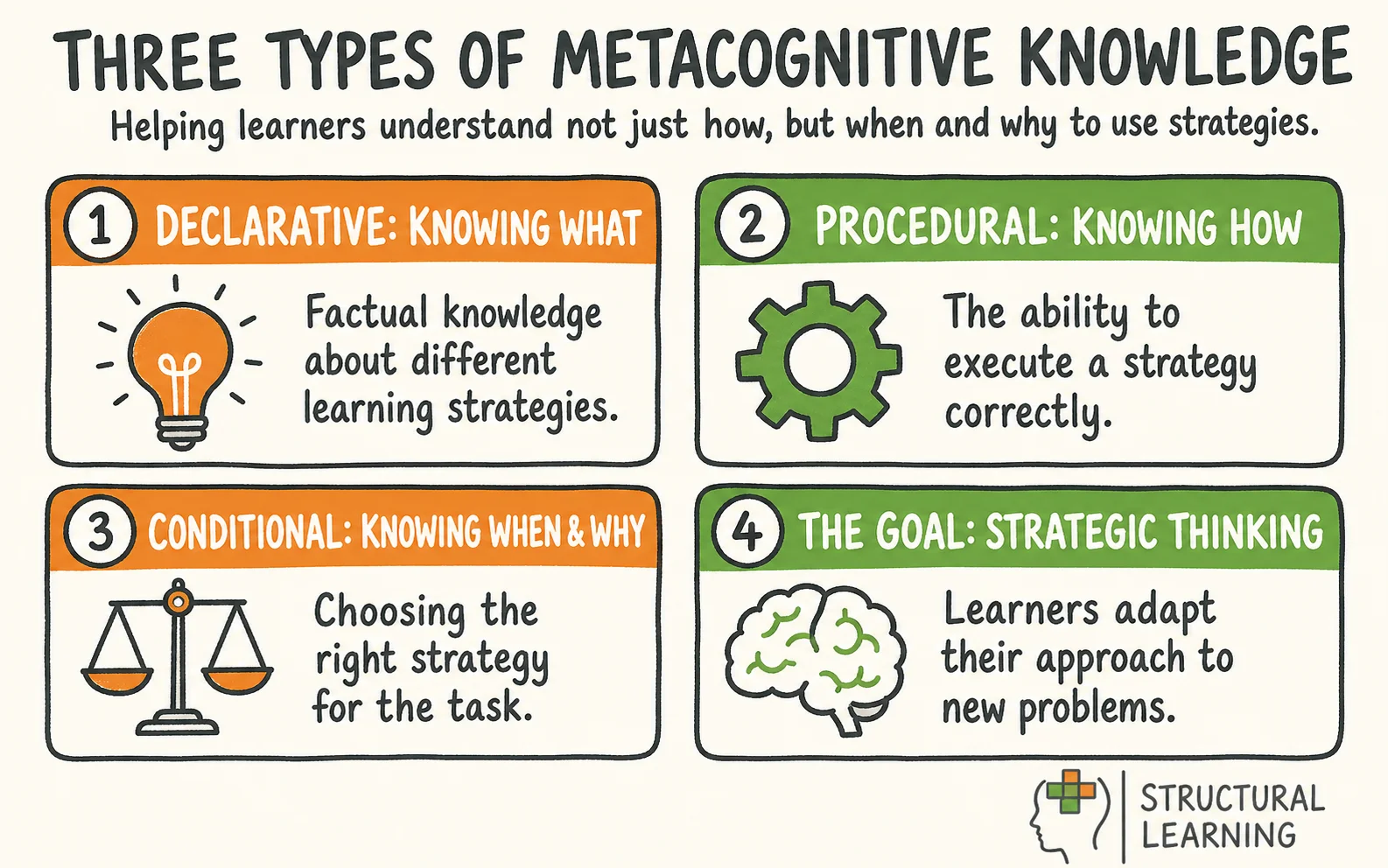
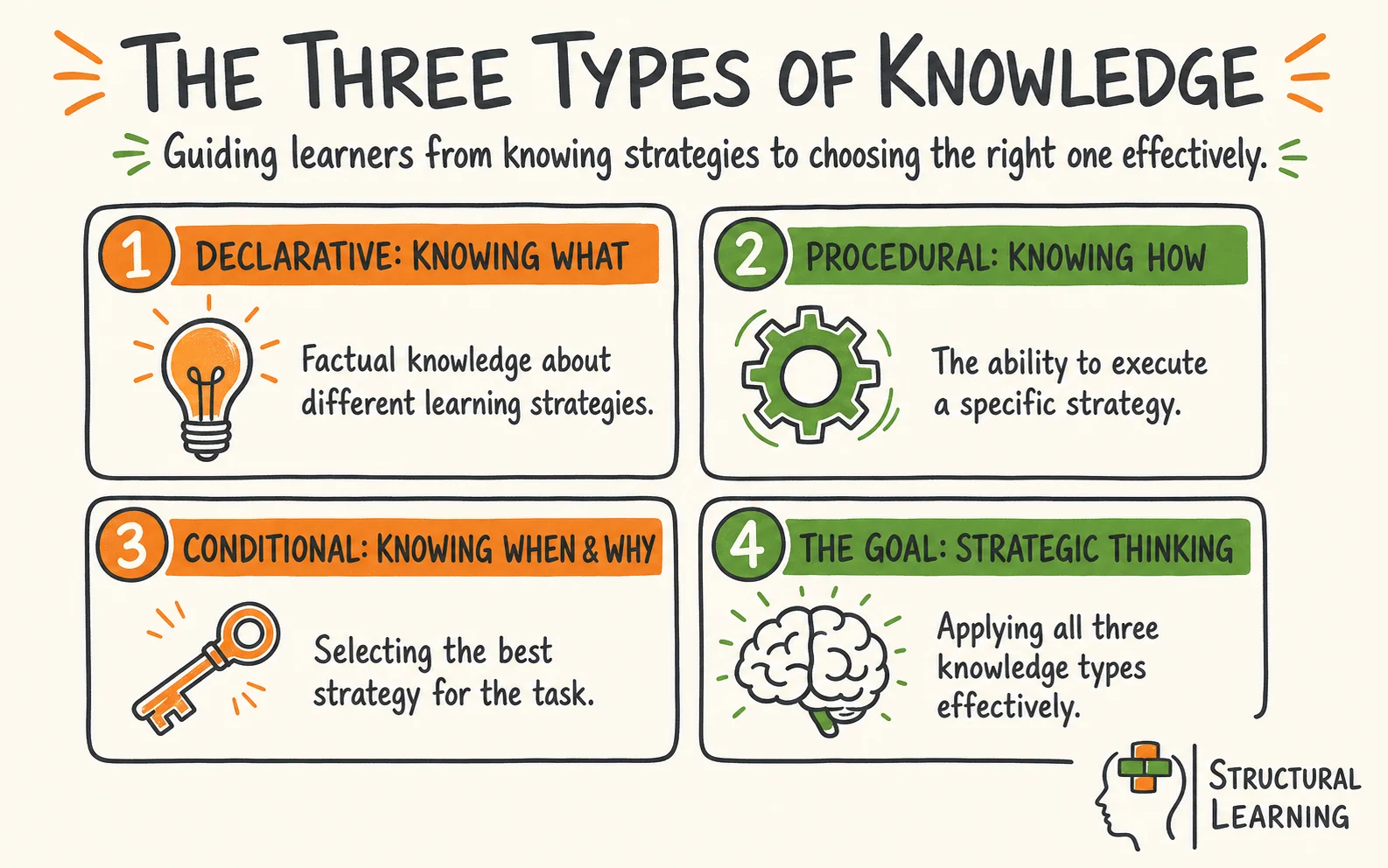
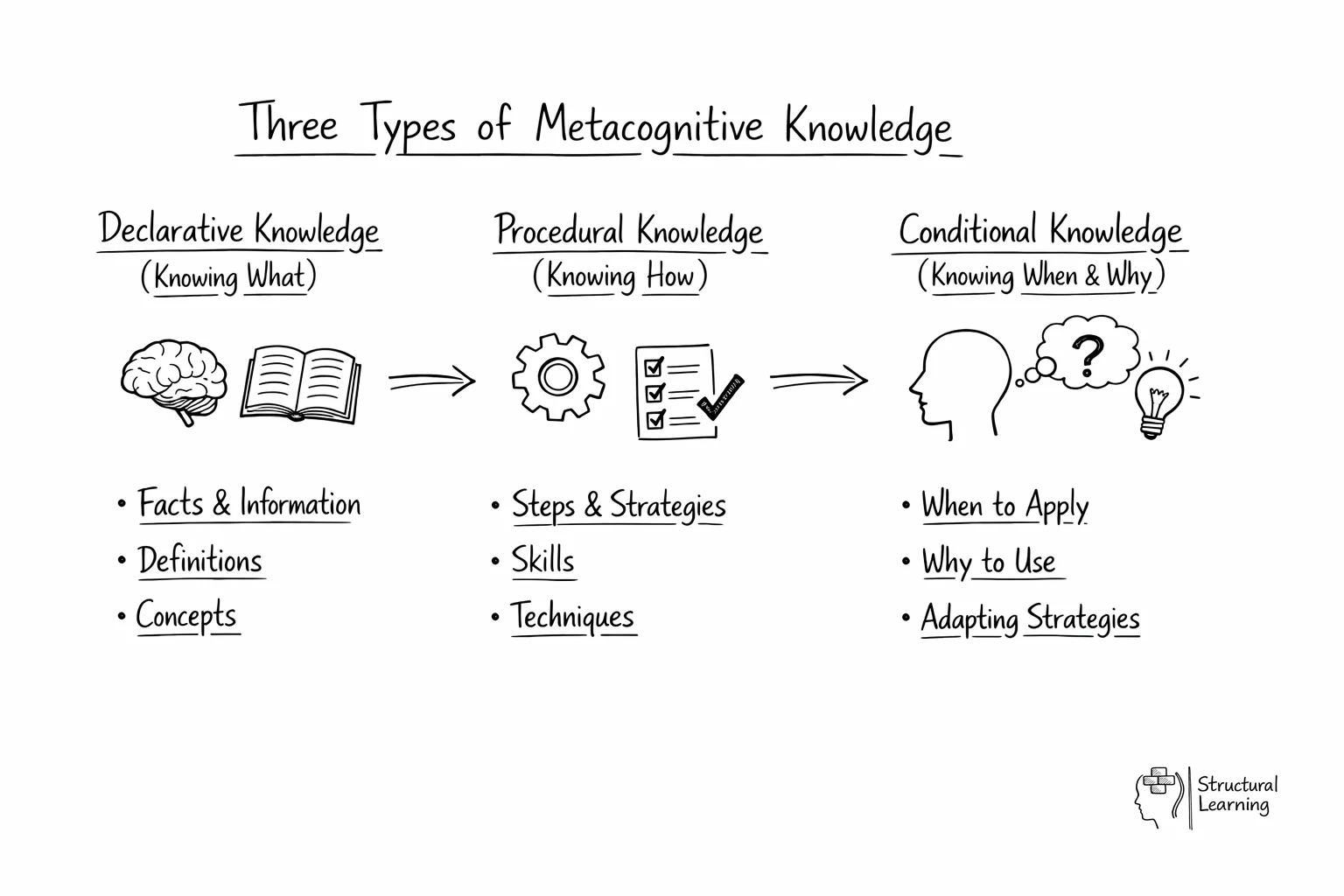
Metacognitive knowledge works through three linked systems, first described by Flavell (1979) and later refined by Paris, Lipson and Wixson (1983). These clear differences help teachers see exactly where learners struggle.
Declarative knowledge means knowing facts about strategies and learning. In persuasive writing, learners with strong declarative knowledge can name techniques: rhetorical questions, emotive language, statistics, and anecdotes. They know which tools are available in their strategy toolkit.
In mathematics, declarative knowledge means knowing what strategies exist. For example, learners know that long multiplication, grid method, and mental methods can all solve multiplication problems. They can name these strategies and describe their basic features.
Procedural knowledge means using a strategy in the right way. Learners show this when they use the grid method to multiply 23 × 47, with correct columns and clear calculation steps.
In English, procedural knowledge shows when learners build a persuasive paragraph. They use topic sentences, evidence, and analysis. They follow the structural steps correctly.
Conditional knowledge helps learners choose strategies, based on the task and their skills. For example, a learner may choose long multiplication for accuracy (Brownell, 1947). However, they might use mental maths when speed is more important (Siegler, 1996). Metacognitive monitoring, tracking the strategy's success, also affects selection (Flavell, 1979).
This comparison table illustrates the distinctions:
| Knowledge Type | Mathematics Example | English Example | Science Example |
|---|---|---|---|
| Declarative | "I know what long division is" | "I know what a topic sentence is" | "I know what a fair test is" |
| Procedural | Can follow long division steps | Can write clear topic sentences | Can design controlled experiments |
| Conditional | Chooses long division for harder problems that need exact answers | Uses topic sentences for formal essays, but not for creative writing | Designs fair tests for causal investigations, but not for descriptive studies |
Inert knowledge occurs when learners possess information, yet cannot use it (Whitehead, 1929). Learners know many strategies but use familiar ones (Siegler, 1996). This can hinder performance, as learners need conditions for strategy deployment (Paris et al., 1983).
Consider revision strategies. Learners often know about flashcards, mind maps, and practise tests (declarative knowledge) and can create them competently (procedural knowledge). However, they might use flashcards for complex essay subjects where concept mapping would prove more effective, or apply mind mapping to factual recall tasks better suited to testing.
Learners' conditional knowledge affects working memory (Sweller et al.). When they understand the task well, they can quickly reject poor strategies. This reduces cognitive load during problem solving. When learners are unsure which strategy to use, that extra burden limits learning.
Research by various people shows it is key. When learners lack conditional knowledge, they waste brain power (Siegler, 1996). They explore bad options or stick to wrong methods. Good conditional knowledge guides attention to effective strategies (Alexander, 2003; Paris, Lipson & Wixson, 1983).
The EEF guidance highlights strategic selection for learners. Effective self-regulated learners know when to use specific strategies. This helps them check their methods and change course if needed. (EEF, date unspecified).
In early years, conditional knowledge appears in fundamental strategy choices. Year 2 learners learning addition might know counting on, number bonds, and concrete materials as solution methods. Conditional knowledge emerges when they choose counting on for 47 + 6 but recall number bonds for 7 + 3.
Teacher language supports this development: "Look at these numbers. Which method would be quickest here? Why?" Learners begin articulating their reasoning: "I'll count on because 47 is big" or "I know 7 + 3 equals 10, so I don't need to count."
Reading strategy selection gives another example. Learners might know phonics decoding, sight word recognition, and guessing from context. Conditional knowledge helps them use phonics for new words and sight recognition for common words. Teachers can model the thinking: "This word is 'the', I know that one. But 'magnificent' is tricky, so I'll sound it out."
In secondary school, conditional knowledge becomes more advanced. In mathematics, Year 9 learners solving quadratic equations may know factoring, completing the square, and the quadratic formula. Conditional knowledge helps them choose by looking at the equation structure: factoring for x², 7x + 12 = 0, but the quadratic formula for 2x², 3x, 7 = 0.
Exam technique represents important conditional knowledge. Learners learn when to show working (maths problem worth 3 marks) versus when to provide brief answers (multiple choice questions). They develop timing awareness: spending 2 minutes on 2-mark questions but 15 minutes on extended response items.
In English, choosing an essay structure shows conditional thinking. Learners may know comparative, chronological, and thematic organisational frameworks. They choose a comparative structure for "Compare how two poets present conflict". They use a chronological approach for "How does Macbeth change throughout the play?"
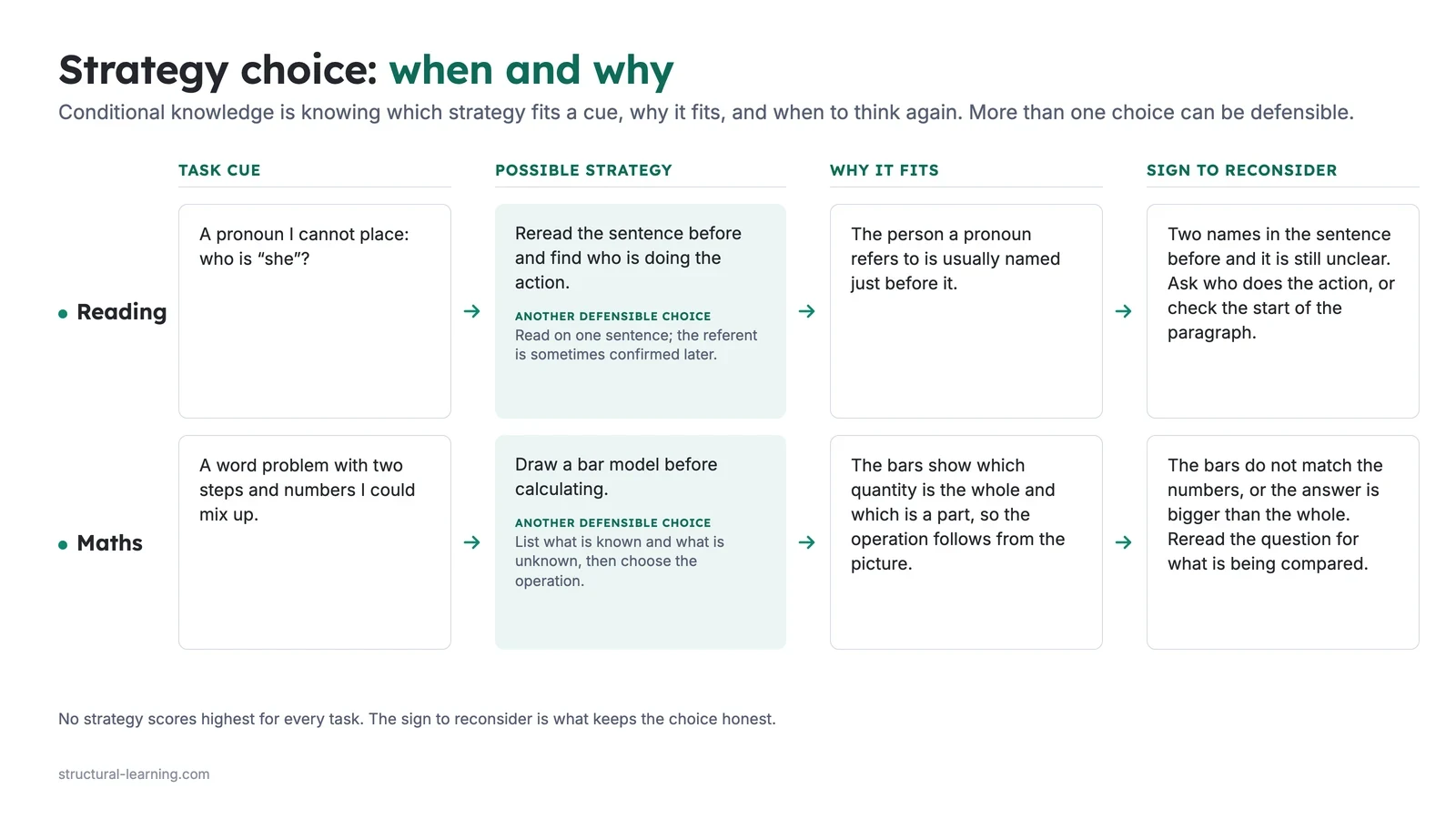
Create physical or digital cards that explicitly state conditional rules. For mathematics: "If the numbers end in 0 or 5, then use mental methods for multiplication." "If the decimal has more than 2 places, then use column method for addition."
Learners practise sorting problems by strategy type before they try to solve them. This analysis before solving builds conditional awareness. In science: "If investigating cause and effect, then use controlled variables." "If observing patterns, then use systematic observation methods."
Demonstrate your strategic decision-making process explicitly. When approaching a comprehension question, verbalise: "This question asks about the writer's feelings, so I'll look for emotive language and personal pronouns rather than just facts." "The question says 'How does the writer create tension?' so I need to identify techniques, not just describe events."
For mathematics problem-solving: "I see this is a percentage decrease question with the original amount unknown. That tells me I need to work backwards, so I'll use the inverse method rather than standard percentage calculations."
After individual problem-solving, learners compare their strategic choices in pairs. Provide sentence starters: "I chose this method because..." "Your approach worked better for this problem because..." "Next time I would..."
Metacognition can improve learning (Flavell, 1979). It helps learners build a wider set of strategies, not just rely on preferred methods. Researchers also show the benefits of reflection (Nelson & Narens, 1990; Dunlosky & Metcalfe, 2009).
End lessons with reflection questions targeting conditional thinking: "Which strategy did you use today? Why did you choose it?" "What would you do differently next time?" "When would this strategy NOT be appropriate?"
Learners build conditional awareness when they reflect often. This shifts their focus away from just getting answers right (Wiggins, 1998). Reflection helps learners think strategically (Schön, 1983) about when to use specific knowledge (Bransford et al., 2000).
This supports flexible thinking. Activities should let learners adapt strategies across subjects. After learning comparison in history, learners can use the same idea to compare English characters. They can also compare geography data sets (Bransford et al., 2000).
Explicit transfer instruction asks learners to connect ideas across subjects. For example: "How is comparing historical sources similar to comparing poems?" "What aspects of our history comparison method won't work for poetry analysis?"
Traditional assessment often checks whether learners can use strategies correctly, but misses the key conditional part. Instead of asking "Solve this equation," assessment should explore strategic reasoning: "Which method would you choose to solve this equation? Explain your reasoning."
This shift shows learners' conditional understanding before they start the method. A learner who chooses factoring for x² + 7x + 12 = 0 shows different conditional knowledge from one who goes straight to the quadratic formula.
Effective conditional assessment uses these question frameworks:
"Why did you choose this approach rather than...?"
"When would this strategy NOT be appropriate?"
"If the problem changed to [variation], how would your approach change?"
"Compare your method with [alternative]. Which works better here? Why?"
In English, instead of "Analyse this poem," ask: "What type of analysis would work best for this poem? Why?" This reveals whether learners understand that different poems require different analytical approaches.
Peer assessment can support conditional knowledge when learners use shared criteria. These criteria help them discuss why a strategy fits a task. Keep the attribution to verified peer-assessment and formative-assessment sources already cited here, such as Topping (1998) and Sadler (2006), rather than adding an unsupported Falchikov date.
The most frequent error involves teaching strategies in isolation without conditional context. Teachers demonstrate how to use mind maps, for instance, but never explain when mind mapping works better than linear notes or when it might prove counterproductive.
Researchers highlight a key error: expecting automatic transfer. Teachers often think learners will use classroom skills elsewhere. Brown et al. (1983) and Bransford & Schwartz (1999) found this requires direct teaching. They proved learners need practice to apply skills in new contexts.
Over-scaffolding is a third danger. Teachers can give so much guidance that learners make fewer choices for themselves.
When this happens, learners rely on cues instead of building knowledge (Schwartz et al., 2016). Good teaching removes support step by step, so learners can choose strategies with less help (Vygotsky, 1978; Wood et al., 1976).
What is conditional knowledge?
Conditional knowledge is metacognitive understanding. It means knowing when and why to use specific learning strategies. It helps learners choose the right tools for different tasks and contexts.
How is it different from declarative knowledge?
Weinstein and Mayer (1986) stated learners need to know existing strategies. Conditional knowledge means learners know when to use them. For example, a learner may know about highlighting (declarative). However, without knowing when to highlight, its use is poor (Weinstein & Mayer, 1986).
How do you teach learners when to use strategies?
Explicit instruction with if-then rules helps learners. Teachers can model strategy selection through think-alouds.
Peer comparison also supports learning. Learners should reflect often on the strategies they choose, and focus on why strategies work, not just doing them (Willingham, 2009).
Can younger learners develop conditional knowledge?
Yes, but with simpler applications. Primary learners can learn when to count on versus using number bonds, or when to sound out words versus using sight recognition. The key is explicit instruction matched to developmental level.
Conditional knowledge helps learners think more strategically. Teach them when and why to use different approaches, which can support metacognition (Brown, 1987). Model your own strategic thinking, then ask learners to explain their choices (Flavell, 1979; Zimmerman, 2000). Find metacognition tools at structural-learning.com.
AI-adaptive scaffolding systems now assess strategy use in real time, which directly addresses Jake's highlighting problem. These platforms use machine learning feedback to spot when learners use strategies in the wrong way. They then give algorithmic prompting at the exact point of misapplication. When Jake highlights numbers in his maths problem, the AI system immediately suggests: "Highlighting works well for finding quotes in English. Try identifying what the question is asking for instead."
AI can support talk about strategy use, but we should describe the evidence with care. Holmes and Tuomi (2022) review AI in education systems and warn against making claims that go beyond what the technology can do. Treat AI prompts as feedback for teacher review, not as proof that a learner has developed conditional knowledge.
Adaptive learning platforms like Century AI and Sparx Maths are becoming more common in UK secondary schools. They create individualised conditional knowledge profiles for each learner. These systems track which strategies each learner overuses, underuses, or misapplies in different contexts.
A learner who relies too much on drawing diagrams receives prompts to try algebraic approaches. Another learner who avoids visual methods gets encouragement to sketch solutions.
In the past, teachers looked back at how learners used strategies. Now, AI can quickly spot when learners use the wrong strategy (Roll et al., 2007). It can give quick help, which builds conditional knowledge (Atkinson, 2002; Shute, 2008). This live support works better than general rules alone (Winne & Hadwin, 1998).
Traditional assessments often show what strategies learners know, but they can miss whether learners know when to apply them. A learner might describe mind-mapping techniques correctly. Yet they may still choose this visual strategy for memorising times tables, where repetition would work better. To assess conditional knowledge well, teachers need methods that reveal learners' decision-making processes, not just their procedural skills.
Think-aloud protocols can show how learners make strategic choices. Ask learners to say their reasoning as they choose strategies for different tasks. For example, give a Year 9 class three scenarios: analysing a poem, solving a physics problem, and preparing for a French vocabulary test. As learners explain their choices, you can see who uses the same favourite method each time and who matches strategies to the task.
Strategy sorts offer a quick way to assess conditional knowledge. Create cards with learning strategies, such as highlighting and summarising, and cards with academic tasks. Learners match strategies to tasks and explain their choices. If a learner pairs diagrams with every task, they may know a strategy procedurally but not conditionally.
Quick exit tickets can capture conditional knowledge development over time. End lessons with questions like 'Why did we use paired discussion for this topic instead of independent note-taking?' or 'Would this strategy work in science lessons? Explain your answer.' These brief assessments, taking just two minutes, reveal whether learners understand the reasoning behind strategic choices rather than simply following teacher instructions blindly.
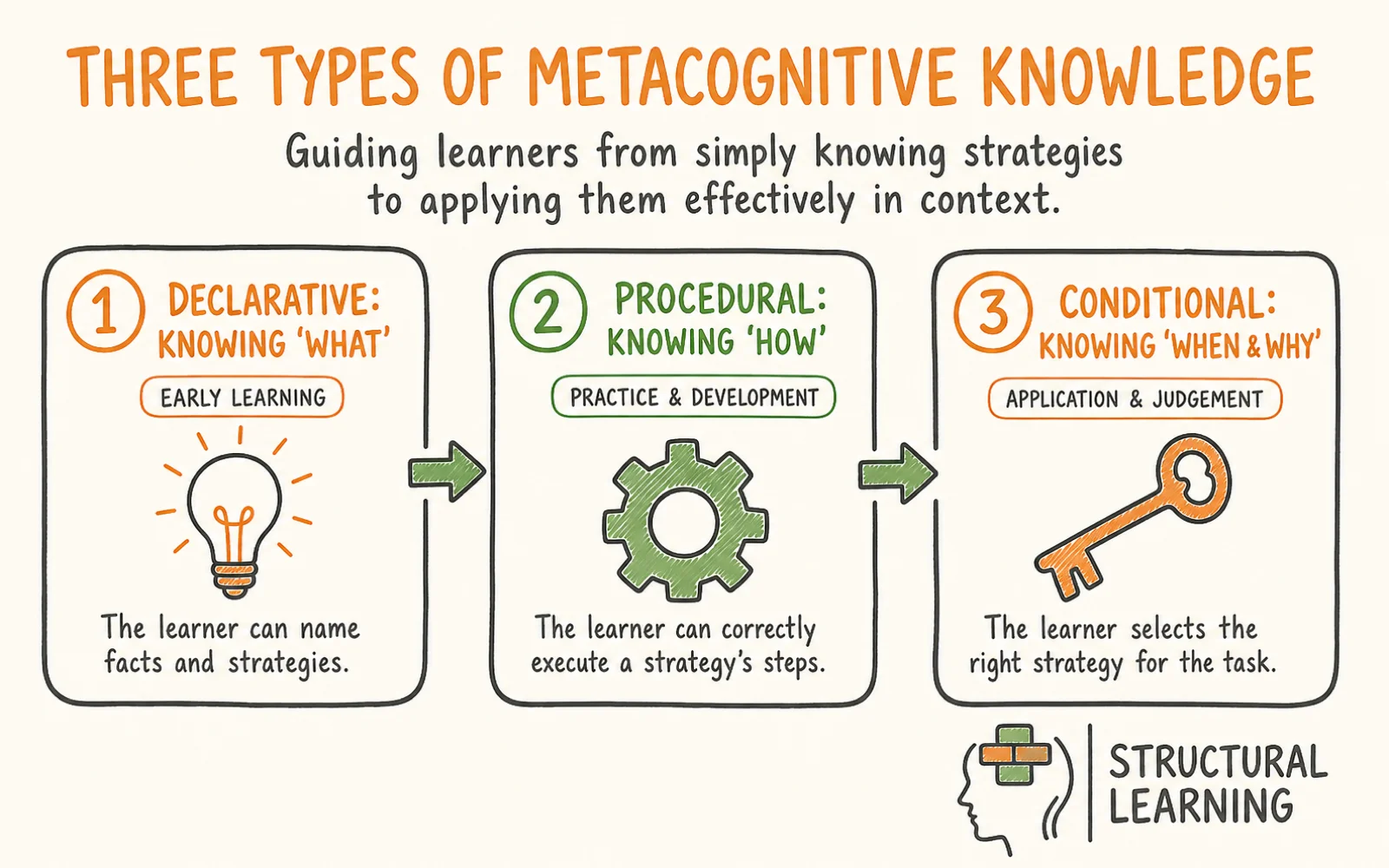
Conditional knowledge means knowing when and why to use specific learning strategies. It is one of three types of metacognitive knowledge identified by Flavell (1979) and Paris, Lipson and Wixson (1983). Declarative knowledge is knowing what strategies exist, and procedural knowledge is knowing how to use them. Conditional knowledge helps learners choose the right strategy for the task, such as using retrieval practice for factual recall but concept mapping to understand relationships.
Declarative knowledge is factual: "I know what a mind map is." Procedural knowledge is operational: "I can create a mind map." Conditional knowledge is strategic: "I use mind maps when I need to see connections between ideas, but flashcards when I need to memorise definitions." The conditional layer transforms learners from strategy collectors into strategic thinkers who select the most effective approach for each task.
Teach conditional knowledge through clear modelling, guided practice, and reflection. First, think aloud as you choose a strategy: "This problem requires exact calculation, so I will use long division rather than estimation." Then give practice tasks where learners explain why they chose a strategy. Finally, add short reflection points so learners judge what worked and what they would change next time.
Teachers can ask learners to explain their strategy choices before starting tasks, rather than just after completing them. Create scenarios where multiple strategies could work and observe whether learners can justify their selection. Use think-aloud protocols where learners verbalise their decision-making process whilst working through problems.
Provide learners with the same problem and multiple strategy options, asking them to predict which would work best and why. Create 'strategy mistake' examples where learners identify inappropriate strategy use and suggest better alternatives. Use comparison tasks where learners try different approaches to the same problem and reflect on their effectiveness.
Explicitly model failed strategy applications and discuss why they didn't work in that context. Create boundary examples that show where a strategy stops being effective. Teach learners to ask 'What am I trying to achieve?' before selecting any strategy, helping them match tools to goals rather than applying techniques automatically.
High achievers often succeed through mastering procedures without developing deep conditional knowledge about when to apply them. They may rely on pattern recognition rather than understanding underlying principles that guide strategy selection. Success in one context can actually reinforce inappropriate strategy use if learners don't learn to evaluate contextual demands.
Teaching strategies focuses on the 'how', demonstrating techniques and procedures until learners can execute them correctly. Teaching strategy selection addresses the 'when and why', helping learners develop criteria for choosing between different approaches based on task demands, context, and goals. Both are necessary, but strategy selection is often overlooked despite being important for transfer.
Assessing conditional knowledge requires moving beyond traditional tests that measure recall or procedure. Teachers need observation tools and questioning techniques that reveal whether learners can match strategies to contexts appropriately. The most effective assessments happen during learning activities, not after them.
Start with 'strategy sorting' exercises where learners categorise different approaches by subject and purpose. Present a mixed collection of tasks from various subjects, then ask learners to explain which strategy they would use and why. For instance, give them a science diagram, a history source, and a maths problem; observe whether they suggest highlighting for the history source but not the maths calculation. This reveals their understanding of when specific techniques work best.
Think-aloud protocols provide deeper insights into learners' conditional knowledge. Ask learners to verbalise their decision-making process before starting a task: 'What strategy will you use? Why is it suitable here? When wouldn't you use this approach?' Jake might say he highlights numbers because it worked in English, revealing his lack of conditional understanding. Record these sessions occasionally to track progress over time.
Create 'strategy mismatch' scenarios where learners identify and correct inappropriate technique applications. Show them examples of strategies used in the wrong context, such as creating a mind map for a simple multiplication problem or writing detailed annotations for a quick mental maths exercise. When learners can spot these mismatches and explain why they're problematic, they demonstrate strong conditional knowledge.
Regular self-assessment rubrics help learners monitor their own conditional knowledge development. Include criteria like 'I chose strategies that matched the task' and 'I can explain why this approach works here but not in other subjects'. This metacognitive reflection transforms strategy collectors into strategic thinkers who actively evaluate their choices.
Adaptive learning platforms now tackle the conditional knowledge gap that traditional teaching struggled to address at scale. When learners like Jake apply highlighting inappropriately, AI tutoring systems provide immediate, algorithm-driven feedback that explains not just what went wrong, but why the strategy failed in this specific context. This real-time assessment capability represents a fundamental shift from delayed teacher feedback to instant, personalised strategy guidance.
Adaptive and intelligent tutoring systems can use learner responses to choose next tasks, hints or feedback. That is different from saying they reliably infer conditional knowledge across subjects. Teachers should inspect the prompt and ask whether it helps the learner select a better strategy for the specific task.
Koedinger and Aleven describe the "assistance dilemma": digital tutors must balance hints, feedback and problem selection. Their work supports careful use of tutoring-system feedback. Use analytics as a cue for teacher inquiry: which strategy is the learner overusing, avoiding or misapplying?
The current DfE guidance on generative AI in education asks schools to use AI safely, effectively and responsibly, with human judgement, data protection and safeguarding built into any use. For conditional knowledge, that means teaching learners when AI support is appropriate and when independent strategy selection is needed.
Conditional knowledge is useful, but it is not a simple fix for poor learning. One limitation is conceptual drift. Flavell (1979) framed metacognitive knowledge around person, task and strategy variables, while the declarative, procedural and conditional taxonomy is usually traced to Paris, Lipson and Wixson (1983). Articles that merge these accounts too quickly can make the evidence look cleaner than it is.
A second critique is that strategy choice is strongly domain-bound. Tricot and Sweller (2014) argue that generic cognitive skills are hard to teach apart from subject knowledge. This challenges study-skills programmes that ask learners to transfer one revision routine across history, maths and science without teaching the cues that make each task different.
Measurement is also difficult. Veenman (2016) warns that off-line self-report questionnaires often diverge from learners' on-line metacognitive behaviour under real task pressure. A learner may say they monitor understanding, yet fail to change strategy when working memory is loaded or time is short.
There are cultural and methodological limits too. Research often reflects Western classroom assumptions about independent verbal reflection, written planning and individual self-regulation. Gutiérrez and Rogoff (2003) caution against treating cultural patterns of learning as fixed traits. Conditional knowledge remains valuable, but it should be taught through specific subjects, varied examples and careful attention to learners' contexts.
Teachers can observe learners during problem-solving tasks to see if they pause to consider which strategy to use rather than immediately applying their go-to approach. Ask learners to explain why they chose a particular strategy and whether they considered alternatives. Look for learners who can articulate when a strategy might not work or when they need to switch approaches mid-task.
Create 'strategy choice' activities where learners must select from multiple options and justify their decisions. Use problem sets that require different approaches so learners learn to match strategies to contexts. Implement think-aloud protocols where learners verbalise their decision-making process when choosing between strategies.
Focus on depth rather than breadth when teaching strategies, ensuring learners understand the 'when' and 'why' before moving to new techniques. Regularly revisit previously taught strategies in new contexts to reinforce appropriate application. Create opportunities for learners to compare and contrast when different strategies work best.
Teaching strategies focuses on the 'how', showing learners the steps to complete a technique. Teaching strategic thinking emphasises the 'when' and 'why', helping learners develop judgement about which approach suits different situations. Strategic thinking requires learners to evaluate contexts, consider multiple options, and make informed decisions about their learning approach.
Explicitly discuss with learners when strategies from one subject might or might not apply to another, using concrete examples like Jake's highlighting. Create cross-curricular projects that require learners to consciously select appropriate strategies for different subject areas. Teach learners to analyse the features of a task or context before choosing their approach.
Flavell, J. (1979). Metacognition and cognitive monitoring.
Sweller, J. (1988). Cognitive load during problem solving.
Paris, Lipson and Wixson (1983) is a foundational source for declarative, procedural and conditional knowledge in strategy use.
Effectiveness of Learning Strategy Instruction on Academic Performance
Donker et al. (2014) is a meta-analysis on learning-strategy instruction. Use it for explicit strategy teaching, not for invented AI effect sizes.
Metacognition and Self-Regulated Learning
The EEF guidance report, archived by DERA, gives practical recommendations for modelling, scaffolding and teaching pupils to plan, monitor and evaluate learning strategies.
State of the Art and Practice in AI in Education
Holmes and Tuomi (2022) is useful for cautious claims about AI in education systems. It should not be used to claim a precise strategy-selection gain.
Exploring the Assistance Dilemma in Experiments with Cognitive Tutors
Koedinger and Aleven (2007) support careful thinking about when tutors should give hints or withhold assistance. They do not support the removed precise improvement claim.
Generative artificial intelligence (AI) in education
The current DfE guidance is the right source for safe and responsible AI use in schools, including human oversight, data protection and local policy.