Shape Coding: The Complete Teacher's Guide to Visual Grammar Instruction
|
January 16, 2026
Teach grammar visually with Shape Coding. This complete guide covers Susan Ebbels' system of shapes, colours, and arrows for children with Developmental Language Disorder.
Main, P. (2026, January 20). Shape Coding: The Complete Teacher's Guide to Visual Grammar Support. Retrieved from https://www.structural-learning.com/post/shape-coding-complete-teachers-guide-visual
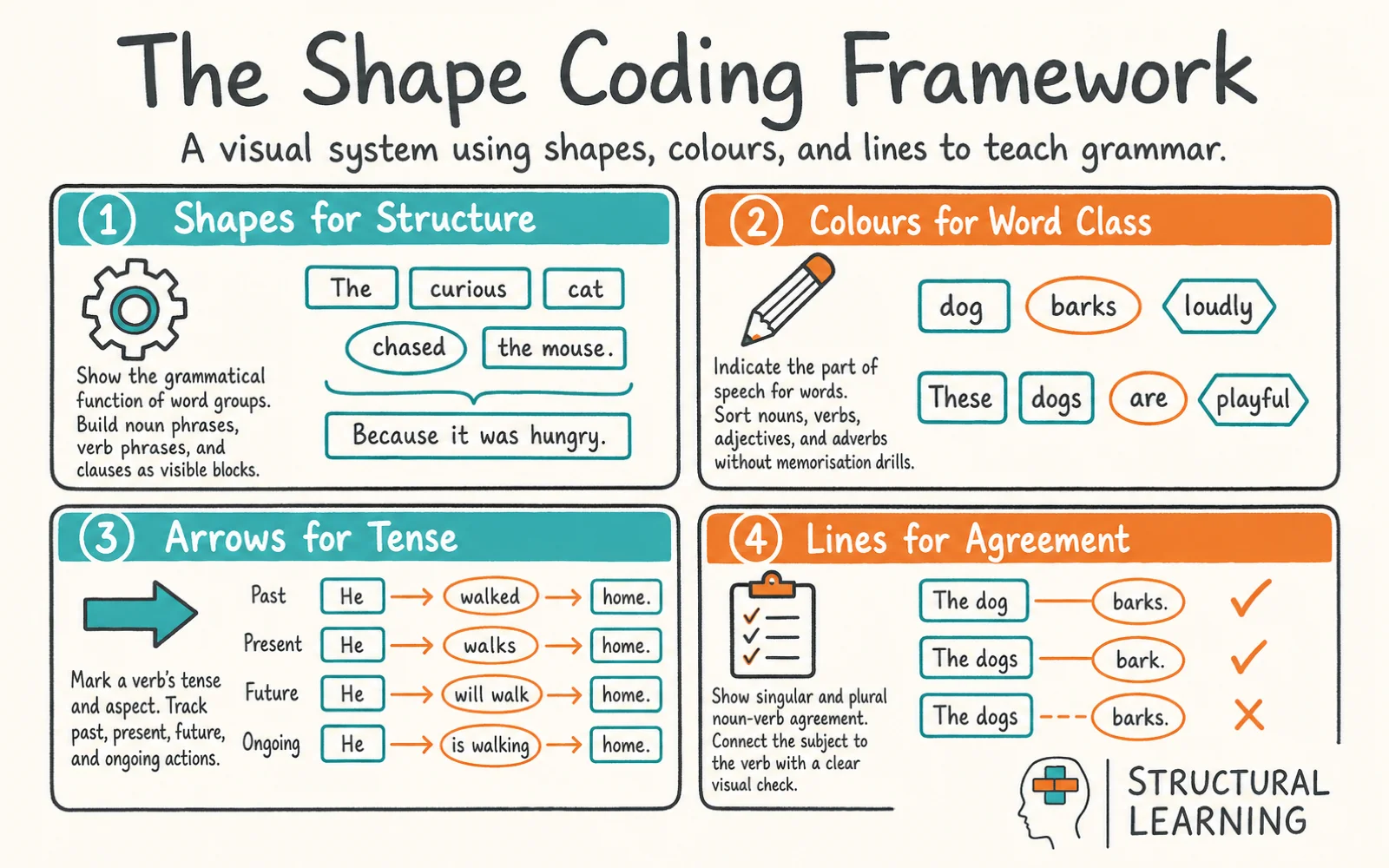
Shape Coding is a visual system for teaching grammar that uses coloured shapes, arrows, and lines to make the rules of English explicit. Developed by speech and language therapist Dr Susan Ebbels at Moor House School and College, this approach helps children with Developmental Language Disorder (DLD) and other language difficulties understand how words combine to form sentences. Now widely used across the UK and internationally, Shape Coding transforms abstract grammatical concepts into concrete visual representations.
Key Takeaways
Shape Coding at a Glance: Making Grammar Visual
Key Takeaways
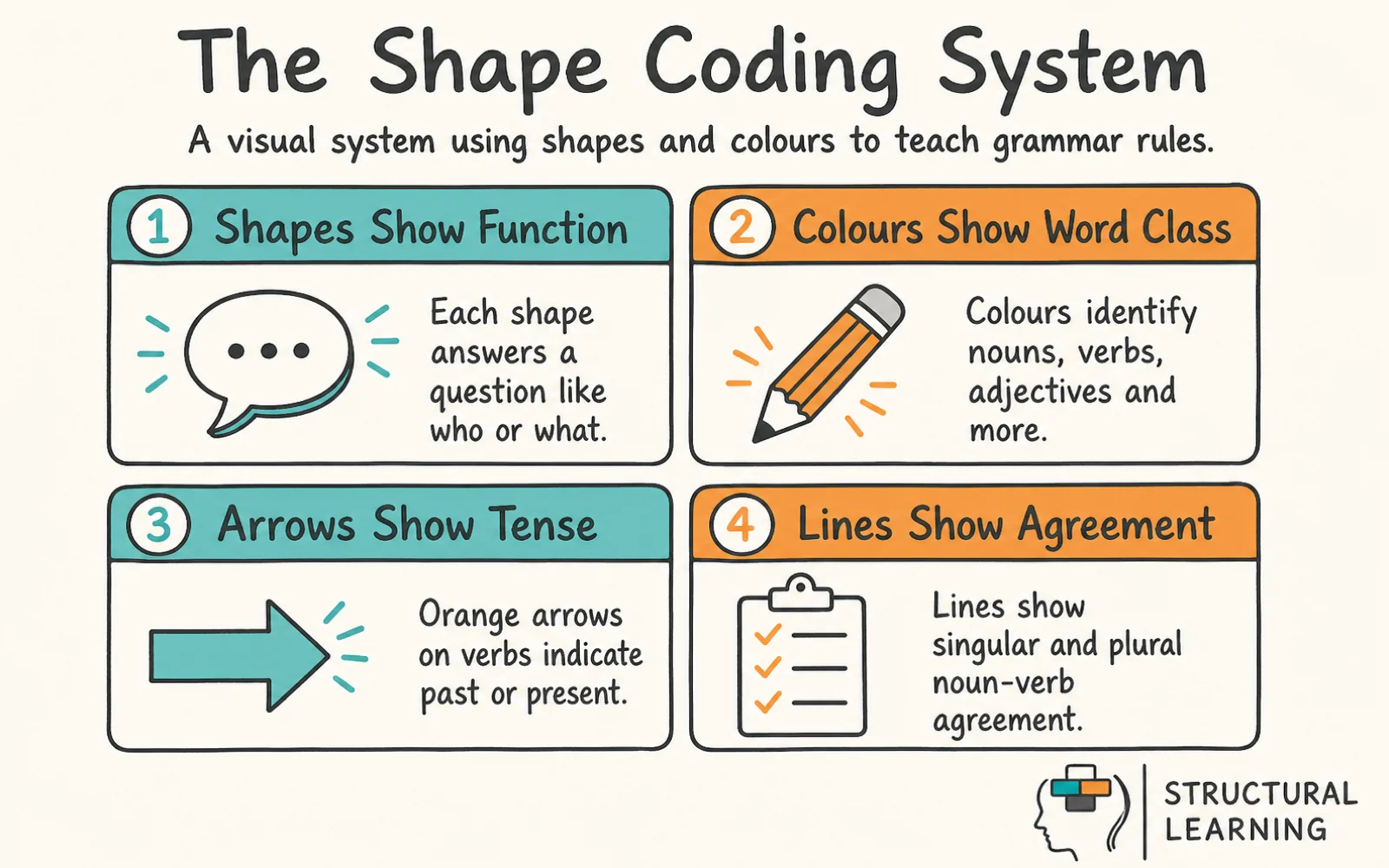
Visual Grammar Rules: Shape Coding uses shapes to show sentence structure, colours to indicate word classes, arrows to mark tense, and lines to show singular/plural agreement. Children can see grammar rather than just hear explanations about it
Question-Based Learning: Each shape corresponds to a question: ovals answer "who" or "what," hexagons answer "what doing," and clouds answer "what like" or "how feel." This links grammatical function to meaning
Self-Checking Tool: Once children understand the system, they can use it to check and edit their own spoken and written sentences. Mismatched colours or shapes signal errors they can identify and correct
Evidence-Based Approach: Research demonstrates Shape Coding's effectiveness for children with DLD, hearing impairment, Down syndrome, and other language difficulties. Studies show significant improvements in grammatical accuracy
What is Shape Coding?
Shape Coding is a visual grammar system that uses coloured shapes, arrows, and lines to teach sentence structure. Dr Susan Ebbels developed this approach at Moor House School to help children with language difficulties understand grammatical rules through concrete visual representations.
What is Shape Coding?
Shape Coding is a visual coding system that shows the rules for how words are put together in sentences. It was designed by Dr Susan Ebbels, a Highly Specialist Speech and Language Therapist who has worked with children with language disorders at Moor House School and College for over 25 years.
The system addresses a fundamental challenge: grammar rules are abstract and invisible. When we say a sentence, we cannot see the underlying structure. For children who struggle to process verbal explanations, this abstractness makes grammar extremely difficult to learn.
Shape Coding makes grammar visible by using:
The system was originally designed for school-aged children with Specific Language Impairment (now called Developmental Language Disorder), but has proven effective with:
Shape Coding Components Explained
Shape Coding uses specific visual elements to represent grammar: coloured ovals for subjects and objects, hexagons for verbs, clouds for descriptions, and rectangles for time and place. Consistent colours indicate word classes whilst arrows show tense and lines mark singular-plural agreement.
Shapes: Sentence Structure
Black shapes surround groups of words to show their grammatical function. Each shape corresponds to a question:
When children see a shape, they know what type of information it contains and what question it answers. This links grammatical structure to meaning.
Colours: Word Classes
Colours indicate the word class (part of speech):
| Colour | Word Class | Examples |
|--------|------------|----------|
| Red | Nouns | dog, table, happiness |
| Orange | Determiners | the, a, some, my |
| Blue | Verbs | run, is, have eaten |
| Green | Adjectives | big, happy, wooden |
| Purple | Adverbs | quickly, yesterday, there |
| Pink | Pronouns | he, she, it, they |
| Yellow | Conjunctions | and, but, because |
The colour coding is consistent throughout the system, so children learn to associate colours with word types automatically.
Arrows: Tense and Aspect
Blue arrows on verbs indicate tense and aspect:
Children can see whether a verb is past, present, or future, and whether the action is ongoing or completed.
Lines: Agreement and Number
Lines under words show singular/plural and agreement:
This helps children avoid errors like "the boys is running" because the noun and verb must match in terms of single or double lines.
Additional line variations can show:
Shape Coding in Action: Practical Steps
Shape Coding implementation follows a systematic progression: teachers begin with simple subject-verb sentences using basic shapes, then gradually introduce adjectives, adverbs, and complex structures. Each step maintains consistent visual coding principles whilst increasing grammatical complexity through structured lessons.
Building a Simple Sentence
Consider the sentence: "The big dog is running."
Using Shape Coding:
- "The" is orange (determiner)
- "big" is green (adjective)
- "dog" is red (noun), single underline (singular)
- "is running" is blue (verb)
- Single underline (singular, to match "dog")
- Wavy arrow (continuous aspect, ongoing action)
Children can see that:
Checking for Errors
If a child writes "The big dogs is running," the Shape Coding would show:
The mismatch is immediately visible. The child can see the error and correct it to "are running" (matching double underlines).
Building Complex Sentences with Shape Coding
Shape Coding can represent increasingly complex structures:
Simple sentence:
[Oval: The cat] [Hexagon: sat]
With adverb:
[Oval: The cat] [Hexagon: sat] [Rectangle: on the mat]
Compound sentence:
[Oval: The cat] [Hexagon: sat] [Yellow: and] [Oval: the dog] [Hexagon: ran]
Complex sentence:
[Yellow: Because] [Oval: it] [Hexagon: was raining], [Oval: the cat] [Hexagon: stayed] [Rectangle: inside]
The same principles apply throughout, building from simple to complex structures using consistent visual coding.
Shape Coding for Different Student Populations
Shape Coding benefits children with Developmental Language Disorder, hearing impairments, Down syndrome, and other language difficulties. Research demonstrates significant improvements in grammatical accuracy for students who struggle with traditional grammar instruction methods in mainstream and specialist educational settings.
Shape Coding for Developmental Language Disorder
DLD affects approximately 7% of children and involves significant difficulties with understanding and using language. Shape Coding provides the explicit teaching these children need because they cannot simply "pick up" grammar from exposure.
Shape Coding for Hearing Impaired Children
Deaf children may miss the grammatical morphemes (word endings, auxiliary verbs) that are often unstressed and harder to hear. Shape Coding shows all the elements that need to be present in a sentence.
Shape Coding for Children with Down Syndrome
Many children with Down syndrome have specific difficulties with grammar while their vocabulary may be stronger. Shape Coding addresses this grammatical weakness directly.
Shape Coding for EAL Learners
EAL learners must learn English grammatical rules that may differ significantly from their first language. Shape Coding makes these rules explicit rather than hoping children will absorb them.
Shape Coding for Autistic Children
Some autistic children have strong visual processing skills and benefit from seeing grammar represented visually. The system's logical, rule-based nature suits some learning styles well.
The Shape Coding Question System
How to Implement Shape Coding Successfully
Shape Coding implementation requires systematic teacher training, consistent visual materials, and structured lesson progression. Schools achieve success by starting with basic sentence patterns, maintaining colour consistency across all materials, and providing regular practise opportunities for students.
Professional Development and Training Requirements
Before implementing Shape Coding, staff need training:
Collaborating with Speech Language Therapists
Shape Coding is often introduced by speech and language therapists and then reinforced by school staff. Coordination ensures:
Classroom Integration
Ways to use Shape Coding in the classroom:
During writing:
During reading:
During speaking:
Starting with Basic Shape Coding Activities
Begin with:
Gradually add:
Ensuring Consistent Daily Practise
Shape Coding works best when:
Shape Coding vs Colourful Semantics Compared
Shape Coding focuses on grammatical structure through shapes and colours, whilst Colourful Semantics emphasises semantic roles through colour-coded question words. Shape Coding targets syntax development, whereas Colourful Semantics primarily addresses vocabulary and meaning relationships in sentences.
Shape Coding is sometimes confused with Colourful Semantics. They are different but complementary approaches:
| Main elements | Shapes, colours, arrows, lines | Colours only |
| What colours show | Word classes | Semantic roles (who, what, where) |
| Target age | Typically 7+ | Typically younger children |
| Complexity | Can handle complex grammar | Focuses on sentence building |
Some practitioners use Colourful Semantics first with younger children, then transition to Shape Coding for more explicit grammatical work. Others use both systems together, blending semantic and syntactic approaches.
Research Evidence Supporting Shape Coding Effectiveness
Shape Coding has a growing evidence base:
The approach is recommended by the Royal College of Speech and Language Therapists and is widely used in specialist language provision.
Dr Susan Ebbels: The Creator of Shape Coding
Dr Susan Ebbels, a specialist speech and language therapist and researcher, developed Shape Coding whilst working at Moor House School and College in Surrey, a specialist provision for children with severe speech and language disorders. With over 30 years of clinical experience and a PhD in linguistics from University College London, Dr Ebbels recognised that traditional grammar teaching methods were failing children with language difficulties.
Her groundbreaking approach emerged from direct classroom observation and clinical practise. Working with children who struggled to form grammatically correct sentences despite years of conventional intervention, Dr Ebbels noticed that making grammar visual transformed their understanding. Her research, published in peer-reviewed journals including the International Journal of Language and Communication Disorders, demonstrates significant improvements in children's grammatical accuracy when using Shape Coding compared to traditional methods.
As Clinical Lead at Moor House and Honorary Research Fellow at UCL, Dr Ebbels continues to refine the system based on evidence from practise. Her work bridges the gap between theoretical linguistics and practical classroom application, ensuring Shape Coding remains accessible to both specialist and mainstream teachers. She regularly provides training across the UK and internationally, emphasising that whilst the system was designed for children with language disorders, it benefits all learners by making the implicit rules of English explicit.
Dr Ebbels' commitment to evidence-based practise means Shape Coding evolves with ongoing research. Recent developments include adaptations for teaching English as an additional language and applications for secondary school pupils studying foreign languages, demonstrating the system's versatility beyond its original therapeutic context.
Latest Shape Coding System Updates and Resources
The Shape Coding system continues to evolve based on classroom feedback and research findings. Recent updates to the methodology reflect teachers' experiences across mainstream and specialist settings, ensuring the approach remains practical and evidence-based.
The most significant recent development is the introduction of simplified starter packs for Key Stage 1 pupils. These resources focus on subject-verb-object structures using just three core shapes, making initial grammar instruction less overwhelming for younger learners. Teachers report that this gradual introduction helps children build confidence before tackling more complex sentence structures. Additionally, new digital resources now include interactive whiteboard materials that allow pupils to drag and drop shapes to build sentences collaboratively.
Dr Ebbels and her team have also released updated assessment tools that align with the 2024 National Curriculum requirements. These include progress tracking sheets that map Shape Coding objectives to year group expectations, helping SENCOs demonstrate measurable improvement in grammatical understanding. The assessment pack includes baseline activities, termly checkpoints, and visual portfolios that showcase pupils' growing ability to construct and analyse sentences independently.
For secondary teachers, recent adaptations address more sophisticated grammar concepts. New resources tackle passive voice, subjunctive mood, and complex subordination whilst maintaining the familiar visual framework. One particularly successful addition is the 'Grammar Detective' activities, where pupils use Shape Coding to identify and correct errors in authentic texts. Teachers using these materials report improved outcomes in GCSE English Language papers, particularly in questions requiring grammatical analysis.
Free downloadable resources continue to expand on the Shape Coding website, including lesson plans, display materials, and video demonstrations. The growing online community now offers monthly webinars where practitioners share implementation strategies and troubleshoot common challenges together.
Shape Coding Success Stories in Primary Schools
Across the UK, primary schools are discovering remarkable results with Shape Coding, particularly for pupils who struggle with traditional grammar teaching. At Riverside Primary in Manchester, Year 3 teacher Sarah Mitchell introduced Shape Coding to support five pupils with language difficulties. Within one term, these children progressed from writing fragmented phrases to constructing complete sentences with subjects, verbs, and objects. "The visual scaffolding gave them confidence to experiment with sentence structure," Mitchell explains. "They could literally see where words should go."
St Mary's Primary in Bristol adopted Shape Coding school-wide after their SENCO observed its impact in intervention groups. Teachers now use the system during whole-class grammar lessons, displaying large magnetic shapes on whiteboards whilst pupils manipulate smaller versions at their desks. Year 4 teacher James Chen notes that Shape Coding particularly benefits EAL learners: "The shapes transcend language barriers. Pupils who struggle with English terminology can still identify that blue hexagons represent actions, regardless of their first language."
Research from the University of Reading (2021) supports these classroom observations, showing that pupils using Shape Coding made an average of 18 months' progress in grammar comprehension over a six-month period, compared to 7 months for control groups. The visual nature of the system appears to activate different neural pathways than traditional grammar instruction, making it accessible to learners with diverse needs.
Practical implementation varies by school, but successful approaches share common features: consistent colour-coding across year groups, regular shape manipulation activities during English lessons, and visual displays showing shape-sentence connections. Many schools report that once established, Shape Coding reduces teacher workload as pupils become independent in identifying and correcting their own grammatical errors.
Frequently Asked Questions
What age is Shape Coding suitable for?
Shape Coding was designed for school-aged children (typically 7-20 years), but simplified versions can be used with younger children. The full system works well from Year 3 onwards.
Can classroom teachers use Shape Coding?
Yes, with training. Many schools have teaching assistants and teachers trained in Shape Coding who use it alongside speech and language therapists.
When will Shape Coding show results?
This varies by child and target. Research studies typically show progress over 8-12 weeks of intervention. Some children show quicker progress; others need longer.
Does Shape Coding replace phonics instruction?
No. Shape Coding teaches grammar (how words combine into sentences). Phonics teaches sound-letter correspondence (how words are spelled and decoded). Both are needed.
Is there a Shape Coding app?
Yes. Shape Coding Lite is a free demonstration version. The full Shape Coding app allows therapists and teachers to create visual sentence representations.
Shape Coding vs traditional grammar teaching?
Traditional grammar teaching often relies on verbal explanations and terminology. Shape Coding provides visual support, making abstract rules concrete and visible. It also links grammatical function to meaning through questions.
Why Shape Coding Works: research-informed Results
Further Reading: Key Research Papers
These peer-reviewed studies provide deeper insights into the research behind this topic:
Vahid Norouzi Larsari & Hassan Abouabdelkader (2024)
This study explores how flipped learning classrooms, where students review grammar content at home before practising in class, can improve EFL students' grammar literacy through a more student-centred approach. The research suggests that reversing traditional instruction allows teachers to dedicate more class time to interactive practise and personalised support. This model may be particularly beneficial for grammar instruction as it gives students time to process rules independently before applying them collaboratively. [Read the full study]
Nguyễn Thị Kim Ngọc (2023)
Research examining mind mapping techniques for teaching grammar to non-English major university students shows promising results for improving grammar achievement. The visual approach helps students organise grammatical concepts and relationships more effectively than traditional memorisation methods. Teachers can use mind mapping as an alternative strategy for students who struggle with conventional grammar instruction, particularly those with limited English exposure.
Nor Alniza Azman et al. (2025)
This case study examines how Islamic education teachers in primary schools implement digital teaching strategies, highlighting common challenges in technology integration including digital mastery and tool selection. The research identifies barriers that prevent effective use of educational technology in religious education contexts. Teachers across subjects may relate to similar struggles with selecting appropriate digital tools and developing technological pedagogical skills. [Read the full study]
Hariharan N Krishnasamy et al. (2025)
This study demonstrates how graphic organisers can significantly improve ESL students' writing performance and knowledge retention by providing visual frameworks for structuring ideas. The research focuses on Form Four students (aged 16) and shows measurable improvements in writing skills when visual planning tools are used. Teachers can implement graphic organisers as scaffolding devices to help ESL learners organise their thoughts before writing and retain learned concepts more effectively. [Read the full study]
Mohammed Sani Ya'u (2025)
A comparative analysis of multimedia tools including mobile apps, online platforms, interactive textbooks, and video tutorials reveals their relative effectiveness for adult English grammar learners in Nigeria. The research provides scientifically supported guidance for selecting appropriate educational technologies for grammar instruction with adult populations. Teachers working with adult learners can use these findings to make informed decisions about which multimedia approaches best support grammar acquisition. [Read the full study]
Summary
Shape Coding is a powerful visual system for teaching grammar to children who struggle with language. By representing grammatical rules through shapes, colours, arrows, and lines, Dr Susan Ebbels created a way to make the invisible visible.
The system is particularly valuable for children with Developmental Language Disorder, hearing impairments, Down syndrome, and other conditions affecting language development. It can also support EAL learners and any child who needs explicit grammar instruction.
Success with Shape Coding requires training, consistency, and coordination with speech and language therapists. When implemented well, children can use the visual coding to understand grammar, produce correct sentences, and check their own work for errors.
The evidence base continues to grow, confirming what practitioners have observed: making grammar visible helps children who cannot learn it through exposure alone.
Shape Coding is a visual system for teaching grammar that uses coloured shapes, arrows, and lines to make the rules of English explicit. Developed by speech and language therapist Dr Susan Ebbels at Moor House School and College, this approach helps children with Developmental Language Disorder (DLD) and other language difficulties understand how words combine to form sentences. Now widely used across the UK and internationally, Shape Coding transforms abstract grammatical concepts into concrete visual representations.
Key Takeaways
Shape Coding at a Glance: Making Grammar Visual
Key Takeaways
Visual Grammar Rules: Shape Coding uses shapes to show sentence structure, colours to indicate word classes, arrows to mark tense, and lines to show singular/plural agreement. Children can see grammar rather than just hear explanations about it
Question-Based Learning: Each shape corresponds to a question: ovals answer "who" or "what," hexagons answer "what doing," and clouds answer "what like" or "how feel." This links grammatical function to meaning
Self-Checking Tool: Once children understand the system, they can use it to check and edit their own spoken and written sentences. Mismatched colours or shapes signal errors they can identify and correct
Evidence-Based Approach: Research demonstrates Shape Coding's effectiveness for children with DLD, hearing impairment, Down syndrome, and other language difficulties. Studies show significant improvements in grammatical accuracy
What is Shape Coding?
Shape Coding is a visual grammar system that uses coloured shapes, arrows, and lines to teach sentence structure. Dr Susan Ebbels developed this approach at Moor House School to help children with language difficulties understand grammatical rules through concrete visual representations.
What is Shape Coding?
Shape Coding is a visual coding system that shows the rules for how words are put together in sentences. It was designed by Dr Susan Ebbels, a Highly Specialist Speech and Language Therapist who has worked with children with language disorders at Moor House School and College for over 25 years.
The system addresses a fundamental challenge: grammar rules are abstract and invisible. When we say a sentence, we cannot see the underlying structure. For children who struggle to process verbal explanations, this abstractness makes grammar extremely difficult to learn.
Shape Coding makes grammar visible by using:
The system was originally designed for school-aged children with Specific Language Impairment (now called Developmental Language Disorder), but has proven effective with:
Shape Coding Components Explained
Shape Coding uses specific visual elements to represent grammar: coloured ovals for subjects and objects, hexagons for verbs, clouds for descriptions, and rectangles for time and place. Consistent colours indicate word classes whilst arrows show tense and lines mark singular-plural agreement.
Shapes: Sentence Structure
Black shapes surround groups of words to show their grammatical function. Each shape corresponds to a question:
When children see a shape, they know what type of information it contains and what question it answers. This links grammatical structure to meaning.
Colours: Word Classes
Colours indicate the word class (part of speech):
| Colour | Word Class | Examples |
|--------|------------|----------|
| Red | Nouns | dog, table, happiness |
| Orange | Determiners | the, a, some, my |
| Blue | Verbs | run, is, have eaten |
| Green | Adjectives | big, happy, wooden |
| Purple | Adverbs | quickly, yesterday, there |
| Pink | Pronouns | he, she, it, they |
| Yellow | Conjunctions | and, but, because |
The colour coding is consistent throughout the system, so children learn to associate colours with word types automatically.
Arrows: Tense and Aspect
Blue arrows on verbs indicate tense and aspect:
Children can see whether a verb is past, present, or future, and whether the action is ongoing or completed.
Lines: Agreement and Number
Lines under words show singular/plural and agreement:
This helps children avoid errors like "the boys is running" because the noun and verb must match in terms of single or double lines.
Additional line variations can show:
Shape Coding in Action: Practical Steps
Shape Coding implementation follows a systematic progression: teachers begin with simple subject-verb sentences using basic shapes, then gradually introduce adjectives, adverbs, and complex structures. Each step maintains consistent visual coding principles whilst increasing grammatical complexity through structured lessons.
Building a Simple Sentence
Consider the sentence: "The big dog is running."
Using Shape Coding:
- "The" is orange (determiner)
- "big" is green (adjective)
- "dog" is red (noun), single underline (singular)
- "is running" is blue (verb)
- Single underline (singular, to match "dog")
- Wavy arrow (continuous aspect, ongoing action)
Children can see that:
Checking for Errors
If a child writes "The big dogs is running," the Shape Coding would show:
The mismatch is immediately visible. The child can see the error and correct it to "are running" (matching double underlines).
Building Complex Sentences with Shape Coding
Shape Coding can represent increasingly complex structures:
Simple sentence:
[Oval: The cat] [Hexagon: sat]
With adverb:
[Oval: The cat] [Hexagon: sat] [Rectangle: on the mat]
Compound sentence:
[Oval: The cat] [Hexagon: sat] [Yellow: and] [Oval: the dog] [Hexagon: ran]
Complex sentence:
[Yellow: Because] [Oval: it] [Hexagon: was raining], [Oval: the cat] [Hexagon: stayed] [Rectangle: inside]
The same principles apply throughout, building from simple to complex structures using consistent visual coding.
Shape Coding for Different Student Populations
Shape Coding benefits children with Developmental Language Disorder, hearing impairments, Down syndrome, and other language difficulties. Research demonstrates significant improvements in grammatical accuracy for students who struggle with traditional grammar instruction methods in mainstream and specialist educational settings.
Shape Coding for Developmental Language Disorder
DLD affects approximately 7% of children and involves significant difficulties with understanding and using language. Shape Coding provides the explicit teaching these children need because they cannot simply "pick up" grammar from exposure.
Shape Coding for Hearing Impaired Children
Deaf children may miss the grammatical morphemes (word endings, auxiliary verbs) that are often unstressed and harder to hear. Shape Coding shows all the elements that need to be present in a sentence.
Shape Coding for Children with Down Syndrome
Many children with Down syndrome have specific difficulties with grammar while their vocabulary may be stronger. Shape Coding addresses this grammatical weakness directly.
Shape Coding for EAL Learners
EAL learners must learn English grammatical rules that may differ significantly from their first language. Shape Coding makes these rules explicit rather than hoping children will absorb them.
Shape Coding for Autistic Children
Some autistic children have strong visual processing skills and benefit from seeing grammar represented visually. The system's logical, rule-based nature suits some learning styles well.
The Shape Coding Question System
How to Implement Shape Coding Successfully
Shape Coding implementation requires systematic teacher training, consistent visual materials, and structured lesson progression. Schools achieve success by starting with basic sentence patterns, maintaining colour consistency across all materials, and providing regular practise opportunities for students.
Professional Development and Training Requirements
Before implementing Shape Coding, staff need training:
Collaborating with Speech Language Therapists
Shape Coding is often introduced by speech and language therapists and then reinforced by school staff. Coordination ensures:
Classroom Integration
Ways to use Shape Coding in the classroom:
During writing:
During reading:
During speaking:
Starting with Basic Shape Coding Activities
Begin with:
Gradually add:
Ensuring Consistent Daily Practise
Shape Coding works best when:
Shape Coding vs Colourful Semantics Compared
Shape Coding focuses on grammatical structure through shapes and colours, whilst Colourful Semantics emphasises semantic roles through colour-coded question words. Shape Coding targets syntax development, whereas Colourful Semantics primarily addresses vocabulary and meaning relationships in sentences.
Shape Coding is sometimes confused with Colourful Semantics. They are different but complementary approaches:
| Main elements | Shapes, colours, arrows, lines | Colours only |
| What colours show | Word classes | Semantic roles (who, what, where) |
| Target age | Typically 7+ | Typically younger children |
| Complexity | Can handle complex grammar | Focuses on sentence building |
Some practitioners use Colourful Semantics first with younger children, then transition to Shape Coding for more explicit grammatical work. Others use both systems together, blending semantic and syntactic approaches.
Research Evidence Supporting Shape Coding Effectiveness
Shape Coding has a growing evidence base:
The approach is recommended by the Royal College of Speech and Language Therapists and is widely used in specialist language provision.
Dr Susan Ebbels: The Creator of Shape Coding
Dr Susan Ebbels, a specialist speech and language therapist and researcher, developed Shape Coding whilst working at Moor House School and College in Surrey, a specialist provision for children with severe speech and language disorders. With over 30 years of clinical experience and a PhD in linguistics from University College London, Dr Ebbels recognised that traditional grammar teaching methods were failing children with language difficulties.
Her groundbreaking approach emerged from direct classroom observation and clinical practise. Working with children who struggled to form grammatically correct sentences despite years of conventional intervention, Dr Ebbels noticed that making grammar visual transformed their understanding. Her research, published in peer-reviewed journals including the International Journal of Language and Communication Disorders, demonstrates significant improvements in children's grammatical accuracy when using Shape Coding compared to traditional methods.
As Clinical Lead at Moor House and Honorary Research Fellow at UCL, Dr Ebbels continues to refine the system based on evidence from practise. Her work bridges the gap between theoretical linguistics and practical classroom application, ensuring Shape Coding remains accessible to both specialist and mainstream teachers. She regularly provides training across the UK and internationally, emphasising that whilst the system was designed for children with language disorders, it benefits all learners by making the implicit rules of English explicit.
Dr Ebbels' commitment to evidence-based practise means Shape Coding evolves with ongoing research. Recent developments include adaptations for teaching English as an additional language and applications for secondary school pupils studying foreign languages, demonstrating the system's versatility beyond its original therapeutic context.
Latest Shape Coding System Updates and Resources
The Shape Coding system continues to evolve based on classroom feedback and research findings. Recent updates to the methodology reflect teachers' experiences across mainstream and specialist settings, ensuring the approach remains practical and evidence-based.
The most significant recent development is the introduction of simplified starter packs for Key Stage 1 pupils. These resources focus on subject-verb-object structures using just three core shapes, making initial grammar instruction less overwhelming for younger learners. Teachers report that this gradual introduction helps children build confidence before tackling more complex sentence structures. Additionally, new digital resources now include interactive whiteboard materials that allow pupils to drag and drop shapes to build sentences collaboratively.
Dr Ebbels and her team have also released updated assessment tools that align with the 2024 National Curriculum requirements. These include progress tracking sheets that map Shape Coding objectives to year group expectations, helping SENCOs demonstrate measurable improvement in grammatical understanding. The assessment pack includes baseline activities, termly checkpoints, and visual portfolios that showcase pupils' growing ability to construct and analyse sentences independently.
For secondary teachers, recent adaptations address more sophisticated grammar concepts. New resources tackle passive voice, subjunctive mood, and complex subordination whilst maintaining the familiar visual framework. One particularly successful addition is the 'Grammar Detective' activities, where pupils use Shape Coding to identify and correct errors in authentic texts. Teachers using these materials report improved outcomes in GCSE English Language papers, particularly in questions requiring grammatical analysis.
Free downloadable resources continue to expand on the Shape Coding website, including lesson plans, display materials, and video demonstrations. The growing online community now offers monthly webinars where practitioners share implementation strategies and troubleshoot common challenges together.
Shape Coding Success Stories in Primary Schools
Across the UK, primary schools are discovering remarkable results with Shape Coding, particularly for pupils who struggle with traditional grammar teaching. At Riverside Primary in Manchester, Year 3 teacher Sarah Mitchell introduced Shape Coding to support five pupils with language difficulties. Within one term, these children progressed from writing fragmented phrases to constructing complete sentences with subjects, verbs, and objects. "The visual scaffolding gave them confidence to experiment with sentence structure," Mitchell explains. "They could literally see where words should go."
St Mary's Primary in Bristol adopted Shape Coding school-wide after their SENCO observed its impact in intervention groups. Teachers now use the system during whole-class grammar lessons, displaying large magnetic shapes on whiteboards whilst pupils manipulate smaller versions at their desks. Year 4 teacher James Chen notes that Shape Coding particularly benefits EAL learners: "The shapes transcend language barriers. Pupils who struggle with English terminology can still identify that blue hexagons represent actions, regardless of their first language."
Research from the University of Reading (2021) supports these classroom observations, showing that pupils using Shape Coding made an average of 18 months' progress in grammar comprehension over a six-month period, compared to 7 months for control groups. The visual nature of the system appears to activate different neural pathways than traditional grammar instruction, making it accessible to learners with diverse needs.
Practical implementation varies by school, but successful approaches share common features: consistent colour-coding across year groups, regular shape manipulation activities during English lessons, and visual displays showing shape-sentence connections. Many schools report that once established, Shape Coding reduces teacher workload as pupils become independent in identifying and correcting their own grammatical errors.
Frequently Asked Questions
What age is Shape Coding suitable for?
Shape Coding was designed for school-aged children (typically 7-20 years), but simplified versions can be used with younger children. The full system works well from Year 3 onwards.
Can classroom teachers use Shape Coding?
Yes, with training. Many schools have teaching assistants and teachers trained in Shape Coding who use it alongside speech and language therapists.
When will Shape Coding show results?
This varies by child and target. Research studies typically show progress over 8-12 weeks of intervention. Some children show quicker progress; others need longer.
Does Shape Coding replace phonics instruction?
No. Shape Coding teaches grammar (how words combine into sentences). Phonics teaches sound-letter correspondence (how words are spelled and decoded). Both are needed.
Is there a Shape Coding app?
Yes. Shape Coding Lite is a free demonstration version. The full Shape Coding app allows therapists and teachers to create visual sentence representations.
Shape Coding vs traditional grammar teaching?
Traditional grammar teaching often relies on verbal explanations and terminology. Shape Coding provides visual support, making abstract rules concrete and visible. It also links grammatical function to meaning through questions.
Why Shape Coding Works: research-informed Results
Further Reading: Key Research Papers
These peer-reviewed studies provide deeper insights into the research behind this topic:
Vahid Norouzi Larsari & Hassan Abouabdelkader (2024)
This study explores how flipped learning classrooms, where students review grammar content at home before practising in class, can improve EFL students' grammar literacy through a more student-centred approach. The research suggests that reversing traditional instruction allows teachers to dedicate more class time to interactive practise and personalised support. This model may be particularly beneficial for grammar instruction as it gives students time to process rules independently before applying them collaboratively. [Read the full study]
Nguyễn Thị Kim Ngọc (2023)
Research examining mind mapping techniques for teaching grammar to non-English major university students shows promising results for improving grammar achievement. The visual approach helps students organise grammatical concepts and relationships more effectively than traditional memorisation methods. Teachers can use mind mapping as an alternative strategy for students who struggle with conventional grammar instruction, particularly those with limited English exposure.
Nor Alniza Azman et al. (2025)
This case study examines how Islamic education teachers in primary schools implement digital teaching strategies, highlighting common challenges in technology integration including digital mastery and tool selection. The research identifies barriers that prevent effective use of educational technology in religious education contexts. Teachers across subjects may relate to similar struggles with selecting appropriate digital tools and developing technological pedagogical skills. [Read the full study]
Hariharan N Krishnasamy et al. (2025)
This study demonstrates how graphic organisers can significantly improve ESL students' writing performance and knowledge retention by providing visual frameworks for structuring ideas. The research focuses on Form Four students (aged 16) and shows measurable improvements in writing skills when visual planning tools are used. Teachers can implement graphic organisers as scaffolding devices to help ESL learners organise their thoughts before writing and retain learned concepts more effectively. [Read the full study]
Mohammed Sani Ya'u (2025)
A comparative analysis of multimedia tools including mobile apps, online platforms, interactive textbooks, and video tutorials reveals their relative effectiveness for adult English grammar learners in Nigeria. The research provides scientifically supported guidance for selecting appropriate educational technologies for grammar instruction with adult populations. Teachers working with adult learners can use these findings to make informed decisions about which multimedia approaches best support grammar acquisition. [Read the full study]
Summary
Shape Coding is a powerful visual system for teaching grammar to children who struggle with language. By representing grammatical rules through shapes, colours, arrows, and lines, Dr Susan Ebbels created a way to make the invisible visible.
The system is particularly valuable for children with Developmental Language Disorder, hearing impairments, Down syndrome, and other conditions affecting language development. It can also support EAL learners and any child who needs explicit grammar instruction.
Success with Shape Coding requires training, consistency, and coordination with speech and language therapists. When implemented well, children can use the visual coding to understand grammar, produce correct sentences, and check their own work for errors.
The evidence base continues to grow, confirming what practitioners have observed: making grammar visible helps children who cannot learn it through exposure alone.