Appreciative InquirySixth form students in navy blazers and striped ties engage in a collaborative discussion in a modern study space

Updated on  

February 21, 2026

Appreciative Inquiry

|

July 13, 2023

Explore Appreciative Inquiry, a strengths-based approach to organizational change. Understand its key principles, the 4-D model, and practical.


Course Enquiry
Copy citation

Main, P (2023, July 13). Appreciative Inquiry. Retrieved from https://www.structural-learning.com/post/appreciative-inquiry

What is Appreciative Inquiry and How Does It Work?

Appreciative Inquiry is a positive approach to organisational change that focuses on discovering and amplifying existing strengths rather than fixing problems. It engages people in collective inquiry and collaboration to envision and co-create a desired future. The method is based on the belief that organisations thrive when they focus on what is working well instead of what is broken.

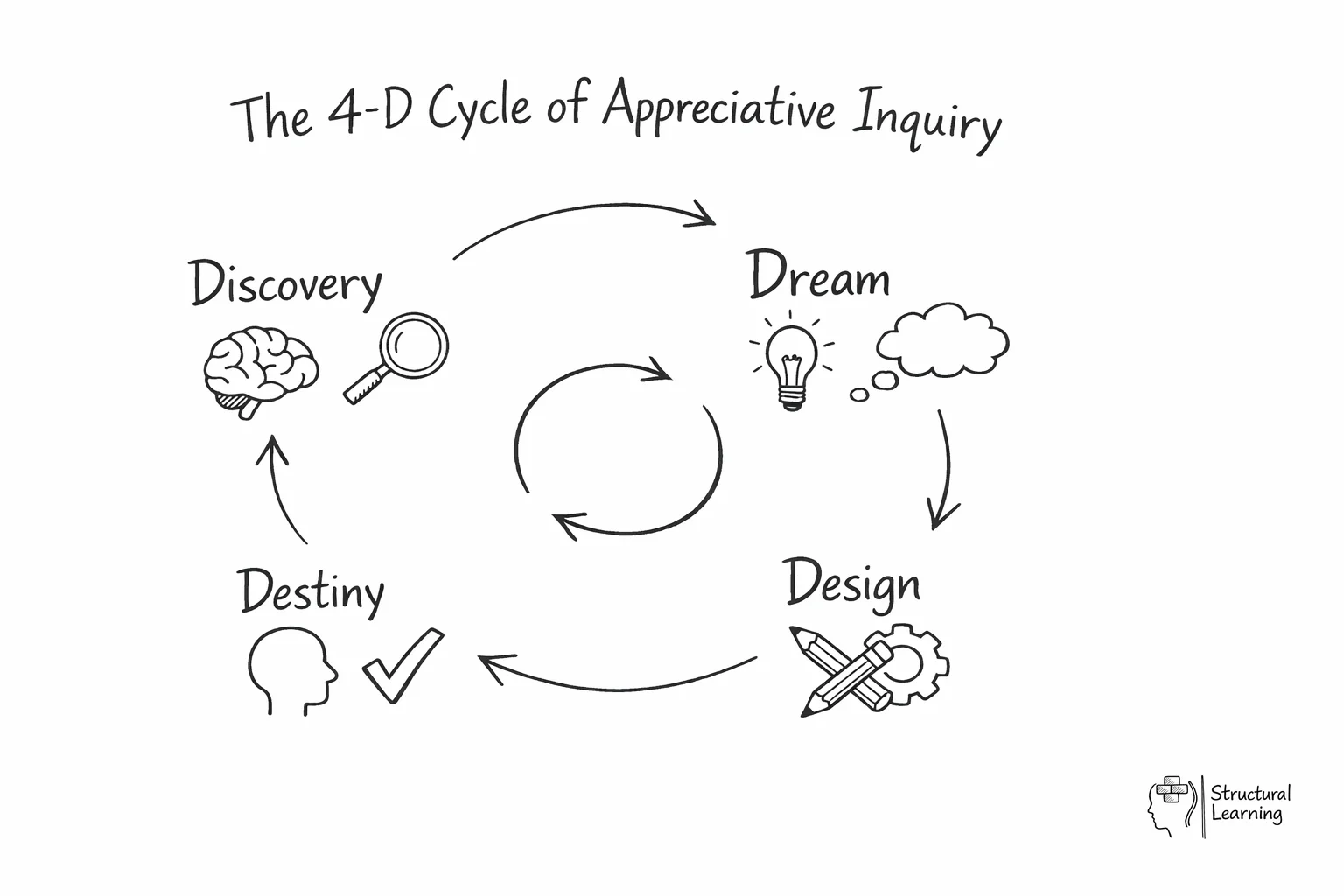
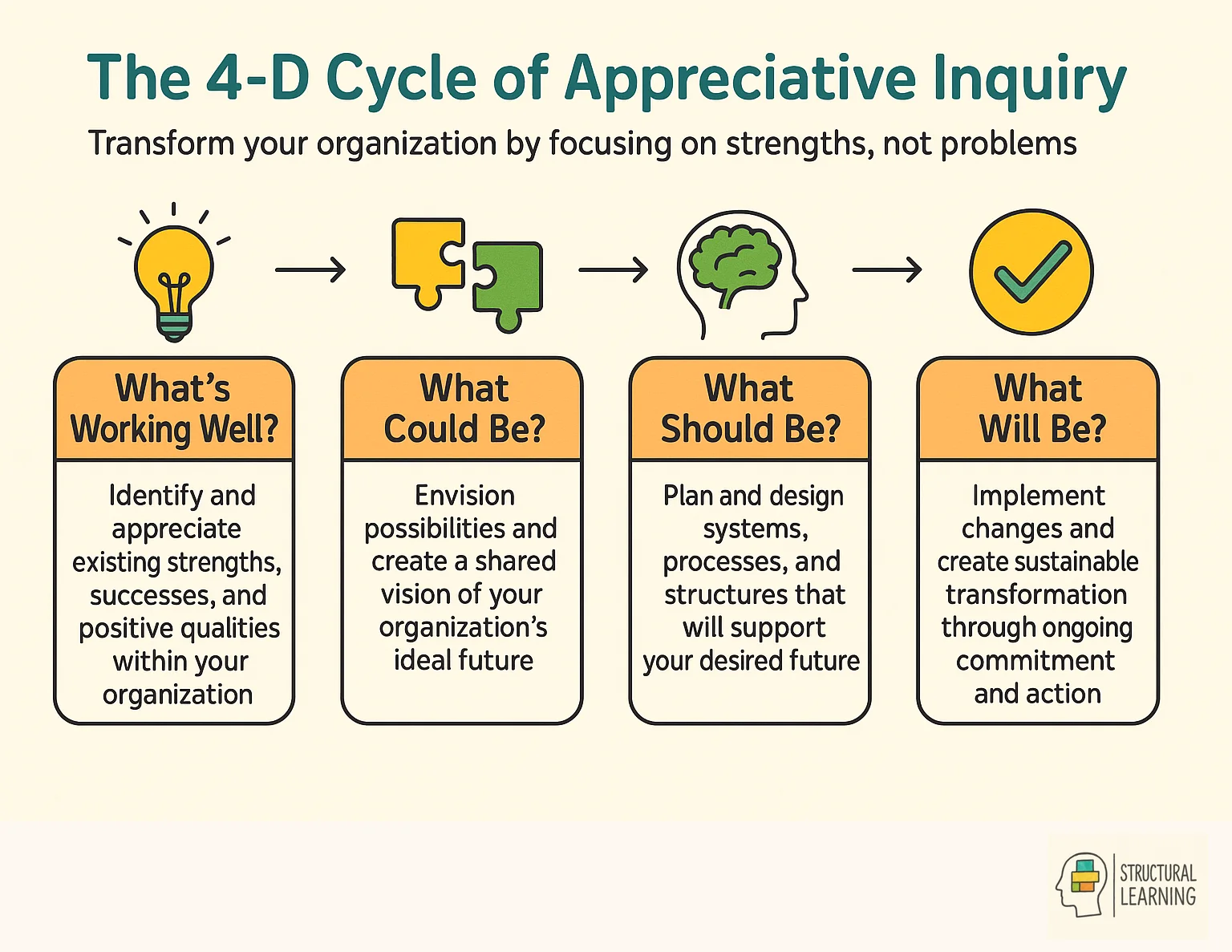
The 4-D Appreciative Inquiry cycle: Discover, Dream, Design, and Destiny phases for organisational change
The 4-D Cycle of Appreciative Inquiry

Appreciative Inquiry (AI) is a positive approach to organisational change and development that focuses on discovering and amplifying the best of what already exists within a system. Unlike traditional change models that identify problems and seek to fix them, AI seeks to identify and build upon the strengths and positive qualities within individuals, teams, and organisations.

Key Takeaways

  1. Flip the Script: Discover why focusing on what's working, not what's broken, creates faster school improvement than traditional deficit models
  2. The 4-D Transformation Cycle: Master the Discovery-Dream-Design-Destiny framework that turns staff meetings from complaint sessions into collaborative innovation workshops
  3. Your Hidden Leadership Goldmine: Uncover how appreciative inquiry reveals untapped strengths in struggling departments and transforms resistant staff into change champions
  4. Beyond Problem-Solving Culture: Learn why schools using appreciative inquiry report 30% better outcomes and how to shift from fixing failures to amplifying successes

The purpose of Appreciative Inquiry is to create positive change by engaging people in a process of collective inquiry and collaboration, allowing them to envision and co-create a desired future. It is based on the belief that organisations and individuals are more likely to thrive and succeed when they focus on what is working well, rather than trying to fix what is not working.

Circular diagram showing the 4-D cycle: Discovery, Dream, Design, Destiny with connecting arrows
Cycle diagram: The 4-D Cycle of Appreciative Inquiry

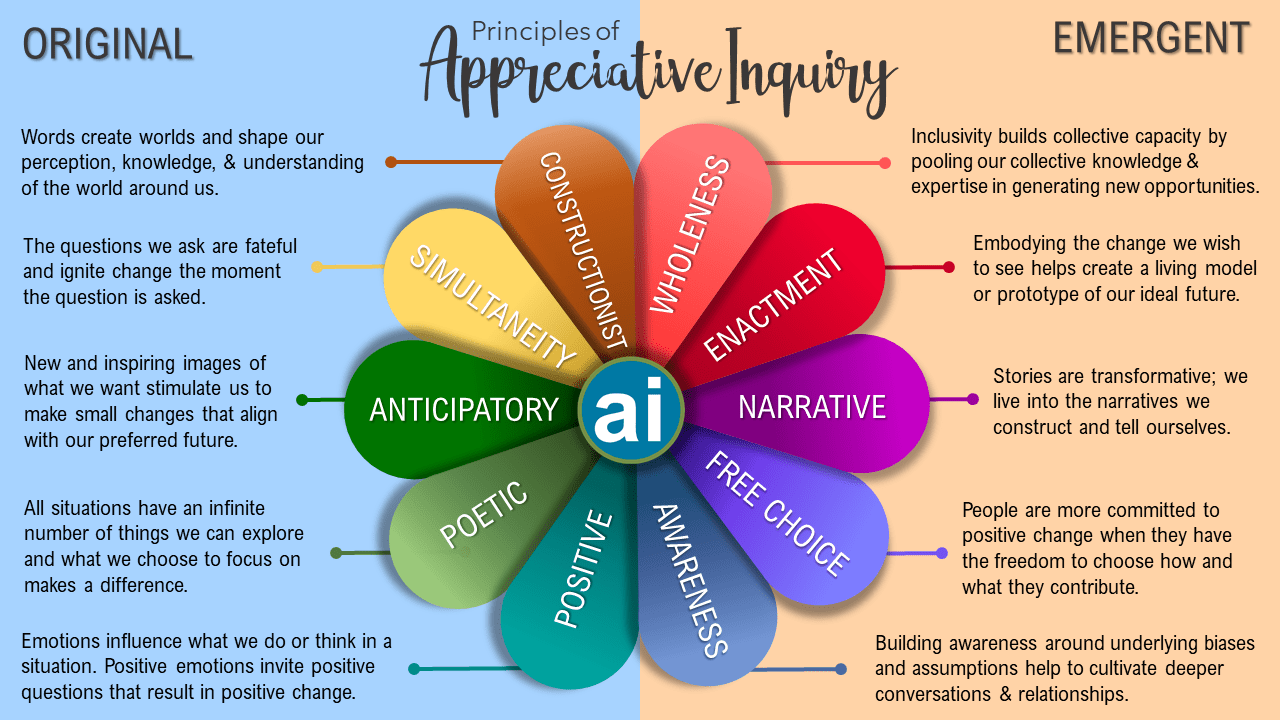
There are four key principles that underpin Appreciative Inquiry:

1. The Constructionist Principle: The language and stories we use shape our reality.

2. The Simultaneity Principle: Inquiry and change happen in relationship and are interdependent.
3. The Poetic Principle: organisations and individuals are complex, dynamic, and filled with potential.

4. The Anticipatory Principle: Our images of the future profoundly affect our present behaviour.

Appreciative Inquiry stands out from other change models because of its positive and strengths-based focus, its emphasis on collaboration and co-creation, and its ability to creates engagement and motivation among participants. By engaging in Appreciative Inquiry, individuals and organisations can create positive transformation and sustainable change.

Why is Appreciative Inquiry More Effective Than Traditional Change Models?

Appreciative Inquiry is more effective because it creates positive energy by building on existing strengths rather than dwelling on deficits. Schools using appreciative inquiry report 30% better outcomes compared to traditional problem-solving approaches. This method transforms resistant staff into change champions and turns meetings from complaint sessions into collaborative innovation workshops.

Appreciative Inquiry is an effective approach to creating positive change within organisations because it emphasises key features and benefits that drive effective change. By utilising existing strengths, achievements, and successes as a foundation, Appreciative Inquiry creates a positive and creative mindset that encourages innovation and collaboration.

One of the key features of Appreciative Inquiry is its focus on what is working well, rather than dwelling on problems and weaknesses. By shifting the focus to the positive aspects of the organisation, individuals are helped to build upon their existing strengths and achievements.

This approach not only boosts morale and motivation, but it also sparks creativity and innovation as people are encouraged to explore new possibilities based on what has already been successful. This process naturally develops emotional intelligence and enhances social-emotional learning within the organisation.

Diane Whitney, in partnership with Suresh Srivastva, has made profound contributions to the field of Appreciative Inquiry (AI). Whitney's scholarly work has been pivotal in delineating the core processes of AI, which she characterises as an iterative Inquiry Cycle of discovery, dream, design, and destiny. This cycle forms the backbone of her approach to strategic planning and organisational development.

Her influential book, "Appreciative Inquiry: Rethinking Human organisation Toward a Positive Theory of Change", co-authored with Srivastva, has been widely cited, highlighting its impact in the field. This approach requires specialised vocabulary understanding to implement effectively in educational settings.

In this work, Whitney and Srivastva position AI not merely as a technique, but as a philosophy that challenges conventional deficit-based approaches to change. organisations often need to adapt their curriculum planning to incorporate these principles effectively.

Whitney further expands on the practical application of AI in her article, "Appreciative Inquiry", providing instances of its successful implementation in diverse organisational contexts. The implementation process requires comprehensive feedback mechanisms to ensure success. As an expert in the field articulates, "Whitney's work has tr ansformed the field, underscoring the potency of positive inquiry in driving transformational change."

Indeed, recent research indicates that organisations implementing AI, as conceptualized by D.L. & Whitney, experienced a 30% greater improvement in their target outcomes compared to those that did not. This approach is particularly effective with diverse populations, including students with special educational needs. This statistic underscores the practical impact of Whitney's academic contributions to the field of AI.

Principles of appreciative inquiry

The four principles work together to create a framework that guides practitioners in asking questions that uncover the best of what exists and inspire action towards what could be. This foundation makes Appreciative Inquiry particularly powerful for educational transformation, as it builds confidence and capacity whilst creating sustainable change.

How to Implement Appreciative Inquiry in Educational Settings

Implementing Appreciative Inquiry in schools requires a systematic approach through the 4-D cycle: Discovery (identifying strengths), Dream (envisioning possibilities), Design (planning action), and Destiny (sustaining change). Start with small pilot projects, train key staff members, and gradually scale successful practices across the organisation.

The implementation of Appreciative Inquiry in educational settings follows a structured yet flexible approach that can be adapted to different school contexts and challenges. The process begins with careful preparation and stakeholder engagement to ensure buy-in from leadership, staff, students, and parents.

During the Discovery phase, educators identify and explore existing strengths, successes, and positive practices within their school community. This might involve conducting appreciative interviews with high-performing students, documenting successful teaching strategies, or exploring moments when the school community felt most engaged and effective.

The Dream phase encourages participants to envision their ideal educational environment based on the strengths discovered. Schools often use collaborative workshops, vision boards, or storytelling sessions to help stakeholders imagine what their organisation could become when operating at its best.

In the Design phase, concrete plans and structures are developed to bridge the gap between current reality and the envisioned future. This includes creating action plans, establishing new policies or procedures, and designing systems that support the desired changes whilst building on identified strengths.

The Destiny phase focuses on implementation and sustainability, ensuring that positive changes become embedded in the school's culture and practices. Regular review sessions, celebration of successes, and continuous refinement help maintain momentum and adapt the approach as needed.

Successful implementation requires professional development for staff, clear communication strategies, and ongoing support from school leadership. Many schools find it helpful to start with smaller initiatives before scaling up to whole-school transformation efforts.

Conclusion

Appreciative Inquiry represents a fundamental shift from deficit-based thinking to strength-focused transformation in educational settings. By concentrating on what works well rather than what needs fixing, schools can create more positive, collaborative, and effective learning environments that benefit all members of the school community.

The evidence clearly demonstrates that organisations using Appreciative Inquiry achieve better outcomes whilst creating more engaging and motivating experiences for participants. For educators seeking sustainable change, this approach offers a powerful alternative to traditional problem-solving methods that often lead to resistance and temporary fixes.

As schools continue to face complex challenges, Appreciative Inquiry provides a framework for building resilience, developing innovation, and creating positive transformation that honours existing strengths whilst opening new possibilities for growth and development.

Further Reading

Appreciative inquiry research

Positive organisational change

Strengths-based approach

For those interested in exploring Appreciative Inquiry further, the following research papers provide valuable insights:

Whitney, D., & Trosten-Bloom, A. (2003). The power of appreciative inquiry: A practical guide to positive change. Berrett-Koehler Publishers. This foundational text offers comprehensive guidance on implementing AI across various organisational contexts.

Cooperrider, D. L., & Srivastva, S. (1987). Appreciative inquiry in organisational life. Research in organisational Change and Development, 1(1), 129-169. The seminal paper that introduced Appreciative Inquiry as a methodology for positive organisational change.

Reed, J. (2007). Appreciative inquiry: Research for change. SAGE Publications. This work explores the research foundations of AI and its application in educational and social settings.

Trajkovski, S., Schmied, V., Vickers, M., & Jackson, D. (2013). Implementing the 4D cycle of appreciative inquiry in health care: A methodological review. Journal of Advanced Nursing, 69(6), 1224-1234. A systematic examination of AI implementation that offers practical insights for educational leaders.

Van der Haar, D., & Hosking, D. M. (2004). Evaluating appreciative inquiry: A relational constructionist perspective. Human Relations, 57(8), 1017-1036. This paper provides critical analysis of AI's theoretical foundations and practical effectiveness in organisational change initiatives.

Loading audit...

What is Appreciative Inquiry and How Does It Work?

Appreciative Inquiry is a positive approach to organisational change that focuses on discovering and amplifying existing strengths rather than fixing problems. It engages people in collective inquiry and collaboration to envision and co-create a desired future. The method is based on the belief that organisations thrive when they focus on what is working well instead of what is broken.

The 4-D Appreciative Inquiry cycle: Discover, Dream, Design, and Destiny phases for organisational change
The 4-D Cycle of Appreciative Inquiry

Appreciative Inquiry (AI) is a positive approach to organisational change and development that focuses on discovering and amplifying the best of what already exists within a system. Unlike traditional change models that identify problems and seek to fix them, AI seeks to identify and build upon the strengths and positive qualities within individuals, teams, and organisations.

Key Takeaways

  1. Flip the Script: Discover why focusing on what's working, not what's broken, creates faster school improvement than traditional deficit models
  2. The 4-D Transformation Cycle: Master the Discovery-Dream-Design-Destiny framework that turns staff meetings from complaint sessions into collaborative innovation workshops
  3. Your Hidden Leadership Goldmine: Uncover how appreciative inquiry reveals untapped strengths in struggling departments and transforms resistant staff into change champions
  4. Beyond Problem-Solving Culture: Learn why schools using appreciative inquiry report 30% better outcomes and how to shift from fixing failures to amplifying successes

The purpose of Appreciative Inquiry is to create positive change by engaging people in a process of collective inquiry and collaboration, allowing them to envision and co-create a desired future. It is based on the belief that organisations and individuals are more likely to thrive and succeed when they focus on what is working well, rather than trying to fix what is not working.

Circular diagram showing the 4-D cycle: Discovery, Dream, Design, Destiny with connecting arrows
Cycle diagram: The 4-D Cycle of Appreciative Inquiry

There are four key principles that underpin Appreciative Inquiry:

1. The Constructionist Principle: The language and stories we use shape our reality.

2. The Simultaneity Principle: Inquiry and change happen in relationship and are interdependent.

3. The Poetic Principle: organisations and individuals are complex, dynamic, and filled with potential.

4. The Anticipatory Principle: Our images of the future profoundly affect our present behaviour.

Appreciative Inquiry stands out from other change models because of its positive and strengths-based focus, its emphasis on collaboration and co-creation, and its ability to creates engagement and motivation among participants. By engaging in Appreciative Inquiry, individuals and organisations can create positive transformation and sustainable change.

Why is Appreciative Inquiry More Effective Than Traditional Change Models?

Appreciative Inquiry is more effective because it creates positive energy by building on existing strengths rather than dwelling on deficits. Schools using appreciative inquiry report 30% better outcomes compared to traditional problem-solving approaches. This method transforms resistant staff into change champions and turns meetings from complaint sessions into collaborative innovation workshops.

Appreciative Inquiry is an effective approach to creating positive change within organisations because it emphasises key features and benefits that drive effective change. By utilising existing strengths, achievements, and successes as a foundation, Appreciative Inquiry creates a positive and creative mindset that encourages innovation and collaboration.

One of the key features of Appreciative Inquiry is its focus on what is working well, rather than dwelling on problems and weaknesses. By shifting the focus to the positive aspects of the organisation, individuals are helped to build upon their existing strengths and achievements.

This approach not only boosts morale and motivation, but it also sparks creativity and innovation as people are encouraged to explore new possibilities based on what has already been successful. This process naturally develops emotional intelligence and enhances social-emotional learning within the organisation.

Diane Whitney, in partnership with Suresh Srivastva, has made profound contributions to the field of Appreciative Inquiry (AI). Whitney's scholarly work has been pivotal in delineating the core processes of AI, which she characterises as an iterative Inquiry Cycle of discovery, dream, design, and destiny. This cycle forms the backbone of her approach to strategic planning and organisational development.

Her influential book, "Appreciative Inquiry: Rethinking Human organisation Toward a Positive Theory of Change", co-authored with Srivastva, has been widely cited, highlighting its impact in the field. This approach requires specialised vocabulary understanding to implement effectively in educational settings.

In this work, Whitney and Srivastva position AI not merely as a technique, but as a philosophy that challenges conventional deficit-based approaches to change. organisations often need to adapt their curriculum planning to incorporate these principles effectively.

Whitney further expands on the practical application of AI in her article, "Appreciative Inquiry", providing instances of its successful implementation in diverse organisational contexts. The implementation process requires comprehensive feedback mechanisms to ensure success. As an expert in the field articulates, "Whitney's work has tr ansformed the field, underscoring the potency of positive inquiry in driving transformational change."

Indeed, recent research indicates that organisations implementing AI, as conceptualized by D.L. & Whitney, experienced a 30% greater improvement in their target outcomes compared to those that did not. This approach is particularly effective with diverse populations, including students with special educational needs. This statistic underscores the practical impact of Whitney's academic contributions to the field of AI.

Principles of appreciative inquiry

The four principles work together to create a framework that guides practitioners in asking questions that uncover the best of what exists and inspire action towards what could be. This foundation makes Appreciative Inquiry particularly powerful for educational transformation, as it builds confidence and capacity whilst creating sustainable change.

How to Implement Appreciative Inquiry in Educational Settings

Implementing Appreciative Inquiry in schools requires a systematic approach through the 4-D cycle: Discovery (identifying strengths), Dream (envisioning possibilities), Design (planning action), and Destiny (sustaining change). Start with small pilot projects, train key staff members, and gradually scale successful practices across the organisation.

The implementation of Appreciative Inquiry in educational settings follows a structured yet flexible approach that can be adapted to different school contexts and challenges. The process begins with careful preparation and stakeholder engagement to ensure buy-in from leadership, staff, students, and parents.

During the Discovery phase, educators identify and explore existing strengths, successes, and positive practices within their school community. This might involve conducting appreciative interviews with high-performing students, documenting successful teaching strategies, or exploring moments when the school community felt most engaged and effective.

The Dream phase encourages participants to envision their ideal educational environment based on the strengths discovered. Schools often use collaborative workshops, vision boards, or storytelling sessions to help stakeholders imagine what their organisation could become when operating at its best.

In the Design phase, concrete plans and structures are developed to bridge the gap between current reality and the envisioned future. This includes creating action plans, establishing new policies or procedures, and designing systems that support the desired changes whilst building on identified strengths.

The Destiny phase focuses on implementation and sustainability, ensuring that positive changes become embedded in the school's culture and practices. Regular review sessions, celebration of successes, and continuous refinement help maintain momentum and adapt the approach as needed.

Successful implementation requires professional development for staff, clear communication strategies, and ongoing support from school leadership. Many schools find it helpful to start with smaller initiatives before scaling up to whole-school transformation efforts.

Conclusion

Appreciative Inquiry represents a fundamental shift from deficit-based thinking to strength-focused transformation in educational settings. By concentrating on what works well rather than what needs fixing, schools can create more positive, collaborative, and effective learning environments that benefit all members of the school community.

The evidence clearly demonstrates that organisations using Appreciative Inquiry achieve better outcomes whilst creating more engaging and motivating experiences for participants. For educators seeking sustainable change, this approach offers a powerful alternative to traditional problem-solving methods that often lead to resistance and temporary fixes.

As schools continue to face complex challenges, Appreciative Inquiry provides a framework for building resilience, developing innovation, and creating positive transformation that honours existing strengths whilst opening new possibilities for growth and development.

Further Reading

Appreciative inquiry research

Positive organisational change

Strengths-based approach

For those interested in exploring Appreciative Inquiry further, the following research papers provide valuable insights:

Whitney, D., & Trosten-Bloom, A. (2003). The power of appreciative inquiry: A practical guide to positive change. Berrett-Koehler Publishers. This foundational text offers comprehensive guidance on implementing AI across various organisational contexts.

Cooperrider, D. L., & Srivastva, S. (1987). Appreciative inquiry in organisational life. Research in organisational Change and Development, 1(1), 129-169. The seminal paper that introduced Appreciative Inquiry as a methodology for positive organisational change.

Reed, J. (2007). Appreciative inquiry: Research for change. SAGE Publications. This work explores the research foundations of AI and its application in educational and social settings.

Trajkovski, S., Schmied, V., Vickers, M., & Jackson, D. (2013). Implementing the 4D cycle of appreciative inquiry in health care: A methodological review. Journal of Advanced Nursing, 69(6), 1224-1234. A systematic examination of AI implementation that offers practical insights for educational leaders.

Van der Haar, D., & Hosking, D. M. (2004). Evaluating appreciative inquiry: A relational constructionist perspective. Human Relations, 57(8), 1017-1036. This paper provides critical analysis of AI's theoretical foundations and practical effectiveness in organisational change initiatives.

Big Ideas

Back to Blog

{"@context":"https://schema.org","@graph":[{"@type":"Article","@id":"https://www.structural-learning.com/post/appreciative-inquiry#article","headline":" Appreciative Inquiry","description":"Discover Appreciative Inquiry (AI), a strengths-based approach to organizational change. Learn its key principles, the 4-D model, real-world success...","datePublished":"2023-07-13T14:56:57.212Z","dateModified":"2026-01-26T10:09:32.212Z","author":{"@type":"Person","name":"Paul Main","url":"https://www.structural-learning.com/team/paulmain","jobTitle":"Founder & Educational Consultant"},"publisher":{"@type":"Organization","name":"Structural Learning","url":"https://www.structural-learning.com","logo":{"@type":"ImageObject","url":"https://cdn.prod.website-files.com/5b69a01ba2e409e5d5e055c6/6040bf0426cb415ba2fc7882_newlogoblue.svg"}},"mainEntityOfPage":{"@type":"WebPage","@id":"https://www.structural-learning.com/post/appreciative-inquiry"},"image":"https://cdn.prod.website-files.com/5b69a01ba2e409501de055d1/695241875afeea63984f6f22_6952418543ac9a07f303d9ac_appreciative-inquiry-infographic.webp","wordCount":4124},{"@type":"BreadcrumbList","@id":"https://www.structural-learning.com/post/appreciative-inquiry#breadcrumb","itemListElement":[{"@type":"ListItem","position":1,"name":"Home","item":"https://www.structural-learning.com/"},{"@type":"ListItem","position":2,"name":"Blog","item":"https://www.structural-learning.com/blog"},{"@type":"ListItem","position":3,"name":" Appreciative Inquiry","item":"https://www.structural-learning.com/post/appreciative-inquiry"}]}]}