Updated on
September 4, 2026
AI Tutoring in the Classroom: What It Can and Cannot Do
Learn how AI tutoring delivers personalised learning, prevents cognitive offloading, and provides data-driven insights. Read our practical classroom guide.


Updated on
September 4, 2026
Learn how AI tutoring delivers personalised learning, prevents cognitive offloading, and provides data-driven insights. Read our practical classroom guide.

A teacher sets a primary mathematics task on long division. Learners input their working out into an intelligent tutoring platform. The AI detects when a learner skips a procedural step, prompting them to review their place value. The learner produces a corrected calculation, actively securing their mathematical schema while the teacher monitors live progress.
AI tutoring refers to the use of artificial intelligence to provide one-to-one academic support to learners. These intelligent tutoring systems use complex algorithms to build a student model, tracking a learner's current knowledge and adapting instruction in real time. Rather than simply delivering information, tools designed for this purpose guide learners through problems using tailored feedback.
This process mimics schema construction. By connecting new concepts to a learner's existing knowledge, the AI helps build robust mental models rather than encouraging rote memorisation (Sweller, 2011). Early research into tutoring systems demonstrated that one-to-one support significantly improves learning outcomes (Bloom, 1984). Modern AI tutoring scales this support, making personalised learning accessible to entire classrooms simultaneously.
By capturing data on how learners approach step-by-step solutions, intelligent tutoring systems create persistent learning states. The student model remembers what a learner struggled with yesterday and adjusts today's practice accordingly. This transforms learning experiences from passive consumption into active, responsive dialogues between the learner and the artificial intelligence.
During a geography lesson, the teacher programmes a Socratic AI prompt: "Act as an expert geographer. Do not give the learner the causes of coastal erosion; ask them to identify the processes shown in the diagram." Learners produce short analytical paragraphs, and the AI questions their evidence base, preventing them from simply copying facts.
Human teachers cannot realistically provide individualised instruction to thirty learners at once. Research indicates that intelligent tutoring systems can produce learning gains comparable to human tutoring (VanLehn, 2011). These tools step in to provide immediate, targeted intervention exactly when a learner encounters a barrier.
High quality AI tutoring prevents cognitive offloading. Cognitive offloading occurs when learners let technology do the thinking for them, bypassing the productive struggle required for long-term retention. Effective tutoring systems force cognitive engagement by refusing to provide final answers. Instead, they use prompting and scaffolding, ensuring the learner does the heavy cognitive lifting required to build robust mental schemas (Luckin et al., 2016).
The true value lies in the data-driven teacher insights these tutoring systems generate. While the AI handles routine practice and immediate feedback, teachers review dashboards highlighting precise misconceptions. This allows educators to target their whole class instruction more effectively, rather than guessing where the gaps in current knowledge lie.
Integrating AI tutoring requires a deliberate blend of human oversight and technological support. The teacher introduces a core concept, and learners use the AI platform to apply that knowledge. The learners produce draft responses, which the AI critiques, allowing the teacher to circulate and focus on learners requiring intensive behavioural or academic support.
Instead of viewing AI as an answer engine, teachers set it up as a critical questioning tool. A teacher introduces a new concept, and learners use the AI to test their understanding. The intelligent tutoring system acts as a Socratic guide, refining learning experiences.
If a learner is stuck on balancing a chemical equation in science, tools designed like Khanmigo will not just provide the balanced formula. The AI asks, "Which element is unbalanced on the reactant side?" The learner must identify the discrepancy before receiving the next hint. This process builds resilience and ensures step-by-step solutions are fully understood.
Teachers use intelligent tutoring to manage diverse attainment levels during independent practice. The teacher sets a baseline task, and the AI adapts the difficulty based on the learner's responses.
In a mathematics lesson on adding fractions, the system diagnoses that a learner consistently forgets to find a common denominator. The AI tutor instantly generates targeted flashcards focusing solely on equivalent fractions. Meanwhile, the teacher receives an alert on their progress tracking dashboard and can provide brief, targeted support to that specific learner.
Teachers delegate highly repetitive, drill-based tasks to the AI. This frees up human teaching time for complex, nuanced discussions, accelerating personalised learning. It is particularly effective for vocabulary acquisition and pronunciation.
In a language lesson, learners spend fifteen minutes using a language learning co-pilot for repetitive vocabulary and pronunciation practice. The intelligent tutoring system listens, corrects pronunciation, and repeats challenging words. The classroom teacher then leads a high energy, conversational role play, knowing learners have already secured the foundational vocabulary.
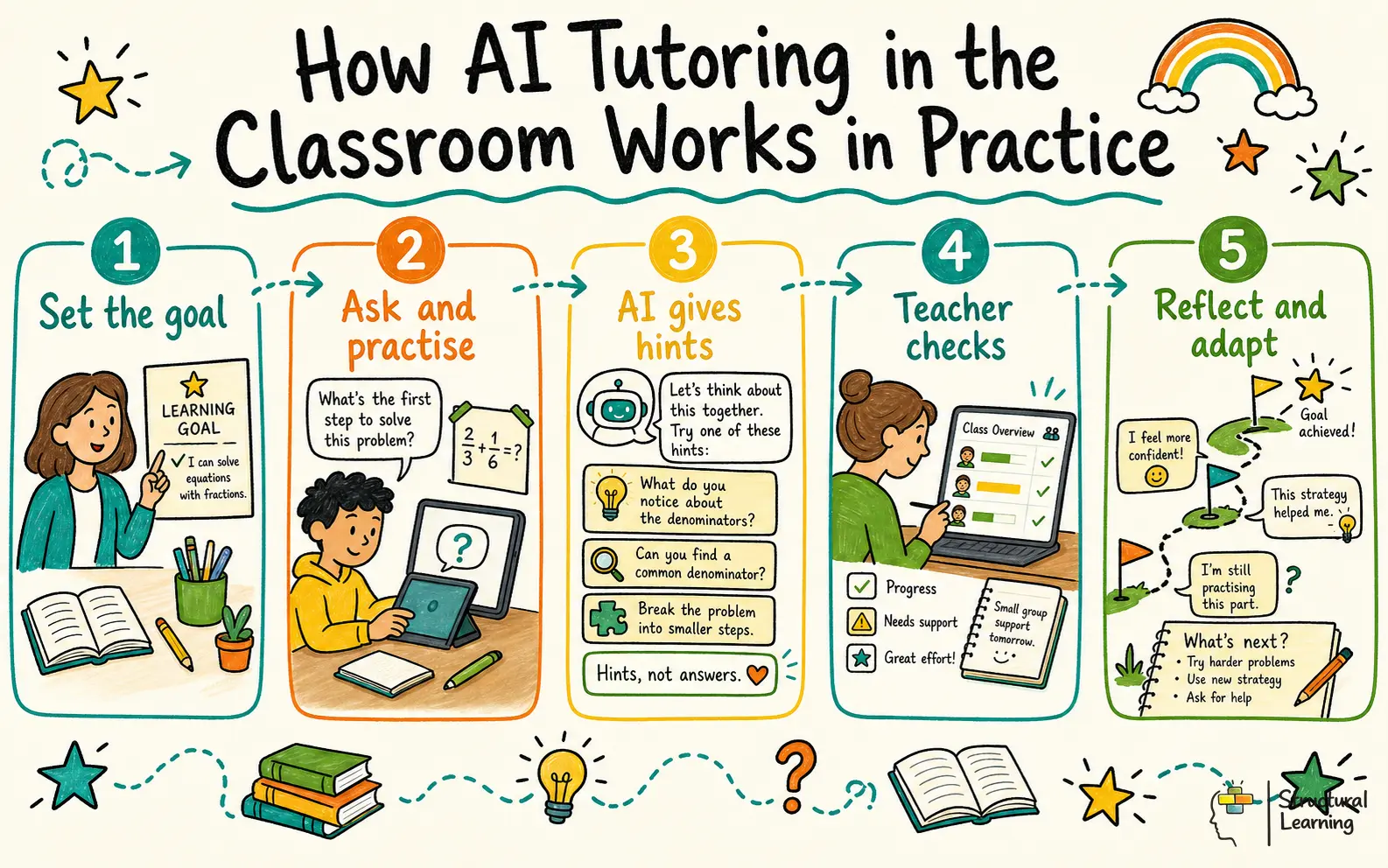
A teacher sets a homework task on Macbeth. Rather than fearing learners will generate a complete essay, the teacher uses an AI tutor configured for formative assessment. Learners produce an essay plan, and the AI flags missing themes like ambition. The teacher reviews the dashboard the next morning to plan the follow-up lesson.
Many educators fear that AI tutoring will encourage cheating. While poorly supervised use of generative text models can lead to plagiarism, purpose-built intelligent tutoring systems are designed to scaffold learning. They use the Socratic method to demand learner input, making it harder to bypass the learning process.
Another misconception is that tutoring systems isolate learners. In reality, the best tools facilitate better human interaction. By handling routine assessment, the AI gives teachers more time to engage in meaningful, one-to-one conversations with learners who need emotional or complex academic support.
Some assume these systems are only for schools with massive budgets or are similar to corporate training tools. However, GOV.UK initiatives and various educational organisations are actively building safe, accessible AI tutoring tools for UK schools. These aim to provide equitable access to high quality support, distinct from expensive corporate training modules.
A Year 5 teacher implements a 'Three Before Me' routine using a curriculum-aligned tool like Third Space Learning. Learners produce their initial working out on mini-whiteboards, consult the AI tutor for a hint, and only ask the human teacher if they remain stuck.
Starting with AI tutoring requires establishing clear routines. Treat the AI as an additional adult in the room with specific rules of engagement to enhance personalised learning.
First, define the scope. Choose a single topic where learners require extensive, repetitive practice, such as solving quadratic equations. Direct the learners to log into the chosen intelligent tutoring platform.
Next, establish the 'Three Before Me' rule, modified for the AI. Learners must ask the AI tutor for a hint, attempt the step, and ask the AI to check their logic before raising their hand for the human teacher. This builds independence.
During the lesson, monitor the teacher dashboard. Look for clusters of red alerts indicating a shared misconception. Stop the class and provide direct instruction on that specific error.
Regardless of the subject, the implementation remains consistent. The teacher sets parameters for the AI, and learners produce evidence of their thinking process, receiving immediate feedback without human delays.
In physics, calculating velocity requires multiple steps. A teacher assigns practice problems via an AI platform. When a learner enters an incorrect final answer, the AI asks them to state the formula they used. It then guides them to check their unit conversions, rather than just revealing the answer. The learner produces the correct calculation sequence.
Teachers use AI tutoring to provide immediate feedback on sentence structure. A learner submits a draft paragraph. The AI highlights run-on sentences and suggests focusing on punctuation, without rewriting the text. The teacher reviews the overall data to see which learners are consistently struggling with comma splices.
During an independent research project on the Industrial Revolution, learners use an AI tutor to refine their search queries. The teacher instructs the AI to only respond with guiding questions. If a learner asks for the causes, the AI prompts, "Consider the changes in agriculture and technology. What specific inventions come to mind?" The learner produces a refined list of search terms based on this guidance.

School leaders and teachers must carefully evaluate how these tools fit into their existing pedagogy. A computing lead sets up a trial across three classrooms. Teachers deploy the AI during retrieval practice, and learners produce daily quizzes on prior topics, giving staff baseline data to monitor long-term retention.
Evaluating Khanmigo, Astra AI, and Third Space Learning depends on your context. Khanmigo excels at Socratic questioning, while Third Space Learning provides structured, curriculum-aligned maths interventions.
AI tutor versus private tutor comparisons highlight massive cost differences. While a private human tutor charges hourly, AI tutoring platforms typically operate on per-learner annual subscriptions, making them highly scalable for schools.
If learners use generic chatbots to generate answers, yes. However, effective intelligent tutoring systems are built to prevent this by forcing learners to engage with their current knowledge and explain their reasoning (Chi et al., 2001).
Teachers create structured prompts that constrain the AI's behaviour. You must explicitly instruct the system to act as a coach, to ask questions rather than give answers, and to adjust its language to the appropriate reading age. When teachers create these parameters, the AI becomes a safe learning environment.
Yes, the underlying student model technology used in schools is heavily utilised in corporate training. Adult learners benefit from the same persistent learning states and adaptive learning experiences as younger learners.
A persistent learning state means the AI remembers a learner's interaction history. When the learner logs in the next day, the system recalls previous mistakes and tailors the new session to address those specific gaps, further supporting personalised learning.
Next lesson, select a single learning objective that requires repetitive practice and trial a free intelligent tutoring platform to manage the feedback loop.
Related AI in education guides: AI policy for schools, AI classroom implementation, human-led AI classroom practice, AI tools for teachers, AI literacy for teachers, AI lesson planning, learning science and AI lesson planning.
Authoritative guidance on AI in education: DfE guidance on generative AI in education, DfE support materials for using AI in education settings, Ofsted findings from AI early adopters in schools and FE, EEF Teacher Choices trial on ChatGPT in lesson preparation.