Updated on
September 4, 2026
AI in the Classroom: A Human-Led Teacher Guide
AI in the classroom can reduce planning time, sharpen feedback and build AI literacy when teachers set clear rules, verify outputs and protect learner data.


Updated on
September 4, 2026
AI in the classroom can reduce planning time, sharpen feedback and build AI literacy when teachers set clear rules, verify outputs and protect learner data.
AI in the classroom is the use of artificial intelligence to support teaching decisions, resource creation, explanation, feedback, tutoring, adaptation and AI literacy while the teacher remains responsible for curriculum, safety and assessment.
It includes teacher-facing uses, such as drafting questions, adapting texts and summarising common errors. It also includes learner-facing routines where learners question, verify or use AI under clear rules. The starting point is always lesson intent, not the tool.
The roots are older than ChatGPT. Intelligent tutoring systems and adaptive platforms grew from work in cognitive science, assessment and computer science. Research on digital tutors suggests that structured practice with timely hints can help learning when tasks are well designed (VanLehn, 2011; Kulik & Fletcher, 2016).
Generative AI changes the classroom problem because it can produce text, questions, explanations, code, images and captions from prompts. That speed brings risk. Learners need to compare AI outputs with taught material, check reasoning, spot bias and explain what they changed (Kasneci et al., 2023; Yan et al., 2023).
A practical Year 5 science example is simple. The teacher asks AI for three short explanations of evaporation. The teacher corrects any weak wording, adds the terms particle, liquid, gas, heat and water vapour, then asks learners to produce a labelled diagram and two retrieval questions from the text.
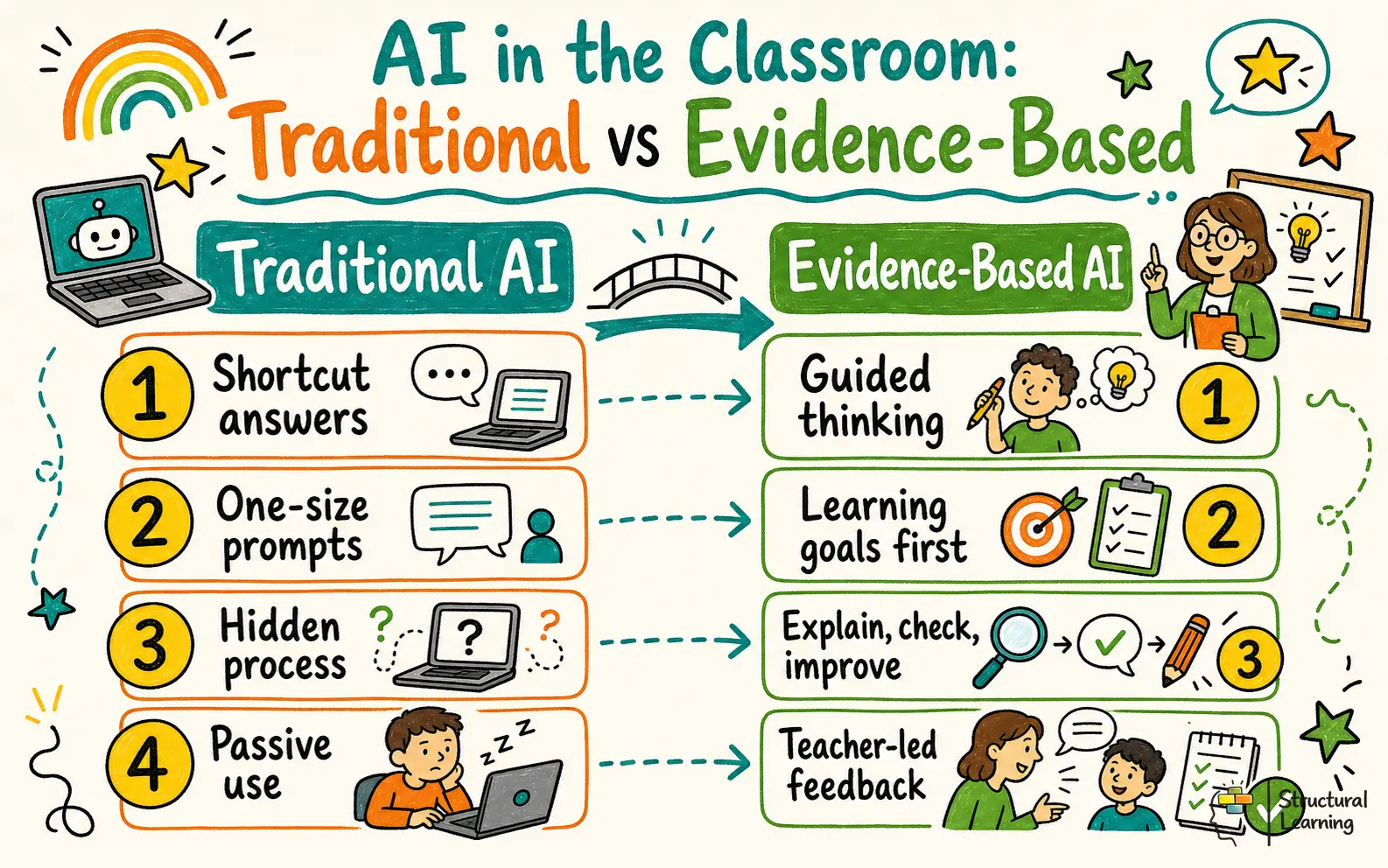
AI matters because it touches the whole teaching and learning cycle: planning, explanation, guided practice, adaptation, feedback, homework and assessment. Used well, it saves time on first drafts. Used badly, it adds errors, privacy risks and shallow tasks.
Teachers should apply established learning principles before they apply AI. Working memory is limited, so new material needs clear sequencing, worked examples and reduced extraneous load (Sweller, 1988; Kirschner, Sweller & Clark, 2006). Retrieval practice helps learners strengthen memory when questions are accurate and revisited over time (Roediger & Karpicke, 2006; Dunlosky et al., 2013). Feedback works when learners act on it, not when they receive long comments they cannot use (Black & Wiliam, 1998; Hattie & Timperley, 2007).
For example, a GCSE maths teacher asks AI to draft six hinge questions on simultaneous equations. The teacher deletes three weak items, keeps the questions that expose substitution and elimination errors, and asks learners to answer on mini-whiteboards. Learners then write one corrected method and explain why a distractor was tempting.
The gain is not the generated worksheet. The gain is faster access to examples that the teacher can test against subject knowledge, cognitive load and formative assessment.
A human-led model keeps AI close to the lesson lifecycle. Each stage has a teacher action, an AI boundary and a visible learner product.
The model protects teacher judgement. AI can act as assistant, tutor and workload reducer only when curriculum intent, cognitive load, assessment validity, privacy and learner independence are kept in view.
Start with the curriculum goal. A strong prompt names the year group, prior knowledge, key vocabulary, likely misconceptions and exact output.
Teacher prompt:
Act as a planning assistant. Create five hinge questions for Year 10 simultaneous equations. Include the misconception tested, the correct answer and why each distractor is plausible. Do not include exam board claims or invented links.
The teacher checks the questions, removes items that test reading more than maths, and keeps the strongest misconception checks. Learners answer on mini-whiteboards, then produce one corrected method with a sentence explaining the error.
AI can make a task shorter without making the thinking weaker. This matters because learners can be overloaded by long instructions, dense texts or too many choices (Sweller, 1988).

In science, the teacher asks AI to turn a long practical instruction into six numbered steps and a vocabulary box. The teacher checks safety language and subject terms. Learners then complete the practical, tick each step and write a cause-and-effect sentence using because.
AI can draft feedback, but the teacher decides the learning priority. Use anonymised work, a rubric and a narrow request such as: "Identify one strength, one misconception and one next-step question."
Before teacher edit:
Good work. You used evidence, but you need to explain more and improve structure.
After teacher edit:
Embed the quotation in sentence two, then explain how the verb shows tension.
Learners spend seven minutes revising the paragraph. Their product is a changed sentence and a two-line note: "I changed the quotation because it was dropped in. I added the verb explanation to connect evidence to meaning."
AI can be used as a tutor when the rule is hints, not answers. The teacher says: "You may ask for one hint, one simpler example or one question back. You may not ask for the final answer."
In KS3 history, learners ask for a hint about long-term and short-term causes of the First World War. They compare the AI response with source extracts, cross out one over-simple claim and produce a corrected paragraph. The reflection log names one useful hint and one rejected sentence.
Learners need to notice how AI changes their thinking. Metacognitive routines help learners plan, monitor and evaluate their work (Flavell, 1979; Zimmerman, 2002).
| Lesson stage | What the teacher does | What learners produce |
|---|---|---|
| Planning | Prompts AI for a first draft of questions, explanations or examples, then checks accuracy and age fit | A clear task sheet, retrieval questions or worked example selected by the teacher |
| Adaptation | Uses AI to create shorter texts, vocabulary lists or step-by-step instructions without lowering the curriculum goal | The same core outcome as the class, with word banks, sentence stems or a visual checklist |
| Instruction | Uses AI-generated examples only after checking them against the intended explanation | A completed worked example, a labelled diagram or a short explanation in their own words |
| Formative assessment | Generates hinge questions, exit tickets or misconception checks, then chooses the items that will change the next teaching move | Mini-whiteboard answers, exit ticket responses or a corrected misconception |
| Feedback | Uses anonymised work and a rubric to draft comments, then edits them to one next step | A revised paragraph, corrected solution or short improvement note |
| Learner support | Allows AI for hints, simpler examples or questions back, not final answers | A transcript extract, reflection log and final answer with evidence of checking |
| AI literacy | Teaches learners to compare AI claims with sources and taught knowledge | An annotated AI output, corrected paragraph or claim-check table |
| Safeguards | Sets rules on permitted use, data protection and process evidence before the task begins | A draft trail, prompt log or declaration of AI support |
Use a three-line learner log:
In English, a learner uses AI to suggest three possible topic sentences. The learner chooses one, rewrites it, checks it against the essay question and explains why the final version is stronger.
AI integrity should centre assessment design, not detection anxiety. AI detectors are probabilistic, can produce false positives and can be less fair to multilingual writers (Liang et al., 2023; Perkins, Roe & Furze, 2024). A detector score is not the same as evidence of misconduct.
Assessment is stronger when the process is visible. Ask for plans, annotated drafts, oral explanation, prompt logs, revision notes and clear permissions. This fits the wider principle that valid assessment depends on the meaning of the evidence collected, not only the final product (Messick, 1989).
A before-and-after essay routine can look like this:
This makes ChatGPT use discussable. It also reduces the equity risk of punishing learners because their writing style is wrongly flagged by a detector.
Privacy rules need classroom wording, not only policy wording. A simple rule works: if the information would not be suitable on a public noticeboard, do not paste it into an open AI tool.
Do not upload:

For SEND, AI can help create access scaffolds. A teacher can turn a dense task instruction into a first-then sequence, a checklist and a word bank. The learner produces the same curriculum outcome as peers, such as a labelled circuit diagram, but with clearer steps and reduced working memory demand. AI must not diagnose need, label a learner or replace specialist judgement.
For EAL, AI can draft glossary examples, sentence stems and model sentences for teacher checking. In geography, learners compare two stems for explaining coastal erosion and choose the one that preserves the subject meaning. The product is a sentence that uses the key term accurately, not a generic fluent paragraph.
Use videos, vendor examples and social media demonstrations as examples of practice, not as evidence. Teachers should still ask: Is the claim accurate? Is the task age-appropriate? Does it protect data? Does it preserve learner thinking?
The first misconception is that AI will replace teachers. AI can draft questions, summaries and comments, but it cannot know the classroom history, notice a learner's hesitation, judge a safeguarding concern or decide which misconception matters today.
In Year 5 science, an AI output says evaporation is "water disappearing". The teacher changes it to "liquid water changing into water vapour". Learners then draw a particle diagram and write a caption explaining the change of state.
The second misconception is that AI differentiation means lowering expectations. Good adaptation changes access, scaffolds and practice while keeping the curriculum goal intact.
For a learner who needs reduced written load, the teacher uses AI to create a word bank and sentence stems for the same history explanation. The learner still explains cause and consequence. The product is shorter, but the thinking demand remains.
The third misconception is that AI outputs are neutral. Language models can produce confident errors, invented links, biased examples and missing perspectives. Learners need verification routines, including source comparison and lateral reading (Wineburg & McGrew, 2017).
In geography, the teacher asks learners to compare an AI summary of climate migration with two named sources. Learners highlight unsupported claims, check links and rewrite one paragraph with more precise evidence.
Start with one low-risk teacher task. Choose a task that needs no personal data, such as drafting retrieval questions, creating hinge questions or simplifying a text that the teacher will check.
| Stage | Teacher action | Learner product |
|---|---|---|
| Before writing | Sets permission: AI for planning only | A bullet plan with one AI-suggested idea marked |
| Drafting | Requires one paragraph written without AI | An annotated paragraph with evidence highlighted |
| Feedback | Gives one target linked to the rubric | A revised paragraph |
| Reflection | Asks learners to explain any AI help | A short process note naming what was accepted or rejected |
A simple first-week routine is:
Set permitted use before learner tasks. Use four labels: no AI, AI for hints, AI for planning, AI for feedback. Write the label on the task sheet so learners know the boundary.
Use the 30% rule for learner work. AI can help with prompts, hints, structures or questions. Learners must still retrieve knowledge, reason, draft, check, revise and explain.
Use five classroom rules:
Before buying or approving a tool, school leaders should check age restrictions, filtering, monitoring, data processing terms, model training settings, retention periods, safeguarding routes, accessibility, bias testing and whether a data protection impact assessment is needed.
A strong classroom routine ends with a learner reflection log:
I used AI for one hint. I checked it against my notes. I rejected one sentence because it gave the answer. I changed my final response by adding evidence.
That log turns AI use into learning evidence rather than hidden assistance.
A department can use the same model across subjects so learners meet consistent expectations: AI may help the process, but the visible product must show reasoning, checking and revision.
Use these answers as classroom scripts. The teacher states the permitted use, models one example and asks learners to produce process evidence.
Not reliably from writing style alone. AI detectors should not be treated as proof because false positives, false negatives and fairness concerns are well documented (Liang et al., 2023; Perkins, Roe & Furze, 2024).
| Subject or need | What the teacher does | What learners produce |
|---|---|---|
| Maths | Generates six misconception-rich questions on simultaneous equations, then keeps the three that test the intended errors | Mini-whiteboard answers, one corrected method and a sentence explaining a distractor |
| English | Uses anonymised writing and a rubric to draft feedback, then edits it to one target | A revised paragraph and a two-sentence revision note |
| Science | Adapts an evaporation text into three reading versions, checks accuracy and adds vocabulary prompts | A labelled diagram, retrieval answers and one misconception correction |
| History | Uses AI as an object of critique for an explanation of the First World War | An annotated paragraph showing omissions and over-simple cause-and-effect |
| Geography | Asks AI for a first draft of a climate migration summary, then checks it against named sources | A claim-check table and a rewritten paragraph with evidence |
| SEND | Converts multi-step instructions into a checklist, first-then sequence and word bank | The same curriculum outcome with clearer access steps |
| EAL | Drafts glossary examples and sentence stems for teacher checking | A sentence using the target term accurately, plus an explanation of the chosen stem |
| AI literacy | Shows an AI output with one error, one vague claim and one missing source | An annotated output and a corrected final answer |
A better routine is to ask for one plan, one annotated draft, one final paragraph and a short note naming any AI help. The teacher then discusses the process with the learner.
The 30% rule is a classroom permission model. AI may support part of the process, but the learner must do the core thinking.
In English, AI may suggest three possible openings. The learner chooses one, rewrites it and explains the choice. In maths, AI may give one hint, but the learner completes the method and justifies each step.
The five rules are: protect data, state the allowed use, verify outputs, show the process and keep the teacher responsible.
A teacher may say: "You can ask AI for a hint, not the answer. Paste the hint into your log, check it against your notes and write whether it helped." Learners produce a logged hint, a checked answer and a short reflection.
AI is safe only when the school has checked the tool, the purpose and the data route. Teachers should not upload names, faces, voice clips, SEND records, safeguarding notes, behaviour logs, images, captions, marks or identifiable work into open tools.
For a feedback task, the teacher uses an anonymised paragraph that has been rewritten to remove identifying details. Learners receive the edited feedback target, not the AI transcript.
AI can support access by changing format, shortening instructions, creating word banks, offering sentence stems and splitting tasks into smaller steps. It must not diagnose needs, predict ability or replace specialist judgement.

For SEND, the teacher turns a long task into a visual checklist. For EAL, the teacher checks AI-generated glossary examples before learners use them. The learner product remains linked to the same curriculum goal.
Yes, when teachers use it for bounded first drafts such as retrieval questions, hinge questions, short feedback comments and routine administrative text. It does not reduce workload when outputs need heavy repair or staff rules are unclear.
A sensible first use is to draft one hinge question set for the next lesson, verify it, teach with mini-whiteboards and ask learners to explain one correction they made.
Related AI in education guides: AI in education, AI policy for schools, AI classroom implementation, AI tools for teachers, AI literacy for teachers.
Authoritative guidance on AI in education: DfE guidance on generative AI in education, DfE support materials for using AI in education settings, Ofsted findings from AI early adopters in schools and FE, EEF Teacher Choices trial on ChatGPT in lesson preparation.
For the wider picture, explore our AI and EdTech tools hub, our home for evidence-based AI guidance across policy, lesson planning, and classroom practice.