The most effective primary school teaching strategies backed by cognitive science. Practical examples, EEF evidence, and implementation tips for teachers.
Primary teaching covers a huge range. It spans from a Reception child holding a pencil to a Year 6 class doing long division. The approaches that work draw on the same cognitive science but look very different at each stage. This guide brings together evidence-based strategies for KS1 and KS2 classrooms: how young learners build early reading and number sense, how to manage cognitive load, how to give feedback that moves learning forward, and how to keep primary learners engaged right across the curriculum.
Key Takeaways
The most effective primary school teaching strategies balance direct instruction with inquiry-based learning to manage cognitive load.
Moving from rote learning to visible thinking requires specific routines like 'Say It' role cards and 'Map It' graphic organisers.
Cognitive science principles, such as retrieval practice and dual coding, significantly improve long-term retention when applied correctly.
Webb's Depth of Knowledge provides a framework to scale learning activities from simple recall to extended thinking.
Adapting the 'Big 8' teaching methods for SEND learners involves targeted scaffolding rather than diluting the curriculum content.
What Are Primary School Teaching Strategies?
Primary school teaching strategies are the specific, evidence-informed actions teachers take to help children learn effectively. They form the bridge between curriculum content and learner understanding. Instead of generic activities, these teaching methods involve deliberate choices about how information is presented, practised, and retrieved.
The origins of modern primary teaching strategies sit within cognitive science and educational psychology. Early models relied heavily on rote memorisation and passive listening. Today, effective approaches focus on transitioning from rote learning to visible thinking. This means teachers use techniques that make learner understanding explicit and observable during the lesson.
Key researchers like Rosenshine (2012) and Sweller (1988) have shaped how we view effective instruction. Their work demonstrates that teaching processes must respect the limits of working memory. By understanding these limits, teachers can select a teaching method that scales appropriately through Webb's Depth of Knowledge (Webb, 1997), moving learners from basic recall to complex problem-solving.
Classroom Example:
What the teacher does: Maps a geography lesson on rivers from Webb's DoK Level 1 (recalling physical features) using direct instruction, to DoK Level 3 (strategic thinking) by having groups compare flood management plans.
What learners produce: First, learners create accurately labelled diagrams of a river system. Then, they write an evaluation of different flood defence ideas.
Why Primary School Teaching Strategies Matter
Primary school teaching strategies matter because they directly dictate the quality of the learning experience. The Education Endowment Foundation (EEF, 2021) highlights that high-quality teaching is the most significant factor in learner progress. Using evidence-based methods ensures that time spent in the classroom translates into long-term learning rather than short-term performance.
A central reason these strategies are important is their role in managing cognitive load in the primary classroom. Sweller (1988) established that working memory can only process a small amount of new information at once. If teachers try to present too much unstructured information, cognitive overload takes place. Using targeted teaching strategies like scaffolding and worked examples reduces this extraneous load, allowing learners to focus on the core concepts.
In addition, intentional teaching methods help balance direct instruction with inquiry-based learning. Direct instruction (Rosenshine, 2012) provides the necessary foundational knowledge. Once that foundation is secure, teachers can introduce guided inquiry to help children think critically. This careful sequencing prevents frustration and builds confident, independent learners.
Classroom Example:
What the teacher does: Breaks down a complex fractions concept into small, modelled steps under a visualiser to manage cognitive load, rather than presenting a full page of abstract word problems immediately.
What learners produce: Accurate independent calculations following guided practice, demonstrating secure foundational knowledge before tackling problem-solving tasks.
Eight Evidence-Based Strategies in the Classroom
Bringing the core teaching strategies to life requires practical application. Here is how evidence-based methods look in a real primary setting.
Strategy 1: Retrieval Practice via Brain Dumps
Retrieval practice forces learners to pull information out of their memory, which strengthens neural pathways. It is far more effective than simply re-reading text. In the classroom, a 'Brain Dump' is a low-stakes way to activate prior knowledge before introducing new content.
What the teacher does: Provides blank paper and sets a three-minute timer. Students write down everything they remember about the previous topic.
What learners produce: Written keywords, sketched diagrams, or noted facts completed in silence without looking at their books.
Concrete example: Before a KS2 history topic on the Romans, the teacher uses a Brain Dump. Learners write down what they know about the Celts. The teacher circulates to spot gaps in knowledge, using this to adjust the upcoming direct instruction.
Strategy 2: Dual Coding for Complex Concepts
Dual coding involves combining verbal and visual information to help learners process and store key information. It does not mean matching learning styles; it means presenting knowledge through two distinct channels to support working memory.
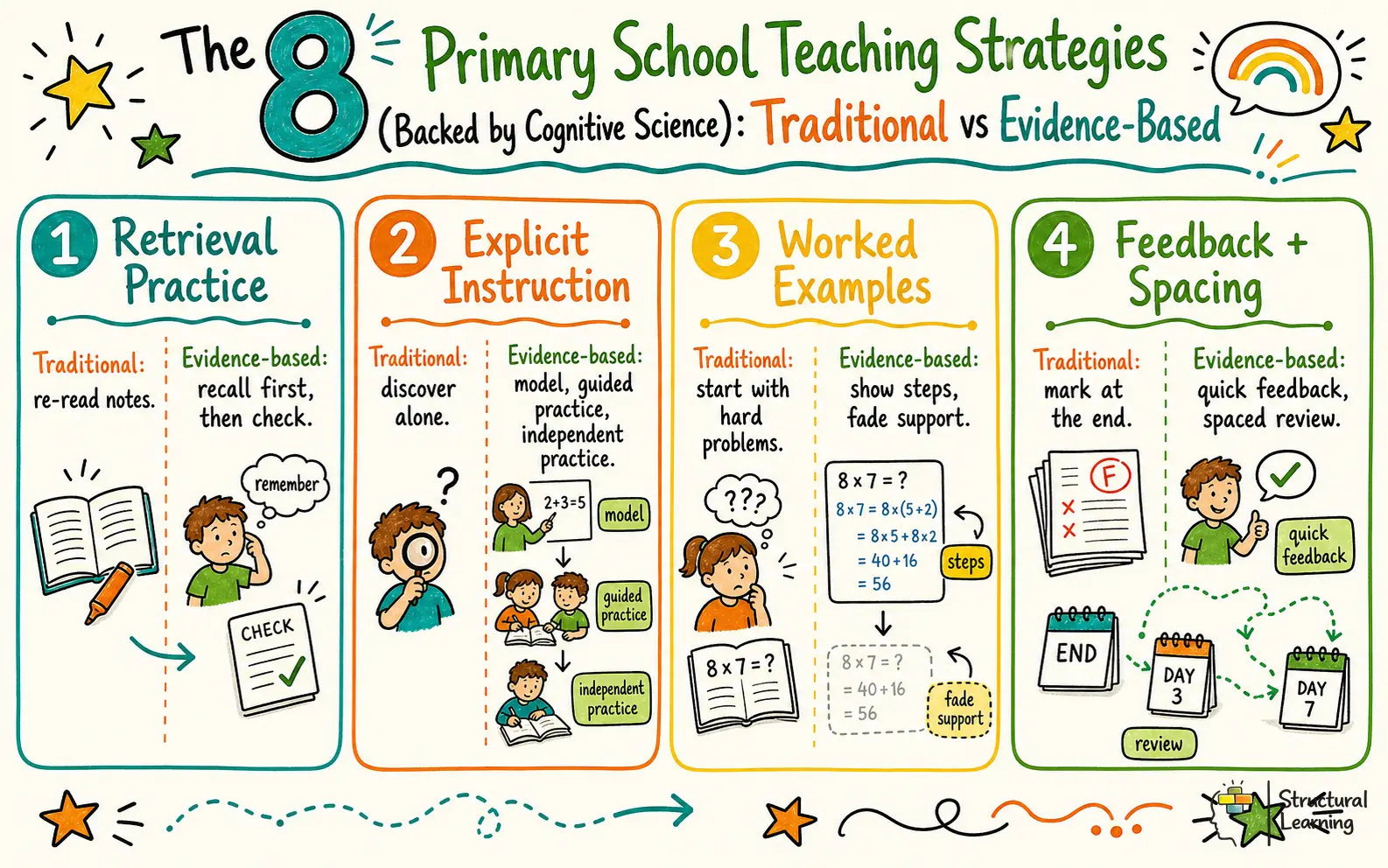
The Big 8 Primary School Teaching Strategies (Backed by Cognitive Science): Traditional vs Evidence-Based
What the teacher does: Explains a concept verbally while simultaneously drawing a simple, labelled diagram on the board, avoiding text-heavy slides.
What learners produce: Copied diagrams with their own brief annotations based on the verbal instruction.
Concrete example: In a KS2 science lesson about the water cycle, the teacher explains evaporation out loud. At the same time, they draw a diagram on the board. The learners listen and copy the diagram, linking the spoken vocabulary directly to the visual representation.
Strategy 3: Graphic Organisers for Visible Thinking
Graphic organisers help learners structure their thoughts and see relationships between concepts. Using specific frameworks like the 'Map It' approach provides a reliable structure for complex tasks.
What the teacher does: Shows how to plan writing using a graphic organiser. They think out loud to explain their decisions.
What learners produce: Categorised ideas within the same template, ensuring they have the necessary structure before attempting to write continuous prose.
Concrete example: When preparing for narrative writing in Year 3, the teacher uses a 'Map It' graphic organiser. They use a storyboard template to outline the beginning, build-up, problem, resolution, and ending. Learners complete their own storyboards, adding specific vocabulary to each section before drafting their stories.
Strategy 4: Structured Oracy with Role Cards
Oracy is learning to talk and learning through talk. Structured oracy requires a clear framework so that peer discussions are productive and equitable. The 'Say It' framework uses role cards to guide exploratory talk.
What the teacher does: Assigns specific roles to groups of three, such as 'Starter', 'Builder', and 'Challenger', providing sentence stems for each role on the board.
What learners produce: Structured group discussion, using role cards to initiate an idea, add to a peer's point, or politely disagree using evidence.
Concrete example: During Year 5 science exploratory talk about forces, the 'Starter' suggests an idea about friction. The 'Builder' uses their sentence stem to add another example. The 'Challenger' then questions the idea, prompting the group to critically evaluate their understanding before writing their conclusion.
Strategy 5: Explicit Modelling and Scaffolding
Modelling shows learners exactly what success looks like. Scaffolding provides temporary support that is gradually removed as competence increases. This is the cornerstone of direct instruction.
What the teacher does: Completes a task under a visualiser while explaining their thinking. They point out common mistakes, then give the class a partly finished version.
What learners produce: A scaffolded task relying on the teacher's model, gradually moving to independent practice as confidence builds.
Example: In a Year 6 English lesson, the teacher shows how to write a complex sentence with a subordinate clause. They also provide sentence starters on the board. Learners write their own sentences using the starters before constructing paragraphs independently.
Strategy 6: Spaced Practice
Spaced practice involves reviewing material over extended intervals rather than cramming. This spacing interrupts the forgetting curve and strengthens long-term memory.
What the teacher does: Deliberately schedules review questions from topics taught weeks or months ago into current daily routines.
What learners produce: Answers to past-topic questions alongside current-topic work, continually retrieving older knowledge.
Example: In a Year 4 geometry class, the teacher adds three fraction questions from last term to the morning starter task.
Strategy 7: Interleaving
Interleaving mixes different but related topics or types of problems within a single practice session, forcing learners to think about which strategy to apply rather than blindly repeating a single method.
What the teacher does: Creates practice tasks that alternate between different concepts requiring different solutions.
What learners produce: Work that demonstrates their ability to select the correct method for each specific problem.
Concrete example: Instead of providing a worksheet containing only multiplication problems, the teacher mixes addition, subtraction, and multiplication word problems. Learners must read carefully to identify which mathematical operation is required for each specific question.
Strategy 8: Actionable Feedback
Feedback must be specific, accurate, and provide a clear path for improvement (Hattie, 2009). Grading alone does not move learning forward; feedback must lead to learner action.
What the teacher does: Highlights a specific error or misconception and provides a direct, immediate prompt for correction.
What learners produce: An immediate edit or redraft of their work applying the feedback given.
Concrete example: The teacher uses live marking under a visualiser to show a common misconception about apostrophe placement. Learners immediately pick up their purple pens and edit their own sentences to correct the error.
Common Misconceptions
The idea that teaching strategies must cater to individual learning styles (visual, auditory, kinaesthetic) is a persistent myth. Evidence (Pashler et al., 2008) shows that categorising learners in this way does not improve outcomes and can limit their learning experience. Instead, teachers should select the teaching method that best fits the content, using dual coding to support all learners.
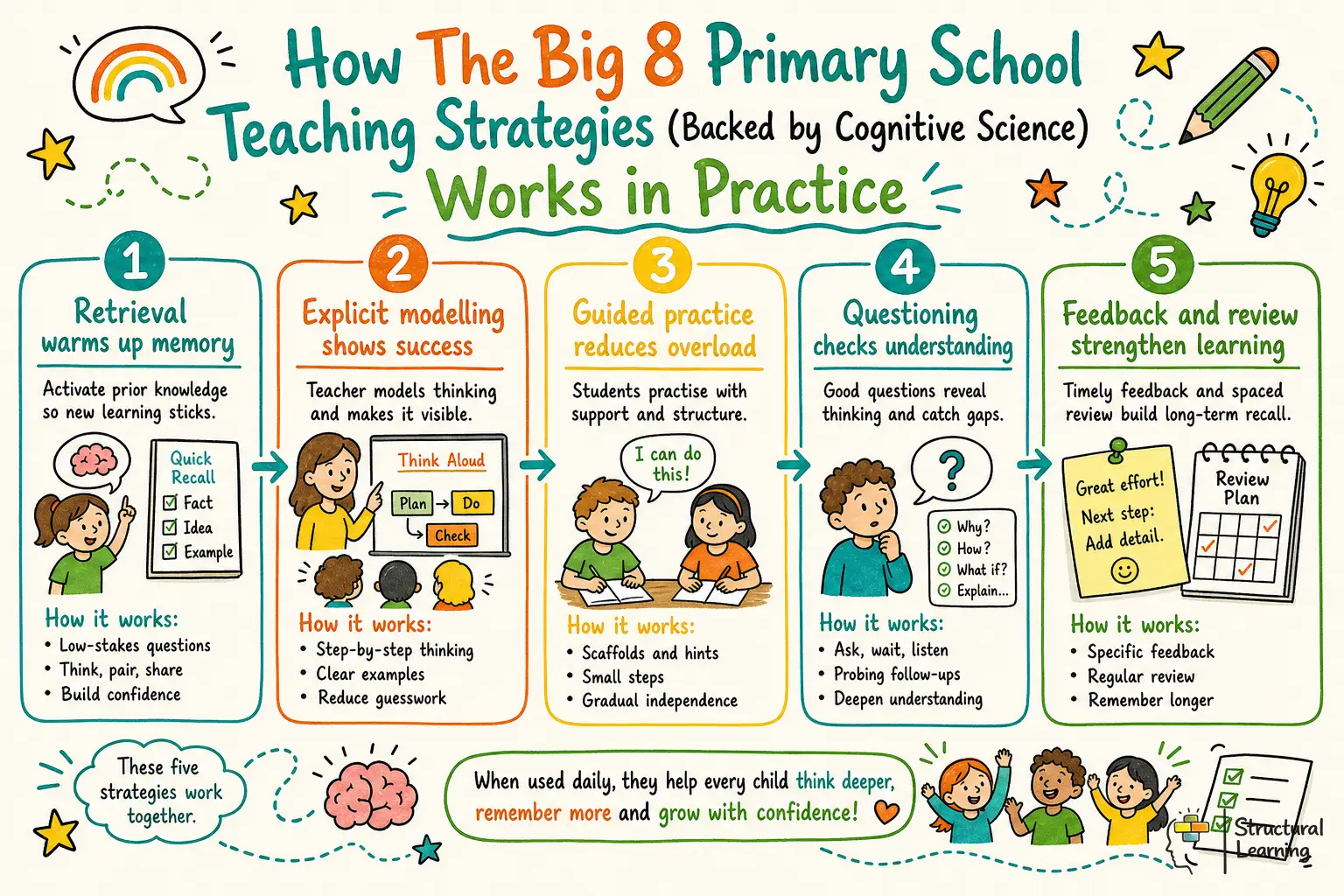
How The Big 8 Primary School Teaching Strategies (Backed by Cognitive Science) Works in Practice
Another misconception is that direct instruction means passive, silent learning. In reality, effective direct instruction is highly interactive. It involves continuous questioning, frequent checks for understanding, and guided practice. It is not simply lecturing from the front of the classroom.
Many believe that inquiry-based learning should replace explicit teaching to help children think critically. However, learners cannot think critically about subjects they know little about. Inquiry is highly effective, but it must be preceded by strong foundational knowledge built through explicit teaching.
Finally, there is a myth that differentiating for SEND learners means creating entirely different, simplified tasks. Effective differentiation involves keeping the learning goal the same but altering the scaffolding. This means providing a word bank, a structural frame, or more guided practice time, rather than diluting the curriculum content.
Classroom Example:
What the teacher does: Instead of giving a SEND learner a simplified text about the Victorians, the teacher provides the same text but adds a glossary and a 'Map It' graphic organiser to manage cognitive load.
What learners produce: The same high-level historical analysis as their peers, achieved through targeted structural support rather than lowered expectations.
Practical Implementation Guide
Implementing the Big 8 teaching strategies requires a deliberate, step-by-step approach. You cannot introduce every new technique on a Monday morning. Here is how to embed these methods sustainably while scaling through Webb's Depth of Knowledge.
Step 1: Audit your current practice. Spend a week noting down which teaching strategies you rely on most. Are you balancing direct instruction with inquiry? Are you managing cognitive load effectively? Identify one specific area for development.
Step 2: Introduce structured retrieval practice. This is the easiest win. Start your next lesson with a three-minute Brain Dump. Make it low-stakes and ensure children know it is for their own benefit, not for grading. This targets DoK Level 1 (Recall).
Step 3: Embed visible thinking routines. Introduce a 'Map It' graphic organiser for your next planning session. Model how to use it explicitly. Do not assume learners know how to organise their thoughts on a page. This supports progression to DoK Level 2 (Skill/Concept).
Step 4: Formalise your classroom talk. Instead of asking for a quick turn and talk, introduce 'Say It' role cards. Assign the roles of Starter, Builder, and Challenger. Provide sentence stems to ensure the conversation remains focused on the learning objective, pushing learners toward DoK Level 3 (Strategic Thinking).
Classroom Example:
What the teacher does: Plans a new science topic on habitats using a structured four-step approach.
What learners produce:
A Brain Dump to retrieve knowledge about animals from last term.
Copied visual diagrams drawn by the teacher to support working memory alongside verbal definitions.
Group discussions using 'Say It' role cards to debate why a polar bear could not survive in a desert.
A completed 'Map It' Venn diagram comparing two different habitats before writing their final comparative paragraph.
Primary School Teaching Strategies Across Subjects
Applying cognitive science to primary teaching means adapting these strategies for the specific demands of each subject.
Classroom Example: Maths
What the teacher does: Uses concrete base-10 blocks on a visualiser alongside written calculations when teaching long multiplication, modelling the concrete-pictorial-abstract approach.
Learner output: Pupils move physical blocks on their desks before using numbers in workbooks. This lowers cognitive load and helps embed understanding.
Classroom Example: English
What the teacher does: Provides a structured map to categorise arguments and issues 'Say It' role cards for oral rehearsal before drafting a persuasive letter.
What learners produce: strong, well-reasoned written arguments, refined through peer challenge where the 'Challenger' role forced them to verbally defend their points.
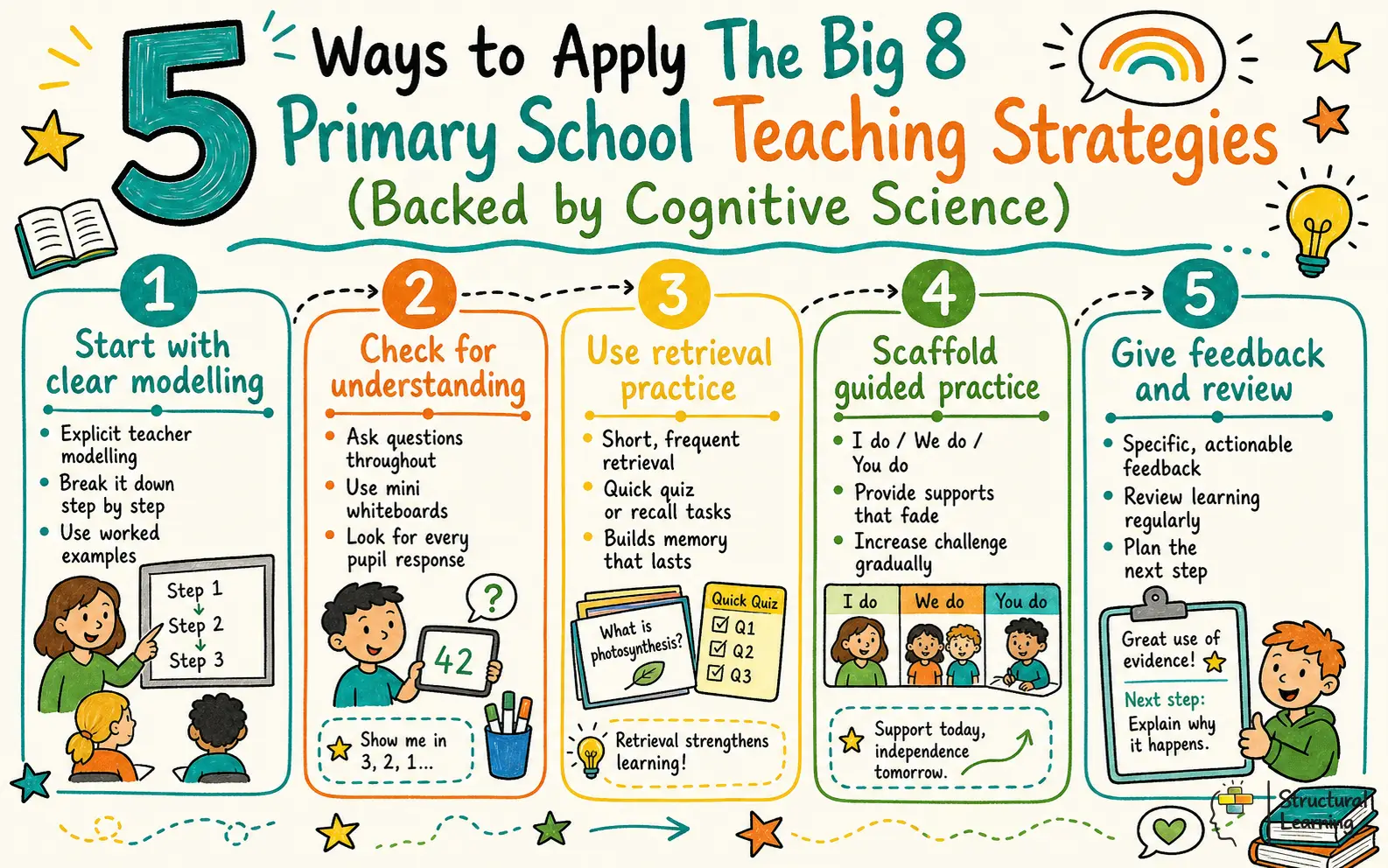
5 Ways to Apply The Big 8 Primary School Teaching Strategies (Backed by Cognitive Science)
Classroom Example: Science
What the teacher does: Explicitly teaches the vocabulary and principles of fair testing using direct instruction, then provides a structured inquiry task to investigate thermal insulators.
What learners produce: A critically evaluated experiment where results are analysed accurately because the foundational knowledge was taught directly beforehand.
Common Questions About Primary School Teaching Strategies
What are the Big 8 teaching strategies?
The Big 8 is a set of proven teaching methods. These include explicit instruction, retrieval practice, dual coding, scaffolding, spaced practice, interleaving, actionable feedback, and structured oracy. They provide a framework for teachers to design lessons that align with how the human brain learns and retains information.
How do I use teaching strategies to manage cognitive load?
You manage cognitive load by breaking complex tasks into smaller, manageable steps. Use worked examples, provide structural scaffolds like graphic organisers, and avoid presenting conflicting visual and auditory information simultaneously.
What is the best teaching method for primary school?
There is no single best teaching method. The most effective approach balances direct instruction for new content with guided inquiry and structured practice. The method chosen must always match the specific learning objective and the prior knowledge of the learners.
How can I ensure children think critically?
To ensure children think critically, you must first secure their foundational knowledge through explicit teaching. Once they have this knowledge base, use structured oracy frameworks like 'Say It' role cards to help deep, analytical discussions.
How do I adapt these core strategies for SEND learners?
Adapting core strategies for SEND learners involves providing heavier scaffolding, not reducing the challenge. Use clear dual coding, break instructions into single steps, and provide thorough graphic organisers to reduce working memory demands.
How do I measure the impact of my teaching strategies?
Measure impact through low-stakes retrieval practice and formative assessment during the lesson. A teaching strategy works if learners can finish independent practice successfully. They must also recall the information a week later during a Brain Dump.
Research sources
Further reading from peer-reviewed research
These 5 studies give source context for the classroom guidance in this article on The Big 8 Primary School Teaching Strategies (Backed by Cognitive Science). They are included as starting points for deeper reading, not as a substitute for local professional judgement.
Azman et al. (2025) | International Journal of Learning, Teaching and Educational Research
This research provides useful context for classroom decisions, especially when teachers match the intervention to learner need and check progress over time.
Dudley et al. (2015) | International Journal of Behavioral Nutrition and Physical Activity
This research provides useful context for classroom decisions, especially when teachers match the intervention to learner need and check progress over time.
This research provides useful context for classroom decisions, especially when teachers match the intervention to learner need and check progress over time.
This research provides useful context for classroom decisions, especially when teachers match the intervention to learner need and check progress over time.
This research provides useful context for classroom decisions, especially when teachers match the intervention to learner need and check progress over time.
About the Author
Paul Main
Founder & Metacognition Researcher
Paul Main is an educator and metacognition researcher who founded Structural Learning in 2002. With a psychology degree from the University of Sunderland and 22+ years helping schools embed thinking skills, he bridges the gap between educational research and classroom practice. Fellow of the RSA and Chartered College of Teaching, with 128+ Google Scholar citations.