Updated on
April 1, 2026
504 Plan vs IEP: What Every Teacher Needs to Know
|
February 26, 2026
A third-grade teacher sits across from two parents at a conference table. The student has been struggling with focus, losing homework.


Updated on
April 1, 2026
|
February 26, 2026
A third-grade teacher sits across from two parents at a conference table. The student has been struggling with focus, losing homework.
A third-grade teacher sits across from two parents at a conference table. The student has been struggling with focus, losing homework, and falling behind in reading. The mother asks, "Should my child have a 504 or an IEP?" This is a fair question. General education teachers hear it more often than their training programmes prepare them for. Both plans protect students with disabilities in public schools. Both require the school to take documented action. But they originate from different federal laws, cover different populations, and provide fundamentally different levels of support.
Getting this distinction right matters. The wrong pathway can leave a student without the instruction they need. It can also burden a family with a process that is too intensive for their child's situation. This guide breaks down the legal foundations, eligibility criteria, services provided, and practical decision points. This helps you advise families and participate in team meetings with confidence.

The IEP and the 504 Plan trace back to two separate pieces of federal legislation, each with a distinct purpose. See also: 504 plan vs iep differences.
The Individuals with Disabilities Education Act (IDEA) is a funding statute. Congress allocates federal dollars to states and school districts specifically to provide a free appropriate public education (FAPE) to students with disabilities. In exchange for that funding, schools must follow detailed procedural requirements: formal evaluations, eligibility determinations, individualized education programs, annual reviews, and triennial reevaluations. IDEA was first enacted in 1975 as the Education for All Handicapped Children Act and has been reauthorized several times, most recently in 2004. The Supreme Court clarified in Endrew F. v. Douglas County School District (2017) that an IEP must be "reasonably calculated to enable a child to make progress appropriate in light of the child's circumstances." This raised the bar from the previous "merely more than de minimis" standard.
Section 504 of the Rehabilitation Act of 1973 is a civil rights statute. It prohibits discrimination against individuals with disabilities in any program that receives federal funding, which includes virtually every public school in the country. Section 504 does not provide additional funding. It requires schools to ensure that students with disabilities have equal access to education. The Office for Civil Rights (OCR) within the U.S. Department of Education enforces Section 504 in schools.
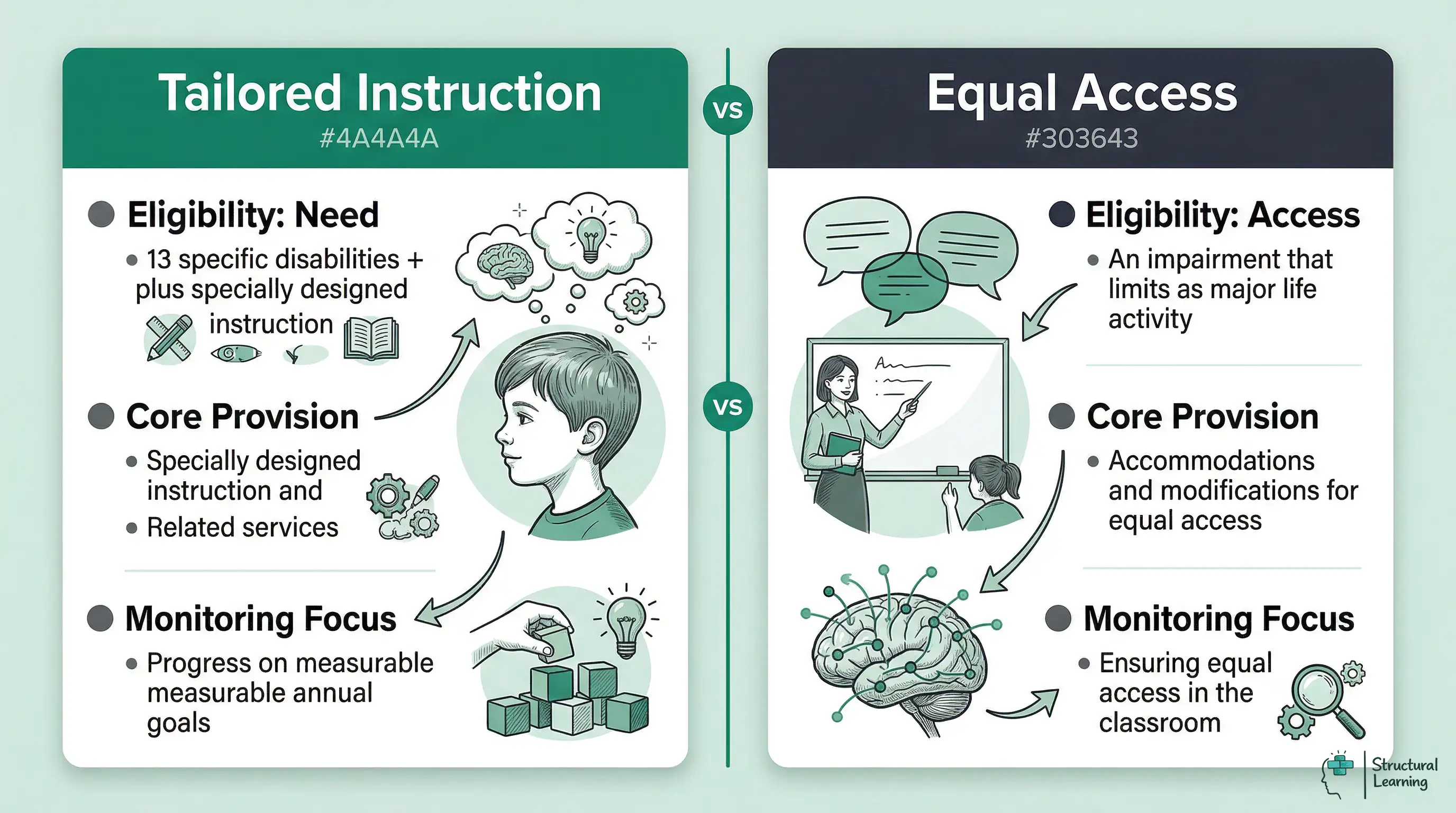
The practical consequence of this legal distinction is significant. IDEA creates an entitlement to services. Section 504 creates a right to access. A student with an IEP receives specially designed instruction tailored to their needs. A student with a 504 Plan receives adjustments to the general education environment that remove barriers to access.
Feature
IEP (IDEA)
504 Plan (Section 504)
Type of law
Federal education funding statute
Federal civil rights statute
Primary purpose
Provide specially designed instruction
Ensure equal access to education
Federal funding provided
Yes
No
Enforced by
State education agencies, OSEP
Office for Civil Rights (OCR)
Written plan required
Yes (detailed IEP document)
Recommended but not federally mandated
The two plans use different eligibility standards, and the gap between them explains why some students qualify for one but not the other.
To receive an IEP under IDEA, a student must meet two criteria. First, they must have a disability that falls within one of 13 categories defined by federal law (see the full list below). Second, because of that disability, they must need specially designed instruction to make progress in the general education curriculum. Both conditions must be met. A student with a diagnosed disability who performs at grade level with standard classroom support does not qualify for an IEP. This is because the second criterion is not met.
Section 504 uses a broader standard. A student is eligible if they have a physical or mental impairment that substantially limits one or more major life activities. Major life activities include learning, reading, concentrating, thinking, communicating, and several others. The 2008 amendments to the Americans with Disabilities Act (which Section 504 references) expanded this definition and instructed schools to interpret "substantially limits" broadly.
The key insight for teachers: every student with an IEP is also protected under Section 504. This is because IDEA disabilities are part of the broader 504 definition. But many students who qualify for a 504 Plan do not meet the stricter IEP criteria. A student with ADHD who manages grade-level work when given preferential seating, movement breaks, and extended time on tests has a disability that substantially limits concentration (504 eligible), but does not need specially designed instruction (not IEP eligible). A different student with ADHD who is failing multiple subjects despite consistent accommodations may need an IEP evaluation, because the accommodations alone are not sufficient.
This creates a practical continuum. Some students move from a 504 Plan to an IEP as their needs increase. Others move from an IEP to a 504 Plan as they develop compensatory strategies and need less intensive support. The plans are not a hierarchy; they are different tools matched to different levels of need. Understanding how executive function affects classroom performance helps teachers recognise when a student's difficulties go beyond what accommodations can address.
The clearest way to understand the difference between an IEP and a 504 Plan is to look at what each one actually delivers.
An IEP provides specially designed instruction (SDI). This means instruction that is adapted in content, methodology, or delivery to address the student's unique needs. SDI is not the same as accommodation. Accommodation changes the environment; SDI changes the teaching. A student receiving SDI in reading might work with a special education teacher using a structured literacy programme. This would be at their instructional level, rather than the year-level curriculum their peers use. The IEP also includes related services (speech-language therapy, occupational therapy, counseling, or others as needed), measurable annual goals with progress monitoring, transition planning beginning at age 16, and procedural safeguards that protect family rights throughout the process.
A 504 Plan provides accommodations and, in some cases, modifications to the general education environment. Accommodations change how a student accesses the same curriculum (extended time, preferential seating, audio versions of texts). Modifications change what the student is expected to learn (reduced number of spelling words, alternative assignments). The 504 Plan does not require measurable annual goals, though some districts include them voluntarily. It does not fund related services, though a school may still provide them as part of ensuring equal access.
The distinction between scaffolding and permanent support is relevant here. A 504 accommodation is ongoing support that removes a barrier. An IEP's specially designed instruction is intended to build skills so the student can eventually need less support.
Component
IEP
504 Plan
Specially designed instruction
Yes, required
No
Related services (speech, OT, counseling)
Yes, if needed
Not typically, but possible
Measurable annual goals
Yes, required
Not required (some districts include them)
Progress monitoring
Required, reported to parents
Not federally required
Transition planning
Required by age 16
Not required
Accommodations
Yes
Yes (primary tool)
Modifications
Yes, if appropriate
Yes, if appropriate
General education participation
Least restrictive environment required
Student remains in general education
To qualify for an IEP, a student must meet criteria in at least one of these federally defined categories. Each state may use slightly different terminology, but the categories themselves are set by federal law.
Some conditions can fall under either pathway. A student with ADHD might receive a 504 Plan if accommodations are enough. They might get an IEP under 'other health impairment' if they need specially designed instruction. The classroom strategies for managing ADHD often determine which pathway is appropriate. Similarly, a student on the autism spectrum might have a 504 Plan if their needs are mainly environmental. They might have an IEP if they need social skills instruction, communication support, or behavioural intervention.
A well-written 504 Plan matches specific accommodations to the functional limitations caused by the student's disability. The following examples represent common accommodations organised by condition. Effective accommodation design requires understanding how working memory and cognitive load interact with the student's disability.
Condition
Common 504 Accommodations
ADHD
Preferential seating away from distractions; extended time on tests (typically time-and-a-half); scheduled movement breaks; chunked assignments with check-in points; visual timers; written and verbal directions; reduced items on worksheets; fidget tools
Anxiety disorders
Quiet or separate testing environment; advance notice of schedule changes; flexible deadlines during flare-ups; permission to leave classroom for self-regulation; reduced public speaking requirements; access to school counselor; modified attendance policy during acute episodes
Dyslexia (without SDI need)
Text-to-speech software; audiobook access; reduced copying from the board; spelling not penalized in non-spelling assessments; extended time for reading-heavy tasks; graphic organizers for written assignments; oral testing options
Physical disabilities
Elevator access; modified PE participation; ergonomic seating; extra time between classes; rest breaks as needed; accessible classroom layout; assistive technology for written work
Diabetes and medical conditions
Unrestricted bathroom access; permission to eat snacks in class; nurse access for blood sugar monitoring; modified attendance policy for medical appointments; water bottle at desk; make-up work without penalty after absences
Depression
Check-in with counselor or trusted adult; flexible assignment deadlines; reduced homework load during episodes; late arrival permission; modified grading for participation during acute periods; quiet workspace option
The most effective 504 Plans are specific rather than generic. "Extended time" is vague. "Time-and-a-half on all timed assessments, administered in the resource room" is specific enough to use consistently across teachers. Using graphic organisers as a 504 accommodation for writing tasks shows why being specific matters. The plan should name which type of organiser and for which assignment types.
When designing accommodations, consider the executive function demands of your classroom routines. A student with ADHD may not need fewer problems on a worksheet. Instead, they might need the problems broken into smaller groups with a brief check-in between each set.

Teachers are often the first to notice that a student is struggling, and are frequently asked for their opinion on which pathway to pursue. The decision is ultimately made by a team, but your classroom observations carry significant weight.
Start with this question: Is the student falling behind academically despite the accommodations currently in place? If the answer is yes, and the student needs instruction that is very different from general education, then an IEP evaluation is the right next step. "Fundamentally different" means a different curriculum, a different pace of instruction, explicit teaching of skills that peers have already acquired, or pull-out services with a specialist.
If the student is keeping pace with grade-level content but needs environmental adjustments to access it fairly, a 504 Plan is likely sufficient. The student with ADHD who understands the material but struggles with test-taking conditions benefits from extended time and a quiet room. They do not need a different reading programme. The student with anxiety who can complete all assignments but shuts down during timed assessments needs a testing accommodation, not specially designed instruction.
A common misconception is that a 504 Plan is "less than" an IEP, or that an IEP is always better. This is not accurate. A 504 Plan is the right tool when the barrier is environmental. An IEP is the right tool when the barrier is instructional. Applying differentiation strategies effectively in the general education classroom can sometimes resolve concerns before either formal pathway is needed.
One more important point: if you believe a student needs evaluation, put the request in writing. Schools have a legal obligation to respond to written referrals. A verbal suggestion in a hallway conversation does not carry the same weight.
The evaluation processes for IEPs and 504 Plans differ in formality, timeline, and scope.
An IEP evaluation is thorough. The school must obtain written parental consent before beginning. The evaluation team, which typically includes a school psychologist, special education teacher, and general education teacher, conducts psychoeducational testing, classroom observations, and reviews existing data. Most states require the evaluation to be completed within 60 calendar days of receiving consent, though some states use school days. The evaluation must assess all areas of suspected disability and use a variety of assessment tools. No single test or criterion can be used as the sole basis for determining eligibility. Using formative assessment data you have already collected helps the evaluation team make accurate decisions. Examples include running records, curriculum-based measures, and behaviour tracking logs.
A 504 evaluation is less formal. Schools can use existing data, including grades, standardized test scores, teacher observations, medical records, and parent input, to determine eligibility. Formal psychoeducational testing is not required, though a school may request it. There is no federally mandated timeline for completing a 504 evaluation, though schools are expected to act within a reasonable period.
For both pathways, referrals can come from parents or school staff. A parent can request an evaluation in writing at any time. A teacher, counselor, or administrator can also initiate the referral process. Schools cannot refuse to evaluate a student when there is reason to suspect a disability, even if the student is earning passing grades. Grades alone do not determine eligibility under either law.
Both IEPs and 504 Plans include protections for families, but the scope of those protections differs substantially.
IDEA provides the most strong procedural safeguards in special education law. Parents must receive prior written notice before the school proposes or refuses to change the identification, evaluation, or placement of their child. They have the right to give or withhold consent at each stage. They can request an Independent Educational Evaluation (IEE) at public expense if they disagree with the school's evaluation. If a dispute arises, parents can pursue mediation, file a state complaint, or request a due process hearing before an impartial hearing officer. IDEA also includes the "stay-put" provision: during any dispute, the student remains in their current placement until the matter is resolved.
Section 504 safeguards are less extensive but still meaningful. Parents must receive notice of any actions the school takes regarding identification, evaluation, or placement under 504. They have the right to examine relevant records. If they disagree with the school's decisions, they can request an impartial hearing at the local level. They can also file a complaint directly with the Office for Civil Rights. However, 504 does not include a stay-put provision. It does not require consent for evaluation (only notice), and does not guarantee the right to an independent evaluation at public expense.
For teachers, the practical takeaway is straightforward. Document your observations carefully and consistently. Attend meetings prepared with data. If a parent raises concerns about their child's plan, direct them to the right person. This could be the school's 504 coordinator or the special education department. Know the difference so you can point families toward the right resource.
Structural Learning serves a global audience, and many of our readers work in UK schools. The US and UK systems address similar needs through different legal frameworks. The table below provides approximate equivalencies; the systems are not identical, but understanding the parallels is useful for teachers who move between systems or collaborate internationally.
US Term
UK Equivalent
Purpose
IEP (Individualized Education Program)
EHCP (Education, Health and Care Plan)
Legally binding plan providing specialist services and instruction for students with significant needs
504 Plan
SEN Support
School-level adjustments and accommodations within the general education setting
MTSS/RTI (Multi-Tiered System of Supports)
Graduated Approach (Assess, Plan, Do, Review)
Tiered intervention framework used before or alongside formal plans
IDEA (federal law)
Children and Families Act 2014 / SEND Code of Practice
Primary legislation governing provision for students with disabilities
FAPE (Free Appropriate Public Education)
SEND provision duty
Legal requirement to meet the educational needs of students with disabilities
The UK's EHCP process shares many features with the US IEP: formal assessment, legally binding provisions, annual review, and a right of appeal. SEN Support in the UK, like the 504 Plan, operates at the school level with less formal documentation requirements. UK readers looking for a thorough guide to the SEND framework should see our full article on special educational needs.
One notable difference is that the UK's Graduated Approach (Assess, Plan, Do, Review) is embedded as a required first step before escalating to an EHCP, whereas in the US, MTSS/RTI is widely used but not federally required as a prerequisite for IEP evaluation. Understanding how to build SEND-friendly learning environments is central to both systems.

An Individualised Education Programme provides specially designed instruction under federal funding laws for students meeting specific disability criteria. A 504 plan falls under civil rights law to ensure equal access through classroom accommodations. While an IEP changes what a student learns, a 504 plan typically changes how they access the learning environment.
Teachers use a 504 plan by providing the specific classroom adjustments listed in the legal document. These modifications remove physical or cognitive barriers to learning and might include preferential seating, extended time on tests, or access to audiobooks. Educators must maintain accurate records of when and how these accommodations are provided to ensure compliance.
An IEP guarantees that a student receives instruction specifically tailored to their unique educational needs. It establishes measurable annual goals and mandates regular progress monitoring by the teaching staff. This formal structure ensures that schools remain legally accountable for helping the student make meaningful academic progress over time.
Research indicates that accommodations are most effective when they are directly linked to a student's specific barriers rather than applied as a generic checklist. Studies show that targeted adjustments can significantly improve academic outcomes when implemented consistently. Evidence suggests that regular review and data collection by teachers are critical for determining if a chosen support strategy actually works.
A frequent mistake is failing to record daily classroom observations and behaviour logs systematically. Teachers sometimes rely on memory rather than written evidence when participating in evaluation meetings with parents. Without consistent documentation, schools struggle to prove that they have met their legal obligations or to identify if an accommodation needs adjusting.
You do not need to be a special education expert to be effective at supporting students with IEPs and 504 Plans. You need to know what the plan says, use it consistently, and document what happens.
Read every plan at the start of the year. This sounds obvious, but surveys of general education teachers consistently show that many do not read their students' accommodation plans thoroughly. Set aside time during the first week to review each plan, note the specific accommodations, and flag anything you are unsure how to use. Contact the case manager or 504 coordinator with questions before the student encounters a situation where the accommodation should have been in place.
Document your implementation. Keep a simple log of when and how you provide accommodations. This protects you professionally and provides data for the team. When an accommodation is not working, your documentation is the evidence the team needs to revise the plan. A spreadsheet with dates, accommodation provided, and brief notes on student response is sufficient.
Communicate with families proactively. Do not wait for the annual review to share concerns. If a student with a 504 Plan is struggling despite accommodations, contact the family and the 504 coordinator. If a student on an IEP is exceeding their goals, share that success. Parents are required members of both IEP and 504 teams; they should not be learning new information for the first time at a meeting.
Speak up when accommodations are not working. Plans can and should be amended when the data shows a need. If a student's extended time accommodation is not helping because the real barrier is reading fluency rather than processing speed, say so. Your observations matter. Teachers who understand metacognitive strategies can help teams identify whether the barrier is a skill gap, a strategy gap, or an environmental mismatch.
Know the difference between accommodation and modification. An accommodation changes how a student accesses the same material (text-to-speech, extra time, preferential seating). A modification changes what the student is expected to do (fewer problems, different reading level, alternative assignment). Both have their place, but they are not interchangeable, and using the wrong term in a meeting can cause confusion.
Next time you sit down to review a student's plan, identify one accommodation you have not been implementing consistently. Put it in place tomorrow and track whether it changes the student's performance over the next two weeks.
External References: UK Government: Extra Support for SEN Children | EEF: Special Educational Needs in Mainstream Schools
A third-grade teacher sits across from two parents at a conference table. The student has been struggling with focus, losing homework, and falling behind in reading. The mother asks, "Should my child have a 504 or an IEP?" This is a fair question. General education teachers hear it more often than their training programmes prepare them for. Both plans protect students with disabilities in public schools. Both require the school to take documented action. But they originate from different federal laws, cover different populations, and provide fundamentally different levels of support.
Getting this distinction right matters. The wrong pathway can leave a student without the instruction they need. It can also burden a family with a process that is too intensive for their child's situation. This guide breaks down the legal foundations, eligibility criteria, services provided, and practical decision points. This helps you advise families and participate in team meetings with confidence.
The IEP and the 504 Plan trace back to two separate pieces of federal legislation, each with a distinct purpose. See also: 504 plan vs iep differences.
The Individuals with Disabilities Education Act (IDEA) is a funding statute. Congress allocates federal dollars to states and school districts specifically to provide a free appropriate public education (FAPE) to students with disabilities. In exchange for that funding, schools must follow detailed procedural requirements: formal evaluations, eligibility determinations, individualized education programs, annual reviews, and triennial reevaluations. IDEA was first enacted in 1975 as the Education for All Handicapped Children Act and has been reauthorized several times, most recently in 2004. The Supreme Court clarified in Endrew F. v. Douglas County School District (2017) that an IEP must be "reasonably calculated to enable a child to make progress appropriate in light of the child's circumstances." This raised the bar from the previous "merely more than de minimis" standard.
Section 504 of the Rehabilitation Act of 1973 is a civil rights statute. It prohibits discrimination against individuals with disabilities in any program that receives federal funding, which includes virtually every public school in the country. Section 504 does not provide additional funding. It requires schools to ensure that students with disabilities have equal access to education. The Office for Civil Rights (OCR) within the U.S. Department of Education enforces Section 504 in schools.
The practical consequence of this legal distinction is significant. IDEA creates an entitlement to services. Section 504 creates a right to access. A student with an IEP receives specially designed instruction tailored to their needs. A student with a 504 Plan receives adjustments to the general education environment that remove barriers to access.
Feature
IEP (IDEA)
504 Plan (Section 504)
Type of law
Federal education funding statute
Federal civil rights statute
Primary purpose
Provide specially designed instruction
Ensure equal access to education
Federal funding provided
Yes
No
Enforced by
State education agencies, OSEP
Office for Civil Rights (OCR)
Written plan required
Yes (detailed IEP document)
Recommended but not federally mandated
The two plans use different eligibility standards, and the gap between them explains why some students qualify for one but not the other.
To receive an IEP under IDEA, a student must meet two criteria. First, they must have a disability that falls within one of 13 categories defined by federal law (see the full list below). Second, because of that disability, they must need specially designed instruction to make progress in the general education curriculum. Both conditions must be met. A student with a diagnosed disability who performs at grade level with standard classroom support does not qualify for an IEP. This is because the second criterion is not met.
Section 504 uses a broader standard. A student is eligible if they have a physical or mental impairment that substantially limits one or more major life activities. Major life activities include learning, reading, concentrating, thinking, communicating, and several others. The 2008 amendments to the Americans with Disabilities Act (which Section 504 references) expanded this definition and instructed schools to interpret "substantially limits" broadly.
The key insight for teachers: every student with an IEP is also protected under Section 504. This is because IDEA disabilities are part of the broader 504 definition. But many students who qualify for a 504 Plan do not meet the stricter IEP criteria. A student with ADHD who manages grade-level work when given preferential seating, movement breaks, and extended time on tests has a disability that substantially limits concentration (504 eligible), but does not need specially designed instruction (not IEP eligible). A different student with ADHD who is failing multiple subjects despite consistent accommodations may need an IEP evaluation, because the accommodations alone are not sufficient.
This creates a practical continuum. Some students move from a 504 Plan to an IEP as their needs increase. Others move from an IEP to a 504 Plan as they develop compensatory strategies and need less intensive support. The plans are not a hierarchy; they are different tools matched to different levels of need. Understanding how executive function affects classroom performance helps teachers recognise when a student's difficulties go beyond what accommodations can address.
The clearest way to understand the difference between an IEP and a 504 Plan is to look at what each one actually delivers.
An IEP provides specially designed instruction (SDI). This means instruction that is adapted in content, methodology, or delivery to address the student's unique needs. SDI is not the same as accommodation. Accommodation changes the environment; SDI changes the teaching. A student receiving SDI in reading might work with a special education teacher using a structured literacy programme. This would be at their instructional level, rather than the year-level curriculum their peers use. The IEP also includes related services (speech-language therapy, occupational therapy, counseling, or others as needed), measurable annual goals with progress monitoring, transition planning beginning at age 16, and procedural safeguards that protect family rights throughout the process.
A 504 Plan provides accommodations and, in some cases, modifications to the general education environment. Accommodations change how a student accesses the same curriculum (extended time, preferential seating, audio versions of texts). Modifications change what the student is expected to learn (reduced number of spelling words, alternative assignments). The 504 Plan does not require measurable annual goals, though some districts include them voluntarily. It does not fund related services, though a school may still provide them as part of ensuring equal access.
The distinction between scaffolding and permanent support is relevant here. A 504 accommodation is ongoing support that removes a barrier. An IEP's specially designed instruction is intended to build skills so the student can eventually need less support.
Component
IEP
504 Plan
Specially designed instruction
Yes, required
No
Related services (speech, OT, counseling)
Yes, if needed
Not typically, but possible
Measurable annual goals
Yes, required
Not required (some districts include them)
Progress monitoring
Required, reported to parents
Not federally required
Transition planning
Required by age 16
Not required
Accommodations
Yes
Yes (primary tool)
Modifications
Yes, if appropriate
Yes, if appropriate
General education participation
Least restrictive environment required
Student remains in general education
To qualify for an IEP, a student must meet criteria in at least one of these federally defined categories. Each state may use slightly different terminology, but the categories themselves are set by federal law.
Some conditions can fall under either pathway. A student with ADHD might receive a 504 Plan if accommodations are enough. They might get an IEP under 'other health impairment' if they need specially designed instruction. The classroom strategies for managing ADHD often determine which pathway is appropriate. Similarly, a student on the autism spectrum might have a 504 Plan if their needs are mainly environmental. They might have an IEP if they need social skills instruction, communication support, or behavioural intervention.
A well-written 504 Plan matches specific accommodations to the functional limitations caused by the student's disability. The following examples represent common accommodations organised by condition. Effective accommodation design requires understanding how working memory and cognitive load interact with the student's disability.
Condition
Common 504 Accommodations
ADHD
Preferential seating away from distractions; extended time on tests (typically time-and-a-half); scheduled movement breaks; chunked assignments with check-in points; visual timers; written and verbal directions; reduced items on worksheets; fidget tools
Anxiety disorders
Quiet or separate testing environment; advance notice of schedule changes; flexible deadlines during flare-ups; permission to leave classroom for self-regulation; reduced public speaking requirements; access to school counselor; modified attendance policy during acute episodes
Dyslexia (without SDI need)
Text-to-speech software; audiobook access; reduced copying from the board; spelling not penalized in non-spelling assessments; extended time for reading-heavy tasks; graphic organizers for written assignments; oral testing options
Physical disabilities
Elevator access; modified PE participation; ergonomic seating; extra time between classes; rest breaks as needed; accessible classroom layout; assistive technology for written work
Diabetes and medical conditions
Unrestricted bathroom access; permission to eat snacks in class; nurse access for blood sugar monitoring; modified attendance policy for medical appointments; water bottle at desk; make-up work without penalty after absences
Depression
Check-in with counselor or trusted adult; flexible assignment deadlines; reduced homework load during episodes; late arrival permission; modified grading for participation during acute periods; quiet workspace option
The most effective 504 Plans are specific rather than generic. "Extended time" is vague. "Time-and-a-half on all timed assessments, administered in the resource room" is specific enough to use consistently across teachers. Using graphic organisers as a 504 accommodation for writing tasks shows why being specific matters. The plan should name which type of organiser and for which assignment types.
When designing accommodations, consider the executive function demands of your classroom routines. A student with ADHD may not need fewer problems on a worksheet. Instead, they might need the problems broken into smaller groups with a brief check-in between each set.
Teachers are often the first to notice that a student is struggling, and are frequently asked for their opinion on which pathway to pursue. The decision is ultimately made by a team, but your classroom observations carry significant weight.
Start with this question: Is the student falling behind academically despite the accommodations currently in place? If the answer is yes, and the student needs instruction that is very different from general education, then an IEP evaluation is the right next step. "Fundamentally different" means a different curriculum, a different pace of instruction, explicit teaching of skills that peers have already acquired, or pull-out services with a specialist.
If the student is keeping pace with grade-level content but needs environmental adjustments to access it fairly, a 504 Plan is likely sufficient. The student with ADHD who understands the material but struggles with test-taking conditions benefits from extended time and a quiet room. They do not need a different reading programme. The student with anxiety who can complete all assignments but shuts down during timed assessments needs a testing accommodation, not specially designed instruction.
A common misconception is that a 504 Plan is "less than" an IEP, or that an IEP is always better. This is not accurate. A 504 Plan is the right tool when the barrier is environmental. An IEP is the right tool when the barrier is instructional. Applying differentiation strategies effectively in the general education classroom can sometimes resolve concerns before either formal pathway is needed.
One more important point: if you believe a student needs evaluation, put the request in writing. Schools have a legal obligation to respond to written referrals. A verbal suggestion in a hallway conversation does not carry the same weight.
The evaluation processes for IEPs and 504 Plans differ in formality, timeline, and scope.
An IEP evaluation is thorough. The school must obtain written parental consent before beginning. The evaluation team, which typically includes a school psychologist, special education teacher, and general education teacher, conducts psychoeducational testing, classroom observations, and reviews existing data. Most states require the evaluation to be completed within 60 calendar days of receiving consent, though some states use school days. The evaluation must assess all areas of suspected disability and use a variety of assessment tools. No single test or criterion can be used as the sole basis for determining eligibility. Using formative assessment data you have already collected helps the evaluation team make accurate decisions. Examples include running records, curriculum-based measures, and behaviour tracking logs.
A 504 evaluation is less formal. Schools can use existing data, including grades, standardized test scores, teacher observations, medical records, and parent input, to determine eligibility. Formal psychoeducational testing is not required, though a school may request it. There is no federally mandated timeline for completing a 504 evaluation, though schools are expected to act within a reasonable period.
For both pathways, referrals can come from parents or school staff. A parent can request an evaluation in writing at any time. A teacher, counselor, or administrator can also initiate the referral process. Schools cannot refuse to evaluate a student when there is reason to suspect a disability, even if the student is earning passing grades. Grades alone do not determine eligibility under either law.
Both IEPs and 504 Plans include protections for families, but the scope of those protections differs substantially.
IDEA provides the most strong procedural safeguards in special education law. Parents must receive prior written notice before the school proposes or refuses to change the identification, evaluation, or placement of their child. They have the right to give or withhold consent at each stage. They can request an Independent Educational Evaluation (IEE) at public expense if they disagree with the school's evaluation. If a dispute arises, parents can pursue mediation, file a state complaint, or request a due process hearing before an impartial hearing officer. IDEA also includes the "stay-put" provision: during any dispute, the student remains in their current placement until the matter is resolved.
Section 504 safeguards are less extensive but still meaningful. Parents must receive notice of any actions the school takes regarding identification, evaluation, or placement under 504. They have the right to examine relevant records. If they disagree with the school's decisions, they can request an impartial hearing at the local level. They can also file a complaint directly with the Office for Civil Rights. However, 504 does not include a stay-put provision. It does not require consent for evaluation (only notice), and does not guarantee the right to an independent evaluation at public expense.
For teachers, the practical takeaway is straightforward. Document your observations carefully and consistently. Attend meetings prepared with data. If a parent raises concerns about their child's plan, direct them to the right person. This could be the school's 504 coordinator or the special education department. Know the difference so you can point families toward the right resource.
Structural Learning serves a global audience, and many of our readers work in UK schools. The US and UK systems address similar needs through different legal frameworks. The table below provides approximate equivalencies; the systems are not identical, but understanding the parallels is useful for teachers who move between systems or collaborate internationally.
US Term
UK Equivalent
Purpose
IEP (Individualized Education Program)
EHCP (Education, Health and Care Plan)
Legally binding plan providing specialist services and instruction for students with significant needs
504 Plan
SEN Support
School-level adjustments and accommodations within the general education setting
MTSS/RTI (Multi-Tiered System of Supports)
Graduated Approach (Assess, Plan, Do, Review)
Tiered intervention framework used before or alongside formal plans
IDEA (federal law)
Children and Families Act 2014 / SEND Code of Practice
Primary legislation governing provision for students with disabilities
FAPE (Free Appropriate Public Education)
SEND provision duty
Legal requirement to meet the educational needs of students with disabilities
The UK's EHCP process shares many features with the US IEP: formal assessment, legally binding provisions, annual review, and a right of appeal. SEN Support in the UK, like the 504 Plan, operates at the school level with less formal documentation requirements. UK readers looking for a thorough guide to the SEND framework should see our full article on special educational needs.
One notable difference is that the UK's Graduated Approach (Assess, Plan, Do, Review) is embedded as a required first step before escalating to an EHCP, whereas in the US, MTSS/RTI is widely used but not federally required as a prerequisite for IEP evaluation. Understanding how to build SEND-friendly learning environments is central to both systems.
An Individualised Education Programme provides specially designed instruction under federal funding laws for students meeting specific disability criteria. A 504 plan falls under civil rights law to ensure equal access through classroom accommodations. While an IEP changes what a student learns, a 504 plan typically changes how they access the learning environment.
Teachers use a 504 plan by providing the specific classroom adjustments listed in the legal document. These modifications remove physical or cognitive barriers to learning and might include preferential seating, extended time on tests, or access to audiobooks. Educators must maintain accurate records of when and how these accommodations are provided to ensure compliance.
An IEP guarantees that a student receives instruction specifically tailored to their unique educational needs. It establishes measurable annual goals and mandates regular progress monitoring by the teaching staff. This formal structure ensures that schools remain legally accountable for helping the student make meaningful academic progress over time.
Research indicates that accommodations are most effective when they are directly linked to a student's specific barriers rather than applied as a generic checklist. Studies show that targeted adjustments can significantly improve academic outcomes when implemented consistently. Evidence suggests that regular review and data collection by teachers are critical for determining if a chosen support strategy actually works.
A frequent mistake is failing to record daily classroom observations and behaviour logs systematically. Teachers sometimes rely on memory rather than written evidence when participating in evaluation meetings with parents. Without consistent documentation, schools struggle to prove that they have met their legal obligations or to identify if an accommodation needs adjusting.
You do not need to be a special education expert to be effective at supporting students with IEPs and 504 Plans. You need to know what the plan says, use it consistently, and document what happens.
Read every plan at the start of the year. This sounds obvious, but surveys of general education teachers consistently show that many do not read their students' accommodation plans thoroughly. Set aside time during the first week to review each plan, note the specific accommodations, and flag anything you are unsure how to use. Contact the case manager or 504 coordinator with questions before the student encounters a situation where the accommodation should have been in place.
Document your implementation. Keep a simple log of when and how you provide accommodations. This protects you professionally and provides data for the team. When an accommodation is not working, your documentation is the evidence the team needs to revise the plan. A spreadsheet with dates, accommodation provided, and brief notes on student response is sufficient.
Communicate with families proactively. Do not wait for the annual review to share concerns. If a student with a 504 Plan is struggling despite accommodations, contact the family and the 504 coordinator. If a student on an IEP is exceeding their goals, share that success. Parents are required members of both IEP and 504 teams; they should not be learning new information for the first time at a meeting.
Speak up when accommodations are not working. Plans can and should be amended when the data shows a need. If a student's extended time accommodation is not helping because the real barrier is reading fluency rather than processing speed, say so. Your observations matter. Teachers who understand metacognitive strategies can help teams identify whether the barrier is a skill gap, a strategy gap, or an environmental mismatch.
Know the difference between accommodation and modification. An accommodation changes how a student accesses the same material (text-to-speech, extra time, preferential seating). A modification changes what the student is expected to do (fewer problems, different reading level, alternative assignment). Both have their place, but they are not interchangeable, and using the wrong term in a meeting can cause confusion.
Next time you sit down to review a student's plan, identify one accommodation you have not been implementing consistently. Put it in place tomorrow and track whether it changes the student's performance over the next two weeks.
External References: UK Government: Extra Support for SEN Children | EEF: Special Educational Needs in Mainstream Schools
{"@context":"https://schema.org","@graph":[{"@type":"Article","@id":"https://www.structural-learning.com/post/504-plan-vs-iep-every-teacher-needs-know-fb255#article","headline":"504 Plan vs IEP: What Every Teacher Needs to Know","description":"A third-grade teacher sits across from two parents at a conference table. The student has been struggling with focus, losing homework.","datePublished":"2026-02-26T15:10:03.642Z","dateModified":"2026-03-02T10:44:10.352Z","author":{"@type":"Person","name":"Paul Main","url":"https://www.structural-learning.com/team/paulmain","jobTitle":"Founder & Educational Consultant"},"publisher":{"@type":"Organization","name":"Structural Learning","url":"https://www.structural-learning.com","logo":{"@type":"ImageObject","url":"https://cdn.prod.website-files.com/5b69a01ba2e409e5d5e055c6/6040bf0426cb415ba2fc7882_newlogoblue.svg"}},"mainEntityOfPage":{"@type":"WebPage","@id":"https://www.structural-learning.com/post/504-plan-vs-iep-every-teacher-needs-know-fb255"},"image":"https://cdn.prod.website-files.com/5b69a01ba2e409501de055d1/69a2d37939ba0e097d516135_69a2d37772115219d926e6b9_student-support-pathways-nb2-infographic.webp","wordCount":3680},{"@type":"BreadcrumbList","@id":"https://www.structural-learning.com/post/504-plan-vs-iep-every-teacher-needs-know-fb255#breadcrumb","itemListElement":[{"@type":"ListItem","position":1,"name":"Home","item":"https://www.structural-learning.com/"},{"@type":"ListItem","position":2,"name":"Blog","item":"https://www.structural-learning.com/blog"},{"@type":"ListItem","position":3,"name":"504 Plan vs IEP: What Every Teacher Needs to Know","item":"https://www.structural-learning.com/post/504-plan-vs-iep-every-teacher-needs-know-fb255"}]}]}