504 Plan vs IEP: Key Differences Every Teacher Should Know504 plan vs IEP comparison documents side by side

Updated on  

March 6, 2026

504 Plan vs IEP: Key Differences Every Teacher Should Know

|

March 6, 2026

504 Plan vs IEP: The Core Difference

A 504 Plan and an Individualized Education Program (IEP) are both legal documents that protect students with disabilities and ensure they receive the support they need in school. However, they operate under different laws, serve different purposes, and provide different types of support. Understanding these differences is essential for classroom teachers because the way you implement a 504 Plan will differ from how you implement an IEP, and students sometimes qualify for one, the other, or both.

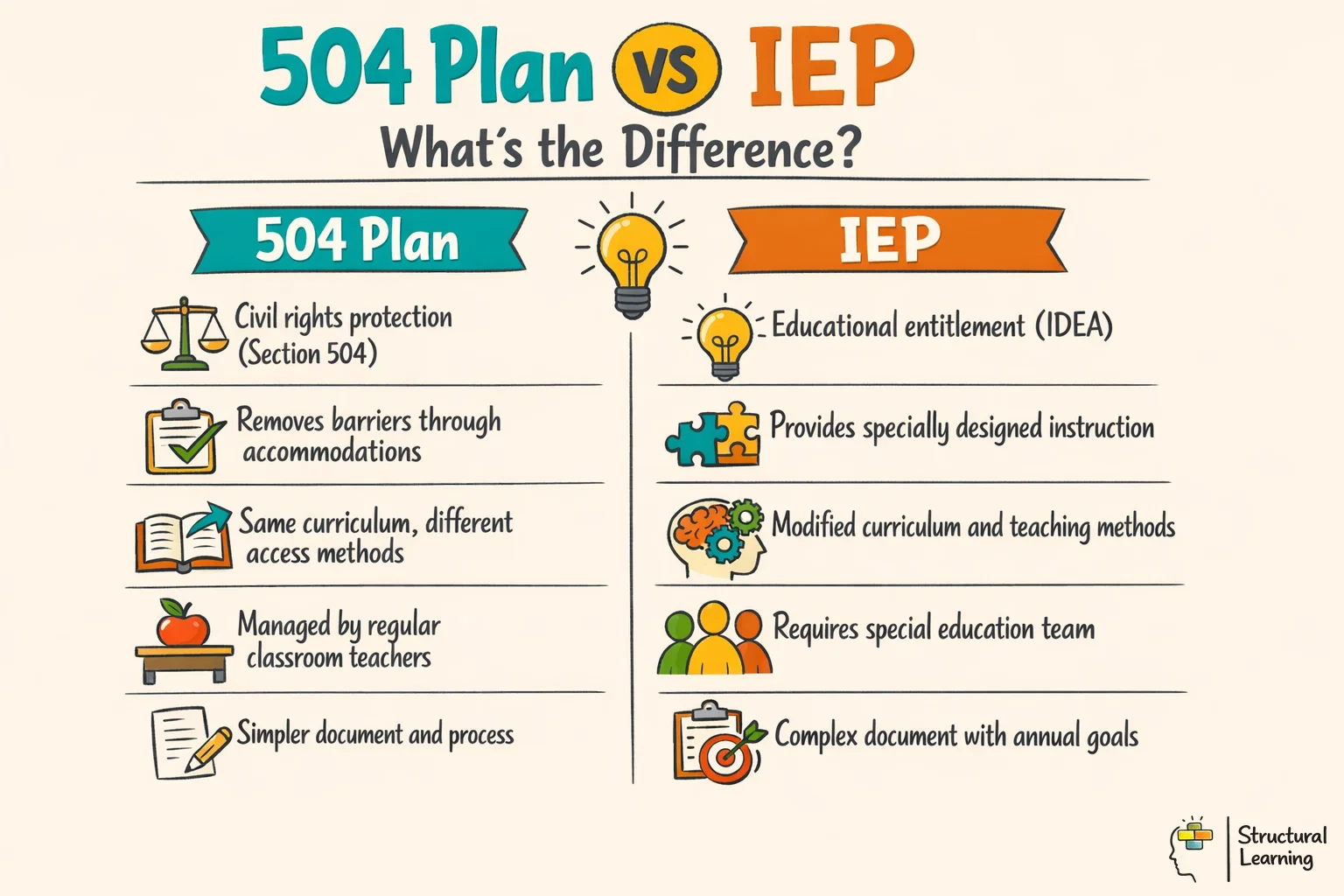
The simplest distinction: a 504 Plan is a civil rights protection document that says "your student must not be discriminated against because of their disability." An IEP is an educational entitlement that says "your student is eligible for specially designed instruction to make progress toward educational goals." Think of 504 as a ramp at the entrance of a building; an IEP as both the ramp and a personal guide who helps you navigate the building itself.

What Is a 504 Plan?

A 504 Plan is a document created under Section 504 of the Rehabilitation Act of 1973, a federal civil rights law. It requires schools to provide accommodations and modifications so that a student with a disability can access the general education curriculum and school activities on equal terms with their non-disabled peers. The emphasis is on removing barriers, not on teaching specialised content.

A 504 Plan typically includes accommodations such as extra time on tests, preferential seating, modified homework loads, or access to assistive technology. These accommodations don't change what the student is learning; they change how the student accesses the learning. If a student with dyslexia receives a 504 Plan, they might be given text-to-speech software or audiobooks so they can access the same English literature as their classmates, just through a different medium.

504 Plans are relatively straightforward documents compared to IEPs. They require a team meeting (which can include parents, teachers, and sometimes the student), a statement of the disability and its impact, and a clear list of accommodations. Unlike IEPs, they do not require specialists like special education teachers or school psychologists to implement or monitor them; regular classroom teachers manage most 504 accommodations.

What Is an IEP?

An IEP is created under the Individuals with Disabilities Education Act (IDEA), a federal special education law passed in 1975 (20 U.S.C. § 1400 et seq.). An IEP is much more comprehensive than a 504 Plan. It not only removes barriers to learning but also provides specially designed instruction (SDI) tailored to the student's individual needs. SDI means the curriculum, teaching methods, or intensity of instruction is modified specifically for that student.

An IEP includes measurable annual goals, descriptions of specially designed instruction, how progress will be monitored, related services (such as speech therapy, occupational therapy, or counselling), and the extent to which the student will participate in the general education classroom. An IEP student learning to read might receive direct, systematic instruction in phonics using a researched intervention like Orton-Gillingham, in addition to participating in the regular reading class. This is specialised teaching, not just accommodation.

IEPs are complex documents developed by a multidisciplinary team that must include special education teachers, regular education teachers, school administrators, parents, the student (when age-appropriate), and often specialists such as school psychologists, speech-language pathologists, or occupational therapists. IEPs are reviewed at least annually and can be revised if the team agrees a change is needed.

Side-by-Side Comparison Table

Aspect 504 Plan IEP
Legal Basis Section 504 of the Rehabilitation Act (civil rights law) IDEA (Individuals with Disabilities Education Act; special education law)
Primary Purpose Remove barriers to access the general curriculum Provide specially designed instruction to meet individual educational needs
Type of Services Accommodations only (no specialised instruction) Accommodations plus specially designed instruction and related services
Funding Funded from district general education budget Funded from special education budget (IDEA federal funds available)
Team Composition School official, teacher, parent, student (sometimes) Special ed teacher, general ed teacher, school psychologist, administrator, parent, student (age-appropriate)
Measurable Goals Not required (may list accommodations) Required (annual measurable goals with progress monitoring)
Curriculum Modification No (student learns same curriculum; access is modified) Yes (may include different curriculum or modified standards)
Review Schedule Reviewed periodically (no fixed timeline) Reviewed annually; reevaluated every three years
Due Process Rights Limited procedural protections Full procedural protections (mediation, due process hearings)
Implementation Responsibility General education classroom teacher Special education teacher (primary), general education teacher (collaboration)

Eligibility: Who Qualifies for Each?

Eligibility criteria differ significantly between 504 and IEP. For a 504 Plan, a student must have a disability (physical, mental, or emotional impairment) that substantially limits a major life activity such as learning, hearing, seeing, walking, breathing, or working. "Substantially limits" is broadly interpreted by courts and the Office for Civil Rights. A student with ADHD, dyslexia, asthma, anxiety, diabetes, or a hearing loss may qualify for a 504 Plan even if they are performing well academically.

Consider a Year 5 student with well-controlled type 1 diabetes who achieves A grades. This student may still qualify for a 504 Plan because diabetes substantially limits the major life activity of eating and metabolic function. The student might receive accommodations such as permission to check blood glucose during class, access to snacks, and flexibility with physical education.

An IEP has narrower eligibility criteria. A student must have a disability in one of thirteen categories defined by IDEA: autism spectrum disorder, deaf-blindness, deafness, emotional disturbance, hearing impairment, intellectual disability, multiple disabilities, orthopedic impairment, other health impairment, specific learning disability, speech or language impairment, traumatic brain injury, or visual impairment. Additionally, the student's disability must adversely affect their educational performance, and they must need specially designed instruction. Simply having a disability label is not sufficient; the student's learning must be negatively affected.

This means a student might have a 504-eligible disability (such as ADHD) but not qualify for an IEP if their ADHD does not adversely affect their educational performance. Conversely, a student who qualifies for an IEP (such as under specific learning disability) will always meet the broader 504 eligibility criteria.

What Services Does Each Provide?

A 504 Plan provides accommodations and modifications that create equal access without changing what the student learns. Common accommodations include extended time on tests, reduced homework, note-taking support, preferential seating, breaks during instruction, use of assistive technology, modified materials (such as large print or simplified text), and alternative assessment methods. The goal is to level the playing field so the student can demonstrate knowledge using the same curriculum as their peers.

An IEP provides accommodations, modifications, and specially designed instruction. This means a student with an IEP might learn different curriculum content, be taught using different methods, have reduced learning standards, or receive one-to-one or small group instruction from a special education teacher. Related services under an IEP might also include speech therapy, occupational therapy, counselling, behaviour support, or adaptive physical education. These services are directly connected to the student's disability and their educational goals (Individuals with Disabilities Education Act, 2004).

For example, two students with dyslexia might receive very different services. A Year 3 student with dyslexia and an IEP might receive daily small group instruction in phonemic awareness and phonics using a specialised intervention, plus continued participation in the general reading class with accommodations. A Year 6 student with dyslexia and a 504 Plan might receive audiobooks, text-to-speech software, and extended time on written tests, allowing them to access grade-level curriculum independently.

Teacher Responsibilities: 504 vs IEP

As a classroom teacher, your responsibilities differ depending on whether a student has a 504 Plan or an IEP. For a 504 Plan, you are responsible for implementing accommodations within your general education classroom. You must follow the accommodations listed (extra time, preferential seating, modified homework, assistive technology) and document that you are implementing them. However, you do not design or modify curriculum, and you are not expected to provide specialised instruction. The accommodation is yours to implement; the learning goal and curriculum remain the same for all students.

For an IEP, your responsibility is collaborative. If you are a general education teacher with an IEP student, you are part of the IEP team. You contribute to the development of goals, implement accommodations in your classroom, and work alongside the special education teacher. If the IEP specifies "small group instruction in reading" with a special education teacher, that is not your sole responsibility, but you coordinate with that teacher and may provide reinforcement during whole-class instruction. You monitor progress toward goals and communicate regularly about how the student is performing against the IEP goals in your classroom.

Documentation is more intensive for IEPs. You may be asked to collect progress monitoring data (such as fluency assessments or quiz scores) to show whether the student is making progress toward their annual goals. For 504 Plans, documentation is simpler; you mainly record that you provided the accommodation (for example, noting that you gave the student extended time).

Can a Student Have Both?

Yes, a student can have both a 504 Plan and an IEP, though it is uncommon. This usually occurs when a school has created a 504 Plan first, then later evaluates the student and determines they also qualify for an IEP. When both are in place, the IEP typically supersedes the 504 Plan in practice, because the IEP is more comprehensive and more legally robust. However, parents may request that both documents be maintained so that specific accommodations from the 504 Plan (such as a particular assistive technology preference) are explicitly listed in both.

More commonly, a student might have a 504 Plan in one area of life (such as for medical management of diabetes) and an IEP for educational needs. For example, a student might have a 504 Plan that covers blood glucose monitoring and eating accommodations, and separately, an IEP that addresses a learning disability in mathematics. In practice, schools usually combine these into a single IEP document with sections addressing both the health-related accommodations and the educational goals.

The Evaluation Process

The pathways to getting a 504 Plan and an IEP differ in timing and process. For a 504 Plan, the process is relatively fast. A parent or teacher expresses concern about a student's disability, and the school convenes a team meeting. The team reviews existing school records, classroom observations, test scores, and medical or diagnostic information. If the team agrees the student has a disability that substantially limits a major life activity, a 504 Plan is created. There is no requirement for formal psychological testing, though testing can be included if helpful. The entire process can be completed in two to four weeks.

For an IEP, the process is more formal and detailed. A parent or teacher requests an evaluation. The school must provide written notice and obtain parental consent. The school then conducts a comprehensive evaluation, which typically includes cognitive testing, academic achievement testing, classroom observations, rating scales, and direct assessment by a school psychologist. This evaluation can take six to twelve weeks. Once the evaluation is complete, the school holds an IEP eligibility and planning meeting. If the child is determined eligible, the IEP is developed at that same meeting (34 CFR § 300.306-309).

One key difference: for a 504 Plan, formal testing is optional. For an IEP, a comprehensive evaluation is required. This is why the IEP process takes longer and involves more specialists. However, the increased scrutiny and specialist involvement is actually protective for the student because it ensures decisions are based on comprehensive data rather than general impressions.

When to Recommend a 504 vs an IEP

As a teacher, you may be in a position to suggest that a parent consider evaluation for a 504 Plan or IEP. The recommendation depends on how the student's disability is affecting learning. If a student is learning the same curriculum as their peers but struggling because of a barrier (such as slow reading fluency, difficulty focusing, or a medical need), a 504 Plan with accommodations is often sufficient. If a student needs different instruction, more intensive teaching, or modified learning goals, an IEP is more appropriate.

Consider a Year 4 student with anxiety who avoids speaking in class or participating in group work. If the student is academically capable but is prevented from showing knowledge due to anxiety symptoms, accommodations such as one-to-one testing, written responses instead of oral, and a reduced workload might be appropriate under a 504 Plan. However, if the student's anxiety is also severely disrupting their ability to attend school, learn, or function in social situations, and the school believes the student needs counselling, behaviour support, and different instructional methods, an IEP might be warranted.

Another guide: ask whether the student needs a specialist to teach them. If the answer is yes, an IEP is likely needed. If the answer is no, but the student needs help accessing the general curriculum, a 504 Plan may suffice. A student with dyslexia who can decode with extended time might need a 504 Plan. A student with dyslexia who cannot decode even with extra time might need an IEP with direct instruction in phonics from a specialist.

Common Teacher Mistakes with 504s and IEPs

Teachers often make mistakes implementing 504 Plans and IEPs, usually unintentionally. One frequent error is not implementing accommodations consistently. A teacher might give a student with ADHD extended time on the unit test but not on daily quizzes, or provide seating near the front of the classroom during lessons but not during group work. Accommodations must be consistent across all instructional settings, not just high-stakes assessments. If the 504 Plan says "extended time," that means extended time on all timed work, not just final exams.

Another common mistake is confusing accommodations with a lowered grade. Some teachers believe that if a student has a 504 Plan or IEP, they should receive a passing grade regardless of performance. This is incorrect. A 504 Plan or IEP does not guarantee a passing grade; it ensures access to learning. A student with extra time still needs to demonstrate knowledge of the curriculum. If a student has an IEP with modified standards, the grade might reflect those modified standards, but grades should never be automatic passes just because a plan is in place.

Teachers also sometimes fail to coordinate with special education teachers or related service providers. If a student has an IEP with speech therapy, the classroom teacher should know what goals are being targeted in therapy and reinforce them during instruction. Similarly, if a student has a 504 Plan requiring specific accommodations, all teachers who work with the student must implement those accommodations, not just the main classroom teacher. Communicating with other staff is essential.

A final mistake is not maintaining documentation of accommodations provided. For legal protection, document that you provided extended time, offered the note-taking support, or allowed the student to take a break. Schools can be liable if a student's accommodations were not implemented but documentation was never provided to show compliance. A simple note in your gradebook, an email to the file, or a checklist showing dates and accommodations given provides evidence that you implemented the plan.

Key Takeaways

  1. 504 Plans are civil rights protections; IEPs are educational entitlements: A 504 Plan removes barriers to access the general curriculum. An IEP provides specially designed instruction tailored to the student's individual educational needs.
  2. Eligibility differs: A student qualifies for a 504 Plan if they have a disability that substantially limits a major life activity. A student qualifies for an IEP if they have a disability in one of thirteen IDEA categories and their disability adversely affects educational performance.
  3. Teachers implement 504s alone; special educators lead IEPs: You are responsible for implementing 504 accommodations in your classroom. For IEPs, you are part of a team with special educators and specialists designing and delivering instruction.
  4. Services differ: 504 Plans provide accommodations only. IEPs provide accommodations, specially designed instruction, and related services such as speech therapy or behaviour support.
  5. Document consistently: Implement accommodations the same way across all settings and document that you did so. This protects both the student's right to equal access and the school's compliance with civil rights law.

Further Reading

A Teacher's Guide to 504 Accommodations provides a comprehensive list of common accommodations you can implement in the classroom.

504 Plans for ADHD: Evidence-Based Accommodations focuses on specific strategies for students with ADHD, one of the most common 504-eligible disabilities.

Response to Intervention (RTI): A Practical Guide for Teachers explains RTI, a prevention framework often used before a student is referred for a 504 Plan or IEP.

PBIS: Positive Behavioural Interventions and Supports describes school-wide behaviour systems that complement individual 504 Plans and IEPs for students with behaviour-related disabilities.

Understanding Special Educational Needs in Your Classroom provides an overview of disability categories and how to support students with diverse needs.

Differentiation Strategies: A Teacher's Guide explores how to modify instruction for students with different learning needs, a key component of IEP implementation.

Scaffolding in Education: A Teacher's Guide explains how to provide temporary support so students can access learning, a strategy often used alongside 504 accommodations and IEP instruction.

Formative Assessment Strategies: A Teacher's Guide describes assessment approaches useful for monitoring progress toward IEP goals.

Progress Monitoring and Curriculum-Based Measurement (CBM): A Teacher's Guide details how to collect data on IEP goal progress, a requirement for all IEPs.

How to Develop Metacognition: A Teacher's Guide explains how to teach students to monitor their own learning, a skill that supports both 504 and IEP students in becoming more independent learners.

Loading audit...

504 Plan vs IEP: The Core Difference

A 504 Plan and an Individualized Education Program (IEP) are both legal documents that protect students with disabilities and ensure they receive the support they need in school. However, they operate under different laws, serve different purposes, and provide different types of support. Understanding these differences is essential for classroom teachers because the way you implement a 504 Plan will differ from how you implement an IEP, and students sometimes qualify for one, the other, or both.

The simplest distinction: a 504 Plan is a civil rights protection document that says "your student must not be discriminated against because of their disability." An IEP is an educational entitlement that says "your student is eligible for specially designed instruction to make progress toward educational goals." Think of 504 as a ramp at the entrance of a building; an IEP as both the ramp and a personal guide who helps you navigate the building itself.

What Is a 504 Plan?

A 504 Plan is a document created under Section 504 of the Rehabilitation Act of 1973, a federal civil rights law. It requires schools to provide accommodations and modifications so that a student with a disability can access the general education curriculum and school activities on equal terms with their non-disabled peers. The emphasis is on removing barriers, not on teaching specialised content.

A 504 Plan typically includes accommodations such as extra time on tests, preferential seating, modified homework loads, or access to assistive technology. These accommodations don't change what the student is learning; they change how the student accesses the learning. If a student with dyslexia receives a 504 Plan, they might be given text-to-speech software or audiobooks so they can access the same English literature as their classmates, just through a different medium.

504 Plans are relatively straightforward documents compared to IEPs. They require a team meeting (which can include parents, teachers, and sometimes the student), a statement of the disability and its impact, and a clear list of accommodations. Unlike IEPs, they do not require specialists like special education teachers or school psychologists to implement or monitor them; regular classroom teachers manage most 504 accommodations.

What Is an IEP?

An IEP is created under the Individuals with Disabilities Education Act (IDEA), a federal special education law passed in 1975 (20 U.S.C. § 1400 et seq.). An IEP is much more comprehensive than a 504 Plan. It not only removes barriers to learning but also provides specially designed instruction (SDI) tailored to the student's individual needs. SDI means the curriculum, teaching methods, or intensity of instruction is modified specifically for that student.

An IEP includes measurable annual goals, descriptions of specially designed instruction, how progress will be monitored, related services (such as speech therapy, occupational therapy, or counselling), and the extent to which the student will participate in the general education classroom. An IEP student learning to read might receive direct, systematic instruction in phonics using a researched intervention like Orton-Gillingham, in addition to participating in the regular reading class. This is specialised teaching, not just accommodation.

IEPs are complex documents developed by a multidisciplinary team that must include special education teachers, regular education teachers, school administrators, parents, the student (when age-appropriate), and often specialists such as school psychologists, speech-language pathologists, or occupational therapists. IEPs are reviewed at least annually and can be revised if the team agrees a change is needed.

Side-by-Side Comparison Table

Aspect 504 Plan IEP
Legal Basis Section 504 of the Rehabilitation Act (civil rights law) IDEA (Individuals with Disabilities Education Act; special education law)
Primary Purpose Remove barriers to access the general curriculum Provide specially designed instruction to meet individual educational needs
Type of Services Accommodations only (no specialised instruction) Accommodations plus specially designed instruction and related services
Funding Funded from district general education budget Funded from special education budget (IDEA federal funds available)
Team Composition School official, teacher, parent, student (sometimes) Special ed teacher, general ed teacher, school psychologist, administrator, parent, student (age-appropriate)
Measurable Goals Not required (may list accommodations) Required (annual measurable goals with progress monitoring)
Curriculum Modification No (student learns same curriculum; access is modified) Yes (may include different curriculum or modified standards)
Review Schedule Reviewed periodically (no fixed timeline) Reviewed annually; reevaluated every three years
Due Process Rights Limited procedural protections Full procedural protections (mediation, due process hearings)
Implementation Responsibility General education classroom teacher Special education teacher (primary), general education teacher (collaboration)

Eligibility: Who Qualifies for Each?

Eligibility criteria differ significantly between 504 and IEP. For a 504 Plan, a student must have a disability (physical, mental, or emotional impairment) that substantially limits a major life activity such as learning, hearing, seeing, walking, breathing, or working. "Substantially limits" is broadly interpreted by courts and the Office for Civil Rights. A student with ADHD, dyslexia, asthma, anxiety, diabetes, or a hearing loss may qualify for a 504 Plan even if they are performing well academically.

Consider a Year 5 student with well-controlled type 1 diabetes who achieves A grades. This student may still qualify for a 504 Plan because diabetes substantially limits the major life activity of eating and metabolic function. The student might receive accommodations such as permission to check blood glucose during class, access to snacks, and flexibility with physical education.

An IEP has narrower eligibility criteria. A student must have a disability in one of thirteen categories defined by IDEA: autism spectrum disorder, deaf-blindness, deafness, emotional disturbance, hearing impairment, intellectual disability, multiple disabilities, orthopedic impairment, other health impairment, specific learning disability, speech or language impairment, traumatic brain injury, or visual impairment. Additionally, the student's disability must adversely affect their educational performance, and they must need specially designed instruction. Simply having a disability label is not sufficient; the student's learning must be negatively affected.

This means a student might have a 504-eligible disability (such as ADHD) but not qualify for an IEP if their ADHD does not adversely affect their educational performance. Conversely, a student who qualifies for an IEP (such as under specific learning disability) will always meet the broader 504 eligibility criteria.

What Services Does Each Provide?

A 504 Plan provides accommodations and modifications that create equal access without changing what the student learns. Common accommodations include extended time on tests, reduced homework, note-taking support, preferential seating, breaks during instruction, use of assistive technology, modified materials (such as large print or simplified text), and alternative assessment methods. The goal is to level the playing field so the student can demonstrate knowledge using the same curriculum as their peers.

An IEP provides accommodations, modifications, and specially designed instruction. This means a student with an IEP might learn different curriculum content, be taught using different methods, have reduced learning standards, or receive one-to-one or small group instruction from a special education teacher. Related services under an IEP might also include speech therapy, occupational therapy, counselling, behaviour support, or adaptive physical education. These services are directly connected to the student's disability and their educational goals (Individuals with Disabilities Education Act, 2004).

For example, two students with dyslexia might receive very different services. A Year 3 student with dyslexia and an IEP might receive daily small group instruction in phonemic awareness and phonics using a specialised intervention, plus continued participation in the general reading class with accommodations. A Year 6 student with dyslexia and a 504 Plan might receive audiobooks, text-to-speech software, and extended time on written tests, allowing them to access grade-level curriculum independently.

Teacher Responsibilities: 504 vs IEP

As a classroom teacher, your responsibilities differ depending on whether a student has a 504 Plan or an IEP. For a 504 Plan, you are responsible for implementing accommodations within your general education classroom. You must follow the accommodations listed (extra time, preferential seating, modified homework, assistive technology) and document that you are implementing them. However, you do not design or modify curriculum, and you are not expected to provide specialised instruction. The accommodation is yours to implement; the learning goal and curriculum remain the same for all students.

For an IEP, your responsibility is collaborative. If you are a general education teacher with an IEP student, you are part of the IEP team. You contribute to the development of goals, implement accommodations in your classroom, and work alongside the special education teacher. If the IEP specifies "small group instruction in reading" with a special education teacher, that is not your sole responsibility, but you coordinate with that teacher and may provide reinforcement during whole-class instruction. You monitor progress toward goals and communicate regularly about how the student is performing against the IEP goals in your classroom.

Documentation is more intensive for IEPs. You may be asked to collect progress monitoring data (such as fluency assessments or quiz scores) to show whether the student is making progress toward their annual goals. For 504 Plans, documentation is simpler; you mainly record that you provided the accommodation (for example, noting that you gave the student extended time).

Can a Student Have Both?

Yes, a student can have both a 504 Plan and an IEP, though it is uncommon. This usually occurs when a school has created a 504 Plan first, then later evaluates the student and determines they also qualify for an IEP. When both are in place, the IEP typically supersedes the 504 Plan in practice, because the IEP is more comprehensive and more legally robust. However, parents may request that both documents be maintained so that specific accommodations from the 504 Plan (such as a particular assistive technology preference) are explicitly listed in both.

More commonly, a student might have a 504 Plan in one area of life (such as for medical management of diabetes) and an IEP for educational needs. For example, a student might have a 504 Plan that covers blood glucose monitoring and eating accommodations, and separately, an IEP that addresses a learning disability in mathematics. In practice, schools usually combine these into a single IEP document with sections addressing both the health-related accommodations and the educational goals.

The Evaluation Process

The pathways to getting a 504 Plan and an IEP differ in timing and process. For a 504 Plan, the process is relatively fast. A parent or teacher expresses concern about a student's disability, and the school convenes a team meeting. The team reviews existing school records, classroom observations, test scores, and medical or diagnostic information. If the team agrees the student has a disability that substantially limits a major life activity, a 504 Plan is created. There is no requirement for formal psychological testing, though testing can be included if helpful. The entire process can be completed in two to four weeks.

For an IEP, the process is more formal and detailed. A parent or teacher requests an evaluation. The school must provide written notice and obtain parental consent. The school then conducts a comprehensive evaluation, which typically includes cognitive testing, academic achievement testing, classroom observations, rating scales, and direct assessment by a school psychologist. This evaluation can take six to twelve weeks. Once the evaluation is complete, the school holds an IEP eligibility and planning meeting. If the child is determined eligible, the IEP is developed at that same meeting (34 CFR § 300.306-309).

One key difference: for a 504 Plan, formal testing is optional. For an IEP, a comprehensive evaluation is required. This is why the IEP process takes longer and involves more specialists. However, the increased scrutiny and specialist involvement is actually protective for the student because it ensures decisions are based on comprehensive data rather than general impressions.

When to Recommend a 504 vs an IEP

As a teacher, you may be in a position to suggest that a parent consider evaluation for a 504 Plan or IEP. The recommendation depends on how the student's disability is affecting learning. If a student is learning the same curriculum as their peers but struggling because of a barrier (such as slow reading fluency, difficulty focusing, or a medical need), a 504 Plan with accommodations is often sufficient. If a student needs different instruction, more intensive teaching, or modified learning goals, an IEP is more appropriate.

Consider a Year 4 student with anxiety who avoids speaking in class or participating in group work. If the student is academically capable but is prevented from showing knowledge due to anxiety symptoms, accommodations such as one-to-one testing, written responses instead of oral, and a reduced workload might be appropriate under a 504 Plan. However, if the student's anxiety is also severely disrupting their ability to attend school, learn, or function in social situations, and the school believes the student needs counselling, behaviour support, and different instructional methods, an IEP might be warranted.

Another guide: ask whether the student needs a specialist to teach them. If the answer is yes, an IEP is likely needed. If the answer is no, but the student needs help accessing the general curriculum, a 504 Plan may suffice. A student with dyslexia who can decode with extended time might need a 504 Plan. A student with dyslexia who cannot decode even with extra time might need an IEP with direct instruction in phonics from a specialist.

Common Teacher Mistakes with 504s and IEPs

Teachers often make mistakes implementing 504 Plans and IEPs, usually unintentionally. One frequent error is not implementing accommodations consistently. A teacher might give a student with ADHD extended time on the unit test but not on daily quizzes, or provide seating near the front of the classroom during lessons but not during group work. Accommodations must be consistent across all instructional settings, not just high-stakes assessments. If the 504 Plan says "extended time," that means extended time on all timed work, not just final exams.

Another common mistake is confusing accommodations with a lowered grade. Some teachers believe that if a student has a 504 Plan or IEP, they should receive a passing grade regardless of performance. This is incorrect. A 504 Plan or IEP does not guarantee a passing grade; it ensures access to learning. A student with extra time still needs to demonstrate knowledge of the curriculum. If a student has an IEP with modified standards, the grade might reflect those modified standards, but grades should never be automatic passes just because a plan is in place.

Teachers also sometimes fail to coordinate with special education teachers or related service providers. If a student has an IEP with speech therapy, the classroom teacher should know what goals are being targeted in therapy and reinforce them during instruction. Similarly, if a student has a 504 Plan requiring specific accommodations, all teachers who work with the student must implement those accommodations, not just the main classroom teacher. Communicating with other staff is essential.

A final mistake is not maintaining documentation of accommodations provided. For legal protection, document that you provided extended time, offered the note-taking support, or allowed the student to take a break. Schools can be liable if a student's accommodations were not implemented but documentation was never provided to show compliance. A simple note in your gradebook, an email to the file, or a checklist showing dates and accommodations given provides evidence that you implemented the plan.

Key Takeaways

  1. 504 Plans are civil rights protections; IEPs are educational entitlements: A 504 Plan removes barriers to access the general curriculum. An IEP provides specially designed instruction tailored to the student's individual educational needs.
  2. Eligibility differs: A student qualifies for a 504 Plan if they have a disability that substantially limits a major life activity. A student qualifies for an IEP if they have a disability in one of thirteen IDEA categories and their disability adversely affects educational performance.
  3. Teachers implement 504s alone; special educators lead IEPs: You are responsible for implementing 504 accommodations in your classroom. For IEPs, you are part of a team with special educators and specialists designing and delivering instruction.
  4. Services differ: 504 Plans provide accommodations only. IEPs provide accommodations, specially designed instruction, and related services such as speech therapy or behaviour support.
  5. Document consistently: Implement accommodations the same way across all settings and document that you did so. This protects both the student's right to equal access and the school's compliance with civil rights law.

Further Reading

A Teacher's Guide to 504 Accommodations provides a comprehensive list of common accommodations you can implement in the classroom.

504 Plans for ADHD: Evidence-Based Accommodations focuses on specific strategies for students with ADHD, one of the most common 504-eligible disabilities.

Response to Intervention (RTI): A Practical Guide for Teachers explains RTI, a prevention framework often used before a student is referred for a 504 Plan or IEP.

PBIS: Positive Behavioural Interventions and Supports describes school-wide behaviour systems that complement individual 504 Plans and IEPs for students with behaviour-related disabilities.

Understanding Special Educational Needs in Your Classroom provides an overview of disability categories and how to support students with diverse needs.

Differentiation Strategies: A Teacher's Guide explores how to modify instruction for students with different learning needs, a key component of IEP implementation.

Scaffolding in Education: A Teacher's Guide explains how to provide temporary support so students can access learning, a strategy often used alongside 504 accommodations and IEP instruction.

Formative Assessment Strategies: A Teacher's Guide describes assessment approaches useful for monitoring progress toward IEP goals.

Progress Monitoring and Curriculum-Based Measurement (CBM): A Teacher's Guide details how to collect data on IEP goal progress, a requirement for all IEPs.

How to Develop Metacognition: A Teacher's Guide explains how to teach students to monitor their own learning, a skill that supports both 504 and IEP students in becoming more independent learners.

No Posts found.
Back to Blog