504 Accommodations for ADHD: An Evidence-Based Teacher's Guide504 Accommodations for ADHD: An Evidence-Based Teacher's Guide - educational concept illustration

Updated on  

February 26, 2026

504 Accommodations for ADHD: An Evidence-Based Teacher's Guide

|

February 26, 2026

More than 7 million children in the United States have been diagnosed with ADHD, roughly 1 in 9 students (CDC, 2022). For teachers, this means at least two or three students in every classroom need accommodations that go beyond general good practice. A Section 504 plan provides the legal framework for those accommodations, but the plan is only as useful as the accommodations themselves.

The problem is that most 504 accommodation lists treat every strategy as equally effective. They are not. Some accommodations have strong research support. Others are handed out reflexively with little evidence they help students with ADHD specifically. This guide rates each accommodation by its evidence base so you can prioritize what actually works.

Key Takeaways

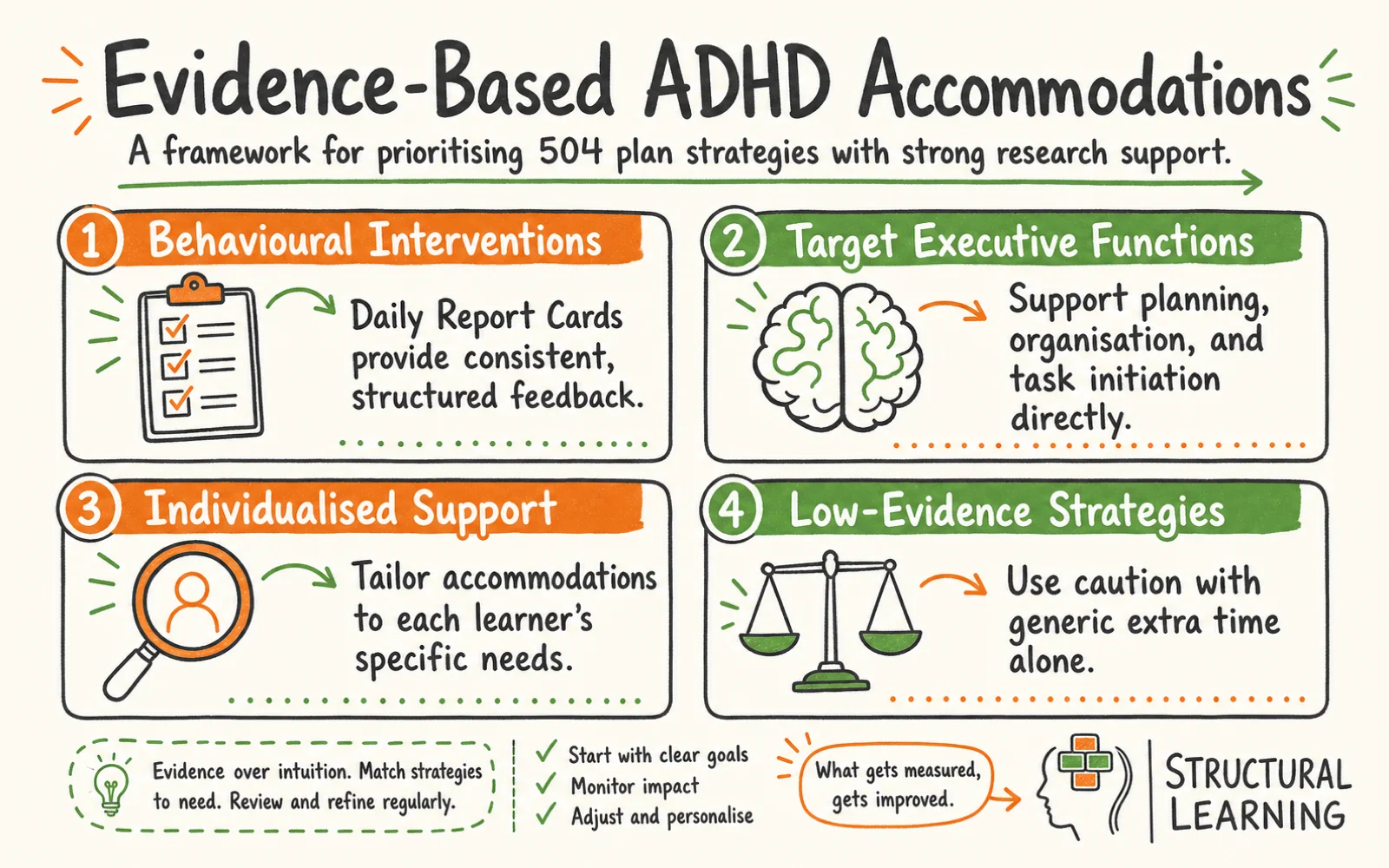
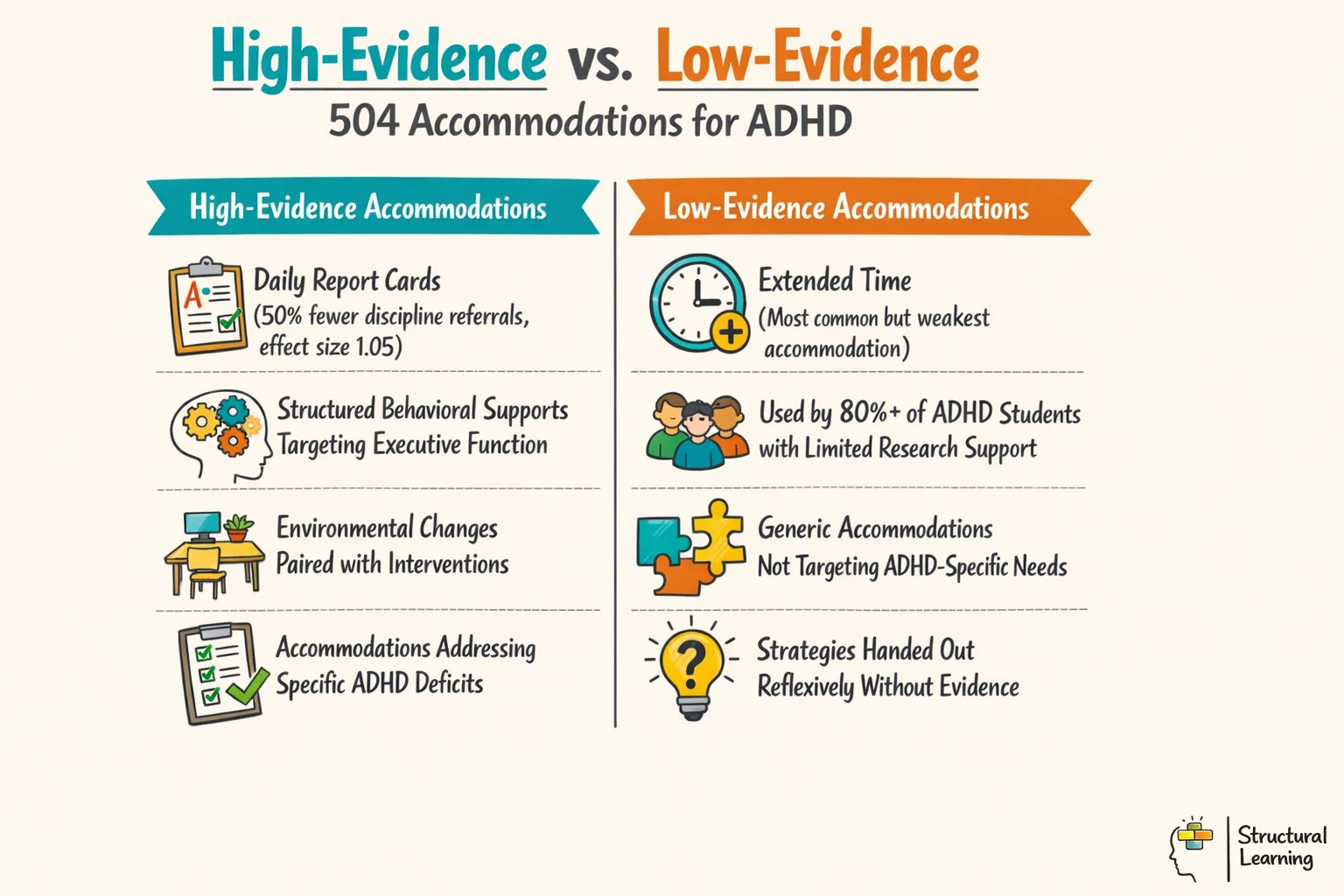
    • Daily Report Cards have the strongest evidence base of any school-based ADHD intervention, producing 50% fewer discipline referrals and a large effect size (Hedge's g = 1.05) in meta-analysis (Pyle and Fabiano, 2017).
    • Extended time is the most common but weakest accommodation. Over 80% of students with ADHD receive it, yet systematic reviews find limited evidence it improves outcomes for this population (Lovett and Nelson, 2021).
    • All three ADHD presentations qualify for 504 plans, and students do not need to be failing academically. The 2016 Dear Colleague Letter confirms that good grades do not disqualify a student.
    • Accommodations work best paired with evidence-based interventions. A 504 plan should include both environmental changes and structured behavioral supports like the Daily Report Card.

What Is a 504 Plan for ADHD?

Section 504 of the Rehabilitation Act of 1973 is a federal civil rights statute, not a special education law. It prohibits disability discrimination in any program receiving federal funding. A 504 plan documents the accommodations a student needs to access education on an equal basis with peers.

A student qualifies under Section 504 if they have a physical or mental impairment that substantially limits one or more major life activities. For students with ADHD, these major life activities include concentrating, learning, reading, thinking, and neurological functioning. All three ADHD presentations qualify:

  • Combined Presentation (most common): substantially limits concentrating, learning, and self-regulation
  • Predominantly Inattentive Presentation: substantially limits concentrating, reading, and sustained attention
  • Predominantly Hyperactive-Impulsive Presentation: substantially limits self-regulation, social interaction, and concentrating

A critical point that many teachers miss: students with ADHD qualify regardless of academic performance. The U.S. Department of Education's 2016 Dear Colleague Letter states explicitly that a student can have good grades and still qualify if ADHD substantially limits a major life activity. A student who works three times harder than peers to achieve a B is still substantially limited.

Accommodation vs. Modification

These terms are often confused but have different legal implications.

Feature Accommodation (504 Plan) Modification (Typically IEP)
What changes How the student learns or shows knowledge What the student learns or the standards expected
Content level Same content, same standards Altered standards or reduced curriculum
Example Extended time on a test Fewer learning objectives assessed
Legal basis Section 504 of the Rehabilitation Act IDEA (Individuals with Disabilities Education Act)
When to use Student can access grade-level content with environmental or procedural changes Student needs specially designed instruction to make progress

If a student with ADHD needs modifications to curriculum content, that typically requires an IEP under IDEA, not a 504 plan. A 504 plan covers changes to access, not changes to standards.

The Evidence Problem

Here is what most 504 accommodation guides will not tell you: the evidence base for common ADHD accommodations is surprisingly thin.

A 2021 systematic review in the Journal of the American Academy of Child and Adolescent Psychiatry (Lovett and Nelson) screened 497 documents and found that most accommodations fail to show evidence of benefits that are specific to students with ADHD. Extended time, more frequent breaks, reduced-distraction testing environments, oral presentation, and calculator use were "not associated with better performance on reading or math testing" for elementary and middle school students with ADHD.

This does not mean accommodations are useless. It means we should be strategic about which ones we prioritize and honest about what the research actually shows. The strongest evidence supports behavioral interventions (particularly the Daily Report Card) and environmental design over procedural accommodations like extended time.

Accommodation Type Evidence Rating Key Finding
Daily Report Card Strong Large effect size (g = 1.05). 50% fewer referrals (Pyle and Fabiano, 2017; Fabiano et al., 2023)
Movement breaks and fidget tools Moderate Wobble cushions improved on-task behavior. Fidget spinners worsened it (University of Kentucky study)
Read-aloud testing Moderate Two RCTs found specific benefits for younger students with ADHD (Harrison et al., 2020)
Preferential seating Conditional Helps inattentive presentation; may backfire for hyperactive-impulsive (Barkley, 2020)
Extended time on tests Weak Most common accommodation but limited ADHD-specific evidence. Less than half of eligible students use it (Lovett and Nelson, 2021)
Reduced homework volume Supported Barkley recommends the "10-minute rule" (10 min x grade level). Reducing problems without reducing content is well-supported
Test breaks with small group Promising Significantly larger score gains than extended time alone (Tandfonline, 2025)

Classroom Environment Accommodations

Environmental design is about reducing barriers before instruction begins. Think of it as designing the space around the student's brain, not asking the brain to adapt to a hostile space.

Seating placement requires more thought than "put them in the front row." For students with the inattentive presentation, seating near the teacher reduces the distance between instruction and the student's attention. For students with the hyperactive-impulsive presentation, the front row can feel like a spotlight. These students often do better near an aisle or at the edge of a group where movement is less disruptive.

Ask the student where they focus best. A Year 4 teacher might say: "Marcus, I want to find the spot where you do your best thinking. Let's try three different seats this week and you tell me which one works." This shifts the conversation from compliance to collaboration.

Sensory supports have mixed but growing evidence. Wobble cushions and resistance bands on chair legs improved on-task behavior in controlled studies. Fidget spinners, however, actually increased attention errors during classroom instruction (PMC, 2022). The distinction matters: a fidget tool that channels movement without visual distraction works; one that becomes a toy does not.

Practical environment accommodations include:

  • Seating away from windows, doors, and high-traffic areas (for inattentive presentation)
  • Standing desk, wobble stool, or resistance bands on chair legs (moderate evidence for hyperactive presentation)
  • Noise-reducing headphones during independent work (reduces auditory distraction)
  • Scheduled movement breaks every 20 to 30 minutes (moderate evidence for refocusing)
  • Designated calm-down area accessible without asking permission (reduces escalation)
  • Consistent classroom layout with minimal furniture rearrangement (predictability reduces cognitive load)

Instruction and Assignment Accommodations

The core challenge for students with ADHD is not intelligence but executive function: the ability to plan, organize, sustain attention, and regulate behavior. Instruction accommodations should compensate for these specific deficits rather than simply giving more time.

Chunked assignments are more effective than extended deadlines. Instead of "Write a five-paragraph essay by Friday," break it into: "Tuesday: outline with three main points. Wednesday: draft paragraphs 1 and 2. Thursday: draft paragraphs 3, 4, and 5. Friday: revise." Each chunk has its own deadline and a checkbox. This externalizes the planning that executive function would normally handle internally. Multi-modal directions matter because ADHD affects working memory. A student who hears "Open your textbook to page 47, read the passage, and answer questions 1 through 5" may lose step two by the time they complete step one. Providing both written and verbal instructions, one step at a time, reduces the working memory demand.
Key instruction accommodations include:

  • Written and verbal instructions together for all assignments
  • Break multi-step directions into single steps with checkboxes
  • Visual timers displayed during timed tasks (externalizes time awareness)
  • Advance notice of transitions with 2-minute and 1-minute warnings
  • Reduced homework volume: Barkley's "10-minute rule" recommends homework of 10 minutes multiplied by grade level as a maximum. A third-grader gets 30 minutes maximum
  • Complete odds only or reduce the number of problems without reducing content level
  • Allow photos of the board instead of hand-copying notes
  • Pre-teaching of vocabulary and concepts before whole-class introduction

Testing Accommodations

Testing accommodations are the most commonly requested and the least well-supported by ADHD-specific evidence. This does not mean they are wrong to include, but it does mean they should be supplemented by stronger interventions.

Extended time is given to over 80% of students with ADHD, making it the most prevalent accommodation. Yet the Lovett and Nelson (2021) review found it was not associated with better performance on reading or math testing for elementary and middle school students. One study found students who received 30 minutes actually completed more problems correctly per minute than those given 45 minutes. Extended time may help with anxiety-related performance issues but does not address the core attention deficit. Read-aloud testing has the strongest evidence of any single testing accommodation, with two randomized experiments finding specific benefits for younger students with ADHD (Harrison et al., 2020). If you can include only one testing accommodation, read-aloud is the best-supported choice for elementary students. Test breaks with small-group testing showed significantly larger score gains than extended time alone in a 2025 study. The combination of a reduced-distraction environment and permission to pause may be more helpful than simply adding minutes.

Recommended testing accommodations, ranked by evidence:

  • Read-aloud of test questions when reading is not the skill being assessed (moderate evidence)
  • Frequent breaks during testing with the ability to stop the clock (promising evidence)
  • Small-group or individual testing environment (promising when combined with breaks)
  • Extended time (1.5x standard; weak ADHD-specific evidence, but widely accepted)
  • Alternative test formats (oral exam, project-based, portfolio) when test anxiety is severe
  • Administer tests at the student's optimal time of day, often morning when medication is most effective

The Daily Report Card: Your Highest-Impact Tool

The Daily Report Card (DRC) has the strongest research support of any school-based ADHD intervention. A meta-analysis by Pyle and Fabiano (2017) found a large effect size (Hedge's g = 1.05) on systematic direct observation. A randomized controlled trial found students using DRCs had 50% fewer discipline referrals and 33% fewer disruptive behaviors compared to students receiving medication alone (Fabiano et al., 2023).

The CDC lists behavioral classroom management, which includes the DRC, as an efficacious treatment for ADHD with clear evidence from systematic reviews.

How a Daily Report Card works:
  • Identify 3 to 5 specific, observable target behaviors. Not "be good" but "raise hand before speaking," "begin assignment within 2 minutes of instruction," "stay in seat during independent work."
  • Set achievable criteria. Start with what the student can already do about 60 to 70% of the time, then gradually raise the bar. A student who currently raises their hand 3 out of 10 times might start with a target of 4 out of 10.
  • Rate each behavior at each transition point. The teacher marks "yes" or "not yet" for each target at morning, midday, and afternoon. This takes about 30 seconds per rating period.
  • Provide immediate feedback. The student sees their card at each check-in. A simple "You hit 4 out of 5 targets this morning, nice work" reinforces the specific behaviors.
  • Connect to home reinforcement. The student brings the card home. If they met criteria, a pre-agreed reward follows (screen time, a preferred activity, a small privilege). The parent does not need to add punishment for missed targets; the absence of the reward is sufficient.
Implementation in practice: A fifth-grade teacher might set up a DRC for a student with Combined Presentation ADHD with these targets:
  • Began work within 2 minutes of instruction (yes/not yet)
  • Raised hand before speaking during group discussion (yes/not yet)
  • Completed assigned work during class time (yes/not yet)
  • Used transition signal (timer, verbal cue) to move between activities (yes/not yet)

The teacher checks the card at 10:30 AM, 12:30 PM, and 2:30 PM. The student needs to meet 3 of 4 targets in at least 2 of 3 periods to earn the home reward. As the student improves, the criteria tighten.

Organization and Executive Function

Students with ADHD often have significant gaps in organizational skills that are not reflected in their intelligence. These accommodations externalize the structure that executive function would normally provide.

  • Teacher checks assignment notebook daily before dismissal. This takes 15 seconds and prevents the "I didn't know there was homework" cycle.
  • Color-coded folders by subject. Simple visual organization reduces decision fatigue.
  • Weekly binder or locker check. Set a 5-minute routine on Fridays where the student and a peer buddy organize materials.
  • Visual schedule posted daily. Not just for younger students. Middle schoolers with ADHD benefit from seeing the day's structure at a glance.
  • Break long-term projects into checkpoints with teacher check-ins at each stage. A two-week project should have at least three checkpoints.
  • Visual timer for task completion. The Time Timer (a commercially available visual countdown) makes abstract time concrete. You can also project a timer on the board for the whole class.
  • End-of-day packing routine with visual checklist. Tape a short list inside the locker door: backpack, planner, homework folder, lunch box.
  • Graphic organizers for writing assignments. These reduce the planning demand of open-ended tasks.

Social-Emotional Accommodations

Students with ADHD are at elevated risk for peer rejection, bullying, and low self-esteem. Social accommodations are often overlooked in 504 plans but can make a significant difference in the student's overall school experience.

  • Explicit social skills instruction. Do not assume students with ADHD know the "unwritten rules." Directly teach turn-taking, conversation entry, reading body language, and how to recover from social mistakes.
  • Structured peer interactions during unstructured times. Lunch, recess, and transitions are the hardest parts of the day for many students with ADHD. Assign a lunch buddy, create structured recess activities, or pair the student with a positive peer model.
  • Private correction only. Public reprimands increase shame and decrease cooperation. Use pre-arranged non-verbal signals to redirect: a tap on the desk, a specific hand gesture, a colored card placed on the corner of the desk.
  • Growth mindset framing for academic struggles. Students with ADHD often internalize failure ("I'm stupid" or "I can't do anything right"). Reframe: "Your brain works differently, and we're building the systems that help it work best."
  • Medication timing awareness. If a student takes morning stimulant medication, the afternoon "crash" period (typically 1 to 3 PM) may require different accommodations than the morning. Some students need more structured support, shorter tasks, or additional movement breaks during this window.

Matching Accommodations to ADHD Type

Not all ADHD accommodations work equally across presentations. A student with the inattentive presentation needs different support than a student with the hyperactive-impulsive presentation.

Accommodation Inattentive Hyperactive-Impulsive Combined
Seat near teacher Highly recommended Use caution; may feel like surveillance Trial both options
Movement breaks Helpful for mental fatigue Essential; channels physical energy Essential
Extended time May help if paired with breaks Often counterproductive; more time means more distraction Offer but don't require
Fidget tools Less needed Highly recommended (wobble cushion, putty) Recommended
Written instructions Essential; compensates for missed verbal cues Helpful but less critical Essential
Daily Report Card Recommended Highly recommended Highly recommended
Reduced homework Recommended Recommended Highly recommended
Visual schedule Highly recommended Recommended for transitions Highly recommended

Accommodations by Grade Level

A 504 plan for a kindergartener should look fundamentally different from one for a high school junior. The demands on executive function increase with age, and accommodations need to evolve accordingly.

Elementary (K to 2)

At this stage, accommodations focus on structure, routine, and physical regulation. Young students with ADHD benefit most from:

  • Visual daily schedule with pictures
  • Frequent movement breaks (every 15 to 20 minutes)
  • Hand-over-hand modeling of organizational routines
  • Color-coded bins for materials
  • Read-aloud testing (strongest evidence at this age)
  • Minimal homework (Barkley recommends eliminating homework entirely for K to 2 students with ADHD)
  • DRC with simple, positively-framed targets ("Kept hands to self during circle time")

Upper Elementary (3 to 5)

Executive function demands increase sharply. The student is now expected to plan, organize materials, and manage multiple assignments. Focus on:

  • Assignment notebook checked daily by teacher
  • Chunked assignments with separate due dates for each part
  • Note-taking supports (copies of slides, note-taking buddy)
  • Self-monitoring checklists ("Am I on task?" every 15 minutes)
  • Begin teaching self-advocacy: "What do you need right now to help you focus?"
  • DRC with 4 to 5 targets and home reinforcement

Middle School (6 to 8)

The transition to multiple teachers, locker management, and rotating schedules is exceptionally difficult for students with ADHD. Accommodations should target:

  • One designated adult as a daily check-in point (homeroom teacher, counselor)
  • Digital planner or calendar with reminder alerts
  • Extended time between classes for locker organization
  • Priority registration for classes with structured, predictable teachers
  • Reduced homework aligned with the 10-minute rule (60 to 80 minutes maximum for 6th to 8th grade)
  • Begin shifting DRC ownership to the student (self-monitoring with teacher verification)

High School (9 to 12)

The focus shifts toward self-advocacy, post-secondary preparation, and independence. Students need to understand their own 504 plan and articulate what they need. Accommodations include:

  • Student participates in 504 plan meetings
  • Testing accommodations documented for SAT/ACT (College Board requires documentation)
  • Access to digital tools: speech-to-text, recording devices, calendar apps
  • Check-in with counselor twice per month
  • Study skills instruction integrated into curriculum
  • Self-monitoring with minimal teacher oversight
  • Career exploration that leverages ADHD strengths: creativity, energy, divergent thinking, hyperfocus

A Neurodiversity-Affirming Approach

Traditional 504 plans frame ADHD as a deficit to be fixed. A neurodiversity-affirming approach recognizes ADHD as neurological variation and designs accommodations that remove barriers rather than suppress traits.

Traditional Framing Neurodiversity-Affirming Framing
"Student will sit still for 20 minutes" "Student will use self-selected movement tools to support focus during 20-minute tasks"
"Student will stay on task without reminders" "Student will use a visual checklist and teacher check-in to maintain progress on assignments"
"Student will control impulsive behavior" "Student will use a pre-agreed signal to request a processing pause before responding"
"Student will complete homework on time" "Student will complete a reduced, focused homework set within the 10-minute rule framework"

A 2023 study in Exceptional Children found that strengths-based approaches increased self-esteem and engagement by 28% in neurodivergent students. When students see accommodations as tools for their success rather than evidence of their failure, they are more likely to use them.

Practical neurodiversity-affirming strategies include:

  • Name the student's strengths in the 504 plan document itself: creativity, energy, divergent thinking, pattern recognition, hyperfocus capacity
  • Frame accommodations as access tools, like glasses for nearsightedness
  • Give the student choice in which accommodations they use and when
  • Teach self-advocacy language: "I learn best when..." rather than "I need help because..."
  • Avoid language that pathologizes: replace "behavior problems" with "regulation needs," replace "can't focus" with "needs environmental support to sustain attention"

When the Plan Is Not Followed

A 504 plan is a legal document. When it is not implemented, the school is violating the student's civil rights under Section 504 of the Rehabilitation Act.

What teachers should do:
  • Document every accommodation provided and the date it was delivered
  • If you cannot implement an accommodation, notify the 504 coordinator immediately
  • Do not decide unilaterally that an accommodation "isn't needed" for your class
What parents should know:
  • They have the right to request a 504 plan meeting at any time
  • They have the right to examine all educational records
  • They can file a complaint directly with the Office for Civil Rights (OCR) without exhausting local remedies first
  • Unlike IDEA, Section 504 does not legally require parent involvement in plan development, though most districts include parents voluntarily

Over the past five years, the OCR received more than 16,000 complaints alleging disability discrimination in K-12 education. More than 10% involved students with ADHD. The most common complaints were: students not timely evaluated for disability, and students not receiving the accommodations documented in their plan.

UK Equivalent: Access Arrangements

For teachers familiar with the UK system, the closest equivalent to a 504 plan is the combination of SEN Support and Access Arrangements under the SEND Code of Practice 2015.

US (Section 504) UK Equivalent
504 Plan SEN Support plan (school-based), with Access Arrangements for exams
IEP (IDEA) EHCP (Education, Health and Care Plan)
Extended time (1.5x) 25% extra time (JCQ Access Arrangements)
504 Coordinator SENCO (Special Educational Needs Coordinator)
OCR complaint SEND Tribunal appeal

The Graduated Approach (Assess, Plan, Do, Review) in the UK serves a similar function to the MTSS/RTI framework in the US, providing tiered support before formal plan development.

Frequently Asked Questions

Can a student with ADHD have both a 504 plan and an IEP?

No. A student receives one or the other. If a student qualifies for an IEP under IDEA (which provides more services and protections), they do not also need a 504 plan. The IEP supersedes the 504 plan. However, if a student does not qualify for an IEP but still has a disability that substantially limits a major life activity, a 504 plan is the appropriate document.

Does a student need a medical diagnosis of ADHD to get a 504 plan?

The school must conduct its own evaluation, but it can consider outside medical documentation. The school cannot require a medical diagnosis as a prerequisite for evaluation. Conversely, a medical diagnosis alone does not automatically qualify a student. The school team must determine whether the ADHD substantially limits a major life activity in the educational setting.

What if a student's ADHD is well-managed with medication?

The ADA Amendments Act of 2008 clarified that the determination of disability must be made without considering mitigating measures, including medication. A student whose ADHD would substantially limit a major life activity without medication still qualifies, even if medication currently controls symptoms.

How often should a 504 plan be reviewed?

Section 504 requires periodic reevaluation, but does not specify a timeline. Best practice is to review the plan annually and reevaluate at least every three years. Teachers should request a plan review whenever accommodations are not working or the student's needs change.

What is the difference between a 504 plan and an IEP?

A 504 plan provides accommodations (changes in how the student accesses education). An IEP provides specially designed instruction (changes in what or how the student is taught). A 504 plan is a civil rights document under Section 504. An IEP is a special education document under IDEA. The IEP provides more protections, more services, and requires specific procedural safeguards.

WIDGET EMBED: 504-accommodation-selector

Start With Evidence, Not Assumptions

The most effective 504 plans for ADHD start with the question: "Which accommodations have the strongest evidence for this student's specific presentation?" rather than "What do we usually put in a 504 plan?"

Begin with the Daily Report Card. It has the strongest research base of any school-based ADHD intervention, and it costs nothing but 90 seconds of teacher time per day. Pair it with environmental design that matches the student's presentation type. Add testing accommodations strategically, prioritizing read-aloud and breaks over extended time alone.

Most importantly, involve the student. Ask what works for them. A student who co-designs their own support system is far more likely to use it than one who has accommodations imposed without their input.

Try the 504 Accommodation Selector

Use this free, interactive tool to identify evidence-based 504 accommodations matched to your student's condition. No data is stored or sent to any server.

504 Accommodation Selector

Build a Section 504 accommodation plan by condition and need

Section 504FERPA Safe60+ Accommodations

Step 1 — Select a condition

Selected Accommodations

    These accommodations are suggestions based on common 504 plans. Each plan must be individualized based on the student's specific needs, medical documentation, and team input. This tool does not store any student data.

    Further Reading: Key Research on 504 Plans and ADHD

    These peer-reviewed studies underpin the evidence base for 504 accommodations in ADHD. Each paper is cited in the text above and is available through university library access.

    School-based interventions for students with attention deficit hyperactivity disorder View study ↗
    473 citations

    DuPaul, G. J., & Weyandt, L. L. (2006)

    This comprehensive review examines the effectiveness of academic, behavioural, and instructional accommodations for students with ADHD in general education classrooms. The authors conclude that multi-component interventions combining environmental structure with contingency management produce the strongest outcomes, providing the evidence base for most 504 accommodation categories.

    A meta-analysis of behavioural treatments for attention-deficit/hyperactivity disorder View study ↗
    891 citations

    Fabiano, G. A., Pelham, W. E., Coles, E. K., Gnagy, E. M., Chronis-Tuscano, A., & O'Connor, B. C. (2009)

    This meta-analysis of 174 studies is the most comprehensive review of behavioural interventions for ADHD, including the Daily Report Card (DRC). Effect sizes for well-implemented behavioural treatments are large (d = 0.83), stronger than for medication alone, making this the foundational paper for schools designing 504 accommodation plans.

    Attention-Deficit Hyperactivity Disorder: A Handbook for Diagnosis and Treatment (4th ed.) View study ↗
    4,200+ citations

    Barkley, R. A. (2015)

    Barkley's handbook remains the definitive clinical reference for ADHD, including chapters on educational management, classroom accommodations, and working with school systems. His executive function deficit model directly informs which accommodation categories are most effective for different ADHD presentations.

    Interventions for students with attention-deficit/hyperactivity disorder View study ↗
    318 citations

    Raggi, V. L., & Chronis, A. M. (2006)

    This review focuses specifically on academic impairment in ADHD and evaluates the evidence for classroom-based interventions including homework programmes, peer tutoring, and instructional modifications. The paper is particularly useful for informing the academic accommodation section of a 504 plan.

    Academic impairment among children with ADHD: Linkages to academic achievement View study ↗
    247 citations

    Harrison, J. R., Bunford, N., Evans, S. W., & Owens, J. S. (2013)

    Harrison and colleagues examine the specific academic domains most affected by ADHD, identifying reading, writing, and mathematics as priority areas for accommodation. Their findings on the gap between ADHD students' intellectual ability and academic output directly support the rationale for extended time and reduced-volume accommodations in 504 plans.

    Loading audit...

    More than 7 million children in the United States have been diagnosed with ADHD, roughly 1 in 9 students (CDC, 2022). For teachers, this means at least two or three students in every classroom need accommodations that go beyond general good practice. A Section 504 plan provides the legal framework for those accommodations, but the plan is only as useful as the accommodations themselves.

    The problem is that most 504 accommodation lists treat every strategy as equally effective. They are not. Some accommodations have strong research support. Others are handed out reflexively with little evidence they help students with ADHD specifically. This guide rates each accommodation by its evidence base so you can prioritize what actually works.

    Key Takeaways

      • Daily Report Cards have the strongest evidence base of any school-based ADHD intervention, producing 50% fewer discipline referrals and a large effect size (Hedge's g = 1.05) in meta-analysis (Pyle and Fabiano, 2017).
      • Extended time is the most common but weakest accommodation. Over 80% of students with ADHD receive it, yet systematic reviews find limited evidence it improves outcomes for this population (Lovett and Nelson, 2021).
      • All three ADHD presentations qualify for 504 plans, and students do not need to be failing academically. The 2016 Dear Colleague Letter confirms that good grades do not disqualify a student.
      • Accommodations work best paired with evidence-based interventions. A 504 plan should include both environmental changes and structured behavioral supports like the Daily Report Card.

    What Is a 504 Plan for ADHD?

    Section 504 of the Rehabilitation Act of 1973 is a federal civil rights statute, not a special education law. It prohibits disability discrimination in any program receiving federal funding. A 504 plan documents the accommodations a student needs to access education on an equal basis with peers.

    A student qualifies under Section 504 if they have a physical or mental impairment that substantially limits one or more major life activities. For students with ADHD, these major life activities include concentrating, learning, reading, thinking, and neurological functioning. All three ADHD presentations qualify:

    • Combined Presentation (most common): substantially limits concentrating, learning, and self-regulation
    • Predominantly Inattentive Presentation: substantially limits concentrating, reading, and sustained attention
    • Predominantly Hyperactive-Impulsive Presentation: substantially limits self-regulation, social interaction, and concentrating

    A critical point that many teachers miss: students with ADHD qualify regardless of academic performance. The U.S. Department of Education's 2016 Dear Colleague Letter states explicitly that a student can have good grades and still qualify if ADHD substantially limits a major life activity. A student who works three times harder than peers to achieve a B is still substantially limited.

    Accommodation vs. Modification

    These terms are often confused but have different legal implications.

    Feature Accommodation (504 Plan) Modification (Typically IEP)
    What changes How the student learns or shows knowledge What the student learns or the standards expected
    Content level Same content, same standards Altered standards or reduced curriculum
    Example Extended time on a test Fewer learning objectives assessed
    Legal basis Section 504 of the Rehabilitation Act IDEA (Individuals with Disabilities Education Act)
    When to use Student can access grade-level content with environmental or procedural changes Student needs specially designed instruction to make progress

    If a student with ADHD needs modifications to curriculum content, that typically requires an IEP under IDEA, not a 504 plan. A 504 plan covers changes to access, not changes to standards.

    The Evidence Problem

    Here is what most 504 accommodation guides will not tell you: the evidence base for common ADHD accommodations is surprisingly thin.

    A 2021 systematic review in the Journal of the American Academy of Child and Adolescent Psychiatry (Lovett and Nelson) screened 497 documents and found that most accommodations fail to show evidence of benefits that are specific to students with ADHD. Extended time, more frequent breaks, reduced-distraction testing environments, oral presentation, and calculator use were "not associated with better performance on reading or math testing" for elementary and middle school students with ADHD.

    This does not mean accommodations are useless. It means we should be strategic about which ones we prioritize and honest about what the research actually shows. The strongest evidence supports behavioral interventions (particularly the Daily Report Card) and environmental design over procedural accommodations like extended time.

    Accommodation Type Evidence Rating Key Finding
    Daily Report Card Strong Large effect size (g = 1.05). 50% fewer referrals (Pyle and Fabiano, 2017; Fabiano et al., 2023)
    Movement breaks and fidget tools Moderate Wobble cushions improved on-task behavior. Fidget spinners worsened it (University of Kentucky study)
    Read-aloud testing Moderate Two RCTs found specific benefits for younger students with ADHD (Harrison et al., 2020)
    Preferential seating Conditional Helps inattentive presentation; may backfire for hyperactive-impulsive (Barkley, 2020)
    Extended time on tests Weak Most common accommodation but limited ADHD-specific evidence. Less than half of eligible students use it (Lovett and Nelson, 2021)
    Reduced homework volume Supported Barkley recommends the "10-minute rule" (10 min x grade level). Reducing problems without reducing content is well-supported
    Test breaks with small group Promising Significantly larger score gains than extended time alone (Tandfonline, 2025)

    Classroom Environment Accommodations

    Environmental design is about reducing barriers before instruction begins. Think of it as designing the space around the student's brain, not asking the brain to adapt to a hostile space.

    Seating placement requires more thought than "put them in the front row." For students with the inattentive presentation, seating near the teacher reduces the distance between instruction and the student's attention. For students with the hyperactive-impulsive presentation, the front row can feel like a spotlight. These students often do better near an aisle or at the edge of a group where movement is less disruptive.

    Ask the student where they focus best. A Year 4 teacher might say: "Marcus, I want to find the spot where you do your best thinking. Let's try three different seats this week and you tell me which one works." This shifts the conversation from compliance to collaboration.

    Sensory supports have mixed but growing evidence. Wobble cushions and resistance bands on chair legs improved on-task behavior in controlled studies. Fidget spinners, however, actually increased attention errors during classroom instruction (PMC, 2022). The distinction matters: a fidget tool that channels movement without visual distraction works; one that becomes a toy does not.

    Practical environment accommodations include:

    • Seating away from windows, doors, and high-traffic areas (for inattentive presentation)
    • Standing desk, wobble stool, or resistance bands on chair legs (moderate evidence for hyperactive presentation)
    • Noise-reducing headphones during independent work (reduces auditory distraction)
    • Scheduled movement breaks every 20 to 30 minutes (moderate evidence for refocusing)
    • Designated calm-down area accessible without asking permission (reduces escalation)
    • Consistent classroom layout with minimal furniture rearrangement (predictability reduces cognitive load)

    Instruction and Assignment Accommodations

    The core challenge for students with ADHD is not intelligence but executive function: the ability to plan, organize, sustain attention, and regulate behavior. Instruction accommodations should compensate for these specific deficits rather than simply giving more time.

    Chunked assignments are more effective than extended deadlines. Instead of "Write a five-paragraph essay by Friday," break it into: "Tuesday: outline with three main points. Wednesday: draft paragraphs 1 and 2. Thursday: draft paragraphs 3, 4, and 5. Friday: revise." Each chunk has its own deadline and a checkbox. This externalizes the planning that executive function would normally handle internally. Multi-modal directions matter because ADHD affects working memory. A student who hears "Open your textbook to page 47, read the passage, and answer questions 1 through 5" may lose step two by the time they complete step one. Providing both written and verbal instructions, one step at a time, reduces the working memory demand.

    Key instruction accommodations include:

    • Written and verbal instructions together for all assignments
    • Break multi-step directions into single steps with checkboxes
    • Visual timers displayed during timed tasks (externalizes time awareness)
    • Advance notice of transitions with 2-minute and 1-minute warnings
    • Reduced homework volume: Barkley's "10-minute rule" recommends homework of 10 minutes multiplied by grade level as a maximum. A third-grader gets 30 minutes maximum
    • Complete odds only or reduce the number of problems without reducing content level
    • Allow photos of the board instead of hand-copying notes
    • Pre-teaching of vocabulary and concepts before whole-class introduction

    Testing Accommodations

    Testing accommodations are the most commonly requested and the least well-supported by ADHD-specific evidence. This does not mean they are wrong to include, but it does mean they should be supplemented by stronger interventions.

    Extended time is given to over 80% of students with ADHD, making it the most prevalent accommodation. Yet the Lovett and Nelson (2021) review found it was not associated with better performance on reading or math testing for elementary and middle school students. One study found students who received 30 minutes actually completed more problems correctly per minute than those given 45 minutes. Extended time may help with anxiety-related performance issues but does not address the core attention deficit. Read-aloud testing has the strongest evidence of any single testing accommodation, with two randomized experiments finding specific benefits for younger students with ADHD (Harrison et al., 2020). If you can include only one testing accommodation, read-aloud is the best-supported choice for elementary students. Test breaks with small-group testing showed significantly larger score gains than extended time alone in a 2025 study. The combination of a reduced-distraction environment and permission to pause may be more helpful than simply adding minutes.

    Recommended testing accommodations, ranked by evidence:

    • Read-aloud of test questions when reading is not the skill being assessed (moderate evidence)
    • Frequent breaks during testing with the ability to stop the clock (promising evidence)
    • Small-group or individual testing environment (promising when combined with breaks)
    • Extended time (1.5x standard; weak ADHD-specific evidence, but widely accepted)
    • Alternative test formats (oral exam, project-based, portfolio) when test anxiety is severe
    • Administer tests at the student's optimal time of day, often morning when medication is most effective

    The Daily Report Card: Your Highest-Impact Tool

    The Daily Report Card (DRC) has the strongest research support of any school-based ADHD intervention. A meta-analysis by Pyle and Fabiano (2017) found a large effect size (Hedge's g = 1.05) on systematic direct observation. A randomized controlled trial found students using DRCs had 50% fewer discipline referrals and 33% fewer disruptive behaviors compared to students receiving medication alone (Fabiano et al., 2023).

    The CDC lists behavioral classroom management, which includes the DRC, as an efficacious treatment for ADHD with clear evidence from systematic reviews.

    How a Daily Report Card works:
    • Identify 3 to 5 specific, observable target behaviors. Not "be good" but "raise hand before speaking," "begin assignment within 2 minutes of instruction," "stay in seat during independent work."
    • Set achievable criteria. Start with what the student can already do about 60 to 70% of the time, then gradually raise the bar. A student who currently raises their hand 3 out of 10 times might start with a target of 4 out of 10.
    • Rate each behavior at each transition point. The teacher marks "yes" or "not yet" for each target at morning, midday, and afternoon. This takes about 30 seconds per rating period.
    • Provide immediate feedback. The student sees their card at each check-in. A simple "You hit 4 out of 5 targets this morning, nice work" reinforces the specific behaviors.
    • Connect to home reinforcement. The student brings the card home. If they met criteria, a pre-agreed reward follows (screen time, a preferred activity, a small privilege). The parent does not need to add punishment for missed targets; the absence of the reward is sufficient.
    Implementation in practice: A fifth-grade teacher might set up a DRC for a student with Combined Presentation ADHD with these targets:
    • Began work within 2 minutes of instruction (yes/not yet)
    • Raised hand before speaking during group discussion (yes/not yet)
    • Completed assigned work during class time (yes/not yet)
    • Used transition signal (timer, verbal cue) to move between activities (yes/not yet)

    The teacher checks the card at 10:30 AM, 12:30 PM, and 2:30 PM. The student needs to meet 3 of 4 targets in at least 2 of 3 periods to earn the home reward. As the student improves, the criteria tighten.

    Organization and Executive Function

    Students with ADHD often have significant gaps in organizational skills that are not reflected in their intelligence. These accommodations externalize the structure that executive function would normally provide.

    • Teacher checks assignment notebook daily before dismissal. This takes 15 seconds and prevents the "I didn't know there was homework" cycle.
    • Color-coded folders by subject. Simple visual organization reduces decision fatigue.
    • Weekly binder or locker check. Set a 5-minute routine on Fridays where the student and a peer buddy organize materials.
    • Visual schedule posted daily. Not just for younger students. Middle schoolers with ADHD benefit from seeing the day's structure at a glance.
    • Break long-term projects into checkpoints with teacher check-ins at each stage. A two-week project should have at least three checkpoints.
    • Visual timer for task completion. The Time Timer (a commercially available visual countdown) makes abstract time concrete. You can also project a timer on the board for the whole class.
    • End-of-day packing routine with visual checklist. Tape a short list inside the locker door: backpack, planner, homework folder, lunch box.
    • Graphic organizers for writing assignments. These reduce the planning demand of open-ended tasks.

    Social-Emotional Accommodations

    Students with ADHD are at elevated risk for peer rejection, bullying, and low self-esteem. Social accommodations are often overlooked in 504 plans but can make a significant difference in the student's overall school experience.

    • Explicit social skills instruction. Do not assume students with ADHD know the "unwritten rules." Directly teach turn-taking, conversation entry, reading body language, and how to recover from social mistakes.
    • Structured peer interactions during unstructured times. Lunch, recess, and transitions are the hardest parts of the day for many students with ADHD. Assign a lunch buddy, create structured recess activities, or pair the student with a positive peer model.
    • Private correction only. Public reprimands increase shame and decrease cooperation. Use pre-arranged non-verbal signals to redirect: a tap on the desk, a specific hand gesture, a colored card placed on the corner of the desk.
    • Growth mindset framing for academic struggles. Students with ADHD often internalize failure ("I'm stupid" or "I can't do anything right"). Reframe: "Your brain works differently, and we're building the systems that help it work best."
    • Medication timing awareness. If a student takes morning stimulant medication, the afternoon "crash" period (typically 1 to 3 PM) may require different accommodations than the morning. Some students need more structured support, shorter tasks, or additional movement breaks during this window.

    Matching Accommodations to ADHD Type

    Not all ADHD accommodations work equally across presentations. A student with the inattentive presentation needs different support than a student with the hyperactive-impulsive presentation.

    Accommodation Inattentive Hyperactive-Impulsive Combined
    Seat near teacher Highly recommended Use caution; may feel like surveillance Trial both options
    Movement breaks Helpful for mental fatigue Essential; channels physical energy Essential
    Extended time May help if paired with breaks Often counterproductive; more time means more distraction Offer but don't require
    Fidget tools Less needed Highly recommended (wobble cushion, putty) Recommended
    Written instructions Essential; compensates for missed verbal cues Helpful but less critical Essential
    Daily Report Card Recommended Highly recommended Highly recommended
    Reduced homework Recommended Recommended Highly recommended
    Visual schedule Highly recommended Recommended for transitions Highly recommended

    Accommodations by Grade Level

    A 504 plan for a kindergartener should look fundamentally different from one for a high school junior. The demands on executive function increase with age, and accommodations need to evolve accordingly.

    Elementary (K to 2)

    At this stage, accommodations focus on structure, routine, and physical regulation. Young students with ADHD benefit most from:

    • Visual daily schedule with pictures
    • Frequent movement breaks (every 15 to 20 minutes)
    • Hand-over-hand modeling of organizational routines
    • Color-coded bins for materials
    • Read-aloud testing (strongest evidence at this age)
    • Minimal homework (Barkley recommends eliminating homework entirely for K to 2 students with ADHD)
    • DRC with simple, positively-framed targets ("Kept hands to self during circle time")

    Upper Elementary (3 to 5)

    Executive function demands increase sharply. The student is now expected to plan, organize materials, and manage multiple assignments. Focus on:

    • Assignment notebook checked daily by teacher
    • Chunked assignments with separate due dates for each part
    • Note-taking supports (copies of slides, note-taking buddy)
    • Self-monitoring checklists ("Am I on task?" every 15 minutes)
    • Begin teaching self-advocacy: "What do you need right now to help you focus?"
    • DRC with 4 to 5 targets and home reinforcement

    Middle School (6 to 8)

    The transition to multiple teachers, locker management, and rotating schedules is exceptionally difficult for students with ADHD. Accommodations should target:

    • One designated adult as a daily check-in point (homeroom teacher, counselor)
    • Digital planner or calendar with reminder alerts
    • Extended time between classes for locker organization
    • Priority registration for classes with structured, predictable teachers
    • Reduced homework aligned with the 10-minute rule (60 to 80 minutes maximum for 6th to 8th grade)
    • Begin shifting DRC ownership to the student (self-monitoring with teacher verification)

    High School (9 to 12)

    The focus shifts toward self-advocacy, post-secondary preparation, and independence. Students need to understand their own 504 plan and articulate what they need. Accommodations include:

    • Student participates in 504 plan meetings
    • Testing accommodations documented for SAT/ACT (College Board requires documentation)
    • Access to digital tools: speech-to-text, recording devices, calendar apps
    • Check-in with counselor twice per month
    • Study skills instruction integrated into curriculum
    • Self-monitoring with minimal teacher oversight
    • Career exploration that leverages ADHD strengths: creativity, energy, divergent thinking, hyperfocus

    A Neurodiversity-Affirming Approach

    Traditional 504 plans frame ADHD as a deficit to be fixed. A neurodiversity-affirming approach recognizes ADHD as neurological variation and designs accommodations that remove barriers rather than suppress traits.

    Traditional Framing Neurodiversity-Affirming Framing
    "Student will sit still for 20 minutes" "Student will use self-selected movement tools to support focus during 20-minute tasks"
    "Student will stay on task without reminders" "Student will use a visual checklist and teacher check-in to maintain progress on assignments"
    "Student will control impulsive behavior" "Student will use a pre-agreed signal to request a processing pause before responding"
    "Student will complete homework on time" "Student will complete a reduced, focused homework set within the 10-minute rule framework"

    A 2023 study in Exceptional Children found that strengths-based approaches increased self-esteem and engagement by 28% in neurodivergent students. When students see accommodations as tools for their success rather than evidence of their failure, they are more likely to use them.

    Practical neurodiversity-affirming strategies include:

    • Name the student's strengths in the 504 plan document itself: creativity, energy, divergent thinking, pattern recognition, hyperfocus capacity
    • Frame accommodations as access tools, like glasses for nearsightedness
    • Give the student choice in which accommodations they use and when
    • Teach self-advocacy language: "I learn best when..." rather than "I need help because..."
    • Avoid language that pathologizes: replace "behavior problems" with "regulation needs," replace "can't focus" with "needs environmental support to sustain attention"

    When the Plan Is Not Followed

    A 504 plan is a legal document. When it is not implemented, the school is violating the student's civil rights under Section 504 of the Rehabilitation Act.

    What teachers should do:
    • Document every accommodation provided and the date it was delivered
    • If you cannot implement an accommodation, notify the 504 coordinator immediately
    • Do not decide unilaterally that an accommodation "isn't needed" for your class
    What parents should know:
    • They have the right to request a 504 plan meeting at any time
    • They have the right to examine all educational records
    • They can file a complaint directly with the Office for Civil Rights (OCR) without exhausting local remedies first
    • Unlike IDEA, Section 504 does not legally require parent involvement in plan development, though most districts include parents voluntarily

    Over the past five years, the OCR received more than 16,000 complaints alleging disability discrimination in K-12 education. More than 10% involved students with ADHD. The most common complaints were: students not timely evaluated for disability, and students not receiving the accommodations documented in their plan.

    UK Equivalent: Access Arrangements

    For teachers familiar with the UK system, the closest equivalent to a 504 plan is the combination of SEN Support and Access Arrangements under the SEND Code of Practice 2015.

    US (Section 504) UK Equivalent
    504 Plan SEN Support plan (school-based), with Access Arrangements for exams
    IEP (IDEA) EHCP (Education, Health and Care Plan)
    Extended time (1.5x) 25% extra time (JCQ Access Arrangements)
    504 Coordinator SENCO (Special Educational Needs Coordinator)
    OCR complaint SEND Tribunal appeal

    The Graduated Approach (Assess, Plan, Do, Review) in the UK serves a similar function to the MTSS/RTI framework in the US, providing tiered support before formal plan development.

    Frequently Asked Questions

    Can a student with ADHD have both a 504 plan and an IEP?

    No. A student receives one or the other. If a student qualifies for an IEP under IDEA (which provides more services and protections), they do not also need a 504 plan. The IEP supersedes the 504 plan. However, if a student does not qualify for an IEP but still has a disability that substantially limits a major life activity, a 504 plan is the appropriate document.

    Does a student need a medical diagnosis of ADHD to get a 504 plan?

    The school must conduct its own evaluation, but it can consider outside medical documentation. The school cannot require a medical diagnosis as a prerequisite for evaluation. Conversely, a medical diagnosis alone does not automatically qualify a student. The school team must determine whether the ADHD substantially limits a major life activity in the educational setting.

    What if a student's ADHD is well-managed with medication?

    The ADA Amendments Act of 2008 clarified that the determination of disability must be made without considering mitigating measures, including medication. A student whose ADHD would substantially limit a major life activity without medication still qualifies, even if medication currently controls symptoms.

    How often should a 504 plan be reviewed?

    Section 504 requires periodic reevaluation, but does not specify a timeline. Best practice is to review the plan annually and reevaluate at least every three years. Teachers should request a plan review whenever accommodations are not working or the student's needs change.

    What is the difference between a 504 plan and an IEP?

    A 504 plan provides accommodations (changes in how the student accesses education). An IEP provides specially designed instruction (changes in what or how the student is taught). A 504 plan is a civil rights document under Section 504. An IEP is a special education document under IDEA. The IEP provides more protections, more services, and requires specific procedural safeguards.

    WIDGET EMBED: 504-accommodation-selector

    Start With Evidence, Not Assumptions

    The most effective 504 plans for ADHD start with the question: "Which accommodations have the strongest evidence for this student's specific presentation?" rather than "What do we usually put in a 504 plan?"

    Begin with the Daily Report Card. It has the strongest research base of any school-based ADHD intervention, and it costs nothing but 90 seconds of teacher time per day. Pair it with environmental design that matches the student's presentation type. Add testing accommodations strategically, prioritizing read-aloud and breaks over extended time alone.

    Most importantly, involve the student. Ask what works for them. A student who co-designs their own support system is far more likely to use it than one who has accommodations imposed without their input.

    Try the 504 Accommodation Selector

    Use this free, interactive tool to identify evidence-based 504 accommodations matched to your student's condition. No data is stored or sent to any server.

    504 Accommodation Selector

    Build a Section 504 accommodation plan by condition and need

    Section 504FERPA Safe60+ Accommodations

    Step 1 — Select a condition

    Selected Accommodations

      These accommodations are suggestions based on common 504 plans. Each plan must be individualized based on the student's specific needs, medical documentation, and team input. This tool does not store any student data.

      Further Reading: Key Research on 504 Plans and ADHD

      These peer-reviewed studies underpin the evidence base for 504 accommodations in ADHD. Each paper is cited in the text above and is available through university library access.

      School-based interventions for students with attention deficit hyperactivity disorder View study ↗
      473 citations

      DuPaul, G. J., & Weyandt, L. L. (2006)

      This comprehensive review examines the effectiveness of academic, behavioural, and instructional accommodations for students with ADHD in general education classrooms. The authors conclude that multi-component interventions combining environmental structure with contingency management produce the strongest outcomes, providing the evidence base for most 504 accommodation categories.

      A meta-analysis of behavioural treatments for attention-deficit/hyperactivity disorder View study ↗
      891 citations

      Fabiano, G. A., Pelham, W. E., Coles, E. K., Gnagy, E. M., Chronis-Tuscano, A., & O'Connor, B. C. (2009)

      This meta-analysis of 174 studies is the most comprehensive review of behavioural interventions for ADHD, including the Daily Report Card (DRC). Effect sizes for well-implemented behavioural treatments are large (d = 0.83), stronger than for medication alone, making this the foundational paper for schools designing 504 accommodation plans.

      Attention-Deficit Hyperactivity Disorder: A Handbook for Diagnosis and Treatment (4th ed.) View study ↗
      4,200+ citations

      Barkley, R. A. (2015)

      Barkley's handbook remains the definitive clinical reference for ADHD, including chapters on educational management, classroom accommodations, and working with school systems. His executive function deficit model directly informs which accommodation categories are most effective for different ADHD presentations.

      Interventions for students with attention-deficit/hyperactivity disorder View study ↗
      318 citations

      Raggi, V. L., & Chronis, A. M. (2006)

      This review focuses specifically on academic impairment in ADHD and evaluates the evidence for classroom-based interventions including homework programmes, peer tutoring, and instructional modifications. The paper is particularly useful for informing the academic accommodation section of a 504 plan.

      Academic impairment among children with ADHD: Linkages to academic achievement View study ↗
      247 citations

      Harrison, J. R., Bunford, N., Evans, S. W., & Owens, J. S. (2013)

      Harrison and colleagues examine the specific academic domains most affected by ADHD, identifying reading, writing, and mathematics as priority areas for accommodation. Their findings on the gap between ADHD students' intellectual ability and academic output directly support the rationale for extended time and reduced-volume accommodations in 504 plans.

      Educational Technology

      Back to Blog

      {"@context":"https://schema.org","@graph":[{"@type":"Article","@id":"https://www.structural-learning.com/post/504-accommodations-adhd-evidence-based#article","headline":"504 Accommodations for ADHD: An Evidence-Based Teacher's Guide","description":"Learn about 504 Accommodations for ADHD: An Evidence-Based Teacher's Guide. A comprehensive guide for teachers covering key concepts, practical strategies,...","datePublished":"2026-02-26T16:12:19.403Z","dateModified":"2026-02-26T16:34:58.990Z","author":{"@type":"Person","name":"Paul Main","url":"https://www.structural-learning.com/team/paulmain","jobTitle":"Founder & Educational Consultant"},"publisher":{"@type":"Organization","name":"Structural Learning","url":"https://www.structural-learning.com","logo":{"@type":"ImageObject","url":"https://cdn.prod.website-files.com/5b69a01ba2e409e5d5e055c6/6040bf0426cb415ba2fc7882_newlogoblue.svg"}},"mainEntityOfPage":{"@type":"WebPage","@id":"https://www.structural-learning.com/post/504-accommodations-adhd-evidence-based"},"wordCount":3997},{"@type":"BreadcrumbList","@id":"https://www.structural-learning.com/post/504-accommodations-adhd-evidence-based#breadcrumb","itemListElement":[{"@type":"ListItem","position":1,"name":"Home","item":"https://www.structural-learning.com/"},{"@type":"ListItem","position":2,"name":"Blog","item":"https://www.structural-learning.com/blog"},{"@type":"ListItem","position":3,"name":"504 Accommodations for ADHD: An Evidence-Based Teacher's Guide","item":"https://www.structural-learning.com/post/504-accommodations-adhd-evidence-based"}]}]}