Updated on
March 6, 2026
504 Accommodations: A Complete Teacher's Guide
|
March 6, 2026
A student in your Year 9 maths class has a 504 plan that requires extended test time. You prepare the accommodation, administer the test in a separate room, but you're uncertain whether you're implementing the accommodation correctly, what other supports the student might need, or whether you're legally compliant. This uncertainty is common. Section 504 of the Rehabilitation Act of 1973 is often misunderstood by teachers, who may confuse it with special educational needs law (IDEA) or assume accommodations are optional.
The truth is simpler: a 504 plan is a legal agreement that requires your school to provide specific accommodations to ensure a student with a disability can access the curriculum on equal terms with their peers. As a classroom teacher, you are the primary person responsible for implementing these accommodations daily. This guide explains what 504 plans are, who qualifies, what accommodations are available, and how to implement them effectively and legally.
A 504 plan is a written agreement that outlines the specific accommodations a student needs to access education on equal terms with non-disabled peers. It is named after Section 504 of the Rehabilitation Act of 1973, a federal civil rights law that protects individuals with disabilities in schools receiving federal funding. The plan is designed by a 504 team (usually the student, parents, teachers, and school administration) and becomes a binding document the school must follow.
The core principle is straightforward: the student's disability should not prevent them from learning the same curriculum as their classmates. If a student's visual impairment makes it difficult to read small text on the board, the accommodation is large-print materials. If a student's ADHD makes sustained attention challenging, the accommodation might be short movement breaks during long lessons. The accommodation removes the barrier created by the disability, allowing the student to engage with the content.
Unlike special education (IDEA), a 504 plan does not require an individualised education program. There is no requirement to teach alternative curriculum or to reduce expectations. The school simply commits to providing the specific accommodations listed in the plan, delivered in the general education classroom or setting.
UK Educator? In UK schools, 504 Plans don't exist. The closest equivalents are reasonable adjustments under the Equality Act 2010 and SEN Support through the Graduated Approach.
See our guides: Special Educational Needs: A Teacher's Guide and Quality First Teaching for SEN.
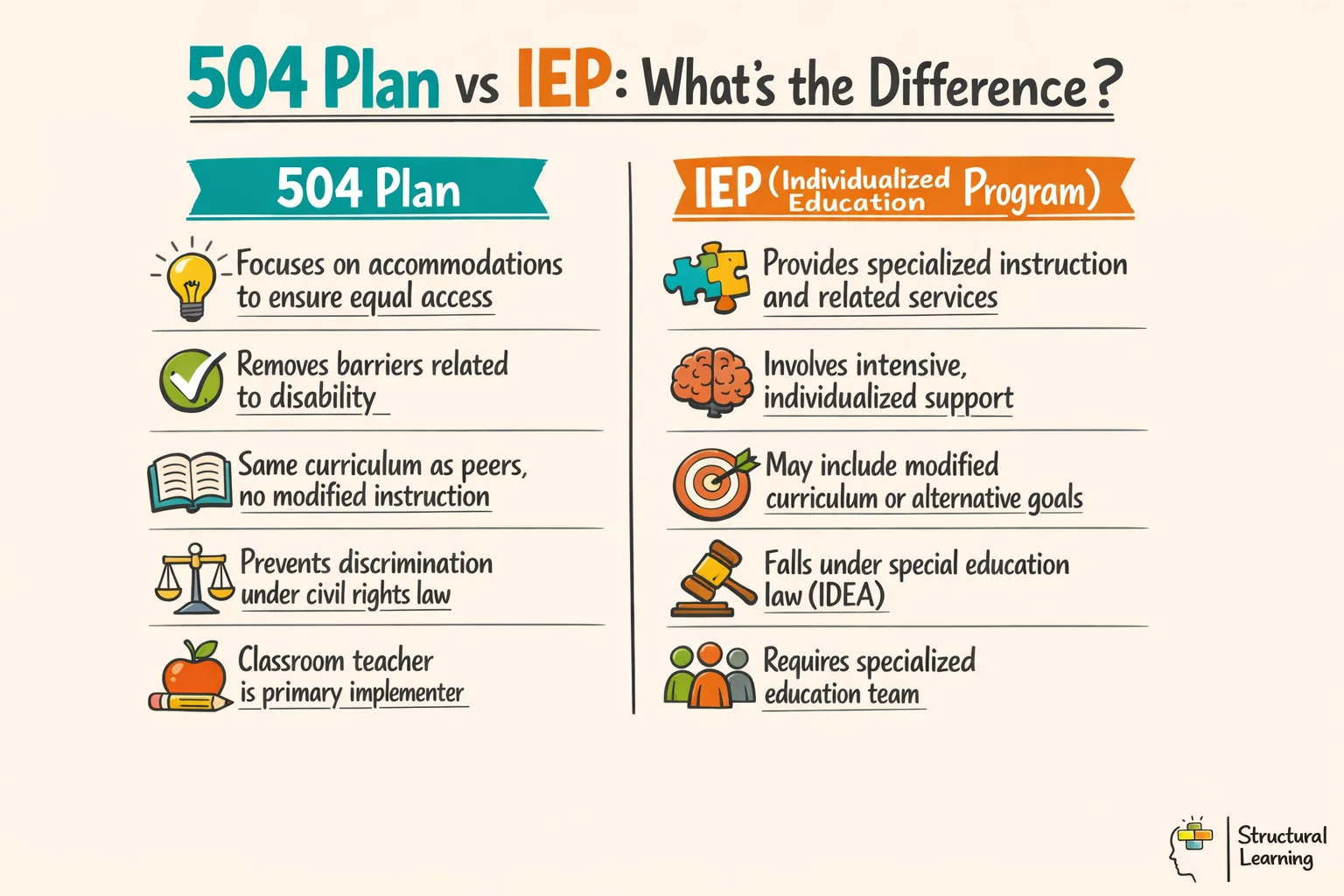
Many teachers use the terms "504 plan" and "IEP" interchangeably, but they are different legal documents with different eligibility criteria, funding, and implementation requirements. Understanding these differences is essential for implementing the right supports.
| Aspect | 504 Plan | IEP |
|---|---|---|
| Legal basis | Section 504, ADA | IDEA |
| Type of law | Civil rights law | Special education law |
| Who is eligible | Any student whose disability substantially limits a major life activity | Students aged 3-21 with one of 13 disability categories who need special education services |
| Curriculum expectations | Same general education curriculum; accommodations only | May include modified curriculum and alternative goals |
| Services provided | Accommodations in the general classroom | Special education instruction, related services, pull-out support |
| Teacher role | Implements accommodations; no separate instruction | Collaborates with special education team; may co-teach or receive support |
| Funding | No additional federal funding; accommodations funded by general education budget | Federal funding (IDEA Part B) plus state/local funding |
| Documentation required | Written plan; less formal than IEP | Comprehensive written document with goals, objectives, progress monitoring |
Here's a practical example: a student with anxiety disorder might have a 504 plan with accommodations like "breaks for anxiety management" and "advanced notice of changes to routine." The student attends all mainstream classes, takes the same curriculum, and sits the same exams; the accommodations simply allow the student to manage anxiety whilst engaging with the work. By contrast, a student with an autism spectrum disorder might have both a 504 plan (for accommodations in mainstream subjects) and an IEP (for specialized instruction in communication and social skills, delivered by the special education team).
Section 504 uses a simple but broad eligibility criterion: a student qualifies if they have a physical or mental impairment that substantially limits one or more major life activities. "Major life activities" include learning, concentrating, attending school, reading, writing, speaking, communicating, interacting socially, working, and moving about. The definition is intentionally wide, covering disabilities that IDEA does not, such as severe anxiety, uncorrected vision loss, and ADHD that does not qualify for special education.
The key phrase is "substantially limits." This means the impairment must significantly restrict a major life activity compared to the average person. A student with mild hay fever is not substantially limited in a major life activity; a student with severe asthma that limits physical activity and school attendance is. Schools must make this determination on a case-by-case basis, considering the nature and severity of the impairment.
Common diagnoses qualifying for 504 plans include ADHD, anxiety disorder, depression, physical disabilities, visual or hearing impairment, chronic illness (asthma, diabetes, epilepsy), learning disabilities, autism spectrum disorder, dyslexia, and speech-language impairment. However, a diagnosis alone does not guarantee eligibility. The school must evaluate whether the specific student's condition substantially limits a major life activity in their case.
Anyone can request a 504 evaluation: a parent, teacher, or even the student themselves. The school cannot simply refuse; it must consider the request and, if evidence suggests a disability may be present, conduct an evaluation. The evaluation must be comprehensive, consider multiple sources of information, and be conducted by a knowledgeable person or team (Zirkel, 2009).
Your school's 504 coordinator (usually a special education administrator or school nurse) manages the formal 504 process: scheduling evaluations, convening the 504 team, drafting the plan, and monitoring compliance. But you are responsible for implementing the accommodation every day in your classroom. This is not a peripheral duty; it is a legal obligation.
Your responsibilities include the following. First, read the 504 plan carefully and ask clarifying questions if the accommodations are vague. "Provide extended time" is clear; "provide support for executive functioning" is too broad. Second, implement the accommodations consistently and in the manner specified in the plan. If the plan states "reduce distractions during independent work," this means every independent work session, not just some. Third, provide the accommodation in a way that does not stigmatise the student or draw attention. If a student uses a separate test-taking room for extended time, do not announce this to the class or call the student out when they leave.
Fourth, monitor the accommodation's effectiveness. Is the student actually benefiting from the extended time, the quiet workspace, or the preferential seating? If not, tell the 504 coordinator. The accommodation may need to be adjusted. Fifth, document which accommodations you provided, when, and what the student produced. This record is crucial evidence that you have complied with the plan and that the student has made progress (or not). Sixth, keep the accommodation plan confidential. Sharing details with other students or staff without a need-to-know violates the student's privacy.
You are not responsible for conducting the initial evaluation or writing the formal 504 plan. The 504 team does this. However, you are likely to be invited to 504 meetings; this is an opportunity to raise concerns about how the disability affects learning in your classroom and to suggest accommodations that would be practical for you to deliver.
Presentation accommodations change how information is delivered to the student, without changing what is being taught. They are among the most common accommodations, particularly for students with visual, hearing, or learning disabilities. Presentation accommodations remove barriers to accessing content so the student can focus on learning rather than decoding the information itself.
Here are 20 specific presentation accommodations to consider:
Example: A Year 6 pupil with low vision attends your English lesson. You have put a copy of the lesson text in large print (18pt) on the student's desk before the lesson starts. During the lesson, you read a passage aloud and discuss it, then provide the passage in digital format so the student can increase the font size further at home. At the end of the week, you email the student a recording of you reading the next week's text so they can preview it. The student is now able to engage with the same content as their peers, not because the curriculum changed, but because you removed the visual access barrier.
Response accommodations change how the student demonstrates their knowledge and skills. Instead of writing an answer, the student might speak it; instead of completing a timed exam, the student might have extended time. Response accommodations do not make the task easier; they simply allow the student to show what they know in a way that does not penalise the disability.
Here are 22 specific response accommodations:
Example: A Year 8 pupil with dysgraphia struggles to produce written work by hand because fine motor coordination is impaired. The accommodation allows typed responses instead of handwritten ones. When you assign a history essay, the student uses a laptop to type instead of writing by hand. The content, length, and expectations remain identical; the method of production is different. The student can now demonstrate their historical knowledge without the motor barrier.
Setting accommodations change where or under what conditions the student works. They allow the student to be removed from distractions or sensory overwhelming environments so they can focus on learning. Setting accommodations are particularly valuable for students with ADHD, anxiety, autism spectrum disorder, or sensory processing differences.
Here are 18 specific setting accommodations:
Example: A Year 7 pupil with ADHD finds the busy classroom environment overwhelming and cannot concentrate during independent work. The accommodation allows the student to work in a quiet testing room for reading and maths tasks during the first 20 minutes of the lesson, then return to the classroom for whole-class discussion. The student is learning the same content, but in an environment where executive function and attention are not strained by sensory and social demands. Their attention improves, and they complete assignments more successfully.
Timing and scheduling accommodations change when the student works or how much time they have to complete work. They account for conditions like ADHD, which may affect processing speed, or anxiety, which may require frequent breaks. Timing accommodations ensure the student's disability does not prevent them from demonstrating their knowledge.
Here are 16 specific timing and scheduling accommodations:
Example: A Year 9 pupil with slow processing speed takes a 60-minute exam. The accommodation is "time and a half" (90 minutes). The student receives the same exam as peers, answers the same questions, and is graded to the same standard. The extra 30 minutes allows the student to process questions, retrieve knowledge, and write responses without the time pressure that would otherwise prevent them from showing what they know.
Students with executive function difficulties (ADHD, autism spectrum disorder, or learning disabilities) often struggle with planning, organisation, and task initiation. These accommodations provide external structure and support for study skills so the student can focus on content learning rather than fighting disability-related planning challenges.
Here are 18 specific organisation and study skills accommodations:
Example: A Year 7 pupil with ADHD forgets homework, loses assignment sheets, and does not know where to start on longer projects. The accommodations include: a written homework log (the student writes down every assignment at the end of each lesson), a project checklist broken into five steps, and email reminders sent by the 504 coordinator on Monday morning. The student still completes the same curriculum and submits the same quality work; the external structure removes the executive function barrier.
Students with anxiety, depression, ADHD, or autism spectrum disorder may struggle with emotional regulation, social interaction, or behaviour management. Behavioural and social-emotional accommodations create predictability, reduce triggers, and provide coping strategies so the student can access learning whilst managing their emotional state.
Here are 17 specific behavioural and social-emotional accommodations:
Example: A Year 6 pupil with anxiety becomes very distressed during whole-class questioning; the fear of being called on and making a mistake causes significant anxiety. The accommodation allows the student to opt in to responding (raising a hand and volunteering) rather than being called on. The student still participates in discussion, but the control and predictability reduce anxiety. Over time, as confidence builds, the student may volunteer more frequently. In the meantime, the accommodation allows the student to engage with learning without the anxiety barrier.
ADHD (attention-deficit/hyperactivity disorder) affects executive function, impulse control, sustained attention, and working memory. Students with ADHD often struggle to initiate tasks, sustain focus during long lessons, remember multi-step instructions, and organise materials. A well-designed 504 plan for ADHD includes accommodations that bypass these challenges so the student can access the curriculum.
Common 504 accommodations for ADHD include the following: extended time on tests (to allow for processing and review); frequent movement breaks (to help the student regulate); a quiet workspace during independent work (to reduce distracting stimuli); preferential seating near the teacher (for proximity cues and support); templates and graphic organiserss (to provide external structure for planning); written instructions in addition to verbal (to reduce reliance on working memory); a task list or checklist (to scaffolding task initiation and completion); the ability to use a fidget tool or move during seat work (to support attention regulation); reduced distraction in the environment (dim lighting, white noise, minimal visual clutter); and frequent check-ins with the teacher (to keep the student on track and catch misunderstandings early). Many students with ADHD also benefit from medication, which may be part of their medical plan; your role is to implement the school accommodations consistently regardless of medication status.
See our article on 504 accommodations for ADHD for more detailed information, specific classroom strategies, and evidence-based approaches.
Example: A Year 8 pupil with ADHD has a 504 plan with the following accommodations: movement breaks every 20 minutes during independent work; a written homework assignment log; a quiet testing room for exams with extended time; a seat near the teacher's desk during whole-class instruction; and a task checklist for multi-step assignments. In maths, the student sits near you, receives the same lesson and assignments as peers, but can stand and stretch every 20 minutes. When a test is administered, the student has 90 minutes instead of 60 in a quiet room. The student is still learning maths to the same standard, but the accommodations allow the student to demonstrate their knowledge without the ADHD-related barriers of attention and impulse control.
Dyslexia is a specific learning disability affecting phonological processing and reading decoding. Students with dyslexia often read slowly, struggle with spelling, and may have difficulty retrieving written words quickly. A well-designed 504 plan for dyslexia removes reading and writing barriers without changing the curriculum.
Common 504 accommodations for dyslexia include the following: access to text-to-speech software to read written materials aloud; large-print or digital-format materials that can be adjusted for font and contrast; extended time on reading-based tests; a spellchecker and grammar checker during writing; the ability to respond orally instead of in writing (for content assessment, not reading fluency); reduced copying tasks (provide materials already written); high-quality phonological instruction using a structured literacy approach (Orton-Gillingham, Multisensory Structured Language, or similar); and consistent access to assistive technology. Students with dyslexia do not have a disability affecting comprehension or intelligence; they have a neurological difference in phonological processing. Accommodations remove the reading barrier so comprehension and knowledge can be demonstrated. See our article on dysgraphia for related information on written expression.
Example: A Year 9 pupil with dyslexia is assigned an English textbook to read. The accommodation provides the text in digital format with adjustable font (18pt sans-serif) and colour overlays. The student also uses text-to-speech software to listen to the text whilst reading along. The curriculum, comprehension questions, and essay assignment are identical; the reading method is different, removing the decoding barrier. The student can now focus on understanding the literary themes rather than struggling with word recognition.
Anxiety disorder (generalised anxiety, social anxiety, panic disorder, or performance anxiety) affects concentration, participation, and assessment performance. Students with anxiety may avoid school, struggle during tests, and be reluctant to participate in class. A well-designed 504 plan for anxiety includes accommodations that reduce anxiety triggers and provide coping support.
Common 504 accommodations for anxiety include the following: opt-in participation (volunteering rather than being called on); advance notice of changes and transitions; a quiet space to decompress during the day; the ability to take breaks from the classroom when anxious; access to a counsellor or trusted adult for support; reduced emphasis on timed or high-stakes testing (alternative assessments, reduced-pressure environments); preferential seating away from distractions and near a trusted adult; advance copies of test materials so the student knows what to expect; a visual schedule showing what will happen during the day; breathing exercises or mindfulness practice built into the classroom routine; and permission to use anxiety management strategies during lessons (fidget tools, quiet self-talk). It is important to note that anxiety is a disability worthy of accommodation; students are not "being difficult" or "avoiding work." The accommodation allows the student to access learning whilst managing a medical condition.
Example: A Year 10 pupil with performance anxiety struggles during high-stakes exams. The accommodations include: testing in a small, quiet space with only the invigilator present; advance copy of the exam to review (not the answers, just to see the format and questions); 10 minutes before the test to use relaxation techniques; and the ability to take a two-minute break halfway through if needed. The exam content and standard are identical; the testing environment reduces the anxiety trigger. The student can now demonstrate their knowledge rather than their anxiety symptoms.
Documentation is one of the most important and most neglected aspects of 504 implementation. Teachers often assume that providing an accommodation is enough, but without documentation, there is no evidence that the accommodation was delivered. If a parent disputes the school's compliance, or if the student's progress stalls, documentation is the only proof you have.
What should you document? Record which accommodations you provided, when, how you delivered them, and what the student produced. You do not need to create a separate log; simply note it in your grade book, assessment record, or lesson plan. For example: "15 March. Extended time test given in testing room. 75 minutes. Student completed all questions. Score: 78%." This brief note shows that you delivered the accommodation and records the outcome.
For ongoing accommodations (preferential seating, movement breaks, oral responses), monthly or term-based reflection is sufficient: "March: Student used preferential seating throughout the month. Participation increased from 2 comments per lesson to 5 per lesson. Homework completion improved to 85% from 60% in February." This shows that the accommodation is being implemented and is having a positive effect.
What should you avoid documenting? Do not write subjective judgments about the student ("lazy," "not trying," "faking"), which can be interpreted as disability bias. Do not disclose the student's diagnosis or private medical information to other staff or students. Do not record information on sticky notes that will be thrown away; use a system that persists (your grade book, an Excel spreadsheet, a Google Doc shared with the 504 coordinator).
At least once per term, share your documentation with the 504 coordinator. This shows that accommodations are being implemented and allows the team to adjust if the accommodation is not working. If you notice that extended time is not helping the student succeed, say so. The 504 plan should be a living document that evolves as you learn what works for each student.
See our articles on formative assessment strategies and metacognition for approaches to documenting student progress and reflecting on learning effectiveness.
Even well-intentioned teachers make mistakes implementing 504 plans. Here are the most common errors and how to avoid them.
Mistake 1: Modifying the curriculum instead of providing accommodations. Accommodations remove barriers so students can access the same curriculum. A modification changes the curriculum itself (different content, lower expectations, different goals). If a student's 504 plan says "large-print materials," you provide the same lesson content in large print. If you provide an easier lesson or fewer problems, you are modifying, not accommodating, and you are likely in violation of the student's 504 rights. The Office for Civil Rights (OCR) distinguishes between accommodation (equal access to same content) and modification (different curriculum). Clarify with the 504 coordinator if you are unsure whether something is an accommodation or modification.
Mistake 2: Providing accommodations inconsistently. If the 504 plan says "extended time on all tests," extended time on some tests is not sufficient. The student needs extended time consistently. If you provide extended time on a maths test but not an English test, you are not following the plan. Inconsistent accommodation undermines its effectiveness and may constitute discrimination. Create a checklist of accommodations and verify before each assessment that you are delivering all of them.
Mistake 3: Failing to read the specific accommodation language. "Provide support for executive functioning" is vague. "Provide a written assignment rubric at the start of each major assignment" is specific and implementable. If the accommodation is vague, ask the 504 coordinator for clarification. What does "support" mean? Do you mean a checklist, a graphic organiser, a template, or one-to-one instruction? Ambiguity leads to inconsistent implementation.
Mistake 4: Stigmatising the student whilst delivering the accommodation. Pulling a student out of class and loudly saying "It's time for your extended time test" tells every other student that this student is different and is getting special treatment. Instead, discreetly pass a note saying the student should come to the testing room, or mention before class ends that certain students will test in a separate space. The accommodation should be delivered in a way that does not broadcast the disability or create social ostracism.
Mistake 5: Not documenting accommodation delivery. You provide extended time, but you do not record that you did. If a parent asks "Is my child getting the accommodation?" you have no evidence. Schools that are audited by the OCR and cannot produce documentation of accommodation delivery are found non-compliant. Keep records. This is a legal and ethical obligation.
Mistake 6: Confusing 504 with IEP. A student might have both a 504 plan and an IEP, or just one or the other. Do not treat them the same. A 504 plan is about accommodation and access to general education. An IEP includes specialised instruction, alternative goals, and intensive support. Read the specific document and implement what is written there, not what you assume should be there.
Mistake 7: Assuming accommodations are "extra" or unfair to other students. Accommodations do not advantage the student; they level the playing field. A student with dyslexia using text-to-speech is not getting an advantage; they are getting access to content in a form they can process, just as a peer without dyslexia can read print. A student with ADHD taking a test with movement breaks is not getting an advantage; they are getting support to manage a disability-related challenge. If other students complain about "unfairness," explain that accommodations remove barriers so students with disabilities can compete on equal terms.
Mistake 8: Providing accommodations only during formal assessment. If the 504 plan includes extended time, this applies during classwork, homework, and tests. If the plan includes a quiet workspace, this applies during independent work in the classroom, not just during exams. Accommodations are for learning, not just for grading. Providing accommodations only during tests whilst requiring the student to work under standard conditions during daily learning is inconsistent and limits the student's access to instruction.
Mistake 9: Not communicating with the student about their own accommodation. The student is the expert on their own disability and what helps. Ask: "Is the extended time helping you?" "Do you prefer the quiet room or working at the back of the classroom?" "Would a written reminder about the assignment checklist be useful?" Students are often motivated to participate in their own 504 plan and can provide valuable feedback on what works.
Mistake 10: Assuming accommodations are permanent and never reassessing. Disabilities change, students develop coping strategies, and accommodations may become more or less necessary over time. A student with anxiety might need opt-in participation in Year 7 but be comfortable volunteering by Year 10. Review the 504 plan annually and adjust based on current needs and progress. This shows that the accommodation is responsive to the student's actual needs, not just a checkbox.
Section 504 is a powerful tool for ensuring that students with disabilities have equal access to education. As a classroom teacher, you are the frontline implementer of these accommodations. Your commitment to understanding the law, reading the specific plan, implementing accommodations consistently, documenting your delivery, and reflecting on effectiveness directly determines whether 504 truly protects students' right to an equal education.
Start by reading every student's 504 plan at the beginning of the year. Ask questions if the language is vague. Create a simple system to track which accommodations you are delivering and document your implementation. Most importantly, remember that accommodations are not favours or "extra help"; they are legal requirements and ethical obligations. A student with a disability should not have to fight to access the same curriculum as their non-disabled peers. Your accommodations make that access possible.
For additional resources, consult your school's 504 coordinator, the Office for Civil Rights website, or your local education authority's guidance on 504 plan implementation. You can also reference the Americans with Disabilities Act and Section 504 of the Rehabilitation Act for the legal foundation of these requirements.
A student in your Year 9 maths class has a 504 plan that requires extended test time. You prepare the accommodation, administer the test in a separate room, but you're uncertain whether you're implementing the accommodation correctly, what other supports the student might need, or whether you're legally compliant. This uncertainty is common. Section 504 of the Rehabilitation Act of 1973 is often misunderstood by teachers, who may confuse it with special educational needs law (IDEA) or assume accommodations are optional.
The truth is simpler: a 504 plan is a legal agreement that requires your school to provide specific accommodations to ensure a student with a disability can access the curriculum on equal terms with their peers. As a classroom teacher, you are the primary person responsible for implementing these accommodations daily. This guide explains what 504 plans are, who qualifies, what accommodations are available, and how to implement them effectively and legally.
A 504 plan is a written agreement that outlines the specific accommodations a student needs to access education on equal terms with non-disabled peers. It is named after Section 504 of the Rehabilitation Act of 1973, a federal civil rights law that protects individuals with disabilities in schools receiving federal funding. The plan is designed by a 504 team (usually the student, parents, teachers, and school administration) and becomes a binding document the school must follow.
The core principle is straightforward: the student's disability should not prevent them from learning the same curriculum as their classmates. If a student's visual impairment makes it difficult to read small text on the board, the accommodation is large-print materials. If a student's ADHD makes sustained attention challenging, the accommodation might be short movement breaks during long lessons. The accommodation removes the barrier created by the disability, allowing the student to engage with the content.
Unlike special education (IDEA), a 504 plan does not require an individualised education program. There is no requirement to teach alternative curriculum or to reduce expectations. The school simply commits to providing the specific accommodations listed in the plan, delivered in the general education classroom or setting.
UK Educator? In UK schools, 504 Plans don't exist. The closest equivalents are reasonable adjustments under the Equality Act 2010 and SEN Support through the Graduated Approach.
See our guides: Special Educational Needs: A Teacher's Guide and Quality First Teaching for SEN.
Many teachers use the terms "504 plan" and "IEP" interchangeably, but they are different legal documents with different eligibility criteria, funding, and implementation requirements. Understanding these differences is essential for implementing the right supports.
| Aspect | 504 Plan | IEP |
|---|---|---|
| Legal basis | Section 504, ADA | IDEA |
| Type of law | Civil rights law | Special education law |
| Who is eligible | Any student whose disability substantially limits a major life activity | Students aged 3-21 with one of 13 disability categories who need special education services |
| Curriculum expectations | Same general education curriculum; accommodations only | May include modified curriculum and alternative goals |
| Services provided | Accommodations in the general classroom | Special education instruction, related services, pull-out support |
| Teacher role | Implements accommodations; no separate instruction | Collaborates with special education team; may co-teach or receive support |
| Funding | No additional federal funding; accommodations funded by general education budget | Federal funding (IDEA Part B) plus state/local funding |
| Documentation required | Written plan; less formal than IEP | Comprehensive written document with goals, objectives, progress monitoring |
Here's a practical example: a student with anxiety disorder might have a 504 plan with accommodations like "breaks for anxiety management" and "advanced notice of changes to routine." The student attends all mainstream classes, takes the same curriculum, and sits the same exams; the accommodations simply allow the student to manage anxiety whilst engaging with the work. By contrast, a student with an autism spectrum disorder might have both a 504 plan (for accommodations in mainstream subjects) and an IEP (for specialized instruction in communication and social skills, delivered by the special education team).
Section 504 uses a simple but broad eligibility criterion: a student qualifies if they have a physical or mental impairment that substantially limits one or more major life activities. "Major life activities" include learning, concentrating, attending school, reading, writing, speaking, communicating, interacting socially, working, and moving about. The definition is intentionally wide, covering disabilities that IDEA does not, such as severe anxiety, uncorrected vision loss, and ADHD that does not qualify for special education.
The key phrase is "substantially limits." This means the impairment must significantly restrict a major life activity compared to the average person. A student with mild hay fever is not substantially limited in a major life activity; a student with severe asthma that limits physical activity and school attendance is. Schools must make this determination on a case-by-case basis, considering the nature and severity of the impairment.
Common diagnoses qualifying for 504 plans include ADHD, anxiety disorder, depression, physical disabilities, visual or hearing impairment, chronic illness (asthma, diabetes, epilepsy), learning disabilities, autism spectrum disorder, dyslexia, and speech-language impairment. However, a diagnosis alone does not guarantee eligibility. The school must evaluate whether the specific student's condition substantially limits a major life activity in their case.
Anyone can request a 504 evaluation: a parent, teacher, or even the student themselves. The school cannot simply refuse; it must consider the request and, if evidence suggests a disability may be present, conduct an evaluation. The evaluation must be comprehensive, consider multiple sources of information, and be conducted by a knowledgeable person or team (Zirkel, 2009).
Your school's 504 coordinator (usually a special education administrator or school nurse) manages the formal 504 process: scheduling evaluations, convening the 504 team, drafting the plan, and monitoring compliance. But you are responsible for implementing the accommodation every day in your classroom. This is not a peripheral duty; it is a legal obligation.
Your responsibilities include the following. First, read the 504 plan carefully and ask clarifying questions if the accommodations are vague. "Provide extended time" is clear; "provide support for executive functioning" is too broad. Second, implement the accommodations consistently and in the manner specified in the plan. If the plan states "reduce distractions during independent work," this means every independent work session, not just some. Third, provide the accommodation in a way that does not stigmatise the student or draw attention. If a student uses a separate test-taking room for extended time, do not announce this to the class or call the student out when they leave.
Fourth, monitor the accommodation's effectiveness. Is the student actually benefiting from the extended time, the quiet workspace, or the preferential seating? If not, tell the 504 coordinator. The accommodation may need to be adjusted. Fifth, document which accommodations you provided, when, and what the student produced. This record is crucial evidence that you have complied with the plan and that the student has made progress (or not). Sixth, keep the accommodation plan confidential. Sharing details with other students or staff without a need-to-know violates the student's privacy.
You are not responsible for conducting the initial evaluation or writing the formal 504 plan. The 504 team does this. However, you are likely to be invited to 504 meetings; this is an opportunity to raise concerns about how the disability affects learning in your classroom and to suggest accommodations that would be practical for you to deliver.
Presentation accommodations change how information is delivered to the student, without changing what is being taught. They are among the most common accommodations, particularly for students with visual, hearing, or learning disabilities. Presentation accommodations remove barriers to accessing content so the student can focus on learning rather than decoding the information itself.
Here are 20 specific presentation accommodations to consider:
Example: A Year 6 pupil with low vision attends your English lesson. You have put a copy of the lesson text in large print (18pt) on the student's desk before the lesson starts. During the lesson, you read a passage aloud and discuss it, then provide the passage in digital format so the student can increase the font size further at home. At the end of the week, you email the student a recording of you reading the next week's text so they can preview it. The student is now able to engage with the same content as their peers, not because the curriculum changed, but because you removed the visual access barrier.
Response accommodations change how the student demonstrates their knowledge and skills. Instead of writing an answer, the student might speak it; instead of completing a timed exam, the student might have extended time. Response accommodations do not make the task easier; they simply allow the student to show what they know in a way that does not penalise the disability.
Here are 22 specific response accommodations:
Example: A Year 8 pupil with dysgraphia struggles to produce written work by hand because fine motor coordination is impaired. The accommodation allows typed responses instead of handwritten ones. When you assign a history essay, the student uses a laptop to type instead of writing by hand. The content, length, and expectations remain identical; the method of production is different. The student can now demonstrate their historical knowledge without the motor barrier.
Setting accommodations change where or under what conditions the student works. They allow the student to be removed from distractions or sensory overwhelming environments so they can focus on learning. Setting accommodations are particularly valuable for students with ADHD, anxiety, autism spectrum disorder, or sensory processing differences.
Here are 18 specific setting accommodations:
Example: A Year 7 pupil with ADHD finds the busy classroom environment overwhelming and cannot concentrate during independent work. The accommodation allows the student to work in a quiet testing room for reading and maths tasks during the first 20 minutes of the lesson, then return to the classroom for whole-class discussion. The student is learning the same content, but in an environment where executive function and attention are not strained by sensory and social demands. Their attention improves, and they complete assignments more successfully.
Timing and scheduling accommodations change when the student works or how much time they have to complete work. They account for conditions like ADHD, which may affect processing speed, or anxiety, which may require frequent breaks. Timing accommodations ensure the student's disability does not prevent them from demonstrating their knowledge.
Here are 16 specific timing and scheduling accommodations:
Example: A Year 9 pupil with slow processing speed takes a 60-minute exam. The accommodation is "time and a half" (90 minutes). The student receives the same exam as peers, answers the same questions, and is graded to the same standard. The extra 30 minutes allows the student to process questions, retrieve knowledge, and write responses without the time pressure that would otherwise prevent them from showing what they know.
Students with executive function difficulties (ADHD, autism spectrum disorder, or learning disabilities) often struggle with planning, organisation, and task initiation. These accommodations provide external structure and support for study skills so the student can focus on content learning rather than fighting disability-related planning challenges.
Here are 18 specific organisation and study skills accommodations:
Example: A Year 7 pupil with ADHD forgets homework, loses assignment sheets, and does not know where to start on longer projects. The accommodations include: a written homework log (the student writes down every assignment at the end of each lesson), a project checklist broken into five steps, and email reminders sent by the 504 coordinator on Monday morning. The student still completes the same curriculum and submits the same quality work; the external structure removes the executive function barrier.
Students with anxiety, depression, ADHD, or autism spectrum disorder may struggle with emotional regulation, social interaction, or behaviour management. Behavioural and social-emotional accommodations create predictability, reduce triggers, and provide coping strategies so the student can access learning whilst managing their emotional state.
Here are 17 specific behavioural and social-emotional accommodations:
Example: A Year 6 pupil with anxiety becomes very distressed during whole-class questioning; the fear of being called on and making a mistake causes significant anxiety. The accommodation allows the student to opt in to responding (raising a hand and volunteering) rather than being called on. The student still participates in discussion, but the control and predictability reduce anxiety. Over time, as confidence builds, the student may volunteer more frequently. In the meantime, the accommodation allows the student to engage with learning without the anxiety barrier.
ADHD (attention-deficit/hyperactivity disorder) affects executive function, impulse control, sustained attention, and working memory. Students with ADHD often struggle to initiate tasks, sustain focus during long lessons, remember multi-step instructions, and organise materials. A well-designed 504 plan for ADHD includes accommodations that bypass these challenges so the student can access the curriculum.
Common 504 accommodations for ADHD include the following: extended time on tests (to allow for processing and review); frequent movement breaks (to help the student regulate); a quiet workspace during independent work (to reduce distracting stimuli); preferential seating near the teacher (for proximity cues and support); templates and graphic organiserss (to provide external structure for planning); written instructions in addition to verbal (to reduce reliance on working memory); a task list or checklist (to scaffolding task initiation and completion); the ability to use a fidget tool or move during seat work (to support attention regulation); reduced distraction in the environment (dim lighting, white noise, minimal visual clutter); and frequent check-ins with the teacher (to keep the student on track and catch misunderstandings early). Many students with ADHD also benefit from medication, which may be part of their medical plan; your role is to implement the school accommodations consistently regardless of medication status.
See our article on 504 accommodations for ADHD for more detailed information, specific classroom strategies, and evidence-based approaches.
Example: A Year 8 pupil with ADHD has a 504 plan with the following accommodations: movement breaks every 20 minutes during independent work; a written homework assignment log; a quiet testing room for exams with extended time; a seat near the teacher's desk during whole-class instruction; and a task checklist for multi-step assignments. In maths, the student sits near you, receives the same lesson and assignments as peers, but can stand and stretch every 20 minutes. When a test is administered, the student has 90 minutes instead of 60 in a quiet room. The student is still learning maths to the same standard, but the accommodations allow the student to demonstrate their knowledge without the ADHD-related barriers of attention and impulse control.
Dyslexia is a specific learning disability affecting phonological processing and reading decoding. Students with dyslexia often read slowly, struggle with spelling, and may have difficulty retrieving written words quickly. A well-designed 504 plan for dyslexia removes reading and writing barriers without changing the curriculum.
Common 504 accommodations for dyslexia include the following: access to text-to-speech software to read written materials aloud; large-print or digital-format materials that can be adjusted for font and contrast; extended time on reading-based tests; a spellchecker and grammar checker during writing; the ability to respond orally instead of in writing (for content assessment, not reading fluency); reduced copying tasks (provide materials already written); high-quality phonological instruction using a structured literacy approach (Orton-Gillingham, Multisensory Structured Language, or similar); and consistent access to assistive technology. Students with dyslexia do not have a disability affecting comprehension or intelligence; they have a neurological difference in phonological processing. Accommodations remove the reading barrier so comprehension and knowledge can be demonstrated. See our article on dysgraphia for related information on written expression.
Example: A Year 9 pupil with dyslexia is assigned an English textbook to read. The accommodation provides the text in digital format with adjustable font (18pt sans-serif) and colour overlays. The student also uses text-to-speech software to listen to the text whilst reading along. The curriculum, comprehension questions, and essay assignment are identical; the reading method is different, removing the decoding barrier. The student can now focus on understanding the literary themes rather than struggling with word recognition.
Anxiety disorder (generalised anxiety, social anxiety, panic disorder, or performance anxiety) affects concentration, participation, and assessment performance. Students with anxiety may avoid school, struggle during tests, and be reluctant to participate in class. A well-designed 504 plan for anxiety includes accommodations that reduce anxiety triggers and provide coping support.
Common 504 accommodations for anxiety include the following: opt-in participation (volunteering rather than being called on); advance notice of changes and transitions; a quiet space to decompress during the day; the ability to take breaks from the classroom when anxious; access to a counsellor or trusted adult for support; reduced emphasis on timed or high-stakes testing (alternative assessments, reduced-pressure environments); preferential seating away from distractions and near a trusted adult; advance copies of test materials so the student knows what to expect; a visual schedule showing what will happen during the day; breathing exercises or mindfulness practice built into the classroom routine; and permission to use anxiety management strategies during lessons (fidget tools, quiet self-talk). It is important to note that anxiety is a disability worthy of accommodation; students are not "being difficult" or "avoiding work." The accommodation allows the student to access learning whilst managing a medical condition.
Example: A Year 10 pupil with performance anxiety struggles during high-stakes exams. The accommodations include: testing in a small, quiet space with only the invigilator present; advance copy of the exam to review (not the answers, just to see the format and questions); 10 minutes before the test to use relaxation techniques; and the ability to take a two-minute break halfway through if needed. The exam content and standard are identical; the testing environment reduces the anxiety trigger. The student can now demonstrate their knowledge rather than their anxiety symptoms.
Documentation is one of the most important and most neglected aspects of 504 implementation. Teachers often assume that providing an accommodation is enough, but without documentation, there is no evidence that the accommodation was delivered. If a parent disputes the school's compliance, or if the student's progress stalls, documentation is the only proof you have.
What should you document? Record which accommodations you provided, when, how you delivered them, and what the student produced. You do not need to create a separate log; simply note it in your grade book, assessment record, or lesson plan. For example: "15 March. Extended time test given in testing room. 75 minutes. Student completed all questions. Score: 78%." This brief note shows that you delivered the accommodation and records the outcome.
For ongoing accommodations (preferential seating, movement breaks, oral responses), monthly or term-based reflection is sufficient: "March: Student used preferential seating throughout the month. Participation increased from 2 comments per lesson to 5 per lesson. Homework completion improved to 85% from 60% in February." This shows that the accommodation is being implemented and is having a positive effect.
What should you avoid documenting? Do not write subjective judgments about the student ("lazy," "not trying," "faking"), which can be interpreted as disability bias. Do not disclose the student's diagnosis or private medical information to other staff or students. Do not record information on sticky notes that will be thrown away; use a system that persists (your grade book, an Excel spreadsheet, a Google Doc shared with the 504 coordinator).
At least once per term, share your documentation with the 504 coordinator. This shows that accommodations are being implemented and allows the team to adjust if the accommodation is not working. If you notice that extended time is not helping the student succeed, say so. The 504 plan should be a living document that evolves as you learn what works for each student.
See our articles on formative assessment strategies and metacognition for approaches to documenting student progress and reflecting on learning effectiveness.
Even well-intentioned teachers make mistakes implementing 504 plans. Here are the most common errors and how to avoid them.
Mistake 1: Modifying the curriculum instead of providing accommodations. Accommodations remove barriers so students can access the same curriculum. A modification changes the curriculum itself (different content, lower expectations, different goals). If a student's 504 plan says "large-print materials," you provide the same lesson content in large print. If you provide an easier lesson or fewer problems, you are modifying, not accommodating, and you are likely in violation of the student's 504 rights. The Office for Civil Rights (OCR) distinguishes between accommodation (equal access to same content) and modification (different curriculum). Clarify with the 504 coordinator if you are unsure whether something is an accommodation or modification.
Mistake 2: Providing accommodations inconsistently. If the 504 plan says "extended time on all tests," extended time on some tests is not sufficient. The student needs extended time consistently. If you provide extended time on a maths test but not an English test, you are not following the plan. Inconsistent accommodation undermines its effectiveness and may constitute discrimination. Create a checklist of accommodations and verify before each assessment that you are delivering all of them.
Mistake 3: Failing to read the specific accommodation language. "Provide support for executive functioning" is vague. "Provide a written assignment rubric at the start of each major assignment" is specific and implementable. If the accommodation is vague, ask the 504 coordinator for clarification. What does "support" mean? Do you mean a checklist, a graphic organiser, a template, or one-to-one instruction? Ambiguity leads to inconsistent implementation.
Mistake 4: Stigmatising the student whilst delivering the accommodation. Pulling a student out of class and loudly saying "It's time for your extended time test" tells every other student that this student is different and is getting special treatment. Instead, discreetly pass a note saying the student should come to the testing room, or mention before class ends that certain students will test in a separate space. The accommodation should be delivered in a way that does not broadcast the disability or create social ostracism.
Mistake 5: Not documenting accommodation delivery. You provide extended time, but you do not record that you did. If a parent asks "Is my child getting the accommodation?" you have no evidence. Schools that are audited by the OCR and cannot produce documentation of accommodation delivery are found non-compliant. Keep records. This is a legal and ethical obligation.
Mistake 6: Confusing 504 with IEP. A student might have both a 504 plan and an IEP, or just one or the other. Do not treat them the same. A 504 plan is about accommodation and access to general education. An IEP includes specialised instruction, alternative goals, and intensive support. Read the specific document and implement what is written there, not what you assume should be there.
Mistake 7: Assuming accommodations are "extra" or unfair to other students. Accommodations do not advantage the student; they level the playing field. A student with dyslexia using text-to-speech is not getting an advantage; they are getting access to content in a form they can process, just as a peer without dyslexia can read print. A student with ADHD taking a test with movement breaks is not getting an advantage; they are getting support to manage a disability-related challenge. If other students complain about "unfairness," explain that accommodations remove barriers so students with disabilities can compete on equal terms.
Mistake 8: Providing accommodations only during formal assessment. If the 504 plan includes extended time, this applies during classwork, homework, and tests. If the plan includes a quiet workspace, this applies during independent work in the classroom, not just during exams. Accommodations are for learning, not just for grading. Providing accommodations only during tests whilst requiring the student to work under standard conditions during daily learning is inconsistent and limits the student's access to instruction.
Mistake 9: Not communicating with the student about their own accommodation. The student is the expert on their own disability and what helps. Ask: "Is the extended time helping you?" "Do you prefer the quiet room or working at the back of the classroom?" "Would a written reminder about the assignment checklist be useful?" Students are often motivated to participate in their own 504 plan and can provide valuable feedback on what works.
Mistake 10: Assuming accommodations are permanent and never reassessing. Disabilities change, students develop coping strategies, and accommodations may become more or less necessary over time. A student with anxiety might need opt-in participation in Year 7 but be comfortable volunteering by Year 10. Review the 504 plan annually and adjust based on current needs and progress. This shows that the accommodation is responsive to the student's actual needs, not just a checkbox.
Section 504 is a powerful tool for ensuring that students with disabilities have equal access to education. As a classroom teacher, you are the frontline implementer of these accommodations. Your commitment to understanding the law, reading the specific plan, implementing accommodations consistently, documenting your delivery, and reflecting on effectiveness directly determines whether 504 truly protects students' right to an equal education.
Start by reading every student's 504 plan at the beginning of the year. Ask questions if the language is vague. Create a simple system to track which accommodations you are delivering and document your implementation. Most importantly, remember that accommodations are not favours or "extra help"; they are legal requirements and ethical obligations. A student with a disability should not have to fight to access the same curriculum as their non-disabled peers. Your accommodations make that access possible.
For additional resources, consult your school's 504 coordinator, the Office for Civil Rights website, or your local education authority's guidance on 504 plan implementation. You can also reference the Americans with Disabilities Act and Section 504 of the Rehabilitation Act for the legal foundation of these requirements.