The Expanding Expression Tool: A Teacher's GuideThe Expanding Expression Tool: A Teacher's Guide: practical strategies for teachers

Updated on  

June 13, 2026

The Expanding Expression Tool: A Teacher's Guide

|

June 13, 2026

A practical teacher guide to expanding expression tool, including who it supports, how to implement it, evidence limits and next-lesson classroom routines.


META: A practical guide for UK teachers and SENCOs on using the Expanding Expression Tool (EET) to develop learners' descriptive language, moving from oral rehearsal to structured writing.
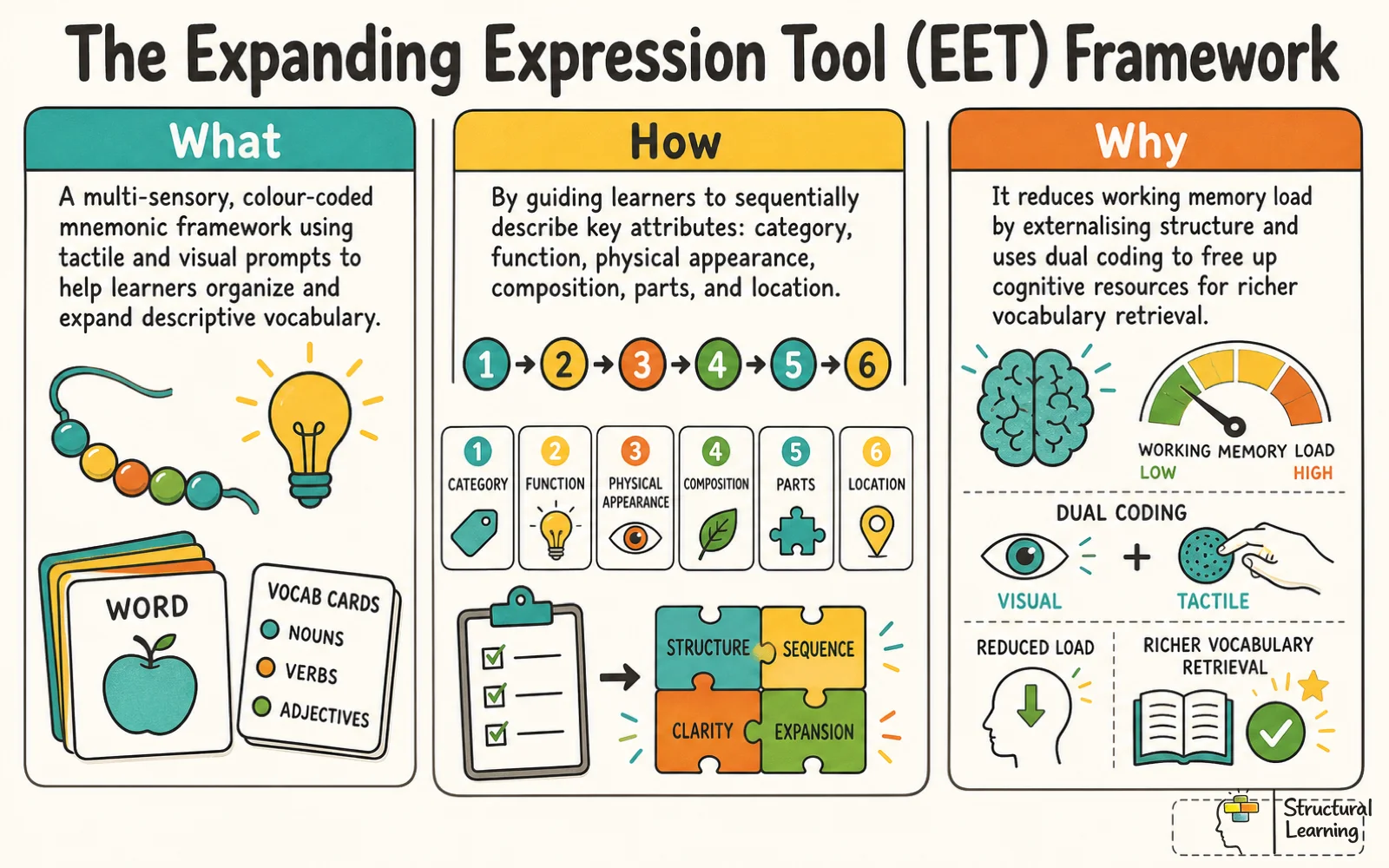
An infographic of the Expanding Expression Tool (EET) showing the What, How, and Why of the framework.
The Expanding Expression Tool (EET) Framework

The Expanding Expression Tool (EET) is a multi-sensory approach designed to help learners develop their expressive and descriptive language skills. It provides a structured, colour-coded framework to help children and young people move beyond simple statements and build a richer, more detailed vocabulary for both speaking and writing.

Expanding Expression Tool Study Notes preview
◆ Structural Learning
Expanding Expression Tool Study Notes
Study notesOne-page revision sheet

Download a one-page study note for Expanding Expression Tool, with the key ideas, limitations and classroom links in one place.

Something went wrong - please try again.

For busy teachers and SENCOs, the EET offers a tangible routine for breaking down the complex task of description into manageable parts. While originally developed in the United States by speech and language therapist Sara L. Smith, its principles can be adapted for UK classrooms to support a wide range of learners.

Key Takeaways

  • What it is: The EET is a mnemonic system that uses colours and symbols to prompt learners to describe an object's attributes: its category, function, appearance, composition, parts, and location.
  • How it works: It reduces cognitive load by externalising the structure of a description. This allows learners to focus on retrieving vocabulary and organising their ideas rather than trying to remember what to write next.
  • Who it's for: It is most commonly used in primary settings, particularly with learners who have Speech, Language and Communication Needs (SLCN), Developmental Language Disorder (DLD), or are on the autistic spectrum. It can also support Early Years Foundation Stage (EYFS) and Key Stage 1 learners in developing foundational oral language.
  • The evidence: The evidence base for the EET itself is still emerging. However, the principles behind it, semantic feature analysis and structured oral language work, are supported by a wider body of research on vocabulary and language development (Lowe et al., 2018; Donolato et al., 2023).

The Cognitive Science Behind the Expanding Expression Tool

At its core, the EET is a practical application of established cognitive science principles. It is designed to manage the cognitive load associated with language production, making the process of description more accessible.

Reducing Working Memory Demands

When a learner is asked to describe something, they must simultaneously hold the object in mind, search their long-term memory for relevant vocabulary, decide on the importance of different features, and structure it all into coherent sentences. This can quickly overwhelm a learner's limited working memory (Sweller, 1988).

The EET acts as an external scaffold. By providing a fixed, predictable structure, it offloads the organisational component of the task. The learner no longer has to ask themselves "What should I say next?". Instead, they can follow the colour-coded prompts, freeing up cognitive resources to focus on the content of their description.

Using Dual Coding to Build Meaning

The tool combines verbal prompts with visual and tactile cues (the coloured beads or symbols). This approach aligns with the principles of dual coding, where information presented in both verbal and non-verbal forms is more likely to be retained and understood. The colours become a memorable shortcut for abstract categories like 'function' or 'composition', helping learners to internalise the structure of a good description.

The EET Colour-Coded System Explained

The Expanding Expression Tool organises description into seven categories, each represented by a colour. While the official kit uses a string of beads, teachers can easily replicate this with coloured cards, whiteboard drawings, or other visual aids.

Colour Category Prompt Question(s) for Learners
Green Group What group or category does it belong to? (e.g., a toy, a food, a tool)
Blue Do What do you do with it? What does it do? (Its function or action)
Eye What does it look like? What is its colour, shape, or size? (Visual attributes)
Wood What is it made of? What is its composition or material?
Pink Parts What are its parts? What features does it have?
White Where? Where would you see it? Where does it come from? (Location/Origin)
Orange What else do I know? What else do I know about this? (Prior knowledge, interesting facts)

A Common Misconception

A frequent mistake teachers make is assuming every colour must be used for every object. This can lead to frustration, for example, when trying to define what a "kitten" is "made of" or the "function" of a "rock". The EET is a flexible scaffold, not a rigid checklist. It is perfectly acceptable, and often necessary, to skip categories that do not naturally apply to the object being described. The goal is richer description, not a forced march through every colour.

Should You Use the Expanding Expression Tool in Your Classroom?

The EET provides a clear, repeatable routine that can benefit many learners. However, it's important to consider its suitability for your specific context and to be aware of its limitations.

Who is the EET for?

  • Learners with SLCN/DLD: The structured nature of the tool provides essential support for learners who struggle with organising language and retrieving vocabulary.
  • Autistic Learners: The predictable, visual structure can reduce anxiety and provide a clear, logical path for communication.
  • Learners with Word-Finding Difficulties: The prompts can act as retrieval cues, helping learners to access and articulate words they know but struggle to recall.
  • Early Years and KS1: The tool provides a playful, concrete way to introduce the concept of description and build foundational oral language skills.
  • English as an Additional Language (EAL) Learners: The visual framework can help EAL learners to structure their English sentences and learn new vocabulary in a supported way.

Limitations and What to Watch Out For

  • Evidence Base: It is important to note that the Expanding Expression Tool is a commercial product, and as of 2026, it lacks a substantial body of independent, peer-reviewed research conducted in UK schools. The wider evidence on oral language interventions is promising (Esposito et al., 2024), but this does not automatically validate any specific branded programme. Some systematic reviews have found mixed or even negative effects for certain language interventions, highlighting the need for careful implementation and monitoring (Rinaldi et al., 2021).
  • Risk of Formulaic Output: If used too rigidly, the EET can lead to formulaic and repetitive writing. The goal is to use the tool as a scaffold to be gradually removed as learners internalise the structure, not to create a permanent dependency on it.
  • Moving Beyond Concrete Nouns: The tool is most effective for describing concrete objects. It is less suited for describing abstract concepts, characters' feelings, or complex processes without significant adaptation.

How to Implement the Expanding Expression Tool: A Step-by-Step Guide

Successful implementation involves moving learners through a "Say It, Map It, Build It" sequence. This takes them from guided oral rehearsal to independent written paragraphs.

Here is a classroom example of the process in a Year 5 science lesson focused on descriptive writing about a space rocket.

Step 1: Choose Your Target Vocabulary

Select a concrete noun that is relevant to your current curriculum topic. This grounds the activity in meaningful learning. For example, instead of a random object, choose a "Viking longship" in history or a "rainforest animal" in geography.

Step 2: Model the 'Say It' Stage (Oral Rehearsal)

The teacher introduces the EET framework and models its use.

Teacher: "Today, we are going to use our expression tool to describe a space rocket. This will help us gather all our ideas before we start writing. Let's go through the colours. Green for Group... a rocket is a type of transport. Blue for Do... it travels to space. Eye for Looks Like... it's tall, white, and pointed at the top."

Learners then practise orally describing the rocket in pairs, using the colour prompts to structure their conversation. This rehearsal phase is critical for activating vocabulary and building confidence before the demands of writing are introduced.

Step 3: Guide the 'Map It' Stage (Graphic Organiser)

Learners move from talking to recording their ideas. They can use a simple graphic organiser with sections corresponding to the EET colours.

This visual map serves as their plan for writing. It breaks the task down and allows them to see all their ideas in one place.

EET Colour Space Rocket Description
Group transport, vehicle
Do travels to space, carries astronauts, breaks through the atmosphere
Looks Like tall, white, pointed nose cone, huge, powerful
Made Of strong metal, titanium alloys, lightweight materials
Parts boosters, fuel tanks, command module, main engine
Where? launchpad, space centre, orbits the Earth
What else? needs a lot of fuel, travels very fast, can be reused

Step 4: Scaffold the 'Build It' Stage (Writing Paragraphs)

Using their completed map, learners now construct their written description. The teacher should model how to turn the notes from the graphic organiser into full sentences, connecting ideas with conjunctions.

Learner's Written Output (example): "A space rocket is a type of transport vehicle. Its main job is to travel to space, carrying astronauts and equipment. The rocket is usually a tall, white structure with a pointed nose cone to help it cut through the air. It is made of very strong but lightweight metals like titanium. A rocket has several key parts, including powerful boosters, large fuel tanks, and a command module where the astronauts sit. You would find a rocket at a space centre on a launchpad. One of the most important things to know is that it travels incredibly fast to escape Earth's gravity."

Integrating EET with Other Structural Approaches

The principles of the EET align well with other tools that make thinking visible and structure learning.

  • Colourful Semantics: While EET structures the description of a single topic, Colourful Semantics focuses on the grammatical structure of a sentence (Who? What doing? What? Where?). They can be used together; first use EET to generate the descriptive content, then use Colourful Semantics to ensure that content is formed into grammatically correct sentences.
  • Shape Coding: Similar to Colourful Semantics, Shape Coding provides a visual system for sentence structure, focusing on parts of speech and morphology. It is a more detailed system often used by specialist teachers and therapists.
  • Universal Thinking Framework / Map It: The 'Map It' stage of the EET process is a form of concept mapping. Teachers can use thinking maps from the Universal Thinking Framework, such as a 'Describing' map, to provide a consistent visual language for this planning stage across the curriculum.

EET Implementation Checklist for Teachers and SENCOs

Use this checklist to guide your implementation and troubleshoot common issues.

Getting Started

  • Have I chosen a concrete noun relevant to our current topic?
  • Have I explicitly modelled how to use the EET with a separate example?
  • Are the visual prompts (beads, cards, poster) clearly visible to the learners?
  • Have I reminded learners that it's okay to skip a colour if it doesn't fit?

During the Activity

  • Are learners being given enough time for oral rehearsal ('Say It') before writing?
  • Am I circulating to support pairs who are struggling to find vocabulary for a category?
  • Is there a visual 'Map It' stage to bridge the gap between talk and text?
  • Am I modelling how to turn the mapped notes into connected sentences?

Moving Towards Independence

  • Am I planning to gradually fade the scaffold (e.g., move from beads to a small card, then to just verbal prompts)?
  • Are learners being given opportunities to use this descriptive structure in different subjects?
  • Am I assessing their written output, not just their ability to fill in the EET categories?

Research Evidence Check

Evidence Synthesis

What is the evidence that semantic feature analysis and structured oral language scaffolds improve expressive language or writing?

Promising support: The Consensus search found relevant papers, but the evidence should be treated as emerging and checked carefully against the article claims.

63% Yes from 8 studiesstrong evidence
  • Yes63%
  • Possibly13%
  • Mixed13%
  • No13%
Teacher takeaway

Use the approach as an explicit routine: model the target skill, give guided practice, build in repetition, and check whether pupils can use it beyond the intervention session.

View the evidence behind this answer8 studies
1Oral language interventions can improve language outcomes in children with neurodevelopmental disorders: A systematic review and meta‐analysisEnrica Donolato et al. (2023) · Campbell Systematic Reviews
meta analysismixed202329 citations

Young people who fail to develop language as expected face significant challenges in all aspects of life. Unfortunately, language disorders are common, either as a distinct condition (e.g., Developmental Language Disorder) or as a part of another neurodevelopmental condition (e.g., autism). Finding ways to attenuate language problems through intervention has the potential to yield great benefits not only for the individual but also for society as a whole. This meta-analytic review examined the effect of oral language interventions for children with neurodevelopmental disorders. The last electronic search was conducted in April 2022. Intervention studies had to target language skills for children from 2 to 18 years of age with Developmental Language Disorder, autism, intellectual disability, Down syndrome, Fragile X syndrome, and Williams syndrome in randomised controlled trials or quasi-experimental designs. Control groups had to include business-as-usual, waiting list, passive or active conditions. However, we excluded studies in which the active control group received a different type, delivery, or dosage of another language intervention. Eligible interventions implemented explicit and structured activities (i.e., explicit instruction of vocabulary, narrative structure or grammatical rules) and/or implicit and broad activities (i.e., shared book reading, general language stimulation). The intervention studies had to assess language skills in receptive and/or expressive modalities. The search provided 8195 records after deduplication. Records were screened by title and abstract, leading to full-text examinations of 448 records. We performed Correlated and Hierarchical Effects models and ran a retrospective power analysis via simulation. Publication bias was assessed via-curve and precision-effect estimate. We examined 38 studies, with 46 group comparisons and 108 effects comparing pre-/post-tests and eight studies, with 12 group comparisons and 21 effects at follow-up. The results showed a mean effect size of = 0.27 at the post-test and = 0.18 at follow-up. However, there was evidence of publication bias and overestimation of the mean effects. Effects from the meta-analysis were significantly related to these elements: (1) receptive vocabulary and omnibus receptive measures showed smaller effect sizes relative to expressive vocabulary, grammar, expressive and receptive discourse, and omnibus expressive tests; and (2) the length of the intervention, where longer sessions conducted over a longer period of time were more beneficial than brief sessions and short-term interventions. Neither moderators concerning participants' characteristics (children's diagnosis, diagnostic status, age, sex, and non-verbal cognitive ability and severity of language impairment), nor those regarding of the treatment components and implementation of the language interventions (intervention content, setting, delivery agent, session structure of the intervention or total number of sessions) reached significance. The same occurred to indicators of study quality. The risk of bias assessment showed that reporting quality for the studies examined in the review was poor. In sum, the current evidence base is promising but inconclusive. Pre-registration and replication of more robust and adequately powered trials, which include a wider range of diagnostic conditions, together with more long-term follow-up comparisons, are needed to drive evidence-based practice and policy.

Classroom implication: Use this as a caution: check learner fit, delivery quality and progress data before treating the approach as settled practice.

2Vocabulary interventions for children with developmental language disorder: a systematic reviewRafiah Ansari et al. (2025) · Frontiers in Psychology
systematic reviewyes20256 citations

Developmental language disorder (DLD) is a neurodevelopmental condition often characterised by vocabulary difficulties that lead to academic and social challenges. The acquisition of vocabulary is a complex, dynamic process of mapping word sound (phonology) to meaning (semantics) supported by contextual cues; a complexity that vocabulary interventions need to address. To understand the key features and impact of such interventions, a systematic review of word-learning studies involving children aged 5-11 with DLD was conducted. A structured search covered seven electronic databases for the period 1990-2023. In addition, the reference lists of identified studies were searched manually. Studies were appraised for quality and data was extracted relating to word-learning effectiveness and intervention characteristics. Findings were reported as written summaries and quantitative data ranges. Sixteen relevant studies were identified with most appraised as medium quality. Interventions tended to be delivered individually in school by speech and language therapists. The most common outcome measure was expressive target-word tests, such as picture naming and word definitions. Interventions explicitly targeting phonological and semantic word features had the most high-quality studies reporting significant vocabulary gain. The inclusion of stories to provide context implicitly during phonological and semantic interventions was beneficial, though stories alone were less effective. Specificity in learning was noted across studies. Gains did not generally transfer to non-targeted words and showed depreciation following therapy. Intervention responses were influenced by children's language profiles. For example, children with more severe language difficulties were less responsive to contextual cues during story reading and were more distracted by extraneous music during multimedia-supported word learning. Whilst the available studies have limitations in range and quality, they do suggest some benefits of combining explicit and implicit vocabulary strategies and considering children's presenting profiles. Implications for practitioners supporting the individual needs of children with DLD are discussed. This includes addressing issues with the generalization and maintenance of vocabulary gains by targeting the most relevant words and encouraging recall and self-management strategies. Further research should explore the influence of home-school carryover. https://www.crd.york.ac.uk/prospero/display_record.php?ID=CRD42022327345, PROSPERO, Reg: CRD42022327345.

Classroom implication: Translate the finding into explicit modelling, guided practice and progress monitoring rather than relying on one-off exposure.

3Efficacy of elaborated semantic features analysis in Aphasia: a quasi-randomised controlled trialE. Efstratiadou et al. (2019) · Aphasiology
systematic reviewpossibly201915 citations

ABSTRACT Background: Word finding difficulty is one of the most common features of aphasia. Semantic Features Analysis (SFA) directly aims to improve word finding in people with aphasia. Evidence from systematic reviews suggests that SFA leads to positive outcomes, yet the evidence comprises single case studies and case series. There is a need to evaluate the efficacy of SFA in controlled group studies/trials. Aims: To evaluate the efficacy of Elaborated Semantic Feature Analysis (ESFA) for word finding in people with aphasia. We investigated: (a) the efficacy of ESFA versus a delayed therapy/control, (b) the efficacy of two therapy approaches – individual versus a combination of individual and group therapy. Methods and procedures: We ran a multi-centre, quasi-randomised controlled trial, nested in a larger study (Thales-Aphasia). Participants were recruited from community settings. They had to be people with aphasia due to stroke at least four months post-onset. Participants were randomized to individual vs combination vs delayed therapy/control groups. Both therapy groups had 3 h of ESFA per week for 12 weeks. Delayed therapy/control group had no intervention for 12 weeks and were then randomized to either individual or combination therapy. The primary outcome was confrontation naming. Secondary outcomes were the Boston Naming Test, Discourse, the Functional Assessment of Communication Skills for adults (ASHA–FACS), the Stroke and Aphasia Quality of Life scale (SAQOL-39g), the General Health Questionnaire-12 item, and the EQ-5D. Outcomes and Results: Of the 72 participants of the Thales-Aphasia project, 58 met eligibility criteria for speech-language therapy and 39 were allocated to ESFA. The critical p-value was adjusted for multiple comparisons (.005). For the therapy versus control comparison, there was a significant main effect of time on the primary outcome (p < .001, η2p = .42) and a significant interaction effect (p = .003, η2p = .21). An interaction effect for the SAQOL-39g (p = .015, η2p = .11) and its psychosocial domain (p = .013, η2p = .12) did not remain significant after Bonferroni adjustment. For the individual versus combination ESFA comparison, there were significant main effects of time on the primary outcome (p < .001, η2p = .49), the BNT (p < .001, η2p = .29) and the ASHA-FACS (p = .001, η2p = .18). Interaction and group effects were not significant. Conclusion: Though underpowered, this study provides evidence on the efficacy of ESFA to improve word finding in aphasia, with gains similar in the two therapy approaches.

Classroom implication: Translate the finding into explicit modelling, guided practice and progress monitoring rather than relying on one-off exposure.

4A Systematic Review and Meta-Analysis of Vocabulary Interventions for Deaf/Hard of Hearing Children and Adolescents.Hülya Aldemir et al. (2023) · Journal of Speech, Language, and Hearing Research
meta analysisyes20237 citations

The development of vocabulary size in deaf/hard of hearing (DHH) children and adolescents can be delayed compared to their peers due to lack of access to early language input. Complementary vocabulary interventions are reported in the literature. Our aim is to evaluate the effectiveness of intervention methods for their vocabulary improvement. Following the Preferred Reporting Items for Systematic Reviews and Meta-Analyses guidelines, we searched five databases for peer-reviewed journal articles in English, published between 2000 and 2022 (inclusive), reporting vocabulary interventions for 2- to 18-year-old DHH children and adolescents without comorbidities. We conducted separate meta-analyses using a random-effects model on receptive oral vocabulary, expressive oral vocabulary, and signed vocabulary. We assessed the methodological quality of each paper. This review is preregistered in PROSPERO (International Prospective Register of Systematic Reviews) with ID CRD42021243479. We included 25 group studies in this review out of 1,724 identified records. The quality assessment of the studies revealed risk of bias ranging from some concerns to high risk. Experimental vocabulary instruction produced improvement in receptive oral vocabulary (Hedges's= 1.08, 95% CI [0.25, 1.90],= 93.46,= .01), expressive oral vocabulary (Hedges's= 1.00, 95% CI [0.18, 1.83],= 96.37,= .02), and signed vocabulary (Hedges's= 1.88, 95% CI [1.09, 2.66],= 96.01,< .001) in the experimental groups. Written vocabulary and general vocabulary skills are also reported as a synthesis of results. Multisensory and multimodal explicit vocabulary instruction for DHH children and adolescents is helpful in improving vocabulary acquisition with respect to baseline levels. However, its effectiveness must be carefully interpreted due to the lack of proper control groups and details onreported in the studies. https://doi.org/10.23641/asha.23646357.

Classroom implication: Translate the finding into explicit modelling, guided practice and progress monitoring rather than relying on one-off exposure.

5Shared characteristics of intervention techniques for oral vocabulary and speech comprehensibility in preschool children with co-occurring features of developmental language disorder and speech sound disorder: a systematic review with narrative synthesisLucy Rodgers et al. (2024) · BMJ Open
systematic reviewyes20245 citations

To descriptively compare and contrast intervention techniques for preschool children with features of developmental language disorder (outcome: oral vocabulary) and speech sound disorder (outcome: speech comprehensibility) and analyse them in relation to effectiveness and theory. This is a systematic review with narrative synthesis. The process was supported by an expert steering group consisting of relevant professionals and people with lived experience. Ovid Emcare, MEDLINE Complete, CINAHL, APA PsycINFO, ERIC, and Communication Source from January 2012 were searched. Relevant studies were obtained from an initial published review (up to January 2012). Interventions for preschool children (80% aged 2:0-5:11 years) with idiopathic speech or language needs; outcomes relating to either oral vocabulary or speech comprehensibility. Searches were conducted on 27 January 2023. Two independent researchers screened at abstract and full-text levels. Data regarding intervention content (eg, techniques) and format/delivery (eg, dosage, location) were extracted. Data were synthesised narratively according to the methods of Campbell. 24 studies were included: 18 for oral vocabulary and 6 for speech comprehensibility. There were 11 randomised controlled trials, 2 cohort studies and 11 case series. Similarities included a focus on input-related techniques and similar therapy activities. Speech studies were more likely to be professional-led and clinic-led, rather than at home and through a parent. Analysis was restricted by heterogeneity in study design and terminology, as well as gaps within intervention reporting. Information deemed important to the expert steering group was missing. Similarities and differences between intervention techniques for oral vocabulary and speech comprehensibility have been identified and synthesised. However, analysis of effectiveness was limited due to issues with study design and heterogeneity within studies. This has implications for the progression of the evidence base within the field. CRD42022373931.

Classroom implication: Translate the finding into explicit modelling, guided practice and progress monitoring rather than relying on one-off exposure.

6Efficacy of the Treatment of Developmental Language Disorder: A Systematic ReviewS. Rinaldi et al. (2021) · Brain Sciences
systematic reviewno202183 citations

Language disorder is the most frequent developmental disorder in childhood and it has a significant negative impact on children's development. The goal of the present review was to systematically analyze the effectiveness of interventions in children with developmental language disorder (DLD) from an evidence-based perspective. We considered systematic reviews, meta-analyses of randomized controlled trials (RCTs), control group cohort studies on any type of intervention aimed at improving children's skills in the phono-articulatory, phonological, semantic-lexical, and morpho-syntactic fields in preschool and primary school children (up to eight years of age) that were diagnosed with DLD. We identified 27 full-length studies, 26 RCT and one review. Early intensive intervention in three- and four-year-old children has a positive effect on phonological expressive and receptive skills and acquisitions are maintained in the medium term. Less evidence is available on the treatment of expressive vocabulary (and no evidence on receptive vocabulary). Intervention on morphological and syntactic skills has effective results on expressive (but not receptive) skills; however, a number of inconsistent results have also been reported. Only one study reports a positive effect of treatment on inferential narrative skills. Limited evidence is also available on the treatment of meta-phonological skills. More studies investigated the effectiveness of interventions on general language skills, which now appears as a promising area of investigation, even though results are not all consistent. The effectiveness of interventions over expressive and receptive phonological skills, morpho-syntactic skills, as well as inferential skills in narrative context underscores the importance that these trainings be implemented in children with DLD.

Classroom implication: Use this as a caution: check learner fit, delivery quality and progress data before treating the approach as settled practice.

7Vocabulary intervention for adolescents with language disorder: a systematic review.Hilary Lowe et al. (2018) · International Journal of Language &amp; Communication Disorders
systematic reviewyes201827 citations

Language disorder and associated vocabulary difficulties can persist into adolescence, and can impact on long-term life outcomes. Previous reviews have shown that a variety of intervention techniques can successfully enhance students' vocabulary skills; however, none has investigated vocabulary intervention specifically for adolescents with language disorder. To carry out a systematic review of the literature on vocabulary interventions for adolescents with language disorder. A systematic search of 14 databases and other sources yielded 1320 studies, of which 13 met inclusion criteria. Inclusion criteria were: intervention effectiveness studies with a focus on enhancing oral receptive and/or expressive vocabulary skills in the study's aims; participants in the age range 11;0-16;11 with receptive and/or expressive language difficulties of any aetiology. There was a high degree of diversity between studies. Types of intervention included: semantic intervention (four studies); comparison of phonological versus semantic intervention (two); and combined phonological-semantic intervention (seven). The strongest evidence for effectiveness was found with a combined phonological-semantic approach. The evidence suggested a potential for all models of delivery to be helpful (individual, small group and whole class). Tentative evidence is emerging for the effectiveness of a phonological-semantic approach in enhancing the vocabulary skills of adolescents who have language disorder. Future research needs to refine and develop the methodologies used in this diverse group of studies in order to replicate their findings and to build consensus.

Classroom implication: Translate the finding into explicit modelling, guided practice and progress monitoring rather than relying on one-off exposure.

8Oral language intervention in the late primary school years is effective: evidence from a randomised control trialR. Esposito et al. (2024) · Journal of Child Psychology and Psychiatry
peer reviewed studyyes20243 citations

Oral language skills provide the foundation for formal education, and children may require language support over an extended period of time to maximise their education potential. Most work on language intervention, however, has focussed on the preschool or early school years. Here, we describe the development and evaluation of the Oral Language for Literacy Intervention (OLLI) programme which is designed to support children with weak language skills in the later primary school years. We conducted a randomised control trial in 33 schools (50 classrooms). The language skills of all 8-9 year-old children in each participating classroom (n = 1,423) were assessed using an automated app (LanguageScreen). The six children with the weakest LanguageScreen scores within each classroom (n = 296) were randomly allocated to the intervention (n = 148) or control group (n = 148). The children in the intervention group received the OLLI programme delivered in individual and small group sessions over 20 weeks. Children in the control group received their typical teaching. Children receiving the OLLI programme made significantly larger gains than children in the control group on a preregistered latent variable reflecting standardised measures of oral language ability (d = 0.38) and on a measure of their written expression (d = 0.42). These findings have important implications for improving educational attainment in children in the late primary school years. The OLLI programme is designed to be deliverable at scale and is of relatively low cost.

Classroom implication: Translate the finding into explicit modelling, guided practice and progress monitoring rather than relying on one-off exposure.

Frequently Asked Questions (FAQs)

1. Is the Expanding Expression Tool an evidence-based practice? The underlying strategies (semantic feature analysis, oral language work) are supported by research. However, the branded EET programme itself has a limited independent evidence base in the UK. Teachers should treat it as a structured tool based on sound principles, but be sure to monitor its impact on their own learners rather than assuming its effectiveness.

2. Can I use the EET with older learners in KS3? Yes, but it requires adaptation. The core structure is still useful, but the visual branding may seem juvenile. You can reframe it as a "Descriptive Framework" or "Attribute Analysis" and use a more mature-looking graphic organiser instead of the caterpillar/beads. The focus for older learners should be on using the structure to analyse more complex and abstract concepts (e.g., describing 'democracy' or 'irony').

3. Do I need to buy the official kit? No. While the kit provides a convenient set of resources, the methodology can be implemented with simple, homemade materials. A set of coloured cards, a poster, or a template on an interactive whiteboard can serve the same function.

4. How is this different from Colourful Semantics? EET helps learners generate a rich set of ideas about a topic. Colourful Semantics helps learners assemble those ideas into a grammatically correct sentence. They answer different questions: EET answers "What can I say about this?", while Colourful Semantics answers "How do I build a sentence?".


Your Next Step

Next lesson, choose a single, concrete object from your current topic. Before learners write anything, ask them to work in pairs and tell their partner three things about it: what group it belongs to (Green), what we do with it (Blue), and what it looks like (Eye). This simple oral rehearsal is the first step in building a more structured approach to description.

Research sources

Further reading from peer-reviewed research

These 5 studies give source context for the classroom guidance in this article on The Expanding Expression Tool: A Teacher's Guide. They are included as starting points for deeper reading, not as a substitute for local professional judgement.

Systematic Review 83 citations mdpi.com

Efficacy of the Treatment of Developmental Language Disorder: A Systematic Review

S. Rinaldi et al. (2021) | Brain Sciences

Use this as a caution: check learner fit, delivery quality and progress data before treating the approach as settled practice.

View study

Systematic Review frontiersin.org

Vocabulary interventions for children with developmental language disorder: a systematic review

Rafiah Ansari et al. (2025) | Frontiers in Psychology

Translate the finding into explicit modelling, guided practice and progress monitoring rather than relying on one-off exposure.

View study

Peer Reviewed Study acamh.onlinelibrary.wiley.com

Oral language intervention in the late primary school years is effective: evidence from a randomised control trial

R. Esposito et al. (2024) | Journal of Child Psychology and Psychiatry

Translate the finding into explicit modelling, guided practice and progress monitoring rather than relying on one-off exposure.

View study

Meta Analysis 29 citations journals.sagepub.com

Oral language interventions can improve language outcomes in children with neurodevelopmental disorders: A systematic review and meta‐analysis

Enrica Donolato et al. (2023) | Campbell Systematic Reviews

Use this as a caution: check learner fit, delivery quality and progress data before treating the approach as settled practice.

View study

Systematic Review 27 citations onlinelibrary.wiley.com

Vocabulary intervention for adolescents with language disorder: a systematic review.

Hilary Lowe et al. (2018) | International Journal of Language &amp; Communication Disorders

Translate the finding into explicit modelling, guided practice and progress monitoring rather than relying on one-off exposure.

View study

Paul Main, Founder of Structural Learning
About the Author
Paul Main
Founder & Metacognition Researcher

Paul Main is an educator and metacognition researcher who founded Structural Learning in 2002. With a psychology degree from the University of Sunderland and 22+ years helping schools embed thinking skills, he bridges the gap between educational research and classroom practice. Fellow of the RSA and Chartered College of Teaching, with 128+ Google Scholar citations.

More →

SEND

Back to Blog