Updated on
September 24, 2026
The SENCO Annual Calendar: Month-by-Month Planning Guide
Month-by-month SENCO planning calendar covering EHCP deadlines, Assess-Plan-Do-Review cycles, transition planning, staff training.


Updated on
September 24, 2026
Month-by-month SENCO planning calendar covering EHCP deadlines, Assess-Plan-Do-Review cycles, transition planning, staff training.
SENCOs face many deadlines. Forgetting an EHCP review or exam access evidence causes problems. Most SENCOs use lists, not annual plans. This calendar covers all key SENCO duties during the year.
It links to legal deadlines in the SEND Code of Practice (DfE, 2015). The term describes a structured process for turning evidence into a classroom decision, not a label on its own.
September is busy for SENCOs. Update the SEND register with accurate data. Screen the new learners entering the school. Brief all staff on each learner's individual needs.
Start with the SEND register itself. Every learner listed as SEN Support or with an EHCP needs their status confirmed. Check that leavers are removed, new arrivals are added, and provision categories match current need. A register that still lists a Year 6 leaver in October signals a system nobody trusts.
Start baseline assessments for new learners in the first two weeks. For Year 7, review primary transition documents and screen reading/spelling (NGRT or WRAT).
Identify learners whose special educational needs were missed during transfer. In primary, use Reception EYFS Profile data as a start. SENCOs should also screen speech and language using a tool.
Staff briefing is the task most SENCOs underestimate. A one-page learner profile for every SEND learner, shared with class teachers and teaching assistants in the first week, prevents three months of avoidable mistakes. The profile should include: the learner's primary area of need, what works in the classroom, what to avoid, and who to contact if concerns arise.
Classroom example. Mrs Patel, SENCO at a two-form-entry primary, runs a 30-minute briefing for each year group team during the first INSET day. She hands each class teacher a printed profile sheet for their SEND learners, walks through the three highest-need cases in detail, and takes questions.
By Friday of the first week, every teacher has a clear picture of their SEND cohort. Without this, teachers spend the first half-term discovering needs reactively, and the first Assess-Plan-Do-Review cycle starts late.
This evidence informs planning for the next Assess-Plan-Do-Review cycle. Teachers and the SENCO should carry out a clear analysis of the learner's needs, drawing on teacher assessment and experience, the learner's previous progress and attainment, their development compared with peers, and the views of parents and the learner (SEND Code of Practice, 2015). By October half-term, teachers use this evidence to plan interventions.
Collect evidence from teachers using a template. It must show each learner's response to teaching. Include any adjustments and progress since September's baseline.
Avoid vague statements like "struggling in maths". Instead, use "cannot count past 20 with resources" as evidence.
Plan: Write SMART targets for each SEND learner. A useful test: could a supply teacher read this target and know exactly what to do? If the target says "Improve reading fluency," the answer is no. If it says "Read 60 words per minute on a Year 3 decodable text by December, measured weekly using a one-minute timed reading," the answer is yes.
Confirm interventions are timetabled, staffed, and resourced. Many APDR cycles fail because the teaching assistant is used for cover. This defeats the plan, despite existing on paper .
Review: Schedule the formal review point for the last week of November. This gives seven weeks of intervention data, which is enough to identify whether the approach is working.
EHCP annual reviews due in the autumn term should be scheduled now. The SEND Code of Practice requires that annual reviews happen within 12 months of the last review or the date the EHCP was issued. Cross-reference your EHCP list with review dates and send invitations to parents, the local authority, and any external professionals at least two weeks in advance. Late annual reviews are a common Ofsted finding and a source of legitimate parental complaint.
Classroom example. Mr Davies, Year 4 teacher, completes his APDR evidence form for Kai, who has SEMH needs. Under "Assess," he records: "Kai left the classroom three times this week during transitions. He responded well to a visual timetable on Tuesday and Wednesday but refused to use it on Thursday after a lunchtime incident." Under "Plan," the SENCO and Mr Davies agree on a target: "Kai will use the visual timetable independently for 4 out of 5 transitions per day by the November review, supported by a 2-minute pre-transition prompt from the TA." This specificity makes the "Review" stage meaningful rather than a rubber-stamp exercise.
December is a data checkpoint, not just an end-of-term wind-down. The SENCO's priority is identifying which SEND learners are not making expected progress and why.
Pull together the data from the first APDR cycle, end-of-autumn assessments, and any intervention tracking. For each learner on the SEND register, answer three questions. First, is the learner making progress towards their SMART targets?
Second, is the current provision (intervention type, frequency, staffing) appropriate? Third, does the evidence suggest the learner needs more support than SEN Support can provide?
That third question matters because January opens the referral window for educational psychology assessments and, in some cases, EHCP requests. If you suspect a learner will need an EHCP request in January, the evidence base must be prepared in December. The local authority will expect to see at least two cycles of the graduated approach (ideally three), evidence of external advice, and clear records showing the school's SEN Support has been put in place and reviewed.
Parent consultation evidence is also gathered in December. Autumn parents' evenings provide an opportunity to record parental views on provision, which is a statutory requirement for EHCP requests and annual reviews.

Ask parents directly: "Are you seeing progress at home? What concerns do you have? Is there anything the school is doing that you feel is particularly helpful?" Record their responses on the learner's file.
A SENCO reviewed autumn data for 47 learners (SEND register). She found six learners progressed below expectations after help. She prepared paperwork for an educational psychologist for two learners. She gathered EHCP evidence for one, including data, logs, and teacher notes.
SENCOs who manage complex cases benefit most from January referrals. Educational psychology services, CAMHS, and SEND teams have growing waiting lists. Refer early, so there is a better chance of assessment before summer.
Referrals need a clear reason, learner response to support, and assessment data. Ask specific questions, like "What impacts Amira's reading, SLD or working memory?." "Assess this learner" isn't helpful. Adjust phonics using insights from.
EHCP requests submitted in January trigger a 20-week statutory timeline. The local authority must decide whether to carry out an EHC needs assessment within six weeks of the request; the whole process from request to final EHC plan must normally take no more than 20 weeks, and if the local authority assesses but decides not to issue a plan, it must notify the parent or young person within 16 weeks of the request (SEND Code of Practice, 2015). A January submission means a potential EHCP in place by June, which allows transition planning for the following September. A March submission pushes the timeline into the next academic year.
Provision mapping should be updated in January to reflect any changes from the autumn review. The provision map shows exactly what additional support each SEND learner receives, at what cost, and from whom. This document is your evidence base for demonstrating that the school's notional SEND budget is being used effectively. Governors, Ofsted inspectors, and local authority SEND teams all expect to see it.
Classroom example. Mrs Chen, SENCO at a primary school, submits an EHCP needs assessment request for Tyler in the second week of January. Her evidence pack includes: three cycles of APDR records, EP consultation notes from last year, speech and language therapy reports, differentiated planning examples showing reasonable adjustments, attendance data, and a parent contribution form from the December consultation.
The local authority panel reviews the request within six weeks and agrees to assess. Had she waited until March, Tyler's EHCP would not have been ready for his Year 6 to Year 7 transition.
The spring term's APDR cycle is the mid-year review point for all SEND learners. By now, every learner should have at least one complete cycle of evidence, and most will have two.
Review all SEND learners. Update SMART targets based on autumn progress data. For learners who met their targets, set new ones that build on the achieved skills.

For learners who did not meet targets, the critical question is whether the target was wrong, the provision was insufficient, or the learner's needs have changed. Each of those answers leads to a different response.
Provision maps need updating to reflect any changes in intervention, staffing, or external support. If a teaching assistant left in January and their intervention group was not reassigned, the provision map should show this gap. Pretending the provision continued when it did not undermines the entire evidence base.
Secondary SENCOs need time to review learner files (February, not April). They should plan staffing and visits for learners with complex needs. Primary SENCOs, compile transition documents now, including EHCPs and reports. Year 6 EHCP reviews must name the secondary school (Department for Education, 2014).
In February, plan teacher assessment moderation. Teachers may overestimate or underestimate SEND learner progress when they are unsure how to assess learners working below age expectations. In a moderation meeting, teachers compare learner assessments. This helps the school use the same judgements (Black & Wiliam, 1998).
Classroom example. At a secondary school, the SENCO convenes a moderation meeting with the English, maths, and science leads. They examine the books and assessment data of four Year 8 SEND learners.
The English teacher has assessed one learner as "working towards" the year's expectations; the maths teacher has assessed the same learner as "well below." After comparing evidence, they agree the learner is working towards in both subjects but that the maths assessments were not adapted to allow the learner to demonstrate understanding. The maths department adjusts its assessment approach, and the SENCO records this as a training need for the spring CPD programme.
April is transition month. For Year 6 SEND learners moving to secondary and new reception learners with identified needs arriving in September, the preparation done now decides whether those children start their new school supported or struggling.
Year 6 to Year 7 handover documents should include: the learner's current provision map, their most recent APDR cycle with targets and outcomes, copies of external professional reports (EP, SALT, OT), the current EHCP or SEN Support plan, and a one-page learner passport written with the learner's input. The passport captures the learner's own voice: what helps them learn, what they find difficult, what they want their new teachers to know.
Secondary SENCO visits to feeder primaries should happen in April or early May. The visiting SENCO needs to observe SEND learners in their current setting, speak to class teachers, and identify any learners who may need enhanced transition (additional visits, social stories, photo books of the new school, a named adult to meet on the first day).
Begin primary intake screening now. Contact the local authority early years team to find learners with EHCPs.
Also contact feeder nurseries. An EHCP before school means provision starts day one. Avoid discovering needs later.
and engage fully with the Local Authority's moderation process, as this will alleviate stress and prevent last-minute issues from arising. It is recommended to seek advice from colleagues or CPD providers on the collection of robust evidence. Consider the recommendations from research, such as Black and Wiliam's (1998) work on formative assessment or Hattie's (2008) research on effect sizes, to enhance teaching and learning.
Scrutinise evidence against exemplification materials and frameworks like the Standards and Testing Agency's (STA) guidance to ensure accurate judgements are made. By doing this, teachers can ensure their learners achieve the best possible outcomes.
Collect "normal way of working" evidence all year. Submit applications early and work with the Local Authority moderation. Ask colleagues or CPD providers for advice on good evidence.
Use research like Black and Wiliam (1998) and Hattie (2008) to improve teaching. Check evidence against STA guidance to make accurate judgements.
| Deadline | Timeline | Key Action |
|---|---|---|
| EHCP needs assessment request | 20 weeks from request to final EHCP | Submit by January for September transition; LA has 6 weeks to decide whether to assess |
| EHCP annual review | Within 12 months of issue or last review | Schedule invitations 6 weeks in advance; submit paperwork to LA within 2 weeks of the review meeting |
| Year 6 EHC plan review (secondary transfer) | By 15 February of the year of transfer | Must name the secondary school; LA must finalise amended EHCP by 31 March |
| Year 11/Year 14 EHCP review (post-16) | By 31 March in the year of transfer | Must include post-16 provision; involve the young person directly |
| DfE school census (SEND data) | January (spring census), May (summer census), October (autumn census) | SEND register must be accurate; SEN provision type and primary need recorded for every SEND learner |
| JCQ exam access arrangements | Specialist assessor report valid for 26 months; arrangements applied for by centre deadline | |
| STA access arrangements (KS2 SATs) | Application deadline usually late February | Apply for modified papers, readers, scribes; check STA guidance annually as deadlines shift |
| SEND Information Report | Updated annually; published on school website | The SEN Information Report must be published on the school website, updated at least annually, and include the information specified in Schedule 1 of the Special Educational Needs and Disability Regulations 2014. |
| Local Offer contribution | Ongoing; reviewed annually by the LA | Ensure school's contribution to the Local Offer is current and accurate |
Classroom example. Ms Okonkwo, primary SENCO, meets with the SENCO from the receiving secondary to hand over files for seven SEND learners. For three learners with EHCPs, she provides full documentation packs. For one learner with autism and high anxiety, she arranges three extra transition visits in June.
The learner will visit the school, meet key staff, practise the route to lessons, and eat lunch in the canteen. She also creates a photo booklet of the secondary school that the learner's current teacher uses during circle time throughout the summer term. Research on transition anxiety (Maras and Aveling, 2006) shows that familiarity with the physical environment reduces anxiety-related behaviours by up to 40% in the first term.
The summer term's APDR cycle is the final formal review of the year. It serves a dual purpose: evaluating the year's progress and generating the evidence base for September's planning.
Complete all outstanding annual reviews. Any EHCP annual review not completed by the end of June creates a backlog that compounds in September. Prioritise Year 5 reviews (these inform Year 6 transition planning for the following year) and any reviews where the local authority has requested amendments to the EHCP.
Exam access arrangements for KS2 SATs and KS4 GCSEs must be in place well before the exam period. The JCQ (Joint Council for Qualifications) requires that access arrangements are the learner's 'normal way of working.' This means they must have been using the arrangement in class and assessments throughout the year. A SENCO who applies for extra time in April for a learner who has never had it before will have the application rejected. Evidence of need (typically a specialist assessor's report) and evidence of normal way of working (teacher statements, intervention records) are both required.
For KS2, the Standards and Testing Agency (STA) sets its own access arrangement rules (STA, 2025). Applications for modified papers, readers, and scribes must be submitted by the published deadline (usually late February for the May tests). Check the STA guidance annually, as deadlines and processes change.
Reviewing intervention effectiveness is the analytical core of this cycle. For every intervention running this year, ask: what was the intended outcome, what was the actual outcome, and what does the cost-per-learner look like? An intervention that costs the school 3,000 pounds per year and produces measurable progress for six learners is defensible. The same intervention producing no measurable change for the same six learners needs to be replaced.
Classroom example. The SENCO reviews the school's phonics intervention programme, which three teaching assistants deliver to 18 learners across Years 2 to 4.
September baseline data shows the learners averaged a reading age 18 months below chronological age. June data shows the average gap has narrowed to 11 months. Seven learners have closed the gap to within six months and can exit the intervention.
Five learners have made no measurable progress. For those five, the SENCO investigates further: two have major attendance issues (below 80%), one has an undiagnosed hearing difficulty found during routine screening, and two appear to need a different intervention approach. This analysis directly shapes September's provision planning.
July is audit month. The work done here determines whether September starts with a clear plan or a scramble. Four tasks structure the SENCO's July.

Review each learner on the SEND register. Should any learners be removed, if SEN support is no longer needed? Based on this year’s evidence, should any learners be added?
Are provision categories (communication and interaction, cognition and learning, SEMH, sensory and physical) accurate? A clean register improves DfE census data (January) and SEND reports.
Intervention impact analysis. Compile the data from all three APDR cycles into a single summary for each intervention programme. Present this to the headteacher and governors as part of the SEND annual report. Governors have a statutory duty to monitor SEND provision (DfE & DoH, 2015, para. 6.3), and they need data to do it, not anecdotes.
Staff training needs assessment. Based on the year's APDR cycles, identify areas where teachers consistently needed support. If six teachers struggled to write SMART targets, that is a September training priority.
If three teachers reported difficulty managing learners with SEMH needs, commission specific CPD. The training plan should be ready before the summer break so it can be scheduled during September INSET days.
Handover to new class teachers. Every SEND learner should have an updated file handed to their new class teacher before term ends. This file includes: the current provision plan, the most recent APDR review, any external professional reports, and the one-page learner profile. A verbal handover meeting between the outgoing and incoming teacher, led by the SENCO, is worth more than any amount of paperwork.
Classroom example. Mr Ahmed, secondary SENCO, produces a one-page SEND summary for each of his 52 SEND learners and distributes them to new form tutors during the July staff meeting. He also runs a 45-minute session for NQTs starting in September, covering: how to read a learner profile, where to find SEND information on the school system, who to contact for urgent concerns, and the dates of the first APDR cycle. The NQTs arrive in September knowing exactly which learners in their tutor groups have SEND, what their needs are, and what they should do first.
The graduated response depends on evidence. Without a structured evidence base, EHCP requests are rejected, annual reviews lack substance, and Ofsted inspectors cannot verify that the school's SEND provision matches its claims. The SENCO file is not bureaucracy for its own sake; it is the documented proof that learners received what they were entitled to receive.
Keep a SEND learner file with key information. Include concern forms with observations (date, observer). Track APDR cycles and SMART targets.
| Month | Priority Tasks | Statutory Deadlines |
|---|---|---|
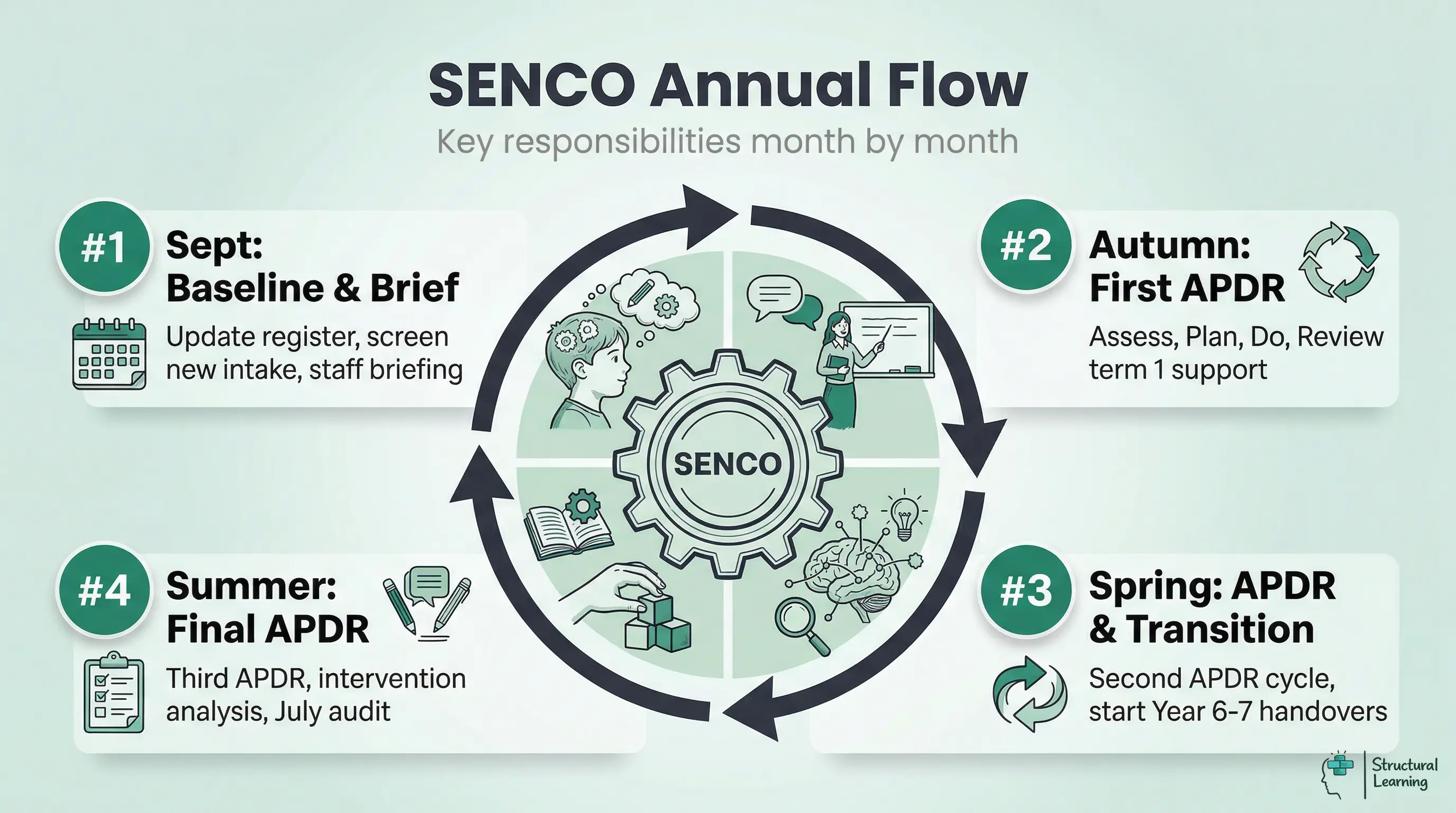
| September | Update SEND register, screen new intake, brief all staff, confirm TA deployment | SEND Information Report published on website; autumn census preparation |
| October | Launch APDR Cycle 1, gather teacher evidence, schedule autumn EHCP reviews | Autumn school census (SEND data submitted) |
| November | Complete APDR Cycle 1 reviews, set SMART targets, hold autumn EHCP annual reviews | EHCP annual reviews due this term |
| December | Data checkpoint, identify non-progressing learners, prepare referral evidence, parent consultations | None (but preparation for January is critical) |
| January | Submit EP referrals and EHCP requests, update provision map, spring census data check | Spring school census; January EHCP requests trigger 20-week timeline |
| February | Launch APDR Cycle 2, begin Year 6 transition planning, moderate teacher assessments | Year 5 EHCP reviews (name secondary school by 15 Feb); STA access arrangement deadline |
| March | Complete APDR Cycle 2 reviews, update provision maps, spring EHCP annual reviews | Year 11/14 EHCP reviews (post-16 transition by 31 March) |
| April | Year 6 handover documents, secondary SENCO visits, reception intake screening, learner passports | LA must finalise amended Year 5 EHCPs by 31 March (carried into April if late) |
| May | Launch APDR Cycle 3, KS2 SATs access arrangements active, enhanced transition visits | Summer school census; KS2 SATs; GCSE/A-level exams begin |
| June | Complete outstanding annual reviews, review intervention effectiveness, finalise transition plans | All EHCP annual reviews for the year should be complete |
| July | SEND register audit, intervention impact report, staff training needs, handover to new teachers | SEND annual report to governors; prepare September priorities |
Show learner progress with work samples. Record parent contact and views. File external reports (EP, SALT, OT, CAMHS). Keep review meeting minutes and local authority letters.
Graduated response evidence. When building a case for an EHCP needs assessment, the local authority panel looks for evidence that the school has followed the graduated approach systematically.
This means at least two (preferably three) complete APDR cycles with clear targets, documented interventions, and measurable outcomes. It means evidence that external advice was sought and acted upon. And it means evidence that the learner's needs cannot be met from the school's own resources at SEN Support level.
Avoid seeing graduated response as ticking boxes, not understanding learner needs. Panels notice this. Identical APDR targets across three cycles show no real approach. Adjusted targets, varied interventions, and professional advice show genuine attempts to help learners, (Ainscow et al., 2006; Dyson, 2001; Norwich, 2013).
How to organise the file. Use a consistent structure across all learner files. A tabbed system works well: Tab 1 for the learner profile and SEND register entry, Tab 2 for APDR cycles in chronological order, Tab 3 for external professional reports, Tab 4 for parental communication, and Tab 5 for the EHCP or annual review documents.
Whether this is a physical file or digital system matters less than consistency. Every SENCO in the school should be able to find any document for any learner within two minutes.
The SENCO showed Ofsted the graduated approach for a Year 3 learner. The file contained teacher concerns from Year 1 and refined APDR targets over three years.
An EP report from Year 2 recommended metacognitive reading strategies. The school implemented the EP’s advice and included parents' views. This coherent support narrative is possible with a well-maintained SENCO file.
Your first action for the next school week: open your SEND register, cross-reference it against your current class lists, and confirm that every learner's provision category, primary area of need, and review date are accurate. If you find errors, correct them now. A clean register is the foundation that everything else in this calendar depends on.
A month-by-month SENCO calendar gives order, but it can hide the uneven reality of school SEND work. Curran et al. (2021) show that SENCO workload is often dominated by administration, meetings and referrals, not strategic teaching support. A calendar that assumes protected time may therefore become a burdensome checklist unless senior leaders align it with cover, finance, HR and governor cycles.
A second limitation is developmental. Termly APDR cycles can make progress look linear, yet neurodivergent development often changes unevenly across settings, relationships and stress levels. Milton (2012) also warns against reading autistic difference through a one-way deficit lens, so review meetings should test whether the environment, adult communication and assessment design have changed, not only whether the learner has met the target.
Assessment evidence can also carry cultural and linguistic bias. Strand and Lindorff (2021) report ethnic disproportionality in SEN identification in England, while Zaniolo (2019) notes the difficulty of culturally and linguistically fair assessment for learners with English as an additional language. September baseline data should therefore be triangulated with family knowledge, classroom observation, first-language evidence where available and pupil voice.
Finally, the policy base is changing. The SEND Code of Practice remains statutory, but the 2023 improvement plan points towards national standards and digital EHCP processes (DfE, 2023). This guide remains useful if schools treat the calendar as a flexible risk map, not a substitute for professional judgement, co-production and timely classroom support.
They help SENCOs plan their year. The SEND Code of Practice (2015) sets out legal duties. Research by Norwich and Nash (2011) gives evidence. Blatchford et al. (2009) also offer insight.
SEND Code of Practice: 0 to 25 Years (Statutory Guidance) View document ↗
Statutory guidance
Department for Education and Department of Health (2015)
The SEND Code of Practice (2015) is the base for SEND provision. Chapters 6 and 9 explain the graduated approach. They also detail SENCO roles and EHCP review needs. All deadlines and processes link back to this guidance.
The SENCO Handbook: Leading and Managing a Whole School Approach
Professional reference
Cowne, Frankl, and Gerschel (2019)
SENCOs can use this guide for strategic planning and managing support (graduated approach). It also assists with external agency collaboration. The annual planning and evidence chapters support the calendar's monthly structure.
Beating Bureaucracy in Special Educational Needs View publication ↗
Practical guide
Gross (2015)
Gross (2017) helps SENCOs reduce paperwork and stay compliant. Her work assists in designing APDR templates for efficiency. Local authorities widely reference her "provision mapping" approach.
Nasen: The SENCO Role in Practice
Professional resource
National Association for Special Educational Needs (2023)
These resources help SENCOs with everyday tasks. They include templates for annual reviews and transition checklists. Nasen provides guidance on working with educational psychologists. The resources align with the SEND Code of Practice and are regularly updated. (Nasen)
Research shows the move from primary to secondary is hard for learners with SEND. (Galton et al., 2003; West et al., 2013) They may feel anxious about new settings. (Evangelou et al., 2018) Schools should plan carefully. (Ofsted, 2010) Good communication between schools helps. (Symes & Humphrey, 2011) This ensures learners get the right support. (Rix et al., 2009)
42 citations
Maras and Aveling (2006)
SEND learners' move to secondary school can be tough. Structured programmes with visits, contacts, and visuals cut anxiety and boosted engagement. These findings support the calendar's April and May transition advice.
The APDR cycle stands for Assess, Plan, Do, Review. It forms the graduated approach that schools must use to identify and support learners with special educational needs. SENCOs typically manage three of these structured cycles across the academic year to ensure interventions are effective and to build a solid evidence base for each child.
EHCP annual reviews must take place within twelve months of the last review or the date the initial plan was issued. A robust SENCO calendar schedules these statutory meetings well in advance to give parents and external professionals the required two weeks of notice. Missing these legal deadlines is a common issue flagged during school inspections.
In September, the SENCO and class teachers must confirm the correct status of every learner listed as SEN Support or holding an EHCP. Staff must check that previous learners are removed, new arrivals are added, and provision categories match current classroom needs. This process ensures all teaching staff rely on accurate data before the first APDR cycle begins.
A frequent mistake is writing vague targets, such as asking a child to improve their reading fluency without specifying how it will be measured. Good SEND targets must be highly specific so that any teaching assistant can read them and know exactly what action to take. For example, a target should state the exact number of words per minute a learner needs to read on a specific text level by December.
The SEND Code asks schools to plan learner transitions carefully. Start preparing in February for primary to secondary moves. This allows SENCOs time to liaise and create learner passports. Early work stops disruption for vulnerable learners (SEND Code of Practice).
DfE (2015).
DfE (2014).
DfE (2023).
Evangelou et al. (2018).
Fullan (2001).
Maras and Aveling (2006).
Ofsted (2010).
Rix et al. (2009).
Sammons (2007).
STA (2025).