The Hypercorrection Effect: A Teacher's GuideThe Hypercorrection Effect: A Teacher's Guide - educational concept illustration

The Hypercorrection Effect: A Teacher's Guide

|

December 29, 2025

The hypercorrection effect shows that confident errors are more easily corrected than uncertain ones, transforming how teachers think about mistakes and feedback in learning.

When students make mistakes, teachers naturally worry about those errors becoming entrenched. This concern intensifies when students seem certain of their incorrect answers. Surely an error held with high confidence would be particularly resistant to correction? Yet research reveals precisely the opposite: errors committed with high confidence are actually more likely to be corrected than errors made hesitantly. This counterintuitive finding, known as the hypercorrection effect, has significant implications for how we think about mistakes, feedback, and learning in the classroom.

Understanding the hypercorrection effect transforms the way teachers approach student misconceptions. Rather than viewing confident errors as obstacles, we can recognise them as opportunities. The surprise students experience when discovering their confident beliefs are wrong appears to create powerful learning moments.

Key Takeaways

  • The hypercorrection effect refers to the finding that errors made with high confidence are corrected more readily than errors made with low confidence when learners receive corrective feedback.
  • The surprise of discovering that something believed to be true is actually false appears to capture attention and enhance memory for the correct information.
  • Teachers can leverage this effect by encouraging students to commit to answers before receiving feedback and by creating safe environments for productive error-making.

What is the Hypercorrection Effect? infographic for teachers
What is the Hypercorrection Effect?

What Is the Hypercorrection Effect?

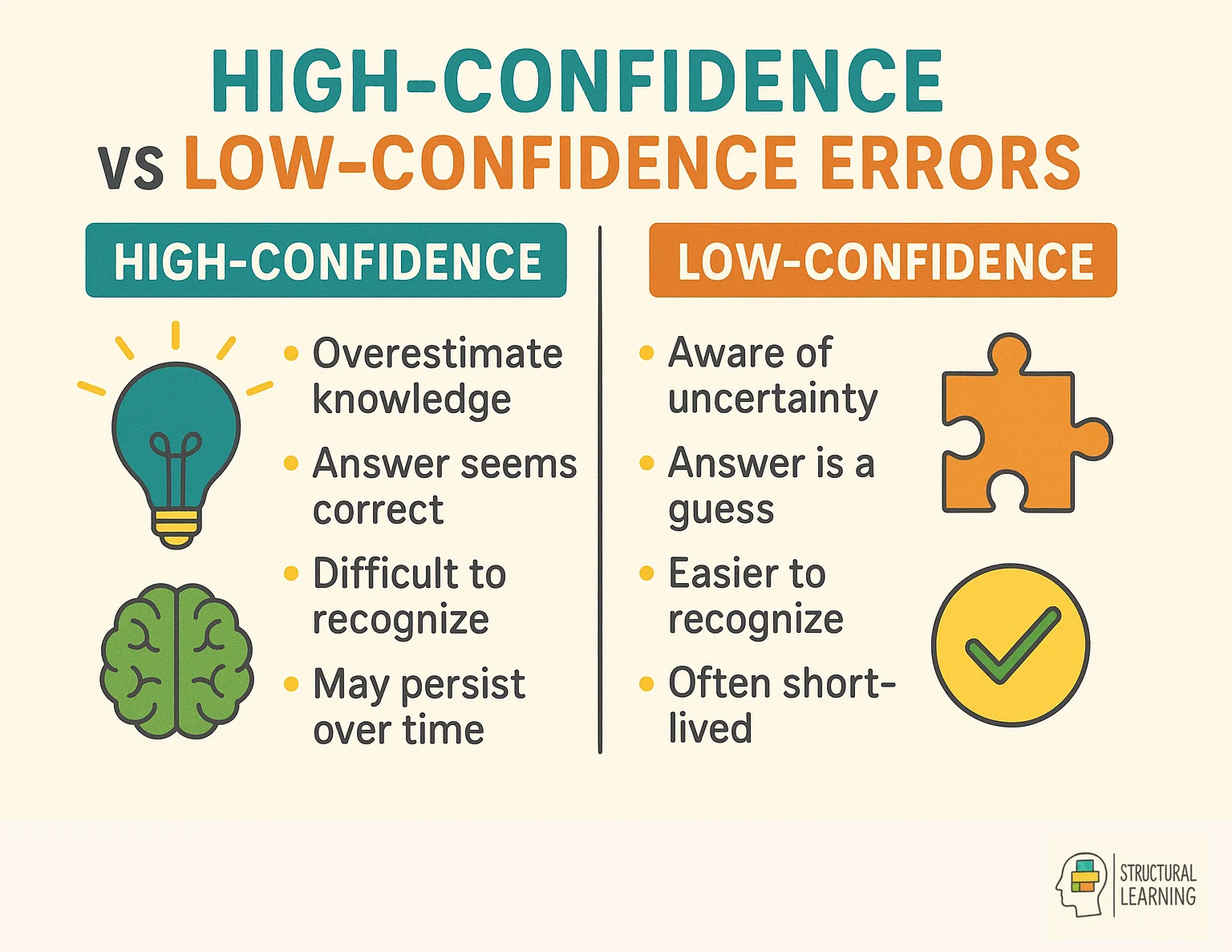
The hypercorrection effect describes a consistent finding in memory research: when people answer questions incorrectly but confidently, they are more likely to learn and remember the correct answer after receiving feedback than when they answer incorrectly with low confidence. High-confidence errors are, paradoxically, easier to fix.

The phenomenon was named by psychologists Janet Metcalfe and Brady Butterfield at Columbia University in 2001, though Raymond Kulhavy had noticed similar patterns in educational research during the 1970s. Since then, dozens of studies have replicated and extended the basic finding across different populations, materials, and settings.

Consider a typical experiment: participants answer general knowledge questions and rate their confidence in each answer. After answering, they receive feedback showing the correct answers. Later, they're tested again on the same questions. The consistent finding is that high-confidence errors show greater correction on the retest than low-confidence errors.

This pattern contradicts common intuition. Strong memories, we might assume, should be difficult to override. An error held with conviction might seem entrenched, resistant to change. The hypercorrection effect reveals that the opposite is often true in learning contexts.

Why Does Hypercorrection Occur?

Several theoretical explanations have been proposed for why confident errors are more readily corrected than tentative ones.

The Surprise Account

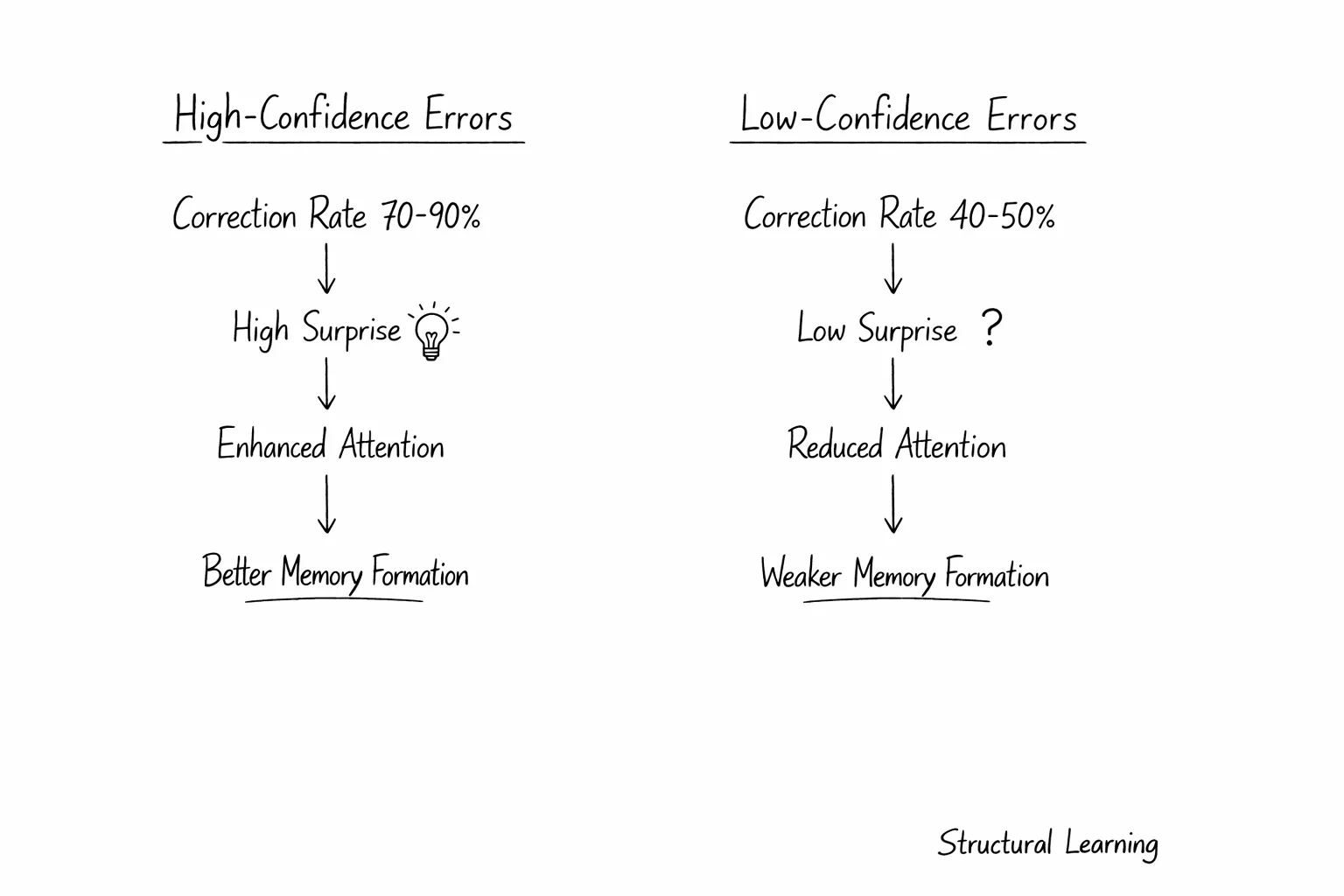
The dominant explanation centres on surprise. When people are highly confident in an answer and discover they're wrong, they experience a notable violation of expectations. This surprise captures attention and triggers enhanced processing of the corrective information.

By contrast, when people have low confidence in an answer and discover they're wrong, there's little surprise. They already suspected they might be incorrect. The confirmation of their uncertainty doesn't trigger the same attentional capture.

Neuroscience research supports this account. Studies using EEG have found stronger late positivity responses, associated with attention and surprise, when participants receive feedback on high-confidence errors compared to low-confidence errors. The brain responds differently to unexpected corrections.

The Attention and Effort Account

Related to surprise, the hypercorrection effect may reflect differential attention and cognitive effort. When confident predictions are violated, people may work harder to understand and remember the correct information. They allocate more cognitive resources to processing the correction.

Low-confidence errors may receive less attention precisely because correction was expected. The discrepancy between belief and reality is smaller, triggering less effortful processing.

The Elaborative Processing Account

High-confidence errors may trigger more elaborative processing of the correction. When discovering a confident belief was wrong, people may think more deeply about why they were wrong, what led to their error, and how the correct answer differs from their incorrect answer.

This elaboration creates richer memory traces for the correct information, potentially explaining enhanced retention. The error itself becomes a cue that helps retrieve the correction.

The Prior Knowledge Account

People typically have higher confidence in domains where they possess more prior knowledge. When a high-confidence error occurs, it may indicate richer background knowledge that, once corrected, supports better retention of the accurate information.

By this account, high-confidence errors are easier to correct not because of confidence per se but because of the knowledge structures that produced the confidence. The correction can integrate into an existing schema rather than floating in isolation.

Research supports this interpretation: people with higher domain knowledge show stronger hypercorrection effects. Their errors, though confident, connect to robust knowledge networks that support retention of corrections.

Research Evidence

The hypercorrection effect has been demonstrated across numerous studies with diverse populations and materials.

Laboratory Studies

Butterfield and Metcalfe's original studies used general knowledge questions, showing that corrections to high-confidence errors persisted over time better than corrections to low-confidence errors. Subsequent studies have replicated this basic effect using trivia, vocabulary, science content, and other materials.

Critically, the effect remains even when controlling for factors like item difficulty or participants' overall ability. The relationship between initial confidence and subsequent correction is robust.

Classroom Research

While most research has occurred in laboratory settings, classroom studies confirm the educational relevance of hypercorrection.

Carpenter and colleagues examined hypercorrection in an introductory horticulture course. College students answered content questions, rated their confidence, received feedback, and were later tested. The hypercorrection effect appeared: high-confidence errors were corrected more readily than low-confidence errors. Students with higher prior knowledge showed stronger effects.

Research using large databases of student responses, such as those from online learning platforms, confirms hypercorrection patterns in authentic educational contexts. These findings suggest the laboratory effect translates to real learning environments.

Transfer and Application

Recent research examines whether hypercorrection extends beyond simple recall to application and transfer. If students correct high-confidence misconceptions, can they apply the corrected knowledge to novel problems?

Corral and Carpenter found evidence that hypercorrection does extend to transfer tests. Students who corrected high-confidence errors could apply that knowledge to new questions, suggesting the corrections involved genuine understanding rather than mere memorisation.

Age and Population Differences

The hypercorrection effect appears robust across age groups, though with some variations. Younger adults show clear hypercorrection. Interestingly, older adults show reduced hypercorrection effects, but for a revealing reason: older adults tend to correct all their errors more uniformly, showing less differentiation based on initial confidence.

Children also demonstrate hypercorrection, suggesting the phenomenon reflects fundamental memory mechanisms rather than adult-specific processes.

Implications for Classroom Practice

Understanding hypercorrection offers practical guidance for teachers seeking to leverage errors for learning.

Encourage Commitment Before Feedback

Students benefit from committing to answers before receiving feedback. When students make predictions, even incorrect ones, they create conditions for hypercorrection to operate. Simply telling students the correct information without first eliciting their beliefs bypasses the surprise mechanism.

Consider structuring activities where students first answer questions, then receive feedback, rather than presenting answers directly. Formative assessment practices naturally create these conditions.

Incorporate Confidence Judgments

Having students rate their confidence serves multiple purposes. It encourages deeper commitment to answers, activating the surprise mechanism for errors. It provides teachers with valuable diagnostic information about which misconceptions are most firmly held. And it supports metacognitive development by asking students to reflect on their own knowledge.

Simple confidence scales work well: "How sure are you?" with options like "guess," "somewhat sure," "very sure." The act of rating confidence strengthens the hypercorrection effect.

Provide Clear, Timely Feedback

Hypercorrection requires corrective feedback. Without feedback, the effect cannot occur. Moreover, feedback quality matters. Clear, explicit correction of errors produces better results than vague or incomplete feedback.

Research suggests immediate feedback may be somewhat more effective than delayed feedback, though hypercorrection occurs even with delays. When practical, providing feedback promptly after errors maximises the surprise and attention mechanisms.

Create Safe Conditions for Error-Making

Students won't express confident answers if they fear embarrassment or penalty for errors. Creating classroom cultures where errors are normalised and valued supports the conditions for hypercorrection.

Frame errors as learning opportunities. Celebrate the discovery of misconceptions as progress rather than failure. When students feel safe expressing potentially incorrect beliefs, they'll engage more fully with the prediction-and-feedback cycle that enables hypercorrection. Building strong classroom community supports this goal.

Use Pretests Strategically

Giving pretests before instruction creates natural conditions for hypercorrection. Students commit to answers before learning, experience surprise when their confident beliefs are wrong, and benefit from enhanced attention to the correct information.

The pretesting effect and hypercorrection effect may work synergistically. Pretests generate errors; feedback corrects those errors; high-confidence errors are corrected most thoroughly.

Address High-Confidence Misconceptions Directly

Teachers can use confidence information diagnostically. When multiple students confidently endorse an incorrect answer, this signals a persistent misconception worth addressing directly.

High-confidence errors often reflect coherent but incorrect mental models. Addressing these models explicitly, explaining not just what is correct but why the incorrect view seems plausible, supports deeper correction.

The Role of Emotions

The surprise that drives hypercorrection carries emotional dimensions. Discovering that something you believed confidently is actually false can provoke various emotional responses: curiosity, embarrassment, frustration, or relief.

How students interpret and regulate these emotions may influence the learning that follows. Students who respond to surprise with curiosity and engagement may benefit more than those who respond with defensiveness or embarrassment.

Teacher framing matters. Presenting error correction as interesting discovery rather than failure supports positive emotional responses. "Isn't it fascinating how easy it is to believe something that turns out to be wrong?" reframes the emotional experience differently than "You got it wrong."

Connections to Other Learning Phenomena

Hypercorrection connects to several other findings in educational psychology.

The Testing Effect

Like the testing effect, hypercorrection highlights the learning power of retrieval and feedback. Testing produces learning partly through error correction; hypercorrection explains why some errors are corrected more effectively than others.

Productive Failure

The productive failure literature, associated with Manu Kapur's research, examines how struggling and failing before instruction can enhance learning. Hypercorrection offers one mechanism: when initial attempts produce confident errors, subsequent instruction corrects those errors particularly effectively.

Desirable Difficulties

Bjork's desirable difficulties framework emphasises that conditions making learning feel harder often produce more durable learning. Making and correcting errors represents one such difficulty. The temporary discomfort of discovering you're wrong pays dividends in stronger memory for the correct information.

Conceptual Change

In science education, conceptual change research examines how students revise misconceptions when learning accurate scientific ideas. Hypercorrection offers a memory-based perspective on conceptual change: confident misconceptions, once confronted with anomalous information, may be particularly susceptible to revision.

High-Confidence Errors vs Low-Confidence Errors: Learning Outcomes infographic for teachers
High-Confidence Errors vs Low-Confidence Errors: Learning Outcomes

Limitations and Boundary Conditions

While hypercorrection is robust, several factors moderate or limit the effect.

Return of Errors Over Time

Corrected errors sometimes return over time. Studies tracking retention over weeks find that some corrected errors, particularly high-confidence ones, re-emerge. This suggests that initial corrections, while strong, may not permanently overwrite original misconceptions.

To combat error return, teachers should provide multiple opportunities for retrieval and correction. Spaced practice on corrected material helps consolidate the correction and prevent error return.

Importance of Feedback

Without corrective feedback, hypercorrection cannot occur. Students don't spontaneously correct their own errors, even confident ones. The effect depends on receiving accurate information that contradicts incorrect beliefs.

This underscores the importance of timely, accurate feedback in educational settings. Self-study without feedback may allow misconceptions to persist unchallenged.

Emotional and Motivational Factors

Extreme emotional responses to errors may interfere with hypercorrection. Students who become highly anxious or defensive when discovering errors may not process corrections effectively. Supporting emotional regulation and growth mindsets may enhance hypercorrection.

Deep Misconceptions

Some misconceptions are deeply rooted in intuitive theories or pervasive cultural beliefs. These may require more than simple feedback to correct. While hypercorrection may begin the correction process, fully revising deep misconceptions often requires extended instruction that addresses the underlying reasoning.

Practical Strategies for Teachers

Quiz-Quiz-Trade

In this cooperative structure, students quiz each other with question cards. Each student must commit to an answer before receiving feedback from a peer. The structure naturally incorporates prediction and correction.

Think-Pair-Share with Commitment

Before sharing with partners, ask students to write down their answer and confidence level. This commitment precedes feedback, enabling hypercorrection. Without the written commitment, students might passively wait for their partner's answer.

Clicker Questions

Using classroom response systems, students commit to answers before seeing class results or receiving explanation. The public commitment (even anonymous) and subsequent revelation create conditions for hypercorrection.

Diagnostic Quizzes

Give ungraded quizzes at the start of units to surface misconceptions. Collect confidence data alongside answers. Use this information to plan instruction that directly addresses high-confidence errors.

Error Analysis Tasks

After assessments, have students analyse their errors. Which were they confident about? What led to the incorrect belief? This reflection supports both metacognition and deeper processing of corrections.

Two-Stage Exams

Students first complete an exam individually, then retake it in groups. Individual stage surfaces errors and commitments; group stage provides feedback. This structure leverages hypercorrection while also building collaborative learning.

The Teacher's Role in Error Correction

Teachers serve as crucial feedback sources. How teachers respond to student errors influences whether hypercorrection occurs and whether students develop healthy relationships with error-making.

Effective error feedback should be clear about what's incorrect and what's correct. Vague feedback leaves errors uncorrected. Specific feedback enables correction.

Effective feedback should be timely, delivered while the error is still mentally accessible. Delayed feedback can still produce hypercorrection, but the connection between error and correction may be weaker.

Effective feedback should be emotionally supportive, treating errors as normal parts of learning rather than causes for shame. This support enables students to engage fully with corrections rather than defending against them.

Teachers model error-making themselves. When teachers acknowledge their own mistakes openly and demonstrate learning from them, students see that experts also err and correct. This modelling normalises the error-correction cycle.

Hypercorrection in Different Subject Areas

The hypercorrection effect appears across subjects, but implementation may vary.

Science

Science education often involves correcting intuitive but incorrect theories about the physical world. High-confidence misconceptions about motion, heat, electricity, and other phenomena are common. Creating conditions for hypercorrection, such as predicting experimental outcomes before observation, can support conceptual change.

Mathematics

Mathematical errors often reflect procedural misunderstandings or conceptual confusions. Students may confidently apply incorrect procedures. Requiring students to commit to answers before receiving worked solutions creates conditions for hypercorrection. Mathematical discussion that surfaces reasoning can reveal why errors seemed correct.

History and Social Studies

Historical misconceptions, sometimes reinforced by popular culture or oversimplified narratives, can be confidently held. Activities that reveal inaccurate beliefs before presenting more nuanced historical understanding leverage hypercorrection.

Language Arts

Spelling errors, grammatical misconceptions, and interpretive errors in literature all represent opportunities for hypercorrection. Activities that ask students to commit to spellings, identify parts of speech, or interpret passages before receiving feedback create necessary conditions.

5 Ways Teachers Can Leverage the Hypercorrection Effect infographic for teachers
5 Ways Teachers Can Leverage the Hypercorrection Effect

Further Reading: Key Papers on the Hypercorrection Effect

The hypercorrection effect has been studied extensively. These foundational papers offer deeper engagement with the phenomenon.

  • Errors Committed with High Confidence Are Hypercorrected (Butterfield and Metcalfe, 2001)
  • This original paper established the hypercorrection effect, demonstrating that general knowledge errors made with high confidence were more likely to be corrected after feedback than low-confidence errors. Butterfield and Metcalfe documented the basic phenomenon and proposed initial theoretical explanations involving attention and surprise.

  • Learning from Errors (Metcalfe, 2017)
  • This comprehensive review examines the broader landscape of error-based learning, with substantial attention to hypercorrection. Metcalfe synthesises decades of research on how errors contribute to learning when properly corrected. The review argues against errorless learning approaches and makes a strong case for leveraging errors in education.

  • Hypercorrection of High-Confidence Errors in the Classroom (Carpenter et al., 2018)
  • This study extended hypercorrection research to an authentic classroom setting. College students in a horticulture course showed clear hypercorrection effects on course-relevant material. The findings confirm that laboratory results translate to real educational contexts and offer guidance for practical application.

  • The Hypercorrection Effect Persists Over a Week, But High-Confidence Errors Return (Butler et al., 2011)
  • This research examined whether hypercorrection persists over time. While the effect did persist over a week, high-confidence errors also showed a tendency to return. The findings highlight the need for multiple correction opportunities and spaced practice to make corrections durable.

  • Long-Term Hypercorrection, Return Errors, and the Transfer of Learning in the Classroom (Corral and Carpenter, 2022)
  • This recent study examined hypercorrection over a full semester, finding that the effect extended to transfer questions requiring application of corrected knowledge. The research confirms that hypercorrection involves genuine learning, not just memorisation of specific answers, and demonstrates educational relevance over extended time periods.

    ---

    Read More

    Loading audit...

    When students make mistakes, teachers naturally worry about those errors becoming entrenched. This concern intensifies when students seem certain of their incorrect answers. Surely an error held with high confidence would be particularly resistant to correction? Yet research reveals precisely the opposite: errors committed with high confidence are actually more likely to be corrected than errors made hesitantly. This counterintuitive finding, known as the hypercorrection effect, has significant implications for how we think about mistakes, feedback, and learning in the classroom.

    Understanding the hypercorrection effect transforms the way teachers approach student misconceptions. Rather than viewing confident errors as obstacles, we can recognise them as opportunities. The surprise students experience when discovering their confident beliefs are wrong appears to create powerful learning moments.

    Key Takeaways

    • The hypercorrection effect refers to the finding that errors made with high confidence are corrected more readily than errors made with low confidence when learners receive corrective feedback.
    • The surprise of discovering that something believed to be true is actually false appears to capture attention and enhance memory for the correct information.
    • Teachers can leverage this effect by encouraging students to commit to answers before receiving feedback and by creating safe environments for productive error-making.

    What is the Hypercorrection Effect? infographic for teachers
    What is the Hypercorrection Effect?

    What Is the Hypercorrection Effect?

    The hypercorrection effect describes a consistent finding in memory research: when people answer questions incorrectly but confidently, they are more likely to learn and remember the correct answer after receiving feedback than when they answer incorrectly with low confidence. High-confidence errors are, paradoxically, easier to fix.

    The phenomenon was named by psychologists Janet Metcalfe and Brady Butterfield at Columbia University in 2001, though Raymond Kulhavy had noticed similar patterns in educational research during the 1970s. Since then, dozens of studies have replicated and extended the basic finding across different populations, materials, and settings.

    Consider a typical experiment: participants answer general knowledge questions and rate their confidence in each answer. After answering, they receive feedback showing the correct answers. Later, they're tested again on the same questions. The consistent finding is that high-confidence errors show greater correction on the retest than low-confidence errors.

    This pattern contradicts common intuition. Strong memories, we might assume, should be difficult to override. An error held with conviction might seem entrenched, resistant to change. The hypercorrection effect reveals that the opposite is often true in learning contexts.

    Why Does Hypercorrection Occur?

    Several theoretical explanations have been proposed for why confident errors are more readily corrected than tentative ones.

    The Surprise Account

    The dominant explanation centres on surprise. When people are highly confident in an answer and discover they're wrong, they experience a notable violation of expectations. This surprise captures attention and triggers enhanced processing of the corrective information.

    By contrast, when people have low confidence in an answer and discover they're wrong, there's little surprise. They already suspected they might be incorrect. The confirmation of their uncertainty doesn't trigger the same attentional capture.

    Neuroscience research supports this account. Studies using EEG have found stronger late positivity responses, associated with attention and surprise, when participants receive feedback on high-confidence errors compared to low-confidence errors. The brain responds differently to unexpected corrections.

    The Attention and Effort Account

    Related to surprise, the hypercorrection effect may reflect differential attention and cognitive effort. When confident predictions are violated, people may work harder to understand and remember the correct information. They allocate more cognitive resources to processing the correction.

    Low-confidence errors may receive less attention precisely because correction was expected. The discrepancy between belief and reality is smaller, triggering less effortful processing.

    The Elaborative Processing Account

    High-confidence errors may trigger more elaborative processing of the correction. When discovering a confident belief was wrong, people may think more deeply about why they were wrong, what led to their error, and how the correct answer differs from their incorrect answer.

    This elaboration creates richer memory traces for the correct information, potentially explaining enhanced retention. The error itself becomes a cue that helps retrieve the correction.

    The Prior Knowledge Account

    People typically have higher confidence in domains where they possess more prior knowledge. When a high-confidence error occurs, it may indicate richer background knowledge that, once corrected, supports better retention of the accurate information.

    By this account, high-confidence errors are easier to correct not because of confidence per se but because of the knowledge structures that produced the confidence. The correction can integrate into an existing schema rather than floating in isolation.

    Research supports this interpretation: people with higher domain knowledge show stronger hypercorrection effects. Their errors, though confident, connect to robust knowledge networks that support retention of corrections.

    Research Evidence

    The hypercorrection effect has been demonstrated across numerous studies with diverse populations and materials.

    Laboratory Studies

    Butterfield and Metcalfe's original studies used general knowledge questions, showing that corrections to high-confidence errors persisted over time better than corrections to low-confidence errors. Subsequent studies have replicated this basic effect using trivia, vocabulary, science content, and other materials.

    Critically, the effect remains even when controlling for factors like item difficulty or participants' overall ability. The relationship between initial confidence and subsequent correction is robust.

    Classroom Research

    While most research has occurred in laboratory settings, classroom studies confirm the educational relevance of hypercorrection.

    Carpenter and colleagues examined hypercorrection in an introductory horticulture course. College students answered content questions, rated their confidence, received feedback, and were later tested. The hypercorrection effect appeared: high-confidence errors were corrected more readily than low-confidence errors. Students with higher prior knowledge showed stronger effects.

    Research using large databases of student responses, such as those from online learning platforms, confirms hypercorrection patterns in authentic educational contexts. These findings suggest the laboratory effect translates to real learning environments.

    Transfer and Application

    Recent research examines whether hypercorrection extends beyond simple recall to application and transfer. If students correct high-confidence misconceptions, can they apply the corrected knowledge to novel problems?

    Corral and Carpenter found evidence that hypercorrection does extend to transfer tests. Students who corrected high-confidence errors could apply that knowledge to new questions, suggesting the corrections involved genuine understanding rather than mere memorisation.

    Age and Population Differences

    The hypercorrection effect appears robust across age groups, though with some variations. Younger adults show clear hypercorrection. Interestingly, older adults show reduced hypercorrection effects, but for a revealing reason: older adults tend to correct all their errors more uniformly, showing less differentiation based on initial confidence.

    Children also demonstrate hypercorrection, suggesting the phenomenon reflects fundamental memory mechanisms rather than adult-specific processes.

    Implications for Classroom Practice

    Understanding hypercorrection offers practical guidance for teachers seeking to leverage errors for learning.

    Encourage Commitment Before Feedback

    Students benefit from committing to answers before receiving feedback. When students make predictions, even incorrect ones, they create conditions for hypercorrection to operate. Simply telling students the correct information without first eliciting their beliefs bypasses the surprise mechanism.

    Consider structuring activities where students first answer questions, then receive feedback, rather than presenting answers directly. Formative assessment practices naturally create these conditions.

    Incorporate Confidence Judgments

    Having students rate their confidence serves multiple purposes. It encourages deeper commitment to answers, activating the surprise mechanism for errors. It provides teachers with valuable diagnostic information about which misconceptions are most firmly held. And it supports metacognitive development by asking students to reflect on their own knowledge.

    Simple confidence scales work well: "How sure are you?" with options like "guess," "somewhat sure," "very sure." The act of rating confidence strengthens the hypercorrection effect.

    Provide Clear, Timely Feedback

    Hypercorrection requires corrective feedback. Without feedback, the effect cannot occur. Moreover, feedback quality matters. Clear, explicit correction of errors produces better results than vague or incomplete feedback.

    Research suggests immediate feedback may be somewhat more effective than delayed feedback, though hypercorrection occurs even with delays. When practical, providing feedback promptly after errors maximises the surprise and attention mechanisms.

    Create Safe Conditions for Error-Making

    Students won't express confident answers if they fear embarrassment or penalty for errors. Creating classroom cultures where errors are normalised and valued supports the conditions for hypercorrection.

    Frame errors as learning opportunities. Celebrate the discovery of misconceptions as progress rather than failure. When students feel safe expressing potentially incorrect beliefs, they'll engage more fully with the prediction-and-feedback cycle that enables hypercorrection. Building strong classroom community supports this goal.

    Use Pretests Strategically

    Giving pretests before instruction creates natural conditions for hypercorrection. Students commit to answers before learning, experience surprise when their confident beliefs are wrong, and benefit from enhanced attention to the correct information.

    The pretesting effect and hypercorrection effect may work synergistically. Pretests generate errors; feedback corrects those errors; high-confidence errors are corrected most thoroughly.

    Address High-Confidence Misconceptions Directly

    Teachers can use confidence information diagnostically. When multiple students confidently endorse an incorrect answer, this signals a persistent misconception worth addressing directly.

    High-confidence errors often reflect coherent but incorrect mental models. Addressing these models explicitly, explaining not just what is correct but why the incorrect view seems plausible, supports deeper correction.

    The Role of Emotions

    The surprise that drives hypercorrection carries emotional dimensions. Discovering that something you believed confidently is actually false can provoke various emotional responses: curiosity, embarrassment, frustration, or relief.

    How students interpret and regulate these emotions may influence the learning that follows. Students who respond to surprise with curiosity and engagement may benefit more than those who respond with defensiveness or embarrassment.

    Teacher framing matters. Presenting error correction as interesting discovery rather than failure supports positive emotional responses. "Isn't it fascinating how easy it is to believe something that turns out to be wrong?" reframes the emotional experience differently than "You got it wrong."

    Connections to Other Learning Phenomena

    Hypercorrection connects to several other findings in educational psychology.

    The Testing Effect

    Like the testing effect, hypercorrection highlights the learning power of retrieval and feedback. Testing produces learning partly through error correction; hypercorrection explains why some errors are corrected more effectively than others.

    Productive Failure

    The productive failure literature, associated with Manu Kapur's research, examines how struggling and failing before instruction can enhance learning. Hypercorrection offers one mechanism: when initial attempts produce confident errors, subsequent instruction corrects those errors particularly effectively.

    Desirable Difficulties

    Bjork's desirable difficulties framework emphasises that conditions making learning feel harder often produce more durable learning. Making and correcting errors represents one such difficulty. The temporary discomfort of discovering you're wrong pays dividends in stronger memory for the correct information.

    Conceptual Change

    In science education, conceptual change research examines how students revise misconceptions when learning accurate scientific ideas. Hypercorrection offers a memory-based perspective on conceptual change: confident misconceptions, once confronted with anomalous information, may be particularly susceptible to revision.

    High-Confidence Errors vs Low-Confidence Errors: Learning Outcomes infographic for teachers
    High-Confidence Errors vs Low-Confidence Errors: Learning Outcomes

    Limitations and Boundary Conditions

    While hypercorrection is robust, several factors moderate or limit the effect.

    Return of Errors Over Time

    Corrected errors sometimes return over time. Studies tracking retention over weeks find that some corrected errors, particularly high-confidence ones, re-emerge. This suggests that initial corrections, while strong, may not permanently overwrite original misconceptions.

    To combat error return, teachers should provide multiple opportunities for retrieval and correction. Spaced practice on corrected material helps consolidate the correction and prevent error return.

    Importance of Feedback

    Without corrective feedback, hypercorrection cannot occur. Students don't spontaneously correct their own errors, even confident ones. The effect depends on receiving accurate information that contradicts incorrect beliefs.

    This underscores the importance of timely, accurate feedback in educational settings. Self-study without feedback may allow misconceptions to persist unchallenged.

    Emotional and Motivational Factors

    Extreme emotional responses to errors may interfere with hypercorrection. Students who become highly anxious or defensive when discovering errors may not process corrections effectively. Supporting emotional regulation and growth mindsets may enhance hypercorrection.

    Deep Misconceptions

    Some misconceptions are deeply rooted in intuitive theories or pervasive cultural beliefs. These may require more than simple feedback to correct. While hypercorrection may begin the correction process, fully revising deep misconceptions often requires extended instruction that addresses the underlying reasoning.

    Practical Strategies for Teachers

    Quiz-Quiz-Trade

    In this cooperative structure, students quiz each other with question cards. Each student must commit to an answer before receiving feedback from a peer. The structure naturally incorporates prediction and correction.

    Think-Pair-Share with Commitment

    Before sharing with partners, ask students to write down their answer and confidence level. This commitment precedes feedback, enabling hypercorrection. Without the written commitment, students might passively wait for their partner's answer.

    Clicker Questions

    Using classroom response systems, students commit to answers before seeing class results or receiving explanation. The public commitment (even anonymous) and subsequent revelation create conditions for hypercorrection.

    Diagnostic Quizzes

    Give ungraded quizzes at the start of units to surface misconceptions. Collect confidence data alongside answers. Use this information to plan instruction that directly addresses high-confidence errors.

    Error Analysis Tasks

    After assessments, have students analyse their errors. Which were they confident about? What led to the incorrect belief? This reflection supports both metacognition and deeper processing of corrections.

    Two-Stage Exams

    Students first complete an exam individually, then retake it in groups. Individual stage surfaces errors and commitments; group stage provides feedback. This structure leverages hypercorrection while also building collaborative learning.

    The Teacher's Role in Error Correction

    Teachers serve as crucial feedback sources. How teachers respond to student errors influences whether hypercorrection occurs and whether students develop healthy relationships with error-making.

    Effective error feedback should be clear about what's incorrect and what's correct. Vague feedback leaves errors uncorrected. Specific feedback enables correction.

    Effective feedback should be timely, delivered while the error is still mentally accessible. Delayed feedback can still produce hypercorrection, but the connection between error and correction may be weaker.

    Effective feedback should be emotionally supportive, treating errors as normal parts of learning rather than causes for shame. This support enables students to engage fully with corrections rather than defending against them.

    Teachers model error-making themselves. When teachers acknowledge their own mistakes openly and demonstrate learning from them, students see that experts also err and correct. This modelling normalises the error-correction cycle.

    Hypercorrection in Different Subject Areas

    The hypercorrection effect appears across subjects, but implementation may vary.

    Science

    Science education often involves correcting intuitive but incorrect theories about the physical world. High-confidence misconceptions about motion, heat, electricity, and other phenomena are common. Creating conditions for hypercorrection, such as predicting experimental outcomes before observation, can support conceptual change.

    Mathematics

    Mathematical errors often reflect procedural misunderstandings or conceptual confusions. Students may confidently apply incorrect procedures. Requiring students to commit to answers before receiving worked solutions creates conditions for hypercorrection. Mathematical discussion that surfaces reasoning can reveal why errors seemed correct.

    History and Social Studies

    Historical misconceptions, sometimes reinforced by popular culture or oversimplified narratives, can be confidently held. Activities that reveal inaccurate beliefs before presenting more nuanced historical understanding leverage hypercorrection.

    Language Arts

    Spelling errors, grammatical misconceptions, and interpretive errors in literature all represent opportunities for hypercorrection. Activities that ask students to commit to spellings, identify parts of speech, or interpret passages before receiving feedback create necessary conditions.

    5 Ways Teachers Can Leverage the Hypercorrection Effect infographic for teachers
    5 Ways Teachers Can Leverage the Hypercorrection Effect

    Further Reading: Key Papers on the Hypercorrection Effect

    The hypercorrection effect has been studied extensively. These foundational papers offer deeper engagement with the phenomenon.

  • Errors Committed with High Confidence Are Hypercorrected (Butterfield and Metcalfe, 2001)
  • This original paper established the hypercorrection effect, demonstrating that general knowledge errors made with high confidence were more likely to be corrected after feedback than low-confidence errors. Butterfield and Metcalfe documented the basic phenomenon and proposed initial theoretical explanations involving attention and surprise.

  • Learning from Errors (Metcalfe, 2017)
  • This comprehensive review examines the broader landscape of error-based learning, with substantial attention to hypercorrection. Metcalfe synthesises decades of research on how errors contribute to learning when properly corrected. The review argues against errorless learning approaches and makes a strong case for leveraging errors in education.

  • Hypercorrection of High-Confidence Errors in the Classroom (Carpenter et al., 2018)
  • This study extended hypercorrection research to an authentic classroom setting. College students in a horticulture course showed clear hypercorrection effects on course-relevant material. The findings confirm that laboratory results translate to real educational contexts and offer guidance for practical application.

  • The Hypercorrection Effect Persists Over a Week, But High-Confidence Errors Return (Butler et al., 2011)
  • This research examined whether hypercorrection persists over time. While the effect did persist over a week, high-confidence errors also showed a tendency to return. The findings highlight the need for multiple correction opportunities and spaced practice to make corrections durable.

  • Long-Term Hypercorrection, Return Errors, and the Transfer of Learning in the Classroom (Corral and Carpenter, 2022)
  • This recent study examined hypercorrection over a full semester, finding that the effect extended to transfer questions requiring application of corrected knowledge. The research confirms that hypercorrection involves genuine learning, not just memorisation of specific answers, and demonstrates educational relevance over extended time periods.

    ---

    Read More

    Educational Technology

    Back to Blog