Using the Story Grammar Marker: A Comprehensive Guide for UK Classrooms
|
June 13, 2026
A practical guide for teachers on using the Story Grammar Marker to support narrative skills, reading comprehension and structured writing in the classroom.
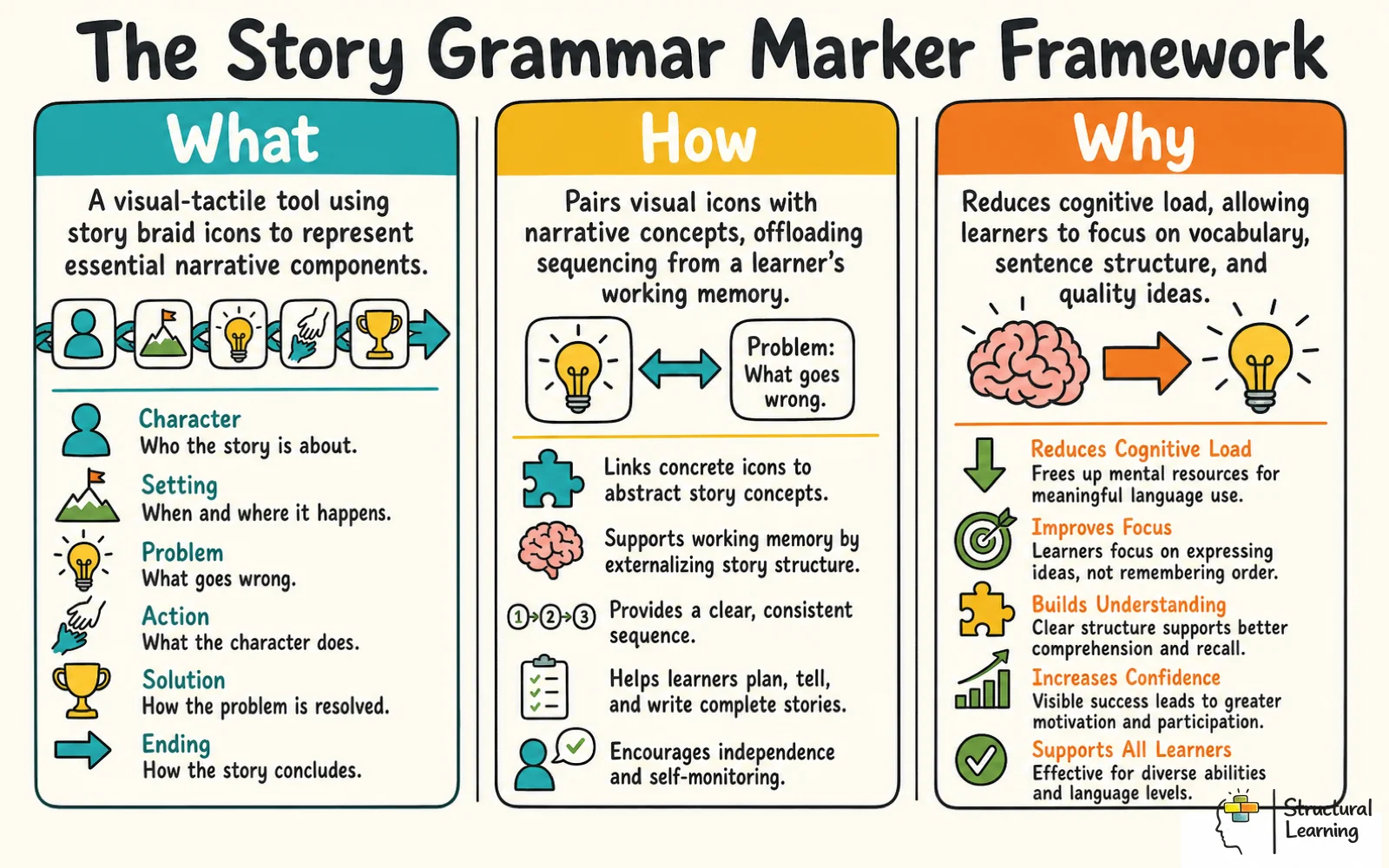
The Story Grammar Marker (SGM) is a visual, tactile tool designed to help learners internalise the structure of a story. Developed by speech and language pathologist Maryellen Moreau, it uses a series of icons on a physical 'story braid' to represent the essential components of a narrative. By externalising these components, the SGM reduces the cognitive load on a learner's working memory, freeing up mental capacity to focus on the quality of their ideas, sentence structure and vocabulary.
The Story Grammar Marker Framework
For many learners, especially those with Special Educational Needs and Disabilities (SEND) or Developmental Language Disorder (DLD), holding the entire structure of a story in their mind while also trying to write or retell it is an overwhelming task. The SGM provides a concrete, physical scaffold that maps directly onto the abstract schema of a story, making the components of narrative explicit and memorable.
Key Takeaways
What it is: The Story Grammar Marker is a hands-on tool that uses icons on a string to represent the key elements of a story's structure.
Cognitive Science: It works by reducing working memory load and applying dual coding principles, pairing visual-tactile icons with abstract narrative concepts.
Who it's for: While beneficial for all learners, it is a particularly powerful intervention for learners with Developmental Language Disorder (DLD), Autism Spectrum Condition (ASC), and other speech, language and communication needs.
Core Function: The tool helps learners to understand, retell, and create well-structured narratives, moving from simple sequences to complex, multi-episode stories.
Classroom Practice: It can be used for whole-class instruction, small group interventions, and individual support, supporting both oral language and written composition.
The Cognitive Science Behind Narrative Scaffolding
Understanding how the Story Grammar Marker works requires a brief look at the cognitive science of storytelling. Creating or comprehending a narrative is a complex cognitive act that places significant demands on working memory.
Reducing Cognitive Load in Literacy
Cognitive Load Theory, first proposed by John Sweller (1988), suggests that our working memory has a very limited capacity. When a task requires a learner to hold and manipulate too many pieces of information at once, their working memory becomes overloaded, and learning is impaired. For a learner struggling with literacy, the act of storytelling involves juggling plot points, character motivations, vocabulary, sentence structure, spelling, and punctuation simultaneously.
The SGM acts as a powerful scaffold to reduce this intrinsic cognitive load. By providing a physical representation of the story's structure, it offloads the task of remembering 'what comes next' from the learner's working memory to the physical tool. This frees up cognitive resources that can be reallocated to higher-order tasks, such as choosing more ambitious vocabulary or constructing more complex sentences.
Working Memory and Storytelling
Imagine asking a learner to tell you about their weekend. They need to retrieve the events from their long-term memory, sequence them chronologically, consider what their listener needs to know, and formulate it all into coherent language. For a learner with working memory deficits, this is a monumental challenge. Events may be missed, the sequence may become muddled, and the resulting story can be confusing for the listener.
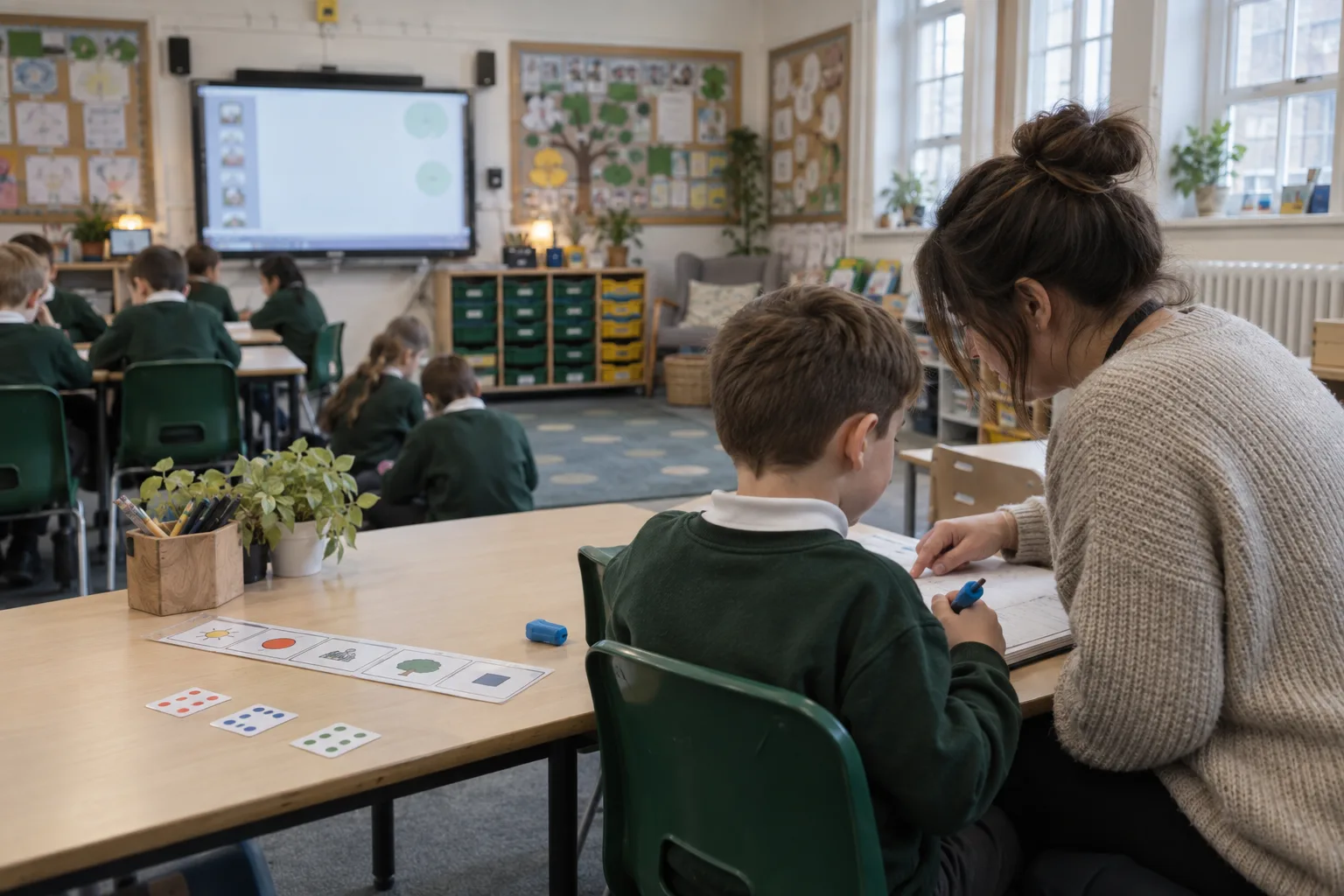
The SGM provides a stable, external anchor. The learner can touch each icon as they tell their story, ensuring each key element is included in the correct order. This is particularly effective for personal recounts, a common activity in primary classrooms.
Dual Coding with Visual Manipulatives
The SGM is a clear example of Allan Paivio's Dual Coding Theory in practice. The theory posits that we process information through two distinct channels: a verbal channel (language) and a non-verbal channel (images). When information is presented in both formats, it is more likely to be remembered.
The SGM pairs an abstract narrative concept (e.g., the 'initiating event') with a concrete, meaningful icon (a shoe, to represent the 'kick-off'). This dual-coding process creates a much stronger memory trace than simply talking about the story part. The multi-sensory nature of the tool, visual, tactile, and kinesthetic, further strengthens this effect, making it a robust tool for a wide range of learners.
Core Components of the Story Grammar Marker
The power of the SGM lies in its carefully designed icons, which represent the universal building blocks of a story. These icons are arranged on a 'story braid' that provides a linear sequence for learners to follow.
The SGM Braid: From Character to Resolution
The main sequence of icons on the Story Grammar Marker helps learners construct a complete story episode.
Icon
Story Grammar Element
Classroom Prompt
Face
Character
Who is the story about?
Star
Setting
Where and when does the story take place?
Shoe
Kick-Off / Initiating Event
What is the problem or event that starts the story?
Heart
Feeling
How does the character feel about the kick-off?
Hand
Plan
What does the character decide to do?
Circles
Planned Attempts
What steps does the character take to achieve their plan?
Bow
Direct Consequence
What happens as a result of their actions?
Ribbon
Resolution
How does the story end? How does the character feel now?
closer look: The Critical Thinking Triangle
A core component of the SGM methodology is the 'Critical Thinking Triangle'. This is not a separate piece but a conceptual grouping of three key icons: the Kick-Off (Shoe), the Feeling (Heart), and the Plan (Hand).
Teachers are encouraged to explicitly teach the causal link between these three elements. The event (Kick-Off) causes an emotional response in the character (Feeling), which in turn motivates them to create a goal-directed Plan. This moves learners beyond simply listing story elements to understanding the fundamentals of character motivation.
Classroom Example (Year 3):
During a shared reading of The Three Little Pigs, the teacher pauses after the wolf blows the first house down.
Teacher: "This is the Kick-Off, the wolf has destroyed the first pig's house. (Points to the 'Shoe' icon). How do you think the pig feels? (Points to the 'Heart' icon). Let's look at his face in the illustration."
Learner: "He feels scared and worried."
Teacher: "Exactly. Because he feels scared, what does he decide to do? What is his Plan? (Points to the 'Hand' icon)."
Learner: "He plans to run to his brother's house."
Teacher: "Perfect. You've just used the Critical Thinking Triangle. The event made him feel scared, and that feeling led to his plan."
This explicit linking of cause and effect is crucial for developing inferential comprehension and for creating believable characters in a learner's own writing.
Implementing SGM in the Classroom: A Phased Approach
Effective implementation of the Story Grammar Marker is a gradual process that builds from oral language to written composition. It should not be treated as a one-off lesson but as a consistent scaffold that is faded over time as learners internalise the narrative structure.
Phase 1: Oral Storytelling and Retelling (EYFS/KS1)
The first step is to establish the SGM as a tool for talking about stories.
Introduce the Icons: Begin with just a few core icons: Character, Setting, and maybe a simple Beginning-Middle-End structure. Tell a familiar story, like a fairy tale, pointing to each icon as you introduce the element.
Model Retelling: Use the SGM to model retelling the story. Run your fingers along the braid, explicitly referencing each icon. "First, we meet the Character, Goldilocks..."
Guided Retelling: Ask learners to use their own student-sized SGMs to help you retell the story. Prompt them with questions linked to the icons. "What comes after the Setting? What's the 'kick-off' in this story?"
Personal Recounts: Use the SGM to scaffold personal news. For a 'what I did at the weekend' activity, the icons provide a structure for learners who struggle to organise their thoughts.
Phase 2: Connecting to Reading Comprehension (KS1/KS2)
Once learners are comfortable with the icons through oral work, the SGM can be used as an analysis tool for reading.
Story Mapping: After reading a picture book or a chapter of a novel, work with the class to map the story onto the SGM icons or a visual poster. This can be done as a whole class on an interactive whiteboard or in small groups with printed templates.
Character Analysis: Use the Critical Thinking Triangle (Kick-Off, Feeling, Plan) to analyse character motivations. This is a powerful way to move beyond literal comprehension. Why did the character do that? What event prompted their action?
Summarising: The SGM provides a natural structure for summarising texts. By identifying the key element for each icon, learners can generate a concise and well-structured summary.
Phase 3: Scaffolding Written Composition (KS2)
The final phase is to transition the structure provided by the SGM into learners' independent writing.
Oral Rehearsal: Before writing, learners should orally rehearse their story using the SGM. This "talk for writing" approach ensures they have a coherent plot before they face the additional cognitive load of writing.
Planning a Story: The SGM icons can be used as a planning framework. Learners can draw the icons in their English books and jot down notes for each section of their story. This is more effective than a blank sheet of paper, which can be intimidating.
Fading the Scaffold: As learners become more proficient, the physical tool can be faded. They might move from the manipulative to a 2D visual map, then to a simple checklist of story elements, and finally to a fully internalised mental model of narrative structure.
Story Grammar Marker for SEND Interventions
For a Special Educational Needs Coordinator (SENCO) or a teacher running interventions, the SGM is an invaluable tool. Its explicit, multi-sensory approach is highly effective for learners who struggle with abstract language concepts.
Supporting Learners with Developmental Language Disorder (DLD)
Learners with DLD often have significant difficulties with narrative tasks. Their stories may be disorganised, miss key information, and lack causal connections. The SGM directly targets these challenges. A systematic review of narrative interventions by Pico et al. (2021) found that such approaches can be effective in improving narrative language outcomes. The SGM provides the explicit structure that these learners need to organise their thoughts and language.
Intervention Checklist for DLD:
Focus on Oral Language First: Do not rush to writing. Build confidence and competence in oral retelling.
Use Repetition: Use the same simple, well-structured story multiple times. Repeated retelling of the same narrative helps to automatise the structure (Miller et al., 2018).
Explicitly Teach Conjunctions: Use the structure of the SGM to explicitly teach causal conjunctions ('because', 'so') and temporal conjunctions ('next', 'after that'). For example, "The character felt sad because of the kick-off."
Autism and Perspective-Taking
Many autistic learners find it difficult to understand and explain character motivations and feelings, a key component of Theory of Mind. The Critical Thinking Triangle is a powerful tool for making these abstract concepts concrete.
Teacher: "We know the Kick-Off was that the boy's ice cream fell on the floor. Let's look at the 'Heart' icon. How does he feel? The author tells us he is crying, which is a clue."
Teacher: "Now, let's think about his Plan. What might he want to do next because he feels sad?"
By explicitly walking through the Kick-Off -> Feeling -> Plan sequence, the framework provides a logical, predictable structure for understanding social situations that may otherwise be confusing.
The Evidence and Limitations
While the Story Grammar Marker is a popular and widely used tool, it is important for teachers to have a clear understanding of the evidence base. Narrative-based language interventions as a whole have been shown to be effective. A systematic review by Petersen (2011) found that such interventions have a positive impact for children with language impairments. More recently, a meta-analysis by Pico et al. (2021) supported the use of interventions targeting narrative language.
However, research specifically on the SGM programme itself is more limited. A key study by Miller, Correa, and Katsiyannis (2018) investigated the effects of a story grammar intervention using the SGM with English learners with language impairments. The study found that the intervention significantly improved the organisation and cohesion of the children's oral narratives.
◆ Structural Learning
Story Grammar Marker Study Notes
Study notesOne-page revision sheet
Download a one-page study note for Story Grammar Marker, with the key ideas, limitations and classroom links in one place.
It is important to note the limitations. Some research suggests that while story grammar interventions are good at improving the overall structure of a story (macrostructure), they may have less impact on sentence-level grammar and the variety of vocabulary used (microstructure) (Winters et al., 22). Therefore, the SGM should be seen as one component of a rich literacy curriculum, not a replacement for explicit vocabulary and sentence-level instruction.
SENCO & Teacher Checklist for Implementation
Before starting, consider the following:
Identify Target Learners: Who are the specific learners who will benefit most? Are you targeting oral language, reading comprehension, or written work?
Establish a Baseline: Before you start, collect a sample of each target learner's narrative ability. This could be a recording of an oral retell or a piece of unaided writing. This is crucial for measuring progress.
Choose Appropriate Texts: Start with simple, highly predictable stories where the story grammar elements are obvious. Fairy tales and traditional tales are ideal.
Integrate, Don't Isolate: How will this tool fit with your existing literacy provision? It should complement, not replace, things like phonics, vocabulary work, and guided reading.
Plan for Fading: From the beginning, have a plan for how you will gradually remove the scaffold. The goal is for learners to internalise the structure, not to become dependent on the physical tool.
What is the evidence that story grammar instruction improves narrative comprehension, retell and written composition?
Mixed evidence: The Consensus search returns a mixed or indirect evidence base, so claims should be framed around the underlying teaching principle rather than the branded programme alone.
38% Yes from 8 studiesstrong evidence
3311
Yes38%
Possibly38%
Mixed13%
No13%
Teacher takeaway
Use the approach as a structured support, not a guarantee: identify the target skill, teach it explicitly, and monitor whether it transfers into classroom language, reading or writing.
Purpose The purpose of this systematic review with meta-analyses was to examine interventions that aimed to improve narrative language outcomes for preschool and elementary school-age children in the United States. Our goal was to examine peer-reviewed publications to describe the characteristics of these interventions and synthesize their overall effectiveness on narrative comprehension and production via meta-analysis. Method We searched electronic databases, examined previously published reviews, and consulted experts in the field to identify published studies that employed robust experimental and quasi-experimental designs. We included randomized controlled trials, studies with nonrandomized comparison groups, and single-case design (SCD) studies. We completed a qualitative synthesis of study factors for all identified studies and calculated meta-analyses for the studies that had sufficient data. All included studies were analyzed for risk of bias. Results Our systematic search yielded 40 studies that included one or more narrative language outcomes as part of their assessment battery. Twenty-four of the included studies were group design studies, including randomized controlled trials and quasi-experimental designs, and the other 16 were SCD studies. Effect sizes were analyzed based on narrative production and comprehension outcomes. The meta-analyses of 26 studies indicated overall positive effects of the interventions, with effect sizes of= 0.51 and 0.54 in the group design studies and= 1.24 in the SCD studies. Conclusions A variety of effective interventions were found that improve narrative production and comprehension outcomes in children with diverse learner characteristics. Some common characteristics across these interventions include manualized curricula, opportunities to produce narrative language, verbal and visual supports, direct instruction of story grammar, and use of authentic children's literature. Supplemental Material https://doi.org/10.23641/asha.15079173.
Classroom implication: Translate the finding into explicit modelling, guided practice and progress monitoring rather than relying on one-off exposure.
Narrative assessment is one potentially underutilized and inconsistent method speech-language pathologists may use when considering a diagnosis of developmental language disorder (DLD). However, narration research encompasses many varied methodologies. This systematic review and meta-analysis aimed to (a) investigate how various narrative assessment types (e.g., macrostructure, microstructure, and internal state language) differentiate children with typical development (TD) from children with DLD, (b) identify specific narrative assessment measures that result in greater group differences, and (c) evaluate participant and sample characteristics that may influence performance differences. Electronic databases (PsycINFO, ERIC, and PubMed) and ASHAWire were searched on July 30, 2019, to locate studies that reported oral narrative language measures for both DLD and TD groups between ages 4 and 12 years; studies focusing on written narration or other developmental disorders only were excluded. We extracted data related to sample participants, narrative task(s) and assessment measures, and research design. Group differences were quantified using standardized mean differences. Analyses used mixed-effects meta-regression with robust variance estimation to account for effect size dependencies. Searches identified 37 eligible studies published between 1987 and 2019, including 382 effect sizes. Overall meta-analysis showed that children with DLD had decreased narrative performance relative to TD peers, with an overall average effect of -0.82, 95% confidence interval [-0.99, -0.66]. Effect sizes showed significant heterogeneity both between and within studies, even after accounting for effect size-, sample-, and study-level predictors. Across model specifications, grammatical accuracy (microstructure) and story grammar (macrostructure) yielded the most consistent evidence of TD-DLD group differences. Present findings suggest some narrative assessment measures yield significantly different performance between children with and without DLD. However, researchers need to improve consistency of inclusionary criteria, descriptions of sample characteristics, and reporting of correlations between measures to determine which assessment measures reliably distinguish between groups. https://doi.org/10.23641/asha.21200380.
Classroom implication: Use this as a caution: check learner fit, delivery quality and progress data before treating the approach as settled practice.
This systematic review focuses on research articles published since 1980 that assess outcomes of narrative-based language intervention for preschool and school-age children with language impairment. The author conducted a comprehensive search of electronic databases and hand searches of other sources for studies using all research designs except nonexperimental case studies. The results of the studies were converted to a common metric using effect sizes. The review yielded nine studies that met inclusion criteria. The majority of studies reported moderate to large effect sizes for narrative macrostructure and microstructure. Although the results of the studies were generally positive, each of the studies had a limited number of participants, limited experimental control, and considerable variation in the procedures and materials used. Clinicians should be cautious when interpreting the results of these studies. Narrative intervention is at an emerging stage of evidence and needs further investigation.
Classroom implication: Translate the finding into explicit modelling, guided practice and progress monitoring rather than relying on one-off exposure.
The purpose of this three-arm randomized controlled trial was to explore the impact of multi-tiered explicit and systematic narrative language instruction on the language students are expected to understand and produce in the school setting (e.g., reading and writing). A sample of 210 kindergarten students were assigned to three conditions: treatment, active control, and no-treatment control. The treatment group received Tier 1, whole group contextualized oral narrative language instruction from their classroom teacher twice a week for 15–20 min over 14 weeks. Students who did not make adequate progress after one month of the large group instruction were assigned to receive additional 20-min Tier 2, small group narrative language intervention sessions, delivered by speech-language pathologists two times each week. The students assigned to the active control group participated in Tier 1 shared storybook reading instruction with their classroom teacher twice a week for 15–20 min. Students in the no-treatment control group participated in classroom activities that were in place at the outset of the school year. Narrative and expository language samples elicited at pretest and posttest were analyzed for several features of complex language. Results indicated that students in the contextualized narrative language group produced significantly more complex language with large effect sizes compared to the shared storybook treatment and no-treatment control groups. Additionally, gains in expository language were noted, indicating that the intervention generalized across discourse types. The findings from this study add to a meaningful corpus of research that supports the use of multi-tiered explicit and systematic contextualized narrative language instruction to increase the complexity of the language of young students, including those who are at risk for language learning difficulty.
Classroom implication: Keep the intervention routine structured and measurable so classroom use can be compared with baseline performance.
Purpose Narrative interventions are a class of language interventions that involve the use of telling or retelling stories. Narrative intervention can be an efficient and versatile means of promoting a large array of academically and socially important language targets that improve children's access to general education curriculum and enhance their peer relations. The purpose of this tutorial is to supply foundational information about the importance of narratives and to offer recommendations about how to maximize the potential of narrative interventions in school-based clinical practice. Method Drawing from decades of cognitive and linguistic research, a tutorial on narratives and narrative language is presented first. Ten principles that support the design and implementation of narrative interventions are described. Results Clinicians can use narrative intervention to teach story grammar, complex language, vocabulary, inferencing, and social pragmatics. Storytelling, as an active intervention ingredient, promotes the comprehension and production of complex language. Conclusion When narrative intervention is implemented following a set of principles drawn from research and extensive clinical experience, speech-language pathologists can efficiently and effectively teach a broad set of academically and socially meaningful skills to diverse students.
Classroom implication: Translate the finding into explicit modelling, guided practice and progress monitoring rather than relying on one-off exposure.
This systematic review provides an examination of the quality, efficacy, and common features of oral narrative interventions on the narratives of children with language disorder. Searches of electronic data bases, ancestral searches and database alerts identified studies that addressed oral narrative intervention in children with language disorder. Structured inclusion procedures were used to select and examine the quality, efficacy and common features of the included studies. Twenty-four research articles published between 1993 and 2018 were included for review. Apart from measures of social validity, the single case research studies were generally of good quality and results can be interpreted with confidence. The group studies were generally of low quality and only four included comparison groups. Single case effects sizes for macrostructure were moderate with lower effect sizes for microstructure. The results for group studies were variable. Successful interventions included the use of icons, visuals, clinician modelling and the participants being provided with an opportunity to state an entire narrative each intervention session. Oral narrative intervention to develop the narratives of children with language disorder may be effective. Areas for future research were identified and include more robust research designs, intervention being delivered to participants in groups, conducting intervention with participants with more significant disabilities, more research conducted with personal narrative, and including more generalization measures.
Classroom implication: Translate the finding into explicit modelling, guided practice and progress monitoring rather than relying on one-off exposure.
This study investigated the effects of a narrative intervention that employed repeated story retells and a Story Grammar Marker on the oral narrative skills of Spanish-speaking English learners with language impairments. Four third- and fourth-grade students participated in the study. Using a single-case multiple probe across participants design, the authors measured three dependent variables: narrative organization skills, narrative productivity, and syntactic complexity. As a result of the intervention, stories became more cohesive and scores for narrative organization increased by approximately 7 points from baseline to intervention across participants. Smaller effects for narrative complexity and syntactic complexity measures were noted. Implications for future research and for practice are provided.
Classroom implication: Translate the finding into explicit modelling, guided practice and progress monitoring rather than relying on one-off exposure.
ABSTRACT This review evaluated the evidence for narrative intervention on language and pragmatic outcomes for school-aged children with autism spectrum disorder (ASD). The study protocol for this review followed the PRISMA-Protocol checklist and was pre-registered on Open Science Framework. Ten electronic databases were searched to identify experimental designs studies that targeted school-aged children aged 5–18 with ASD. Two independent reviewers evaluated the inclusion eligibility of full-text studies. All included studies were critically appraised by two independent reviewers. Data were coded for study characteristics and outcomes of interest. Results from different outcome measures were synthesized qualitatively. The report was reviewed with the PRISMA checklist to ensure complete reporting. Forty participants from seven studies were included in this review. Six single-case experimental design studies and one group study were included. All these studies included methodological flaws that reduced the strength of evidence. The results indicated that narrative intervention might have large effects on comprehension of discourse, medium effects on production of macrostructure and microstructure, and small effects on pragmatic skills compared to pretreatment. For maintenance effects and other outcome constructs, including pragmatic skills, it was inconclusive whether the narrative intervention had true effects. Evidence from this review suggests that narrative intervention may produce medium-size effects on several constructs of language outcomes. Nonetheless, there was no evidence that showed those gains could be maintained post-treatment. The methodological weaknesses and the small sample of included studies restrict stronger conclusions from being drawn. More high-quality group studies with clearly described treatment procedures are needed.
Classroom implication: Use this as a caution: check learner fit, delivery quality and progress data before treating the approach as settled practice.
Frequently Asked Questions about the Story Grammar Marker
What age is the Story Grammar Marker suitable for?
The SGM is highly adaptable. Its foundational components can be used in the Early Years (ages 3-5) to develop basic sequencing and oral language. It is most commonly used throughout Key Stage 1 and Key Stage 2 (ages 5-11) to develop narrative comprehension and writing. Adapted versions can also be used with older learners who have significant language needs.
Can SGM be used for non-fiction texts?
While the SGM is designed for narrative, the principles of using visual, tactile scaffolds can be adapted for non-fiction. MindWing Concepts, the company behind SGM, has developed other tools specifically for expository text, such as the 'ThemeMaker'. The core idea of identifying the underlying structure of a text type is transferable.
How does SGM support learners with dyslexia?
Learners with dyslexia often have underlying weaknesses in working memory and language processing. The SGM supports these learners by reducing the cognitive load of narrative tasks, allowing them to focus their mental energy on the specific challenges of decoding, spelling and sentence construction. The multi-sensory nature of the tool provides multiple pathways for learning, which is a key principle of dyslexia-friendly teaching.

Next-Lesson Action
Your next step is to introduce the core icons in a low-stakes oral activity. Choose a story that every learner in your class knows well, such as The Three Little Pigs or Goldilocks and the Three Bears. As you retell the story, explicitly point to the Character, Setting, and Kick-Off icons on a visual display. Ask the learners to touch their own visual prompts as you go. Focus only on making the connection between the part of the story and the icon, establishing the foundation for all future work.
Research sources
Further reading from peer-reviewed research
These 5 studies give source context for the classroom guidance in this article on Using the Story Grammar Marker: A Comprehensive Guide for UK Classrooms. They are included as starting points for deeper reading, not as a substitute for local professional judgement.
Peer Reviewed Study78 citationspubs.asha.org
Narrative Intervention: Principles to Practice.
T. Spencer et al. (2020) | Language, Speech, and Hearing Services in Schools
Translate the finding into explicit modelling, guided practice and progress monitoring rather than relying on one-off exposure.
Paul Main is an educator and metacognition researcher who founded Structural Learning in 2002. With a psychology degree from the University of Sunderland and 22+ years helping schools embed thinking skills, he bridges the gap between educational research and classroom practice. Fellow of the RSA and Chartered College of Teaching, with 128+ Google Scholar citations.