Updated on
September 17, 2026
Standards-Based Grading in K-12: A Practical Guide
What standards-based grading is, why it matters, how it works in the classroom, and how to read a rubric score such as a 2.5.


Updated on
September 17, 2026
What standards-based grading is, why it matters, how it works in the classroom, and how to read a rubric score such as a 2.5.
Standards-based grading is an assessment framework that measures learner mastery against specific curriculum standards rather than calculating a single cumulative average. By separating academic achievement from behavioural factors like punctuality, effort, and compliance, this grading system provides a precise picture of what learners actually understand and can achieve. Moving away from traditional grading gives teachers actionable data to target instruction, improve teaching-learning cycles, and support learner progress.
Standards-based grading (SBG) shifts the focus of assessment from accumulating points to demonstrating mastery. Rick Wormeli (2006) argues that a grade must be an accurate communication of academic achievement above all else. In traditional grading, a single letter grade often hides specific deficits because it averages high test scores with missing homework. Standards-based grading changes this dynamic by isolating specific academic skills. Teachers use proficiency scales to measure exactly what learners know and are able to do against specific learning standards.
A core component of standards-based grading (SBG) is the four-point proficiency scale. Instead of a percentage out of one hundred, learners receive a score typically ranging from 1 to 4. A score of 3 represents proficiency at the current grade-level expectations. A score of 4 indicates a learner is exceeding grade-level expectations by applying the knowledge to complex, novel situations. A score of 1 or 2 shows the learner is still developing the necessary skills.
Many districts ask what standard grading means when transitioning away from letter grades. Thomas Guskey (2015) highlights how traditional grading masks true achievement by grouping unrelated tasks together. When grading, SBG principles dictate that a learner who struggles early in a unit but demonstrates total mastery by the end should receive a score reflecting that final mastery. This approach ensures that report cards communicate true academic readiness for the next grade level.
The traditional grading system often creates an adversarial relationship between teachers and learners. When learners discover that early mistakes permanently damage their final grade, their motivation drops significantly. Averaging early failure with later success penalises learners who simply take longer to grasp a complex concept. Standards-based grading changes grading practices to be more equitable by prioritising the most recent evidence of learning.
From a cognitive science perspective, specific feedback drives learning far more effectively than ambiguous scores. Robert Marzano (2010) notes that clear, standard-aligned feedback helps learners build accurate mental models of their own progress. When learners see a low percentage on a test, the emotional response often blocks cognitive processing. Clear proficiency scales reduce this extraneous cognitive load (Sweller, 1988). Learners can see exactly which specific skill requires more practice rather than feeling overwhelmed by a global failure.
This framework also transforms how teachers plan their daily lessons. When you track learner progress by specific state standards, you immediately see patterns across your classroom. If eighty percent of your class scores a 2 on a fraction standard, you know exactly what your next lesson must cover. This clear connection between teaching, learning, and assessment makes instructional planning highly efficient. It eliminates the guesswork from lesson design and ensures that every activity directly supports mastery.
Transitioning to standards-based grading requires practical, classroom-tested routines. Teachers need systems that collect accurate data without adding hours of marking time to their evenings. The following strategies demonstrate how to bring standard grading SBG into your daily instructional practice.
The foundation of the grading system is the proficiency rubric. The teacher translates complex state standards into learner-friendly language across a four-point scale. The teacher distributes this rubric at the very beginning of the unit. During the lesson, the teacher references the rubric to show learners exactly what proficiency looks like.
The learners use the rubric to self-assess their own work before submitting it. They read the descriptions for a score of 3 and compare it to their current draft. Learners actively highlight where their work meets the standard and identify areas where they are only demonstrating a level 2 understanding.
For example, a science teacher creates a rubric for a 'Claim, Evidence, and Reasoning' standard. A score of 2 states "I can make a claim but my evidence is incomplete." A score of 3 states "I can make a claim and support it with accurate data from the lab." When grading lab reports, the teacher simply circles the corresponding level on the rubric, providing immediate and specific feedback.
In an SBG classroom, formative assessments do not penalise the learner. The teacher uses low-stakes tasks to gather data on learner progress before the summative exam. The teacher deploys visual frameworks like a 'Map It' graphic organiser to quickly check understanding. The teacher reviews these maps to identify which specific standards need reteaching.
The learners complete the graphic organisers individually or in small groups. Because these tasks are not tied to a final letter grade, learners take more academic risks. They use the formative feedback to adjust their thinking and study habits prior to the final assessment.
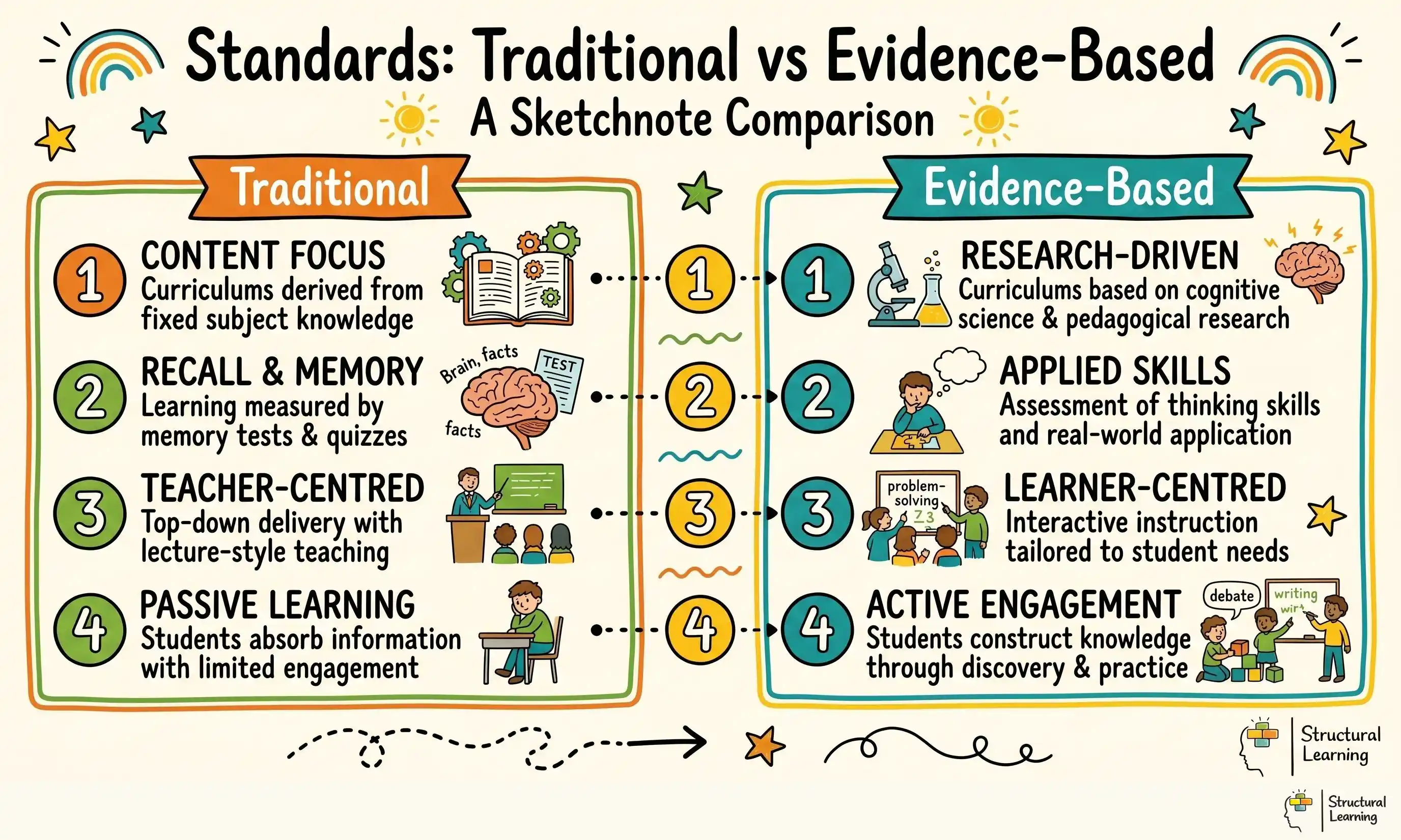
For example, a history teacher introduces a new unit on historical conflict. Before a major essay, the teacher asks learners to map the economic causes of the conflict. The teacher reviews the maps and notices that most learners score a 2 on the 'causation' standard. The teacher pauses the planned curriculum to deliver a targeted mini-lesson on causation the very next day.
To maintain the integrity of the academic grade, teachers must track behavioural factors separately. The teacher creates a separate rubric for 'Work Habits' or 'Citizenship'. The teacher records missing assignments, late work, and class participation under this behavioural category. The teacher ensures that a late penalty never reduces an academic proficiency score.
The learners receive clear feedback on both their academic mastery and their executive functioning skills. Learners understand that while failing to complete homework impacts their work habits score, it does not mean they are bad at maths. This separation helps learners take ownership of their behaviour without damaging their academic self-esteem.
For example, a primary school teacher notices a learner consistently aces in-class maths assessments but never turns in homework. In a traditional grading system, this learner might receive a C. Under SBG, the learner receives a 4 for maths proficiency and a 1 for work habits. When the teacher meets with the parents, they can address the specific issue of home organisation rather than mistakenly discussing a maths deficit.
When schools adopt new proficiency scales, the nuances of scoring can confuse both teachers and parents. A common question is how to handle a learner who falls between the clear descriptions of a 2 and a 3. Understanding the half-point scores is crucial for accurate reporting. A score of 2.5 in standards-based grading means the learner is demonstrating partial success with the grade-level expectations but still makes occasional errors.
Teachers use the 2.5 score to signal that a learner is approaching proficiency and is ready for the final conceptual leap. The teacher looks at the summative assessment and identifies that the learner understands the core procedure but struggles with application. The teacher assigns a 2.5 to validate the progress made while clearly indicating that mastery is not yet complete. This specific score acts as a trigger for targeted classroom interventions.
Learners view a 2.5 as an encouraging sign that they are incredibly close to their goal. Instead of feeling defeated by a low percentage, the learner asks what specific error is holding them back from a 3. For instance, a learner might score a 2.5 in a reading comprehension standard because they can identify the main idea but struggle to find supporting details in the text. The teacher then provides a specific graphic organiser to help the learner isolate textual evidence during the next reading block.
One of the greatest strengths of standards-based grading is its seamless integration with special educational needs and disability (SEND) frameworks. Traditional grades often fail to communicate meaningful data for learners receiving accommodations under an Individualised Education Programme (IEP) or a Section 504 plan. A letter grade of 'D' provides no diagnostic value for an IEP team. SBG, however, isolates specific skills, allowing special education teachers to track exact areas of need (Jung & Guskey, 2011).
Within a Multi-Tiered System of Supports (MTSS) or Response to Intervention (RTI) framework, SBG provides the precise data required for targeted interventions. A general education teacher can bring specific proficiency scores to an RTI data meeting. If a learner consistently scores a 1.5 on phonemic awareness standards, the MTSS team knows exactly which Tier 2 intervention to deploy. The team does not have to waste time administering diagnostic tests because the standard grading SBG data already identifies the gap.
Accommodations outlined in an IEP dictate how a learner accesses the curriculum, but the standard itself remains the same. If a learner requires a quiet room for testing, the teacher provides that accommodation and then assesses the work against the standard proficiency scale. This ensures that learners with disabilities are held to the same rigorous learning standards as their peers, while receiving the legal supports they require to demonstrate what they know and are able to do.
A major pillar of standards-based grading is the belief that learners should have multiple opportunities to demonstrate mastery. However, unrestricted retakes can quickly overwhelm a teacher's workload. Managing reassessments requires strict procedures that protect teacher time while still honouring the learning process. The most effective strategy is implementing a 'Ticket to Retest' system.
The teacher sets the parameters for any reassessment opportunity. The teacher requires the learner to complete a specific corrective action before sitting for a new version of the test. The teacher only assesses the specific standard the learner failed, rather than grading an entirely new, full-length exam. This targeted approach drastically reduces marking time.
The learner takes ownership of the reassessment process. The learner must show evidence of new learning, such as completing previously missing practice work or attending a tutorial session. The learner then requests a reassessment for only the isolated standard they need to improve.
For example, a learner fails the graphing portion of an algebra test but passes the equation-solving portion. To earn a reassessment, the learner completes an online practice module specifically on graphing. The teacher then provides a short, five-minute reassessment covering only the graphing standard. The teacher updates the gradebook with the new proficiency score, completely replacing the previous low score.
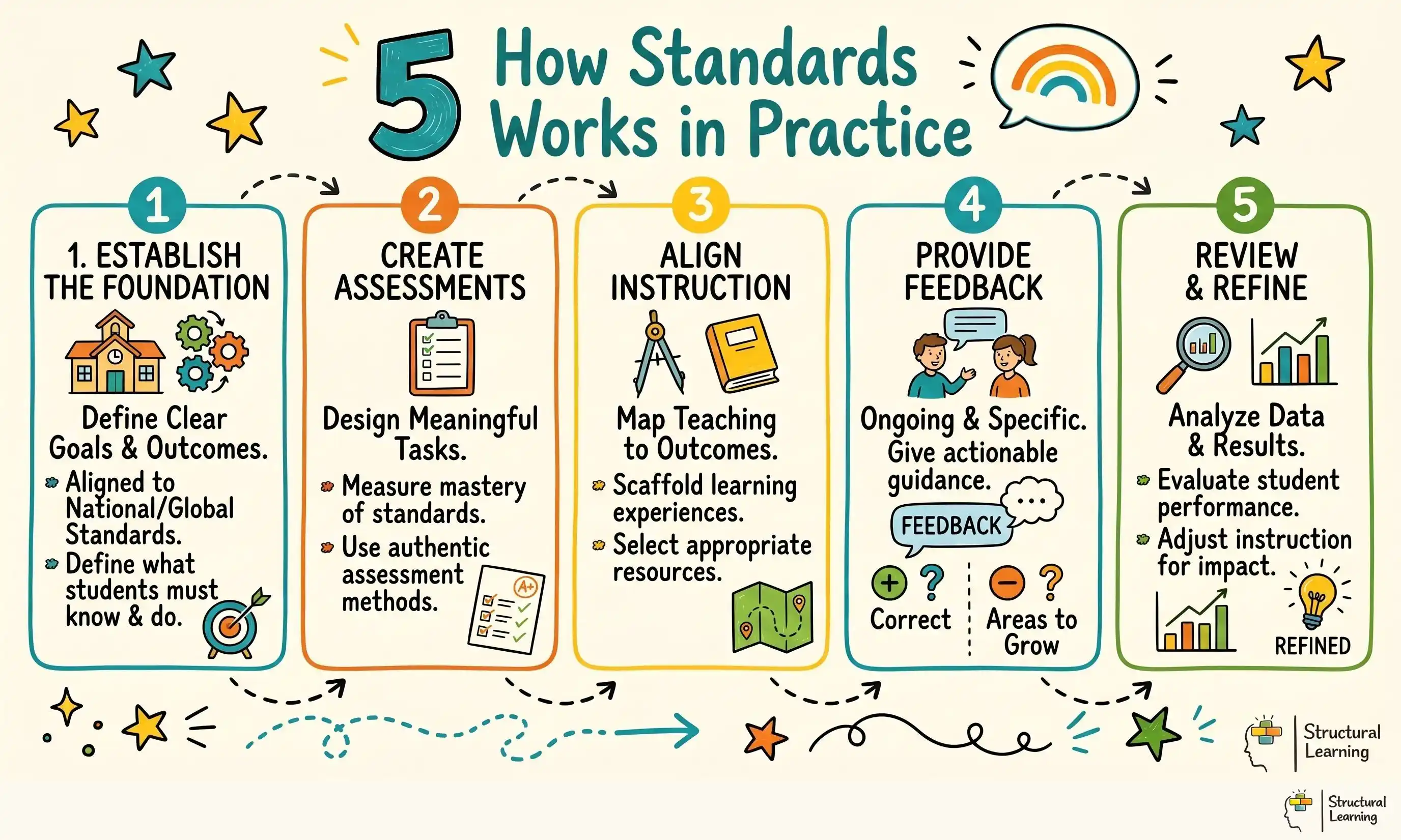
Despite its benefits, transitioning to standards-based grading often triggers resistance based on persistent myths. Addressing these misconceptions directly is crucial for school-wide buy-in. Examining our grading practices is essential to move past these hurdles.
The first major misconception is that standards-based grading lowers academic expectations. Critics argue that allowing retakes makes school too easy. In reality, SBG demands actual mastery of the content. In a traditional system, a learner can pass a class by behaving well, completing every worksheet, and earning extra credit, even if they fail every exam. SBG removes extra-credit assignments completely. Learners can only pass by proving they actually understand the learning standards.
Another common myth is that a score of 3 means 'average' and a 4 means 'perfect'. In this framework, a 3 means the learner is fully meeting grade-level expectations. It is the target goal for all learners. A score of 4 is reserved for learners who can apply that knowledge in highly complex, unprompted scenarios. Teachers must explicitly teach parents and learners that achieving a 3 is a significant academic success.
Finally, many secondary school teachers worry that eliminating traditional grading will harm their learners' college admissions chances. They fear that colleges will not understand proficiency scales. However, most school districts translate final SBG proficiency scores into traditional letter grades or GPA equivalents for secondary school transcripts. Admissions officers care about rigorous academic preparation, and SBG provides a much more robust framework for ensuring learners are actually ready for university-level work.
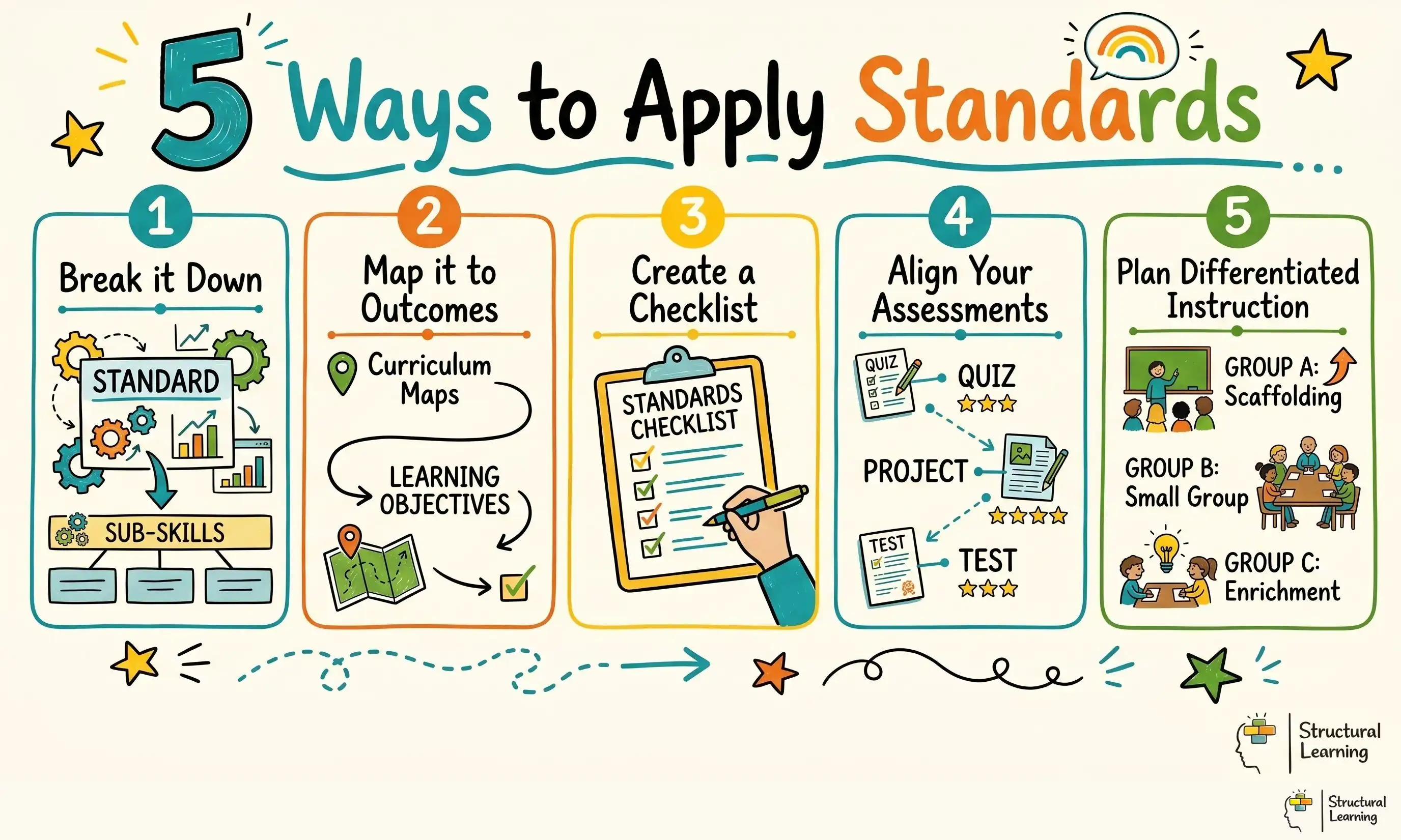
Shifting your classroom to standards-based grading requires careful planning and a phased approach. Attempting to change everything overnight will lead to frustration. Follow these practical steps to begin implementing this grading system in your own classroom.
Step One requires unpacking the curriculum standards. The teacher takes the required standards and breaks them down into isolated, teachable skills. The teacher removes any confusing academic jargon and rewrites the standard into a clear "I can" statement. This makes the target accessible to the learners.
Step Two involves building the four-point proficiency scales for each unpacked standard. The teacher defines exactly what a 1, 2, 3, and 4 look like for that specific skill. The teacher gathers exemplar pieces of past learner work to serve as anchor papers for each level.
Step Three focuses on communication. The teacher introduces the new grading practices to the learners during the first week of school. The teacher explains that mistakes are part of the learning process and that final mastery is the only thing that counts. The teacher explicitly bans extra credit and explains how the reassessment process will work.
Step Four requires updating the gradebook structure. The teacher stops organising the gradebook by assignment type, such as 'Homework' or 'Quizzes'. Instead, the teacher organises the gradebook by specific learning standards. Every entry in the gradebook must tie directly back to a specific skill, giving a clear visual map of learner progress over time.
For example, a teacher unpacks a standard about adding fractions. The teacher creates a rubric where a 3 requires solving the problem with unlike denominators, and a 4 requires creating a word problem that utilises the same fraction concept. The teacher sets up the gradebook with a specific column labelled "Fractions: Unlike Denominators" and tracks learner progress exclusively in that column.
The flexibility of standards-based grading allows it to work effectively across diverse academic disciplines. While the core philosophy remains the same, the application looks slightly different depending on the subject area. Here is how standards-based grading operates in different K-12 contexts.
In a secondary English classroom, traditional grading often relies on subjective overall scores for essays. SBG breaks the essay down into distinct learning targets, such as 'Thesis Statement', 'Textual Evidence', and 'Grammar and Mechanics'. A learner might score a 4 on their thesis statement but a 2 on grammar. The teacher provides targeted lessons on punctuation, and the learner revises only that specific aspect of the essay to improve their grammar score.
In a middle school maths classroom, the focus shifts from the number of correct answers to the understanding of the mathematical concept. A teacher might give a five-question assessment on geometry. If a learner makes a simple calculation error on every problem but demonstrates the correct geometric formula each time, the teacher does not fail them. The teacher gives a 3 for 'Geometric Concepts' and a 2 for 'Calculation Accuracy', separating the procedural error from the conceptual understanding.
In a primary science classroom, standards-based grading allows teachers to focus heavily on the scientific process. When conducting an experiment on plant habitats, the teacher assesses the learners on the standard of 'Making Observations'. A learner who struggles to write a formal lab report can still earn a 3 by verbally explaining their observations to the teacher. This ensures that language difficulties do not artificially lower a science proficiency score.
The most challenging aspect of transitioning to standards-based grading is often communicating the change to parents. Parents are deeply conditioned to expect traditional letter grades and percentages. When report cards arrive covered in 2s and 3s, panic can ensue if the school district has not provided adequate proactive communication.
Teachers should send a detailed letter home at the start of the year explaining the shift in grading practices. The communication must clearly explain that a 3 is the target goal and represents full proficiency. Teachers must reassure parents that eliminating extra-credit assignments and late penalties actually increases the academic rigour of the classroom by ensuring grades reflect true mastery.
During parent-teacher consultations, teachers should use the proficiency rubrics to guide the conversation. Instead of saying, "Your child has a C average," the teacher places the rubric on the table and says, "Your child is currently scoring a 2.5 in reading comprehension because they are working on finding textual evidence." The teacher then provides a specific strategy the parent can use at home to help the learner reach a 3. This shifts the consultation from a defensive discussion about points to a collaborative conversation about learner progress.
Homework is considered a formative assessment and practice. It should be tracked in the gradebook for completion under a 'Work Habits' category, but it should never be averaged into the final academic proficiency score. Practice should not be penalised.
This requires a shift in classroom culture towards intrinsic motivation. Teachers must clearly explain that completing the formative practice is the only way to earn a proficient score on the summative assessment. Tracking work habits separately also provides leverage for parent conversations.
No. You do not need to rewrite entire exams. You only need to assess the specific standard the learner missed. This can often be accomplished with a short conversation, a single whiteboard problem, or a brief written paragraph during a tutorial session.
Most school districts use a conversion scale to turn proficiency scores into traditional letter grades at the very end of the term. For example, a learner with mostly 3s and 4s across their standards will receive an 'A' or 'B' on their official transcript, ensuring they are competitive for university admissions.
Not exactly. An 'A' in traditional grading can be earned by doing all the homework and getting 90% on tests. A 4 in SBG means the learner has gone above and beyond the explicit grade-level expectations to apply the knowledge in a complex, novel way. It requires a deeper level of cognitive processing than a traditional 'A'.
SBG demands that every individual learner demonstrate mastery of the learning standards. Therefore, teachers should not assign a single 'group grade' for a project. Group work is an instructional strategy, but the final assessment of mastery must be measured individually to ensure accurate reporting.
Look at your next upcoming assessment and rewrite just one question to measure a single, specific curriculum standard rather than testing a general, overarching concept.