SMART IEP Goals: A Practical Writing Guide for Teachers

Updated on  

March 7, 2026

SMART IEP Goals: A Practical Writing Guide for Teachers

|

March 7, 2026

SMART IEP goals transform vague good intentions into measurable commitments. The difference between "improve reading" and "increase oral reading fluency from 45 to 75 correct words per minute on Year 4 level texts by March 2027, measured weekly using curriculum-based measurement" is the difference between hoping a pupil improves and knowing whether they have. Every IEP goal that cannot be measured is a goal that cannot be taught with precision, monitored with confidence, or defended at an annual review.

Key Takeaways

  1. SMART stands for Specific, Measurable, Achievable, Relevant, Time-bound: Each element eliminates a category of vagueness that makes goals unworkable in practice.
  2. Measurability is the most commonly missing element: If you cannot describe how you will measure progress, the goal is not ready for an IEP.
  3. Baseline data drives goal-setting: Every SMART goal starts with where the pupil is now, not where you wish they were.
  4. Progress monitoring every two weeks prevents surprises: Regular data collection catches stalled progress early enough to adjust teaching before the annual review.

What Makes an IEP Goal SMART?

The SMART acronym gives you five tests to apply to every goal before it enters an IEP document. Each test eliminates a specific type of vagueness.
Specific means the goal names the exact skill, the conditions under which it will be demonstrated, and the expected behaviour. "Improve writing" fails this test. "Write a three-paragraph persuasive essay with a thesis statement, two supporting arguments with evidence, and a concluding paragraph" passes it. A Year 7 English teacher reading the second goal knows exactly what to teach, what to model, and what the finished product looks like.

Measurable means you can attach a number to progress. Frequency (3 out of 5 attempts), accuracy (80% correct), duration (sustained attention for 15 minutes), or rate (75 correct words per minute) all work. If you cannot describe your measurement tool and scoring criteria, the goal is not measurable. This is where most IEP goals fail.

Achievable means the goal represents realistic growth based on the pupil's current performance and rate of progress. A pupil reading at 30 words per minute will not reach 120 words per minute in one term. Research on typical growth rates (Fuchs et al., 1993) provides benchmarks: primary pupils typically gain 1-2 words per minute per week with targeted instruction. Setting a target of 50-55 words per minute after 12 weeks of intervention is ambitious but achievable.

Relevant means the goal addresses a skill that matters for the pupil's educational access and life outcomes. A goal targeting shoe-tying for a Year 9 pupil whose primary barrier is written expression is not relevant, regardless of how well-written it is. The goal should connect directly to the pupil's identified area of need from their assessment data.

Time-bound means the goal has a clear deadline, typically aligned with the annual review cycle. "By [date]" appears in every SMART goal. Without a deadline, there is no urgency and no defined point at which you evaluate whether the intervention worked.

Common IEP Goal Mistakes

Vague Goals That Cannot Be Measured

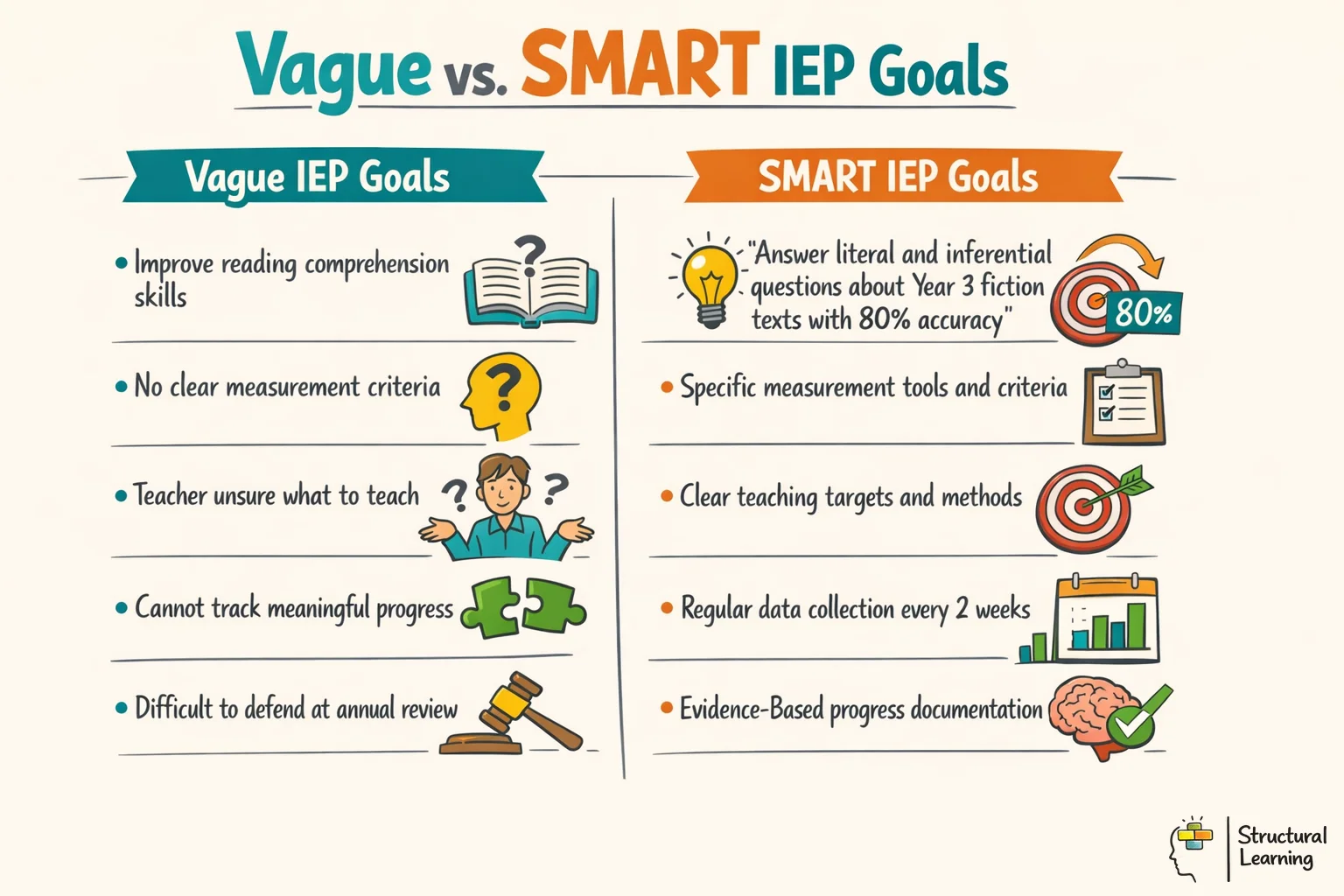
The most common mistake is writing goals that sound professional but contain no measurable criteria. "The pupil will improve his reading comprehension skills" appears on thousands of IEPs every year, and it is useless. Improve how? Measured by what? From what baseline to what target? A teacher reading this goal has no idea what to teach, how to measure progress, or when the goal has been met.

The fix is straightforward: replace every vague verb with a specific, observable action. "Improve comprehension" becomes "answer literal and inferential comprehension questions about Year 3 level fiction texts with 80% accuracy across three consecutive probes." The teacher now knows: the text level, the question types, the accuracy threshold, and the consistency criterion.

Goals That Are Too Easy or Too Hard

A goal the pupil can already achieve is pointless. A goal the pupil cannot possibly reach is demoralising. Both waste instructional time and erode trust in the IEP process. The solution is baseline data. Before writing any goal, assess the pupil's current performance on the exact skill you plan to target. If a pupil currently solves single-digit addition problems with 90% accuracy, a goal targeting 95% accuracy is too easy. A goal targeting multi-digit multiplication is too hard. A goal targeting single-digit subtraction with regrouping at 80% accuracy builds on the existing skill while introducing appropriate challenge.

Goals Disconnected from Classroom Practice

An IEP goal that only a specialist can work on is a goal that gets practised for 30 minutes per week instead of all day. The strongest IEP goals are ones that classroom teachers can embed into routine instruction. A speech and language goal targeting "use of conjunctions to extend sentences" can be practised in every writing task, every oral response, and every peer discussion. A goal targeting "produce the /r/ sound in isolation" can only be practised during speech therapy sessions. Both may be necessary, but the first type produces faster progress because it receives more practice.

Writing SMART Goals Step by Step

Follow this five-step process for every goal you write.

Step 1: Collect baseline data. Assess the pupil on the exact skill you plan to target. Use the same tool and conditions you will use for progress monitoring. Record the score. This is your starting point.

Step 2: Determine a realistic target. Use research-based growth rates where available. For reading fluency, Hasbrouck and Tindal (2017) provide national norms. For behaviour goals, look at the pupil's current frequency and set a 50% reduction as an initial target. For academic skills without published norms, use the pupil's own rate of progress over the past term as a guide.

Step 3: Write the goal using this formula. By [date], [pupil's name] will [specific observable behaviour] in [conditions/context] with [accuracy/frequency criterion] as measured by [assessment tool/method].

Example: By June 2027, Amir will read aloud Year 4 level passages at a rate of 90 correct words per minute with fewer than 5 errors, as measured by weekly curriculum-based measurement probes administered by the class teacher.

Step 4: Plan progress monitoring. Decide how often you will measure (fortnightly is the minimum), what tool you will use (the same one each time), and who will collect the data. Build this into your timetable. If it is not scheduled, it will not happen.

Step 5: Set decision rules. Decide in advance what you will do if progress stalls. If the pupil shows no growth across four consecutive data points, you change the intervention, not the goal. This prevents the common trap of waiting until the annual review to discover that six months of instruction produced no measurable change.

SMART Goal Examples by Area

Reading and Literacy Goals

Fluency: By March 2027, Priya will read Year 3 level passages at 80 correct words per minute with 95% accuracy, as measured by fortnightly CBM probes. Baseline: 52 CWPM.

Comprehension: By July 2027, Marcus will answer inferential questions about Year 5 level non-fiction texts with 75% accuracy across three consecutive assessments, as measured by the school's reading comprehension assessment. Baseline: 40% accuracy on inferential questions.

Writing: By December 2026, Fatima will independently write a four-sentence paragraph that includes a topic sentence, two supporting details, and a concluding sentence, scoring at least 12/16 on the school's paragraph rubric, in 3 out of 4 writing tasks. Baseline: writes 1-2 unconnected sentences without a clear topic.

Mathematics Goals

Computation: By June 2027, Jake will solve two-digit addition and subtraction problems with regrouping with 85% accuracy on weekly timed probes (20 problems in 5 minutes). Baseline: 45% accuracy with regrouping.

Problem-solving: By March 2027, Amira will solve one-step word problems involving multiplication and division, correctly identifying the operation and computing the answer, with 80% accuracy across fortnightly probes. Baseline: 30% accuracy (frequently selects wrong operation).

Behaviour and Social Skills Goals

Task engagement: By July 2027, Connor will remain on-task during independent work periods for at least 12 out of 15 minutes, as measured by momentary time-sampling at 1-minute intervals, across 4 out of 5 observed sessions. Baseline: on-task for 5 out of 15 minutes.

Social interaction: By December 2026, Suki will initiate a positive social interaction with a peer (greeting, asking to join, offering help) at least twice per day during unstructured times, as recorded by the teaching assistant on a frequency tally. Baseline: 0-1 peer initiations per week.

Emotional regulation: By March 2027, Ethan will use a taught calming strategy (deep breathing, counting to 10, or asking for a break) when frustrated, reducing incidents of leaving the classroom from 8 per week to 2 or fewer, as recorded on the behaviour log. Baseline: 8 elopements per week.

Communication and Speech Goals

Expressive language: By June 2027, Lily will use complete sentences of at least 5 words to answer questions and make requests in the classroom, in 80% of observed opportunities across 3 consecutive sessions. Baseline: uses 2-3 word phrases.

Pragmatic language: By December 2026, Omar will maintain a topic of conversation for at least 3 conversational turns with a peer, in 4 out of 5 observed interactions during structured social skills sessions. Baseline: shifts topic after 1 turn.

Executive Function Goals

Organisation: By March 2027, Zoe will independently use a daily task checklist to complete and submit all assigned work within the lesson period, for 4 out of 5 school days per week, as verified by the class teacher's daily check. Baseline: completes and submits work independently on 1 out of 5 days.

Working memory: By July 2027, Lucas will follow three-step verbal instructions without repetition, completing all three steps correctly, in 7 out of 10 opportunities across fortnightly probes. Baseline: follows one-step instructions; loses the second and third steps.

Measuring Progress on IEP Goals

Writing a SMART goal without a progress monitoring system is like setting a destination without checking the map during the drive. You might arrive, but you will not know until it is too late to change course.

Frequency: Measure progress at least every two weeks. Weekly is better for academic skills. Daily frequency counts are appropriate for behaviour goals. The more data points you have, the earlier you can detect stalled progress.

Curriculum-based measurement (CBM) is the gold standard for academic progress monitoring (Deno, 1985). CBM uses brief, standardised probes that take 1-3 minutes to administer. A reading fluency CBM involves the pupil reading aloud for one minute while the teacher marks errors. The score (correct words per minute) is plotted on a graph. After 6-8 data points, you can draw a trend line and compare it to the aim line connecting baseline to target.

Graphing is essential. A table of numbers does not communicate progress as clearly as a line graph. Plot each data point on a simple chart with the date on the x-axis and the score on the y-axis. Draw the aim line from baseline to target. When the data line falls below the aim line for four consecutive points, the intervention needs changing. This is the four-point decision rule (Fuchs & Fuchs, 1986), and it prevents months of ineffective instruction.

Who collects the data matters. The person monitoring progress should be the person who can adjust the instruction. If a teaching assistant collects data but the class teacher makes instructional decisions, there must be a reliable communication system. Fortnightly data review meetings between the SENCO, class teacher, and any specialists ensure that data leads to action.

SMART Goals and the EHCP Process

In England and Wales, pupils with the most significant needs have an Education, Health and Care Plan (EHCP) that sets out long-term outcomes and shorter-term targets. SMART IEP goals sit within this framework as the operational targets that contribute to broader EHCP outcomes.

An EHCP outcome might read: "By age 16, Kai will be able to communicate his needs and preferences to unfamiliar adults in community settings." This is a long-term aspiration. The SMART IEP goals break this down into teachable steps for the current year: "By December 2026, Kai will request help from a school staff member he does not work with regularly, using a full sentence, in 3 out of 5 opportunities."

At the annual review, SMART goals provide the evidence base for deciding whether the EHCP provision is working. If all IEP goals have been met, the provision is effective. If goals have not been met despite faithful implementation, either the goals were set too ambitiously or the provision needs changing. Without measurable goals, annual reviews become opinion-based conversations rather than evidence-based decisions.

The SEND Code of Practice (DfE, 2015) requires that outcomes in EHCPs are specific, measurable, and achievable. SMART goals directly fulfil this statutory requirement. When Local Authorities challenge whether provision is necessary, well-written SMART goals with progress monitoring data provide the strongest possible evidence.

Involving Pupils in Their Own Goals

Research on self-advocacy and self-regulation consistently shows that pupils who understand and contribute to their own goals make faster progress (Wehmeyer et al., 2012). This does not mean asking a Year 3 pupil to write their own IEP. It means translating the goal into language the pupil understands and involving them in monitoring.

A Year 5 pupil with a reading fluency goal can understand: "Right now you read 52 words in a minute. We're working toward 80 words by March. Every Friday, we'll time your reading and you'll colour in your chart." The pupil sees the chart growing, understands the target, and feels ownership over their progress. When the chart shows a plateau, the teacher and pupil discuss what might help: "Should we try a different text level? Do you want to practise with a partner?"

At secondary level, pupils should attend their own IEP review meetings and present their own progress data. A Year 10 pupil who can say, "My goal was to submit 80% of homework on time. In September I was at 40%. I'm now at 65%. I've been using the planner system and it's helping, but I still struggle on days when I have multiple subjects" is demonstrating both metacognitive awareness and self-advocacy. Those skills are more valuable than any single academic target.

Next Steps for Your Classroom

Pull out one IEP from your current caseload. Read the first goal. Apply the five SMART tests: Is it specific enough that another teacher could implement it without asking you what it means? Can you describe exactly how you would measure progress? Is the target achievable based on baseline data and realistic growth rates? Does it address the pupil's most significant barrier to learning? Does it have a clear deadline? If any test fails, rewrite the goal using the formula from this article. Then set up your first progress monitoring session for next week.

Further Reading: Key Research on IEP Goal Writing

These studies provide the research foundation for writing measurable, effective IEP goals.

Writing Measurable IEP Goals and Objectives View study ↗
520 citations

Bateman & Linden (2012)

The definitive practitioner guide to IEP goal writing. Provides the condition-behaviour-criterion formula and dozens of examples across academic and behavioural domains. Essential reading for any teacher or SENCO writing IEPs.

Using Curriculum-Based Measurement to Establish Growth Standards for Students with Learning Disabilities View study ↗
890 citations

Fuchs et al. (1993)

Establishes research-based growth rates for academic skills that inform achievable goal-setting. Provides the data teachers need to set ambitious but realistic targets grounded in typical progress rates.

Curriculum-Based Measurement: The Emerging Alternative View study ↗
1,400+ citations

Deno (1985)

The foundational paper on curriculum-based measurement. Explains how brief, repeated probes produce reliable progress data that directly informs instructional decisions. The basis for all modern IEP progress monitoring systems.

Formative Evaluation of Individual Student Programs: A New Role for School Psychologists View study ↗
340 citations

Fuchs & Fuchs (1986)

Introduces the four-point decision rule for progress monitoring. When four consecutive data points fall below the aim line, the intervention should be changed. This simple protocol prevents months of ineffective instruction and is now standard practice in data-based individualisation.

Compiled Oral Reading Fluency Norms View study ↗
1,100+ citations

Hasbrouck & Tindal (2017)

Provides national reading fluency norms by year group and percentile. Essential reference for setting achievable reading fluency targets on IEPs. Updated regularly with new data to ensure benchmarks reflect current student populations.

Loading audit...

SMART IEP goals transform vague good intentions into measurable commitments. The difference between "improve reading" and "increase oral reading fluency from 45 to 75 correct words per minute on Year 4 level texts by March 2027, measured weekly using curriculum-based measurement" is the difference between hoping a pupil improves and knowing whether they have. Every IEP goal that cannot be measured is a goal that cannot be taught with precision, monitored with confidence, or defended at an annual review.

Key Takeaways

  1. SMART stands for Specific, Measurable, Achievable, Relevant, Time-bound: Each element eliminates a category of vagueness that makes goals unworkable in practice.
  2. Measurability is the most commonly missing element: If you cannot describe how you will measure progress, the goal is not ready for an IEP.
  3. Baseline data drives goal-setting: Every SMART goal starts with where the pupil is now, not where you wish they were.
  4. Progress monitoring every two weeks prevents surprises: Regular data collection catches stalled progress early enough to adjust teaching before the annual review.

What Makes an IEP Goal SMART?

The SMART acronym gives you five tests to apply to every goal before it enters an IEP document. Each test eliminates a specific type of vagueness.

Specific means the goal names the exact skill, the conditions under which it will be demonstrated, and the expected behaviour. "Improve writing" fails this test. "Write a three-paragraph persuasive essay with a thesis statement, two supporting arguments with evidence, and a concluding paragraph" passes it. A Year 7 English teacher reading the second goal knows exactly what to teach, what to model, and what the finished product looks like.

Measurable means you can attach a number to progress. Frequency (3 out of 5 attempts), accuracy (80% correct), duration (sustained attention for 15 minutes), or rate (75 correct words per minute) all work. If you cannot describe your measurement tool and scoring criteria, the goal is not measurable. This is where most IEP goals fail.

Achievable means the goal represents realistic growth based on the pupil's current performance and rate of progress. A pupil reading at 30 words per minute will not reach 120 words per minute in one term. Research on typical growth rates (Fuchs et al., 1993) provides benchmarks: primary pupils typically gain 1-2 words per minute per week with targeted instruction. Setting a target of 50-55 words per minute after 12 weeks of intervention is ambitious but achievable.

Relevant means the goal addresses a skill that matters for the pupil's educational access and life outcomes. A goal targeting shoe-tying for a Year 9 pupil whose primary barrier is written expression is not relevant, regardless of how well-written it is. The goal should connect directly to the pupil's identified area of need from their assessment data.

Time-bound means the goal has a clear deadline, typically aligned with the annual review cycle. "By [date]" appears in every SMART goal. Without a deadline, there is no urgency and no defined point at which you evaluate whether the intervention worked.

Common IEP Goal Mistakes

Vague Goals That Cannot Be Measured

The most common mistake is writing goals that sound professional but contain no measurable criteria. "The pupil will improve his reading comprehension skills" appears on thousands of IEPs every year, and it is useless. Improve how? Measured by what? From what baseline to what target? A teacher reading this goal has no idea what to teach, how to measure progress, or when the goal has been met.

The fix is straightforward: replace every vague verb with a specific, observable action. "Improve comprehension" becomes "answer literal and inferential comprehension questions about Year 3 level fiction texts with 80% accuracy across three consecutive probes." The teacher now knows: the text level, the question types, the accuracy threshold, and the consistency criterion.

Goals That Are Too Easy or Too Hard

A goal the pupil can already achieve is pointless. A goal the pupil cannot possibly reach is demoralising. Both waste instructional time and erode trust in the IEP process. The solution is baseline data. Before writing any goal, assess the pupil's current performance on the exact skill you plan to target. If a pupil currently solves single-digit addition problems with 90% accuracy, a goal targeting 95% accuracy is too easy. A goal targeting multi-digit multiplication is too hard. A goal targeting single-digit subtraction with regrouping at 80% accuracy builds on the existing skill while introducing appropriate challenge.

Goals Disconnected from Classroom Practice

An IEP goal that only a specialist can work on is a goal that gets practised for 30 minutes per week instead of all day. The strongest IEP goals are ones that classroom teachers can embed into routine instruction. A speech and language goal targeting "use of conjunctions to extend sentences" can be practised in every writing task, every oral response, and every peer discussion. A goal targeting "produce the /r/ sound in isolation" can only be practised during speech therapy sessions. Both may be necessary, but the first type produces faster progress because it receives more practice.

Writing SMART Goals Step by Step

Follow this five-step process for every goal you write.

Step 1: Collect baseline data. Assess the pupil on the exact skill you plan to target. Use the same tool and conditions you will use for progress monitoring. Record the score. This is your starting point.

Step 2: Determine a realistic target. Use research-based growth rates where available. For reading fluency, Hasbrouck and Tindal (2017) provide national norms. For behaviour goals, look at the pupil's current frequency and set a 50% reduction as an initial target. For academic skills without published norms, use the pupil's own rate of progress over the past term as a guide.

Step 3: Write the goal using this formula. By [date], [pupil's name] will [specific observable behaviour] in [conditions/context] with [accuracy/frequency criterion] as measured by [assessment tool/method].

Example: By June 2027, Amir will read aloud Year 4 level passages at a rate of 90 correct words per minute with fewer than 5 errors, as measured by weekly curriculum-based measurement probes administered by the class teacher.

Step 4: Plan progress monitoring. Decide how often you will measure (fortnightly is the minimum), what tool you will use (the same one each time), and who will collect the data. Build this into your timetable. If it is not scheduled, it will not happen.

Step 5: Set decision rules. Decide in advance what you will do if progress stalls. If the pupil shows no growth across four consecutive data points, you change the intervention, not the goal. This prevents the common trap of waiting until the annual review to discover that six months of instruction produced no measurable change.

SMART Goal Examples by Area

Reading and Literacy Goals

Fluency: By March 2027, Priya will read Year 3 level passages at 80 correct words per minute with 95% accuracy, as measured by fortnightly CBM probes. Baseline: 52 CWPM.

Comprehension: By July 2027, Marcus will answer inferential questions about Year 5 level non-fiction texts with 75% accuracy across three consecutive assessments, as measured by the school's reading comprehension assessment. Baseline: 40% accuracy on inferential questions.

Writing: By December 2026, Fatima will independently write a four-sentence paragraph that includes a topic sentence, two supporting details, and a concluding sentence, scoring at least 12/16 on the school's paragraph rubric, in 3 out of 4 writing tasks. Baseline: writes 1-2 unconnected sentences without a clear topic.

Mathematics Goals

Computation: By June 2027, Jake will solve two-digit addition and subtraction problems with regrouping with 85% accuracy on weekly timed probes (20 problems in 5 minutes). Baseline: 45% accuracy with regrouping.

Problem-solving: By March 2027, Amira will solve one-step word problems involving multiplication and division, correctly identifying the operation and computing the answer, with 80% accuracy across fortnightly probes. Baseline: 30% accuracy (frequently selects wrong operation).

Behaviour and Social Skills Goals

Task engagement: By July 2027, Connor will remain on-task during independent work periods for at least 12 out of 15 minutes, as measured by momentary time-sampling at 1-minute intervals, across 4 out of 5 observed sessions. Baseline: on-task for 5 out of 15 minutes.

Social interaction: By December 2026, Suki will initiate a positive social interaction with a peer (greeting, asking to join, offering help) at least twice per day during unstructured times, as recorded by the teaching assistant on a frequency tally. Baseline: 0-1 peer initiations per week.

Emotional regulation: By March 2027, Ethan will use a taught calming strategy (deep breathing, counting to 10, or asking for a break) when frustrated, reducing incidents of leaving the classroom from 8 per week to 2 or fewer, as recorded on the behaviour log. Baseline: 8 elopements per week.

Communication and Speech Goals

Expressive language: By June 2027, Lily will use complete sentences of at least 5 words to answer questions and make requests in the classroom, in 80% of observed opportunities across 3 consecutive sessions. Baseline: uses 2-3 word phrases.

Pragmatic language: By December 2026, Omar will maintain a topic of conversation for at least 3 conversational turns with a peer, in 4 out of 5 observed interactions during structured social skills sessions. Baseline: shifts topic after 1 turn.

Executive Function Goals

Organisation: By March 2027, Zoe will independently use a daily task checklist to complete and submit all assigned work within the lesson period, for 4 out of 5 school days per week, as verified by the class teacher's daily check. Baseline: completes and submits work independently on 1 out of 5 days.

Working memory: By July 2027, Lucas will follow three-step verbal instructions without repetition, completing all three steps correctly, in 7 out of 10 opportunities across fortnightly probes. Baseline: follows one-step instructions; loses the second and third steps.

Measuring Progress on IEP Goals

Writing a SMART goal without a progress monitoring system is like setting a destination without checking the map during the drive. You might arrive, but you will not know until it is too late to change course.

Frequency: Measure progress at least every two weeks. Weekly is better for academic skills. Daily frequency counts are appropriate for behaviour goals. The more data points you have, the earlier you can detect stalled progress.

Curriculum-based measurement (CBM) is the gold standard for academic progress monitoring (Deno, 1985). CBM uses brief, standardised probes that take 1-3 minutes to administer. A reading fluency CBM involves the pupil reading aloud for one minute while the teacher marks errors. The score (correct words per minute) is plotted on a graph. After 6-8 data points, you can draw a trend line and compare it to the aim line connecting baseline to target.

Graphing is essential. A table of numbers does not communicate progress as clearly as a line graph. Plot each data point on a simple chart with the date on the x-axis and the score on the y-axis. Draw the aim line from baseline to target. When the data line falls below the aim line for four consecutive points, the intervention needs changing. This is the four-point decision rule (Fuchs & Fuchs, 1986), and it prevents months of ineffective instruction.

Who collects the data matters. The person monitoring progress should be the person who can adjust the instruction. If a teaching assistant collects data but the class teacher makes instructional decisions, there must be a reliable communication system. Fortnightly data review meetings between the SENCO, class teacher, and any specialists ensure that data leads to action.

SMART Goals and the EHCP Process

In England and Wales, pupils with the most significant needs have an Education, Health and Care Plan (EHCP) that sets out long-term outcomes and shorter-term targets. SMART IEP goals sit within this framework as the operational targets that contribute to broader EHCP outcomes.

An EHCP outcome might read: "By age 16, Kai will be able to communicate his needs and preferences to unfamiliar adults in community settings." This is a long-term aspiration. The SMART IEP goals break this down into teachable steps for the current year: "By December 2026, Kai will request help from a school staff member he does not work with regularly, using a full sentence, in 3 out of 5 opportunities."

At the annual review, SMART goals provide the evidence base for deciding whether the EHCP provision is working. If all IEP goals have been met, the provision is effective. If goals have not been met despite faithful implementation, either the goals were set too ambitiously or the provision needs changing. Without measurable goals, annual reviews become opinion-based conversations rather than evidence-based decisions.

The SEND Code of Practice (DfE, 2015) requires that outcomes in EHCPs are specific, measurable, and achievable. SMART goals directly fulfil this statutory requirement. When Local Authorities challenge whether provision is necessary, well-written SMART goals with progress monitoring data provide the strongest possible evidence.

Involving Pupils in Their Own Goals

Research on self-advocacy and self-regulation consistently shows that pupils who understand and contribute to their own goals make faster progress (Wehmeyer et al., 2012). This does not mean asking a Year 3 pupil to write their own IEP. It means translating the goal into language the pupil understands and involving them in monitoring.

A Year 5 pupil with a reading fluency goal can understand: "Right now you read 52 words in a minute. We're working toward 80 words by March. Every Friday, we'll time your reading and you'll colour in your chart." The pupil sees the chart growing, understands the target, and feels ownership over their progress. When the chart shows a plateau, the teacher and pupil discuss what might help: "Should we try a different text level? Do you want to practise with a partner?"

At secondary level, pupils should attend their own IEP review meetings and present their own progress data. A Year 10 pupil who can say, "My goal was to submit 80% of homework on time. In September I was at 40%. I'm now at 65%. I've been using the planner system and it's helping, but I still struggle on days when I have multiple subjects" is demonstrating both metacognitive awareness and self-advocacy. Those skills are more valuable than any single academic target.

Next Steps for Your Classroom

Pull out one IEP from your current caseload. Read the first goal. Apply the five SMART tests: Is it specific enough that another teacher could implement it without asking you what it means? Can you describe exactly how you would measure progress? Is the target achievable based on baseline data and realistic growth rates? Does it address the pupil's most significant barrier to learning? Does it have a clear deadline? If any test fails, rewrite the goal using the formula from this article. Then set up your first progress monitoring session for next week.

Further Reading: Key Research on IEP Goal Writing

These studies provide the research foundation for writing measurable, effective IEP goals.

Writing Measurable IEP Goals and Objectives View study ↗
520 citations

Bateman & Linden (2012)

The definitive practitioner guide to IEP goal writing. Provides the condition-behaviour-criterion formula and dozens of examples across academic and behavioural domains. Essential reading for any teacher or SENCO writing IEPs.

Using Curriculum-Based Measurement to Establish Growth Standards for Students with Learning Disabilities View study ↗
890 citations

Fuchs et al. (1993)

Establishes research-based growth rates for academic skills that inform achievable goal-setting. Provides the data teachers need to set ambitious but realistic targets grounded in typical progress rates.

Curriculum-Based Measurement: The Emerging Alternative View study ↗
1,400+ citations

Deno (1985)

The foundational paper on curriculum-based measurement. Explains how brief, repeated probes produce reliable progress data that directly informs instructional decisions. The basis for all modern IEP progress monitoring systems.

Formative Evaluation of Individual Student Programs: A New Role for School Psychologists View study ↗
340 citations

Fuchs & Fuchs (1986)

Introduces the four-point decision rule for progress monitoring. When four consecutive data points fall below the aim line, the intervention should be changed. This simple protocol prevents months of ineffective instruction and is now standard practice in data-based individualisation.

Compiled Oral Reading Fluency Norms View study ↗
1,100+ citations

Hasbrouck & Tindal (2017)

Provides national reading fluency norms by year group and percentile. Essential reference for setting achievable reading fluency targets on IEPs. Updated regularly with new data to ensure benchmarks reflect current student populations.

No Posts found.
Back to Blog