Updated on
September 24, 2026
Mini Whiteboards: 8 Whole-Class Checks (and When Not To)
Eight mini whiteboard routines that show every learner's answer at once, the words to say, the trap in each, and when a raised board is the wrong tool.

Updated on
September 24, 2026
Eight mini whiteboard routines that show every learner's answer at once, the words to say, the trap in each, and when a raised board is the wrong tool.
Use mini whiteboards well to boost learner involvement and check progress. These boards improve questioning, offering insight into each learner's thinking. Strategic use turns this resource into a teaching tool because it gives teachers quick evidence they can use to adapt instruction.
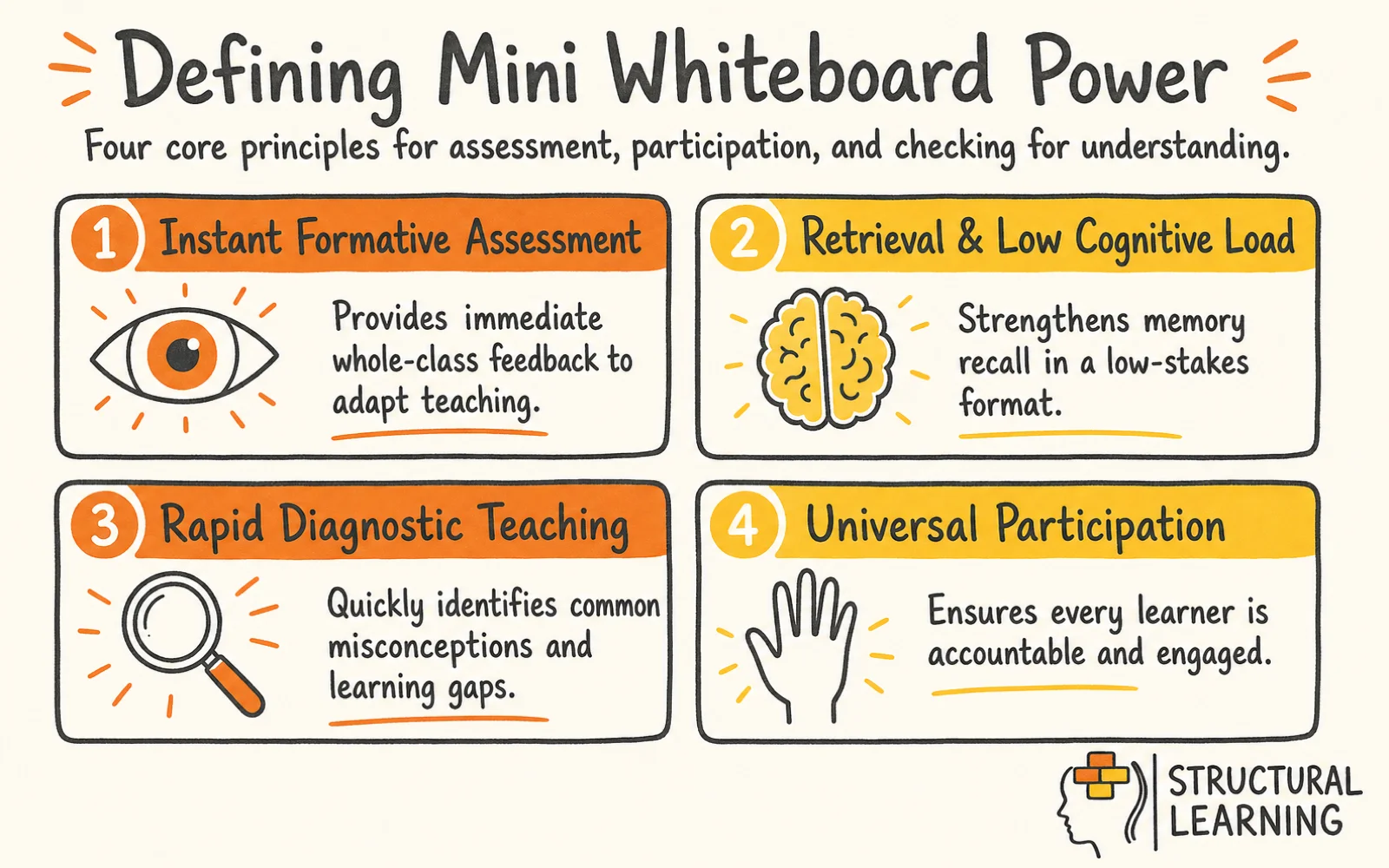
Mini whiteboards combine formative assessment and total participation. Wiliam (2011) calls them effective response tools because every learner shows their thinking. Learners cannot hide or opt out (Wiliam, 2011). They prevent reliance on only a few learners (Wiliam, 2011).
Traditional questioning creates a sampling problem. When a teacher asks "Who can tell me?" and three students volunteer, the teacher receives data from 10% of the class and assumes the rest understand. Mini whiteboards solve this by collecting evidence from every student simultaneously.
Cognitive load theory explains why the format matters. Writing a short response on a whiteboard constrains the answer, which focuses working memory on the core concept. Students cannot waffle or hide behind lengthy paragraphs. The constraint itself is the scaffold.
When learners know they will show answers, they must think (Black & Wiliam, 1998). This links to cold calling: expect all learners to participate and engage. Mini whiteboards make thinking visible without requiring every learner to speak aloud, so they can lower the social pressure of public response.
Roediger and Karpicke (2006) found generating answers boosts memory better than just hearing them. Learners practise retrieval each time they write on a whiteboard.
| Method | Shows Every Learner | Instant Feedback | Low Stakes | Supports SEND | Preparation |
|---|---|---|---|---|---|
| Mini Whiteboards | Yes | Yes | Yes | Strong (visual) | Minimal |
| Hand-Raising | No (5-10% sample) | Partial | Medium | Weak | None |
| Exit Tickets | Yes | Delayed | Yes | Medium | Some |
| Digital Polling | Yes | Yes | Yes | Variable | Technology needed |
| Cold Calling | One at a time | Yes | Medium | Medium | None |
| Retrieval Grids | Yes | Delayed | Yes | Strong | Medium |
The case against mini whiteboards on X this term is not that they do not work. It is what they become when a tool turns into a rule. Four objections come up more than any other, all from classroom teachers, and each one points at a fix that costs a habit, not a budget.
"I was told in observation feedback to use mini whiteboards for the starter." An English teacher posted that line on 13 September 2026 and had 24 replies within a day. The replies did not argue about boards; they argued about who decides. A geography head of department wrote that a retrieval starter on boards should not be the default starter
(@lcgeography, 13 Sep 2026), and Christine Counsell called a rule either way an absurd generic imposition
(@Counsell_C, 14 Sep 2026). The evidence sits on their side of the argument, not the observer's. Black and Wiliam (1998) defined formative assessment by what a teacher does with the evidence, never by the device that collected it (Assessment and Classroom Learning), and Rosenshine (2012) reports that the most effective teachers checked for understanding often, not that they checked with any one tool (Principles of Instruction). The fix for an observer is to score what happened after the scan: the reteach, the circulate, the cold call. The fix for a teacher is to match the check to the answer, which is what the picker below does in two clicks.
"If they're writing more than ten words, you can't possibly check everything." A vice principal's reply in the same thread (@Miss_GJohnston, 13 Sep 2026, quoted below), and the objection every English teacher recognises. It is right, as a scanning limit: thirty boards of three sentences cannot be read from the front in five seconds, so a long answer on a board is a long answer nobody reads. It is not a reason to drop the board. English and history teachers in the same thread describe the routine that fixes it: the closed check (a term, a letter, a one-line claim) on the board, the scan, then the full answer in the book while you stand next to the six learners the boards named. The board picks the names. The book carries the answer.
"Two minutes a check, two or three times a lesson, and independent practice shrinks." A maths lead practitioner who used boards for six months under instruction says he picked up 2 or 3 misconceptions
in that time and has seen no correlation between MWB use and progress
anywhere he has worked (@Friendly_Maths, 7 and 8 Jun 2026). Take the claim seriously, because no trial of mini whiteboards exists to answer it; the research on this page is about checking and retrieval, not about the board. Dylan Wiliam's reply to a similar thread in June is the honest version of the cost: in the KMOFAP study, teachers who found out mid-lesson that learners had not understood felt obliged to do something about it
and had to recalibrate what they could cover (@dylanwiliam, 24 Jun 2026). A check that never changes the next five minutes is two minutes lost. A check that does is the lesson. Two a lesson is the ceiling most teachers put on it, one on the new material and one at the step you expect to break; a third is time taken from practice.
"A raised board is not proof they understand it." Bigger writing is easier to copy. A retired biology teacher stood at the back of a trainee teacher's lesson and saw messages written on the back of boards for students on the row behind
(@RoseJean12, 26 Mar 2026). Doug Lemov, who likes boards, still writes that MWBs can be a crutch
(@Doug_Lemov, 26 Mar 2026, United States). All true, and all fixable in the routine rather than by abandoning it. Hover, then hold the board under the chin facing you, so the neighbour never sees it. Ask two learners with different answers what makes them say it, because a board shows the answer and never the reason. Turn the boards round now and then. And keep what Adam Boxer's line manager told him in his first week with boards, quoted below: the class were getting it wrong the day before too. The board did not create the errors. It revealed them.
Each objection is a check that went missing. The table sorts the eight whole-class checks on this page by what each gives you and what the staffroom says against it; the picker below chooses one for what you just taught, and the planner behind the form puts the question, the wrong answers you expect and the call on one page. For what to do with a check that fails, see checking for understanding; for the pause after the question, wait time; for the prompts, 30 questioning prompts by purpose; for the check at the door, 12 plenary ideas.
| Check | What it gives you | The staffroom objection |
|---|---|---|
| Show me: hover, then show | The count of wrong boards and where they sit in the room. | They copy the person next to them, and holding up a word is not understanding. |
| Step by step | The step where the boards diverge. | The quick ones sit waiting while I wait for the slow ones, on every single step. |
| Hinge question with letters | Which wrong letter the room chose. | Writing three good wrong answers takes longer than the lesson. |
| Self-check and tally | The scores below five, and the question with the most hands. | It is a quiz with extra steps, and they mark themselves generously. |
| Board, then book | The boards give you six names in five seconds. | So the starter takes ten minutes instead of five. |
| Cold call after the scan | Whether the reasoning matches the answer. | Naming someone who got it wrong is exactly what the boards were meant to avoid. |
| Paper, and circulate | The sentence that stops at the claim. | I cannot get round thirty books in the time, so I read the same six every lesson. |
| Swap and mark | The pairs who disagree, and the line they disagree on. | Peer marking is only as good as the peer; two wrong answers tick each other. |
Ask teachers on social media about mini whiteboards and teachers answer about something else: whether a lesson visit may tell you to put your starter on boards, what happens to an answer over ten words, what two-minute checks cost in practice time, and what the scan showed that hands-up had hidden. Their words, unedited, in the order the four objections above take them.
During observation feedback today, I was told I should use MWB for the starter (retrieval activity) with my year 9 class. English teachers: opinions?!
To me, the whole point of MWBs is that Ss hold them up + teachers scan for success rate. If Ss are writing more than 10 words, teachers can’t possibly check everything. Why not just have them write it on paper while you circulate? MWBs are overused and often used poorly imo…
So let’s say the MWB check takes two minutes and you’re doing this 2 or 3 times a lesson. Over time independent practice is being reduced in favour of students holding up answers.
yeah, and they were getting stuff wrong yesterday and the day before too. you just had no idea.
A raised board tells you who has an answer. It does not tell you why, and it cannot carry more than about ten words. Say what you just taught and what you need to know, and you get the check that fits, the words to say, and the thing it cannot tell you.
Say what you taught and what you need to see, then show the check.
Before you trust what you see
Decide the threshold before you ask. More than a third wrong is a reteach before anything new; three or fewer wrong is three names to stand next to during practice. A check that changes nothing about the next five minutes was a performance.
The question and its wrong options are the slow part. The Structural Learning app writes a hinge question with diagnostic distractors, or a talk task for the reteach, for your topic and year group in a couple of clicks. Try it on a free account, no card needed.
Clear routines help learners from week one, becoming automatic (Hattie, 2009). Consistent practice boosts confidence and frees up cognitive resources (Sweller, 1988). This allows learners to focus better on new material (Kirschner, Sweller & Clark, 2006).
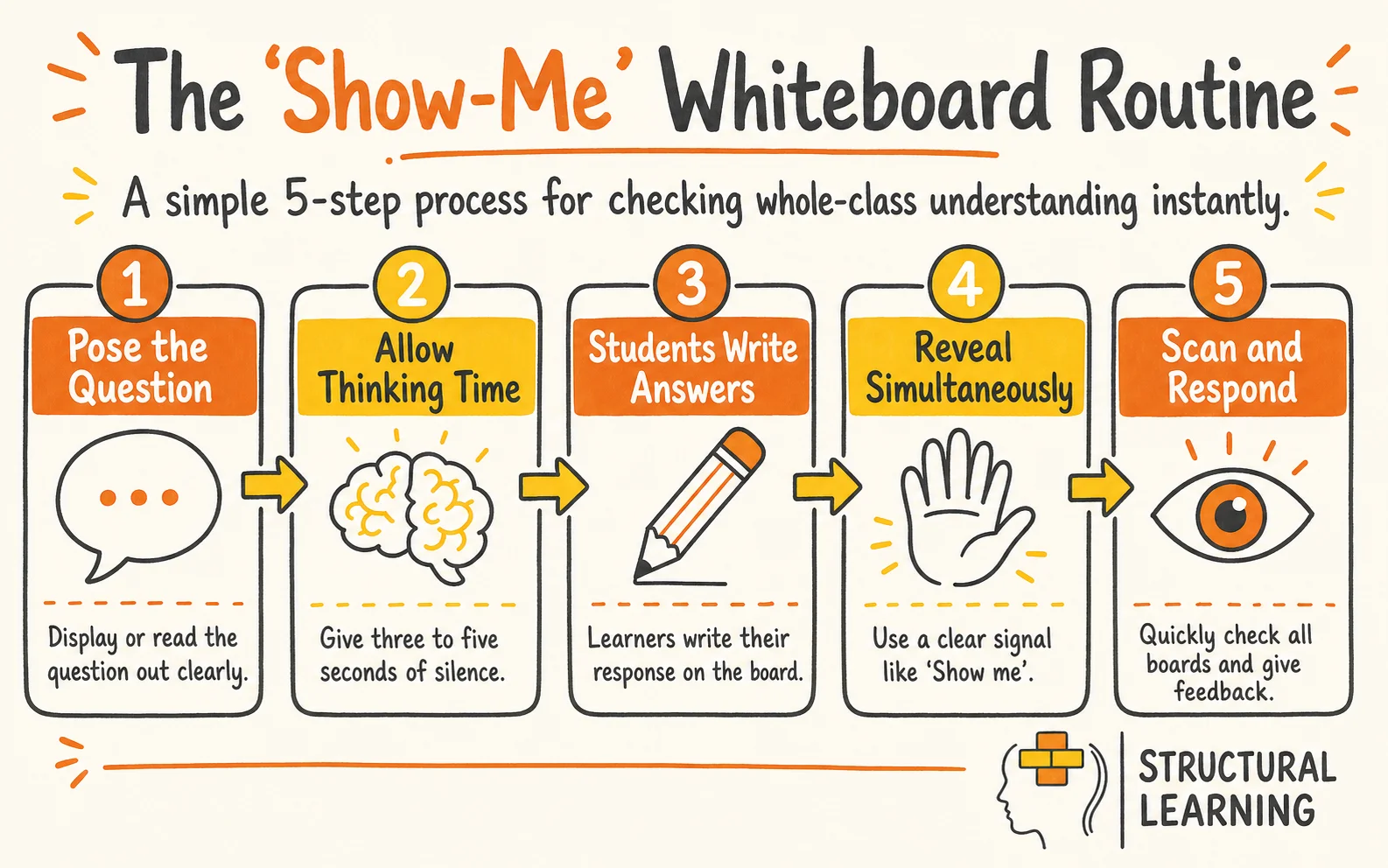
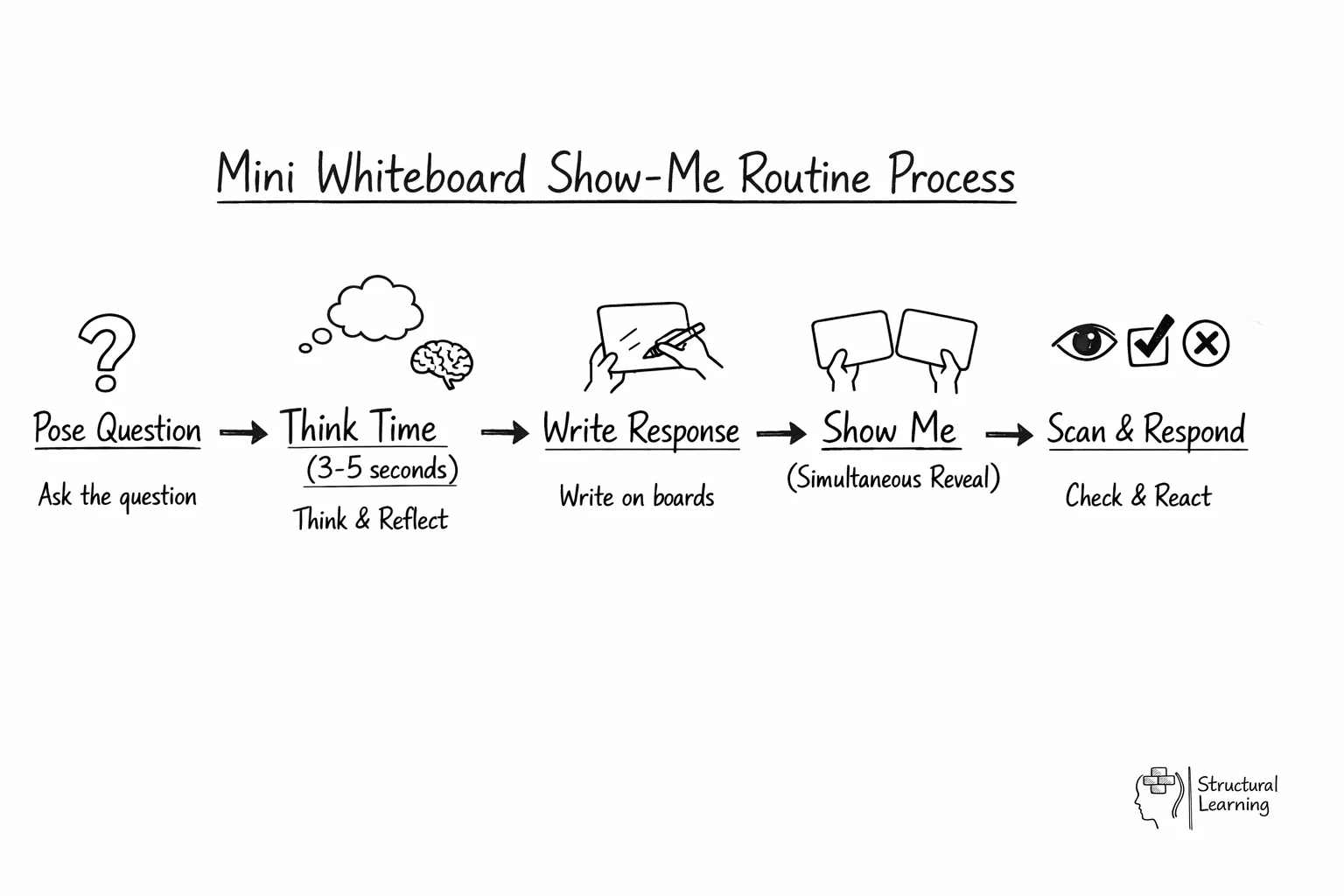
Step 1: Pose the question. Display or read the question clearly. For a Year 8 Science class studying respiration: "Write the word equation for aerobic respiration."
Step 2: Think time. Give three to five seconds of silent thinking. This supports students with slower processing speeds and mirrors the wait time research (Rowe, 1986) that improves response quality. Say: "Think first. Do not write yet."
Step 3: Write. Students write their response. Keep this to 15-20 seconds for recall questions, longer for explanation questions.
Step 4: Show me. On the cue "Show me" (or "Boards up"), every student raises their board simultaneously. The simultaneous reveal prevents copying.
Step 5: Scan and respond. The teacher scans all boards in 2-3 seconds and makes an instructional decision. "I can see most of you have glucose + oxygen. Three boards show carbon dioxide on the left. Let us clarify."
Recall questions: "What is the capital of Kenya?" Perfect for retrieval practice at the start of lessons.
Multiple choice with reasoning: "Is this statement true or false? Explain in three words why." This adds metacognitive demand to a simple format.
Diagrams and sketches: "Draw a circuit with two bulbs in parallel." Whiteboards allow visual responses that verbal answers cannot capture. This connects to dual coding by requiring students to translate knowledge into a different modality.
Learners rate their fraction confidence (1 to 5). This quick self-check builds awareness of their own thinking. Research by Dunlosky and Rawson (2012) supports metacognition. Pintrich (2002) also found links between self-regulation and achievement.
Archer and Hughes (2011) found explicit instruction builds learner understanding. Retrieval practice, like recalling key terms, helps learners learn. Roediger and Karpicke (2006) show this strengthens curriculum knowledge. Bjork and Bjork (1992) say regular recall helps long-term retention.
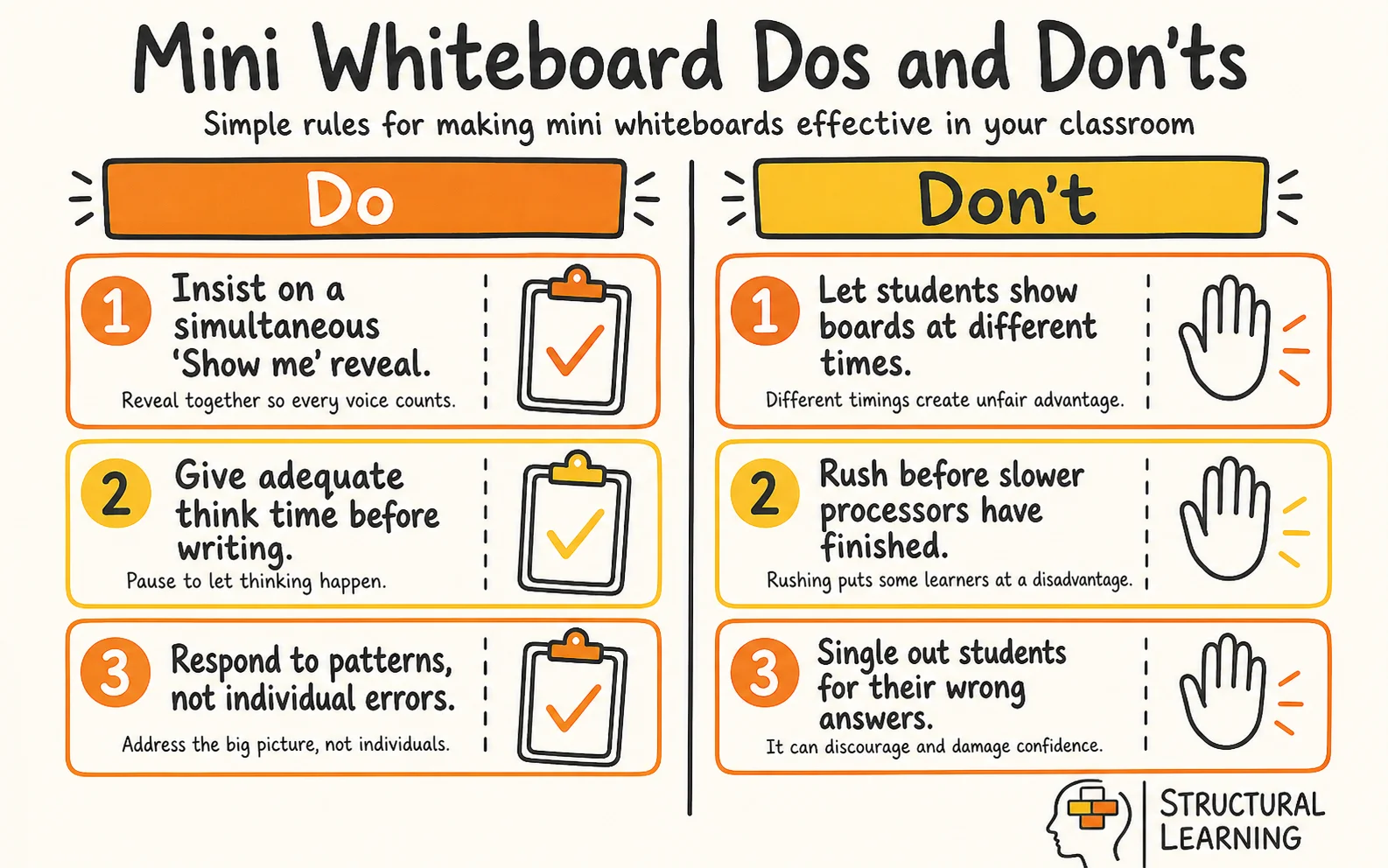
| Do | Don't |
|---|---|
| Insist on simultaneous reveal ("Show me") | Let learners show boards at different times (enables copying) |
| Give adequate think time before writing | Rush to "Show me" before slower processors finish |
| Scan all boards before commenting | Focus on the first correct board you see |
| Respond to patterns, not individuals | Single out wrong answers ("James, why did you write that?") |
| Use boards for low-stakes practise | Grade whiteboard responses |
| Clean boards between questions | Let old answers create confusion |
Six routines as teachers describe them this term, with what you would notice from the back of the room and what the evidence can and cannot say about each. The evidence column is the research on checking, not on the board: no trial of mini whiteboards exists.
| Routine, as teachers describe it | What you would notice | What the evidence says |
|---|---|---|
Pens down, hover, chin it, show me1 = pens down 2 = hover 3 = hold MWB in front of face so you you can see it Show me. At every stage I can check attention |
Boards face down until the call, then held under the chin so only the teacher sees them. Every call is also an attention check. | Wiliam (2011) puts the value of an all-learner response system in the commitment: everyone answers, nobody opts out. The synchronised reveal is what stops the copying that Third Space Learning and Craig Barton both name as the data's weak point. |
Board for the multiple choice, book for the deeper answerWe’ve started to use them for a multiple choice vocabulary task straight after the retrieval but they have to write the deeper thinking answer in their books |
A vocabulary check on the board straight after the retrieval; the extended answer written in the book while the teacher walks the room with the boards' names in mind. | The ten-word ceiling is a scanning limit, not a learning one. Black and Wiliam (1998) describe formative assessment as evidence used to adapt teaching; the book step is where an English answer becomes evidence you can read. |
Three multiple choice and one sentence, one slide split in fourHistory teacher here. I have three questions on the board that are multiple choice, and the fourth question requires a sentence. I divide my slide into four for this. Answer on mwb It’s my do now task |
A do-now on boards: three letters and a sentence. The letters are scanned in seconds; the sentence is the item the teacher has to read. | A multiple-choice item whose wrong options carry known misconceptions is Wiliam's (2011) hinge question; it reads the room. The sentence is the one item a raised board cannot carry, so it needs the circulate step. |
Eight to ten retrieval questions, self-marked, score shownSorry to chime in since not an English teacher but I do that and love it. Students answer 8–10 retrieval questions on their mini-whiteboards at the start of class. I reveal the correct answers, students check and tally their score, then show their boards. I can quickly scan the room and identify any problem areas that need to be retaught. |
Answers revealed, learners tick their own, a score in the corner, boards up. The teacher scans for the low scores and the question everyone missed. | Roediger and Karpicke (2006) found the act of retrieving is what strengthens memory, so the questions do the work whether or not the boards go up. A score is a count, not a diagnosis: add a hands-up per item to find the misconception. |
Share and build after the scanWe use mini whiteboards for this and it works really well. But we don’t just stop at seeing their answers, we pick some good ones to share and ask students how it can be built further upon or if they agree and why etc etc. Mini whiteboards just gives them the starting point x |
Two or three good boards chosen from the scan and shared; the class asked how to build on them or whether they agree. The board is the start of the talk. | Rosenshine (2012) pairs checking for understanding with the processing that follows it. The scan chooses who speaks and what gets built; without that step the check reads the room and changes nothing. |
A department set of 32 boards and pens in folders, not learner-owned kitI prefer 2 personally because we can retain control of A) them having one and B) cleanliness and standards C) all pens work |
Boards handed out from a folder per room; every pen works; the set is counted back in. No "my pen's run out" minute. | Durrington Research School's own disadvantages list (pens, noise, handing out, doodling) ends with the observation that most of them are routines and organisation. A set the teacher owns removes the friction that makes the check slow. |
A Year 6 teacher uses whiteboards for fluency practise: "Simplify the fraction 8/12. " Scan boards. "I can see 2/3 appearing on most boards. Four of you wrote 4/6. That is equivalent but not fully simplified. What do we divide by?"
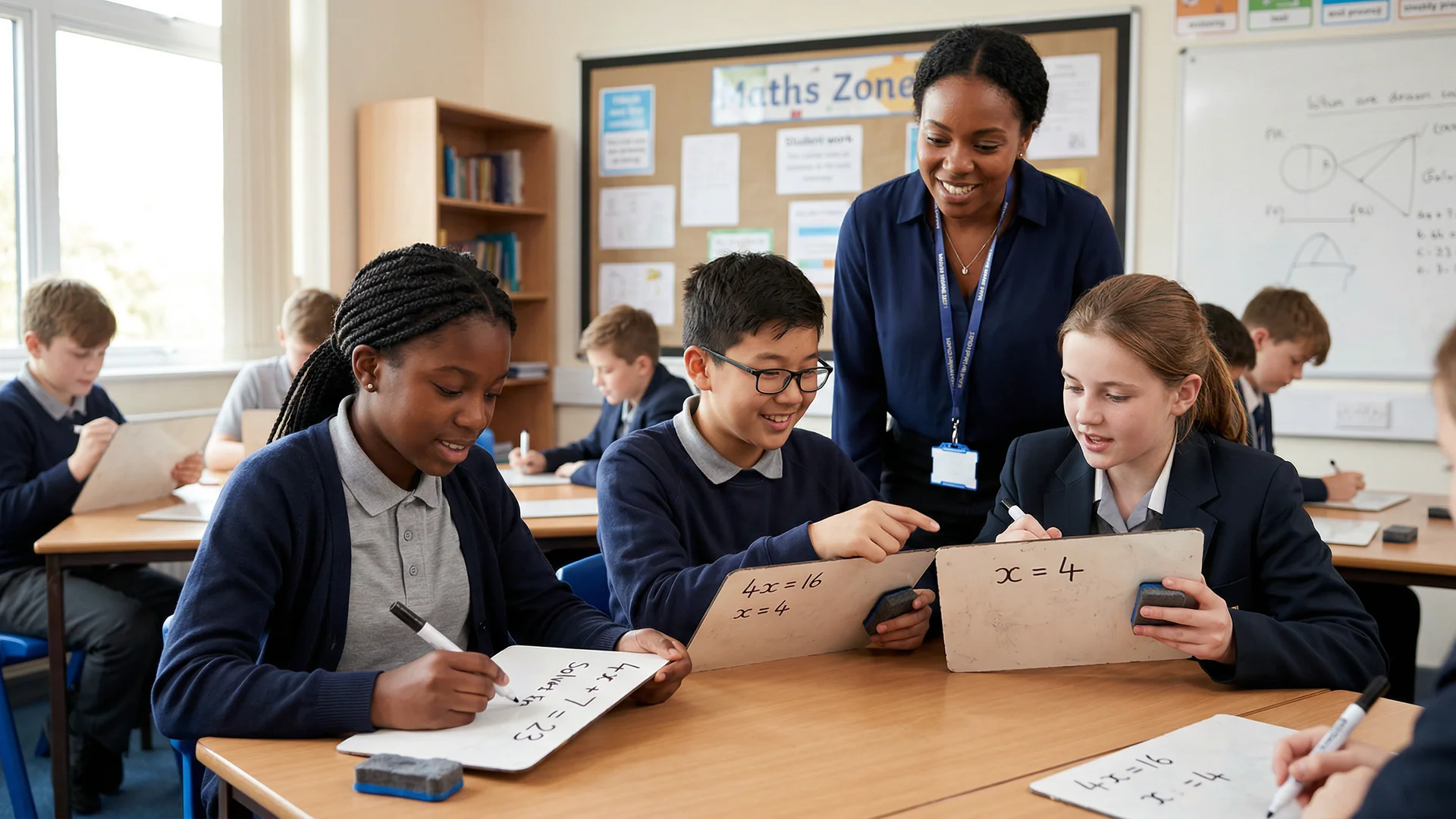
For problem-solving, students show their working: "Write the first step you would take to solve 3x + 7 = 22." The teacher sees who subtracts 7 first versus who divides by 3, revealing a misconception about order of operations.
Mini whiteboards suit hinge questions in Science. A Year 9 Chemistry teacher displays: "Which of these is NOT a sign of a chemical reaction? A) Colour change B) Temperature change C) Dissolving D) Gas produced." Students write their letter. The teacher instantly sees who confuses dissolving (physical change) with chemical change.
A Year 10 English teacher studying "An Inspector Calls" asks: "Write one word that describes Mr Birling's attitude in Act 1." Boards show: arrogant, dismissive, confident, selfish, superior. The teacher uses this vocabulary as a springboard: "Excellent range. 'Arrogant' and 'superior' suggest slightly different things. Who can explain the distinction?"
In History, whiteboards support chronological thinking: "Put these events in order: 1, 2, 3, 4." The teacher sees who has the sequence correct without waiting for individual responses.
Mini whiteboards work from Year 1 onwards. A Year 2 teacher uses them for phonics: "Write a word with the 'igh' sound." Boards show: night, light, high, bright, fight. The teacher can immediately see who is secure and who needs additional practise.
Structural Learning works well with mini whiteboards. Learners can draw graphic organisers, visually sort concepts, and use Green "Extract" cards to find specific details. Keep this as a practical classroom scaffold rather than attaching it to unrelated cognitive-acceleration or retrieval citations.
For students with special educational needs, mini whiteboards offer several advantages over verbal responses:
Use sentence stems on the board: write "The character feels _____ because _____" and students complete the blanks. The Structural Learning Map It approach provides visual templates that students can replicate on their whiteboards, creating structured responses without the overwhelm of a blank page.
Challenge higher-attaining students with:
Keep a set of 30 boards, pens, and erasers in a clearly labelled tray. Assign one student per table to distribute and collect. Build this into your lesson routine so it takes less than 30 seconds.
Pen management: Board pens dry out. Buy in bulk and store horizontally with caps on. Replace immediately when they fade. A faint response is worse than no response because the teacher cannot read it.
Erasing: Small pieces of felt or old socks work better than tissue paper. Some teachers use the cuff of a school jumper (with permission).
Board size: A4 boards work best for most classrooms. A5 boards suit younger children or quick recall activities.
Mistake 1: Only using boards for recall. Whiteboards can support higher-order thinking too. "Draw a diagram showing how the water cycle connects to weather patterns." "Sketch a character arc for Macbeth."
Mistake 2: Allowing staggered reveals. If students show boards at different times, faster students copy slower students. Always use a simultaneous cue.
Mistake 3: Overusing boards. If every question requires a whiteboard, the technique loses its power. Use boards at two or three key moments per lesson, not for every interaction.
Computer vision and AI may eventually help teachers sort photographed mini-whiteboard responses, but this should be treated as an emerging workflow rather than a proven mini-whiteboard intervention. The current DfE guidance on generative AI in education stresses safe, responsible use, staff oversight and attention to data protection. Teachers should not upload learner work to unapproved tools or rely on automated grouping without checking the outputs.

A safer workflow is manual first: ask a diagnostic question, scan the boards, note common answer patterns and decide whether to reteach, extend or move on. Only use digital capture where the school has approved the tool, the data route is clear and learner privacy is protected.
If a school-approved tool is used, treat its analysis as a prompt for teacher judgement. A camera or tablet might help group common answer patterns, but the teacher still needs to interpret misconceptions, decide whether the task was well designed, and choose the next explanation or example.
AI analysis can be useful only if it makes a teacher's next decision clearer. For now, mini whiteboards remain strongest as a low-tech formative-assessment routine: every learner responds, the teacher scans patterns, and feedback happens immediately.
Mini whiteboards give teachers fast formative assessment data. Teachers see every learner's concept grasp, not just vocal ones (Black & Wiliam, 1998). This moves lesson choices from guesswork to evidence, improving teaching.
Using boards lets you spot issues fast. Drawing fractions shows what learners misunderstand (Wiliam, 2011). A learner might say "half of 24 is 12" but draw the relationship incorrectly; that reveals shallow understanding rather than secure knowledge. You can then quickly help learners (Black & Wiliam, 1998).
Mini whiteboards ease evidence collection. Teachers photograph errors for meetings. They track learner progress, noting mistakes. Teachers spot class misconceptions needing reteaching. One teacher created groups mid lesson. Learners with secure understanding tackled extensions. Those with errors received support. (Wiliam, 2011; Black & Wiliam, 1998).
Assessment Reform Group (2002) found quick feedback helps learners progress. Mini whiteboards allow this, making "short learning cycles" (Black & Wiliam). Learners get fast feedback; response and correction happen quickly. This speeds learning up, unlike slower traditional marking.
Mini whiteboards help check learner progress if used well. Good organisation and storage are key for success. Keep boards handy near your teaching space. Use crates or wall pockets so learners get and return boards fast.
Learners need A4 whiteboards, black dry-erase markers, and erasers. Laminated card offers a cheaper whiteboard alternative. Store markers in pots to avoid lid hunts. This reduces transition time to under 30 seconds for lessons.
Establish clear routines from day one. Teach students to hold boards at chest height facing forwards, ensuring you can scan all responses quickly. Create a simple signal system: 'boards up' means show answers, 'boards down' means stop writing. Practise these routines during low-stakes activities first, such as spelling tests or times tables, before moving to more complex subject content.
Think about classroom layout. Position seating so you can see all boards from the front. Give learners with motor needs clipboards or easels where helpful. Rotate board monitors weekly so resource routines are shared and transitions stay quick.
Mini whiteboards show learner understanding quickly. Teachers fix errors instantly, not during marking (Wiliam, 2011). You see every learner's knowledge at once. This helps find common mistakes fast (Black & Wiliam, 1998).
Design questions to reveal common misconceptions for learners. In maths, ask learners to write '3/4 + 1/2'. This shows if they grasp fraction addition. In science, learners can draw particle diagrams (solids, liquids, gases). This quickly shows who understands particle theory.
Once you've identified gaps, mini whiteboards help you respond immediately. If half your class shows the same error, pause and reteach that specific concept. If only three students struggle, note their names and provide targeted support whilst others move forwards. This responsive teaching approach, advocated by Black and Wiliam (2009), means misconceptions don't embed themselves through weeks of practise.
Use mini-whiteboard data to plan ahead. Tally common errors spotted during whiteboard work. If 15 learners confuse metaphors and similes (Monday), revisit this Tuesday. This informs your teaching, targeting real learning needs (Wiliam, 2011).
Mini whiteboards draw on several evidence traditions:
Wiliam (2011) said assessment for learning has five key strategies. These strategies engineer classroom discussions and tasks. They get evidence of learner progress. Mini whiteboards easily achieve this on a large scale.
Himmele and Himmele (2011) say all learners must actively engage, not just some. Mini whiteboards work well because they encourage every learner to give an answer.
Roediger and Karpicke (2006) found testing helps: writing answers retrieves information. Even wrong answers boost learning after teacher feedback. Addressing misconceptions after a "Show me" moment works (Roediger and Karpicke, 2006).
Ebbinghaus (1885) and Cepeda et al. (2006) found spaced practice helps. Use the whiteboard regularly to help learners recall information. Review Monday's work on Wednesday, then next week. This spacing improves memory.
Next lesson, replace one "Who can tell me?" question with "Write it on your board and show me." Watch how the room changes when 30 students think simultaneously instead of three.
Assessment and Classroom Learning
Black, P. and Wiliam, D. (1998). Assessment in Education: Principles, Policy & Practice.
Use this as the formative-assessment anchor for collecting evidence of learning and adapting teaching.
Improving Students' Learning With Effective Learning Techniques
Dunlosky, J. et al. (2013). Psychological Science in the Public Interest.
It covers retrieval practice and distributed practice.
Test-Enhanced Learning
Roediger, H. L. and Karpicke, J. D. (2006). Psychological Science.
Use this for the claim that generating answers through retrieval can strengthen later recall.
Cognitive Load During Problem Solving
Sweller, J. (1988). Cognitive Science.
This is the appropriate source for cognitive-load framing, not for basic classroom-organisation advice.
Wait Time: Slowing Down May Be A Way of Speeding Up!
Rowe, M. B. (1986). Journal of Teacher Education.
Use this for silent thinking time before learners reveal their boards.
Generative artificial intelligence (AI) in education
Department for Education. Current GOV.UK guidance for schools and colleges.
Use this for cautious AI-use boundaries, staff oversight and data-protection responsibilities.