PBIS: A Teacher's Guide to Positive Behavioural Interventions and SupportsPBIS positive behavioural interventions in school

Updated on  

March 6, 2026

PBIS: A Teacher's Guide to Positive Behavioural Interventions and Supports

|

March 6, 2026

Positive Behavioural Interventions and Supports (PBIS) is a data-driven framework that helps teachers prevent behaviour problems before they start. Instead of waiting for students to misbehave and punishing them, PBIS teaches good behaviour proactively, rewards it consistently, and uses data to identify students who need extra help. Schools using PBIS report 20-40% reductions in office discipline referrals and improvements in academic achievement, particularly for students with disabilities and those from disadvantaged backgrounds (Horner et al., 2009).

PBIS started at the University of Oregon in the 1990s, developed by George Sugai and Robert Horner working with the US Office of Special Education Programs (OSEP). Today it operates in thousands of schools across America and is increasingly adopted internationally. The framework rests on three core ideas: most behaviour is learned, good behaviour can be taught like any other skill, and data should drive your decisions about which students need more support.

This guide explains how PBIS works, how to implement it in your classroom, and how to avoid the common mistakes that derail many schools. You do not need to wait for your whole school to adopt PBIS to benefit from its principles. Many of the strategies work powerfully at classroom level alone.

Key Takeaways

  1. PBIS is prevention, not just punishment. You teach and reinforce expected behaviours systematically, reducing the need for corrections later.
  2. Use the 5:1 ratio: For every correction, aim for five specific praise statements about good behaviour. This is backed by decades of behaviour science (Skinner, 1957; Thorndike, 1898).
  3. Data drives decisions. Track which students struggle most using Office Discipline Referrals (ODRs) and Functional Behaviour Assessments (FBAs), then target support where it matters.
  4. Three-tier model scales support. Tier 1 is universal (all students), Tier 2 is targeted (small groups at risk), Tier 3 is intensive (individual students with serious behaviour needs).
  5. Teaching the matrix works. Explicitly teach what "respect" or "responsibility" looks like in the classroom, hallway, cafeteria, and playground, not just assuming students know.

What Is PBIS?

PBIS is a systems approach to school behaviour that applies behavioural science principles to whole-school organisation. The central idea is straightforward: behaviour is shaped by environmental conditions and consequences. Students are more likely to behave well if they understand what good behaviour looks like, see others being rewarded for it, and experience consistent positive consequences (Sugai & Horner, 2002).

In a PBIS school, staff agree on three to five core values (commonly Respect, Responsibility, and Safety). They then define what these values look like in every location and situation. They teach these expectations explicitly, monitor compliance through data, and celebrate students who follow the expectations. When students break rules, staff respond with brief, calm corrections followed by re-teaching, not lengthy lectures or harsh punishment.

The framework is not soft-touch permissiveness. PBIS schools have clear consequences for rule violations. The difference is that consequences are connected to teaching, not divorced from it. A student who swears in class does not just get detention; a teacher calmly explains why respectful language matters, describes what respectful communication sounds like, and monitors whether the student has genuinely learned.

A Year 6 teacher implements PBIS by spending the first week of term explicitly teaching what "responsibility" means at four locations: the desk (independent work), the carpet (whole-class time), the door (lining up), and the playground. She shows a video of a student taking responsibility during independent work (raising a hand instead of interrupting). She praises specific instances all week. By October, behaviour issues in independent work have dropped by half because students know exactly what responsibility looks like in that context.

UK Educator? PBIS shares principles with UK positive behaviour support and whole-school SEMH strategies. The UK approach typically sits within the Graduated Approach framework.

See our guide: Emotional Regulation Strategies for the Classroom.

The Three Tiers of PBIS

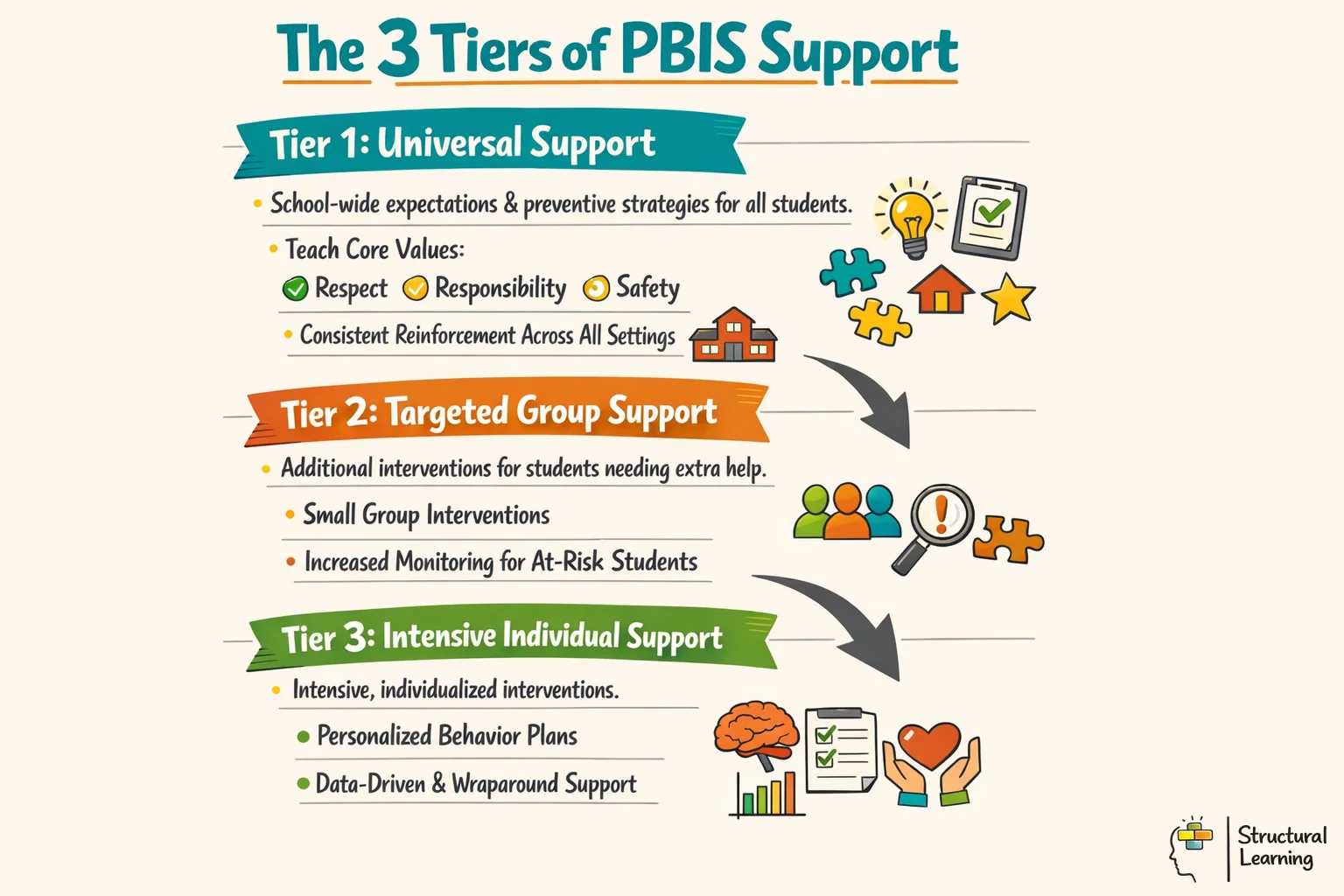
PBIS uses a three-tier model, similar to Response to Intervention (RTI). Tier 1 provides universal behaviour support for all students. Tier 2 targets students showing early warning signs. Tier 3 provides intensive support for students with complex behaviour needs.

The three-tier model reflects the reality of behaviour. Most students respond well to clear expectations and consistent reinforcement (Tier 1). A smaller group of students need more frequent feedback, smaller rewards, or problem-solving conversations (Tier 2). An even smaller group need individualised behaviour plans, adult-directed instruction, or therapeutic involvement (Tier 3).

Research suggests this distribution roughly follows a normal curve: approximately 80% of students thrive with Tier 1 alone; 15% need Tier 2 support; 5% need Tier 3. Schools that jump straight to harsh Tier 3 responses (suspension, exclusion) for students who actually need Tier 2 support end up with worse outcomes (Horner et al., 2009).

In a typical secondary school, Tier 1 includes schoolwide expectations and rewards (merit points, certificates, assemblies). Tier 2 includes small-group interventions like lunchtime social skills clubs for students with poor peer relationships, or check-in/check-out procedures for students struggling with organisation. Tier 3 includes a student with an Emotional and Behavioural Difficulty (EBD) diagnosis who needs a detailed Behaviour Intervention Plan (BIP) with specific strategies for handling anger outbursts.

Tier 1: Schoolwide Expectations

Tier 1 PBIS starts with agreement on core values, usually three to five schoolwide expectations. Examples include Respect, Responsibility, Safety, Kindness, and Excellence. These values are broad enough to apply in every setting (classroom, hall, playground, toilet) but specific enough that you can teach and observe them.

The critical next step is building a teaching matrix. This is a table that defines what each value looks like in each setting. For instance, "Respect" in the classroom might mean: listening when others speak, raising your hand, and using kind language. "Respect" in the hall might mean: staying in line, walking quietly, and helping peers who are struggling. "Respect" on the playground means: including others, accepting when you lose a game, and asking permission to join activities.

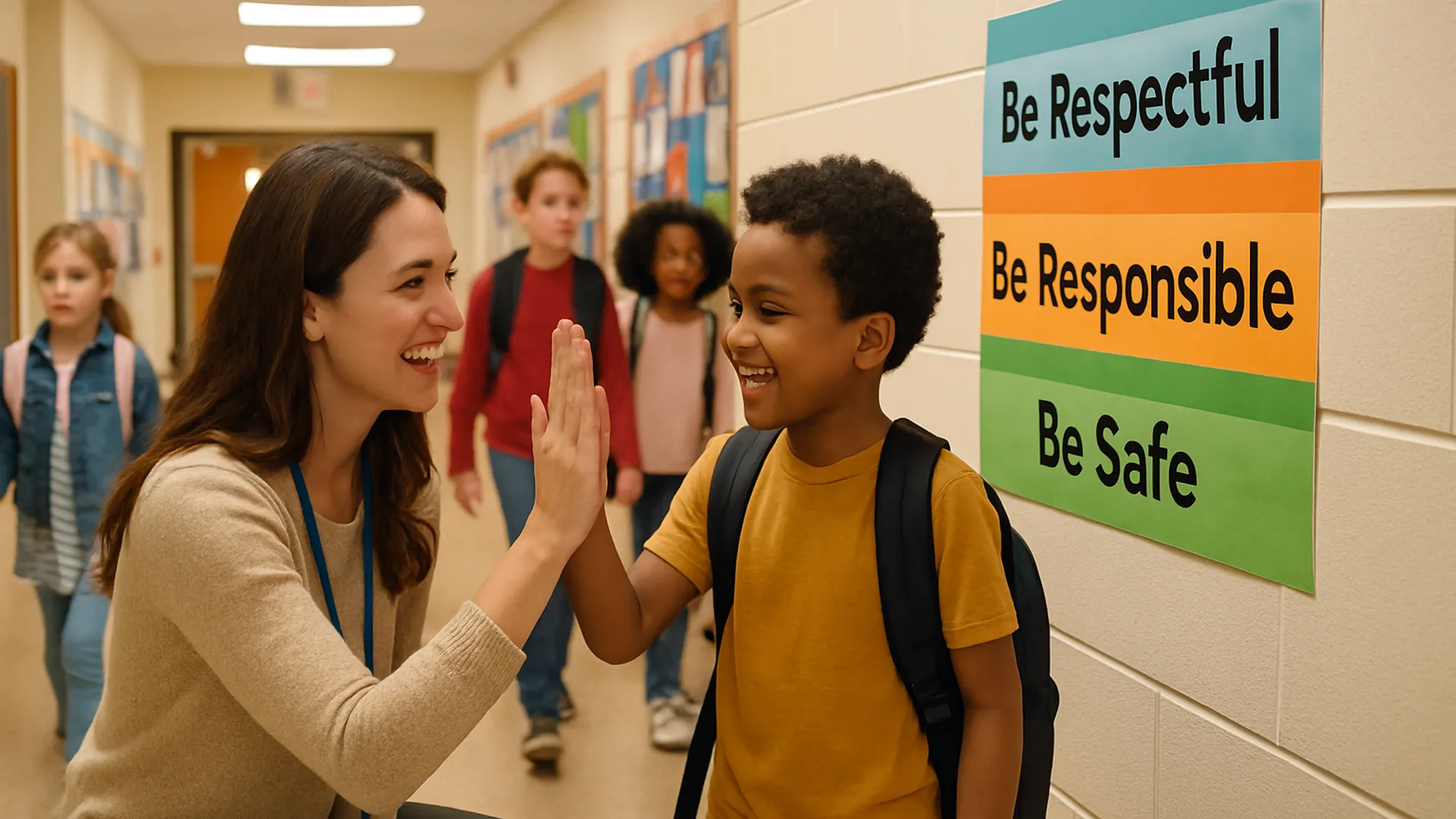
Many schools create posters showing these expectations. More importantly, they schedule explicit teaching lessons in the first week and re-teach regularly. One secondary school uses a five-minute tutor time session each Monday to teach one expectation in one setting. By half-term, every expectation-setting pair has been taught.

Tier 1 also includes a reward system. This might be merit points (House points in UK schools), token economies (collect stamps, earn prizes), or social recognition (celebrated in assembly). The reward should be frequent, accessible, and valued by students. Secondary students might earn points toward free time or technology privileges; primary students might earn extra playtime or tangible rewards.

A primary school Year 3 class uses "Responsibility" expectations. The teacher displays a poster: "Responsibility means: lining up quietly, walking carefully, doing my best work, and looking after the classroom." In the first week, she teaches these explicitly using a video role-play. Throughout September, she gives immediate specific praise: "I saw you walk to the carpet carefully without bumping anyone. That is responsibility." By October, students line up faster and with fewer reminders because they understand exactly what responsibility means and they have received consistent, specific recognition for showing it.

Tier 2: Targeted Group Supports

Tier 2 supports are for students who are not responding to Tier 1 alone. You identify these students by tracking Office Discipline Referrals (ODRs). If a student has had three or more referrals in a term, they are a candidate for Tier 2 support.

Common Tier 2 strategies include small group interventions. A primary example is a lunchtime social skills group for students who struggle with peer relationships and get into conflicts. The group might meet twice weekly for six weeks, learning skills like joining play, handling frustration, and apologising. Another example is a after-school homework club for students who forget equipment or homework.

Check-in/check-out (CICO) is another powerful Tier 2 strategy. A student checks in with an adult first thing in the morning, sets a behaviour goal for the day, and gets a card to track progress. They check out at the end of the day, review how they did, and take home the card for a parent to sign. This is particularly effective for students who struggle with organisation, impulse control, or remembering rules (Horner et al., 2009).

Tier 2 also includes more frequent praise and feedback. A student in CICO might get specific praise five or six times daily instead of once weekly. This dramatically increases the rate of learning because behaviour is shaped by immediate consequences.

Tier 2 strategies are not meant to be permanent. The goal is to help students succeed so they no longer need them. A student in a social skills group should be monitored for progress and exited within six to eight weeks if they are meeting goals.

A secondary school identifies a Year 9 boy with six ODRs for social rudeness and confrontation. He joins a Tier 2 small group run by a teaching assistant twice weekly. The group uses role-plays to practise responding calmly when peers provoke them, and problem-solving conversations to understand why the student reacted aggressively. After five weeks, his ODRs drop to zero. After another five weeks off the group, he maintains progress and needs no further support. He was not a "bad kid" needing punishment; he was a student needing explicit teaching of a missing skill.

Tier 3: Intensive Individual Supports

Tier 3 supports are for students with serious behaviour needs that do not respond to Tier 1 and Tier 2. These students often have diagnosed disabilities (EBD, autism, ADHD), trauma histories, or complex social-emotional needs. Tier 3 requires a Functional Behaviour Assessment (FBA) and a detailed Behaviour Intervention Plan (BIP).

An FBA answers the question: why is this student behaving this way? It looks at antecedents (what happens just before the behaviour), the behaviour itself, and consequences (what happens after). For example, a student might have aggressive outbursts that are preceded by transitions, seem to be triggered by sensory overload in crowded spaces, and are maintained by adult attention or escape from difficult work.

Once you understand the function of the behaviour, you can design a BIP that teaches alternative skills and modifies the environment. For the student above, the plan might include: advance warning before transitions, a quiet space to retreat to when overwhelmed, specific calming strategies taught by the special education teacher, and a system where the student gets attention for using the calm-down skills rather than for aggression.

Tier 3 always involves specialists (SENCO, school psychologist, outside behaviour consultant). Classroom teachers rarely work in Tier 3 alone. The BIP is a collaborative document involving the student, parents, teachers, and specialists.

A student with autism has severe aggressive episodes (hitting, throwing things) triggered by transitions or sensory overload. The FBA reveals he is trying to escape overwhelming situations. The BIP includes: visual schedules showing transitions in advance, noise-cancelling headphones, access to a calm room, a visual signal he can use to request a break before he escalates, and explicit teaching of a deep breathing routine. After three months, his aggressive episodes have reduced by 70% because the environment is now designed to prevent escalation, and he has learned an alternative way to communicate distress.

Teaching Behavioural Expectations

The single biggest mistake schools make is assuming students know what good behaviour looks like. They don't. Students learn behaviour the same way they learn maths or literacy: through explicit instruction, guided practice, and feedback. Teaching expectations is not a one-off assembly; it is a systematic curriculum.

Effective teaching of expectations follows a simple formula. First, you explain the expectation in simple, concrete language. "Respect means listening when someone else is speaking and using kind words." Second, you model it. Show a video, role-play, or demonstrate the expected behaviour and the opposite. Third, you have students practise. In the classroom, a teacher might say, "I am going to pretend to be someone interrupting you. You show me how to respond respectfully." Fourth, you give immediate feedback. Praise when students show the behaviour; correct misunderstandings when they do not.

This teaching is scheduled, not incidental. A secondary school blocks off one tutor period per week for the first half of term to teach expectations systematically. A primary school uses part of the first week back each term. The teaching is not lengthy (five to ten minutes per session), but it is intentional and regular.

Teaching should always include why the expectation matters, especially for older students. "Respect means listening when someone else is speaking. Why does this matter? Because when we listen, we learn each other's ideas, we feel valued, and we understand each other better. When we interrupt, people feel ignored, and we get confused about what is happening."

A Year 5 class focuses on "Responsibility" in week one of term. On Monday, the teacher shows a two-minute video of a responsible student doing homework (managing their own time, asking for help appropriately, checking their work). She asks, "What did responsibility look like?" Students brainstorm: planning ahead, not waiting until the last moment, asking for help when stuck, checking the work. On Tuesday, she models an irresponsible approach (rushing, not reading instructions) and asks students to spot the mistakes. On Wednesday, students role-play doing homework responsibly while the teacher gives live feedback. By Friday, students have experienced responsibility in multiple ways and can describe it in detail.

Reward Systems That Work

Rewards are essential in PBIS, but many schools implement them badly. A broken reward system either is not valued (students do not care), is not frequent enough (students forget the connection between behaviour and reward), or is unfairly distributed (the same students get rewarded every week).

Effective rewards are specific to what behaviour earns them, frequent, and accessible to all students. A secondary school uses merit points. Students earn one merit for meeting expectations (lining up quietly, completing homework) and three merits for exceeding expectations (helping a peer, making a brilliant suggestion). The important detail is that merits are awarded frequently by all staff, not just once weekly by the head. Students see the immediate connection between their behaviour and the reward.

The reward itself should be something students actually value. A primary school offers tangible rewards (stickers, pencils, small toys) because young children are motivated by these. A secondary school might offer merits that count toward free time, line-skipping privileges, music in study period, or technology access. A teacher surveys students to find out what they value; the most effective rewards vary by student.

Praise is also a reward, and arguably the most important one. Research on B.F. Skinner's work on reinforcement shows that specific praise (naming the behaviour) is far more effective than generic praise. Instead of "Well done," say, "I noticed you waited patiently for your turn to speak. That is respectful." The student now knows exactly which behaviour you are rewarding, making them more likely to repeat it (Skinner, 1957).

The 5:1 ratio (five pieces of praise for every correction) is the gold standard. Schools that achieve this ratio see the largest behaviour improvements. Most teachers operate at 1:1 or worse (more corrections than praise). Consciously aiming for 5:1 requires deliberate habit change.

A primary teacher tracks her praise to students using a tally. She aims for 5:1. On Monday, she gives 12 corrections and only two praises (0.17:1). By Friday, she has increased to three praising statements for every correction (3:1). She consciously looks for good behaviour, narrates it, and links it to school values. A student sits with a peer during shared reading; she immediately says, "You are showing responsibility by helping your friend find the page. Thank you." The result is noticeable: students are on-task more, seek her attention for good reasons, and are happier.

Data-Driven Behaviour Decisions

A cornerstone of PBIS is using data, not instinct, to decide which students need help and what support they need. The primary data source is Office Discipline Referrals (ODRs). Every time a student breaks a rule and is referred to an administrator (or logged in a classroom behaviour log), that is an ODR.

PBIS schools use School-Wide Information System (SWIS) software or equivalent to track ODRs by student, behaviour type, location, and time. A report might show: "Three students account for 30% of all referrals," or "Most referrals happen in the hall before lunch," or "Aggression is the most common behaviour in Year 8." These patterns guide intervention decisions.

Once you identify high-need students, you conduct a Functional Behaviour Assessment. The FBA is not a guess; it is a data-gathering process using behaviour observation sheets, structured interviews with staff who know the student, and direct observation of the behaviour in its natural context. The goal is to identify the antecedent, behaviour, and consequence pattern.

Data also drives monitoring of whether interventions are working. If a student is in a Tier 2 small group for social skills, you track whether ODRs are decreasing. If they are not decreasing after four weeks, the intervention is not working, and you change it. This is continuous improvement driven by data, not by assuming an intervention will work.

Teachers should also use classroom-level data. A formative assessment approach to behaviour means assessing which students are meeting expectations frequently and which are struggling. You might use a simple checklist (Did student show respect? Responsibility? Safety?) completed two or three times weekly. The students struggling on the checklist need more teaching or support.

A secondary school downloads their SWIS data at half-term. They see that 15 Year 9 students have five or more referrals. They identify a pattern: most referrals are in transition periods (moving between lessons) and involve disrespect or defiance. They decide to launch a Tier 2 intervention: five minutes of the tutor period each morning is now dedicated to teaching respectful responses to authority and managing transitions. They also implement check-in/check-out for the 15 students. After three weeks, referrals drop by half. Without the data analysis, they might have blamed the students or parents without examining the evidence.

PBIS in the Classroom: Daily Practices

Even if your school is not implementing schoolwide PBIS, you can use PBIS principles in your classroom. The daily practices are surprisingly simple: be explicit about expectations, catch students doing things right, respond calmly to misbehaviour, and collect data on who is struggling.

Start the term by explaining your classroom expectations. Most teachers have three or four: Respect, Responsibility, Kindness, and Effort. In week one, teach what each looks like in your specific classroom. Use the same teaching formula: explain, model, practise, feedback. Do this systematically, not casually.

Second, implement a reward system. This might be a simple behaviour chart, a token jar where the class earns stickers and cashes them in for rewards, or individual reward systems for students who need more frequent feedback. The key is that rewards are frequent, visible, and valued.

Third, respond to misbehaviour briefly and calmly. PBIS does not mean no consequences; it means consequences are tied to teaching. A student calls out during a lesson. A PBIS response is: "Hands up, thank you," (stating the expectation), then during a calm moment later, "I noticed you called out when you knew the answer. I see your enthusiasm. Next time, raise your hand and I will call on you so everyone gets a turn." This takes 20 seconds, not ten minutes of lecturing.

Fourth, track behaviour to see who needs extra help. Keep a simple tally or checklist. Which students are off-task consistently? Which are not showing respect to peers? Which are struggling to manage frustration? These students are candidates for a conversation about what they need.

A Year 4 teacher implements classroom PBIS. She teaches expectations in week one, focusing on "Respect" (listening, kind words), "Responsibility" (doing your best, asking for help), and "Trying" (it is okay to get it wrong; mistakes help us learn). She starts a simple token reward: students earn a token for showing expectations, ten tokens earns a choice of activity. She praises specifically and frequently. During a maths lesson, a student rushes through a problem and gets it wrong. The teacher calmly says, "That is a smart mistake. Let us talk about it." The student realises his error and fixes it. A peer watches and realises trying means not giving up. By October, off-task behaviour has dropped from 20% of observation points to 5%, and students ask her for help instead of giving up.

PBIS vs Traditional Discipline

PBIS differs from traditional discipline in its underlying theory and its outcomes. Traditional discipline assumes behaviour problems are choices and responds with punishment. PBIS assumes behaviour is learned and responds with teaching. The differences are profound.

Aspect PBIS Traditional Discipline
Underlying belief Behaviour is learned. Students can be taught. Behaviour problems are choices or defiance. Punishment deters.
Strategy Teach expectations proactively. Reinforce frequently. Support students who struggle. React to rule-breaking. Punish. Assume students know the rules.
Ratio of positive to corrective 5:1 or higher. Emphasise what you want to see. Often 1:1 or reversed. Focus on what is wrong.
Data use Track ODRs. Identify patterns. Adjust support based on data. Anecdotal. Respond to incidents as they happen.
When a student breaks a rule Brief consequence plus re-teaching. Calm adult response. Punishment (detention, suspension). Often emotional adult response.
Who needs intensive support Identified by data (ODRs). Offered before suspending. Often identified only after multiple suspensions. Too late.
Equity outcomes Reduces disparities in discipline (students of colour, students with SEN suspended less). Increases disparities. Students of colour suspended 3x more; students with disabilities 4x more.
Impact on academics Improved attendance and grades because students are in class and engaged. Worse academics. Suspension removes time on task and increases likelihood of drop-out.

Research comparing schools with and without PBIS shows dramatic differences. Schools implementing PBIS correctly report 20-40% reductions in office discipline referrals, 20-30% increases in academic achievement (particularly for students with disabilities), and better climate and safety perceptions (Horner et al., 2009). Critically, PBIS narrows, not widens, the discipline gap between students of colour and white students; between students with disabilities and non-disabled students.

Traditional discipline inadvertently harms the most vulnerable students. Students with undiagnosed ADHD or autism get suspended for not following expectations they do not understand. Students from backgrounds where communication styles differ from school norms get punished for "disrespect" rather than taught. The result is a school-to-prison pipeline where exclusion increases (Losen & Whitaker, 2018).

A secondary school switched from zero-tolerance discipline to PBIS. In year one, they explicitly taught expectations, tracked ODRs by demographic group, and discovered that students with disabilities had 5x more referrals than non-disabled peers. Rather than concluding the students were "worse," they provided Tier 2 and Tier 3 support. By year two, the referral gap narrowed to 1.5x. Academic outcomes improved for all students, particularly students with SEN. Suspensions dropped from 120 per year to 15.

Common PBIS Mistakes

Schools often implement PBIS incompletely or incorrectly, seeing no results and abandoning it. Knowing the pitfalls helps you avoid them.

Mistake 1: Teaching expectations once and expecting they will stick. Expectations need to be taught in week one, re-taught in week four, refreshed in January, and reinforced throughout the year. Many schools teach once and then wonder why students do not remember. Schedule explicit teaching like you would a curriculum.

Mistake 2: Reward systems that are inaccessible. A reward system where only high-achieving, well-behaved students earn rewards is not PBIS; it is unfair. PBIS rewards should be accessible to all students, including those who are struggling. A student might earn a reward for trying (not giving up) rather than succeeding. The reward should help them, not reinforce they are already good.

Mistake 3: Not tracking who is receiving recognition. Without data, the same students (usually those who are already well-behaved) get praised and rewarded repeatedly, while struggling students get ignored or corrected. Keep a simple tally sheet. Make sure you have praised every student, including those who are quiet and compliant but do not excel.

Mistake 4: Skipping the three-tier model. Some schools implement only Tier 1 (whole-school expectations) and then use harsh consequences for the few students who do not respond. This misses the entire point of PBIS. If a student is not responding to Tier 1 and expectations teaching, they need Tier 2 support, not a harsher punishment.

Mistake 5: Not collecting data. A school says they use PBIS but does not track ODRs or examine which students are struggling. They cannot be data-driven if they are not collecting data. Even a simple spreadsheet is better than nothing.

Mistake 6: Not involving all staff. A headteacher and a few teachers enthusiastically implement PBIS while the rest of the staff ignores it. Students learn quickly that some teachers will enforce expectations and others will not. Consistency across all adults is essential.

Mistake 7: Over-relying on points and prizes. Some schools implement PBIS by starting with expensive reward systems. While rewards help, the real power is in the teaching of expectations and the praising of good behaviour. A school without a token system but with excellent explicit teaching and consistent praise will outperform a school with a fancy reward app but poor teaching.

A primary school launched PBIS enthusiastically, teaching expectations in week one and creating a colourful rewards chart. By half-term, enthusiasm waned. Staff stopped praising, stopped teaching expectations, and complaints arose that rewards were too expensive. By Easter, PBIS was abandoned. What went wrong? They did not schedule expectations teaching into the year. They did not train all staff. They focused on rewards rather than the core work of teaching and praising. A neighbouring school in year two of PBIS had integrated expectations teaching into their annual calendar, trained every staff member including lunchtime supervisors, and were still improving consistently because they focused on fundamentals.

Getting Started with PBIS

If your school is not implementing PBIS, you can start in your classroom. If your school is beginning PBIS, here is a realistic roadmap.

Step 1: Choose three to five core expectations. Have a staff conversation about what behaviours are most important to your school. Prioritise behaviour that is observable and teachable. "Respect, Responsibility, Safety" is common. Avoid abstract values that are hard to define or teach.

Step 2: Build a teaching matrix. Create a table showing what each expectation looks like in each setting (classroom, hall, playground, lunch, transitions). Make it concrete. "Respect in the classroom means listening when others speak, using kind words, and staying in your seat." Do not assume students know this.

Step 3: Schedule expectations teaching. Block out time in week one to teach expectations explicitly. Plan to re-teach in week four, before half-term, after Christmas, and in the summer term. Make it part of your calendar. Do not treat it as something extra to fit in.

Step 4: Implement a reward system. This can be simple (praise and recognition) or more elaborate (points, token jars, certificates). Make sure rewards are frequent and accessible. Ask students what would motivate them rather than guessing.

Step 5: Aim for the 5:1 ratio. Count your praise statements for one week. Are you praising five times for every correction? If not, consciously increase praise. Look for good behaviour and name it. Use specific language. This shift is the single most impactful change many teachers make.

Step 6: Collect data. At school level, track Office Discipline Referrals. At classroom level, use a simple checklist or observation form. Which students are meeting expectations consistently? Which are struggling? Use this information to decide who needs Tier 2 support.

Step 7: Implement Tier 2 for students not responding to Tier 1. Do not jump to harsh consequences. Offer a small group social skills session, check-in/check-out, or one-to-one mentoring. Monitor whether they improve. If they do not within four weeks, move to Tier 3 (Functional Behaviour Assessment and Behaviour Intervention Plan).

Step 8: Review progress. At the end of the term, review your ODR data. Are discipline referrals decreasing? Are more students showing expected behaviours? Are you seeing improvement in attendance and academics? Use this information to refine your approach for next term.

For classroom teachers implementing PBIS alone, start with Steps 1 through 5 above. The core work is teaching expectations, praising consistently, and using a reward system that is accessible. These three elements will improve behaviour in your classroom significantly. Move to data collection (Step 6) once you are confident with the first five steps.

For schools implementing schoolwide PBIS, form a leadership team (principal, SENCo or behaviour lead, classroom teachers, teaching assistants, lunchtime supervisors). Commit to two years of consistent implementation before evaluating outcomes. Year one is building capacity (training, systems, data). Year two is refinement and scaling to all students. Trying to judge success in year one is premature.

A Year 2 teacher with no schoolwide support decides to implement classroom PBIS. She identifies three expectations (Respect, Responsibility, Trying), explains them in week one, and teaches them explicitly using role-play. She commits to the 5:1 praise ratio. She starts a simple token jar; when the jar is full, the class gets 15 minutes of extra playtime. She tracks which students are struggling using a simple checklist. By October, behaviour has improved markedly. Off-task time dropped from 25% to 8%. Two students who were frequently in trouble (Aisha and Marcus) are now meeting expectations consistently because they feel successful when praised for small improvements. This teacher has not waited for the school to implement PBIS; she has used PBIS principles and seen rapid results.

Further Reading and Resources

For more information on related topics, explore these articles:

Key research papers and official resources:

  • Horner, R. H., Sugai, G., Smolkowski, K., et al. (2009). A randomized control trial of school-wide positive behaviour support in elementary schools. Journal of School Psychology, 47(6), 371-390. (Foundational efficacy research; shows 20-40% reductions in referrals.)
  • Sugai, G., & Horner, R. H. (2002). Introduction to the special series on positive behaviour support in schools. Journal of Emotional and Behavioural Disorders, 10(3), 130-135. (Original PBIS framework by its creators.)
  • Losen, D. J., & Whitaker, A. (2018). 11 million suspensions are still too many: The need to improve school discipline and address racial disparities. UCLA Civil Rights-Civil Liberties Law Review. (Documents equity disparities in traditional discipline.)
  • Skinner, B. F. (1957). Verbal behaviour. Appleton-Century-Crofts. (Foundational work on reinforcement and learning.)
  • Thorndike, E. L. (1898). Animal intelligence. The Psychological Review Monographs, 2(4), 1-109. (Early research on positive reinforcement and the "law of effect".)
  • PBIS Org (2024). Centre on Positive Behavioural Interventions and Supports. Available at www.pbis.org. (Official US hub for PBIS research and training.)
  • Office of Special Education Programs (OSEP). (2023). Positive Behavioural Interventions and Supports. US Department of Education. Available at https://www2.ed.gov/programs/osepidea/pbis/index.html. (Official funding and guidance from US government.)

Key Takeaway: PBIS is not a quick fix, a reward programme, or a punishment system. It is a framework for teaching behaviour systematically, using data to guide decisions, and supporting all students, particularly those who struggle. When implemented with fidelity, it reduces behaviour problems, improves academics, narrows discipline gaps, and creates schools where students feel safe and valued. Start with expectations teaching and praising; build from there.

Loading audit...

Positive Behavioural Interventions and Supports (PBIS) is a data-driven framework that helps teachers prevent behaviour problems before they start. Instead of waiting for students to misbehave and punishing them, PBIS teaches good behaviour proactively, rewards it consistently, and uses data to identify students who need extra help. Schools using PBIS report 20-40% reductions in office discipline referrals and improvements in academic achievement, particularly for students with disabilities and those from disadvantaged backgrounds (Horner et al., 2009).

PBIS started at the University of Oregon in the 1990s, developed by George Sugai and Robert Horner working with the US Office of Special Education Programs (OSEP). Today it operates in thousands of schools across America and is increasingly adopted internationally. The framework rests on three core ideas: most behaviour is learned, good behaviour can be taught like any other skill, and data should drive your decisions about which students need more support.

This guide explains how PBIS works, how to implement it in your classroom, and how to avoid the common mistakes that derail many schools. You do not need to wait for your whole school to adopt PBIS to benefit from its principles. Many of the strategies work powerfully at classroom level alone.

Key Takeaways

  1. PBIS is prevention, not just punishment. You teach and reinforce expected behaviours systematically, reducing the need for corrections later.
  2. Use the 5:1 ratio: For every correction, aim for five specific praise statements about good behaviour. This is backed by decades of behaviour science (Skinner, 1957; Thorndike, 1898).
  3. Data drives decisions. Track which students struggle most using Office Discipline Referrals (ODRs) and Functional Behaviour Assessments (FBAs), then target support where it matters.
  4. Three-tier model scales support. Tier 1 is universal (all students), Tier 2 is targeted (small groups at risk), Tier 3 is intensive (individual students with serious behaviour needs).
  5. Teaching the matrix works. Explicitly teach what "respect" or "responsibility" looks like in the classroom, hallway, cafeteria, and playground, not just assuming students know.

What Is PBIS?

PBIS is a systems approach to school behaviour that applies behavioural science principles to whole-school organisation. The central idea is straightforward: behaviour is shaped by environmental conditions and consequences. Students are more likely to behave well if they understand what good behaviour looks like, see others being rewarded for it, and experience consistent positive consequences (Sugai & Horner, 2002).

In a PBIS school, staff agree on three to five core values (commonly Respect, Responsibility, and Safety). They then define what these values look like in every location and situation. They teach these expectations explicitly, monitor compliance through data, and celebrate students who follow the expectations. When students break rules, staff respond with brief, calm corrections followed by re-teaching, not lengthy lectures or harsh punishment.

The framework is not soft-touch permissiveness. PBIS schools have clear consequences for rule violations. The difference is that consequences are connected to teaching, not divorced from it. A student who swears in class does not just get detention; a teacher calmly explains why respectful language matters, describes what respectful communication sounds like, and monitors whether the student has genuinely learned.

A Year 6 teacher implements PBIS by spending the first week of term explicitly teaching what "responsibility" means at four locations: the desk (independent work), the carpet (whole-class time), the door (lining up), and the playground. She shows a video of a student taking responsibility during independent work (raising a hand instead of interrupting). She praises specific instances all week. By October, behaviour issues in independent work have dropped by half because students know exactly what responsibility looks like in that context.

UK Educator? PBIS shares principles with UK positive behaviour support and whole-school SEMH strategies. The UK approach typically sits within the Graduated Approach framework.

See our guide: Emotional Regulation Strategies for the Classroom.

The Three Tiers of PBIS

PBIS uses a three-tier model, similar to Response to Intervention (RTI). Tier 1 provides universal behaviour support for all students. Tier 2 targets students showing early warning signs. Tier 3 provides intensive support for students with complex behaviour needs.

The three-tier model reflects the reality of behaviour. Most students respond well to clear expectations and consistent reinforcement (Tier 1). A smaller group of students need more frequent feedback, smaller rewards, or problem-solving conversations (Tier 2). An even smaller group need individualised behaviour plans, adult-directed instruction, or therapeutic involvement (Tier 3).

Research suggests this distribution roughly follows a normal curve: approximately 80% of students thrive with Tier 1 alone; 15% need Tier 2 support; 5% need Tier 3. Schools that jump straight to harsh Tier 3 responses (suspension, exclusion) for students who actually need Tier 2 support end up with worse outcomes (Horner et al., 2009).

In a typical secondary school, Tier 1 includes schoolwide expectations and rewards (merit points, certificates, assemblies). Tier 2 includes small-group interventions like lunchtime social skills clubs for students with poor peer relationships, or check-in/check-out procedures for students struggling with organisation. Tier 3 includes a student with an Emotional and Behavioural Difficulty (EBD) diagnosis who needs a detailed Behaviour Intervention Plan (BIP) with specific strategies for handling anger outbursts.

Tier 1: Schoolwide Expectations

Tier 1 PBIS starts with agreement on core values, usually three to five schoolwide expectations. Examples include Respect, Responsibility, Safety, Kindness, and Excellence. These values are broad enough to apply in every setting (classroom, hall, playground, toilet) but specific enough that you can teach and observe them.

The critical next step is building a teaching matrix. This is a table that defines what each value looks like in each setting. For instance, "Respect" in the classroom might mean: listening when others speak, raising your hand, and using kind language. "Respect" in the hall might mean: staying in line, walking quietly, and helping peers who are struggling. "Respect" on the playground means: including others, accepting when you lose a game, and asking permission to join activities.

Many schools create posters showing these expectations. More importantly, they schedule explicit teaching lessons in the first week and re-teach regularly. One secondary school uses a five-minute tutor time session each Monday to teach one expectation in one setting. By half-term, every expectation-setting pair has been taught.

Tier 1 also includes a reward system. This might be merit points (House points in UK schools), token economies (collect stamps, earn prizes), or social recognition (celebrated in assembly). The reward should be frequent, accessible, and valued by students. Secondary students might earn points toward free time or technology privileges; primary students might earn extra playtime or tangible rewards.

A primary school Year 3 class uses "Responsibility" expectations. The teacher displays a poster: "Responsibility means: lining up quietly, walking carefully, doing my best work, and looking after the classroom." In the first week, she teaches these explicitly using a video role-play. Throughout September, she gives immediate specific praise: "I saw you walk to the carpet carefully without bumping anyone. That is responsibility." By October, students line up faster and with fewer reminders because they understand exactly what responsibility means and they have received consistent, specific recognition for showing it.

Tier 2: Targeted Group Supports

Tier 2 supports are for students who are not responding to Tier 1 alone. You identify these students by tracking Office Discipline Referrals (ODRs). If a student has had three or more referrals in a term, they are a candidate for Tier 2 support.

Common Tier 2 strategies include small group interventions. A primary example is a lunchtime social skills group for students who struggle with peer relationships and get into conflicts. The group might meet twice weekly for six weeks, learning skills like joining play, handling frustration, and apologising. Another example is a after-school homework club for students who forget equipment or homework.

Check-in/check-out (CICO) is another powerful Tier 2 strategy. A student checks in with an adult first thing in the morning, sets a behaviour goal for the day, and gets a card to track progress. They check out at the end of the day, review how they did, and take home the card for a parent to sign. This is particularly effective for students who struggle with organisation, impulse control, or remembering rules (Horner et al., 2009).

Tier 2 also includes more frequent praise and feedback. A student in CICO might get specific praise five or six times daily instead of once weekly. This dramatically increases the rate of learning because behaviour is shaped by immediate consequences.

Tier 2 strategies are not meant to be permanent. The goal is to help students succeed so they no longer need them. A student in a social skills group should be monitored for progress and exited within six to eight weeks if they are meeting goals.

A secondary school identifies a Year 9 boy with six ODRs for social rudeness and confrontation. He joins a Tier 2 small group run by a teaching assistant twice weekly. The group uses role-plays to practise responding calmly when peers provoke them, and problem-solving conversations to understand why the student reacted aggressively. After five weeks, his ODRs drop to zero. After another five weeks off the group, he maintains progress and needs no further support. He was not a "bad kid" needing punishment; he was a student needing explicit teaching of a missing skill.

Tier 3: Intensive Individual Supports

Tier 3 supports are for students with serious behaviour needs that do not respond to Tier 1 and Tier 2. These students often have diagnosed disabilities (EBD, autism, ADHD), trauma histories, or complex social-emotional needs. Tier 3 requires a Functional Behaviour Assessment (FBA) and a detailed Behaviour Intervention Plan (BIP).

An FBA answers the question: why is this student behaving this way? It looks at antecedents (what happens just before the behaviour), the behaviour itself, and consequences (what happens after). For example, a student might have aggressive outbursts that are preceded by transitions, seem to be triggered by sensory overload in crowded spaces, and are maintained by adult attention or escape from difficult work.

Once you understand the function of the behaviour, you can design a BIP that teaches alternative skills and modifies the environment. For the student above, the plan might include: advance warning before transitions, a quiet space to retreat to when overwhelmed, specific calming strategies taught by the special education teacher, and a system where the student gets attention for using the calm-down skills rather than for aggression.

Tier 3 always involves specialists (SENCO, school psychologist, outside behaviour consultant). Classroom teachers rarely work in Tier 3 alone. The BIP is a collaborative document involving the student, parents, teachers, and specialists.

A student with autism has severe aggressive episodes (hitting, throwing things) triggered by transitions or sensory overload. The FBA reveals he is trying to escape overwhelming situations. The BIP includes: visual schedules showing transitions in advance, noise-cancelling headphones, access to a calm room, a visual signal he can use to request a break before he escalates, and explicit teaching of a deep breathing routine. After three months, his aggressive episodes have reduced by 70% because the environment is now designed to prevent escalation, and he has learned an alternative way to communicate distress.

Teaching Behavioural Expectations

The single biggest mistake schools make is assuming students know what good behaviour looks like. They don't. Students learn behaviour the same way they learn maths or literacy: through explicit instruction, guided practice, and feedback. Teaching expectations is not a one-off assembly; it is a systematic curriculum.

Effective teaching of expectations follows a simple formula. First, you explain the expectation in simple, concrete language. "Respect means listening when someone else is speaking and using kind words." Second, you model it. Show a video, role-play, or demonstrate the expected behaviour and the opposite. Third, you have students practise. In the classroom, a teacher might say, "I am going to pretend to be someone interrupting you. You show me how to respond respectfully." Fourth, you give immediate feedback. Praise when students show the behaviour; correct misunderstandings when they do not.

This teaching is scheduled, not incidental. A secondary school blocks off one tutor period per week for the first half of term to teach expectations systematically. A primary school uses part of the first week back each term. The teaching is not lengthy (five to ten minutes per session), but it is intentional and regular.

Teaching should always include why the expectation matters, especially for older students. "Respect means listening when someone else is speaking. Why does this matter? Because when we listen, we learn each other's ideas, we feel valued, and we understand each other better. When we interrupt, people feel ignored, and we get confused about what is happening."

A Year 5 class focuses on "Responsibility" in week one of term. On Monday, the teacher shows a two-minute video of a responsible student doing homework (managing their own time, asking for help appropriately, checking their work). She asks, "What did responsibility look like?" Students brainstorm: planning ahead, not waiting until the last moment, asking for help when stuck, checking the work. On Tuesday, she models an irresponsible approach (rushing, not reading instructions) and asks students to spot the mistakes. On Wednesday, students role-play doing homework responsibly while the teacher gives live feedback. By Friday, students have experienced responsibility in multiple ways and can describe it in detail.

Reward Systems That Work

Rewards are essential in PBIS, but many schools implement them badly. A broken reward system either is not valued (students do not care), is not frequent enough (students forget the connection between behaviour and reward), or is unfairly distributed (the same students get rewarded every week).

Effective rewards are specific to what behaviour earns them, frequent, and accessible to all students. A secondary school uses merit points. Students earn one merit for meeting expectations (lining up quietly, completing homework) and three merits for exceeding expectations (helping a peer, making a brilliant suggestion). The important detail is that merits are awarded frequently by all staff, not just once weekly by the head. Students see the immediate connection between their behaviour and the reward.

The reward itself should be something students actually value. A primary school offers tangible rewards (stickers, pencils, small toys) because young children are motivated by these. A secondary school might offer merits that count toward free time, line-skipping privileges, music in study period, or technology access. A teacher surveys students to find out what they value; the most effective rewards vary by student.

Praise is also a reward, and arguably the most important one. Research on B.F. Skinner's work on reinforcement shows that specific praise (naming the behaviour) is far more effective than generic praise. Instead of "Well done," say, "I noticed you waited patiently for your turn to speak. That is respectful." The student now knows exactly which behaviour you are rewarding, making them more likely to repeat it (Skinner, 1957).

The 5:1 ratio (five pieces of praise for every correction) is the gold standard. Schools that achieve this ratio see the largest behaviour improvements. Most teachers operate at 1:1 or worse (more corrections than praise). Consciously aiming for 5:1 requires deliberate habit change.

A primary teacher tracks her praise to students using a tally. She aims for 5:1. On Monday, she gives 12 corrections and only two praises (0.17:1). By Friday, she has increased to three praising statements for every correction (3:1). She consciously looks for good behaviour, narrates it, and links it to school values. A student sits with a peer during shared reading; she immediately says, "You are showing responsibility by helping your friend find the page. Thank you." The result is noticeable: students are on-task more, seek her attention for good reasons, and are happier.

Data-Driven Behaviour Decisions

A cornerstone of PBIS is using data, not instinct, to decide which students need help and what support they need. The primary data source is Office Discipline Referrals (ODRs). Every time a student breaks a rule and is referred to an administrator (or logged in a classroom behaviour log), that is an ODR.

PBIS schools use School-Wide Information System (SWIS) software or equivalent to track ODRs by student, behaviour type, location, and time. A report might show: "Three students account for 30% of all referrals," or "Most referrals happen in the hall before lunch," or "Aggression is the most common behaviour in Year 8." These patterns guide intervention decisions.

Once you identify high-need students, you conduct a Functional Behaviour Assessment. The FBA is not a guess; it is a data-gathering process using behaviour observation sheets, structured interviews with staff who know the student, and direct observation of the behaviour in its natural context. The goal is to identify the antecedent, behaviour, and consequence pattern.

Data also drives monitoring of whether interventions are working. If a student is in a Tier 2 small group for social skills, you track whether ODRs are decreasing. If they are not decreasing after four weeks, the intervention is not working, and you change it. This is continuous improvement driven by data, not by assuming an intervention will work.

Teachers should also use classroom-level data. A formative assessment approach to behaviour means assessing which students are meeting expectations frequently and which are struggling. You might use a simple checklist (Did student show respect? Responsibility? Safety?) completed two or three times weekly. The students struggling on the checklist need more teaching or support.

A secondary school downloads their SWIS data at half-term. They see that 15 Year 9 students have five or more referrals. They identify a pattern: most referrals are in transition periods (moving between lessons) and involve disrespect or defiance. They decide to launch a Tier 2 intervention: five minutes of the tutor period each morning is now dedicated to teaching respectful responses to authority and managing transitions. They also implement check-in/check-out for the 15 students. After three weeks, referrals drop by half. Without the data analysis, they might have blamed the students or parents without examining the evidence.

PBIS in the Classroom: Daily Practices

Even if your school is not implementing schoolwide PBIS, you can use PBIS principles in your classroom. The daily practices are surprisingly simple: be explicit about expectations, catch students doing things right, respond calmly to misbehaviour, and collect data on who is struggling.

Start the term by explaining your classroom expectations. Most teachers have three or four: Respect, Responsibility, Kindness, and Effort. In week one, teach what each looks like in your specific classroom. Use the same teaching formula: explain, model, practise, feedback. Do this systematically, not casually.

Second, implement a reward system. This might be a simple behaviour chart, a token jar where the class earns stickers and cashes them in for rewards, or individual reward systems for students who need more frequent feedback. The key is that rewards are frequent, visible, and valued.

Third, respond to misbehaviour briefly and calmly. PBIS does not mean no consequences; it means consequences are tied to teaching. A student calls out during a lesson. A PBIS response is: "Hands up, thank you," (stating the expectation), then during a calm moment later, "I noticed you called out when you knew the answer. I see your enthusiasm. Next time, raise your hand and I will call on you so everyone gets a turn." This takes 20 seconds, not ten minutes of lecturing.

Fourth, track behaviour to see who needs extra help. Keep a simple tally or checklist. Which students are off-task consistently? Which are not showing respect to peers? Which are struggling to manage frustration? These students are candidates for a conversation about what they need.

A Year 4 teacher implements classroom PBIS. She teaches expectations in week one, focusing on "Respect" (listening, kind words), "Responsibility" (doing your best, asking for help), and "Trying" (it is okay to get it wrong; mistakes help us learn). She starts a simple token reward: students earn a token for showing expectations, ten tokens earns a choice of activity. She praises specifically and frequently. During a maths lesson, a student rushes through a problem and gets it wrong. The teacher calmly says, "That is a smart mistake. Let us talk about it." The student realises his error and fixes it. A peer watches and realises trying means not giving up. By October, off-task behaviour has dropped from 20% of observation points to 5%, and students ask her for help instead of giving up.

PBIS vs Traditional Discipline

PBIS differs from traditional discipline in its underlying theory and its outcomes. Traditional discipline assumes behaviour problems are choices and responds with punishment. PBIS assumes behaviour is learned and responds with teaching. The differences are profound.

Aspect PBIS Traditional Discipline
Underlying belief Behaviour is learned. Students can be taught. Behaviour problems are choices or defiance. Punishment deters.
Strategy Teach expectations proactively. Reinforce frequently. Support students who struggle. React to rule-breaking. Punish. Assume students know the rules.
Ratio of positive to corrective 5:1 or higher. Emphasise what you want to see. Often 1:1 or reversed. Focus on what is wrong.
Data use Track ODRs. Identify patterns. Adjust support based on data. Anecdotal. Respond to incidents as they happen.
When a student breaks a rule Brief consequence plus re-teaching. Calm adult response. Punishment (detention, suspension). Often emotional adult response.
Who needs intensive support Identified by data (ODRs). Offered before suspending. Often identified only after multiple suspensions. Too late.
Equity outcomes Reduces disparities in discipline (students of colour, students with SEN suspended less). Increases disparities. Students of colour suspended 3x more; students with disabilities 4x more.
Impact on academics Improved attendance and grades because students are in class and engaged. Worse academics. Suspension removes time on task and increases likelihood of drop-out.

Research comparing schools with and without PBIS shows dramatic differences. Schools implementing PBIS correctly report 20-40% reductions in office discipline referrals, 20-30% increases in academic achievement (particularly for students with disabilities), and better climate and safety perceptions (Horner et al., 2009). Critically, PBIS narrows, not widens, the discipline gap between students of colour and white students; between students with disabilities and non-disabled students.

Traditional discipline inadvertently harms the most vulnerable students. Students with undiagnosed ADHD or autism get suspended for not following expectations they do not understand. Students from backgrounds where communication styles differ from school norms get punished for "disrespect" rather than taught. The result is a school-to-prison pipeline where exclusion increases (Losen & Whitaker, 2018).

A secondary school switched from zero-tolerance discipline to PBIS. In year one, they explicitly taught expectations, tracked ODRs by demographic group, and discovered that students with disabilities had 5x more referrals than non-disabled peers. Rather than concluding the students were "worse," they provided Tier 2 and Tier 3 support. By year two, the referral gap narrowed to 1.5x. Academic outcomes improved for all students, particularly students with SEN. Suspensions dropped from 120 per year to 15.

Common PBIS Mistakes

Schools often implement PBIS incompletely or incorrectly, seeing no results and abandoning it. Knowing the pitfalls helps you avoid them.

Mistake 1: Teaching expectations once and expecting they will stick. Expectations need to be taught in week one, re-taught in week four, refreshed in January, and reinforced throughout the year. Many schools teach once and then wonder why students do not remember. Schedule explicit teaching like you would a curriculum.

Mistake 2: Reward systems that are inaccessible. A reward system where only high-achieving, well-behaved students earn rewards is not PBIS; it is unfair. PBIS rewards should be accessible to all students, including those who are struggling. A student might earn a reward for trying (not giving up) rather than succeeding. The reward should help them, not reinforce they are already good.

Mistake 3: Not tracking who is receiving recognition. Without data, the same students (usually those who are already well-behaved) get praised and rewarded repeatedly, while struggling students get ignored or corrected. Keep a simple tally sheet. Make sure you have praised every student, including those who are quiet and compliant but do not excel.

Mistake 4: Skipping the three-tier model. Some schools implement only Tier 1 (whole-school expectations) and then use harsh consequences for the few students who do not respond. This misses the entire point of PBIS. If a student is not responding to Tier 1 and expectations teaching, they need Tier 2 support, not a harsher punishment.

Mistake 5: Not collecting data. A school says they use PBIS but does not track ODRs or examine which students are struggling. They cannot be data-driven if they are not collecting data. Even a simple spreadsheet is better than nothing.

Mistake 6: Not involving all staff. A headteacher and a few teachers enthusiastically implement PBIS while the rest of the staff ignores it. Students learn quickly that some teachers will enforce expectations and others will not. Consistency across all adults is essential.

Mistake 7: Over-relying on points and prizes. Some schools implement PBIS by starting with expensive reward systems. While rewards help, the real power is in the teaching of expectations and the praising of good behaviour. A school without a token system but with excellent explicit teaching and consistent praise will outperform a school with a fancy reward app but poor teaching.

A primary school launched PBIS enthusiastically, teaching expectations in week one and creating a colourful rewards chart. By half-term, enthusiasm waned. Staff stopped praising, stopped teaching expectations, and complaints arose that rewards were too expensive. By Easter, PBIS was abandoned. What went wrong? They did not schedule expectations teaching into the year. They did not train all staff. They focused on rewards rather than the core work of teaching and praising. A neighbouring school in year two of PBIS had integrated expectations teaching into their annual calendar, trained every staff member including lunchtime supervisors, and were still improving consistently because they focused on fundamentals.

Getting Started with PBIS

If your school is not implementing PBIS, you can start in your classroom. If your school is beginning PBIS, here is a realistic roadmap.

Step 1: Choose three to five core expectations. Have a staff conversation about what behaviours are most important to your school. Prioritise behaviour that is observable and teachable. "Respect, Responsibility, Safety" is common. Avoid abstract values that are hard to define or teach.

Step 2: Build a teaching matrix. Create a table showing what each expectation looks like in each setting (classroom, hall, playground, lunch, transitions). Make it concrete. "Respect in the classroom means listening when others speak, using kind words, and staying in your seat." Do not assume students know this.

Step 3: Schedule expectations teaching. Block out time in week one to teach expectations explicitly. Plan to re-teach in week four, before half-term, after Christmas, and in the summer term. Make it part of your calendar. Do not treat it as something extra to fit in.

Step 4: Implement a reward system. This can be simple (praise and recognition) or more elaborate (points, token jars, certificates). Make sure rewards are frequent and accessible. Ask students what would motivate them rather than guessing.

Step 5: Aim for the 5:1 ratio. Count your praise statements for one week. Are you praising five times for every correction? If not, consciously increase praise. Look for good behaviour and name it. Use specific language. This shift is the single most impactful change many teachers make.

Step 6: Collect data. At school level, track Office Discipline Referrals. At classroom level, use a simple checklist or observation form. Which students are meeting expectations consistently? Which are struggling? Use this information to decide who needs Tier 2 support.

Step 7: Implement Tier 2 for students not responding to Tier 1. Do not jump to harsh consequences. Offer a small group social skills session, check-in/check-out, or one-to-one mentoring. Monitor whether they improve. If they do not within four weeks, move to Tier 3 (Functional Behaviour Assessment and Behaviour Intervention Plan).

Step 8: Review progress. At the end of the term, review your ODR data. Are discipline referrals decreasing? Are more students showing expected behaviours? Are you seeing improvement in attendance and academics? Use this information to refine your approach for next term.

For classroom teachers implementing PBIS alone, start with Steps 1 through 5 above. The core work is teaching expectations, praising consistently, and using a reward system that is accessible. These three elements will improve behaviour in your classroom significantly. Move to data collection (Step 6) once you are confident with the first five steps.

For schools implementing schoolwide PBIS, form a leadership team (principal, SENCo or behaviour lead, classroom teachers, teaching assistants, lunchtime supervisors). Commit to two years of consistent implementation before evaluating outcomes. Year one is building capacity (training, systems, data). Year two is refinement and scaling to all students. Trying to judge success in year one is premature.

A Year 2 teacher with no schoolwide support decides to implement classroom PBIS. She identifies three expectations (Respect, Responsibility, Trying), explains them in week one, and teaches them explicitly using role-play. She commits to the 5:1 praise ratio. She starts a simple token jar; when the jar is full, the class gets 15 minutes of extra playtime. She tracks which students are struggling using a simple checklist. By October, behaviour has improved markedly. Off-task time dropped from 25% to 8%. Two students who were frequently in trouble (Aisha and Marcus) are now meeting expectations consistently because they feel successful when praised for small improvements. This teacher has not waited for the school to implement PBIS; she has used PBIS principles and seen rapid results.

Further Reading and Resources

For more information on related topics, explore these articles:

Key research papers and official resources:

  • Horner, R. H., Sugai, G., Smolkowski, K., et al. (2009). A randomized control trial of school-wide positive behaviour support in elementary schools. Journal of School Psychology, 47(6), 371-390. (Foundational efficacy research; shows 20-40% reductions in referrals.)
  • Sugai, G., & Horner, R. H. (2002). Introduction to the special series on positive behaviour support in schools. Journal of Emotional and Behavioural Disorders, 10(3), 130-135. (Original PBIS framework by its creators.)
  • Losen, D. J., & Whitaker, A. (2018). 11 million suspensions are still too many: The need to improve school discipline and address racial disparities. UCLA Civil Rights-Civil Liberties Law Review. (Documents equity disparities in traditional discipline.)
  • Skinner, B. F. (1957). Verbal behaviour. Appleton-Century-Crofts. (Foundational work on reinforcement and learning.)
  • Thorndike, E. L. (1898). Animal intelligence. The Psychological Review Monographs, 2(4), 1-109. (Early research on positive reinforcement and the "law of effect".)
  • PBIS Org (2024). Centre on Positive Behavioural Interventions and Supports. Available at www.pbis.org. (Official US hub for PBIS research and training.)
  • Office of Special Education Programs (OSEP). (2023). Positive Behavioural Interventions and Supports. US Department of Education. Available at https://www2.ed.gov/programs/osepidea/pbis/index.html. (Official funding and guidance from US government.)

Key Takeaway: PBIS is not a quick fix, a reward programme, or a punishment system. It is a framework for teaching behaviour systematically, using data to guide decisions, and supporting all students, particularly those who struggle. When implemented with fidelity, it reduces behaviour problems, improves academics, narrows discipline gaps, and creates schools where students feel safe and valued. Start with expectations teaching and praising; build from there.

No Posts found.
Back to Blog