Updated on
September 23, 2026
Metacognitive Monitoring: Fixing Learner Overconfidence
Why learners overestimate what they know, and how to fix it. Research-backed calibration strategies from Hacker (1998) and the Dunning-Kruger effect.


Updated on
September 23, 2026
Why learners overestimate what they know, and how to fix it. Research-backed calibration strategies from Hacker (1998) and the Dunning-Kruger effect.
Metacognitive monitoring is a learner's running estimate of how well they understand something. Overconfidence is fixed by calibration: before a quiz, learners write a predicted score, you mark it, they write the actual score beside it, and the gap is tracked until confidence follows evidence.
Metacognitive monitoring is the judgement a learner makes about what they know while they learn. The fix for overconfidence is to check that judgement against a real result. Most learners rate themselves too high, and the weakest do so most (Kruger & Dunning, 1999).
So ask for a score before a task, mark it, and put the two side by side. Repeat that until confidence tracks evidence. Classroom calibration training and feedback reduce overconfidence in every subject, and the routines below fit inside ordinary lessons.
Metacognitive monitoring means watching and judging what you think you know as you learn. It also means changing that view when new evidence comes in. That includes predicting before you study, rating your confidence as you recall, and checking your understanding after feedback.
Koriat, Lichtenstein and Fischhoff (1980) studied the reasons people give for their confidence judgements. This means knowing when certain strategies are useful and why they work (Bjork, Dunlosky, & Kornell, 2013). This understanding can change with the context (Hattie & Yates, 2014).
A Year 11 learner sits at her desk for six hours, re-reading her chemistry notes and highlighting key points in different colours. She feels confident and believes she knows the material inside out. The next day, her mock exam result arrives: 42%. How did six hours of focussed revision lead to this result?
The answer lies in broken metacognitive monitoring.
Calibration accuracy is the gap between how well learners think they know something and how well they actually do. When the gap is large, learners make poor choices. They skip topics they haven't mastered. They spend too long on material they already know. And they pick revision strategies that don't work.
Learning on your own matters for success at GCSE and A-Level. Learners who misjudge what they understand can waste revision time. This affects disadvantaged learners most of all.
These learners often lack good study strategies and self-awareness (Dunning, 2011; Kruger & Dunning, 1999). As a result, they may fall short of what they could do (Metcalfe, 2009).
Research shows, again and again, that most learners are poor judges of their own learning. They mistake familiarity for fluency, and confuse recognising something with recalling it. They let overconfidence wreck their preparation. The good news? Calibration can be taught, measured and improved with the right classroom strategies.
Metacognitive monitoring is the ongoing assessment of your own learning whilst engaged in a task. It's the inner voice asking: Do I understand this? Am I making progress? Should I change approach? This constant self-checking is half of what the psychologists Thomas Nelson and Louis Narens called the metacognitive system.
Nelson and Narens (1990) describe metacognition as two linked processes: monitoring and control. Monitoring means judging where your learning is right now. Control means acting on that judgement.
Think of a car. Monitoring is the speedometer. Control is the accelerator and the brakes.
In the classroom, monitoring happens when a Year 8 learner reads a history paragraph and thinks: 'I'm not sure I understand the causes of World War One'. Control kicks in when they decide to re-read the section or ask for help. The system works well when monitoring is accurate.
The problem starts when monitoring fails. Say that same learner feels sure about the causes of World War One but has not really grasped them. They will move on too soon: poor control, built on poor monitoring. The reverse happens too. A learner who underrates their understanding may waste time going over material they already know.
Learners often find monitoring hard because it can feel automatic. Unlike maths or essay writing, metacognitive monitoring runs in the background. Few learners are ever taught how to judge their own learning (Nelson & Narens, 1990). So they often misjudge how well they understand something (Bjork, 1999; Dunlosky & Bjork, 2008).
Kruger and Dunning (1999) showed that a lack of skill can breed overconfidence. Learners who struggle may not know that they do. High achievers often underrate their skills. This pattern helps teachers make sense of self-assessment problems.
Low-performing learners lack the knowledge they would need to judge what they don't know. A Year 9 learner who hasn't grasped basic algebra can't tell whether they are ready for quadratic equations. They do not have the subject knowledge that accurate self-assessment needs.
Take Sarah, who is struggling with photosynthesis in GCSE Biology. She reads about chlorophyll and light reactions. The terms feel familiar, so she rates her understanding as 7/10. In fact, she can't explain how these parts work together. Because her knowledge is thin, she can't see the gaps in it.
This overconfidence is a real problem during revision. Learners who most need extra practise are often the least likely to seek it. They skip foundation topics and try harder problems too early. Then they wonder why their exam results do not match their expectations.
Gifted learners often find learning easy, assuming it is for everyone. When learners quickly grasp complex ideas, they may underestimate their success. They might also worry too much about being ready (Gross, 2002).
Take James, a top-set Year 7 mathematician who solved simultaneous equations in minutes during the lesson. He rates his confidence as 4/10, thinking: 'If I found it easy, everyone must have.' Meanwhile, most of his classmates are still struggling with the basics. Because James is good at maths, he is sharply aware of what he does not yet know. That leads to underconfidence.
A clear example shows this well. After a Year 7 fractions lesson, learners predicted their quiz scores. Low-performers predicted an average of 14/20 but scored 8/20. High-performers predicted 16/20 but actually scored 19/20.
The biggest gaps in calibration accuracy were at both extremes.
Teachers see two main types of metacognitive judgements in class: Judgements of Learning (JOL) and Feelings of Knowing (FOK). These terms help explain why revision often goes wrong. They also show how to improve learner self-assessment.
A Judgement of Learning is a learner's prediction of how well they will remember, or do on, what they are studying right now. After reading about the digestive system, a Year 6 learner might think: 'I'll remember this for the test next week.' These judgements shape revision choices directly.
JOLs feel natural, but they often mislead. Learners base them on how easy the material feels right now, not on how likely future retrieval is. Material feels easy when just studied. That inflates confidence, which then crashes when memory fades.
A delayed judgement of learning is usually more accurate than one made straight away (Nelson & Dunlosky, 1991). Right after studying, learners can mistake what is still fresh for what they have really kept. A ten-minute delay makes calibration a good deal more accurate.
A Feeling of Knowing is the sense that you could recall something if you had the right cue. You cannot reach it right now, but you know it is there. In a history lesson on the Tudor monarchs, a learner might think: 'I know about Henry VIII's wives, but I can't quite remember all their names right now'.
FOKs, or feelings of knowing, affect what learners do next. They may keep trying to retrieve an answer, or give up and ask for help. Accurate FOKs support efficient learning because learners can tell the difference between information that is truly forgotten and information that just needs more retrieval practice.
Both JOLs and FOKs shape how learners spend their study time, which revision strategies they pick, and when they ask for help. When these judgements go wrong, learners waste time on easy material and neglect the topics they haven't mastered.
Researchers (Rhodes & Tauber, 2011) found that learners with poor judgement waste revision time. Poor strategy choices also hold back results. Teachers should build learners' metacognitive skills, because research (Nelson & Narens, 1990) shows this helps in exams.
This pattern, described by Kruger and Dunning (1999), affects learning. Learners may skip revision they need if they think they already know the topic. Underrating their knowledge makes learners waste time, said Dunlosky and Rawson (2015). They might reread memory topics they know well but neglect harder social influence topics (Bjork et al, 2013).
Putting effort in the wrong place wastes time, above all in exam season. Learners revise a lot, but not well (Bjork, 1994). They practise easy topics instead of hard ones (Kornell & Bjork, 2008). Disappointment then follows, and it was predictable (Dunlosky et al., 2013).
The EEF's guidance on metacognition stresses that learners must learn to judge their own progress accurately. Without this skill, even keen learners can work hard and see little gain.
Learners often say they use passive strategies such as rereading more than active retrieval practice. Weinstein, Madan and Sumeracki (2018) review the learning strategies that work. Re-reading and highlighting feel productive but do not help learning. Learners mistake material that feels familiar for real knowledge, as Brown et al. (2014) discuss.
At the same time, they avoid testing themselves, spacing their practise, or trying to explain concepts to others. These strategies feel harder because they reveal gaps in understanding. That can make them seem less appealing, even though they work better.
This hits disadvantaged learners hardest, because they may know less about how to study. Without good self-monitoring, they struggle to see when their methods fail (Bjork et al., 2013; Dunlosky & Rawson, 2012). That makes change hard (Metcalfe & Finn, 2008; Nelson & Narens, 1990).
Strategies that help include clear teaching (Hattie, 2012) and worked examples (Sweller, 1988). Learners also gain from regular feedback (Wiliam, 2011) and from prompts to explain things to themselves (Chi, 2000). Encourage practice tests (Roediger & Karpicke, 2006) and teach metacognitive skills (Flavell, 1979).

Before any assessment or activity, ask learners to predict their performance. After receiving results, have them reflect on the accuracy of their predictions. A Year 4 teacher might say: 'Before we start the times tables test, write down how many you think you'll get right.'
After marking, learners compare their predictions with their actual scores. A learner who predicted 15/20 but scored 8/20 can start to see their own overconfidence. Doing this regularly helps learners spot patterns in how accurate their self-assessment is.
Before a test, learners name the topics they feel sure about and the topics they feel unsure about. After the test, check whether their predictions matched how they did (Dunlosky et al., 2013). This helps teachers and learners find the gaps and close them (Metcalfe, 2009; Kruger & Dunning, 1999).
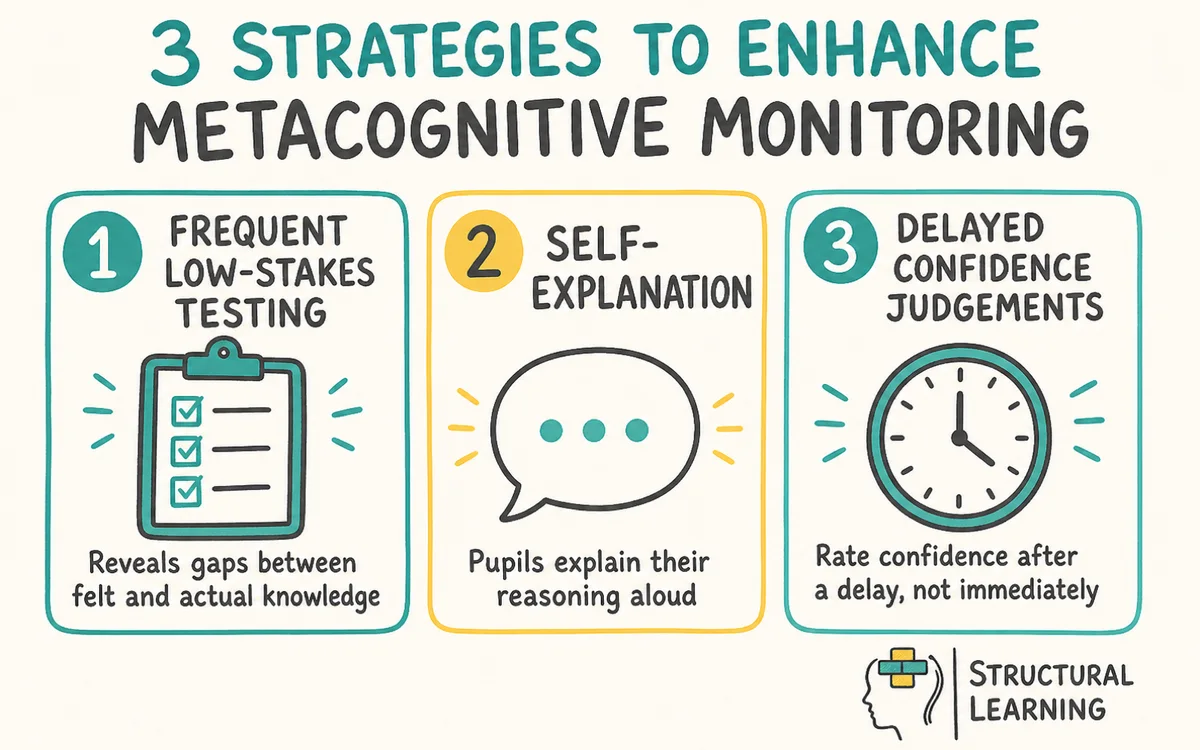
Swap immediate confidence ratings for delayed ones. Instead of asking 'How well do you understand photosynthesis?' straight after the lesson, wait until the next day or the next week. The delay cuts the pull of short-term familiarity on the judgement.
In secondary subjects, use delayed judgements of learning (JOLs) as starter tasks. These are quick checks where learners judge what they still remember after a gap. On Monday, ask learners to rate how well they understand the poetry analysis from last Wednesday. Then compare these ratings with their assessment performance (Dunlosky & Metcalfe, 2009).
Primary teachers can use this in weekly reviews. Every Friday, ask Year 6 learners to rate their confidence on last week's learning objectives. Then set them practice questions on the same objectives.
For each quiz question, learners give an answer and a confidence rating on a 1-5 scale. Mark the answers as normal. Then track calibration by comparing each confidence rating with whether the answer was right.
A well-calibrated Year 10 science learner rates easy questions high (4-5) and gets them right. They rate hard questions low (1-2) and often get them wrong. Poor calibration shows up as high confidence on wrong answers, or low confidence on right ones.
Make simple tracking sheets that show each learner's calibration pattern over time. Share them in private, so learners can see their own metacognitive strengths and weaknesses.
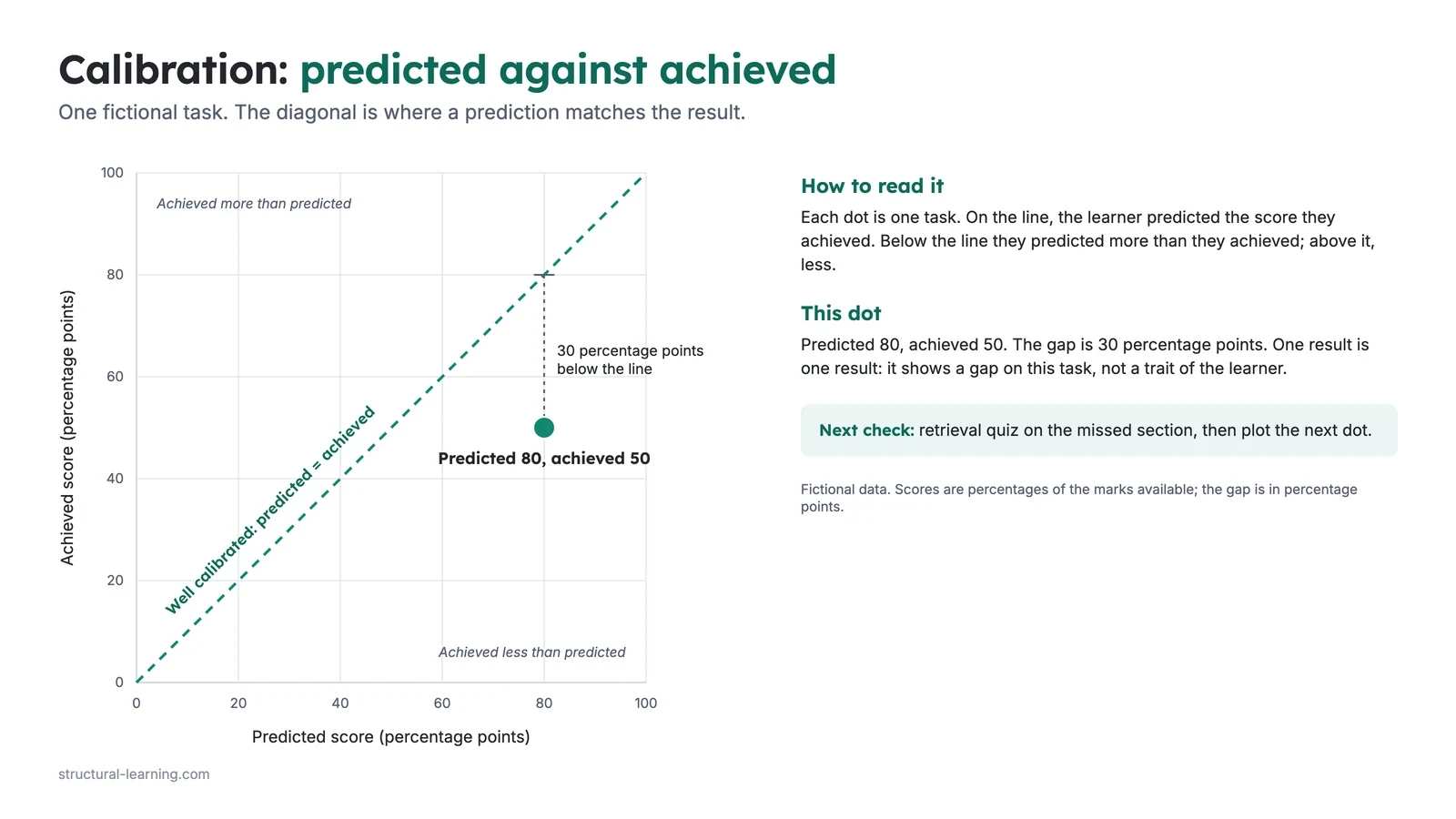
Show the link between confidence and results with a simple graph. Plot predicted scores on the x-axis and actual scores on the y-axis. Perfect calibration is a diagonal line, where every prediction matches the result.
Give learners these graphs each month, so they can see their calibration gains. Secondary learners can draw their own. Primary teachers could put up the class pattern and talk about the overconfidence most children share, as Lichtenstein et al. (1982) and Moore & Healy (2008) describe.
Use a different colour for each subject. That helps learners see whether their calibration changes from one subject to another. Many learners calibrate well in their strong subjects but poorly in their weaker ones.
After any big assessment, use a structured reflection sheet that looks at both the result and how accurate the learner's judgement was. Include questions like: 'Which topics did you expect to do well on? Which were harder than expected? What does this tell you about your revision approach?'
Many teachers find that exam wrappers help learners revise better. Learners may rate their knowledge of a topic too high, as Dunlosky and Rawson (2012) showed. Exam wrappers make that gap visible, and that lets learners change how they study.
For primary, keep it to a single lesson: 'Was today's maths lesson easier or harder than you expected? What made it challenging?'
Pair learners and ask them to predict each other's performance on upcoming assessments. This outside view is often more accurate than self-assessment. It can help learners recognise their own blind spots.
After assessments, pairs compare their predictions with the real results. Ask them what clues they used to predict each score. Then discuss whether a partner can judge performance more accurately than the learner's own self-assessment.
Extend this by having learners explain ideas to a partner before a test. Teaching something shows up gaps that inner monitoring might miss.
Eight routines teachers described on social media.
| Routine, as teachers describe it | What you would notice | What the evidence says |
|---|---|---|
| Reveal, tally, reteach the lowest Display the answers. Learners self-mark in green. Hands up per item. Reteach the one or two with the lowest success rate.
|
A count written next to each question. The reteach is chosen from the data, not from who looks unsure. | Sherrington (2023): green-penning is not teaching unless a practice loop follows. This routine spends the time on the reteach. Not a trial of the tally itself. |
| Thirty-item self-mark tally Thirty multiple-choice items. Learners mark their own. Hands up on each number. The teacher writes how many got each one wrong.
|
A running tally on the board. The photograph and video in the post are not used here. | A whole-class snapshot is the move Wiliam keeps asking for: evidence from everyone, not one volunteer. The EEF metacognition toolkit mean of +8 months is not a trial of a 30-item tally. |
| Boards up after the reveal Reveal the answers. Learners check and tally. Boards up. The teacher scans for problem areas to reteach.
|
Every board visible at once. Short answers only. | Jamie Clark (2 Jul 2026): boards are a snapshot and a participation system. A check that does not change instruction is theatre. Miss Johnston: more than ten words and you cannot scan. |
| Hinge, then 80, 40, or the middle One question. If about 80 percent have it, move on. Under 40, reteach. In the middle, unpick the uncertainty.
|
A hinge slide. A decision, not a colour. The photographed researchED slide is redrawn elsewhere, not republished. | 80 and 40 are a practitioner rule of thumb, not a published cut-off. A geography teacher asked if they were research-backed; the thread did not answer. Clark independently uses about 80 percent as a threshold. No study has tested it. |
| Live feedback, not a green-pen copy Instant live feedback instead of writing the right answer in green in a book.
|
The model is on the board or under a visualiser. The second attempt is watched, not copied. | Sherrington (2023): the weakest go through the motions and add to the list of things they do not know. Barton (2024): correcting is easy and masks the lack of thinking. Both ask for a second attempt on the same idea. |
| Find the error, then fix it Wrong work on task cards. Groups decide if a mistake was made, then correct it and name the common miss. US 6th-grade maths.
|
A “correct it” instruction on the board. The photographed board is redrawn as our own diagram, credited below. | One Texas classroom, not a trial. Closer to monitoring than a thumbs-up, because the learner has to see the error. |
| “Does everyone understand?” objection A nod, a few confident hands, and the lesson moves on. The objection is that this is not a check.
|
The same hands. Others stay invisible. The recommended replacement in the same thread is boards, a hinge, or a short written task. | Wiliam (@dylanwiliam): “self-assessment is both emotionally challenging and cognitively demanding”; start with anonymous peer work. Kruger and Dunning (1999): bottom quartile scored at the 12th percentile and estimated the 62nd. |
| Exit ticket as walkthrough theatre objection A last-three-minutes slip collected for the walkthrough. Serving teachers call it performative. Leaders in the same window still want the data.
@BasedRedWolf |
The ticket exists. Instruction does not change. One 4th-grade reply uses mini-whiteboards instead. | Teachers split on whether exit tickets inform teaching or mainly produce evidence for observers. @HawkeyeHouston: last three minutes are recitation. @thsuburbanmommy: tickets for admin, boards for teaching. @MrCamTeach (principal) waits on the ticket data. Not a trial of tickets. |
Calibration accuracy is quick to check. Simple methods show how well learners understand their own learning, and they help build thinking skills (Winne & Hadwin, 1998). Measuring it helps learners build these skills (Zimmerman, 2000; Dunlosky & Rawson, 2012).
Researchers (Lichtenstein et al., 1982; Kruger & Dunning, 1999) found this helps. Ask learners to predict their score before a quiz (Lichtenstein et al., 1982). Record the predictions and the actual results. From those two numbers you can work out calibration accuracy (Kruger & Dunning, 1999).
Use this basic formula: calibration accuracy = 100 minus the gap between the predicted score and the actual score. For example, a learner predicts 15/20 and scores 13/20. The gap is 2, so calibration accuracy is 98%. Perfect calibration scores 100%, and a very poor prediction lands close to 0%.
For younger learners, keep it simple with traffic light predictions: green (confident), amber (unsure), red (will struggle). After the assessment, check whether the colours matched how they did.
Focus on each learner's pattern, not just the class average. Some learners often rate themselves too high, while others rate themselves too low. Many need structured feedback before their self-assessment gets accurate. Use these patterns to plan the support each learner needs (Butler & Winne, 1995).
Set up a simple way to track how calibration improves over the term. Secondary teachers may find a spreadsheet useful. Primary teachers may prefer a visual display that shows progress for each child or for the class.
Track how accurate each learner is on each assessment. Check whether overconfident learners are getting more realistic. Check too whether anxious, high-achieving learners are gaining confidence. Chart these changes so you can see the gains over time (Butler & Winne, 1995; Hattie & Timperley, 2007).
Subject areas differ for learners. A Year 9 learner may do well in English, but struggle in maths. Target metacognitive teaching based on what learners need most. (Dignath et al., 2008; Dunlosky & Rawson, 2012).
Researchers such as Zimmerman (2000) and Butler and Winne (1995) show regular feedback helps. Share calibration data often. Learners improve when they know their patterns. Some need instruction to fix self-assessment errors (Yan & Brown, 2017).
Try prediction-postdiction cycles for two weeks in one subject. Use regular assessments. Ask learners to predict their results (Metcalfe, 2017). After two weeks, show learners their calibration patterns. Talk about how accurate their self-awareness was (Dunlosky & Rawson, 2012; Kruger & Dunning, 1999).
Calibration accuracy measures how well learners judge their own learning. Perfect calibration means predicted performance matches actual performance. Poor calibration creates large gaps between confidence and competence. This leads to weak learning choices (Bjork, 1999; Kruger & Dunning, 1999).
Why learners overestimate their knowledge
Learners can confuse familiarity with real understanding. Material may seem easy after reading, but this does not guarantee later recall (Bjork, 1999). Learners often struggle to judge their knowledge because explicit self-assessment guidance is rare (Dunlosky & Rawson, 2012).
Researchers found that prediction tasks improved learning (Dunlosky & Rawson, 2012). Learners predict their scores before tests. Compare predictions to results (Hacker et al., 2000) to check accuracy. Confidence ratings offer more data (Metcalfe, 1998; Nelson, 1984).
Calibration means judging learning accurately. It often improves with age and expertise, but many adults still struggle. Clear teaching in self-assessment helps learners of any age. Metacognitive training improves calibration more than natural development (Bjork, 1999; Kruger & Dunning, 1999).
Accurate learner judgement helps learners choose better revision tasks and strategies. This can improve their outcomes. Try prediction-postdiction cycles in your next unit. Learners can build self-awareness and change how they learn.
For more metacognition tips, read about retrieval practice and spaced learning. (Bjork et al., 2013; Dunlosky & Rawson, 2012)
Monitoring is the judgement: how well do I know this? Control is the decision that follows: stop, reread, self-test or ask for help. Nelson and Narens (1990) describe the two as a loop, with monitoring passing information up and control sending instructions down.
A learner who rates a topic amber and then chooses a retrieval quiz on it rather than rereading is running the whole loop. Most calibration work targets monitoring, because a control decision built on a false judgement is wasted effort.
A score predicted before a test and compared with the result afterwards. A red, amber or green rating against each success criterion. A judgement of learning made the day after a lesson rather than straight after it. A show of hands per question so the whole class sees which items were missed most.
Each is a judgement about knowing. Each becomes useful only when it is checked against a real performance and the learner acts on the difference.
Yes, within a subject and with repetition. Prediction-postdiction cycles, delayed judgements of learning and confidence-weighted quizzing all improve calibration when a class runs them across a term rather than once. Dunlosky and Rawson (2012) found gains from simple routines of this kind.
The gains do not transfer well between subjects, so a learner trained in maths still needs the routine in history. The EEF guidance makes the same point: teach the strategy on specific content, not as a stand-alone lesson.
Digital dashboards show learners' confidence patterns as they happen. AI checks how well learners predict their own performance (Nelson, 1984; Dunlosky & Metcalfe, 2009). The system can quickly flag learners who think they understand more than they do.
Adaptive questions can put performance data and confidence data side by side. That can flag learners who may need metacognitive support. Azevedo and Gašević (2019) discuss how learning analytics can help spot these patterns. Treat the data as a signal to check further, not as a diagnosis on its own.
Treat an AI-generated dashboard as a prompt for you to look further, not as evidence on its own. Live feedback can make calibration visible. But you still need to check what the system is measuring: confidence, performance or both. And you need to check whether the next step it suggests fits the learner in front of you.
Teachers get the best from these tools when they know what the tools can and cannot do. Technology is good at spotting patterns and gathering data. It cannot replace a teacher's grasp of what motivates a learner (Laurillard, 2002) or of their background (Mercer & Littleton, 2007).
The Dunning-Kruger effect happens when learners who know less rate their ability too high (Kruger & Dunning, 1999). They do not yet see the gaps in their knowledge. More able learners can see how complex the subject is (Kruger & Dunning, 2002), so they may doubt how ready they are.
This effect can create a risky cycle in your classroom. Learners who need the most support may not ask for it because they think they have already mastered the material. Kruger and Dunning (1999) found that people in the bottom quartile on tests of logic, grammar, and humour greatly overestimated their performance and placed themselves above average. In school, this can mean learners skip important revision, ignore feedback, and choose tasks far beyond their current abilities.
Tackle this overconfidence by adding regular reality checks to your lessons. Start each topic with a diagnostic quiz, and ask learners to predict their scores before you show the results. This quick comparison helps calibrate their self-assessment, so their confidence fits the evidence. In revision and group work, ask learners to rate confidence, test the same points, and justify peer assessment with evidence from the task.
Worked examples make thinking visible. Learners show how they solve a problem, out loud or in writing. That shows the gaps in understanding to you and to them. Metacognition swaps false confidence for accurate self-knowledge (Bjork et al., 2013).
Learners then know when they truly understand the content.
Dunlosky and Rawson (2012) found quick calibration gains through simple techniques. These strategies make learners test their knowledge, not just review it. Testing reveals gaps missed during passive learning.
Start with prediction exercises before any assessment. Ask learners to estimate their score out of ten for each topic area, then compare these predictions with actual results. This creates immediate feedback loops that highlight overconfidence. For instance, a Year 9 maths class might predict their algebra score before a quiz; those who predicted 8/10 but scored 4/10 quickly learn they need more practise with factorising.
Run regular retrieval practice using the 'delayed judgement of learning' technique. After teaching new content, wait 24 hours before you ask learners to rate their understanding on a scale. The delay stops the illusion of knowing that comes from facts still sitting in working memory. A history teacher might teach the causes of World War One on Monday. On Tuesday, they ask learners to rate how confident they are that they could explain each cause without notes.
Ask learners to use journals to record predicted and actual results. This helps them spot patterns in misjudgements over time (Bjork et al., 2013).
For example, learners in geography might rate themselves too high on maps and too low on essays. Comparing predictions with results, again and again, turns vague feelings into useful data (Dunlosky & Rawson, 2012).
Five classrooms below show what teachers did with the results, described on social media. Two counted misses and retaught the worst items. One watched a green-pen copy improve the book and not the idea. One gave one feedback slide; one named error types at cards.
Five classroom examples show learners checking answers, spotting errors and deciding what to correct next.
1 · process
1 · Display the correct answers on the board
2 · Students correct in green pen
3 · Show of hands to obtain success rate for each question
4 · Select the 1-2 with the lowest success rate
The green pen is not the lesson. The lesson is the count, then the reteach of the items the class actually failed.
2 · process
1 · 30 multiple choice questions
2 · Students mark their own
3 · Hands up when I say each question number
4 · Write down how many got each one wrong
The teacher faces the class with a list of numbers, not a stamp. The artefact is the tally, then the items that stacked.
@XpatEducator linked Jamie Clark’s Mini-Whiteboards Revisited: a board show with no instructional change is theatre.
3 · cause and effect
The stall · The weakest copy Ag = Silver into green ink. The book looked improved. The idea did not.
What unstuck it · Give out the answers, then spend the time reteaching and practising, rather than on the copy.
Sherrington sat at the back and watched the weakest copy Ag = Silver into green ink. Give out the answers, then spend the time reteaching and practising.
The 2023 essay is at teacherhead.com; Barton’s 2024 maths version is Correcting in green pen does not work.
4 · process
1 · Note general feedback
2 · List key spellings regardless of if they had issues or not
3 · Summative knowledge extension questions
One slide, not 30 individual comments. Everyone copies the same three moves. The photographs in the post are not used.
5 · process
1 · If the card is incorrect, correct it
2 · Identifying common mistakes
3 · Name the error type. Not the first test as an answer key.
Groups stand at cards, not a thumbs-up. See the error, name it, write the fix. A second attempt that uses the first test as an answer key is not this.
Calibration accuracy measures how well a learner's confidence matches their actual performance. For example, a well-calibrated learner who gives themselves 7 out of 10 on a topic would score about 70% on a test of it. Hacker, Bol and Keener (2008) found that most learners are poorly calibrated. The lowest performers were the most overconfident.
Improving calibration helps learners make better choices about what to study. It also helps them decide when they have studied enough.
Learners think they know more than they do. The Dunning-Kruger effect (Kruger & Dunning, 1999) shows that limited skill gets in the way of self-awareness. Rereading notes gives a false sense of knowing. Recognising content feels easier than recalling it from memory (Karpicke & Roediger, 2008). Passive revision lifts confidence without real learning (Brown, Roediger & McDaniel, 2014).
Teachers can measure metacognitive monitoring by setting predictions beside results. Before a test, ask learners to predict their score. Then compare those predictions with what they got.
Judgement of learning (JOL) tasks ask learners to rate their confidence on each item before they answer. Traffic light self-assessment, where learners mark their understanding red, amber or green, gives quick data once you set it beside actual results. Track calibration over time to show learners that their monitoring is getting better.
Use the questions below to decide whether a check changes teaching, helps learners correct an error or merely records completion.
question
“Quizzing must reveal wrong answers leading to reteaching. Green penning isn’t teaching. Design RP for high success rate.”
What the replies and the evidence say. The 4 September post recirculates his 2023 Teacherhead essay: the weakest copy the right answer and add to the list of things they do not know. Barton (2024) is the maths version: correcting is easy and masks the lack of thinking. The replies did not defend the copy. The replacement they both name is a second attempt on the same idea, then a reteach of the items the class actually missed.
question
“Asking “Does everyone understand?” tells us almost nothing. The pupils who are confident may nod. The same hands may go up. Others remain invisible.”
What the replies and the evidence say. The next post in the same thread names the replacement: mini-whiteboards, a hinge, choral response, or a short written task, because depth from one learner is not evidence from the class. Wiliam (@dylanwiliam): “self-assessment is both emotionally challenging and cognitively demanding,” so start with anonymous peer work. Kruger and Dunning (1999) is the mechanism: the least skilled are the least able to see it.
question
“Teachers already know which students understand the material by walking the room, having conversations, and observing student work. Exit tickets often feel performative.”
What the replies and the evidence say. Teachers split on whether exit tickets inform the next teaching move or mainly serve observers. @HawkeyeHouston: the last three minutes are recitation. @thsuburbanmommy (4th grade): she does not adjust from tickets and only uses them for admin; she uses mini-whiteboards instead. @MrCamTeach, a principal in the same window, still waits on the ticket data. If the ticket does not change the next five minutes, it is the walkthrough artefact, not the check.
question
“If a student scores a 40% on a test, then gets a second attempt using the first test as an answer key and earns 100%, this is not only disengenuous to parents but also unhelpful for teachers.”
What the replies and the evidence say. This is a grade-recovery fight, not a monitoring routine. Fairfax County, as of July 2024, allowed retakes for full credit (Washington Post, 1 Jul 2024). The later policy, in force in 2025, caps a summative retake at 90 percent (FCPS Katherine Johnson MS bulletin, 29 Oct 2025). Loudoun County, 2025, capped the retake at 70 percent (Loudoun Now, 11 Apr 2025). @MosleySSCC still posts corrections plus reteach as gap-closing. Split the artefact: name the error type, or it is copying the key.
question
“currently we have over use of AI generated hinge questions. Teachers need to ask is this retrieval, assessment or a tick box because of SLT initiatives?”
What the replies and the evidence say. The thread did not produce a defence of the generated hinge. Helen Reynolds’s 80/40 rule only works if each wrong option names a different miss. If the teacher cannot say what A, B and C mean, the hinge is the tick-box she is naming. Keep the decision; bin the option set you did not write.
Metacognitive monitoring is useful, but it is not a simple cure for overconfidence. First, accuracy depends on the subject. A learner who judges their understanding well in GCSE Maths may still misjudge an essay plan in A Level History. Each subject has its own cues for quality, evidence and error. That limits what a generic whole-school checklist or a one-off assembly can do.
Second, some overconfidence may be useful. Taylor and Brown (1988) argued that mild positive illusions can help learners stay motivated, keep going, and recover after failure. Bandura (1997) also showed that self-efficacy shapes whether learners take on demanding tasks. The aim is not to strip out confidence. It is to tie confidence to evidence from recall, explanation and worked examples.
Third, the measurement itself is contested. Judgements of Learning can change the learning they measure, so a monitoring task is not always a neutral measure. Double, Birney and Walker (2018) showed that asking learners to judge their learning can change how well they remember later. That matters when teachers use confidence ratings both to assess and to intervene.
Finally, calibration metrics can carry cultural and neurotypical assumptions. Learners with ADHD, autism, anxiety or language differences may monitor themselves unevenly. That can come from demands on executive function, working memory or communication, not from arrogance or a lack of effort. Even with these limits, metacognitive monitoring is still worth doing. Use it with care, subject by subject, and set confidence beside evidence of what learners can actually do.
Try one prediction in your next lesson. Before a short quiz, ask every learner to write a score out of ten on the corner of the page. Mark, then have them write the real score beside it. Ask the class who was more than two points out, and in which direction. That single comparison is the start of calibration, and it costs three minutes.
Azevedo, R. and Gašević, D. (2019). Analyzing multimodal multichannel data about self-regulated learning with advanced learning technologies: Issues and challenges. Computers in Human Behavior, 96, 207 to 210.
Bandura, A. (1997). Self-Efficacy: The Exercise of Control. W. H. Freeman. ISBN 9780716728504.
Barton, C. (2024). Correcting in green pen does not work. Tips for Teachers, 14 November 2024.
Bjork, R. A. (1994). Memory and metamemory considerations in the training of human beings. In J. Metcalfe and A. P. Shimamura (eds), Metacognition: Knowing About Knowing (pp. 185 to 205). MIT Press.
Bjork, R. A. (1999). Assessing our own competence: Heuristics and illusions. In D. Gopher and A. Koriat (eds), Attention and Performance XVII: Cognitive Regulation of Performance: Interaction of Theory and Application (pp. 435 to 459). MIT Press.
Bjork, R. A., Dunlosky, J. and Kornell, N. (2013). Self-regulated learning: Beliefs, techniques, and illusions. Annual Review of Psychology, 64, 417 to 444.
Brown, P. C., Roediger, H. L. and McDaniel, M. A. (2014). Make It Stick: The Science of Successful Learning. Belknap Press of Harvard University Press.
Butler, D. L. and Winne, P. H. (1995). Feedback and self-regulated learning: A theoretical synthesis. Review of Educational Research, 65(3), 245 to 281.
Chi, M. T. H. (2000). Self-explaining expository texts: The dual processes of generating inferences and repairing mental models. In R. Glaser (ed.), Advances in Instructional Psychology (Vol. 5, pp. 161 to 238). Lawrence Erlbaum.
Dignath, C., Buettner, G. and Langfeldt, H.-P. (2008). How can primary school students learn self-regulated learning strategies most effectively? A meta-analysis on self-regulation training programmes. Educational Research Review, 3(2), 101 to 129.
Double, K. S., Birney, D. P. and Walker, S. A. (2018). A meta-analysis and systematic review of reactivity to judgements of learning. Memory, 26(6), 741 to 750.
Dunlosky, J. and Bjork, R. A. (eds) (2008). Handbook of Metamemory and Memory. Psychology Press.
Dunlosky, J. and Metcalfe, J. (2009). Metacognition. SAGE.
Dunlosky, J. and Rawson, K. A. (2012). Overconfidence produces underachievement: Inaccurate self evaluations undermine students' learning and retention. Learning and Instruction, 22(4), 271 to 280.
Dunlosky, J. and Rawson, K. A. (2015). Do students use testing and feedback while learning? A focus on key concept definitions and learning to criterion. Learning and Instruction, 39, 32 to 44.
Dunlosky, J., Rawson, K. A., Marsh, E. J., Nathan, M. J. and Willingham, D. T. (2013). Improving students' learning with effective learning techniques: Promising directions from cognitive and educational psychology. Psychological Science in the Public Interest, 14(1), 4 to 58.
Dunning, D. (2011). The Dunning-Kruger effect: On being ignorant of one's own ignorance. Advances in Experimental Social Psychology, 44, 247 to 296.
Education Endowment Foundation (2025). Metacognition and self-regulation. Teaching and Learning Toolkit. Education Endowment Foundation.
Flavell, J. H. (1979). Metacognition and cognitive monitoring: A new area of cognitive-developmental inquiry. American Psychologist, 34(10), 906 to 911.
Gross, M. U. M. (2002). Social and emotional issues for exceptionally intellectually gifted students. In M. Neihart, S. M. Reis, N. M. Robinson and S. M. Moon (eds), The Social and Emotional Development of Gifted Children: What Do We Know? (pp. 19 to 29). Prufrock Press.
Hacker, D. J., Bol, L. and Keener, M. C. (2008). Metacognition in education: A focus on calibration. In J. Dunlosky and R. A. Bjork (eds), Handbook of Metamemory and Memory (pp. 429 to 455). Psychology Press.
Hacker, D. J., Bol, L., Horgan, D. D. and Rakow, E. A. (2000). Test prediction and performance in a classroom context. Journal of Educational Psychology, 92(1), 160 to 170.
Hattie, J. (2012). Visible Learning for Teachers: Maximizing Impact on Learning. Routledge.
Hattie, J. and Timperley, H. (2007). The power of feedback. Review of Educational Research, 77(1), 81 to 112.
Hattie, J. and Yates, G. C. R. (2014). Visible Learning and the Science of How We Learn. Routledge.
Karpicke, J. D. and Roediger, H. L. (2008). The critical importance of retrieval for learning. Science, 319(5865), 966 to 968.
Koriat, A., Lichtenstein, S. and Fischhoff, B. (1980). Reasons for confidence. Journal of Experimental Psychology: Human Learning and Memory, 6(2), 107 to 118.
Kornell, N. and Bjork, R. A. (2008). Optimising self-regulated study: The benefits and costs of dropping flashcards. Memory, 16(2), 125 to 136.
Kruger, J. and Dunning, D. (1999). Unskilled and unaware of it: How difficulties in recognizing one's own incompetence lead to inflated self-assessments. Journal of Personality and Social Psychology, 77(6), 1121 to 1134.
Kruger, J. and Dunning, D. (2002). Unskilled and unaware, but why? A reply to Krueger and Mueller (2002). Journal of Personality and Social Psychology, 82(2), 189 to 192.
Laurillard, D. (2002). Rethinking University Teaching: A Conversational Framework for the Effective Use of Learning Technologies (2nd edition). RoutledgeFalmer.
Lichtenstein, S., Fischhoff, B. and Phillips, L. D. (1982). Calibration of probabilities: The state of the art to 1980. In D. Kahneman, P. Slovic and A. Tversky (eds), Judgment under Uncertainty: Heuristics and Biases (pp. 306 to 334). Cambridge University Press.
Mercer, N. and Littleton, K. (2007). Dialogue and the Development of Children's Thinking: A Sociocultural Approach. Routledge.
Metcalfe, J. (1998). Cognitive optimism: Self-deception or memory-based processing heuristics? Personality and Social Psychology Review, 2(2), 100 to 110.
Metcalfe, J. (2009). Metacognitive judgments and control of study. Current Directions in Psychological Science, 18(3), 159 to 163.
Metcalfe, J. (2017). Learning from errors. Annual Review of Psychology, 68, 465 to 489.
Metcalfe, J. and Finn, B. (2008). Evidence that judgments of learning are causally related to study choice. Psychonomic Bulletin and Review, 15(1), 174 to 179.
Moore, D. A. and Healy, P. J. (2008). The trouble with overconfidence. Psychological Review, 115(2), 502 to 517.
Nelson, T. O. (1984). A comparison of current measures of the accuracy of feeling-of-knowing predictions. Psychological Bulletin, 95(1), 109 to 133.
Nelson, T. O. and Dunlosky, J. (1991). When people's judgments of learning (JOLs) are extremely accurate at predicting subsequent recall: The "delayed-JOL effect". Psychological Science, 2(4), 267 to 271.
Nelson, T. O. and Narens, L. (1990). Metamemory: A theoretical framework and new findings. Psychology of Learning and Motivation, 26, 125 to 173.
Rhodes, M. G. and Tauber, S. K. (2011). The influence of delaying judgments of learning on metacognitive accuracy: A meta-analytic review. Psychological Bulletin, 137(1), 131 to 148.
Roediger, H. L. and Karpicke, J. D. (2006). Test-enhanced learning: Taking memory tests improves long-term retention. Psychological Science, 17(3), 249 to 255.
Sherrington, T. (2023). The view from the back: the trouble with green-penning corrections. teacherhead, 27 June 2023.
Sweller, J. (1988). Cognitive load during problem solving: Effects on learning. Cognitive Science, 12(2), 257 to 285.
Taylor, S. E. and Brown, J. D. (1988). Illusion and well-being: A social psychological perspective on mental health. Psychological Bulletin, 103(2), 193 to 210.
Weinstein, Y., Madan, C. R. and Sumeracki, M. A. (2018). Teaching the science of learning. Cognitive Research: Principles and Implications, 3, 2.
Wiliam, D. (2011). Embedded Formative Assessment. Solution Tree Press.
Winne, P. H. and Hadwin, A. F. (1998). Studying as self-regulated learning. In D. J. Hacker, J. Dunlosky and A. C. Graesser (eds), Metacognition in Educational Theory and Practice (pp. 277 to 304). Lawrence Erlbaum.
Yan, Z. and Brown, G. T. L. (2017). A cyclical self-assessment process: towards a model of how students engage in self-assessment. Assessment and Evaluation in Higher Education, 42(8), 1247 to 1262.
Zimmerman, B. J. (2000). Attaining self-regulation: A social cognitive perspective. In M. Boekaerts, P. R. Pintrich and M. Zeidner (eds), Handbook of Self-Regulation (pp. 13 to 39). Academic Press.