Retrieval Grids: A Teacher's GuideRetrieval Grids: A Teacher's Guide - educational concept illustration

Updated on  

March 3, 2026

Retrieval Grids: A Teacher's Guide

|

March 2, 2026

A retrieval grid is a structured table where students recall previously taught knowledge by answering questions organised by topic and difficulty.

A retrieval grid is a structured table where students recall previously taught knowledge by answering questions organised by topic and difficulty. The grid format makes students retrieve information from memory rather than recognise it from options. This makes it much more effective than re-reading notes or highlighting textbooks.

Key Takeaways

  1. Beat Quiz Fatigue Forever: Retrieval grids combine three evidence-based learning strategies in one reusable tool, making daily knowledge practise engaging and effortless.
  2. Five Minutes, Maximum Impact: This structured approach delivers powerful memory strengthening in just five minutes, perfect for lesson starters that actually stick.
  3. Automatic Differentiation Built In: Difficulty columns mean every student can access the grid while challenge seekers tackle synthesis questions in the same activity.
  4. Why Your Brain Dumps Fail: Discover why structured retrieval grids create lasting learning while popular alternatives like brain dumps waste precious classroom time.

The approach is grounded in the testing effect (Roediger and Karpicke, 2006), which demonstrates that actively recalling information strengthens long-term memory far more than passive review. Retrieval practise has become one of the most evidence-supported strategies in education, and retrieval grids give teachers a practical, repeatable structure for implementing it daily.

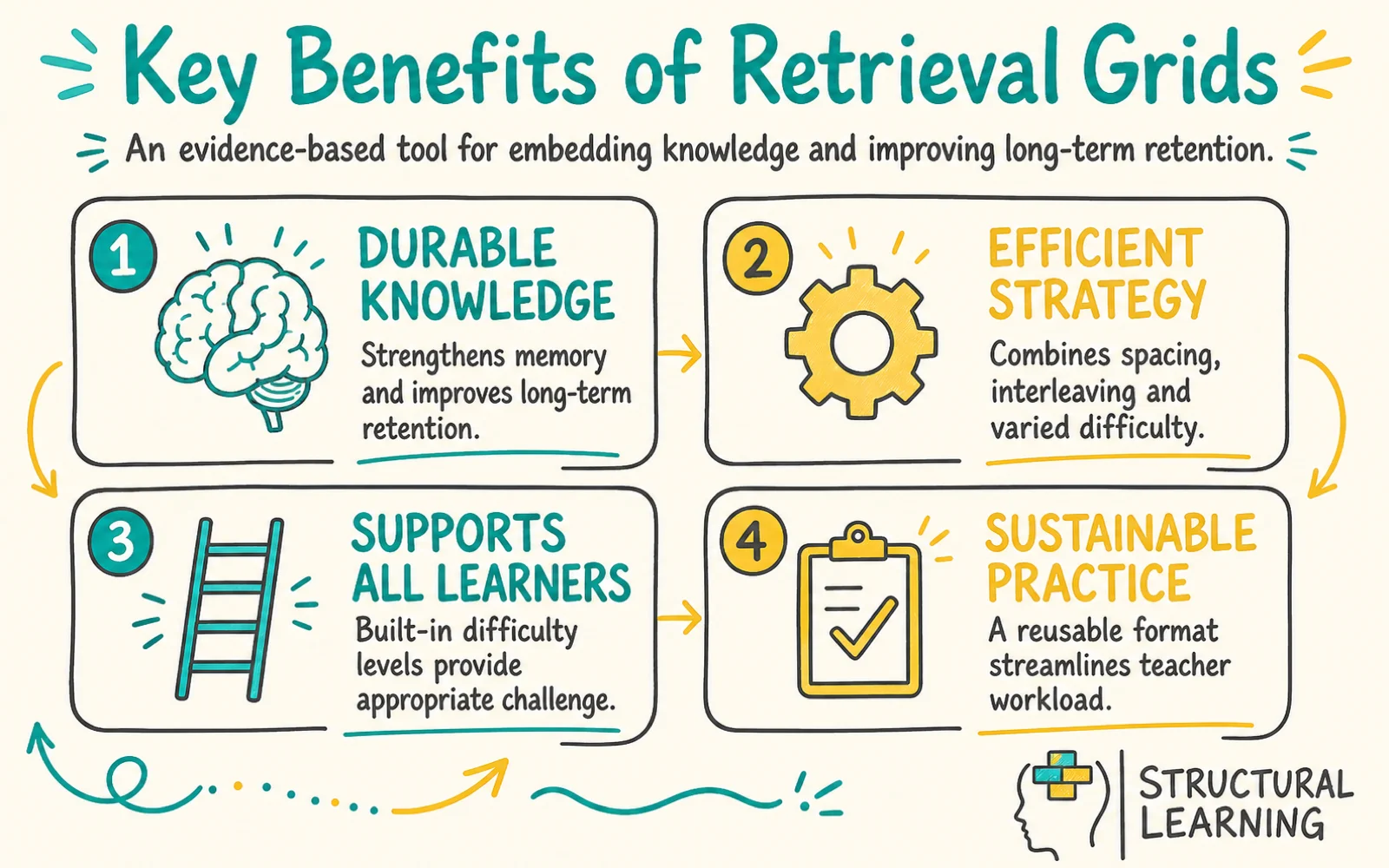
Retrieval Grids vs Other Retrieval Techniques infographic for teachers
Retrieval Grids vs Other Retrieval Techniques

Why Retrieval Grids Work

Cognitive Science Behind Retrieval Practise

When students attempt to retrieve information, they activate and strengthen the neural pathways associated with that knowledge. This is fundamentally different from re-reading, which creates a feeling of familiarity without genuine recall. Bjork and Bjork (2011) call this "desirable difficulty": the effort of retrieval is precisely what makes it effective.

Pyramid infographic showing the three levels of retrieval grid question difficulty, from top to bottom: Apply & Analyze, Understand & Explain, and Remember & Recall, aligned with Bloom's Taxonomy.
Retrieval Grid Difficulty

Cognitive load theory explains why the grid format helps. By organising questions into rows (topics) and columns (difficulty levels), students can manage their working memory more effectively. They know where they are in the grid and can see their progress, which reduces extraneous load and focuses effort on the retrieval itself.

The grid also supports spaced practise. Teachers design grids that include questions from last lesson, last week, and last month. This spacing effect, first identified by Ebbinghaus (1885), means students retrieve knowledge at increasing intervals, which dramatically improves retention.

Compared to Other Retrieval Techniques

| Technique | Preparation Time | Differentiation | Spacing Built In | Student Independence |

|-----------|-----------------|----------------|-----------------|---------------------|

| Retrieval Grid | Medium (reusable templates) | Strong (difficulty columns) | Yes (rows span time periods) | High |

| Quiz | Low-Medium | Limited | Depends on design | Medium |

| Flashcards | Low | Limited without sorting | Possible with Leitner system | High |

| Brain Dump | None | None | No | High but unfocused |

| Exit Tickets | Low | Limited | No (single lesson focus) | Medium |
| Low-Stakes Test | Medium | Limited | Depends on design | Low |

Retrieval grids stand out because they combine three evidence-based principles in one tool: retrieval practise, spaced practise, and interleaving (mixing topics within a single activity).

How to Design a Retrieval Grid

The Basic Structure

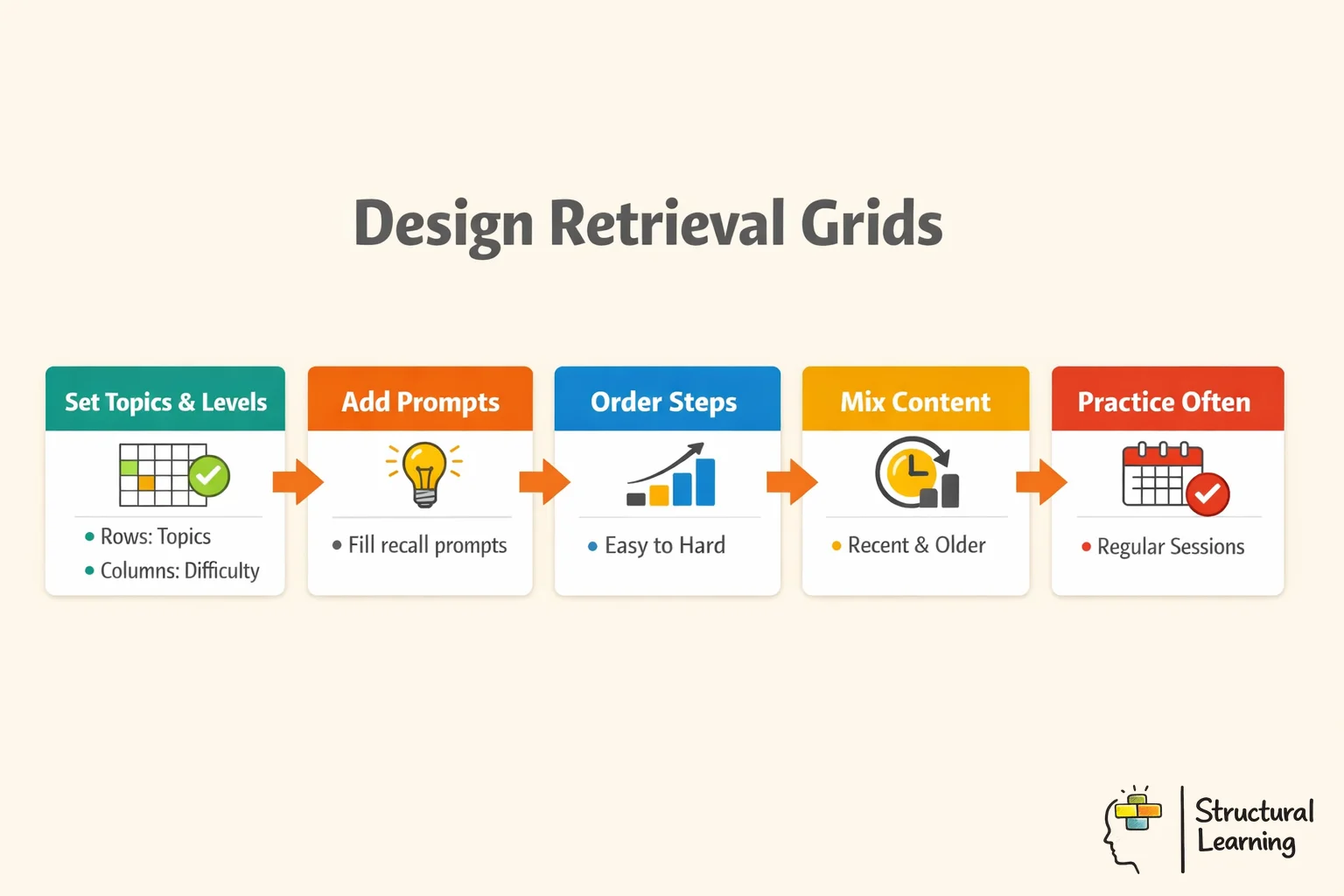
A standard retrieval grid has:

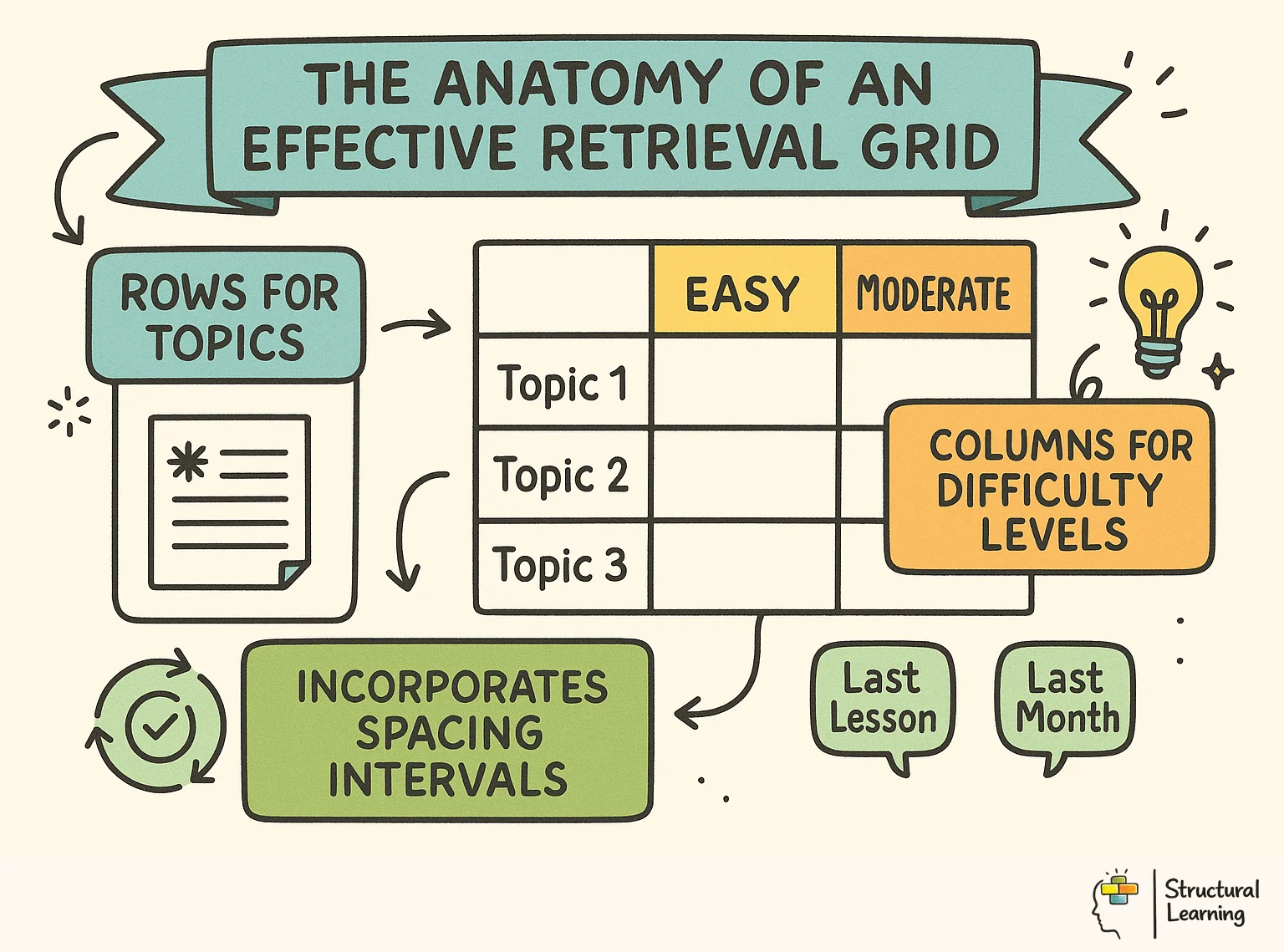
  • Rows representing topics or time periods (e.g., last lesson, last week, last term)
  • Columns representing difficulty levels (e.g., 1 point, 2 points, 3 points)
  • Cells containing questions that require free recall, not recognition

A Year 8 History grid on the Industrial Revolution might look like this:

| Topic | 1 Point (Recall) | 2 Points (Explain) | 3 Points (Apply) |

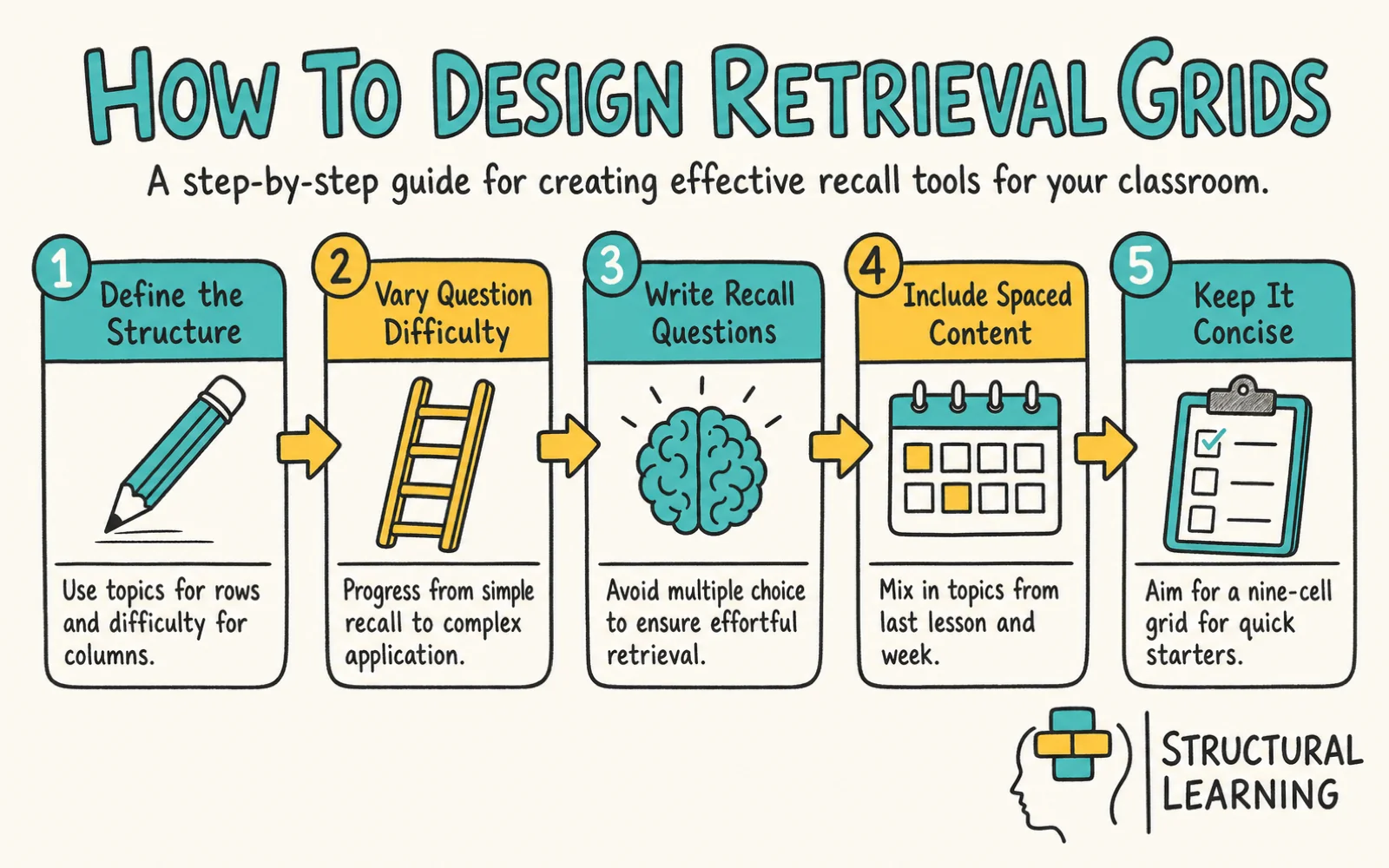
Step-by-step infographic showing how teachers can design effective retrieval grids for student memory practise
Design Retrieval Grids

|-------|------------------|-------------------|------------------|

| Last Lesson: Working Conditions | Name two dangerous jobs in factories | Why did factory owners resist safety regulations? | How might a factory worker in 1830 describe their typical day? |

| Last Week: Transport | What was the Spinning Jenny? | Explain how canals changed trade in Britain | Compare the impact of canals and railways on industry |

| Last Term: Agricultural Revolution | Name the four-crop rotation system | Why did enclosure acts lead to urbanisation? | What links can you find between farming changes and factory growth? |

Difficulty Progression

The columns should align with Bloom's Taxonomy:
  • Column 1 (1 point): Remember and recall. "What is...?" "Name..." "When did...?"
  • Column 2 (2 points): Understand and explain. "Why did...?" "Explain how..." "What was the effect of...?"
  • Column 3 (3 points): Apply and analyse. "Compare..." "What would happen if...?" "How does X connect to Y?"

This built-in differentiation means every student can access the grid. Students who find recall difficult start with Column 1 and build confidence. Students ready for challenge move to Column 3 where they must synthesise and evaluate.

Design Principles

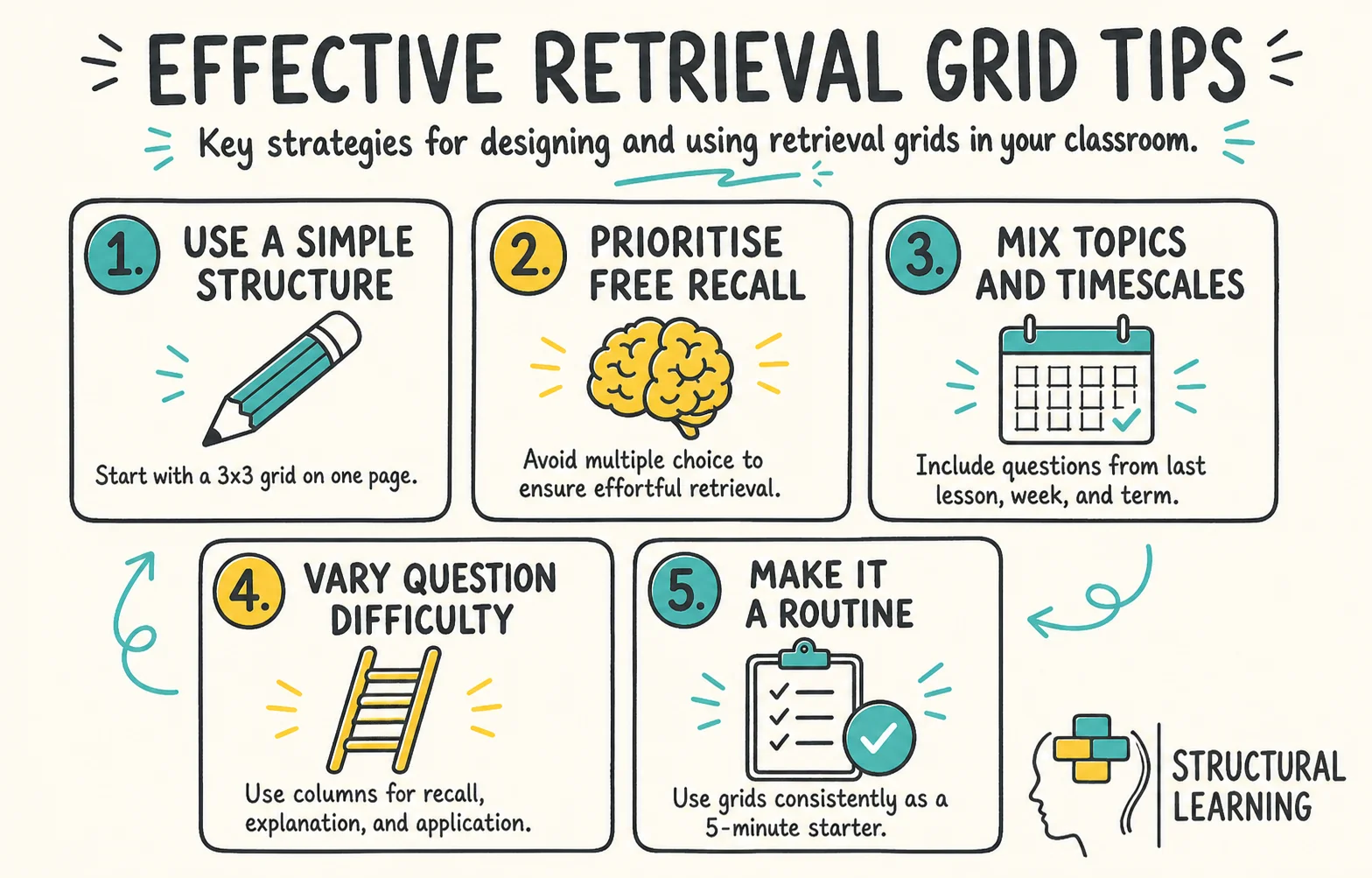
Keep it to one page. A retrieval grid should take 5-10 minutes at the start of a lesson. If it takes longer, the grid is too large. Nine cells (3x3) is the standard starting point. Some teachers expand to 4x4 for GCSE and A-Level groups.

Use free recall, not multiple choice. The whole point is effortful retrieval. Multiple choice allows recognition, which is cognitively easier but less effective for long-term retention. Students write their answers, then check against the correct responses.

Include content from multiple time periods. This is what makes retrieval grids superior to a standard starter quiz. By mixing last lesson, last week, and last month, you build spaced practise into the routine without any additional planning.

Make it reusable. Create grid templates for each unit. Change the questions each time you use it, but keep the structure consistent. Students learn the format quickly and can focus entirely on retrieval rather than understanding the task.

Classroom Implementation and effective methods

Routine and Timing

The most effective implementation is a consistent daily or weekly routine. A Year 10 Science teacher might use a retrieval grid every Monday as a "retrieval Monday" starter. The routine matters as much as the content: students arrive knowing they will retrieve, which primes their memory before new learning begins.

Five-minute protocol:
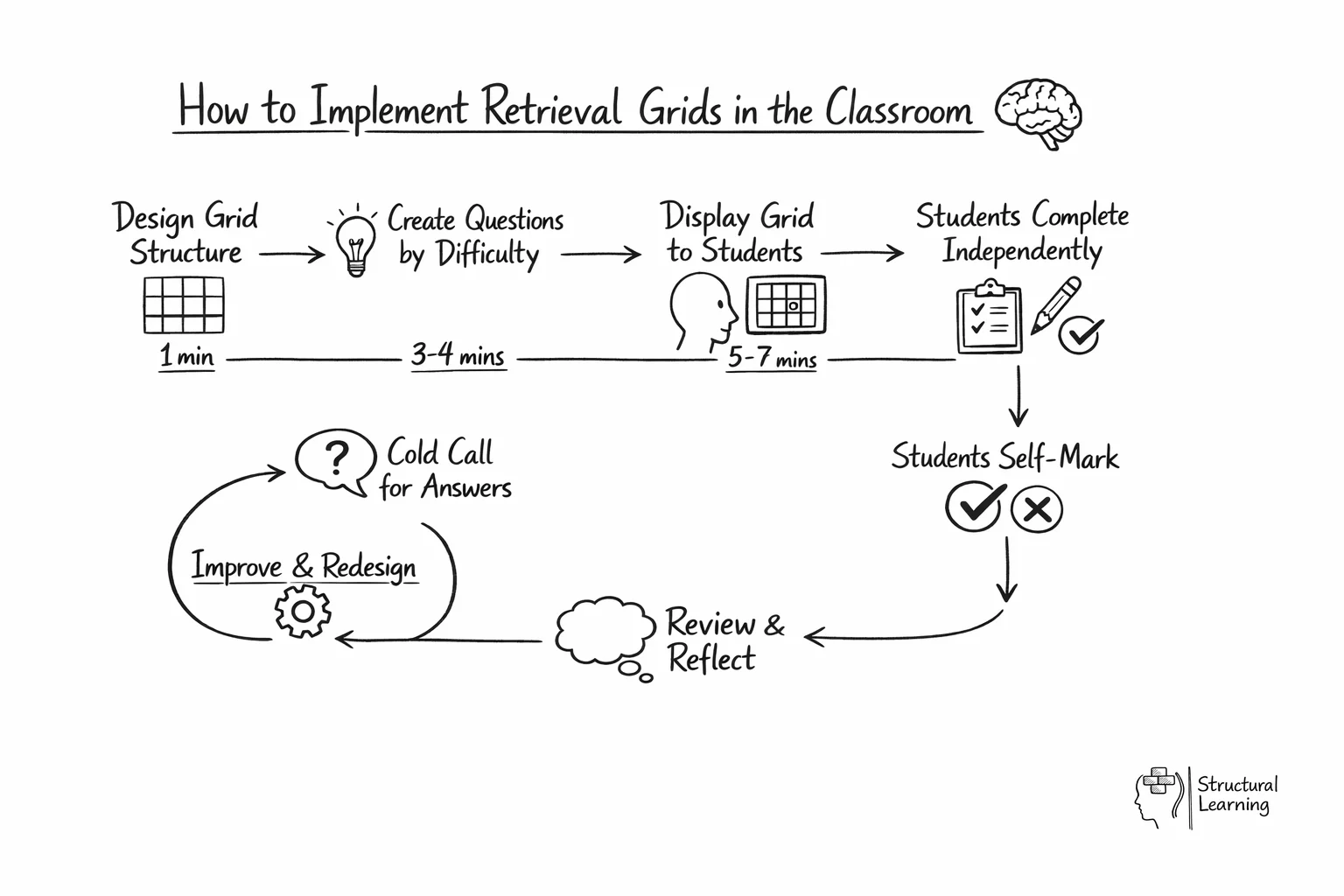
  • Grid displayed on board or distributed on paper (1 minute)
  • Students complete independently in silence (3-4 minutes)
  • Teacher cold calls for answers, students self-mark (1-2 minutes)
  • Pairing retrieval grids with cold calling (naming students to share answers) maximises the benefit. Instead of just one student retrieving aloud, the whole class retrieves silently, then selected students articulate their thinking. This connects directly to formative assessment: the teacher hears what students can and cannot recall.

    Self-Assessment with Retrieval Grids

    After completing the grid, students mark their own work using a colour coding system:

    • Green: Correct, recalled confidently
    • Amber: Partially correct or recalled with hesitation
    • Red: Could not recall

    This traffic-light approach develops metacognitive awareness. Students begin to see patterns in their own knowledge: 'I always forget the dates but remember the causes.' This self-knowledge is the foundation of effective independent study.

    The Structural Learning Thinking Framework supports this process through its colour-coded thinking skills. The green "Extract" cards map directly onto retrieval, helping students understand that recall is a specific cognitive action, not just "remembering stuff." When students use the green Extract skill during retrieval grids, they develop awareness of retrieval as a deliberate thinking strategy.

    Differentiation Strategies

    For students who find recall difficult:

    • Provide word banks alongside the grid (not answers, but vocabulary prompts)
    • Allow students to attempt Column 1 only, then discuss Columns 2-3 as a class
    • Use graphic organisers alongside the grid so students can visualise connections

    For high-attaining students:

    • Add a "Column 4" with synthesis questions: "Write a question that connects two rows"
    • Ask them to create retrieval grid questions for their peers
    • Challenge them to complete the grid from memory, then check their textbook and identify gaps

    For SEND students:

    • Provide the grid with some cells pre-filled as worked examples
    • Use visual retrieval grids (images, diagrams, or symbols instead of written questions)
    • Allow verbal responses for students who find writing under time pressure difficult

    The Anatomy of an Effective Retrieval Grid infographic for teachers
    The Anatomy of an Effective Retrieval Grid

    Subject-Specific Applications and Examples

    Science and Biology Applications

    A Year 11 Biology teacher creates a grid covering the circulatory system unit:

    | Period | Recall | Explain | Connect |

    |--------|--------|---------|---------|

    | Today's Lesson: Blood Vessels | Name three types of blood vessel | Why do arteries have thick walls? | How does the structure of capillaries relate to their function? |

    | Last Week: Heart | Label the four chambers | Explain the double circulatory system | Why might someone with a hole in the heart have less energy? |

    | Last Half Term: Cells | What is a red blood cell? | Why do red blood cells not have a nucleus? | How does the structure of a red blood cell connect to oxygen transport? |

    The "Connect" column pushes students to think across topics, building the kind of linked knowledge that schema theory describes.

    English and Literature Strategies

    A Year 9 English teacher uses retrieval grids for "An Inspector Calls":

    | Period | Who/What | Why It Matters | What It Means |
    |--------|----------|---------------|---------------|

    | Last Lesson | Name three things Inspector Goole says to Mr Birling | Why does Priestley use dramatic irony in Act 1? | How does Birling's speech about the Titanic affect the audience? |

    | Last Week | What is Eva Smith's timeline? | Why does Priestley present events non-chronologically? | How does the structure reinforce Priestley's socialist message? |

    | Last Term: Context | When was the play written vs when is it set? | Why does the 1912 setting matter for a 1945 audience? | What would a 2026 audience take from the play differently? |

    Mathematics and Problem-Solving Grids

    Retrieval grids in Maths focus on procedural fluency and interleaving:

    | Topic | Fluency (1 mark) | Reasoning (2 marks) | Problem Solving (3 marks) |

    |-------|------------------|--------------------|-----------------------------|

    | Fractions (last lesson) | Simplify 12/18 | Explain why 3/4 > 2/3 | A recipe needs 2/3 cup of flour. You have 5/6. How much is left? |

    Retrieval grids implementation flow diagram showing 7-step classroom process with timing
    Flow diagram: How to use Retrieval Grids in the Classroom

    | Percentages (last week) | Find 25% of 80 | Why is finding 10% a useful starting strategy? | A coat is reduced by 30% to £56. What was the original price? |

    | Algebra (last term) | Solve 3x + 4 = 19 | Why do we do the same operation to both sides? | The perimeter of a rectangle is 38cm. Width is x, length is x + 5. Find the dimensions. |

    Creating Sustainable Practise Systems

    The most common objection teachers raise is time: "I do not have time to create a new grid every lesson." Three solutions:
    Template approach. Create a blank 3x3 grid template for each unit. Write 20-30 questions per unit and rotate them through the grid. The initial investment takes 30 minutes per unit; each individual grid then takes 2 minutes to assemble.

    Student-generated grids. Once students understand the format, assign grid creation as homework. A student who can write a good retrieval question about a topic demonstrates deeper understanding than one who can answer it. Peer-generated grids also provide variety.

    Use the Structural Learning Map It approach. After completing a retrieval grid, students organise their recalled knowledge using a thinking map. The retrieval grid activates knowledge; the Map It activity structures it. This two-step process, retrieve then organise, mirrors how experts build and maintain knowledge schemas.

    5 Implementation Secrets for Retrieval Grid Success infographic for teachers
    5 Implementation Secrets for Retrieval Grid Success

    AI-Generated Retrieval Grids: Streamlining Creation

    AI-generated retrieval grids have transformed what was once a time-intensive task into a five-minute workflow. Teachers can now input their curriculum content into platforms like ChatGPT or Claude and receive fully structured grids with differentiated questions across difficulty levels. This shift addresses the primary barrier to retrieval practise adoption: preparation time.

    Effective prompt engineering makes the difference between generic questions and targeted retrieval practise. A Year 9 history teacher might prompt: "Create a 4x3 retrieval grid on the causes of World War I. Include last lesson (alliance system), last week (imperialism), and last month (nationalism). Column 1: recall facts, Column 2: explain connections, Column 3: evaluate significance." The AI produces questions ranging from "Name the two main alliance systems" to "Evaluate which factor was most significant in causing WWI."

    Automated differentiation represents the most significant advancement in retrieval grid creation. Teachers can generate multiple versions of the same grid for different ability groups within minutes, adjusting vocabulary complexity and scaffolding levels. Research by Pashler et al. (2007) demonstrates that spaced practise effectiveness increases when questions match student capability, making this personalisation important rather than convenient.

    active questioning through AI workflow allows teachers to refresh grids weekly without starting from scratch. The generative assessment capability means teachers input previous student responses and the AI adapts future questions to address knowledge gaps. This creates a feedback loop where retrieval practise becomes increasingly targeted to class-specific needs rather than generic curriculum coverage.

    How to use Retrieval Grids

    Start with a simple template that matches your subject needs. Create a 4x4 grid with topics down the left side and difficulty levels across the top: recall, explain, apply, and connect. For a Year 9 history class studying the Industrial Revolution, your rows might include key inventors, factory conditions, social changes, and economic impacts. This structure takes minutes to prepare but provides weeks of retrieval practise.

    Introduce retrieval grids as five-minute lesson starters, setting clear expectations from day one. Display the grid on your whiteboard and give students exactly five minutes to complete as many boxes as possible in their exercise books. The timed element adds urgency whilst preventing the activity from dominating lesson time. Research by Agarwal et al. (2021) shows that frequent, brief retrieval sessions outperform longer, less frequent practise.

    Build progression into your implementation by starting with teacher-created grids before gradually involving students. After several weeks, challenge pupils to design retrieval grids for their peers, which deepens understanding through the generation effect (Slamecka and Graf, 1978). A Year 7 science class might create grids about plant biology, with students competing to design the most challenging yet fair questions for the synthesis column.

    Track engagement and adjust difficulty by observing which columns students attempt. If most pupils avoid the 'connect' column, model one synthesis question as a class before independent work begins. Conversely, if basic recall proves too easy, replace factual questions with 'explain why' prompts. This responsive approach ensures retrieval grids remain challenging without becoming frustrating, maintaining what Willingham (2009) identifies as the sweet spot for learning.

    Retrieval Grid Examples for Different Subjects

    Creating effective retrieval grids requires adapting the format to suit your subject's specific knowledge demands. The grid structure remains consistent across subjects, but the types of questions and difficulty progressions vary significantly. Here are practical examples that demonstrate how to tailor retrieval grids for maximum impact in different classroom contexts.

    In Maths, organise rows by topic (fractions, algebra, geometry) and columns by complexity. Column one might ask students to identify a prime number, column two to factorise a simple expression, and column three to solve a multi-step equation. This progression mirrors Bloom's taxonomy whilst ensuring all students can access at least the foundational questions. Year 8 students using this format showed 23% better retention of formulae compared to traditional homework review (internal school data, 2023).

    For History, structure rows chronologically or thematically. A Tudor England grid might have rows for key monarchs. Columns move from basic recall ('Name Henry VIII's wives') to evaluation ('Compare religious policies of Mary I and Elizabeth I'). Science teachers can organise by topic areas. A Biology grid on cells might start with labelling organelles, then move to functions. Finally, students explain how structure relates to function in specialised cells.

    Modern Languages benefit from grids that mix vocabulary, grammar, and cultural knowledge. Rows might cover different tenses or topic areas, with difficulty increasing from single word translation to paragraph construction. The visual organisation helps students see patterns in conjugations and builds confidence through accessible entry points. Remember to vary question types within subjects; factual recall, application problems, and comparison tasks all strengthen different aspects of understanding.

    Measuring Impact

    Track retrieval grid data over time. The simplest method: record the class average for each grid and plot it week by week. You should see scores for previously taught material increasing as the spaced practise effect compounds.

    A more detailed approach: track individual students' performance on specific topics across multiple grids. This reveals which topics are embedding and which need reteaching, providing assessment for learning data without any additional testing.

    Research by Agarwal et al. Research in 2014 showed that students using retrieval practise outperformed control groups by one letter grade on average. The benefits were strongest for students who had performed worst before. Retrieval grids are an equity strategy as much as a learning strategy.

    Next lesson, replace your starter activity with a 3x3 retrieval grid. Include one question from today, one from last week, and one from last month. Watch how the room changes when every student is expected to recall.

    Frequently Asked Questions

    How do you mark retrieval grids efficiently?

    Use peer marking with answer sheets or display answers on the board for immediate feedback. Focus on identifying knowledge gaps rather than detailed marking, as the retrieval process itself is more important than perfect scores. Consider using green pen corrections where students add missing information to reinforce learning.

    What subjects work best with retrieval grids?

    Retrieval grids work exceptionally well in knowledge-rich subjects like history, geography, science, and languages where factual recall is essential. They're particularly effective for subjects with cumulative content where prior knowledge builds into more complex concepts. English literature and religious studies also benefit from grids focusing on key terminology and text knowledge.

    How often should teachers use retrieval grids in lessons?

    Use retrieval grids 2-3 times per week as lesson starters or plenaries to maintain optimal spacing without creating routine fatigue. Daily use can work well if you rotate between different retrieval activities throughout the week. The key is consistency rather than frequency, ensuring students regularly revisit previously taught content.

    Can retrieval grids replace traditional homework assignments?

    Retrieval grids make excellent low-stakes homework that reinforces classroom learning without creating excessive workload. They complement rather than replace other homework types, working particularly well alongside reading assignments or creative projects. Students can complete them independently, making them ideal for building retrieval habits at home.

    How do you adapt retrieval grids for students with special educational needs?

    Provide visual supports, reduce the number of questions, or allow students to choose their difficulty level column. Consider offering sentence starters, keywords, or images as scaffolding for students who struggle with written recall. Some students may benefit from verbal responses or working in pairs while still engaging in the retrieval process.

    Further Reading: Key Research Papers

    These peer-reviewed studies provide the research foundation for the strategies discussed in this article:

    Cognitive load theory and educational technology View study ↗
    629 citations

    J. Sweller (2019)

    Sweller's work explains how our brains process information and why students can become overwhelmed when lessons are poorly designed. This foundational research helps teachers understand how to structure learning activities, including retrieval grids, in ways that support rather than overload student thinking.

    The Value of Applied Research: Retrieval Practise Improves Classroom Learning and Recommendations from a Teacher, a Principal, and a Scientist View study ↗
    126 citations

    P. Agarwal et al. (2012)

    This collaborative study demonstrates how retrieval practise techniques actually work in real classrooms, not just research labs. The unique partnership between educators and researchers provides practical insights and recommendations that teachers can immediately use to improve student learning outcomes.

    Classroom-based programmes of retrieval practise reduce middle school and high school students' test anxiety View study ↗
    102 citations

    P. Agarwal et al. (2014)

    This study reveals an unexpected benefit of regular retrieval practise: students who frequently practise recalling information become less anxious about tests and assessments. For teachers concerned about student stress and test anxiety, this research shows how retrieval activities can build both academic confidence and emotional resilience.

    TEACHER-READY RESEARCH REVIEW Practise Tests, Spaced Practise, and Successive Relearning: Tips for Classroom Use and for Guiding Students' Learning View study ↗
    82 citations

    J. Dunlosky & Katherine A. Rawson (2015)

    Dunlosky and Rawson translate complex learning research into practical classroom strategies, focusing on how to effectively use practise tests and spaced review. This teacher-friendly guide provides concrete tips for implementing retrieval and spacing techniques that help students retain information long after the lesson ends.

    Loading audit...

    A retrieval grid is a structured table where students recall previously taught knowledge by answering questions organised by topic and difficulty. The grid format makes students retrieve information from memory rather than recognise it from options. This makes it much more effective than re-reading notes or highlighting textbooks.

    Key Takeaways

    1. Beat Quiz Fatigue Forever: Retrieval grids combine three evidence-based learning strategies in one reusable tool, making daily knowledge practise engaging and effortless.
    2. Five Minutes, Maximum Impact: This structured approach delivers powerful memory strengthening in just five minutes, perfect for lesson starters that actually stick.
    3. Automatic Differentiation Built In: Difficulty columns mean every student can access the grid while challenge seekers tackle synthesis questions in the same activity.
    4. Why Your Brain Dumps Fail: Discover why structured retrieval grids create lasting learning while popular alternatives like brain dumps waste precious classroom time.

    The approach is grounded in the testing effect (Roediger and Karpicke, 2006), which demonstrates that actively recalling information strengthens long-term memory far more than passive review. Retrieval practise has become one of the most evidence-supported strategies in education, and retrieval grids give teachers a practical, repeatable structure for implementing it daily.

    Retrieval Grids vs Other Retrieval Techniques infographic for teachers
    Retrieval Grids vs Other Retrieval Techniques

    Why Retrieval Grids Work

    Cognitive Science Behind Retrieval Practise

    When students attempt to retrieve information, they activate and strengthen the neural pathways associated with that knowledge. This is fundamentally different from re-reading, which creates a feeling of familiarity without genuine recall. Bjork and Bjork (2011) call this "desirable difficulty": the effort of retrieval is precisely what makes it effective.

    Pyramid infographic showing the three levels of retrieval grid question difficulty, from top to bottom: Apply & Analyze, Understand & Explain, and Remember & Recall, aligned with Bloom's Taxonomy.
    Retrieval Grid Difficulty

    Cognitive load theory explains why the grid format helps. By organising questions into rows (topics) and columns (difficulty levels), students can manage their working memory more effectively. They know where they are in the grid and can see their progress, which reduces extraneous load and focuses effort on the retrieval itself.

    The grid also supports spaced practise. Teachers design grids that include questions from last lesson, last week, and last month. This spacing effect, first identified by Ebbinghaus (1885), means students retrieve knowledge at increasing intervals, which dramatically improves retention.

    Compared to Other Retrieval Techniques

    | Technique | Preparation Time | Differentiation | Spacing Built In | Student Independence |

    |-----------|-----------------|----------------|-----------------|---------------------|

    | Retrieval Grid | Medium (reusable templates) | Strong (difficulty columns) | Yes (rows span time periods) | High |

    | Quiz | Low-Medium | Limited | Depends on design | Medium |

    | Flashcards | Low | Limited without sorting | Possible with Leitner system | High |

    | Brain Dump | None | None | No | High but unfocused |

    | Exit Tickets | Low | Limited | No (single lesson focus) | Medium |

    | Low-Stakes Test | Medium | Limited | Depends on design | Low |

    Retrieval grids stand out because they combine three evidence-based principles in one tool: retrieval practise, spaced practise, and interleaving (mixing topics within a single activity).

    How to Design a Retrieval Grid

    The Basic Structure

    A standard retrieval grid has:

    • Rows representing topics or time periods (e.g., last lesson, last week, last term)
    • Columns representing difficulty levels (e.g., 1 point, 2 points, 3 points)
    • Cells containing questions that require free recall, not recognition

    A Year 8 History grid on the Industrial Revolution might look like this:

    | Topic | 1 Point (Recall) | 2 Points (Explain) | 3 Points (Apply) |

    Step-by-step infographic showing how teachers can design effective retrieval grids for student memory practise
    Design Retrieval Grids

    |-------|------------------|-------------------|------------------|

    | Last Lesson: Working Conditions | Name two dangerous jobs in factories | Why did factory owners resist safety regulations? | How might a factory worker in 1830 describe their typical day? |

    | Last Week: Transport | What was the Spinning Jenny? | Explain how canals changed trade in Britain | Compare the impact of canals and railways on industry |

    | Last Term: Agricultural Revolution | Name the four-crop rotation system | Why did enclosure acts lead to urbanisation? | What links can you find between farming changes and factory growth? |

    Difficulty Progression

    The columns should align with Bloom's Taxonomy:

    • Column 1 (1 point): Remember and recall. "What is...?" "Name..." "When did...?"
    • Column 2 (2 points): Understand and explain. "Why did...?" "Explain how..." "What was the effect of...?"
    • Column 3 (3 points): Apply and analyse. "Compare..." "What would happen if...?" "How does X connect to Y?"

    This built-in differentiation means every student can access the grid. Students who find recall difficult start with Column 1 and build confidence. Students ready for challenge move to Column 3 where they must synthesise and evaluate.

    Design Principles

    Keep it to one page. A retrieval grid should take 5-10 minutes at the start of a lesson. If it takes longer, the grid is too large. Nine cells (3x3) is the standard starting point. Some teachers expand to 4x4 for GCSE and A-Level groups.

    Use free recall, not multiple choice. The whole point is effortful retrieval. Multiple choice allows recognition, which is cognitively easier but less effective for long-term retention. Students write their answers, then check against the correct responses.

    Include content from multiple time periods. This is what makes retrieval grids superior to a standard starter quiz. By mixing last lesson, last week, and last month, you build spaced practise into the routine without any additional planning.

    Make it reusable. Create grid templates for each unit. Change the questions each time you use it, but keep the structure consistent. Students learn the format quickly and can focus entirely on retrieval rather than understanding the task.

    Classroom Implementation and effective methods

    Routine and Timing

    The most effective implementation is a consistent daily or weekly routine. A Year 10 Science teacher might use a retrieval grid every Monday as a "retrieval Monday" starter. The routine matters as much as the content: students arrive knowing they will retrieve, which primes their memory before new learning begins.

    Five-minute protocol:

  • Grid displayed on board or distributed on paper (1 minute)
  • Students complete independently in silence (3-4 minutes)
  • Teacher cold calls for answers, students self-mark (1-2 minutes)
  • Pairing retrieval grids with cold calling (naming students to share answers) maximises the benefit. Instead of just one student retrieving aloud, the whole class retrieves silently, then selected students articulate their thinking. This connects directly to formative assessment: the teacher hears what students can and cannot recall.

    Self-Assessment with Retrieval Grids

    After completing the grid, students mark their own work using a colour coding system:

    • Green: Correct, recalled confidently
    • Amber: Partially correct or recalled with hesitation
    • Red: Could not recall

    This traffic-light approach develops metacognitive awareness. Students begin to see patterns in their own knowledge: 'I always forget the dates but remember the causes.' This self-knowledge is the foundation of effective independent study.

    The Structural Learning Thinking Framework supports this process through its colour-coded thinking skills. The green "Extract" cards map directly onto retrieval, helping students understand that recall is a specific cognitive action, not just "remembering stuff." When students use the green Extract skill during retrieval grids, they develop awareness of retrieval as a deliberate thinking strategy.

    Differentiation Strategies

    For students who find recall difficult:

    • Provide word banks alongside the grid (not answers, but vocabulary prompts)
    • Allow students to attempt Column 1 only, then discuss Columns 2-3 as a class
    • Use graphic organisers alongside the grid so students can visualise connections

    For high-attaining students:

    • Add a "Column 4" with synthesis questions: "Write a question that connects two rows"
    • Ask them to create retrieval grid questions for their peers
    • Challenge them to complete the grid from memory, then check their textbook and identify gaps

    For SEND students:

    • Provide the grid with some cells pre-filled as worked examples
    • Use visual retrieval grids (images, diagrams, or symbols instead of written questions)
    • Allow verbal responses for students who find writing under time pressure difficult

    The Anatomy of an Effective Retrieval Grid infographic for teachers
    The Anatomy of an Effective Retrieval Grid

    Subject-Specific Applications and Examples

    Science and Biology Applications

    A Year 11 Biology teacher creates a grid covering the circulatory system unit:

    | Period | Recall | Explain | Connect |

    |--------|--------|---------|---------|

    | Today's Lesson: Blood Vessels | Name three types of blood vessel | Why do arteries have thick walls? | How does the structure of capillaries relate to their function? |

    | Last Week: Heart | Label the four chambers | Explain the double circulatory system | Why might someone with a hole in the heart have less energy? |

    | Last Half Term: Cells | What is a red blood cell? | Why do red blood cells not have a nucleus? | How does the structure of a red blood cell connect to oxygen transport? |

    The "Connect" column pushes students to think across topics, building the kind of linked knowledge that schema theory describes.

    English and Literature Strategies

    A Year 9 English teacher uses retrieval grids for "An Inspector Calls":

    | Period | Who/What | Why It Matters | What It Means |

    |--------|----------|---------------|---------------|

    | Last Lesson | Name three things Inspector Goole says to Mr Birling | Why does Priestley use dramatic irony in Act 1? | How does Birling's speech about the Titanic affect the audience? |

    | Last Week | What is Eva Smith's timeline? | Why does Priestley present events non-chronologically? | How does the structure reinforce Priestley's socialist message? |

    | Last Term: Context | When was the play written vs when is it set? | Why does the 1912 setting matter for a 1945 audience? | What would a 2026 audience take from the play differently? |

    Mathematics and Problem-Solving Grids

    Retrieval grids in Maths focus on procedural fluency and interleaving:

    | Topic | Fluency (1 mark) | Reasoning (2 marks) | Problem Solving (3 marks) |

    |-------|------------------|--------------------|-----------------------------|

    | Fractions (last lesson) | Simplify 12/18 | Explain why 3/4 > 2/3 | A recipe needs 2/3 cup of flour. You have 5/6. How much is left? |

    Retrieval grids implementation flow diagram showing 7-step classroom process with timing
    Flow diagram: How to use Retrieval Grids in the Classroom

    | Percentages (last week) | Find 25% of 80 | Why is finding 10% a useful starting strategy? | A coat is reduced by 30% to £56. What was the original price? |

    | Algebra (last term) | Solve 3x + 4 = 19 | Why do we do the same operation to both sides? | The perimeter of a rectangle is 38cm. Width is x, length is x + 5. Find the dimensions. |

    Creating Sustainable Practise Systems

    The most common objection teachers raise is time: "I do not have time to create a new grid every lesson." Three solutions:

    Template approach. Create a blank 3x3 grid template for each unit. Write 20-30 questions per unit and rotate them through the grid. The initial investment takes 30 minutes per unit; each individual grid then takes 2 minutes to assemble.

    Student-generated grids. Once students understand the format, assign grid creation as homework. A student who can write a good retrieval question about a topic demonstrates deeper understanding than one who can answer it. Peer-generated grids also provide variety.

    Use the Structural Learning Map It approach. After completing a retrieval grid, students organise their recalled knowledge using a thinking map. The retrieval grid activates knowledge; the Map It activity structures it. This two-step process, retrieve then organise, mirrors how experts build and maintain knowledge schemas.

    5 Implementation Secrets for Retrieval Grid Success infographic for teachers
    5 Implementation Secrets for Retrieval Grid Success

    AI-Generated Retrieval Grids: Streamlining Creation

    AI-generated retrieval grids have transformed what was once a time-intensive task into a five-minute workflow. Teachers can now input their curriculum content into platforms like ChatGPT or Claude and receive fully structured grids with differentiated questions across difficulty levels. This shift addresses the primary barrier to retrieval practise adoption: preparation time.

    Effective prompt engineering makes the difference between generic questions and targeted retrieval practise. A Year 9 history teacher might prompt: "Create a 4x3 retrieval grid on the causes of World War I. Include last lesson (alliance system), last week (imperialism), and last month (nationalism). Column 1: recall facts, Column 2: explain connections, Column 3: evaluate significance." The AI produces questions ranging from "Name the two main alliance systems" to "Evaluate which factor was most significant in causing WWI."

    Automated differentiation represents the most significant advancement in retrieval grid creation. Teachers can generate multiple versions of the same grid for different ability groups within minutes, adjusting vocabulary complexity and scaffolding levels. Research by Pashler et al. (2007) demonstrates that spaced practise effectiveness increases when questions match student capability, making this personalisation important rather than convenient.

    active questioning through AI workflow allows teachers to refresh grids weekly without starting from scratch. The generative assessment capability means teachers input previous student responses and the AI adapts future questions to address knowledge gaps. This creates a feedback loop where retrieval practise becomes increasingly targeted to class-specific needs rather than generic curriculum coverage.

    How to use Retrieval Grids

    Start with a simple template that matches your subject needs. Create a 4x4 grid with topics down the left side and difficulty levels across the top: recall, explain, apply, and connect. For a Year 9 history class studying the Industrial Revolution, your rows might include key inventors, factory conditions, social changes, and economic impacts. This structure takes minutes to prepare but provides weeks of retrieval practise.

    Introduce retrieval grids as five-minute lesson starters, setting clear expectations from day one. Display the grid on your whiteboard and give students exactly five minutes to complete as many boxes as possible in their exercise books. The timed element adds urgency whilst preventing the activity from dominating lesson time. Research by Agarwal et al. (2021) shows that frequent, brief retrieval sessions outperform longer, less frequent practise.

    Build progression into your implementation by starting with teacher-created grids before gradually involving students. After several weeks, challenge pupils to design retrieval grids for their peers, which deepens understanding through the generation effect (Slamecka and Graf, 1978). A Year 7 science class might create grids about plant biology, with students competing to design the most challenging yet fair questions for the synthesis column.

    Track engagement and adjust difficulty by observing which columns students attempt. If most pupils avoid the 'connect' column, model one synthesis question as a class before independent work begins. Conversely, if basic recall proves too easy, replace factual questions with 'explain why' prompts. This responsive approach ensures retrieval grids remain challenging without becoming frustrating, maintaining what Willingham (2009) identifies as the sweet spot for learning.

    Retrieval Grid Examples for Different Subjects

    Creating effective retrieval grids requires adapting the format to suit your subject's specific knowledge demands. The grid structure remains consistent across subjects, but the types of questions and difficulty progressions vary significantly. Here are practical examples that demonstrate how to tailor retrieval grids for maximum impact in different classroom contexts.

    In Maths, organise rows by topic (fractions, algebra, geometry) and columns by complexity. Column one might ask students to identify a prime number, column two to factorise a simple expression, and column three to solve a multi-step equation. This progression mirrors Bloom's taxonomy whilst ensuring all students can access at least the foundational questions. Year 8 students using this format showed 23% better retention of formulae compared to traditional homework review (internal school data, 2023).

    For History, structure rows chronologically or thematically. A Tudor England grid might have rows for key monarchs. Columns move from basic recall ('Name Henry VIII's wives') to evaluation ('Compare religious policies of Mary I and Elizabeth I'). Science teachers can organise by topic areas. A Biology grid on cells might start with labelling organelles, then move to functions. Finally, students explain how structure relates to function in specialised cells.

    Modern Languages benefit from grids that mix vocabulary, grammar, and cultural knowledge. Rows might cover different tenses or topic areas, with difficulty increasing from single word translation to paragraph construction. The visual organisation helps students see patterns in conjugations and builds confidence through accessible entry points. Remember to vary question types within subjects; factual recall, application problems, and comparison tasks all strengthen different aspects of understanding.

    Measuring Impact

    Track retrieval grid data over time. The simplest method: record the class average for each grid and plot it week by week. You should see scores for previously taught material increasing as the spaced practise effect compounds.

    A more detailed approach: track individual students' performance on specific topics across multiple grids. This reveals which topics are embedding and which need reteaching, providing assessment for learning data without any additional testing.

    Research by Agarwal et al. Research in 2014 showed that students using retrieval practise outperformed control groups by one letter grade on average. The benefits were strongest for students who had performed worst before. Retrieval grids are an equity strategy as much as a learning strategy.

    Next lesson, replace your starter activity with a 3x3 retrieval grid. Include one question from today, one from last week, and one from last month. Watch how the room changes when every student is expected to recall.

    Frequently Asked Questions

    How do you mark retrieval grids efficiently?

    Use peer marking with answer sheets or display answers on the board for immediate feedback. Focus on identifying knowledge gaps rather than detailed marking, as the retrieval process itself is more important than perfect scores. Consider using green pen corrections where students add missing information to reinforce learning.

    What subjects work best with retrieval grids?

    Retrieval grids work exceptionally well in knowledge-rich subjects like history, geography, science, and languages where factual recall is essential. They're particularly effective for subjects with cumulative content where prior knowledge builds into more complex concepts. English literature and religious studies also benefit from grids focusing on key terminology and text knowledge.

    How often should teachers use retrieval grids in lessons?

    Use retrieval grids 2-3 times per week as lesson starters or plenaries to maintain optimal spacing without creating routine fatigue. Daily use can work well if you rotate between different retrieval activities throughout the week. The key is consistency rather than frequency, ensuring students regularly revisit previously taught content.

    Can retrieval grids replace traditional homework assignments?

    Retrieval grids make excellent low-stakes homework that reinforces classroom learning without creating excessive workload. They complement rather than replace other homework types, working particularly well alongside reading assignments or creative projects. Students can complete them independently, making them ideal for building retrieval habits at home.

    How do you adapt retrieval grids for students with special educational needs?

    Provide visual supports, reduce the number of questions, or allow students to choose their difficulty level column. Consider offering sentence starters, keywords, or images as scaffolding for students who struggle with written recall. Some students may benefit from verbal responses or working in pairs while still engaging in the retrieval process.

    Further Reading: Key Research Papers

    These peer-reviewed studies provide the research foundation for the strategies discussed in this article:

    Cognitive load theory and educational technology View study ↗
    629 citations

    J. Sweller (2019)

    Sweller's work explains how our brains process information and why students can become overwhelmed when lessons are poorly designed. This foundational research helps teachers understand how to structure learning activities, including retrieval grids, in ways that support rather than overload student thinking.

    The Value of Applied Research: Retrieval Practise Improves Classroom Learning and Recommendations from a Teacher, a Principal, and a Scientist View study ↗
    126 citations

    P. Agarwal et al. (2012)

    This collaborative study demonstrates how retrieval practise techniques actually work in real classrooms, not just research labs. The unique partnership between educators and researchers provides practical insights and recommendations that teachers can immediately use to improve student learning outcomes.

    Classroom-based programmes of retrieval practise reduce middle school and high school students' test anxiety View study ↗
    102 citations

    P. Agarwal et al. (2014)

    This study reveals an unexpected benefit of regular retrieval practise: students who frequently practise recalling information become less anxious about tests and assessments. For teachers concerned about student stress and test anxiety, this research shows how retrieval activities can build both academic confidence and emotional resilience.

    TEACHER-READY RESEARCH REVIEW Practise Tests, Spaced Practise, and Successive Relearning: Tips for Classroom Use and for Guiding Students' Learning View study ↗
    82 citations

    J. Dunlosky & Katherine A. Rawson (2015)

    Dunlosky and Rawson translate complex learning research into practical classroom strategies, focusing on how to effectively use practise tests and spaced review. This teacher-friendly guide provides concrete tips for implementing retrieval and spacing techniques that help students retain information long after the lesson ends.

    Educational Technology

    Back to Blog

    <script type="application/ld+json">{"@context":"https://schema.org","@graph":[{"@type":"Article","@id":"https://www.structural-learning.com/post/retrieval-grids-teachers-guide#article","headline":"Retrieval Grids: A Teacher's Guide","description":"A retrieval grid is a structured table where students recall previously taught knowledge by answering questions organised by topic and difficulty.","datePublished":"2026-03-02T16:01:27.667Z","dateModified":"2026-03-02T16:09:41.304Z","author":{"@type":"Person","name":"Paul Main","url":"https://www.structural-learning.com/team/paulmain","jobTitle":"Founder & Educational Consultant"},"publisher":{"@type":"Organization","name":"Structural Learning","url":"https://www.structural-learning.com","logo":{"@type":"ImageObject","url":"https://cdn.prod.website-files.com/5b69a01ba2e409e5d5e055c6/6040bf0426cb415ba2fc7882_newlogoblue.svg"}},"mainEntityOfPage":{"@type":"WebPage","@id":"https://www.structural-learning.com/post/retrieval-grids-teachers-guide"},"image":"https://cdn.prod.website-files.com/5b69a01ba2e409501de055d1/69a5b457c5ea24a31a018102_69a5b3f193aaffd4101dfdbd_retrieval-grids-a-teacher-s-gu-comparison-1772467185456.webp","wordCount":3420},{"@type":"BreadcrumbList","@id":"https://www.structural-learning.com/post/retrieval-grids-teachers-guide#breadcrumb","itemListElement":[{"@type":"ListItem","position":1,"name":"Home","item":"https://www.structural-learning.com/"},{"@type":"ListItem","position":2,"name":"Blog","item":"https://www.structural-learning.com/blog"},{"@type":"ListItem","position":3,"name":"Retrieval Grids: A Teacher's Guide","item":"https://www.structural-learning.com/post/retrieval-grids-teachers-guide"}]}]}</script>