Updated on
September 24, 2026
Memory Encoding: 15 Strategies for Long-Term Learning
Memory encoding turns information into knowledge learners can retrieve. Use elaboration, organisation, imagery and self-reference to build lasting recall.


Updated on
September 24, 2026
Memory encoding turns information into knowledge learners can retrieve. Use elaboration, organisation, imagery and self-reference to build lasting recall.
Encoding strategies help learners remember things long term. Teachers should use elaborative processing, dual coding, and spaced retrieval practice (Anderson, 2000). These methods build connections and strengthen recall. Teachers' encoding choices matter more than natural ability (Brown et al., 2014).
For a practical overview of how these ideas apply in lessons, see our guide to working memory in the classroom.
Encoding is the process of transforming experiences into memory traces. It's the gateway to learning: without effective encoding, there's nothing to retrieve later. Yet much classroom practice focuses on exposure to information rather than active processing of it. Students read, listen, and highlight, but these passive activities often produce weak encoding that leads to rapid forgetting. Without techniques like spaced practice, even well-encoded information may not transfer effectively to long-term memory.
Cognitive science research (decades' worth) offers memory strategies. These strategies reliably strengthen memories, creating longer-lasting knowledge. Teachers can easily include these practical methods in daily lessons. This also aids learner self-regulation (Bjork, 1992; Brown et al., 1991; Roediger & Butler, 2011).
Encoding turns experiences into brain patterns for later recall. Better initial encoding means learners remember information more effectively. For more on this topic, see 8 effective memorization techniques. Active processing aids memory more than passive methods. Teachers can use encoding strategies (Brown et al., 2014) to boost learner outcomes.
Successful encoding determines if learners use information later (Anderson, 2000). Teachers should know that learners actively build knowledge (Bransford et al., 2000). Effective teaching supports this active encoding process (Brown et al. For more on this topic, see Memorable teaching., 2014).
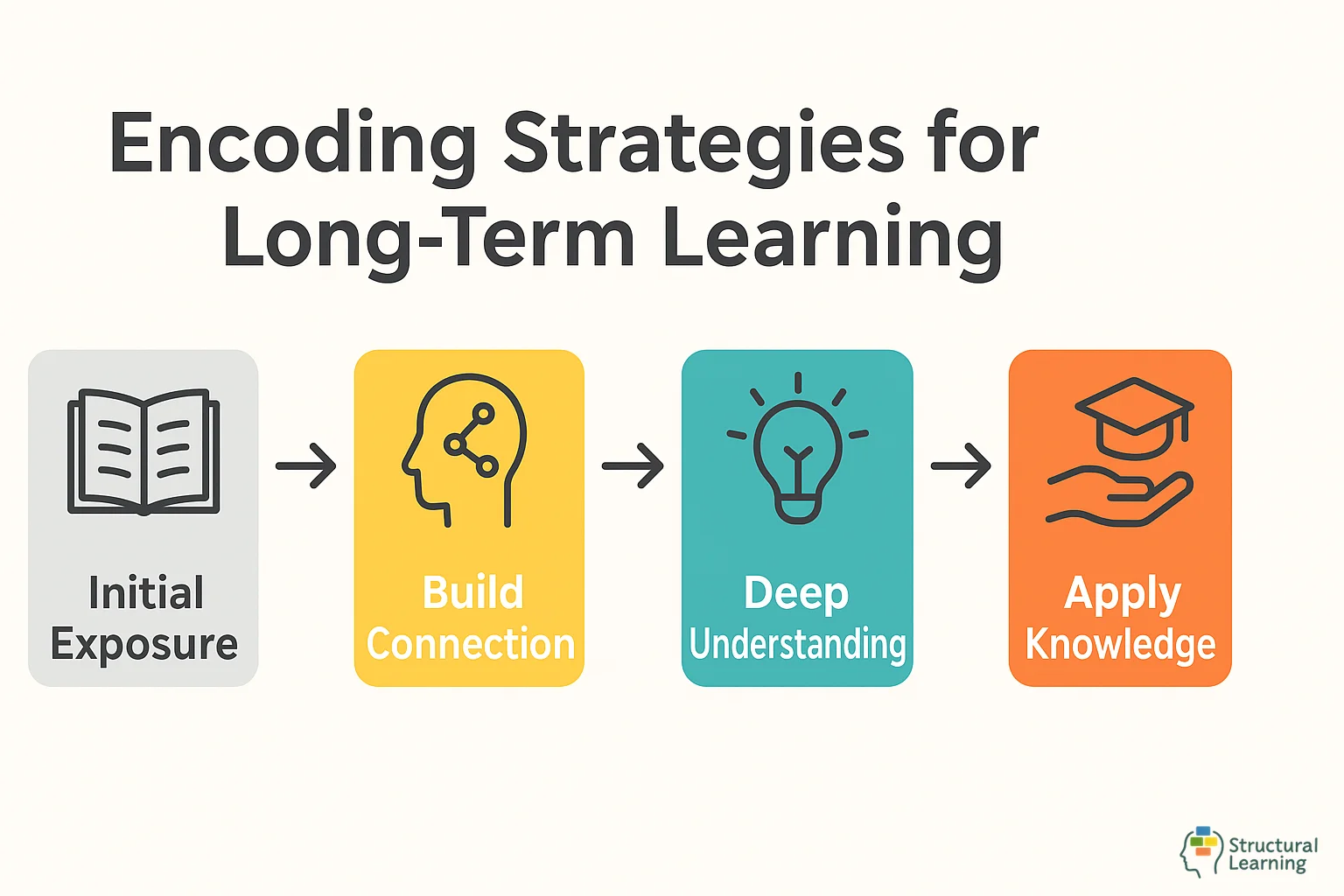
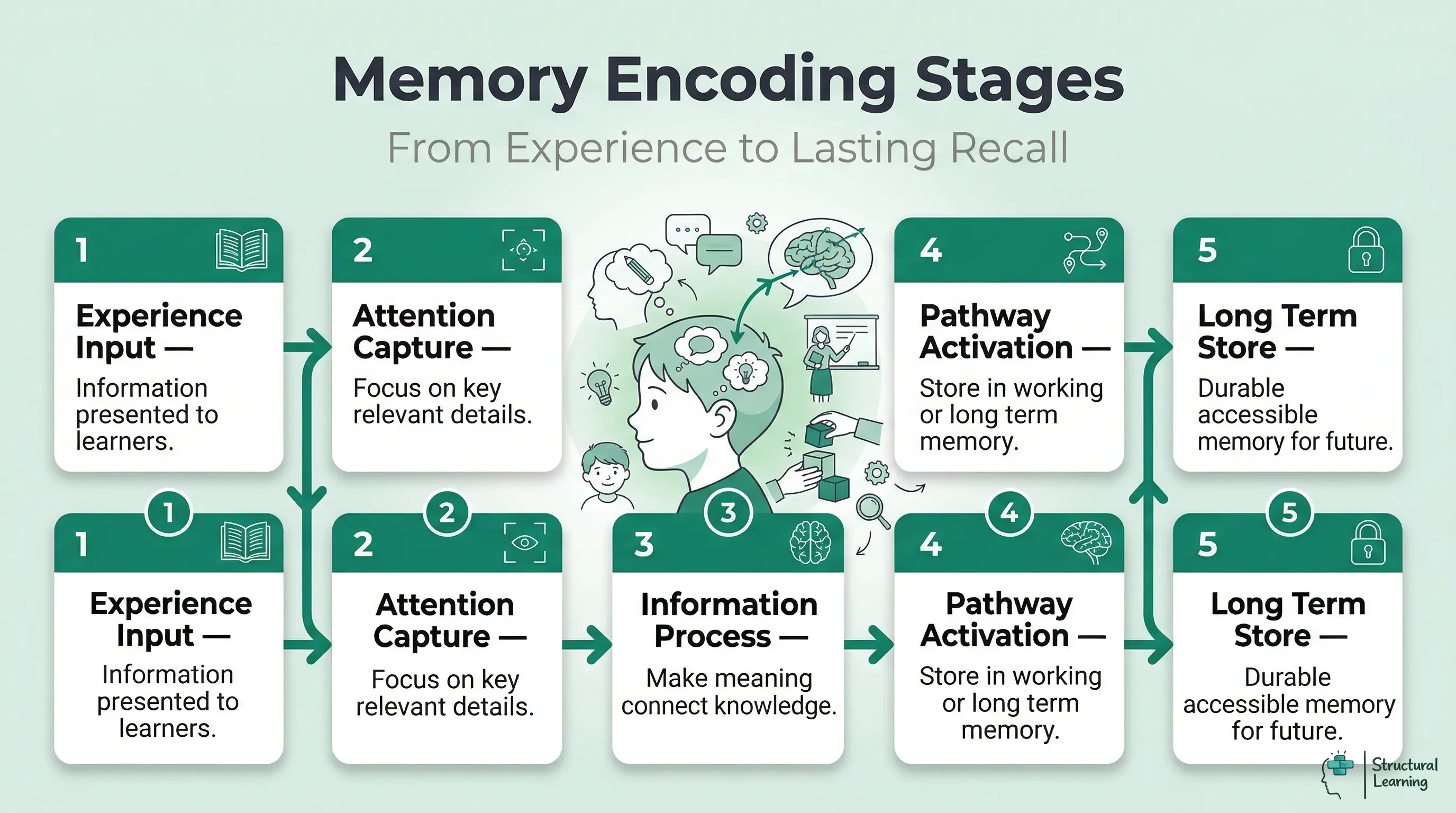
Encoding involves capture, processing, and storage. Learners focus during capture, ignoring distractions (Baddeley, 1986). Processing links new ideas to existing knowledge, forming connections (Craik & Lockhart, 1972). Storage activates memory pathways, both working and long-term (Atkinson & Shiffrin, 1968).
Teachers must plan encoding stages deliberately. They should guide attention, promote meaningful processing and reduce avoidable load (Anderson, 2000; Craik & Lockhart, 1972; Sweller, 1988). This turns teaching into cognitive support rather than simple exposure to information.
Encoding strategies work best when teachers manage learner workload. Teachers can chunk information (Miller, 1956) and offer clear structures. Use visual, verbal, and active methods, like timelines for history. This multi modal teaching helps learners recall information (Paivio, 1971) and prevents memory overload.
Encoding knowledge helps teachers understand why passive listening often fails. Information rarely moves into long-term memory unless learners actively process it. Questioning, discussion, practice and retrieval all support stronger encoding when they require learners to connect new ideas to what they already know (Anderson, 2000; Brown et al., 2014).
Encoding refers to the initial processing of information that creates a memory trace. When you pay attention to something, your brain converts that experience into neural patterns that can be stored and later retrieved. The nature of this processing determines how well the information will be remembered.
Think of encoding as translation. Your experiences exist in the external world; encoding translates them into the internal language of your neural networks. Poor translation produces garbled messages that are hard to understand later. Good translation produces clear representations that remain accessible over time.
Limited working memory impacts how learners encode information. It only holds so much at once, so encoding is selective. Attention drives encoding, otherwise the information is lost (Baddeley, 1986). Metacognition helps learners focus their attention (Flavell, 1979; Brown, 1978).
Teachers can use encoding pathways via lesson plans. Timeline visuals (visual), stories (auditory), and cause-effect talks (semantic) aid learning. This multi-modal method aids all learners' memory (Baddeley, 1994; Paivio, 1986; Tulving, 1972).
Chunking complex information aids learner encoding, especially when cognitive load is high. Teachers should use clear structures and remove extra details (Baddeley, 2003). Questioning and summarising help learners connect new ideas to old knowledge (Craik & Lockhart, 1972). This supports deeper understanding that lasts longer (Tulving, 1983).
| Encoding Type | Processing Level | Student Activity | Memory Outcome |
|---|---|---|---|
| Structural Encoding | Shallow (visual features) | Noticing if a word is in capitals or what colour something is | Weak, quickly forgotten; brief retention only |
| Phonemic Encoding | Shallow (acoustic features) | Repeating information, focusing on sound or rhythm | Moderate; better than structural but still limited |
| Semantic Encoding | Deep (meaning-based) | Thinking about what information means and how it relates to prior knowledge | Strong; durable long-term memories formed |
| Elaborative Encoding | Deep (connection-building) | Creating links between new and existing knowledge through explanation | Very strong; multiple retrieval pathways created |
| Self-Referential Encoding | Deep (personal connection) | Relating information to personal experiences or oneself | Excellent; the "self-reference effect" produces superior recall |
| Organisational Encoding | Deep (structure-building) | Categorising, grouping, or structuring information hierarchically | Strong; organised information is easier to retrieve |
Based on Craik and Lockhart's Levels of Processing Theory (1972) and subsequent encoding research. The key insight: how information is processed during learning matters more than how long it's studied. Five minutes of deep processing beats twenty minutes of shallow processing.
Craik and Lockhart's (1972) Levels of Processing theory says deep information processing improves memory. Learners remember better when they connect meaning, not just surface features. Teachers, engage learners with activities that require explanation, comparison, or application (Craik & Tulving, 1975). This is more effective than rote memorisation.
Craik and Lockhart suggested levels of processing in 1972; their encoding framework is still key.
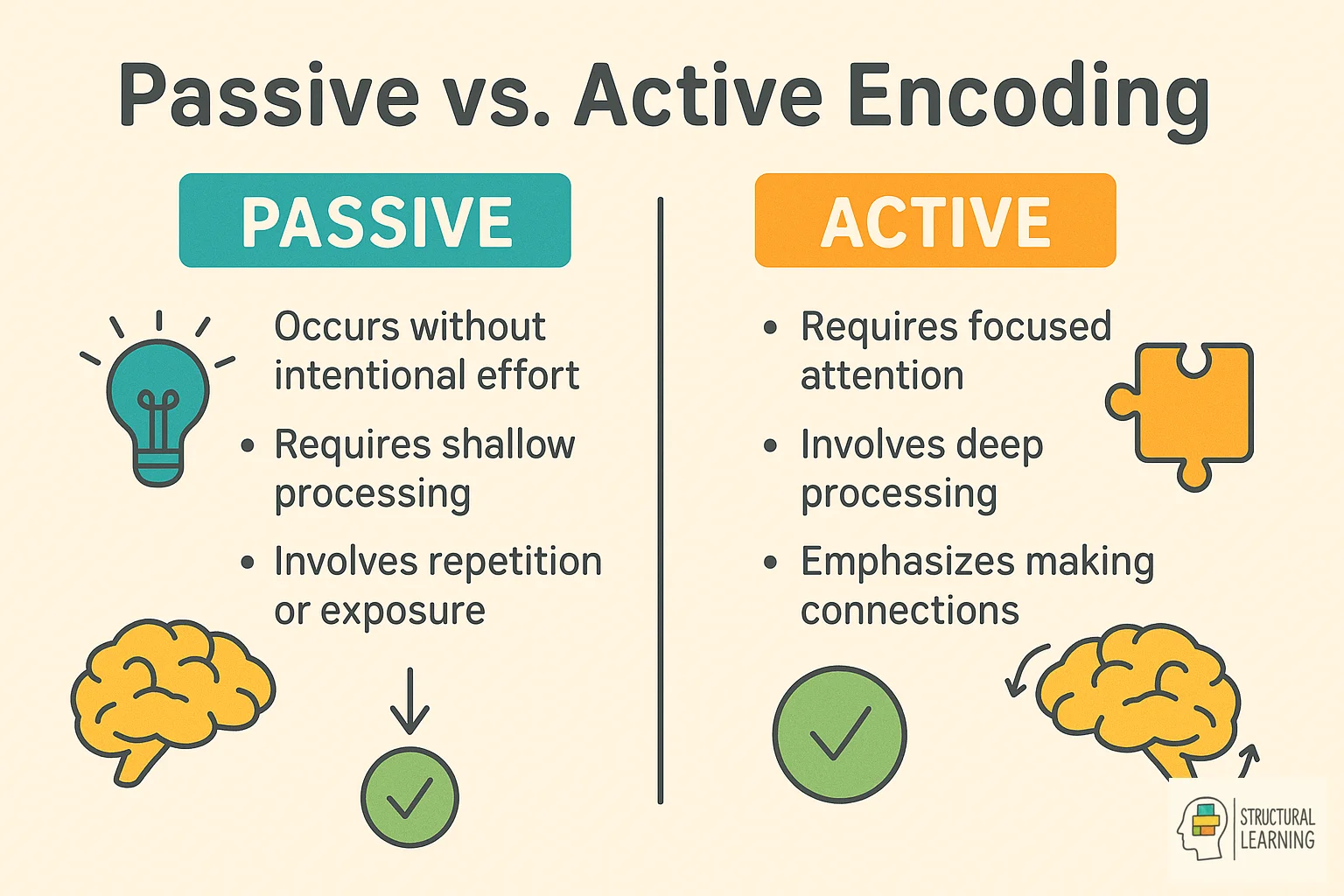
Shallow processing focuses on surface features of information: what it looks like, what it sounds like. Reading words without thinking about their meaning constitutes shallow processing. So does noting that a fact appeared on page 47 without engaging with what the fact means.
Shallow processing produces weak, easily forgotten memories. It's fast and requires little effort, which is why students often default to it. But the speed comes at a cost to retention.
Deep processing engages with meaning and connections. When you think about what something means, how it relates to what you already know, or why it matters, you're processing deeply. This semantic processing creates richer, more elaborate memory traces.
Deep processing takes more effort than shallow processing, but the investment pays off in better retention. Students who spend five minutes processing deeply often remember more than students who spend twenty minutes processing shallowly.
This hinders deeper learning (Craik & Lockhart, 1972). Shallow processing, like copying notes, limits understanding. Learners need active engagement. Discussing texts and linking flashcards encourages deeper learning (Anderson & Krathwohl, 2001).
Teachers can shift towards deep processing by asking students to explain meaning, generate connections, and apply information to new situations. Any activity that requires thinking about what something means, rather than just what it looks like, promotes deep encoding.
Elaborative interrogation (asking why) works, research shows (Pressley, 1993). Learners benefit from self-explanation (Chi et al., 1989) and dual coding (Paivio, 1986). Give concrete examples (Thompson et al., 2021) and use the generation effect (Bertsch et al., 2007). These strategies improve learning because they require active thought and multiple routes to recall the information. Teachers can integrate these into lessons and homework.
Elaboration, distinctiveness, and organisation aid memory encoding (Craik & Lockhart, 1972; Hunt & Worthen, 2006). Teachers can directly teach these strategies to learners. Structuring lessons around these ideas helps learners remember content better.
Elaborative interrogation, self-explanation, and keyword mnemonics work well. Weinstein et al. (2018) showed these help learners remember facts. Anderson and Reder (1979) found prior knowledge helps learners learn. These techniques build knowledge networks, which aids recall (Rea & Modigliani, 1966).
Elaboration takes many forms:
Researchers have shown elaborative interrogation helps learners understand facts (Pressley, McDaniel, Brewer, & Hampton, 1990). This method asks learners to explain why something is true. When learners create explanations, memories become stronger (Smith, Holliday, & Austin, 2010). Stronger memories help with long-term recall (Willoughby, Wood, Desmarais, Sims, & Race, 1994).
In the classroom, build elaboration into instruction by regularly pausing to ask: "Why is this the case?" "How does this connect to what we learned last week?" "Can you think of an example from your own experience?"
Research on mnemonic and subjective organization suggests that organised encoding and retrieval cues can support recall, but this should not be described as proof (e.g., Bower, 1970; Tulving's subjective-organisation work). Learners recall organised content easier during encoding and retrieval. Unstructured information makes learning harder.
Effective organisation strategies include:
Organisation works partly by chunking information. Rather than encoding many separate items, learners encode a smaller number of organised chunks. Each chunk serves as a retrieval cue for its contents.
Research by Bower (1970) and Mandler (1967) shows that teachers can aid encoding. Explicitly present information's structure to support learners. Consistent lesson structures help learners fit new knowledge, as suggested by Bransford et al. (2000).
Visualisation creates mental images, helping learners remember information. Paivio's (1971) dual-coding theory suggests visual and verbal memories differ. Encoding with both strengthens retention better than one alone, as shown by Clark and Paivio (1991).
Dual coding theory, developed by Allan Paivio, explains this advantage. Information encoded both verbally and visually benefits from two independent memory traces. If one trace fades, the other may remain accessible.

Visualisation strategies include:
Encourage students to create mental pictures as they learn. Ask: "Can you picture this?" "What would this look like?" "Draw what you're imagining."
Therefore, teachers can encourage learners to relate new material to themselves. This self-reference effect, studied by Rogers et al (1977) and Symons & Johnson (1997), improves encoding. Researchers Kuiper & Rogers (1979) and Turk et al (2004) showed personal connections help learners remember information.
Research shows learners remember new information better when they link it to personal experiences (Craik & Lockhart, 1972). Making this connection builds stronger memory encoding through deeper processing (Anderson, 2000). Consider how learners' opinions or goals relate to the content.
Classroom applications include:
This explains why personalised examples often produce better learning than generic ones. Asking "How does this apply to your life?" produces stronger encoding than presenting the same information in decontextualised form.
Distinctive information sticks in the memory. Encoding creates a unique memory trace, making it easier to recall (Eysenck, 2012). Retrieval improves when information differs from similar material (Hunt, 2003; Schmidt, 1991).
Strategies promoting distinctiveness:
Research (Bjork & Bjork, 1992) shows that distinctive encoding supports better memory. Highlighting differences between similar concepts aids learning (Hunt & Einstein, 1981). Distinctive encoding helps learners avoid confusion during recall (Schmidt, 1991).
Attention helps learners encode information for memory (Ericsson & Kintsch, 1995). Without focus, information skips working memory and isn't stored long term (Baddeley, 2000). Teachers can limit distractions, use engaging methods, and shorten lessons to boost focus (Sousa, 2017).
Encoding requires attention. Information that doesn't receive attention cannot be encoded, no matter how long it's presented. This makes attention the gateway to all learning.
Researchers suggest classrooms have many distractions (Posner, 1980). Learners must focus on key information, ignoring other things. Teachers aid attention by clearly marking important points (Johnstone & Heinz, 2000). Reducing distractions also helps learners (Evans & Maxwell, 1997).
Learners need focus for lessons to work. Attention can dip during extended exposition, so vary activity, include brief movement where appropriate and place key content when learners are ready to process it. These choices protect encoding by reducing avoidable attention loss.
Divided attention hurts encoding (Craik & Lockhart, 1972). Learners encode less when checking phones during lessons. Overly complex instruction overwhelms attention capacity (Sweller, 1988; Chandler & Sweller, 1991).
| Feature | Shallow Processing | Deep Processing |
|---|---|---|
| Focus | Surface features (appearance, sound) | Meaning and connections |
| Examples | Copying notes, highlighting text, memorising location | Explaining concepts, making connections, applying to new situations |
| Memory Strength | Weak, easily forgotten | Strong, durable memories |
| Effort Required | Low effort, fast processing | Higher effort, slower processing |
| Classroom Activities | Reading without discussion, reviewing flashcards | Explaining meaning, generating connections |
| Retention Rate | Poor long-term retention | Better retention with less review time |
Effective teaching considers cognitive load (Sweller, 1988). Instructional design impacts learner attention and encoding. Reducing load helps learners focus on key content for encoding (Mayer & Moreno, 2003; Paas et al., 2003).
Working memory is limited: Miller (1956) proposed about seven plus or minus two items/chunks, while later work such as Cowan (2001) argued for about four chunks. Overloaded working memory makes remembering hard (Baddeley, 2000). Teachers can chunk information and provide time to process it (Sweller, 1988).
Baddeley and Hitch (1974) proposed a multi-component model of working memory. It briefly holds and processes information for learners. Cowan (1988) saw it as activated parts of long-term memory.
Working memory has limits; learners can only hold 3-5 chunks at once. (Cowan, 2010). When encoding overloads working memory, information is lost (Baddeley, 1992; Engle, 2002).
Breaking content into chunks helps learners encode information. Present a few ideas at once and allow processing. Avoid overloading working memory with complexity, as suggested by researchers Miller (1956) and Sweller (1988).
Research suggests working memory is key for learners (Craik & Lockhart, 1972). If working memory is overloaded, learners process superficially (Baddeley, 1986). Learners revert to surface-level learning when stretched beyond capacity (Sweller, 1988).
Focus learning by reducing extra mental effort. Design resources clearly and simply. Provide support to learners; this reduces pressure on their working memory (Sweller, 1988; Chandler & Sweller, 1991; Mayer & Moreno, 2003).
Students with relevant prior knowledge can encode new information more efficiently because they can chunk it into existing schemas. This is why activating prior knowledge at the start of lessons supports encoding: it prepares mental structures to receive new information.
Encoding and retrieval are interconnected processes where the way information is initially encoded determines how easily it can be retrieved later. Strong encoding creates multiple retrieval cues and pathways, while poor encoding leaves few ways to access the memory. Teachers should align encoding activities with how students will need to retrieve and use the information, such as encoding math concepts through problem-solving if that's how they'll be tested.
(Tulving & Thomson, 1973) showed encoding shapes later recall. Effective retrieval cues depend on encoding conditions. This idea, encoding specificity, matters for learner success (Tulving, 1983; Godden & Baddeley, 1975).
Information is encoded along with context: where you learned it, what you were thinking, what was happening around you. These contextual elements become linked to the memory and can serve as retrieval cues.
This explains why students sometimes perform better in the room where they learned material, or why returning to a topic can trigger recall of related information. The context provides cues that access the encoded memory.
Retrieval is most successful when it matches the type of processing used during encoding. If you encoded information by thinking about its meaning, tests that require meaning-based retrieval will succeed. If you encoded by rote repetition, meaning-based questions may fail even though the information is stored.
This principle suggests that encoding should match anticipated retrieval. If students will need to apply concepts to novel problems, they should practise application during encoding. If they will need to recall factual details, they should encode those details specifically.
Encoding strategies let teachers create lasting memories (Brown et al., 2014). Learners who actively process information remember more (Craik & Lockhart, 1972). This strengthens memories, aiding recall and application (Anderson, 2000).
Encoding research is clear: initial processing quality impacts later memory. Teachers understanding encoding plan lessons that actively engage learners with meaning, not just passive exposure. The key question is: "Did learners deeply process content for recall?" Instructional choices either help or hinder encoding; choose meaningful thinking activities for better recall. (Craik & Lockhart, 1972; Baddeley, 1986; Anderson, 1983)
Maths and science learners gain from worked examples and visuals (Atkinson & Shiffrin, 1968). Language arts learners benefit from elaboration and connecting texts. History learners improve with timelines and cause-effect mapping. Teachers should match encoding to their subject.
Anderson (1990) explored encoding strategies. These strategies vary because learners have different knowledge (Bransford et al, 2000). Support each learner by considering their subject-specific aims (Bransford et al, 2000).
Science encoding benefits from:
Indeed, research shows that diagrams really help learners grasp tricky ideas (Schnotz, 2002; Ainsworth, 2006). Encoding information visually works well in science, specifically for processes and structures. Mayer (2009) found visual aids improve a learner's understanding of relationships.
Mathematical encoding benefits from:
Learners must encode maths procedures and related concepts. Encoding procedures without understanding means knowledge is weak (Star, 2005). This inflexible knowledge limits problem-solving (Rittle-Johnson et al., 2001; Crooks & Alibali, 2008).
Historical encoding benefits from:
Historical understanding requires encoding events within causal narratives, not as isolated facts.
Language encoding benefits from:
Research by Stahl (1986) and Beck et al. (2002) shows meaningful use helps learners encode words. Isolated memorisation is a less effective vocabulary teaching approach.
Teachers boost learner encoding by explaining memory with analogies, distinguishing passive reading from active work. Show learners encoding tricks, like self-testing and elaboration, then provide AI feedback practice. Discussing strategy effectiveness for content types builds independent learners (Bjork, 1994; Brown et al., 2007; Dunlosky et al., 2013).
This leads to improved academic performance (Bjork et al., 2013). Research by Dunlosky et al. (2013) suggests self-testing and spaced practice work best. Other strategies like rereading and summarisation are less useful, according to Karpicke (2012).
Learners frequently reread or highlight, thinking it helps. Teachers should explain shallow versus deep processing. This helps learners understand why those strategies may not work well (Brown et al., 2014; Roediger & Karpicke, 2006).
Explicitly teach encoding strategies. Show learners how to elaborate, organise, and visualise concepts. Think aloud while encoding; this makes the process clearer. Use techniques outlined by researchers like Craik and Lockhart (1972). Practice helps solidify encoding (Baddeley, 1986).
Structured practice of encoding strategies helps learners; provide feedback. Support learners with strategies at first. Gradually give them more responsibility as competence develops. (Bjork and Bjork, 2011; Weinstein et al., 2000).
Use prompts that encourage students to monitor their encoding:
Retrieval practice at lesson start helps encoding (Rohrer & Pashler, 2007). Think-pair-share promotes active learning (Lyman, 1981). Exit tickets encourage learners to elaborate (Yorke & Druce, 2009). Regular breaks prevent overload. Consistent patterns support new concept introduction (Anderson, 2010). These routines offer deep processing without extra planning.
Embedding encoding strategies in classroom routines ensures consistent application.
Begin lessons by activating prior knowledge relevant to new content. This prepares schemas for encoding and creates connection points for new information.
Encoding boosts learning. After teaching key concepts, get learners to explain or visualise. Applying knowledge also works, as does connecting ideas. These activities are quick but greatly improve retention (Weinstein et al., 2018).
These activities also serve as a useful form of formative assessment (Brown et al., 2018). This helps you identify learners needing extra support. Encoding consolidation will reinforce learning (Anderson, 2000).

Strategic timing can improve learning during the day. Use short memory bridges in morning lessons to connect new content to prior learning. After breaks, use two-minute recaps to reactivate relevant knowledge before asking learners to handle new material.
Movement boosts daily learning. Try "walk and talk" while learners discuss ideas, or use gestures. Motor activity strengthens memory. Vary teaching: visuals for complexity, rhythm for sequences, stories for abstracts. This variety helps all learners encode information.
Spaced practice, with learners revisiting material over time, helps memory (Cepeda et al., 2008). Interleaved practice can improve learning when learners must discriminate among similar concepts or problem types, though effects depend on the task and materials (Rohrer, 2012). Teachers should plan review cycles bringing back old material in new situations, which improves memory (Kang, 2016).
These processes must be coordinated to ensure learning persists (Bjork & Bjork, 1992). Learners require strong encoding for a solid base. Consolidation and retrieval practice help learners retain knowledge long-term (Roediger & Karpicke, 2006). Coordinated encoding, consolidation, and retrieval build lasting learning (Brown, Roediger & McDaniel, 2014).
A complete approach to memory combines:
Teachers who address all three processes maximise their impact on long-term learning.
Teachers should create conditions for better memory transfer. Spaced repetition works best; learners review information at increasing intervals. Introduce concepts, then revisit them within 24 hours, then after three days. Repeat this after one week and one month for retention (Ebbinghaus, 1885; Cepeda et al., 2008).
Meaningful links speed up learning transfer. Learners connect new information to what they know already (Bransford et al., 2000). This builds more neural pathways. Encourage learners to relate new ideas to life or past lessons, boosting connections (Anderson, 1983; Brown, 2014).
Researchers like Craik and Lockhart (1972) found that elaborative encoding helps learners retain information longer. Learners question, summarise, and teach others instead of just rehearsing facts. Concept maps and analogies help learners process information meaningfully (Anderson, 1983). This builds stronger memories (Smith, 1979).
Sleep aids long-term transfer, so avoid cramming new concepts. Introduce ideas with processing time, letting overnight consolidation work. This spacing allows the hippocampus to strengthen memories (Dudai, 2004; Ellenbogen et al., 2006), aiding retrieval (Robertson, 2009).
Begin by replacing passive activities with active ones, such as turning reading assignments into guided note-taking with specific prompts for elaboration. Start each lesson with a brief retrieval practice of yesterday's content and end with students explaining one key concept to a partner. Choose one encoding strategy to master at a time, implementing it consistently for several weeks before adding another.
Begin improving encoding in your classroom with these manageable changes.
Ask "why" and "how" questions that require explanation rather than recognition. Every lesson should include moments where students must explain concepts in their own words.
Graphic organisers aid learners in structuring information. Maps, webs, and hierarchies help learners see patterns (Robinson, 1998). This supports better encoding and recall (Marzano et al., 2001). Teachers can use these to improve learning.
This helps learners connect new information (Ausubel, 1968). Explicitly link to what learners already know. This aids new encoding (Anderson, 1977; Bransford et al., 2000). Schema activation prepares learners for understanding.
Chunk information and reduce unnecessary complexity to lower cognitive load. Learners should then fully process the remaining information. (Sweller, 1988; Mayer & Moreno, 2003; Clark, Nguyen & Sweller, 2006)
Build encoding pauses into instruction. After presenting key content, stop and prompt encoding activity before moving on.
Teachers can easily use these strategies. They shift existing lesson time to activities for real learning (Bjork et al., 2013). This boosts understanding, unlike superficial methods (Brown et al., 2014; Roediger & Karpicke, 2006). Learners benefit from activities supporting long-term knowledge retention (Dunlosky et al., 2013).
Craik and Lockhart (1972) explored processing levels. Roediger and Karpicke (2006) researched the testing effect. Dunlosky (2013) reviewed effective learning techniques. These papers show why some encoding works. Learning Scientists and Retrieval Practice websites offer summaries for teachers.
The following papers provide deeper exploration of encoding and its educational applications.
Craik and Lockhart (1972) changed memory research with processing levels. They said deeper processing during encoding improves memory. Semantic processing creates better retention (Craik & Tulving, 1975). Their work sparked more research on encoding and learning.
Research by authors shows elaborative interrogation works well. Asking learners to explain why facts are true improves recall. This method builds links between new and current knowledge.
Spacing and interleaved practice showed promise (Dunlosky et al., 2013). Elaborative interrogation and self-explanation worked well in research. Highlighting and re-reading were less effective for learners (Dunlosky et al., 2013).
Paivio describes dual coding theory and its effect on learning. Combining words and visuals creates stronger memories than using one alone. This supports using diagrams and images, plus multimedia, when teaching learners.
Encoding and retrieval influence each other, (Bjork, 1975). Retrieval practice gives learners better retention than elaborative study, (Karpicke & Roediger, 2008). This shows active processing is vital, (Anderson, 2000).
Experiences are transformed through the process of encoding into memory traces that can be stored and retrieved later. Without effective encoding, there's nothing for students to retrieve from memory, making it the gateway to all learning. The quality of initial encoding determines how well information will be remembered, regardless of how many times students review it afterwards.
Teachers can promote deep processing by asking students to explain meaning, generate connections, and apply information to new situations rather than just copying notes or highlighting text. Build regular pauses into lessons to ask questions like 'Why is this the case?' or 'How does this connect to what we learned last week?' Any activity that requires thinking about what something means, rather than just what it looks like, promotes deep encoding.
Weinstein et al. (2018) identified five useful learning strategies. Elaborative interrogation, self-explanation, and dual coding help learners. Concrete examples and the generation effect also assist their learning. These methods promote thinking and improve memory, research shows.
Research by Craik and Lockhart (1972) shows that shallow processing attends to surface features rather than meaning. This creates weaker memories because the learner has done less semantic work. Ask learners to explain, connect and use new material so processing becomes deeper.
Elaborative interrogation involves prompting students to explain why facts are true, which creates elaborated memory traces that persist longer than unelaborated information. Teachers can build this into instruction by regularly asking questions like 'Why is this the case?', 'How does this connect to previous learning?', or 'Can you think of an example from your own experience?' This technique helps students link new information to existing knowledge, creating multiple retrieval pathways.
Bower (1970) found organisation aids encoding. Chunking helps learners retrieve information faster. Teachers should explicitly show lesson structure. Consistent frameworks support learners building knowledge (Ausubel, 1960).
According to Paivio's (1971) dual coding theory, words and images create stronger memory. If one memory trace weakens, the other supports learner recall. Clark and Paivio (1991) suggest teachers use both visual and verbal learning materials.
These sources draw on work directly relevant to encoding, retrieval and durable learning.