Co-Teaching Models for Inclusion: A Teacher's Guide to Friend and Cook's Framework
|
February 26, 2026
A practical guide to all six co-teaching models (Friend and Cook): when to use each, co-planning strategies, research evidence, and how co-teaching delivers IEP services in inclusive classrooms.
Co-teaching is a service delivery model in which two professionals, typically a general education teacher and a special education teacher, share responsibility for planning, delivering, and assessing instruction for a diverse group of students in a single classroom. The definition most widely used in research comes from Friend and Cook (1996): co-teaching requires that both professionals have joint instructional responsibility for a heterogeneous group of students, including those with disabilities, in a shared physical space. That definition rules out a lot of what schools informally call "co-teaching." A teacher and a paraprofessional are not a co-teaching pair. A special educator who dips in and out of a general education class is not co-teaching. The two-professional, shared-accountability standard is the starting point, and everything else follows from it.
Co-teaching became the dominant inclusion model in the United States because of the Individuals with Disabilities Education Act (IDEA), which requires that students with disabilities receive their education in the least restrictive environment (LRE) appropriate to their needs. For the majority of students with disabilities, that least restrictive environment is the general education classroom. Co-teaching is the structural mechanism by which schools deliver specialised instruction and IEP accommodations inside that general education setting, rather than removing students to separate resource rooms or self-contained classes.
Key Takeaways
Co-teaching requires two licensed professionals with joint accountability: Friend and Cook's definition excludes teacher-paraprofessional pairs. Both teachers must share planning, instruction, and assessment responsibility for the same heterogeneous class, including students with IEPs.
Six distinct models exist, and most classrooms use only one: Research by Scruggs and colleagues (2007) found that the vast majority of co-taught classrooms default to One Teach, One Assist, where the special educator plays a secondary role. Rotating through all six models based on lesson type is what separates high-performing co-teaching pairs from the rest.
Planning time is the single biggest predictor of co-teaching quality: Murawski and Swanson's (2001) meta-analysis found that co-teaching only produces reliable learning gains when it is accompanied by structured, protected co-planning time. Schools that pair teachers without providing that time see no benefit over traditional pull-out models.
The relationship between co-teachers matters as much as the model used: Power imbalances, unclear roles, and lack of parity between the general education teacher and the special educator undermine every model. Addressing the relationship directly, including who controls the pace, who grades work, and whose name appears on communications, is not optional.
What Co-Teaching Actually Is
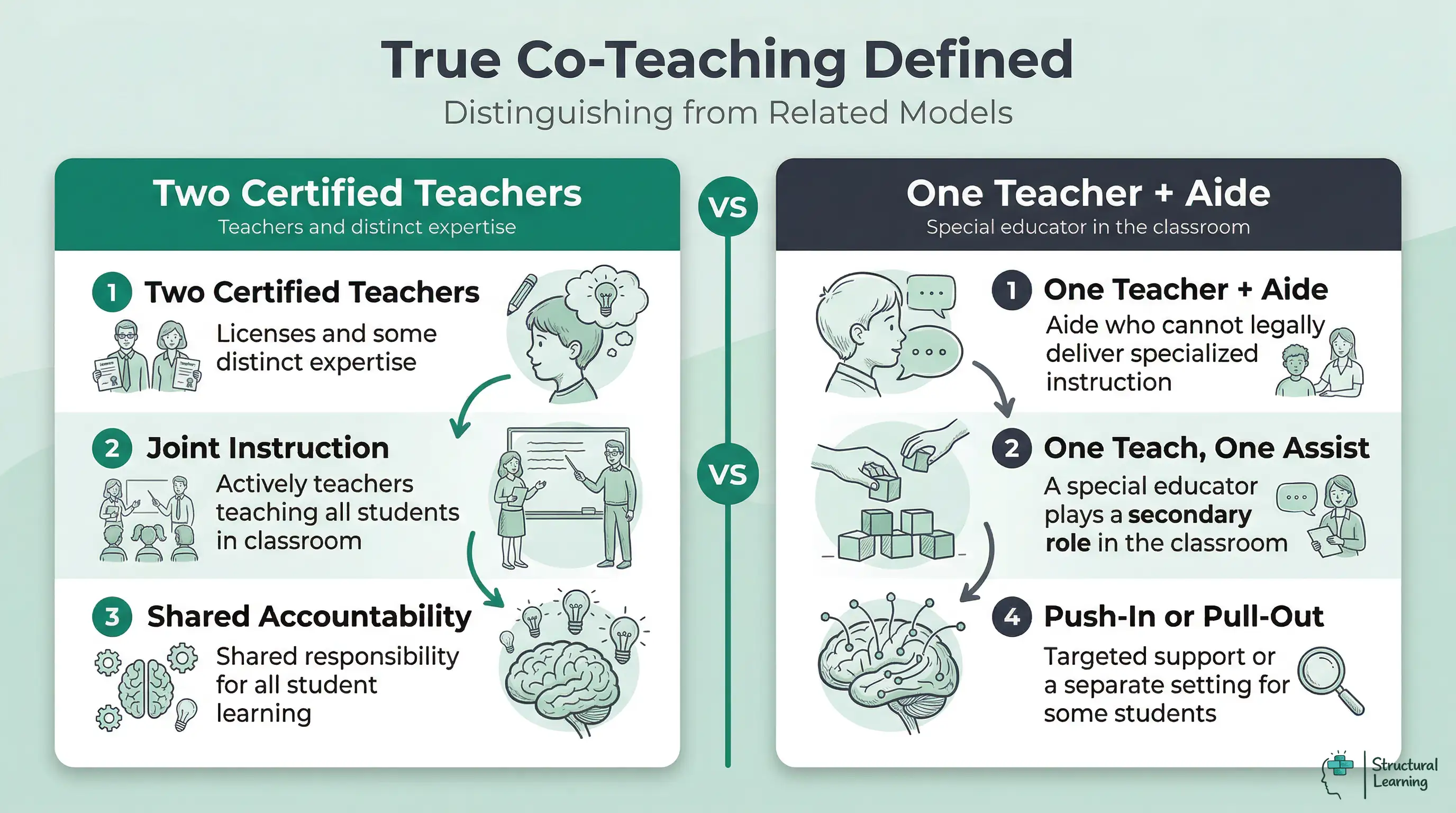
Friend and Cook's (1996) definition has three components that matter practically. First, co-teaching involves two or more certified professionals, not one teacher and one aide. The distinction is significant because special educators bring a different expertise set to the classroom, knowledge of disability, individualised instruction, evidence-based interventions for specific learning profiles, and assessment under IDEA. A paraprofessional cannot legally deliver specialised instruction, and deploying one as if they were a second teacher is both a compliance risk and a pedagogical loss.
Second, co-teaching involves joint delivery of substantive instruction. Both professionals must be teaching, not one teaching while the other manages behaviour or copies notes onto the board. If the special educator spends most of the lesson circulating quietly and correcting work, that is not co-teaching by any research definition, and it will not produce the outcomes associated with co-teaching in the literature.
Third, co-teaching serves a heterogeneous group that includes students with disabilities. It is not a model for general ability grouping or team teaching among general educators. Its purpose is to bring the expertise of special educational needs provision into the general education environment so that students with IEPs receive their services in the LRE.
Co-teaching is also distinct from two related but different models. Push-in refers to a specialist coming into the general education classroom to work with specific students, typically a small cluster of students with IEPs, while the general education teacher continues with the whole class. This is not co-teaching because there is no joint instructional responsibility for the whole group. Pull-out refers to removing students from the general education setting to receive services in a resource room or separate space. Pull-out remains an appropriate model for students whose IEPs require it, but it is at a more restrictive point on the LRE continuum. Co-teaching sits between these extremes: it keeps students in the general education classroom while ensuring that the specialised expertise of the special educator is present for everyone.
The Six Co-Teaching Models
Friend and Cook identified six distinct models of co-teaching, each with different structures, different demands on teachers, and different benefits for students. Understanding all six and knowing when to use each is the practical core of effective co-teaching.
One Teach, One Observe
In this model, one teacher delivers instruction to the whole class while the other systematically observes and collects data. This is not passive monitoring. The observing teacher should have a defined observation purpose, a data collection tool, and a debrief plan. What are they watching for? It might be how many students respond to open questions, which students never volunteer, how long a student with ADHD sustains attention before going off task, or whether a student with a reading IEP goal is tracking text during shared reading.
One Teach, One Observe is most useful at the start of a co-teaching relationship, when both teachers are still building a shared understanding of which students need what. It is also useful at specific diagnostic moments during the year, when both teachers want an accurate picture of classroom functioning before making decisions about grouping or intervention.
A concrete example: a Year 8 science class is learning about states of matter. The general education teacher leads the lesson while the special educator uses a structured observation form to track which students answer questions correctly on the first attempt, which students answer after a prompt, and which never respond at all. That data goes directly into the planning conversation for the following lesson, where the special educator can suggest which students need additional pre-teaching before the next topic.
One Teach, One Observe is not a sustainable everyday model and should not become the default. Its value is in the quality of data it generates, not in its instructional power.
One Teach, One Assist
In this model, one teacher delivers instruction to the whole class while the other circulates, providing quiet support to individual students as needed. This is the most commonly observed model in co-taught classrooms, and it is also the most frequently misused. Scruggs, Mastropieri and McDuffie (2007) conducted a qualitative meta-synthesis of 32 co-teaching studies and found that One Teach, One Assist was overwhelmingly the dominant model in observed classrooms, with the special educator almost always in the assistant role.
The problem is not with the model itself. It is appropriate when the general education teacher is introducing new content for the first time, when a student with a specific support need requires brief in-the-moment help, or when the lesson structure does not lend itself to splitting the class. The problem arises when it becomes the only model used, because it positions the special educator as a glorified aide, makes students with IEPs visible as the recipients of that assistant's attention, and removes any instructional contribution from the co-teacher's expertise.
Used correctly, One Teach, One Assist looks like this: a maths class is working through a new multi-step problem. The general education teacher explains the procedure at the front. The special educator circulates, watching for students who have stalled at step two, quietly rereading the prompt to a student with a processing difficulty, or redirecting a student with executive function challenges back to their work. The circulating teacher is not interrupting the flow of instruction. They are providing responsive, just-in-time support that keeps students on track without public identification.
The risk to monitor is whether students with IEPs learn to wait for the special educator rather than attempting work independently. If the same students receive assistance every lesson, the model is reinforcing dependence rather than building capability.
Station Teaching
In station teaching, the class is divided into three or more groups, each rotating through learning stations at intervals. Both teachers lead one station each, and at least one station involves independent or collaborative work without direct teacher involvement. This model reduces the teacher-to-student ratio substantially and gives both professionals genuine instructional roles with equal weight.
Station teaching suits lessons where the content can be meaningfully divided into components that do not need to be learned in strict sequence, where students benefit from different activity types across the same lesson, or where the class includes a significant range of readiness levels that would make whole-class instruction ineffective.
A concrete example: a Year 6 English lesson on figurative language. Station one is run by the general education teacher and focuses on identifying figurative language in a poem. Station two is run by the special educator and focuses on students writing their own examples of two figurative language types. Station three is an independent station with a card-sorting activity matching figurative language terms to definitions. Each group of eight students spends fifteen minutes at each station. The special educator's station can be calibrated for additional scaffolding without identifying specific students as "the group that needs help," because all groups cycle through all stations.
Station teaching requires more planning than One Teach, One Assist. Both teachers need to design their stations in advance, agree on the content focus of each, and establish clear transition routines. The payoff is a lesson where both professionals are genuinely teaching and where student groupings can be adjusted lesson by lesson based on observed need.
Parallel Teaching
In parallel teaching, the class is divided into two roughly equal groups, and each teacher delivers the same instructional content simultaneously to their group. The content is the same. The approaches may differ. The benefit is a halved student-to-teacher ratio, which increases the frequency of student response and the teacher's ability to monitor understanding.
Parallel teaching is particularly useful for lessons that rely heavily on discussion, where a class of thirty makes it impossible for most students to contribute meaningfully. It is also useful for review and practice sessions, where students need repeated opportunities to respond and receive feedback, and for lessons where the general education teacher and special educator want to differentiate the approach without differentiating the content.
The key design principle is that both teachers must teach the same learning objective. The differentiation is in the mode of delivery, the examples used, or the level of scaffolding provided, not in what students are expected to learn. A student with an IEP who receives parallel teaching with the special educator should be working toward the same grade-level standard as their peers, with access to whatever accommodations and modifications their IEP specifies.
A concrete example: a Year 9 history class is reviewing causes of the First World War. The general education teacher takes half the class through a discussion-based analysis of the alliance system. The special educator takes the other half through the same analysis using a graphic organiser framework that provides more structure for students who need it. Both groups are working on the same historical thinking skill. Fifteen minutes in, both groups have produced analysis they can share with the other group.
Parallel teaching requires a classroom large enough for two simultaneous instructional groups to function without excessive noise interference, and both teachers need to be comfortable leading their group independently.
Alternative Teaching
In alternative teaching, one teacher works with a small group of students for a targeted purpose while the other teacher works with the remaining, larger group. The small group might be receiving pre-teaching, re-teaching, enrichment, or assessment. This model addresses the reality that in any class, some students are ready to move forward, some need more time with current content, and some have gaps from previous learning that are blocking progress.
Alternative teaching is the model most directly connected to tiered support within an MTSS framework. The small group pulled by the special educator is not necessarily always students with IEPs. It might be students who struggled on last week's exit ticket, or students who are ready for an extension task, or a rotating group receiving strategic intervention on a specific skill.
A concrete example: a Year 7 maths lesson on fractions. Exit data from the previous lesson showed that six students cannot yet reliably convert between improper fractions and mixed numbers. At the start of the lesson, the special educator takes those six students to one side of the room for a fifteen-minute re-teaching session using manipulatives, while the general education teacher leads the rest of the class through the day's new content: adding and subtracting fractions with different denominators. The six students then rejoin the class for the independent practice phase. No student has missed the new content. Six students have received targeted intervention that would otherwise require a pull-out session.
The risk is that the same students are always in the small alternative group, which re-creates the stigma of pull-out inside the general education classroom. The composition of the alternative group should rotate, and the purpose of the small group should vary across the week.
Team Teaching
In team teaching, both professionals teach the whole class simultaneously, sharing delivery, discussion facilitation, and instructional decision-making in real time. One teacher might be explaining a concept while the other models a worked example on the board. One might ask a higher-order question while the other listens to student responses and follows up. One might notice a widespread misconception mid-lesson and signal to the other to pause and address it.
Team teaching requires the highest level of trust, communication, and planning of all six models. Both teachers must be genuinely comfortable with the content, comfortable with each other, and comfortable departing from a script when the lesson calls for it. Structured questioning strategies work especially well in team teaching because one teacher can ask while the other listens and probes student responses. It takes time to develop. New co-teaching pairs rarely manage genuine team teaching in their first semester together.
When it works, team teaching is the most powerful model because students benefit from two expert perspectives integrated seamlessly. The special educator is not positioned as the helper. Both teachers are positioned as co-authorities on the content. Students with IEPs receive the implicit message that their teacher knows the subject matter, not just "the special education stuff."
A concrete example: a Year 10 biology lesson on natural selection. The general education teacher explains the mechanism of natural selection while the special educator draws a visual timeline of generations on the board. Mid-explanation, the special educator asks a clarifying question: "So when you say 'survival of the fittest,' do you mean the physically strongest individual?" The general education teacher unpacks the misconception that the question surfaces. The special educator follows up with a student who shrugged: "What do you think? Strongest or best adapted?" The exchange feels like a genuine intellectual dialogue. Students see two professionals thinking through content together, which models the kind of academic talk they are expected to produce.
Choosing the Right Model
The most common mistake co-teaching pairs make is treating the choice of model as fixed, either defaulting permanently to One Teach, One Assist or rotating models by day of the week regardless of what the lesson needs. Model selection should be driven by three questions: What does this lesson require structurally? What do these students need right now? What are both teachers comfortable delivering?
Model
Teacher Roles
Student Grouping
Best For
Planning Demand
Trust Level
Lesson Example
One Teach, One Observe
One leads; one collects data
Whole class
Diagnostic, start of unit, IEP data collection
Low (agree observation focus)
Low
Science teacher introduces states of matter; SpEd records response rates per student
One Teach, One Assist
One leads; one circulates
Whole class
New content introduction, complex demonstrations
Low
Low
Maths teacher models multi-step equation; SpEd supports students who stall
Biology: both teachers unpack natural selection, one explains while other models and asks
Model selection should also account for where you are in the unit sequence. New content introductions often suit One Teach, One Observe or One Teach, One Assist. Mid-unit practice suits station teaching or parallel teaching. Pre-assessment or re-teaching suits alternative teaching. End-of-unit review suits parallel teaching or team teaching. This is not a rigid formula, but it gives both teachers a starting framework.
Co-Planning: The Non-Negotiable
Every piece of research on co-teaching effectiveness points to the same finding: co-teaching without co-planning produces little or no benefit over single-teacher instruction. Murawski and Swanson's (2001) meta-analysis of seventeen co-teaching studies found effect sizes that ranged from negligible to substantial, and the variable most consistently associated with strong outcomes was the presence of structured, joint planning time. Schools that give co-teachers a weekly protected planning period consistently outperform schools that tell co-teachers to "plan when you can."
Planning time has a specific content. It is not social catch-up, and it is not one teacher briefing the other on what the lesson will cover. Effective co-planning addresses at least five questions for each lesson or lesson sequence.
What is the learning objective, and what does mastery look like for students at different readiness levels? This question requires the general education teacher to articulate the content standard and the special educator to identify where students with IEPs or other learning needs are relative to that standard, and what accommodations or modifications will allow them to access it.
What is the lesson structure, and which co-teaching model fits it? Model selection happens in planning, not at the classroom door. Both teachers need to know their role before the lesson begins.
What does each teacher specifically do at each phase of the lesson? "We'll use station teaching" is not a plan. "I lead station one on paragraph structure using the graphic organiser we agreed; you lead station two on revision using the mentor text; station three is independent writing" is a plan.
Which students need what, and how will we know? This is where the special educator brings IEP knowledge to bear. Which students have accommodations for extended time, reduced visual complexity, preferential seating, or verbal rather than written response? How will the co-teachers coordinate delivery of those accommodations in a way that does not single students out? Understanding how working memory capacity affects a student's ability to process instruction simultaneously with completing a task is relevant here, since many accommodations, such as chunked instructions and reduced written output, exist precisely to manage working memory demand.
How will we assess understanding at the end of the lesson, and what do we do with that information? Formative assessment strategies in a co-taught class can be more powerful than in a single-teacher class because two teachers can each observe half the room simultaneously, or because the special educator can circulate and gather verbal responses from students who do not respond in writing.
A co-planning template that both teachers complete in advance of the meeting is more efficient than open-ended discussion. Dieker (2001) developed a lesson plan format specifically for co-taught classrooms, which uses a two-column structure showing what each teacher does at each phase of the lesson. Using a shared template keeps planning focused and ensures both teachers leave with the same understanding of who does what.
Making the Co-Teaching Relationship Work
The instructional quality of a co-taught class is inseparable from the quality of the relationship between co-teachers. A skilled pair of educators who have built genuine trust and mutual respect can make even an imperfect model work well. A pair with unresolved tensions about roles, expertise, and authority will underperform regardless of which model they use.
The most persistent structural problem in co-teaching relationships is the power imbalance between the general education teacher and the special educator. General education teachers typically control the content, the pace, and the classroom. They are often more senior in building seniority or more familiar to the students. Special educators are often perceived, and sometimes treated, as guests in the classroom. This perception undermines the model at its foundation.
Friend (2008) describes "parity" as the observable indicator of a genuine co-teaching relationship. Parity means both teachers have an equal presence in the classroom. Both names appear on the door, the whiteboard, and parent communications. Both teachers have a desk or working space in the room. Both address all students and are addressed by all students. Both teachers participate visibly in routines like homework collection, behaviour management, and transitions. When parity is absent, students quickly identify the "real teacher" and the "helper teacher," and the special educator's authority and effectiveness drop accordingly.
Handling disagreements professionally is part of co-teaching competency. Both teachers will have different views on pace, on how much scaffolding is too much, on whether a student needs more challenge or more support. Disagreements that are worked out in planning conversations are healthy and productive. Disagreements that play out in front of students, or that are suppressed until they become resentments, are destructive. Establishing a norm early in the partnership, such as signalling a need to talk with a mutually agreed phrase and then following up outside the classroom, prevents public conflict while keeping both teachers honest.
Respecting each other's expertise means the general education teacher defers to the special educator on questions of disability, learning profile, and intervention, while the special educator defers to the general education teacher on content scope, sequence, and assessment standards. Neither teacher knows everything. The co-teaching model works precisely because it brings two different knowledge bases into the same room.
What the Research Says
The research base on co-teaching is substantial, but it carries important qualifications. Murawski and Swanson's (2001) meta-analysis remains the most cited quantitative synthesis. They analysed seventeen studies that met their inclusion criteria, which included a control group, a quantitative outcome measure, and a description of the co-teaching model used. The mean effect size across studies was 0.40, which is educationally meaningful, equivalent to roughly four to five months of additional learning. However, the effect sizes varied dramatically across studies, from near zero to above 1.0, and the authors noted that the variability was largely explained by implementation quality. Co-teaching with planning time, training, and administrative support produced large effects. Co-teaching without those conditions produced effects near zero.
Scruggs, Mastropieri and McDuffie (2007) conducted a qualitative meta-synthesis of thirty-two published co-teaching studies and arrived at a more sobering picture of typical implementation. Across the studies, the modal pattern was One Teach, One Assist with the special educator in the assistant role, no shared planning time, teachers who expressed enthusiasm for the model but described significant implementation barriers, and administrators who assumed that placing two teachers in a room was sufficient. Their conclusion was that co-teaching, as typically implemented, falls far short of its theoretical potential.
Conderman and Hedin (2012) identified administrator support as the critical variable that distinguishes schools where co-teaching improves outcomes from schools where it does not. Administrator support means protecting planning time in the schedule, providing both teachers with training in all six models, conducting classroom observations specifically to give feedback on co-teaching implementation, and communicating to the broader school community that both teachers in a co-taught class are equally responsible for student outcomes. The parallels with how Rosenshine's Principles require systematic instructional design rather than improvisation are worth noting: effective co-teaching, like effective explicit instruction, demands deliberate preparation and structured routines.
Dieker and Murawski (2003) made the argument that the quality of the co-teaching relationship is both a process variable and an outcome variable. It matters in itself because teachers who are miserable in their partnership will leave co-teaching settings, which disrupts student relationships and requires starting the implementation process over. Schools that invest in relationship development, including structured co-teacher matching, initial training on communication and conflict, and ongoing coaching, see better retention of co-teaching pairs and better long-term outcomes for students.
Co-Teaching and IEP Implementation
Co-teaching is a service delivery model, not a placement. Students with IEPs who are educated in co-taught classrooms are still entitled to all of the services, accommodations, and modifications specified in their IEPs. The co-teaching structure is how those entitlements are delivered in the general education setting. This distinction matters because it is easy for co-taught classrooms to drift toward whole-class instruction that does not specifically address the individual needs of students with IEPs.
The special educator in a co-taught class carries continuing legal and professional responsibility for monitoring IEP implementation. That includes tracking whether extended-time accommodations are being applied consistently on assessments, whether students who require reduced assignment length are receiving it, whether students with reading accommodations are receiving text-to-speech or read-aloud support during co-taught lessons, and whether progress toward IEP goals is being measured at the frequency specified in the IEP document.
Specialised instruction (SDI) delivered in the general education setting requires intentional planning. SDI is not a support provided to students when they struggle; it is a systematically designed, evidence-based instructional approach matched to the individual student's disability and documented learning profile. In a co-taught class, SDI might look like the special educator using direct instruction principles with a small group using alternative teaching, or delivering pre-teaching sessions on vocabulary before a reading assignment, or providing systematic phonics instruction during an independent work phase of the lesson. The form varies. The requirement that it be systematic, intentional, and evidence-based does not.
Progress monitoring in co-taught classes benefits from having two teachers because data collection can be more frequent and more nuanced. The special educator can administer brief curriculum-based measurement probes during independent work time, collect writing samples aligned to IEP writing goals, or conduct structured observation for behavioural IEP goals, without disrupting the general education teacher's instruction. That data should feed directly into planning conversations, IEP progress reporting, and decisions about whether a student's placement in the co-taught setting remains appropriate or whether a more intensive service delivery model is needed.
Understanding 504 plans versus IEP structures is important here, because co-taught classes typically include students with both types of plans, and the implementation obligations differ. A student with a 504 plan is entitled to accommodations but not to specially designed instruction, and the monitoring obligation falls on the 504 coordinator rather than the special educator.
Common Pitfalls
The most damaging pitfall is the "glorified aide" problem. When the special educator spends the majority of lesson time in a subordinate role, hovering near students with IEPs, carrying books, or restating instructions the general education teacher just gave, the co-teaching model is being used as a compliance mechanism rather than an instructional one. Students with IEPs may be physically present in the general education classroom, but they are receiving a qualitatively impoverished education in which neither teacher is genuinely engaged with their learning at a specialist level.
The structural default to One Teach, One Assist is the mechanism by which the glorified aide problem perpetuates itself. It is low-planning, low-conflict, and low-disruption, which makes it comfortable for both teachers. It also produces the weakest outcomes of any model when used as the default across the school year.
Lack of planning time is the most frequently cited barrier to effective co-teaching in both quantitative and qualitative research. When schools schedule two teachers in the same room without providing protected joint planning time, they are running co-habitation rather than co-teaching. Teachers in this situation typically describe their arrangement as superficial, stressful, and unsatisfying, and they are correct in their assessment. The fix is structural: it requires administrative commitment to scheduling.
Mismatched pairs create avoidable friction. A general education teacher who is resistant to inclusion and a newly certified special educator who is unsure of their classroom authority will not produce effective co-teaching regardless of training or planning time. Schools that treat co-teacher assignment as logistically convenient, matching whoever has the same prep period, rather than relationally considered, typically see higher attrition from co-teaching positions and lower quality implementation.
No training is a systemic failure. Friend (2008) consistently emphasises that co-teaching is a professional skill that must be learned and practised. Placing two qualified teachers in a room together is not sufficient preparation. Both teachers need training in the six models, practice with co-planning tools, and ongoing coaching. Without it, teachers default to what is familiar, which for the general education teacher is solo whole-class instruction, and for the special educator is circulating support.
Students identifying "the real teacher" is a diagnostic signal, not an inevitability. When students direct all questions to the general education teacher, ask the special educator's permission before approaching the general educator, or respond differently to instructions from each teacher, the parity problem is visible and requires an immediate conversation between the two teachers about how their roles are presenting to students.
Making Your Next Lesson Better
Before your next co-taught lesson, both teachers should answer three questions in writing. Which of the six models fits this lesson's structure and this group's current needs? What is each teacher specifically doing at each phase of the lesson? Which IEP accommodations need to be implemented during this lesson, and who is responsible for each?
If you cannot answer all three questions before the lesson starts, the planning has not happened yet. Start there.
Further Reading
Key Research Papers on Co-Teaching
These studies form the evidence base for co-teaching as an inclusion model. Each addresses a distinct dimension of implementation, from effect sizes to relationship quality to administrator behaviour.
A Meta-Analysis of Co-Teaching ResearchView study ↗ 12 citations
Murawski, W. W., & Swanson, H. L. (2001)
This foundational meta-analysis examined seventeen co-teaching studies and found a mean effect size of 0.40, with outcomes strongly moderated by implementation quality. The study established that co-teaching without structured planning time and training produces near-zero effects, a finding that school administrators often overlook when designing inclusion programmes.
"I Know It When I See It": Identifying Co-TeachingView study ↗ 8 citations
Dieker, L. A., & Murawski, W. W. (2003)
Dieker and Murawski argue that co-teaching is frequently misidentified in schools, with teacher-paraprofessional pairs and push-in arrangements counted as co-teaching in reporting. The paper proposes observable indicators of genuine co-teaching, including joint grading, shared planning, and equal instructional delivery, and makes the case that relationship quality is both a process variable and an outcome that should be monitored independently.
A Qualitative Meta-Synthesis of Inclusive Co-Teaching ResearchView study ↗ 15 citations
Scruggs, T. E., Mastropieri, M. A., & McDuffie, K. A. (2007)
This qualitative synthesis of thirty-two co-teaching studies is the most complete picture of how co-teaching actually operates in typical schools. The dominant finding was that One Teach, One Assist was overwhelmingly the most common model, with the special educator almost always in the assistant role. The study also found that teachers consistently reported enthusiasm for the model alongside significant barriers, including lack of planning time, mismatched pairings, and insufficient administrative support.
Co-Teaching: An Illustration of the Complexity of Collaboration in Special EducationView study ↗ 7 citations
Friend, M., Cook, L., Hurley-Chamberlain, D., & Shamberger, C. (2010)
This paper from Friend and Cook, the original architects of the six-model framework, reviews two decades of co-teaching research and identifies administrator behaviour as the variable most clearly associated with sustained implementation quality. The authors argue that schools which reduce co-teaching to a scheduling solution, placing two teachers in a room without training or planning time, cannot expect the outcomes associated with the model in the research literature.
Practical Strategies for Co-Teaching SuccessView study ↗ 6 citations
Conderman, G., & Hedin, L. (2012)
Conderman and Hedin synthesise classroom-level evidence for specific co-teaching practices, including structured lesson planning templates, role clarification protocols, and formative assessment coordination between co-teachers. Their practical framework translates the research findings from Murawski, Scruggs, and Friend into concrete classroom procedures, making this paper a useful complement to the more theoretical literature in the field.
Co-teaching is a service delivery model in which two professionals, typically a general education teacher and a special education teacher, share responsibility for planning, delivering, and assessing instruction for a diverse group of students in a single classroom. The definition most widely used in research comes from Friend and Cook (1996): co-teaching requires that both professionals have joint instructional responsibility for a heterogeneous group of students, including those with disabilities, in a shared physical space. That definition rules out a lot of what schools informally call "co-teaching." A teacher and a paraprofessional are not a co-teaching pair. A special educator who dips in and out of a general education class is not co-teaching. The two-professional, shared-accountability standard is the starting point, and everything else follows from it.
Co-teaching became the dominant inclusion model in the United States because of the Individuals with Disabilities Education Act (IDEA), which requires that students with disabilities receive their education in the least restrictive environment (LRE) appropriate to their needs. For the majority of students with disabilities, that least restrictive environment is the general education classroom. Co-teaching is the structural mechanism by which schools deliver specialised instruction and IEP accommodations inside that general education setting, rather than removing students to separate resource rooms or self-contained classes.
Key Takeaways
Co-teaching requires two licensed professionals with joint accountability: Friend and Cook's definition excludes teacher-paraprofessional pairs. Both teachers must share planning, instruction, and assessment responsibility for the same heterogeneous class, including students with IEPs.
Six distinct models exist, and most classrooms use only one: Research by Scruggs and colleagues (2007) found that the vast majority of co-taught classrooms default to One Teach, One Assist, where the special educator plays a secondary role. Rotating through all six models based on lesson type is what separates high-performing co-teaching pairs from the rest.
Planning time is the single biggest predictor of co-teaching quality: Murawski and Swanson's (2001) meta-analysis found that co-teaching only produces reliable learning gains when it is accompanied by structured, protected co-planning time. Schools that pair teachers without providing that time see no benefit over traditional pull-out models.
The relationship between co-teachers matters as much as the model used: Power imbalances, unclear roles, and lack of parity between the general education teacher and the special educator undermine every model. Addressing the relationship directly, including who controls the pace, who grades work, and whose name appears on communications, is not optional.
What Co-Teaching Actually Is
Friend and Cook's (1996) definition has three components that matter practically. First, co-teaching involves two or more certified professionals, not one teacher and one aide. The distinction is significant because special educators bring a different expertise set to the classroom, knowledge of disability, individualised instruction, evidence-based interventions for specific learning profiles, and assessment under IDEA. A paraprofessional cannot legally deliver specialised instruction, and deploying one as if they were a second teacher is both a compliance risk and a pedagogical loss.
Second, co-teaching involves joint delivery of substantive instruction. Both professionals must be teaching, not one teaching while the other manages behaviour or copies notes onto the board. If the special educator spends most of the lesson circulating quietly and correcting work, that is not co-teaching by any research definition, and it will not produce the outcomes associated with co-teaching in the literature.
Third, co-teaching serves a heterogeneous group that includes students with disabilities. It is not a model for general ability grouping or team teaching among general educators. Its purpose is to bring the expertise of special educational needs provision into the general education environment so that students with IEPs receive their services in the LRE.
Co-teaching is also distinct from two related but different models. Push-in refers to a specialist coming into the general education classroom to work with specific students, typically a small cluster of students with IEPs, while the general education teacher continues with the whole class. This is not co-teaching because there is no joint instructional responsibility for the whole group. Pull-out refers to removing students from the general education setting to receive services in a resource room or separate space. Pull-out remains an appropriate model for students whose IEPs require it, but it is at a more restrictive point on the LRE continuum. Co-teaching sits between these extremes: it keeps students in the general education classroom while ensuring that the specialised expertise of the special educator is present for everyone.
The Six Co-Teaching Models
Friend and Cook identified six distinct models of co-teaching, each with different structures, different demands on teachers, and different benefits for students. Understanding all six and knowing when to use each is the practical core of effective co-teaching.
One Teach, One Observe
In this model, one teacher delivers instruction to the whole class while the other systematically observes and collects data. This is not passive monitoring. The observing teacher should have a defined observation purpose, a data collection tool, and a debrief plan. What are they watching for? It might be how many students respond to open questions, which students never volunteer, how long a student with ADHD sustains attention before going off task, or whether a student with a reading IEP goal is tracking text during shared reading.
One Teach, One Observe is most useful at the start of a co-teaching relationship, when both teachers are still building a shared understanding of which students need what. It is also useful at specific diagnostic moments during the year, when both teachers want an accurate picture of classroom functioning before making decisions about grouping or intervention.
A concrete example: a Year 8 science class is learning about states of matter. The general education teacher leads the lesson while the special educator uses a structured observation form to track which students answer questions correctly on the first attempt, which students answer after a prompt, and which never respond at all. That data goes directly into the planning conversation for the following lesson, where the special educator can suggest which students need additional pre-teaching before the next topic.
One Teach, One Observe is not a sustainable everyday model and should not become the default. Its value is in the quality of data it generates, not in its instructional power.
One Teach, One Assist
In this model, one teacher delivers instruction to the whole class while the other circulates, providing quiet support to individual students as needed. This is the most commonly observed model in co-taught classrooms, and it is also the most frequently misused. Scruggs, Mastropieri and McDuffie (2007) conducted a qualitative meta-synthesis of 32 co-teaching studies and found that One Teach, One Assist was overwhelmingly the dominant model in observed classrooms, with the special educator almost always in the assistant role.
The problem is not with the model itself. It is appropriate when the general education teacher is introducing new content for the first time, when a student with a specific support need requires brief in-the-moment help, or when the lesson structure does not lend itself to splitting the class. The problem arises when it becomes the only model used, because it positions the special educator as a glorified aide, makes students with IEPs visible as the recipients of that assistant's attention, and removes any instructional contribution from the co-teacher's expertise.
Used correctly, One Teach, One Assist looks like this: a maths class is working through a new multi-step problem. The general education teacher explains the procedure at the front. The special educator circulates, watching for students who have stalled at step two, quietly rereading the prompt to a student with a processing difficulty, or redirecting a student with executive function challenges back to their work. The circulating teacher is not interrupting the flow of instruction. They are providing responsive, just-in-time support that keeps students on track without public identification.
The risk to monitor is whether students with IEPs learn to wait for the special educator rather than attempting work independently. If the same students receive assistance every lesson, the model is reinforcing dependence rather than building capability.
Station Teaching
In station teaching, the class is divided into three or more groups, each rotating through learning stations at intervals. Both teachers lead one station each, and at least one station involves independent or collaborative work without direct teacher involvement. This model reduces the teacher-to-student ratio substantially and gives both professionals genuine instructional roles with equal weight.
Station teaching suits lessons where the content can be meaningfully divided into components that do not need to be learned in strict sequence, where students benefit from different activity types across the same lesson, or where the class includes a significant range of readiness levels that would make whole-class instruction ineffective.
A concrete example: a Year 6 English lesson on figurative language. Station one is run by the general education teacher and focuses on identifying figurative language in a poem. Station two is run by the special educator and focuses on students writing their own examples of two figurative language types. Station three is an independent station with a card-sorting activity matching figurative language terms to definitions. Each group of eight students spends fifteen minutes at each station. The special educator's station can be calibrated for additional scaffolding without identifying specific students as "the group that needs help," because all groups cycle through all stations.
Station teaching requires more planning than One Teach, One Assist. Both teachers need to design their stations in advance, agree on the content focus of each, and establish clear transition routines. The payoff is a lesson where both professionals are genuinely teaching and where student groupings can be adjusted lesson by lesson based on observed need.
Parallel Teaching
In parallel teaching, the class is divided into two roughly equal groups, and each teacher delivers the same instructional content simultaneously to their group. The content is the same. The approaches may differ. The benefit is a halved student-to-teacher ratio, which increases the frequency of student response and the teacher's ability to monitor understanding.
Parallel teaching is particularly useful for lessons that rely heavily on discussion, where a class of thirty makes it impossible for most students to contribute meaningfully. It is also useful for review and practice sessions, where students need repeated opportunities to respond and receive feedback, and for lessons where the general education teacher and special educator want to differentiate the approach without differentiating the content.
The key design principle is that both teachers must teach the same learning objective. The differentiation is in the mode of delivery, the examples used, or the level of scaffolding provided, not in what students are expected to learn. A student with an IEP who receives parallel teaching with the special educator should be working toward the same grade-level standard as their peers, with access to whatever accommodations and modifications their IEP specifies.
A concrete example: a Year 9 history class is reviewing causes of the First World War. The general education teacher takes half the class through a discussion-based analysis of the alliance system. The special educator takes the other half through the same analysis using a graphic organiser framework that provides more structure for students who need it. Both groups are working on the same historical thinking skill. Fifteen minutes in, both groups have produced analysis they can share with the other group.
Parallel teaching requires a classroom large enough for two simultaneous instructional groups to function without excessive noise interference, and both teachers need to be comfortable leading their group independently.
Alternative Teaching
In alternative teaching, one teacher works with a small group of students for a targeted purpose while the other teacher works with the remaining, larger group. The small group might be receiving pre-teaching, re-teaching, enrichment, or assessment. This model addresses the reality that in any class, some students are ready to move forward, some need more time with current content, and some have gaps from previous learning that are blocking progress.
Alternative teaching is the model most directly connected to tiered support within an MTSS framework. The small group pulled by the special educator is not necessarily always students with IEPs. It might be students who struggled on last week's exit ticket, or students who are ready for an extension task, or a rotating group receiving strategic intervention on a specific skill.
A concrete example: a Year 7 maths lesson on fractions. Exit data from the previous lesson showed that six students cannot yet reliably convert between improper fractions and mixed numbers. At the start of the lesson, the special educator takes those six students to one side of the room for a fifteen-minute re-teaching session using manipulatives, while the general education teacher leads the rest of the class through the day's new content: adding and subtracting fractions with different denominators. The six students then rejoin the class for the independent practice phase. No student has missed the new content. Six students have received targeted intervention that would otherwise require a pull-out session.
The risk is that the same students are always in the small alternative group, which re-creates the stigma of pull-out inside the general education classroom. The composition of the alternative group should rotate, and the purpose of the small group should vary across the week.
Team Teaching
In team teaching, both professionals teach the whole class simultaneously, sharing delivery, discussion facilitation, and instructional decision-making in real time. One teacher might be explaining a concept while the other models a worked example on the board. One might ask a higher-order question while the other listens to student responses and follows up. One might notice a widespread misconception mid-lesson and signal to the other to pause and address it.
Team teaching requires the highest level of trust, communication, and planning of all six models. Both teachers must be genuinely comfortable with the content, comfortable with each other, and comfortable departing from a script when the lesson calls for it. Structured questioning strategies work especially well in team teaching because one teacher can ask while the other listens and probes student responses. It takes time to develop. New co-teaching pairs rarely manage genuine team teaching in their first semester together.
When it works, team teaching is the most powerful model because students benefit from two expert perspectives integrated seamlessly. The special educator is not positioned as the helper. Both teachers are positioned as co-authorities on the content. Students with IEPs receive the implicit message that their teacher knows the subject matter, not just "the special education stuff."
A concrete example: a Year 10 biology lesson on natural selection. The general education teacher explains the mechanism of natural selection while the special educator draws a visual timeline of generations on the board. Mid-explanation, the special educator asks a clarifying question: "So when you say 'survival of the fittest,' do you mean the physically strongest individual?" The general education teacher unpacks the misconception that the question surfaces. The special educator follows up with a student who shrugged: "What do you think? Strongest or best adapted?" The exchange feels like a genuine intellectual dialogue. Students see two professionals thinking through content together, which models the kind of academic talk they are expected to produce.
Choosing the Right Model
The most common mistake co-teaching pairs make is treating the choice of model as fixed, either defaulting permanently to One Teach, One Assist or rotating models by day of the week regardless of what the lesson needs. Model selection should be driven by three questions: What does this lesson require structurally? What do these students need right now? What are both teachers comfortable delivering?
Model
Teacher Roles
Student Grouping
Best For
Planning Demand
Trust Level
Lesson Example
One Teach, One Observe
One leads; one collects data
Whole class
Diagnostic, start of unit, IEP data collection
Low (agree observation focus)
Low
Science teacher introduces states of matter; SpEd records response rates per student
One Teach, One Assist
One leads; one circulates
Whole class
New content introduction, complex demonstrations
Low
Low
Maths teacher models multi-step equation; SpEd supports students who stall
Biology: both teachers unpack natural selection, one explains while other models and asks
Model selection should also account for where you are in the unit sequence. New content introductions often suit One Teach, One Observe or One Teach, One Assist. Mid-unit practice suits station teaching or parallel teaching. Pre-assessment or re-teaching suits alternative teaching. End-of-unit review suits parallel teaching or team teaching. This is not a rigid formula, but it gives both teachers a starting framework.
Co-Planning: The Non-Negotiable
Every piece of research on co-teaching effectiveness points to the same finding: co-teaching without co-planning produces little or no benefit over single-teacher instruction. Murawski and Swanson's (2001) meta-analysis of seventeen co-teaching studies found effect sizes that ranged from negligible to substantial, and the variable most consistently associated with strong outcomes was the presence of structured, joint planning time. Schools that give co-teachers a weekly protected planning period consistently outperform schools that tell co-teachers to "plan when you can."
Planning time has a specific content. It is not social catch-up, and it is not one teacher briefing the other on what the lesson will cover. Effective co-planning addresses at least five questions for each lesson or lesson sequence.
What is the learning objective, and what does mastery look like for students at different readiness levels? This question requires the general education teacher to articulate the content standard and the special educator to identify where students with IEPs or other learning needs are relative to that standard, and what accommodations or modifications will allow them to access it.
What is the lesson structure, and which co-teaching model fits it? Model selection happens in planning, not at the classroom door. Both teachers need to know their role before the lesson begins.
What does each teacher specifically do at each phase of the lesson? "We'll use station teaching" is not a plan. "I lead station one on paragraph structure using the graphic organiser we agreed; you lead station two on revision using the mentor text; station three is independent writing" is a plan.
Which students need what, and how will we know? This is where the special educator brings IEP knowledge to bear. Which students have accommodations for extended time, reduced visual complexity, preferential seating, or verbal rather than written response? How will the co-teachers coordinate delivery of those accommodations in a way that does not single students out? Understanding how working memory capacity affects a student's ability to process instruction simultaneously with completing a task is relevant here, since many accommodations, such as chunked instructions and reduced written output, exist precisely to manage working memory demand.
How will we assess understanding at the end of the lesson, and what do we do with that information? Formative assessment strategies in a co-taught class can be more powerful than in a single-teacher class because two teachers can each observe half the room simultaneously, or because the special educator can circulate and gather verbal responses from students who do not respond in writing.
A co-planning template that both teachers complete in advance of the meeting is more efficient than open-ended discussion. Dieker (2001) developed a lesson plan format specifically for co-taught classrooms, which uses a two-column structure showing what each teacher does at each phase of the lesson. Using a shared template keeps planning focused and ensures both teachers leave with the same understanding of who does what.
Making the Co-Teaching Relationship Work
The instructional quality of a co-taught class is inseparable from the quality of the relationship between co-teachers. A skilled pair of educators who have built genuine trust and mutual respect can make even an imperfect model work well. A pair with unresolved tensions about roles, expertise, and authority will underperform regardless of which model they use.
The most persistent structural problem in co-teaching relationships is the power imbalance between the general education teacher and the special educator. General education teachers typically control the content, the pace, and the classroom. They are often more senior in building seniority or more familiar to the students. Special educators are often perceived, and sometimes treated, as guests in the classroom. This perception undermines the model at its foundation.
Friend (2008) describes "parity" as the observable indicator of a genuine co-teaching relationship. Parity means both teachers have an equal presence in the classroom. Both names appear on the door, the whiteboard, and parent communications. Both teachers have a desk or working space in the room. Both address all students and are addressed by all students. Both teachers participate visibly in routines like homework collection, behaviour management, and transitions. When parity is absent, students quickly identify the "real teacher" and the "helper teacher," and the special educator's authority and effectiveness drop accordingly.
Handling disagreements professionally is part of co-teaching competency. Both teachers will have different views on pace, on how much scaffolding is too much, on whether a student needs more challenge or more support. Disagreements that are worked out in planning conversations are healthy and productive. Disagreements that play out in front of students, or that are suppressed until they become resentments, are destructive. Establishing a norm early in the partnership, such as signalling a need to talk with a mutually agreed phrase and then following up outside the classroom, prevents public conflict while keeping both teachers honest.
Respecting each other's expertise means the general education teacher defers to the special educator on questions of disability, learning profile, and intervention, while the special educator defers to the general education teacher on content scope, sequence, and assessment standards. Neither teacher knows everything. The co-teaching model works precisely because it brings two different knowledge bases into the same room.
What the Research Says
The research base on co-teaching is substantial, but it carries important qualifications. Murawski and Swanson's (2001) meta-analysis remains the most cited quantitative synthesis. They analysed seventeen studies that met their inclusion criteria, which included a control group, a quantitative outcome measure, and a description of the co-teaching model used. The mean effect size across studies was 0.40, which is educationally meaningful, equivalent to roughly four to five months of additional learning. However, the effect sizes varied dramatically across studies, from near zero to above 1.0, and the authors noted that the variability was largely explained by implementation quality. Co-teaching with planning time, training, and administrative support produced large effects. Co-teaching without those conditions produced effects near zero.
Scruggs, Mastropieri and McDuffie (2007) conducted a qualitative meta-synthesis of thirty-two published co-teaching studies and arrived at a more sobering picture of typical implementation. Across the studies, the modal pattern was One Teach, One Assist with the special educator in the assistant role, no shared planning time, teachers who expressed enthusiasm for the model but described significant implementation barriers, and administrators who assumed that placing two teachers in a room was sufficient. Their conclusion was that co-teaching, as typically implemented, falls far short of its theoretical potential.
Conderman and Hedin (2012) identified administrator support as the critical variable that distinguishes schools where co-teaching improves outcomes from schools where it does not. Administrator support means protecting planning time in the schedule, providing both teachers with training in all six models, conducting classroom observations specifically to give feedback on co-teaching implementation, and communicating to the broader school community that both teachers in a co-taught class are equally responsible for student outcomes. The parallels with how Rosenshine's Principles require systematic instructional design rather than improvisation are worth noting: effective co-teaching, like effective explicit instruction, demands deliberate preparation and structured routines.
Dieker and Murawski (2003) made the argument that the quality of the co-teaching relationship is both a process variable and an outcome variable. It matters in itself because teachers who are miserable in their partnership will leave co-teaching settings, which disrupts student relationships and requires starting the implementation process over. Schools that invest in relationship development, including structured co-teacher matching, initial training on communication and conflict, and ongoing coaching, see better retention of co-teaching pairs and better long-term outcomes for students.
Co-Teaching and IEP Implementation
Co-teaching is a service delivery model, not a placement. Students with IEPs who are educated in co-taught classrooms are still entitled to all of the services, accommodations, and modifications specified in their IEPs. The co-teaching structure is how those entitlements are delivered in the general education setting. This distinction matters because it is easy for co-taught classrooms to drift toward whole-class instruction that does not specifically address the individual needs of students with IEPs.
The special educator in a co-taught class carries continuing legal and professional responsibility for monitoring IEP implementation. That includes tracking whether extended-time accommodations are being applied consistently on assessments, whether students who require reduced assignment length are receiving it, whether students with reading accommodations are receiving text-to-speech or read-aloud support during co-taught lessons, and whether progress toward IEP goals is being measured at the frequency specified in the IEP document.
Specialised instruction (SDI) delivered in the general education setting requires intentional planning. SDI is not a support provided to students when they struggle; it is a systematically designed, evidence-based instructional approach matched to the individual student's disability and documented learning profile. In a co-taught class, SDI might look like the special educator using direct instruction principles with a small group using alternative teaching, or delivering pre-teaching sessions on vocabulary before a reading assignment, or providing systematic phonics instruction during an independent work phase of the lesson. The form varies. The requirement that it be systematic, intentional, and evidence-based does not.
Progress monitoring in co-taught classes benefits from having two teachers because data collection can be more frequent and more nuanced. The special educator can administer brief curriculum-based measurement probes during independent work time, collect writing samples aligned to IEP writing goals, or conduct structured observation for behavioural IEP goals, without disrupting the general education teacher's instruction. That data should feed directly into planning conversations, IEP progress reporting, and decisions about whether a student's placement in the co-taught setting remains appropriate or whether a more intensive service delivery model is needed.
Understanding 504 plans versus IEP structures is important here, because co-taught classes typically include students with both types of plans, and the implementation obligations differ. A student with a 504 plan is entitled to accommodations but not to specially designed instruction, and the monitoring obligation falls on the 504 coordinator rather than the special educator.
Common Pitfalls
The most damaging pitfall is the "glorified aide" problem. When the special educator spends the majority of lesson time in a subordinate role, hovering near students with IEPs, carrying books, or restating instructions the general education teacher just gave, the co-teaching model is being used as a compliance mechanism rather than an instructional one. Students with IEPs may be physically present in the general education classroom, but they are receiving a qualitatively impoverished education in which neither teacher is genuinely engaged with their learning at a specialist level.
The structural default to One Teach, One Assist is the mechanism by which the glorified aide problem perpetuates itself. It is low-planning, low-conflict, and low-disruption, which makes it comfortable for both teachers. It also produces the weakest outcomes of any model when used as the default across the school year.
Lack of planning time is the most frequently cited barrier to effective co-teaching in both quantitative and qualitative research. When schools schedule two teachers in the same room without providing protected joint planning time, they are running co-habitation rather than co-teaching. Teachers in this situation typically describe their arrangement as superficial, stressful, and unsatisfying, and they are correct in their assessment. The fix is structural: it requires administrative commitment to scheduling.
Mismatched pairs create avoidable friction. A general education teacher who is resistant to inclusion and a newly certified special educator who is unsure of their classroom authority will not produce effective co-teaching regardless of training or planning time. Schools that treat co-teacher assignment as logistically convenient, matching whoever has the same prep period, rather than relationally considered, typically see higher attrition from co-teaching positions and lower quality implementation.
No training is a systemic failure. Friend (2008) consistently emphasises that co-teaching is a professional skill that must be learned and practised. Placing two qualified teachers in a room together is not sufficient preparation. Both teachers need training in the six models, practice with co-planning tools, and ongoing coaching. Without it, teachers default to what is familiar, which for the general education teacher is solo whole-class instruction, and for the special educator is circulating support.
Students identifying "the real teacher" is a diagnostic signal, not an inevitability. When students direct all questions to the general education teacher, ask the special educator's permission before approaching the general educator, or respond differently to instructions from each teacher, the parity problem is visible and requires an immediate conversation between the two teachers about how their roles are presenting to students.
Making Your Next Lesson Better
Before your next co-taught lesson, both teachers should answer three questions in writing. Which of the six models fits this lesson's structure and this group's current needs? What is each teacher specifically doing at each phase of the lesson? Which IEP accommodations need to be implemented during this lesson, and who is responsible for each?
If you cannot answer all three questions before the lesson starts, the planning has not happened yet. Start there.
Further Reading
Key Research Papers on Co-Teaching
These studies form the evidence base for co-teaching as an inclusion model. Each addresses a distinct dimension of implementation, from effect sizes to relationship quality to administrator behaviour.
A Meta-Analysis of Co-Teaching ResearchView study ↗ 12 citations
Murawski, W. W., & Swanson, H. L. (2001)
This foundational meta-analysis examined seventeen co-teaching studies and found a mean effect size of 0.40, with outcomes strongly moderated by implementation quality. The study established that co-teaching without structured planning time and training produces near-zero effects, a finding that school administrators often overlook when designing inclusion programmes.
"I Know It When I See It": Identifying Co-TeachingView study ↗ 8 citations
Dieker, L. A., & Murawski, W. W. (2003)
Dieker and Murawski argue that co-teaching is frequently misidentified in schools, with teacher-paraprofessional pairs and push-in arrangements counted as co-teaching in reporting. The paper proposes observable indicators of genuine co-teaching, including joint grading, shared planning, and equal instructional delivery, and makes the case that relationship quality is both a process variable and an outcome that should be monitored independently.
A Qualitative Meta-Synthesis of Inclusive Co-Teaching ResearchView study ↗ 15 citations
Scruggs, T. E., Mastropieri, M. A., & McDuffie, K. A. (2007)
This qualitative synthesis of thirty-two co-teaching studies is the most complete picture of how co-teaching actually operates in typical schools. The dominant finding was that One Teach, One Assist was overwhelmingly the most common model, with the special educator almost always in the assistant role. The study also found that teachers consistently reported enthusiasm for the model alongside significant barriers, including lack of planning time, mismatched pairings, and insufficient administrative support.
Co-Teaching: An Illustration of the Complexity of Collaboration in Special EducationView study ↗ 7 citations
Friend, M., Cook, L., Hurley-Chamberlain, D., & Shamberger, C. (2010)
This paper from Friend and Cook, the original architects of the six-model framework, reviews two decades of co-teaching research and identifies administrator behaviour as the variable most clearly associated with sustained implementation quality. The authors argue that schools which reduce co-teaching to a scheduling solution, placing two teachers in a room without training or planning time, cannot expect the outcomes associated with the model in the research literature.
Practical Strategies for Co-Teaching SuccessView study ↗ 6 citations
Conderman, G., & Hedin, L. (2012)
Conderman and Hedin synthesise classroom-level evidence for specific co-teaching practices, including structured lesson planning templates, role clarification protocols, and formative assessment coordination between co-teachers. Their practical framework translates the research findings from Murawski, Scruggs, and Friend into concrete classroom procedures, making this paper a useful complement to the more theoretical literature in the field.
{"@context":"https://schema.org","@graph":[{"@type":"Article","@id":"https://www.structural-learning.com/post/co-teaching-models-inclusion-teachers-guide#article","headline":"Co-Teaching Models for Inclusion: A Teacher's Guide to Friend and Cook's Framework","description":"A practical guide to all six co-teaching models (Friend and Cook): when to use each, co-planning strategies, research evidence, and how co-teaching delivers...","datePublished":"2026-02-26T19:37:15.170Z","dateModified":"2026-02-26T19:37:16.061Z","author":{"@type":"Person","name":"Paul Main","url":"https://www.structural-learning.com/team/paulmain","jobTitle":"Founder & Educational Consultant"},"publisher":{"@type":"Organization","name":"Structural Learning","url":"https://www.structural-learning.com","logo":{"@type":"ImageObject","url":"https://cdn.prod.website-files.com/5b69a01ba2e409e5d5e055c6/6040bf0426cb415ba2fc7882_newlogoblue.svg"}},"mainEntityOfPage":{"@type":"WebPage","@id":"https://www.structural-learning.com/post/co-teaching-models-inclusion-teachers-guide"},"wordCount":5464},{"@type":"BreadcrumbList","@id":"https://www.structural-learning.com/post/co-teaching-models-inclusion-teachers-guide#breadcrumb","itemListElement":[{"@type":"ListItem","position":1,"name":"Home","item":"https://www.structural-learning.com/"},{"@type":"ListItem","position":2,"name":"Blog","item":"https://www.structural-learning.com/blog"},{"@type":"ListItem","position":3,"name":"Co-Teaching Models for Inclusion: A Teacher's Guide to Friend and Cook's Framework","item":"https://www.structural-learning.com/post/co-teaching-models-inclusion-teachers-guide"}]}]}