Updated on
September 24, 2026
EHCP Annual Review: Timeline, Questions and Free Planner
A step-by-step guide to the EHCP annual review, with the statutory timeline, who does what, questions to ask and a free prep planner and agenda.


Updated on
September 24, 2026
A step-by-step guide to the EHCP annual review, with the statutory timeline, who does what, questions to ask and a free prep planner and agenda.
Every child with an Education, Health and Care Plan has a legal right to an annual review. For teachers, this is one of the most important meetings of the year. It determines whether a learner's support stays the same, increases, or changes direction entirely. The term describes a structured process for turning evidence into a classroom decision, not a label on its own.
Yet many teachers come to annual reviews feeling underprepared. They may be unsure what to say, or unclear about their role in the process. This guide gives you what you need to contribute with confidence, from statutory requirements to practical paperwork.
The number of children and young people with Education, Health and Care Plans has grown sharply. In January 2024, the Department for Education recorded 576,474 children and young people in England with an EHCP, or 4.8% of learners. Local authorities issued 84,428 new EHC plans during 2023, according to DfE (2024).
This pressure changes the annual review. Ministry of Justice tribunal data shows SEND appeals at record levels, having risen for eight consecutive years to new maximums. A review meeting can therefore become a legal evidence record as well as a collaborative discussion. A weak teacher report can later affect whether a young person keeps therapy, transport, specialist equipment or named support.
For school leaders, the pattern across annual reviews matters too. Aggregated evidence on delayed therapy reports, unfunded provision, repeated Section F gaps or uncosted teaching assistant support can help headteachers challenge high-needs funding decisions with the local authority. The aim is not to make meetings adversarial by default. It is to make the evidence precise enough to survive scrutiny.
An EHCP annual review is the statutory review process for checking whether a child or young person's Education, Health and Care Plan still reflects their needs, outcomes and provision. The legal basis sits in Section 44 of the Children and Families Act 2014, supported by Chapter 9 of the SEND Code of Practice (DfE and DoH, 2015).
The first review must be held within 12 months of the EHC plan being issued. Later annual reviews must happen within 12 months of the previous review, not 12 months after the plan was last amended. If the local authority decides to amend the plan, the High Court ruling in R (L, M and P) v Devon County Council [2022] EWHC 493 (Admin) confirmed that the final amended EHC plan must be issued within a maximum of 12 weeks from the annual review meeting.
The 2015 Code is still the statutory baseline. The SEND and Alternative Provision Improvement Plan set out plans for national standards and more digital EHCP processes (DfE, 2023). However, it did not remove the annual review duties. Until reforms are fully in place, schools should treat local digital templates as admin tools and the EHC plan as the legal document.
For children under five, local authorities should consider reviewing the EHC plan every three to six months. The statutory annual review duty still applies. This shorter cycle matters because early communication, sensory and mobility needs can change within a term. For more on this topic, see Ehc plans what teachers need.
For learners in Year 9 and above, Preparation for Adulthood outcomes are statutory. The review must address education or training, employment, independent living, community participation and health (DfE and DoH, 2015).
The annual review is not a box-ticking exercise. It is the process where the local authority decides one of three outcomes: maintain the EHC plan, amend it, or cease it if the young person no longer requires the level of support an EHCP provides. IPSEA and Contact, the charity for families with disabled children, both stress that the annual review is a process, not just a meeting.
This matters because the report, the local authority decision and any amended plan determine what happens next. For more on this topic, see Ordinarily available provision. Every recommendation you make in this meeting carries weight.
The local authority must make sure the annual review takes place. In practice, many schools arrange the review meeting for the local authority, and the SENCO usually chairs it. Parents do not have to attend for the process to be valid, but schools should make attendance possible through timing, interpreters, accessible papers or a remote option. Local SENDIASS services such as SENDIASS Camden, SEND Advice Surrey or Suffolk SENDIASS give families independent advice when the process feels unclear.
The SENCO usually chairs the review meeting, sends invitations, gathers reports and keeps the process on track. The class teacher adds daily evidence about progress, behaviour, independence, communication and peer relationships. In secondary schools, subject teachers should give short comments linked to outcomes, so the SENCO does not have to infer progress from grades alone.
The parent or carer is a statutory invitee. Their views on progress, concerns, and aspirations are central to the process. Schools should make every effort to secure attendance, including offering flexible meeting times or virtual attendance options.
The learner should also contribute, either by attending part of the meeting or by providing their views in writing, through pictures, or via a trusted adult. Person-centred approaches put the child at the heart of the review.
EHCP meetings may involve speech and language therapists, occupational therapists, educational psychologists, paediatricians or social workers. This depends on the needs in Sections B, C and D of the plan. A local authority SEND officer may attend or request a written report. The key point is integration: health and social care evidence should link to education outcomes, not sit as separate paperwork.
For example, a speech and language report may recommend visual processing support. In your teacher contribution, explain how this support affects reading, group work or behaviour in lessons. From Year 9, invite representatives from future settings or services if they can add evidence for Preparation for Adulthood.
Good annual reviews do not happen in a single afternoon. The best ones are built across the year, with evidence gathered systematically and contributions requested well in advance. Here is a practical timeline that works in a real school.
The SENCO identifies which reviews are due and books meeting dates. As the class teacher, this is your prompt to start pulling together evidence. Look at the outcomes listed in the EHCP and begin noting where the learner has made progress and where they have not. Check your provision map to confirm which interventions have been in place and for how long.
The SENCO sends formal invitations to all attendees, including parents and external professionals. Parent contribution forms are sent home at this point (more on these below). As a teacher, you should now be writing your formal contribution.

Use the staff scoring rubric to rate the learner across all 20 assessment areas. Gather work samples, formative assessment data, and any records of incidents or breakthroughs.
All written contributions should be submitted to the SENCO for collation. This includes reports from external professionals. If a therapist or psychologist cannot attend, their written report needs to be in the pack.
The SENCO prepares the meeting agenda and ensures the learner's views have been captured. Chase any missing contributions now. Waiting until the day of the meeting creates gaps in the evidence.
Arrive with your written contribution, specific examples ready to share, and a clear view on whether the current EHCP outcomes are still appropriate. Be prepared to discuss what is working in the classroom and what is not. Think about which provision has had the greatest impact and which has made little difference. If you use quality first teaching strategies alongside targeted support, be ready to explain how both layers contribute.
The SENCO writes the annual review report and adds all recommendations. They then send it to the Local Authority. The report includes everyone's views, progress against outcomes, and plan recommendations. Your input directly shapes this important document.
The SEND Code of Practice sets out what the annual review must address. This is not a general catch-up about how the child is doing. It is a focussed evaluation structured around five key areas.
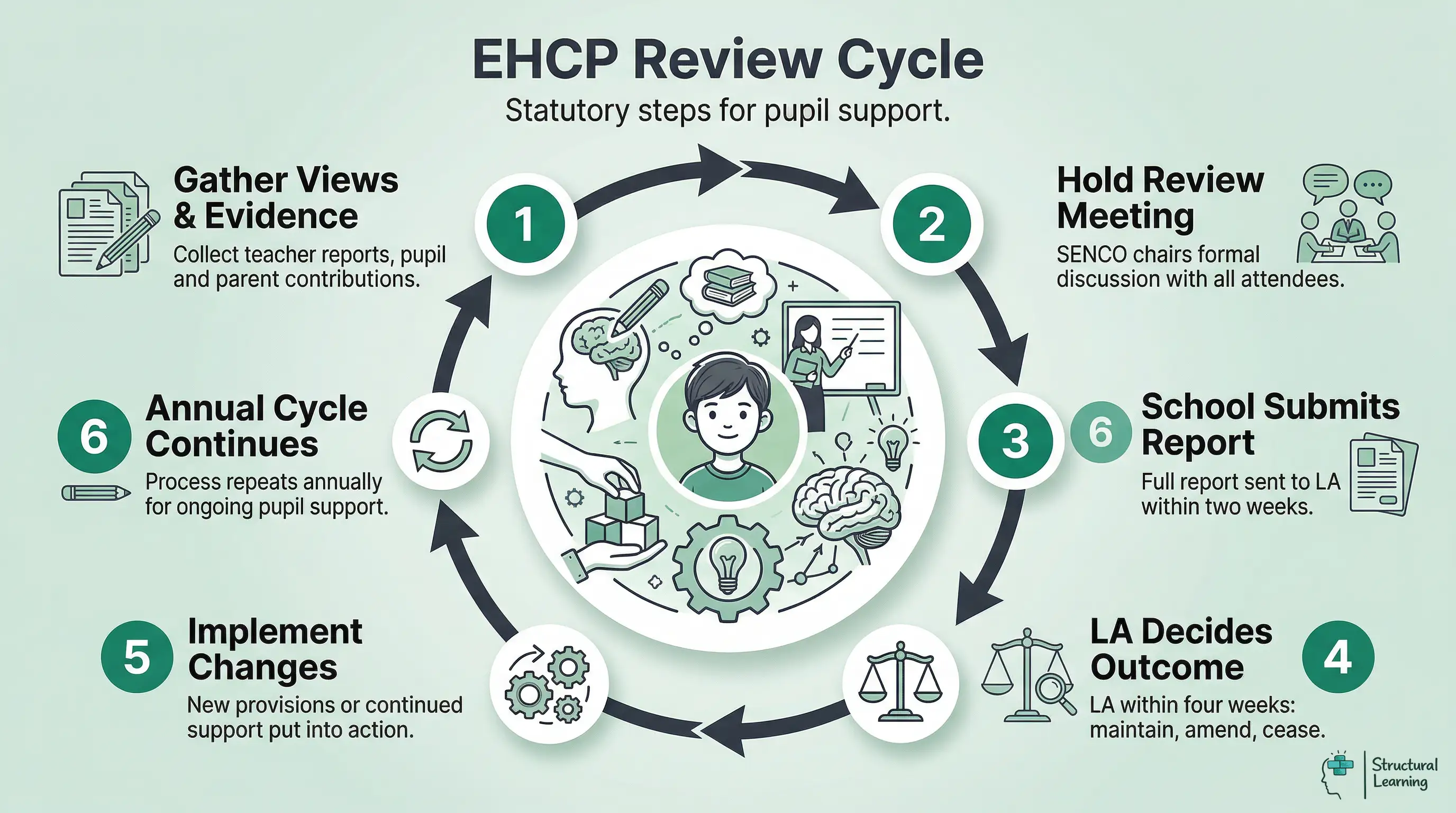
The review process has four statutory stages. Preparation comes first: the school or local authority gathers views from the child or young person, parents, teachers, health professionals and social care.
The review meeting then tests progress against the EHC plan outcomes, not just whether support hours were delivered. Within two weeks, the chair sends the report and recommendations to the local authority. Within four weeks of the review meeting, the local authority must say whether it will maintain, amend or cease the plan.
Ofsted (2021) found that many annual reviews still focus on provision delivery rather than outcome achievement. The stronger question is: what changed for the young person because of the support? A therapy block that happened but did not improve communication, attendance or independence should trigger a change in provision, not a tick in a compliance box.
Every EHCP contains specific outcomes. These are the measurable goals the plan is designed to help the child achieve. Your job in the review is to report honestly on progress towards each one. Has the child met the outcome?
Are they making progress towards it? Has progress stalled? Be specific. "He's doing well" is not useful. "He can now write three connected sentences independently, up from one at the last review" tells the meeting something it can act on.
EHCPs detail support for each learner. This includes TA time, therapy, equipment, or adjusted learning. Reviews check if provision matches the EHCP and helps the learner.
Little reading progress despite literacy help means change is needed. See if strategies or support worked with the listed provision.
The child's voice must be represented, but it should not be extracted under pressure in a room full of adults. For some learners, this means attending part of the review meeting and speaking directly.
For others, it means visual tools, sentence starters, a one-page profile, Talking Mats, symbols or a short conversation with a trusted adult before the meeting.
Ask concrete questions: What helps you start work? What makes school harder? Where do you feel safe? What do you want adults to stop doing?
A trauma-informed review treats anxiety as evidence, not misbehaviour. A learner with autism may need the timetable to feel predictable above all else. A learner with social, emotional, and mental health needs may need a safe exit route when noise or conflict becomes too much.
Parents bring the perspective that no professional can replicate. They see the child at home, in the community, and in moments of genuine success and genuine distress. Their views on progress, ongoing concerns, and aspirations for the future are a statutory part of the review. Two structured approaches for gathering these views are outlined in the section below.
From Year 9 onwards, annual reviews must include Preparation for Adulthood. The review should check whether the EHC plan is building skills for education or training, employment, independent living, community participation and health. This is not about forcing a fixed decision at age 14 (DfE, 2015, Chapter 8). Instead, it turns aspirations into teachable steps, such as travel training, supported work experience, self-advocacy in medical appointments or using assistive technology without adult prompting.
Your written contribution is the foundation of the review. Many schools use a structured staff scoring rubric that asks you to rate the learner across 20 areas on a scale of 0 to 5. This creates a consistent, comparable dataset that tracks change over time. When five staff members each complete the same rubric, the meeting has a rich, multi-perspective picture of the child.
The scoring scale works as follows: 0 means cause for serious concern, 1 is poor, 2 is satisfactory, 3 is good, 4 is very good, and 5 is excellent. Below is the full set of 20 assessment areas used in the Statutory Annual Review Tracker, organised into four domains.
Rubrics use structured professional judgement; they do not replace it. Black and Wiliam (1998) showed that assessment only improves learning when criteria are clear and teachers use the evidence to adapt the next step. A score increase is useful only when the notes explain which provision contributed to it.
Hattie (2009) reported feedback and formative evaluation as high-impact influences, but an annual review is not simply feedback to the learner. It is feedback to the adults and the system: which provision worked, which barrier remains, and what must change in the next EHC plan cycle.
Use classroom observations when completing the rubric, not assumptions. A learner's scores may vary between subjects like art and maths. Note these differences; don't average them.
This variation gives useful information. When staff compare independent scores, they can see patterns quickly. Scores that stay low show priority needs. Scores that vary suggest the context affects the learner.
Alongside the numerical scores, prepare written commentary. Describe specific examples of progress. "She now puts her hand up to answer questions in science, which she would not do in September" carries more weight than a score of 3 for participation. Include data where you have it: reading ages, spelling ages, standardised test scores, or the number of behavioural incidents compared to the previous term.
The annual review is not a meeting about the child. It is a meeting with the child and their family. The SEND Code of Practice is clear: person-centred approaches must run through the entire review process. This means gathering the learner's views and the family's views before the meeting, presenting them during it, and reflecting them in the outcomes.
Many schools use a structured parental views form sent home four weeks before the meeting. This form typically covers eight areas, designed to capture both factual updates and the parent's perspective on what matters most. The table below shows the standard questions and what each one is trying to surface.
Some schools use a second, more open-ended form that takes a person-centred approach. Rather than asking about progress in clinical terms, it asks families to reflect on what they like and admire about their child, what is working well at home and outside school, and what is not working well. This format produces richer, more personal responses that keep the child at the centre of the conversation.
The person-centred family contribution form covers seven areas. "What we like and admire about our child" starts with strengths before needs. "What we consider to be our child's achievements over the year" captures progress that school data can miss, such as sleeping through the night, joining a birthday party or walking into school without distress.
"What we would like to see our child achieve" and "our hopes for our child" feed directly into outcome-setting. The "what's working well" and "what's not working well" sections, across home and outside-school contexts, give the review meeting a fuller view of the child's life.
There is an equity risk here. Some families have more time, professional language and confidence in meetings, so they can make need sound more persuasive in law. Others may play down support needs to protect their child from a deficit label. Milton's (2012) double empathy account warns that adults can misread neurodivergent communication and frame it as a deficit, so teachers help by adding precise classroom evidence.
UNCRC Article 12 says children capable of forming their own views have the right to express those views freely in matters affecting them, with those views given due weight according to age and maturity. The Children and Families Act 2014 (Section 19) asks councils to consider learners' feelings on EHCPs. Ofsted (2021) found 31% of "requires improvement" SEND inspections lacked learner voice. Carpenter et al. (2015) and the SEND Code of Practice both highlight that genuine learner input shapes more meaningful outcomes when it is built into the review from the start (DfE, 2015).
Do not underestimate the value of sending both forms. The structured form captures the factual updates the Local Authority needs. The person-centred form captures the human story that should drive every decision. When a parent writes "we hope she will have a friend she can invite to her birthday party," that single sentence can reframe an entire discussion about social communication targets.
How you capture the learner's views depends on their age, communication needs, and preferences. Some learners will want to attend the meeting and speak for themselves. Others will prefer to contribute through a one-page profile, a video, drawings, or a conversation with a trusted adult beforehand.
The key is that their views are genuinely theirs, not interpreted or sanitised by adults. Ask open questions: What do you enjoy at school? What is hard? What would you change?
What do you want to learn next? For learners with complex communication needs, use visual supports, talking mats, or symbol-based tools to ensure their voice is heard.
The meeting itself is only the midpoint of the process. What happens afterwards determines whether the review actually leads to change.
The SENCO sends a written report to the local authority within two weeks of the review meeting and circulates it to everyone invited. The report should summarise evidence, record the views of the child or young person, parent and professionals, and recommend one of the three outcomes: maintain, amend or cease the EHC plan (DfE and DoH, 2015).
The local authority must notify its decision within four weeks of the review meeting. If it decides to maintain the plan, it should confirm this in writing. If it decides to amend, it must send proposed amendments, give the parent or young person at least 15 days to comment, and then issue the final amended EHC plan as soon as practicable.
| Domain | Assessment Area | Score (0-5) | What to Consider |
|---|---|---|---|
| Overall Coping & Progress | How well has this learner coped this academic year? | General resilience, wellbeing, adjustment to routines | |
| Progress within your subject | Attainment relative to EHCP outcomes and starting points | ||
| How well are they coping with the expectations of the school environment? | Managing transitions, school rules, environmental demands | ||
| Communication & Language | Expressive language | Ability to express thoughts, ideas, and needs verbally. Consider oracy skills | |
| Ability to understand what is being asked of him/her | Processing instructions, following multi-step directions | ||
| Ability to understand the language used in lessons | Subject-specific vocabulary, abstract concepts, figurative language | ||
| Social communication skills | Turn-taking, reading social cues, pragmatic language | ||
| Literacy skills | Reading accuracy, comprehension, writing composition | ||
| Numeracy skills | Number sense, problem-solving, mathematical reasoning | ||
| Engagement & Independence | Ability to complete tasks that he/she has been asked to do | Task completion with and without support | |
| Participation in lessons | Answering questions, joining discussions, volunteering | ||
| Engagement with learning | Motivation, curiosity, willingness to attempt challenging work | ||
| Ability to engage with teacher-led activities (not of their choosing) | Compliance, flexibility, tolerance of non-preferred tasks | ||
| Ability to work independently | Self-regulation, staying on task without adult prompting | ||
| Ability to concentrate and attend to learning | Sustained attention, executive function, managing distractions | ||
| Social & Emotional | Ability to interact with peers | Initiating interaction, responding to others, conflict resolution | |
| Evidence of friendships | Reciprocal relationships, play/socialising at break times | ||
| Ability to work with partners/groups | Collaboration, sharing resources, negotiating roles | ||
| Ability to react appropriately when faced with challenging situations | Emotional regulation, use of emotion coaching strategies, de-escalation | ||
| Ability to react appropriately in unstructured times | Break times, transitions, free choice periods |
The March 2022 High Court decision in R (L, M and P) v Devon County Council [2022] EWHC 493 (Admin) confirmed the outer limit: where a plan is to be amended, the final amended EHC plan must be issued within 12 weeks of the annual review meeting. If the local authority decides to cease the plan, the parent or young person has the right to appeal to the SEND Tribunal.
If the plan is amended, the new provision must be put in place. As a class teacher, you need to know what has changed and adjust your practice accordingly.
Has the number of support hours changed? Have new outcomes been set? Has a new therapy been added?
Read the amended plan carefully and update your provision map to reflect the changes. If the plan is maintained without changes, that does not mean nothing happened. It means the current provision is judged to be appropriate. Continue delivering it as described.
Annual reviews go wrong in predictable ways. Knowing the common pitfalls helps you avoid them.
An annual review is not a parents' evening. It is a statutory meeting with legal consequences. The discussion must focus on the EHCP outcomes, not general chat about how the child is getting on.
Before the meeting, re-read the EHCP. Know the outcomes. Know the provision. Come ready to report against them specifically.
SENCOs lead reviews, but teachers' input is key. You see each learner daily. Note engagement, executive function, relationships, and progress.
Your observations are shapes. Don't assume SENCOs know everything. Complete and submit your feedback promptly.
Ofsted's SEND review and Ministry of Justice tribunal statistics point to the same issue. In successful family appeals, annual review evidence is often weak or missing. When local authorities lose at tribunal, they face large extra costs for provision. The DfE (2023) shows that annual reviews affect learner education and finances for schools and the LA.
"He's doing better" is not evidence. "His reading age has increased from 7.2 to 8.1 since September, and he now accesses year-group texts with pre-teaching of vocabulary" is evidence. Quantify where you can.
Use dates, scores, work samples and specific examples. If progress has been limited, say so honestly and explain the barriers. The review exists to solve problems, not to paint a reassuring picture.
This is becoming more important as schools and local authorities test digital casework systems and AI-assisted drafting. DfE guidance on generative AI in education requires human oversight of AI-generated content (DfE, 2025). Generic wording such as "access to adult support as required" can slip into a plan unless a teacher adds human-level detail: the task, the setting, the trigger, the adult action and the outcome. Specific classroom evidence helps stop standardised provision that fits no young person well.
It is surprisingly common for annual reviews to happen without the child's views being genuinely represented. A form filled in by a teaching assistant who wrote what they thought the child meant is not the pupil voice.
Give the child genuine agency. Use accessible methods. Allow enough time. If a child says "I don't like my helper sitting next to me all the time," that is valuable information that should shape how support is delivered.
The annual review recommends changes. But recommendations only matter if someone acts on them.
After the meeting, check: has the Local Authority responded within four weeks? If not, chase them through the SENCO. Has the amended plan arrived?
Does it reflect what was agreed? If the plan has been maintained, are you still delivering the provision as described? The review cycle is continuous. What you do between reviews matters as much as the meeting itself.
For learners in Year 9 and above, transition planning is not optional. It is a statutory requirement. If the annual review for a Year 10 learner does not include any discussion of post-16 options, employment aspirations, or independent living skills, it has not met the legal standard.
| Question | Purpose |
|---|---|
| Have there been any significant changes in your child's life over the last 12 months? | Identifies life events (family changes, bereavement, house moves) that may affect progress or behaviour at school |
| Have there been any updates to your child's health needs? (New diagnoses/assessments) | Captures medical changes that may require EHCP amendments, such as a new ADHD diagnosis or updated sensory profile |
| I feel my child has made progress in these areas... | Surfaces progress the parent observes at home that school may not see, such as increased independence or improved social skills outside school |
| I feel my child still needs support in these areas... | Highlights ongoing concerns and areas where the parent feels provision is not yet effective |
| Short term (next 12 months), I would like my child to achieve... | Informs the setting of new EHCP outcomes, grounded in parental aspiration |
| Longer term (next 3-4 years), I would like my child to achieve... | Shapes the broader aspirational goals that guide transition planning and long-term provision |
| Do you have concerns about the health and/or social care elements of the EHCP? | Flags gaps in multi-agency provision that the school alone cannot address |
| Any other concerns, comments, or feedback? | Catches anything the structured questions miss, giving parents a space to raise what matters most to them |
Start these conversations early. They shape the outcomes that will be written into the EHCP for the remaining school years.
EHCP annual reviews are required meetings. They check if plans still meet each learner's needs. Schools, parents, and councils assess current support. The council then decides to keep, change, or end the plan (DfE, 2015, Chapter 9).
Teachers track each learner's progress against the outcomes in the plan. Academic data, social communication records, and behaviour observations all help. Examples of interventions that worked also help the SENCO understand daily classroom experiences (DfE, 2015, Chapter 9).
Under the Children and Families Act 2014, a review must take place at least once every 12 months for school-aged children. For children under the age of five, the frequency increases to every three to six months to reflect their rapid development. Schools must organise the meeting in plenty of time to meet strict local authority deadlines.
SENCOs usually chair meetings and organise staff input. Parents, teachers, and health/social care workers (as listed) must be invited. Encourage the learner to participate, either in person or via a form (DfE, 2015).
Teachers often miss linking observations to EHCP outcomes. Some overemphasise grades and miss independence skills. Waiting until the last minute leads to poor evidence (Slee, 2011). This evidence poorly shows the learner's progress.
Reviews ensure support adapts as a learner's needs change. Reviews offer a chance to celebrate progress and find areas needing help. For Year 9 learners and above, reviews plan for adulthood, living independently, and employment.
Related reading: Quantified Section F provision without a 1:1 TA
DfE (2015).
DfE (2024).
DfE and DoH (2015).
Florian (2014).
Hattie (2017).
Lamb (2009).
Norwich (2013).
Slee (2011).
Annual review guidance has limits because the statutory process is not a neutral classroom tool. Lamb (2009) found that many families experience SEND systems as adversarial, and Ofsted (2021) later reported reviews that tracked provision delivery without testing impact on outcomes. The result is a methodological weakness: schools can document hours, meetings and reports while still knowing too little about whether the EHC plan changed the young person's learning, independence or wellbeing.
There are also cultural limits. Slee (2011) and Tomlinson (2017) argue that inclusion systems can reproduce deficit thinking, especially when access to support depends on proving failure. Milton (2012) adds that autistic communication is often misread when professionals interpret it through non-autistic norms. Annual reviews therefore risk turning learner voice into adult translation unless teachers use accessible, person-centred methods.
The learning research cited in this guide also needs caution. Hattie's synthesis is useful for keeping attention on impact, but Snook et al. (2009) and Simpson (2017) criticise the averaging of very different studies into ranking tables. Black and Wiliam (1998) give a strong account of formative assessment, yet Bennett (2011) shows that its effects depend on subject knowledge, task quality and how teachers act on the evidence.
These critiques do not weaken the case for annual reviews. They sharpen it. The enduring value of the process lies in disciplined professional judgement: clear evidence, genuine family and learner voice, and a plan that changes because the child or young person has changed.
The following resources provide the statutory, empirical, and practical foundations for high-quality annual reviews.
SEND Code of Practice: 0 to 25 Years
DfE and DoH (2015). Primary statutory guidance for all schools in England
Chapter 9 outlines EHCP annual review law: timelines, roles, and Local Authority duties. All teachers helping with reviews should read this chapter. It is key for any tribunal or disagreement.
Assessment for Learning: Beyond the Black Box
Black, P. and Wiliam, D. (1998). One of the most cited works in modern educational research
Formative assessment raises learner achievement (Hattie, 2017). Effect sizes range from 0.4 to 0.7 (Black & Wiliam, 1998). Teachers can document progress for annual reviews using these principles.
and practice. Warnock, M. (1978). Special Educational Needs.
Report of the Committee of Enquiry into the Education of Handicapped Children and Young People. London: HMSO. Warnock, M. (2005).
Special Educational Needs: A New Look. London: Philosophy of Education Society of Great Britain. Norwich, B. (2008). Dilemmas of difference, inclusion and disability: international perspectives and future directions.
London: Routledge. Lewis, A. & Norwich, B. (2005). Special teaching for special children?
A study of within class grouping. London: Institute of Education, University of London.
Florian, L. (2014). What counts as evidence of inclusive practice? European Journal of Special Needs Education, 29(3), 286-294.
These seminal reports and studies have shaped understanding of special educational needs. They offer important insights into inclusive practices and the diverse needs of learners. Policy and practice development can benefit from engagement with Lamb (2009) and Warnock (1978, 2005). Norwich (2008), Lewis & Norwich (2005), and Florian (2014) also provide useful perspectives.
Lamb (2009) and Warnock (1978, 2005) reports shaped SEND understanding. Norwich (2008) and Lewis & Norwich (2005) offer further perspectives. Florian (2014) provides insights into inclusive practice evidence. These studies inform SEND policy and help teachers understand learner needs.
Lamb's inquiry showed annual reviews often fail parents (Lamb, 2009). Recommendations shaped the Children and Families Act 2014. This led to EHCPs, explaining the present review format (Children and Families Act, 2014).
Person-Centred Reviews: Research Evidence
Carpenter, B. et al. (2015). Widely cited in UK SEND practice guidance
Carpenter and colleagues argue that involving learners in annual review planning is one of the strongest levers for meaningful EHCP outcomes. Their work offers practical support for spending time on learner feedback before reviews, rather than treating reviews as adult-led paperwork exercises.
SEND Tribunal Trends: Annual Statistics
DfE (2024). Official government statistical release
DfE stats show SENCOs and teachers important SEND context. The 2024 data shows 576,000 EHCPs, up 78% since 2016. Tribunal success for families reached 93% (DfE, 2024). These figures highlight the need for effective annual reviews.