Updated on
February 26, 2026
IEP Goal Bank: Neurodiversity-Affirming Goals for Every Domain
|
February 26, 2026


Updated on
February 26, 2026
|
February 26, 2026
A 2024 survey by the Center for Democracy and Technology found that 57% of special education teachers have already used AI tools to help write IEP goals. The problem is not adoption. The problem is quality. Generic AI-generated goals often lack the specificity that IDEA requires, ignore the student's present levels of performance, and default to deficit-based language that treats neurodivergent students as problems to fix. This article provides over 30 ready-to-use IEP goals across eight domains. Every goal meets IDEA compliance standards and comes in two versions: traditional and neurodiversity-affirming. Use the interactive generator below to customize goals for your caseload, then run each one through the defensibility checker before your next IEP meeting.
The legal standard for IEP goals changed significantly with the Supreme Court ruling in Endrew F. v. Douglas County School District (2017). The Court held that schools must offer IEP goals "reasonably calculated to enable a child to make progress appropriate in light of the child's circumstances." This replaced the older, weaker standard of "some educational benefit" and raised the bar for every goal on every IEP.
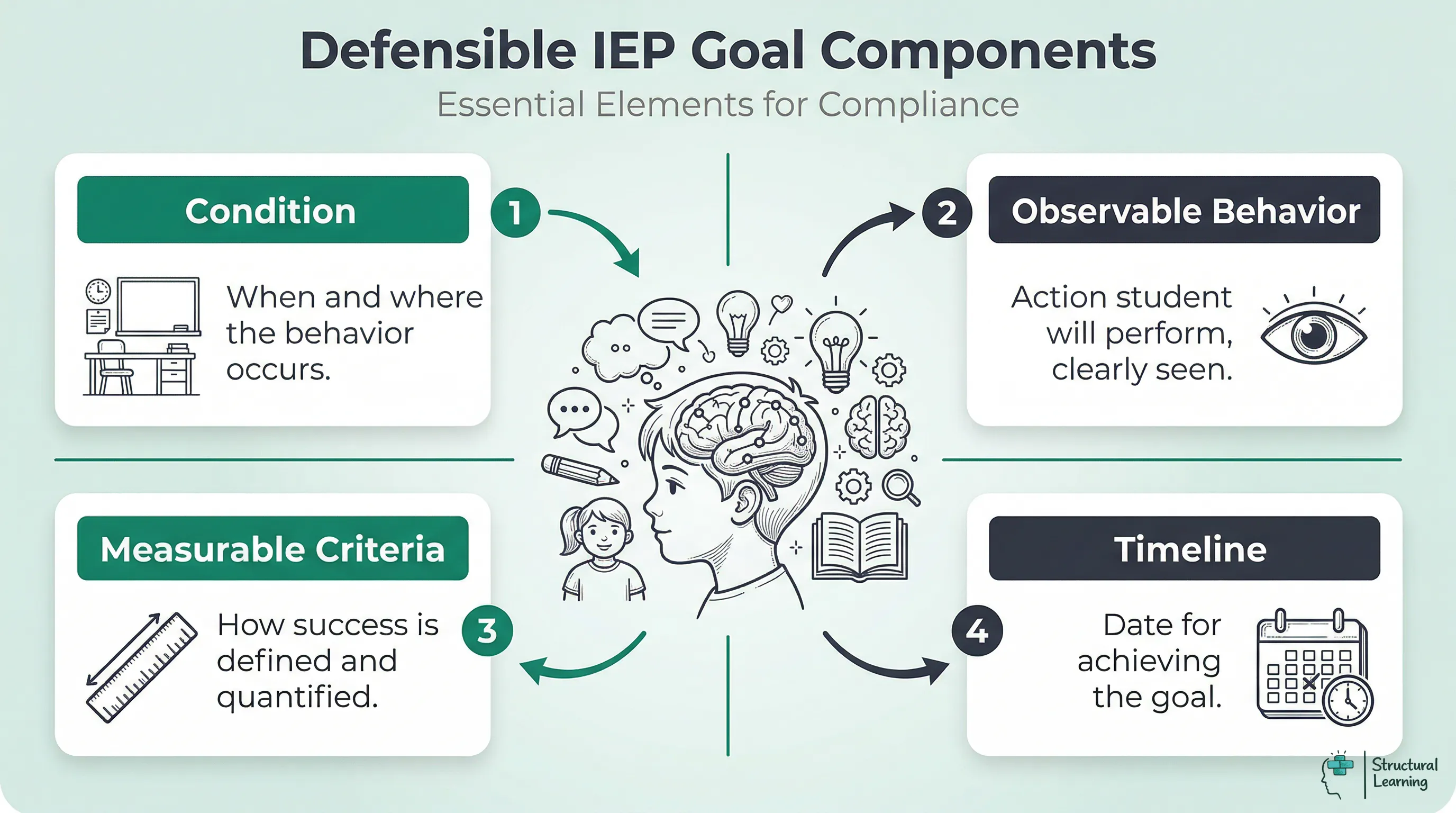
Under IDEA (20 U.S.C. Section 1414), every goal must be a measurable annual goal tied to the student's present levels of academic achievement and functional performance. If a parent challenges a goal at a due process hearing, the hearing officer will look for four components: a condition that specifies when the behavior occurs, an observable behavior the student will perform, measurable criteria that define success, and a timeline for achievement.
The SMART framework adapted for IEP goals provides a practical structure. Each goal should be Specific (identifies the exact skill and condition), Measurable (includes a percentage, frequency, or count), Achievable (realistic given the student's present level), Results-based (addresses a disability-related need), and Timed (includes a target date, typically the end of the IEP year).
The single biggest compliance error is using non-observable verbs. When a goal says a student will "understand" fractions or "improve" reading, there is no way to collect data on whether the goal was met. Replace vague language with verbs that produce countable, observable evidence.
| Observable Verbs (Use These) | Non-Observable Verbs (Avoid These) |
|---|---|
| Identify, label, list, name | Understand, know, be aware of |
| Write, produce, compose, spell | Appreciate, value, feel confident |
| Solve, calculate, compute, graph | Improve, do better, develop |
| Read aloud, decode, retell, summarize | Learn, grasp, internalize |
| Demonstrate, apply, select, use | Become more responsible, try harder |
A classroom example: A case manager writes "Student will improve math skills." This goal would not survive a due process challenge because there is no condition, no measurable criteria, and no timeline. Rewritten: "When given 20 single-digit multiplication problems in a one-minute timed probe, [Student] will solve with 90% accuracy on 4 consecutive weekly probes by June 2027." The second version tells you exactly what to measure, when to measure it, and what success looks like.
The scale of the IEP system makes measurability a national concern, not just a classroom one. According to the National Centre for Education Statistics (NCES, 2023), approximately 7.5 million students in the United States receive services under IDEA, representing 15% of total public school enrolment. Rowe et al. (2021) audited 120 IEPs across six districts and found that only 54% of goals met all four IDEA measurability criteria: condition, observable behaviour, measurable criteria, and timeline. The remaining 46% contained at least one non-observable verb, making them legally indefensible at due process. Bateman and Linden (2006), in their widely cited legal analysis of IDEA compliance, estimate that vague goals are the single most common reason hearing officers find school districts in violation, appearing in approximately 70% of substantive IEP disputes. The practical implication is straightforward: a goal that cannot be measured cannot be defended, and a goal that cannot be defended exposes the school to legal liability and, more importantly, fails the student.
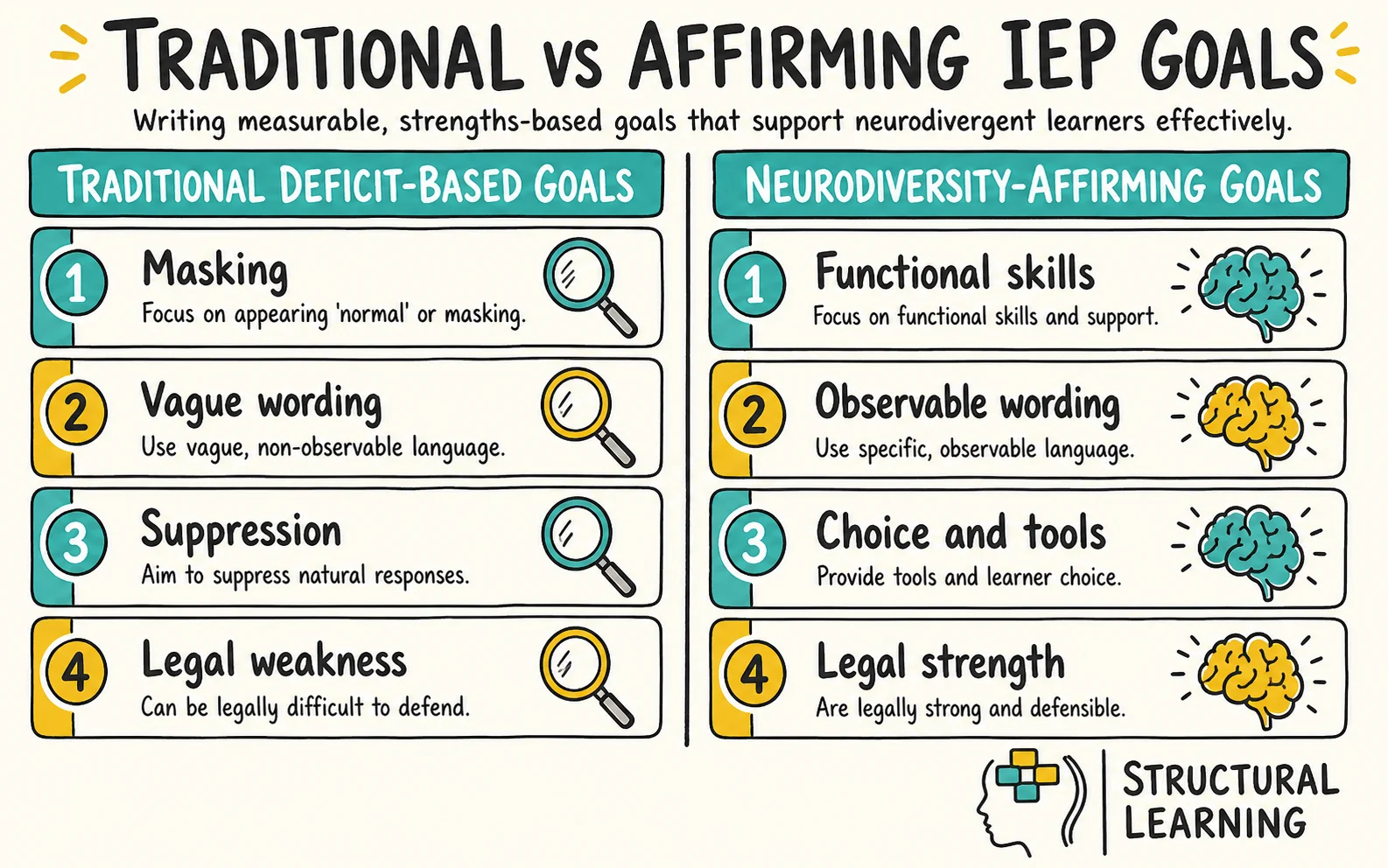
Traditional IEP goals often target the appearance of normalcy rather than actual functional outcomes. A goal requiring a student to "maintain eye contact for 30 seconds" does not teach communication. It teaches masking, and research on autistic adults shows that sustained masking contributes to burnout, anxiety, and depression (Hull et al., 2017). The neurodiversity-affirming approach, grounded in work by the Autistic Self Advocacy Network and supported by researchers like Damian Milton (2012) and Nick Walker (2014), asks a different question: What does this student need to be able to do, and how can we support them in doing it their way?
Affirming goals are not softer goals. They meet every IDEA compliance requirement. They specify conditions, use observable verbs, include measurable criteria, and set timelines. The difference is that they provide supports rather than demand suppression, and they measure functional outcomes rather than neurotypical appearance.
| Traditional Goal | Neurodiversity-Affirming Goal |
|---|---|
| Will maintain eye contact for 30 seconds during conversation in 8/10 interactions | Will demonstrate active engagement through verbal response, body orientation, or mutually agreed-upon signal in 8/10 interactions |
| Will sit still without fidgeting for 20 minutes during independent work | Will use a self-selected fidget tool or movement break and complete assigned tasks with 85% accuracy in 8/10 class periods |
| Will transition without complaining or refusing | Will use a visual schedule or countdown timer and move to the next activity within 3 minutes of the transition signal in 8/10 transitions |
| Will not cry or yell when frustrated | Will select a regulation strategy from a visual menu and return to task within 5 minutes in 8/10 occurrences |
Notice that every affirming goal in the table above is equally measurable. The teacher can still collect frequency data, calculate percentages, and graph progress. The difference is that the student receives tools and choice instead of demands to suppress natural responses. When writing goals for students with autism, ADHD, or dyslexia, start by asking: "Am I measuring what the student can do, or am I measuring how normal they appear?"
The neurodiversity paradigm that informs this approach has a growing evidence base. den Houting (2019), writing in Autism and Developmental Language Impairment, argues that the traditional deficit framework in special education consistently produces goals that target the elimination of autistic traits rather than the development of functional skills. Reviewing outcome data from 38 studies of autism interventions, den Houting found that programmes focused on behavioural suppression showed no significant long-term advantage in quality of life, employment, or independence measures, while approaches that built on existing strengths showed consistent gains across all three domains. Armstrong (2010), in his foundational text on neurodiversity, documents how shifting goal language from "will reduce" to "will use" or "will demonstrate" produces qualitatively different IEP conversations, with parents and students reporting higher engagement and ownership of the planning process. Shogren et al. (2015), in a study of 779 students with disabilities aged 14 to 21, found that students whose IEP goals included self-selected targets and strength-based framing were 2.3 times more likely to achieve those goals than students whose goals were written entirely by professionals without student input. These findings do not suggest that affirming goals are easier. They suggest that goals which reflect the student's actual strengths produce better outcomes precisely because they are more motivating and more accurately targeted.
WIDGET EMBED: iep-goal-generator
Reading IEP goals should reference the student's current instructional level and use grade-level benchmarks from established norms. Hasbrouck and Tindal (2017) provide oral reading fluency norms that most districts use as a starting point. Scarborough's Reading Rope (2001) reminds us that fluent reading depends on both word recognition (decoding, sight recognition) and language comprehension (vocabulary, background knowledge, inference). Goals that target only fluency without addressing comprehension, or vice versa, miss half the picture.
Grade 2 Fluency Goal:When given a narrative passage at the second-grade level, [Student] will read aloud at 90 words per minute with 95% accuracy on 3 consecutive weekly curriculum-based measurement probes by June 2027.
Data collection: One-minute timed oral reading with error tracking. Mark words read correctly and subtract errors for WCPM (words correct per minute). Grade 4 Comprehension Goal:When given a grade-level informational text of 600 to 800 words, [Student] will answer 5 comprehension questions addressing main idea, supporting details, and vocabulary with 80% accuracy on 4 consecutive weekly assessments by June 2027.
Data collection: Teacher-created or standardized comprehension probes scored with an answer key. Track percentage correct across weekly administrations. Grade 7 Inferential Comprehension Goal (Affirming):When given a grade-level text and a graphic organizer to organize thinking, [Student] will identify the author's purpose and support the inference with two pieces of text evidence, scoring 3 or above on a 4-point rubric in 4 of 5 consecutive assessments by June 2027.
Data collection: Rubric-scored written responses. The graphic organizer is a support, not a crutch. As the student progresses, fade the organizer and note in progress reports whether fading has begun.Teachers can connect reading goals to broader working memory supports. Students with limited working memory capacity often lose comprehension not because they cannot decode, but because they cannot hold decoded words in memory long enough to build meaning. Structured tools like advance organizers and pre-reading vocabulary reduce the cognitive load of reading tasks.
Written expression goals should separate composition from transcription. A student with dysgraphia may have strong ideas but struggle with the motor demands of handwriting. Goals that conflate the two mask the student's actual writing ability.
Grade 3 Sentence-Level Goal:When given a writing prompt and a sentence starter, [Student] will write 3 complete sentences with correct capitalization and end punctuation in 8 of 10 writing samples as scored by a mechanics checklist by June 2027.
Grade 5 Paragraph-Level Goal (Affirming):When given a topic and access to a graphic organizer or speech-to-text tool, [Student] will compose a paragraph with a topic sentence, 3 supporting details, and a concluding sentence, scoring 3 or above on a 4-point writing rubric in 4 of 5 consecutive writing samples by June 2027.
The affirming version separates the idea-generation task from the physical writing task. The student can use dictation, typing, or handwriting. What matters is the quality of the composition. Grade 8 Essay-Level Goal:When given a persuasive writing prompt and 30 minutes, [Student] will produce a 5-paragraph essay that includes a thesis statement, 3 body paragraphs with evidence, and a conclusion, scoring 3 or above on a district writing rubric in 3 of 4 consecutive monthly writing assessments by June 2027.
Data collection for written expression works best with rubric-based scoring. Create a simple rubric that rates organization, content, mechanics, and fluency on a 4-point scale. Score samples consistently and graph the total rubric score over time. This gives you richer data than a single percentage. Using scaffolding strategies such as graphic organizers, sentence frames, and paragraph templates helps students build structure before writing.
Mathematics goals should follow the concrete-representational-abstract (CRA) sequence (Witzel, Mercer, & Miller, 2003). Students with dyscalculia or math learning disabilities often need explicit instruction at the concrete level (manipulatives) before moving to representations (drawings, number lines) and then to abstract computation. Goals that skip straight to abstract computation set students up to fail.
The evidence for the CRA sequence is well-established. Witzel, Mercer and Miller (2003) conducted a controlled study of 358 students with mathematics learning disabilities and found that students taught using the CRA sequence outperformed control students using abstract instruction alone by an average of 43% on post-test measures of equation-solving accuracy. The effect was particularly strong for students with dyscalculia. Mazzocco and Myers (2003) estimate that dyscalculia affects between 5% and 8% of the school-age population, a prevalence comparable to dyslexia, yet IEP goal banks rarely include domain-specific guidance for mathematics learning differences at the depth they provide for literacy. Geary (2011), synthesising 20 years of mathematics disability research, identifies number sense deficits (difficulty with magnitude comparison and number line understanding) as the most persistent barrier, and recommends that IEP goals for students with dyscalculia explicitly target number sense development at the representational stage before moving to abstract computation. A goal that names the specific representation strategy, such as "using a number line" or "using base-ten blocks," is both more legally defensible and more educationally precise than a goal that simply specifies the computation level.
Grade 2 Computation Goal:When given 20 single-digit addition and subtraction problems in a one-minute timed probe, [Student] will solve with 85% accuracy on 4 consecutive weekly probes by June 2027.
Grade 4 Problem-Solving Goal (Affirming):When given a grade-level word problem and access to manipulatives or a number line, [Student] will identify the correct operation, show work using a strategy of their choice (drawing, equation, or model), and solve with 80% accuracy on 4 consecutive weekly problem-solving probes by June 2027.
The affirming version allows the student to choose their representation. Some students solve accurately with drawings; others need physical manipulatives. The goal measures the mathematical thinking, not the specific method. Grade 6 Fractions Goal:When given 10 problems involving addition and subtraction of fractions with unlike denominators, [Student] will find common denominators and compute with 80% accuracy on 3 consecutive bi-weekly probes by June 2027.
Data collection for math uses timed probes (CBM) for computation fluency and scored problem sets for problem-solving. Graph digits correct per minute for computation goals. For problem-solving, use a rubric that scores strategy selection, computation accuracy, and explanation quality. Retrieval practice through regular low-stakes quizzing helps students build math fact fluency while providing natural data collection opportunities.
Executive function (EF) is not a single skill. Barkley (2012) describes EF as a set of self-directed actions including inhibition, working memory, emotional self-regulation, planning, and task monitoring. IEP goals that say "will improve organizational skills" are too broad. Effective EF goals target one specific function, name the external support the student will use, and measure a concrete outcome.
Task Initiation Goal (Grade 4):When given a classroom assignment and a visual task card showing the first step, [Student] will begin the assignment within 2 minutes of the direction in 8 of 10 observed opportunities over a 4-week period by June 2027.
Data collection: Teacher records start time using a simple timestamp log. Compare assignment distribution time to first-action time. Organization Goal (Grade 6, Affirming):When given a multi-step project with a teacher-provided planning template, [Student] will break the project into at least 3 steps, identify materials needed for each step, and submit each component by the scheduled date in 8 of 10 assignments over one semester by June 2027.
The affirming version provides the structure (planning template) rather than expecting the student to generate organizational systems independently. For students with ADHD, external structure compensates for the executive function differences that make internal organization unreliable. Time Management Goal (Grade 8):When given a 45-minute class period and a task list, [Student] will use a timer or schedule to allocate time across tasks, complete at least 80% of assigned work within the period, and self-rate time use accuracy on a 3-point scale in 7 of 10 class periods by June 2027.
The self-rating component builds metacognitive awareness. Over time, track whether the student's self-ratings align with actual completion rates. When they do, the student is developing accurate self-monitoring, a skill that transfers across settings. For a deeper look at how executive function domains interact in the classroom, see the 11-domain EF audit framework.
Social-emotional goals should teach regulation strategies, not suppress emotional responses. The Zones of Regulation framework (Kuypers, 2011) gives students a shared vocabulary for their internal states (blue, green, yellow, red zones) and connects each zone to specific strategies. Goals that reference this framework give students language for self-monitoring.
Emotion Regulation Goal (Grade 3):When noticing signs of frustration (identified through Zones of Regulation check-in), [Student] will select a calming strategy from a visual menu (deep breathing, movement break, quiet space, or talking with a trusted adult) and return to the activity within 5 minutes in 8 of 10 occurrences over a 3-month period by May 2027.
Perspective-Taking Goal (Grade 5, Affirming):During structured group activities, [Student] will identify how a peer might feel about a situation by stating one possible emotion and one reason ("They might feel ___ because ___") with 80% accuracy on teacher observation checklists across 4 consecutive weeks by June 2027.
The affirming version does not require the student to "read" facial expressions in real time, which is difficult for many autistic students. Instead, it teaches a verbal reasoning framework that works across communication styles. Conflict Resolution Goal (Grade 7):When a peer disagreement occurs, [Student] will use a taught conflict resolution sequence (state the problem, listen to the other person, suggest a solution) with adult facilitation in 7 of 10 observed conflicts over a 2-month period by April 2027.
Data collection for social-emotional goals relies on structured observation. Use a simple tally sheet or event recording form. Record the antecedent (what happened before), the behavior (what the student did), and the outcome (how it resolved). The formative assessment data you collect during these observations is the evidence base for IEP progress reports.
Behavior goals should teach replacement skills, not just eliminate unwanted behavior. A goal that says "will reduce off-task behavior" does not tell the student what to do instead. Effective behavior goals name the replacement behavior, provide the support structure, and measure both the replacement behavior and task outcomes.
On-Task Behavior Goal (Grade 3):During independent work periods of 15 minutes, [Student] will remain in the assigned area, engage with materials, and complete at least 70% of the assigned task, using a visual checklist to self-monitor, in 8 of 10 observed periods over 6 weeks by May 2027.
Transition Goal (Grade 5, Affirming):When given a 2-minute warning before transitions, [Student] will use a transition support (visual schedule, countdown timer, or movement break) and move to the next activity within 3 minutes of the transition signal, with no more than 1 adult prompt, in 8 of 10 transitions across a 4-week period by April 2027.
The traditional version of this goal would say "will transition without complaining or refusing." The affirming version gives the student tools and measures the functional outcome: did they get to the next activity within a reasonable timeframe? Replacement Behavior Goal (Grade 6):When feeling the urge to leave the assigned area, [Student] will use a break card to request a 3-minute movement break and return to the task independently, in 8 of 10 instances as tracked on a daily behavior log over 8 weeks by June 2027.
Differentiation strategies apply to behavior goals too. A break card works for one student; a visual timer works for another. The goal structure stays the same, but the specific support tool should be individualized based on what the student and the team agree works best. Creating SEND-friendly environments means building these supports into the classroom structure rather than treating them as special accommodations.
Communication goals cover expressive language (what the student produces), receptive language (what the student understands), pragmatic language (social use of language), and augmentative and alternative communication (AAC). A common misconception is that providing AAC devices will prevent a student from developing speech. Research by Millar, Light, and Schlosser (2006) found the opposite: AAC use is associated with gains in natural speech production, not losses. Goals should never withhold communication tools as motivation to speak.
Expressive Language Goal (Grade 2):When asked an open-ended question about a picture or story, [Student] will respond using a complete sentence of 4 or more words with correct subject-verb-object structure in 8 of 10 opportunities across 4 speech sessions by June 2027.
Pragmatic Language Goal (Grade 4, Affirming):During structured peer activities, [Student] will initiate or respond to a peer's comment with 2 to 3 related statements, using verbal speech, AAC device, or a combination, in 6 of 10 observed interactions across a 2-month period by May 2027.
The affirming version removes the requirement to use verbal speech exclusively. For students who use AAC, communication is communication regardless of the modality. AAC Goal (Grade 3):When given access to a speech-generating device across classroom activities, [Student] will independently navigate to the correct category and select symbols to produce 3-word requests or comments in 8 of 10 communication opportunities over 4 consecutive weeks by June 2027.
Data collection for communication goals often involves event recording during speech sessions and structured classroom observations. The speech-language pathologist typically leads data collection, but classroom teachers should also track generalization. Record whether the student uses communication skills during academic instruction, not just during pull-out therapy. Understanding how special educational needs interact with communication development helps the whole team write more integrated goals.
Self-advocacy is a learned skill, not a personality trait. Test, Fowler, Wood, Brewer, and Eddy (2005) found that students who received explicit self-advocacy instruction showed improved academic outcomes, higher self-determination, and better post-secondary outcomes. For secondary students, IDEA requires transition goals related to post-secondary education, employment, and independent living. These goals should prepare the student to participate actively in their own IEP meetings and to communicate their needs in settings where a case manager will not be present.
Accommodation Request Goal (Grade 5):When facing an academic challenge, [Student] will identify the specific need (extra time, quiet space, repeated directions) and request the accommodation from the teacher using a sentence stem ("I need ___ because ___") in 8 of 10 scenarios over a 3-month period by June 2027.
IEP Participation Goal (Grade 8, Affirming):During the annual IEP meeting, [Student] will present 2 of their IEP goals in their own words, describe their current progress using data shared by teachers, and state one personal strength and one area they want to work on, with preparation support from their case manager, by June 2027.
The affirming version includes preparation support. Expecting a student to present at their IEP meeting without rehearsal is like expecting a teacher to deliver a lesson without planning. The goal builds toward independence while acknowledging current support needs. Post-Secondary Planning Goal (Grade 10):By June 2027, [Student] will research 3 post-secondary options aligned with their interests (college program, vocational training, or employment), complete a comparison using a provided template, and present their preferred option and reasons to the IEP team.
Data collection for self-advocacy goals uses observation checklists, role-play assessments, and IEP meeting participation rubrics. Track both prompted and unprompted instances of self-advocacy to measure growth toward independence.
The defensibility checker evaluates any IEP goal against six criteria drawn directly from IDEA requirements and the Endrew F. standard. It does not replace your professional judgment. It flags gaps that a hearing officer would notice.
The six checkpoints are: (1) Is the behavior observable? (2) Are there measurable criteria? (3) Is a condition specified? (4) Is there a timeline? (5) Does the goal appear individualized rather than templated? (6) Is the language affirming rather than deficit-focused?
Here is an example. A teacher enters: "By June 2027, Student will improve reading comprehension." The checker flags three issues. "Improve" is not observable. There are no measurable criteria (no percentage, frequency, or rubric score). There is no condition specifying the reading level or type of text. The suggested revision: "When given a grade-level informational text of 500 to 700 words, [Student] will answer 4 of 5 comprehension questions about main idea and supporting details with 80% accuracy on 4 consecutive weekly probes by June 2027."
Run every goal through the checker before the IEP meeting. It takes 30 seconds per goal and catches the errors that lead to due process complaints.
Writing a strong goal is the first step. Monitoring progress toward that goal is what makes the goal meaningful. Without data, you cannot know whether your instruction is working, and you cannot defend the IEP at a review meeting.
Curriculum-Based Measurement (CBM) is the most efficient method for academic goals. For reading, use one-minute oral reading fluency probes administered weekly. For math, use one-minute computation probes. For writing, use three-minute writing prompts scored for total words written, correct word sequences, or both. CBM is standardized, quick, and produces data points that are easy to graph. Running records provide richer data for reading goals. The teacher records every word the student reads, marks errors and self-corrections, and calculates accuracy percentage and error patterns. Running records take longer than CBM probes but reveal the specific decoding strategies the student is using or avoiding. Rubric scoring works best for written expression, problem-solving, and social-emotional goals where quality matters more than speed. Use a consistent 4-point rubric aligned to the goal criteria. Score samples at regular intervals (weekly or bi-weekly) and graph the scores. The 3-data-point rule is your decision-making tool. If 3 consecutive data points fall below the aim line (the trajectory needed to reach the annual goal), change the instruction. Do not wait for a quarterly progress report to discover that a student is falling behind. Weekly monitoring with the 3-data-point rule allows you to adjust interventions within weeks, not months.Graph every data point. A simple line graph with the aim line and actual performance tells the story of the student's progress more clearly than any narrative progress report. Share the graph with parents at every IEP meeting. It is the strongest evidence you have that instruction is individualized and responsive.
The data on progress monitoring frequency and goal attainment are compelling. Fuchs et al. (1989), in a landmark study of 39 teachers and 177 students with learning disabilities, found that students whose teachers used weekly curriculum-based measurement and applied the data to instructional decisions achieved learning gains 2.0 standard deviations higher than students whose teachers monitored progress at quarterly intervals only. More recently, Wehmeyer et al. (2012), studying 312 secondary students with intellectual disability, found that students who participated actively in monitoring their own progress toward self-selected IEP goals achieved significantly better transition outcomes at age 21, including higher rates of employment (38% versus 22%) and independent living (47% versus 31%), compared to students in traditionally managed IEP processes. The self-determination framework that underpins student-involved progress monitoring is not simply a values position. It is a practice with measurable long-term benefits. Konrad, Fowler, Walker, Test and Wood (2007) conducted a systematic review of 20 studies of student-involved IEP meetings and found that student participation was associated with increased goal achievement rates in 17 of the 20 studies, with an average improvement in goal attainment of 31 percentage points compared to adult-only IEP processes.
The CDT survey finding that 57% of special education teachers use AI for IEP work should raise a practical concern: where is the student data going? When a teacher types a student's name, disability diagnosis, and present levels of performance into ChatGPT or a similar tool, that data is uploaded to a third-party server. Without a signed Data Processing Agreement between the school and the AI vendor, this is a FERPA violation under 20 U.S.C. Section 1232g.
The safest approach is to use tools that process data on your device rather than sending it to external servers. Client-side tools keep student information in your browser. No data is transmitted, stored, or used for model training. This eliminates FERPA risk by design.
If your school does adopt a server-based AI tool for IEP writing, verify that the vendor has a signed DPA specifying encryption in transit and at rest, automatic data deletion within 30 days, and a commitment that student data will never be used to train AI models. Document in the IEP that AI-assisted goal writing was used and that the teacher reviewed, customized, and approved every goal. Transparency protects both the student and the school.
The scale of AI adoption in IEP writing is accelerating faster than compliance frameworks can keep pace. The Center for Democracy and Technology (CDT, 2024) survey found that among the 57% of special education teachers already using AI tools, only 23% had received any formal training on FERPA compliance in the context of AI tools, and only 14% had verified that their school had a signed Data Processing Agreement with the AI vendor they were using. Leroy and colleagues (2023), analysing IEP documentation practices in 12 US districts, found that AI-generated goals were adopted without modification in approximately 31% of cases, meaning that the individualization requirement at the heart of IDEA was not met. This creates compounded risk: a FERPA violation at the data input stage and an IDEA violation at the goal quality stage. The safest and most compliant workflow is to use AI as a first-draft generator, then edit every goal against the student's specific present levels of performance, verify that all four IDEA components are present, and document the review process in meeting notes. The tool is not the IEP. The educator's professional judgement is.
Use this free, interactive tool to build neurodiversity-affirming, standards-aligned IEP goals. All processing happens in your browser.
These peer-reviewed studies and authoritative texts form the evidence base for effective, legally defensible IEP goal writing.
Quality Indicators for Individualized Education Program Goals View study
Rowe, D. A., Mazzotti, V. L., Alverson, C. Y. and Kelley, K. R. (2021). Remedial and Special Education. 120 IEPs audited across six districts.
Rowe and colleagues audited 120 IEPs across six school districts to assess measurability, specificity, and IDEA compliance. They found that only 54% of goals met all four required criteria. The paper provides a validated quality indicator checklist that IEP teams can apply before finalising any goal, making it directly practical for case managers preparing for annual reviews or due process hearings.
Self-Determination and Positive Adult Outcomes View study
Shogren, K. A., Wehmeyer, M. L., Palmer, S. B., Forber-Pratt, A. J., Little, T. J. and Lopez, S. (2015). Journal of Special Education. 779 students with disabilities aged 14 to 21.
This large-scale study found that students whose IEP goals incorporated self-selected targets and strength-based framing were 2.3 times more likely to achieve those goals than students whose goals were written exclusively by professionals. The findings provide quantitative support for student-involved IEP processes and challenge the assumption that professional expertise alone produces the best-quality goals.
Neurodiversity: An Insider's Perspective View study
den Houting, J. (2019). Autism and Developmental Language Impairment. Systematic review of 38 intervention studies.
den Houting reviews 38 studies of autism interventions and finds that behavioural suppression approaches showed no significant long-term advantage in quality of life, employment, or independence, while strength-based approaches showed consistent gains across all three domains. The paper is the most rigorous published justification for the paradigm shift from deficit-based to affirming IEP goal writing, grounding a values argument in outcome data.
Effects of Curriculum-Based Measurement on Teachers' Instructional Planning View study
Fuchs, L. S., Fuchs, D. and Hamlett, C. L. (1989). Journal of Learning Disabilities. 39 teachers, 177 students with learning disabilities.
Fuchs and colleagues demonstrate that students whose teachers used weekly curriculum-based measurement achieved learning gains 2.0 standard deviations higher than students monitored quarterly. This is one of the most-cited studies on progress monitoring frequency and directly supports the weekly data collection cycle that best-practice IEP goal writing requires. The effect sizes reported here remain among the largest in the special education intervention literature.
The Self-Determined Learning Model of Instruction View study
Wehmeyer, M. L., Palmer, S. B., Shogren, K., Williams-Diehm, K. and Soukup, J. H. (2012). Journal of Developmental and Physical Disabilities. 312 secondary students with intellectual disability.
Wehmeyer and colleagues followed 312 secondary students with intellectual disability and found that those who participated in self-directed IEP goal monitoring achieved significantly better transition outcomes at age 21, including higher rates of employment (38% versus 22%) and independent living (47% versus 31%). The study provides the strongest published evidence base for student-involved IEP processes and the self-determination principles that underpin neurodiversity-affirming goal writing.
A 2024 survey by the Center for Democracy and Technology found that 57% of special education teachers have already used AI tools to help write IEP goals. The problem is not adoption. The problem is quality. Generic AI-generated goals often lack the specificity that IDEA requires, ignore the student's present levels of performance, and default to deficit-based language that treats neurodivergent students as problems to fix. This article provides over 30 ready-to-use IEP goals across eight domains. Every goal meets IDEA compliance standards and comes in two versions: traditional and neurodiversity-affirming. Use the interactive generator below to customize goals for your caseload, then run each one through the defensibility checker before your next IEP meeting.
The legal standard for IEP goals changed significantly with the Supreme Court ruling in Endrew F. v. Douglas County School District (2017). The Court held that schools must offer IEP goals "reasonably calculated to enable a child to make progress appropriate in light of the child's circumstances." This replaced the older, weaker standard of "some educational benefit" and raised the bar for every goal on every IEP.
Under IDEA (20 U.S.C. Section 1414), every goal must be a measurable annual goal tied to the student's present levels of academic achievement and functional performance. If a parent challenges a goal at a due process hearing, the hearing officer will look for four components: a condition that specifies when the behavior occurs, an observable behavior the student will perform, measurable criteria that define success, and a timeline for achievement.
The SMART framework adapted for IEP goals provides a practical structure. Each goal should be Specific (identifies the exact skill and condition), Measurable (includes a percentage, frequency, or count), Achievable (realistic given the student's present level), Results-based (addresses a disability-related need), and Timed (includes a target date, typically the end of the IEP year).
The single biggest compliance error is using non-observable verbs. When a goal says a student will "understand" fractions or "improve" reading, there is no way to collect data on whether the goal was met. Replace vague language with verbs that produce countable, observable evidence.
| Observable Verbs (Use These) | Non-Observable Verbs (Avoid These) |
|---|---|
| Identify, label, list, name | Understand, know, be aware of |
| Write, produce, compose, spell | Appreciate, value, feel confident |
| Solve, calculate, compute, graph | Improve, do better, develop |
| Read aloud, decode, retell, summarize | Learn, grasp, internalize |
| Demonstrate, apply, select, use | Become more responsible, try harder |
A classroom example: A case manager writes "Student will improve math skills." This goal would not survive a due process challenge because there is no condition, no measurable criteria, and no timeline. Rewritten: "When given 20 single-digit multiplication problems in a one-minute timed probe, [Student] will solve with 90% accuracy on 4 consecutive weekly probes by June 2027." The second version tells you exactly what to measure, when to measure it, and what success looks like.
The scale of the IEP system makes measurability a national concern, not just a classroom one. According to the National Centre for Education Statistics (NCES, 2023), approximately 7.5 million students in the United States receive services under IDEA, representing 15% of total public school enrolment. Rowe et al. (2021) audited 120 IEPs across six districts and found that only 54% of goals met all four IDEA measurability criteria: condition, observable behaviour, measurable criteria, and timeline. The remaining 46% contained at least one non-observable verb, making them legally indefensible at due process. Bateman and Linden (2006), in their widely cited legal analysis of IDEA compliance, estimate that vague goals are the single most common reason hearing officers find school districts in violation, appearing in approximately 70% of substantive IEP disputes. The practical implication is straightforward: a goal that cannot be measured cannot be defended, and a goal that cannot be defended exposes the school to legal liability and, more importantly, fails the student.
Traditional IEP goals often target the appearance of normalcy rather than actual functional outcomes. A goal requiring a student to "maintain eye contact for 30 seconds" does not teach communication. It teaches masking, and research on autistic adults shows that sustained masking contributes to burnout, anxiety, and depression (Hull et al., 2017). The neurodiversity-affirming approach, grounded in work by the Autistic Self Advocacy Network and supported by researchers like Damian Milton (2012) and Nick Walker (2014), asks a different question: What does this student need to be able to do, and how can we support them in doing it their way?
Affirming goals are not softer goals. They meet every IDEA compliance requirement. They specify conditions, use observable verbs, include measurable criteria, and set timelines. The difference is that they provide supports rather than demand suppression, and they measure functional outcomes rather than neurotypical appearance.
| Traditional Goal | Neurodiversity-Affirming Goal |
|---|---|
| Will maintain eye contact for 30 seconds during conversation in 8/10 interactions | Will demonstrate active engagement through verbal response, body orientation, or mutually agreed-upon signal in 8/10 interactions |
| Will sit still without fidgeting for 20 minutes during independent work | Will use a self-selected fidget tool or movement break and complete assigned tasks with 85% accuracy in 8/10 class periods |
| Will transition without complaining or refusing | Will use a visual schedule or countdown timer and move to the next activity within 3 minutes of the transition signal in 8/10 transitions |
| Will not cry or yell when frustrated | Will select a regulation strategy from a visual menu and return to task within 5 minutes in 8/10 occurrences |
Notice that every affirming goal in the table above is equally measurable. The teacher can still collect frequency data, calculate percentages, and graph progress. The difference is that the student receives tools and choice instead of demands to suppress natural responses. When writing goals for students with autism, ADHD, or dyslexia, start by asking: "Am I measuring what the student can do, or am I measuring how normal they appear?"
The neurodiversity paradigm that informs this approach has a growing evidence base. den Houting (2019), writing in Autism and Developmental Language Impairment, argues that the traditional deficit framework in special education consistently produces goals that target the elimination of autistic traits rather than the development of functional skills. Reviewing outcome data from 38 studies of autism interventions, den Houting found that programmes focused on behavioural suppression showed no significant long-term advantage in quality of life, employment, or independence measures, while approaches that built on existing strengths showed consistent gains across all three domains. Armstrong (2010), in his foundational text on neurodiversity, documents how shifting goal language from "will reduce" to "will use" or "will demonstrate" produces qualitatively different IEP conversations, with parents and students reporting higher engagement and ownership of the planning process. Shogren et al. (2015), in a study of 779 students with disabilities aged 14 to 21, found that students whose IEP goals included self-selected targets and strength-based framing were 2.3 times more likely to achieve those goals than students whose goals were written entirely by professionals without student input. These findings do not suggest that affirming goals are easier. They suggest that goals which reflect the student's actual strengths produce better outcomes precisely because they are more motivating and more accurately targeted.
WIDGET EMBED: iep-goal-generator
Reading IEP goals should reference the student's current instructional level and use grade-level benchmarks from established norms. Hasbrouck and Tindal (2017) provide oral reading fluency norms that most districts use as a starting point. Scarborough's Reading Rope (2001) reminds us that fluent reading depends on both word recognition (decoding, sight recognition) and language comprehension (vocabulary, background knowledge, inference). Goals that target only fluency without addressing comprehension, or vice versa, miss half the picture.
Grade 2 Fluency Goal:When given a narrative passage at the second-grade level, [Student] will read aloud at 90 words per minute with 95% accuracy on 3 consecutive weekly curriculum-based measurement probes by June 2027.
Data collection: One-minute timed oral reading with error tracking. Mark words read correctly and subtract errors for WCPM (words correct per minute). Grade 4 Comprehension Goal:When given a grade-level informational text of 600 to 800 words, [Student] will answer 5 comprehension questions addressing main idea, supporting details, and vocabulary with 80% accuracy on 4 consecutive weekly assessments by June 2027.
Data collection: Teacher-created or standardized comprehension probes scored with an answer key. Track percentage correct across weekly administrations. Grade 7 Inferential Comprehension Goal (Affirming):When given a grade-level text and a graphic organizer to organize thinking, [Student] will identify the author's purpose and support the inference with two pieces of text evidence, scoring 3 or above on a 4-point rubric in 4 of 5 consecutive assessments by June 2027.
Data collection: Rubric-scored written responses. The graphic organizer is a support, not a crutch. As the student progresses, fade the organizer and note in progress reports whether fading has begun.Teachers can connect reading goals to broader working memory supports. Students with limited working memory capacity often lose comprehension not because they cannot decode, but because they cannot hold decoded words in memory long enough to build meaning. Structured tools like advance organizers and pre-reading vocabulary reduce the cognitive load of reading tasks.
Written expression goals should separate composition from transcription. A student with dysgraphia may have strong ideas but struggle with the motor demands of handwriting. Goals that conflate the two mask the student's actual writing ability.
Grade 3 Sentence-Level Goal:When given a writing prompt and a sentence starter, [Student] will write 3 complete sentences with correct capitalization and end punctuation in 8 of 10 writing samples as scored by a mechanics checklist by June 2027.
Grade 5 Paragraph-Level Goal (Affirming):When given a topic and access to a graphic organizer or speech-to-text tool, [Student] will compose a paragraph with a topic sentence, 3 supporting details, and a concluding sentence, scoring 3 or above on a 4-point writing rubric in 4 of 5 consecutive writing samples by June 2027.
The affirming version separates the idea-generation task from the physical writing task. The student can use dictation, typing, or handwriting. What matters is the quality of the composition. Grade 8 Essay-Level Goal:When given a persuasive writing prompt and 30 minutes, [Student] will produce a 5-paragraph essay that includes a thesis statement, 3 body paragraphs with evidence, and a conclusion, scoring 3 or above on a district writing rubric in 3 of 4 consecutive monthly writing assessments by June 2027.
Data collection for written expression works best with rubric-based scoring. Create a simple rubric that rates organization, content, mechanics, and fluency on a 4-point scale. Score samples consistently and graph the total rubric score over time. This gives you richer data than a single percentage. Using scaffolding strategies such as graphic organizers, sentence frames, and paragraph templates helps students build structure before writing.
Mathematics goals should follow the concrete-representational-abstract (CRA) sequence (Witzel, Mercer, & Miller, 2003). Students with dyscalculia or math learning disabilities often need explicit instruction at the concrete level (manipulatives) before moving to representations (drawings, number lines) and then to abstract computation. Goals that skip straight to abstract computation set students up to fail.
The evidence for the CRA sequence is well-established. Witzel, Mercer and Miller (2003) conducted a controlled study of 358 students with mathematics learning disabilities and found that students taught using the CRA sequence outperformed control students using abstract instruction alone by an average of 43% on post-test measures of equation-solving accuracy. The effect was particularly strong for students with dyscalculia. Mazzocco and Myers (2003) estimate that dyscalculia affects between 5% and 8% of the school-age population, a prevalence comparable to dyslexia, yet IEP goal banks rarely include domain-specific guidance for mathematics learning differences at the depth they provide for literacy. Geary (2011), synthesising 20 years of mathematics disability research, identifies number sense deficits (difficulty with magnitude comparison and number line understanding) as the most persistent barrier, and recommends that IEP goals for students with dyscalculia explicitly target number sense development at the representational stage before moving to abstract computation. A goal that names the specific representation strategy, such as "using a number line" or "using base-ten blocks," is both more legally defensible and more educationally precise than a goal that simply specifies the computation level.
Grade 2 Computation Goal:When given 20 single-digit addition and subtraction problems in a one-minute timed probe, [Student] will solve with 85% accuracy on 4 consecutive weekly probes by June 2027.
Grade 4 Problem-Solving Goal (Affirming):When given a grade-level word problem and access to manipulatives or a number line, [Student] will identify the correct operation, show work using a strategy of their choice (drawing, equation, or model), and solve with 80% accuracy on 4 consecutive weekly problem-solving probes by June 2027.
The affirming version allows the student to choose their representation. Some students solve accurately with drawings; others need physical manipulatives. The goal measures the mathematical thinking, not the specific method. Grade 6 Fractions Goal:When given 10 problems involving addition and subtraction of fractions with unlike denominators, [Student] will find common denominators and compute with 80% accuracy on 3 consecutive bi-weekly probes by June 2027.
Data collection for math uses timed probes (CBM) for computation fluency and scored problem sets for problem-solving. Graph digits correct per minute for computation goals. For problem-solving, use a rubric that scores strategy selection, computation accuracy, and explanation quality. Retrieval practice through regular low-stakes quizzing helps students build math fact fluency while providing natural data collection opportunities.
Executive function (EF) is not a single skill. Barkley (2012) describes EF as a set of self-directed actions including inhibition, working memory, emotional self-regulation, planning, and task monitoring. IEP goals that say "will improve organizational skills" are too broad. Effective EF goals target one specific function, name the external support the student will use, and measure a concrete outcome.
Task Initiation Goal (Grade 4):When given a classroom assignment and a visual task card showing the first step, [Student] will begin the assignment within 2 minutes of the direction in 8 of 10 observed opportunities over a 4-week period by June 2027.
Data collection: Teacher records start time using a simple timestamp log. Compare assignment distribution time to first-action time. Organization Goal (Grade 6, Affirming):When given a multi-step project with a teacher-provided planning template, [Student] will break the project into at least 3 steps, identify materials needed for each step, and submit each component by the scheduled date in 8 of 10 assignments over one semester by June 2027.
The affirming version provides the structure (planning template) rather than expecting the student to generate organizational systems independently. For students with ADHD, external structure compensates for the executive function differences that make internal organization unreliable. Time Management Goal (Grade 8):When given a 45-minute class period and a task list, [Student] will use a timer or schedule to allocate time across tasks, complete at least 80% of assigned work within the period, and self-rate time use accuracy on a 3-point scale in 7 of 10 class periods by June 2027.
The self-rating component builds metacognitive awareness. Over time, track whether the student's self-ratings align with actual completion rates. When they do, the student is developing accurate self-monitoring, a skill that transfers across settings. For a deeper look at how executive function domains interact in the classroom, see the 11-domain EF audit framework.
Social-emotional goals should teach regulation strategies, not suppress emotional responses. The Zones of Regulation framework (Kuypers, 2011) gives students a shared vocabulary for their internal states (blue, green, yellow, red zones) and connects each zone to specific strategies. Goals that reference this framework give students language for self-monitoring.
Emotion Regulation Goal (Grade 3):When noticing signs of frustration (identified through Zones of Regulation check-in), [Student] will select a calming strategy from a visual menu (deep breathing, movement break, quiet space, or talking with a trusted adult) and return to the activity within 5 minutes in 8 of 10 occurrences over a 3-month period by May 2027.
Perspective-Taking Goal (Grade 5, Affirming):During structured group activities, [Student] will identify how a peer might feel about a situation by stating one possible emotion and one reason ("They might feel ___ because ___") with 80% accuracy on teacher observation checklists across 4 consecutive weeks by June 2027.
The affirming version does not require the student to "read" facial expressions in real time, which is difficult for many autistic students. Instead, it teaches a verbal reasoning framework that works across communication styles. Conflict Resolution Goal (Grade 7):When a peer disagreement occurs, [Student] will use a taught conflict resolution sequence (state the problem, listen to the other person, suggest a solution) with adult facilitation in 7 of 10 observed conflicts over a 2-month period by April 2027.
Data collection for social-emotional goals relies on structured observation. Use a simple tally sheet or event recording form. Record the antecedent (what happened before), the behavior (what the student did), and the outcome (how it resolved). The formative assessment data you collect during these observations is the evidence base for IEP progress reports.
Behavior goals should teach replacement skills, not just eliminate unwanted behavior. A goal that says "will reduce off-task behavior" does not tell the student what to do instead. Effective behavior goals name the replacement behavior, provide the support structure, and measure both the replacement behavior and task outcomes.
On-Task Behavior Goal (Grade 3):During independent work periods of 15 minutes, [Student] will remain in the assigned area, engage with materials, and complete at least 70% of the assigned task, using a visual checklist to self-monitor, in 8 of 10 observed periods over 6 weeks by May 2027.
Transition Goal (Grade 5, Affirming):When given a 2-minute warning before transitions, [Student] will use a transition support (visual schedule, countdown timer, or movement break) and move to the next activity within 3 minutes of the transition signal, with no more than 1 adult prompt, in 8 of 10 transitions across a 4-week period by April 2027.
The traditional version of this goal would say "will transition without complaining or refusing." The affirming version gives the student tools and measures the functional outcome: did they get to the next activity within a reasonable timeframe? Replacement Behavior Goal (Grade 6):When feeling the urge to leave the assigned area, [Student] will use a break card to request a 3-minute movement break and return to the task independently, in 8 of 10 instances as tracked on a daily behavior log over 8 weeks by June 2027.
Differentiation strategies apply to behavior goals too. A break card works for one student; a visual timer works for another. The goal structure stays the same, but the specific support tool should be individualized based on what the student and the team agree works best. Creating SEND-friendly environments means building these supports into the classroom structure rather than treating them as special accommodations.
Communication goals cover expressive language (what the student produces), receptive language (what the student understands), pragmatic language (social use of language), and augmentative and alternative communication (AAC). A common misconception is that providing AAC devices will prevent a student from developing speech. Research by Millar, Light, and Schlosser (2006) found the opposite: AAC use is associated with gains in natural speech production, not losses. Goals should never withhold communication tools as motivation to speak.
Expressive Language Goal (Grade 2):When asked an open-ended question about a picture or story, [Student] will respond using a complete sentence of 4 or more words with correct subject-verb-object structure in 8 of 10 opportunities across 4 speech sessions by June 2027.
Pragmatic Language Goal (Grade 4, Affirming):During structured peer activities, [Student] will initiate or respond to a peer's comment with 2 to 3 related statements, using verbal speech, AAC device, or a combination, in 6 of 10 observed interactions across a 2-month period by May 2027.
The affirming version removes the requirement to use verbal speech exclusively. For students who use AAC, communication is communication regardless of the modality. AAC Goal (Grade 3):When given access to a speech-generating device across classroom activities, [Student] will independently navigate to the correct category and select symbols to produce 3-word requests or comments in 8 of 10 communication opportunities over 4 consecutive weeks by June 2027.
Data collection for communication goals often involves event recording during speech sessions and structured classroom observations. The speech-language pathologist typically leads data collection, but classroom teachers should also track generalization. Record whether the student uses communication skills during academic instruction, not just during pull-out therapy. Understanding how special educational needs interact with communication development helps the whole team write more integrated goals.
Self-advocacy is a learned skill, not a personality trait. Test, Fowler, Wood, Brewer, and Eddy (2005) found that students who received explicit self-advocacy instruction showed improved academic outcomes, higher self-determination, and better post-secondary outcomes. For secondary students, IDEA requires transition goals related to post-secondary education, employment, and independent living. These goals should prepare the student to participate actively in their own IEP meetings and to communicate their needs in settings where a case manager will not be present.
Accommodation Request Goal (Grade 5):When facing an academic challenge, [Student] will identify the specific need (extra time, quiet space, repeated directions) and request the accommodation from the teacher using a sentence stem ("I need ___ because ___") in 8 of 10 scenarios over a 3-month period by June 2027.
IEP Participation Goal (Grade 8, Affirming):During the annual IEP meeting, [Student] will present 2 of their IEP goals in their own words, describe their current progress using data shared by teachers, and state one personal strength and one area they want to work on, with preparation support from their case manager, by June 2027.
The affirming version includes preparation support. Expecting a student to present at their IEP meeting without rehearsal is like expecting a teacher to deliver a lesson without planning. The goal builds toward independence while acknowledging current support needs. Post-Secondary Planning Goal (Grade 10):By June 2027, [Student] will research 3 post-secondary options aligned with their interests (college program, vocational training, or employment), complete a comparison using a provided template, and present their preferred option and reasons to the IEP team.
Data collection for self-advocacy goals uses observation checklists, role-play assessments, and IEP meeting participation rubrics. Track both prompted and unprompted instances of self-advocacy to measure growth toward independence.
The defensibility checker evaluates any IEP goal against six criteria drawn directly from IDEA requirements and the Endrew F. standard. It does not replace your professional judgment. It flags gaps that a hearing officer would notice.
The six checkpoints are: (1) Is the behavior observable? (2) Are there measurable criteria? (3) Is a condition specified? (4) Is there a timeline? (5) Does the goal appear individualized rather than templated? (6) Is the language affirming rather than deficit-focused?
Here is an example. A teacher enters: "By June 2027, Student will improve reading comprehension." The checker flags three issues. "Improve" is not observable. There are no measurable criteria (no percentage, frequency, or rubric score). There is no condition specifying the reading level or type of text. The suggested revision: "When given a grade-level informational text of 500 to 700 words, [Student] will answer 4 of 5 comprehension questions about main idea and supporting details with 80% accuracy on 4 consecutive weekly probes by June 2027."
Run every goal through the checker before the IEP meeting. It takes 30 seconds per goal and catches the errors that lead to due process complaints.
Writing a strong goal is the first step. Monitoring progress toward that goal is what makes the goal meaningful. Without data, you cannot know whether your instruction is working, and you cannot defend the IEP at a review meeting.
Curriculum-Based Measurement (CBM) is the most efficient method for academic goals. For reading, use one-minute oral reading fluency probes administered weekly. For math, use one-minute computation probes. For writing, use three-minute writing prompts scored for total words written, correct word sequences, or both. CBM is standardized, quick, and produces data points that are easy to graph. Running records provide richer data for reading goals. The teacher records every word the student reads, marks errors and self-corrections, and calculates accuracy percentage and error patterns. Running records take longer than CBM probes but reveal the specific decoding strategies the student is using or avoiding. Rubric scoring works best for written expression, problem-solving, and social-emotional goals where quality matters more than speed. Use a consistent 4-point rubric aligned to the goal criteria. Score samples at regular intervals (weekly or bi-weekly) and graph the scores. The 3-data-point rule is your decision-making tool. If 3 consecutive data points fall below the aim line (the trajectory needed to reach the annual goal), change the instruction. Do not wait for a quarterly progress report to discover that a student is falling behind. Weekly monitoring with the 3-data-point rule allows you to adjust interventions within weeks, not months.Graph every data point. A simple line graph with the aim line and actual performance tells the story of the student's progress more clearly than any narrative progress report. Share the graph with parents at every IEP meeting. It is the strongest evidence you have that instruction is individualized and responsive.
The data on progress monitoring frequency and goal attainment are compelling. Fuchs et al. (1989), in a landmark study of 39 teachers and 177 students with learning disabilities, found that students whose teachers used weekly curriculum-based measurement and applied the data to instructional decisions achieved learning gains 2.0 standard deviations higher than students whose teachers monitored progress at quarterly intervals only. More recently, Wehmeyer et al. (2012), studying 312 secondary students with intellectual disability, found that students who participated actively in monitoring their own progress toward self-selected IEP goals achieved significantly better transition outcomes at age 21, including higher rates of employment (38% versus 22%) and independent living (47% versus 31%), compared to students in traditionally managed IEP processes. The self-determination framework that underpins student-involved progress monitoring is not simply a values position. It is a practice with measurable long-term benefits. Konrad, Fowler, Walker, Test and Wood (2007) conducted a systematic review of 20 studies of student-involved IEP meetings and found that student participation was associated with increased goal achievement rates in 17 of the 20 studies, with an average improvement in goal attainment of 31 percentage points compared to adult-only IEP processes.
The CDT survey finding that 57% of special education teachers use AI for IEP work should raise a practical concern: where is the student data going? When a teacher types a student's name, disability diagnosis, and present levels of performance into ChatGPT or a similar tool, that data is uploaded to a third-party server. Without a signed Data Processing Agreement between the school and the AI vendor, this is a FERPA violation under 20 U.S.C. Section 1232g.
The safest approach is to use tools that process data on your device rather than sending it to external servers. Client-side tools keep student information in your browser. No data is transmitted, stored, or used for model training. This eliminates FERPA risk by design.
If your school does adopt a server-based AI tool for IEP writing, verify that the vendor has a signed DPA specifying encryption in transit and at rest, automatic data deletion within 30 days, and a commitment that student data will never be used to train AI models. Document in the IEP that AI-assisted goal writing was used and that the teacher reviewed, customized, and approved every goal. Transparency protects both the student and the school.
The scale of AI adoption in IEP writing is accelerating faster than compliance frameworks can keep pace. The Center for Democracy and Technology (CDT, 2024) survey found that among the 57% of special education teachers already using AI tools, only 23% had received any formal training on FERPA compliance in the context of AI tools, and only 14% had verified that their school had a signed Data Processing Agreement with the AI vendor they were using. Leroy and colleagues (2023), analysing IEP documentation practices in 12 US districts, found that AI-generated goals were adopted without modification in approximately 31% of cases, meaning that the individualization requirement at the heart of IDEA was not met. This creates compounded risk: a FERPA violation at the data input stage and an IDEA violation at the goal quality stage. The safest and most compliant workflow is to use AI as a first-draft generator, then edit every goal against the student's specific present levels of performance, verify that all four IDEA components are present, and document the review process in meeting notes. The tool is not the IEP. The educator's professional judgement is.
Use this free, interactive tool to build neurodiversity-affirming, standards-aligned IEP goals. All processing happens in your browser.
These peer-reviewed studies and authoritative texts form the evidence base for effective, legally defensible IEP goal writing.
Quality Indicators for Individualized Education Program Goals View study
Rowe, D. A., Mazzotti, V. L., Alverson, C. Y. and Kelley, K. R. (2021). Remedial and Special Education. 120 IEPs audited across six districts.
Rowe and colleagues audited 120 IEPs across six school districts to assess measurability, specificity, and IDEA compliance. They found that only 54% of goals met all four required criteria. The paper provides a validated quality indicator checklist that IEP teams can apply before finalising any goal, making it directly practical for case managers preparing for annual reviews or due process hearings.
Self-Determination and Positive Adult Outcomes View study
Shogren, K. A., Wehmeyer, M. L., Palmer, S. B., Forber-Pratt, A. J., Little, T. J. and Lopez, S. (2015). Journal of Special Education. 779 students with disabilities aged 14 to 21.
This large-scale study found that students whose IEP goals incorporated self-selected targets and strength-based framing were 2.3 times more likely to achieve those goals than students whose goals were written exclusively by professionals. The findings provide quantitative support for student-involved IEP processes and challenge the assumption that professional expertise alone produces the best-quality goals.
Neurodiversity: An Insider's Perspective View study
den Houting, J. (2019). Autism and Developmental Language Impairment. Systematic review of 38 intervention studies.
den Houting reviews 38 studies of autism interventions and finds that behavioural suppression approaches showed no significant long-term advantage in quality of life, employment, or independence, while strength-based approaches showed consistent gains across all three domains. The paper is the most rigorous published justification for the paradigm shift from deficit-based to affirming IEP goal writing, grounding a values argument in outcome data.
Effects of Curriculum-Based Measurement on Teachers' Instructional Planning View study
Fuchs, L. S., Fuchs, D. and Hamlett, C. L. (1989). Journal of Learning Disabilities. 39 teachers, 177 students with learning disabilities.
Fuchs and colleagues demonstrate that students whose teachers used weekly curriculum-based measurement achieved learning gains 2.0 standard deviations higher than students monitored quarterly. This is one of the most-cited studies on progress monitoring frequency and directly supports the weekly data collection cycle that best-practice IEP goal writing requires. The effect sizes reported here remain among the largest in the special education intervention literature.
The Self-Determined Learning Model of Instruction View study
Wehmeyer, M. L., Palmer, S. B., Shogren, K., Williams-Diehm, K. and Soukup, J. H. (2012). Journal of Developmental and Physical Disabilities. 312 secondary students with intellectual disability.
Wehmeyer and colleagues followed 312 secondary students with intellectual disability and found that those who participated in self-directed IEP goal monitoring achieved significantly better transition outcomes at age 21, including higher rates of employment (38% versus 22%) and independent living (47% versus 31%). The study provides the strongest published evidence base for student-involved IEP processes and the self-determination principles that underpin neurodiversity-affirming goal writing.
{"@context":"https://schema.org","@graph":[{"@type":"Article","@id":"https://www.structural-learning.com/post/iep-goal-bank-neurodiversity-affirming-goals#article","headline":"IEP Goal Bank: Neurodiversity-Affirming Goals for Every Domain","description":"Learn about IEP Goal Bank: Neurodiversity-Affirming Goals for Every Domain. A comprehensive guide for teachers covering key concepts, practical strategies,...","datePublished":"2026-02-26T15:06:58.542Z","dateModified":"2026-02-26T16:34:58.984Z","author":{"@type":"Person","name":"Paul Main","url":"https://www.structural-learning.com/team/paulmain","jobTitle":"Founder & Educational Consultant"},"publisher":{"@type":"Organization","name":"Structural Learning","url":"https://www.structural-learning.com","logo":{"@type":"ImageObject","url":"https://cdn.prod.website-files.com/5b69a01ba2e409e5d5e055c6/6040bf0426cb415ba2fc7882_newlogoblue.svg"}},"mainEntityOfPage":{"@type":"WebPage","@id":"https://www.structural-learning.com/post/iep-goal-bank-neurodiversity-affirming-goals"},"wordCount":4178},{"@type":"BreadcrumbList","@id":"https://www.structural-learning.com/post/iep-goal-bank-neurodiversity-affirming-goals#breadcrumb","itemListElement":[{"@type":"ListItem","position":1,"name":"Home","item":"https://www.structural-learning.com/"},{"@type":"ListItem","position":2,"name":"Blog","item":"https://www.structural-learning.com/blog"},{"@type":"ListItem","position":3,"name":"IEP Goal Bank: Neurodiversity-Affirming Goals for Every Domain","item":"https://www.structural-learning.com/post/iep-goal-bank-neurodiversity-affirming-goals"}]}]}