Executive Function in the Classroom: An 11-Domain Audit
|
February 26, 2026
Assess executive function across 11 domains with this classroom audit tool. Covers working memory, inhibition, cognitive flexibility, planning, and more with EHCP-ready output for SENCOs.
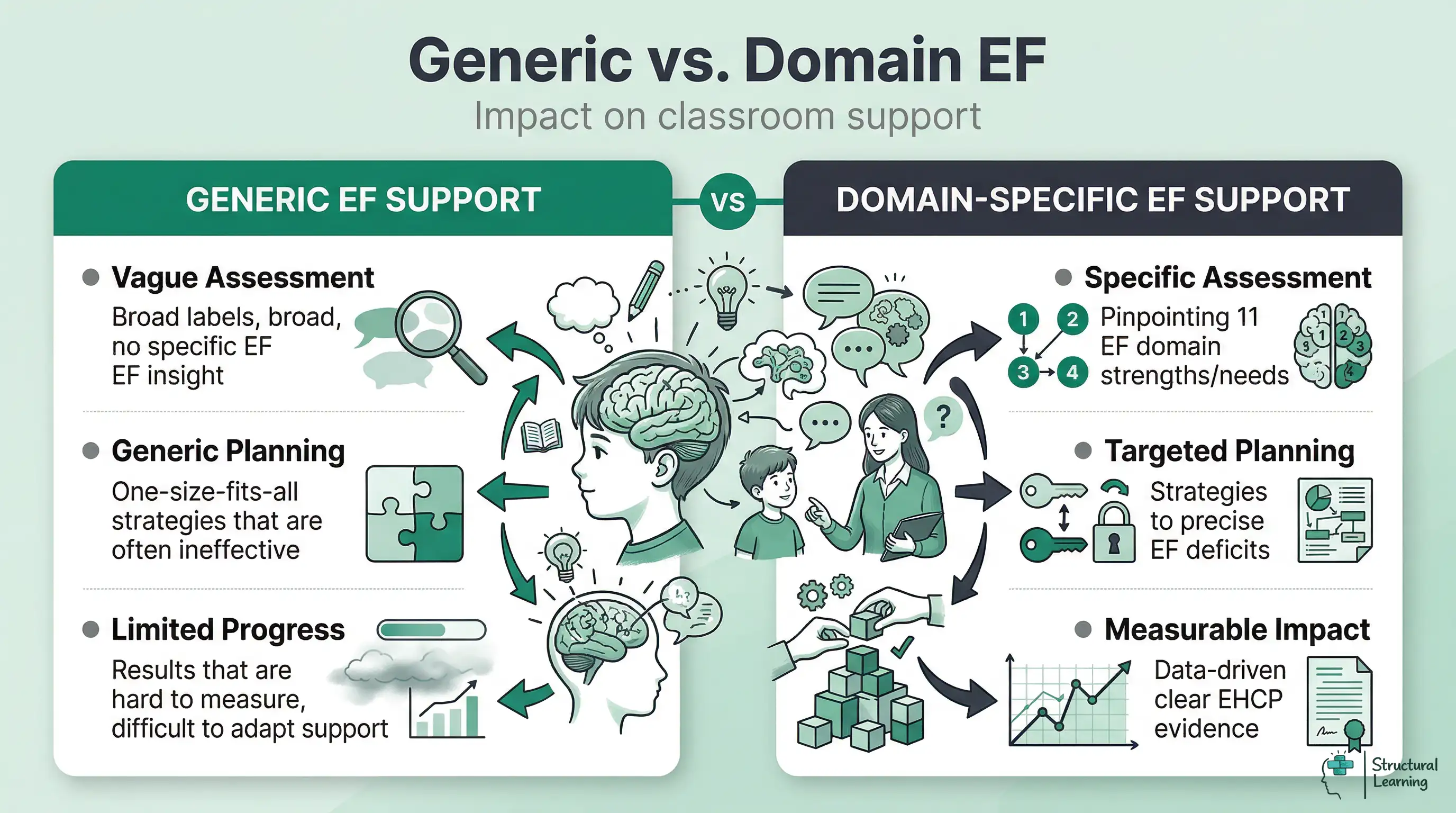
Executive function difficulties sit beneath nearly every SEND profile a SENCO encounters. ADHD, autism, dyspraxia, anxiety, and specific learning difficulties all involve breakdowns in executive function, yet most schools lack a structured way to assess which domains are affected. Without domain-level data, provision maps stay vague and EHCP contributions read as generic narratives rather than targeted evidence.
This audit covers all 11 executive function domains. Each domain includes observable classroom indicators, what competent performance looks like, and strategies that map directly to the Graduated Approach. The interactive profiler at the end generates a visual profile with EHCP-ready language.
Key Takeaways
Executive function is not a single skill: It comprises 11 separable domains (Miyake et al., 2000; Diamond, 2013), and a pupil may be strong in some while severely impaired in others. Profiling across all 11 reveals the specific pattern driving classroom difficulty.
Domain-level assessment transforms provision planning: Generic descriptors such as "poor concentration" tell you nothing about intervention. Identifying whether the difficulty sits in sustained attention, task initiation, or working memory changes the strategy entirely.
Different conditions produce different EF signatures: ADHD typically affects inhibition and working memory; autism affects cognitive flexibility and self-monitoring; DCD affects planning and time management. Mapping the pattern helps SENCOs distinguish overlapping presentations.
The Graduated Approach requires structured evidence: The SEND Code of Practice (2015) expects Assess-Plan-Do-Review cycles with measurable data. The Executive Function Profiler below produces exactly this, formatted for EHCP annual reviews and external referrals.
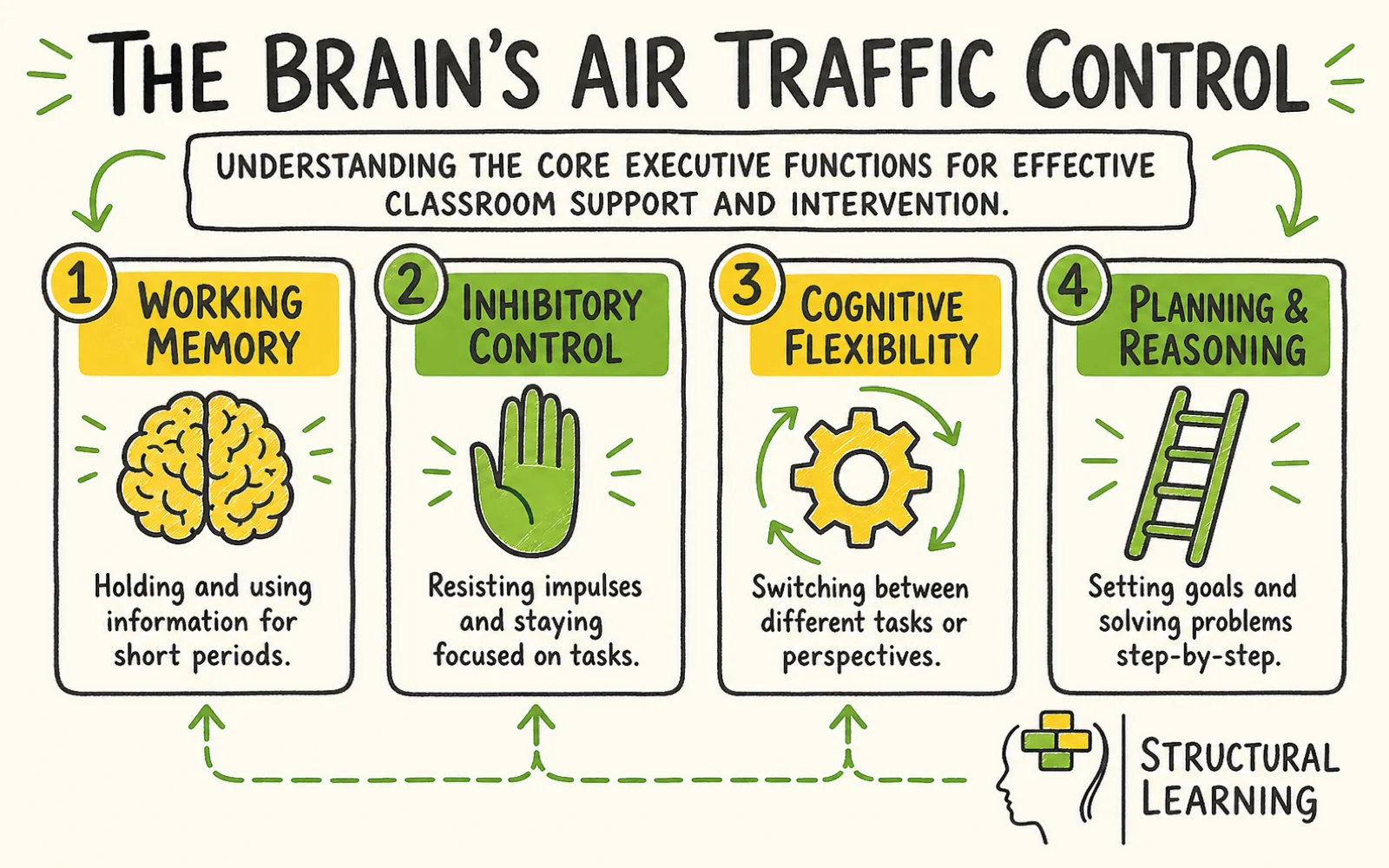
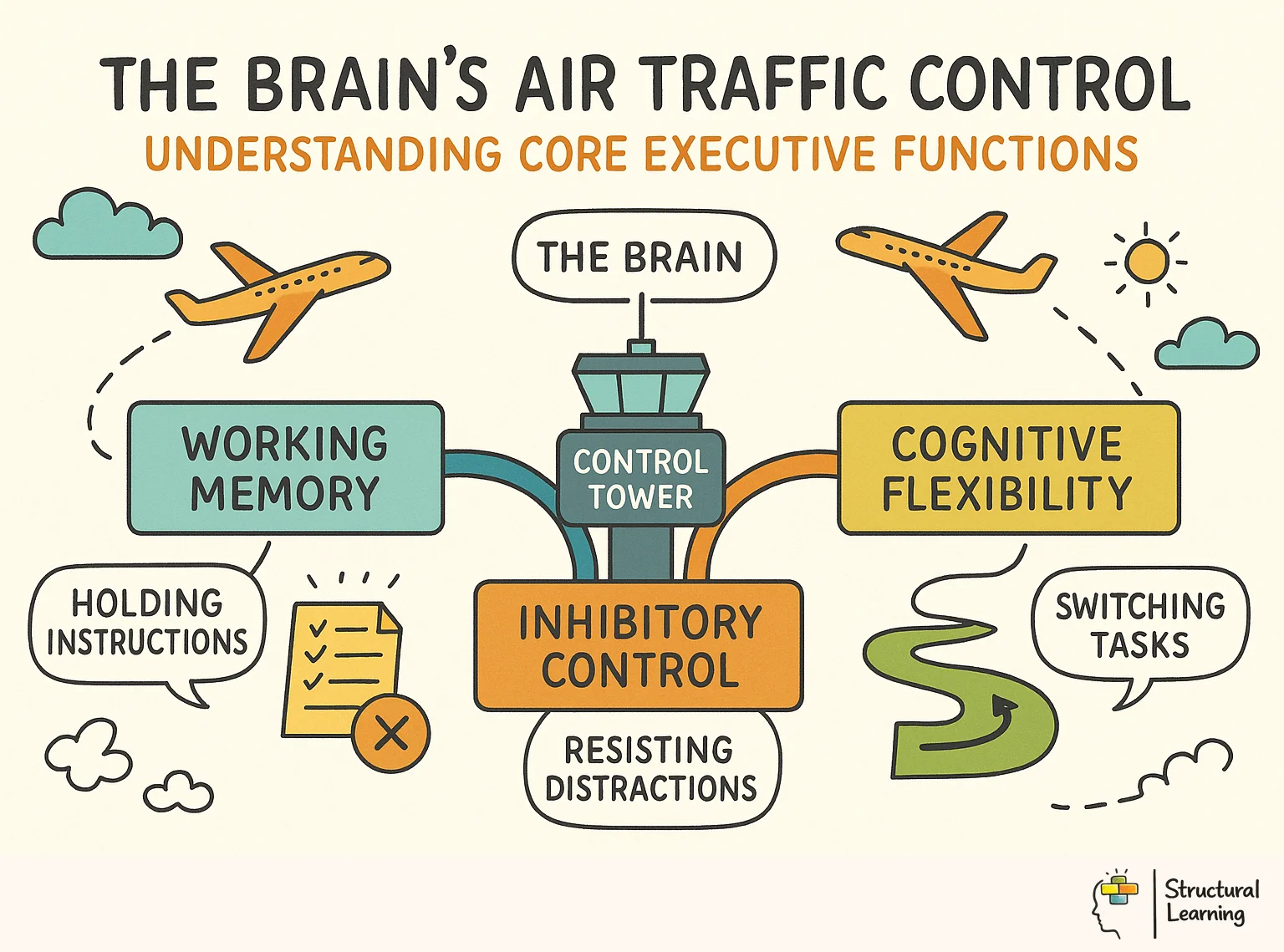
The Brain's Air Traffic Control: Understanding Core Executive Functions
What Executive Function Means for Teachers
Executive function is the set of mental processes that allow a person to plan, focus attention, remember instructions, and manage multiple tasks. Think of it as the brain's air traffic control system (Center on the Developing Child, Harvard, 2011). When executive function works well, a pupil can listen to a teacher's instructions, hold them in working memory, resist the urge to chat with a neighbour, and begin the task independently. When it does not, the same pupil might appear defiant, lazy, or disorganised when the real issue is neurological.
Miyake et al. (2000) identified three core executive functions: working memory updating, inhibition, and cognitive flexibility. Subsequent research expanded this into a broader framework. Diamond (2013) added higher-order functions including planning, reasoning, and problem-solving. Gioia et al. (2000), through developing the BRIEF assessment, mapped eight clinical domains. Drawing on this cumulative evidence, the 11-domain model used in this audit captures the full range of executive demands a pupil faces during a typical school day.
For classroom teachers, the practical implication is straightforward. A pupil who cannot start a writing task (task initiation deficit) needs a different intervention from a pupil who starts but loses track halfway through (sustained attention deficit), who in turn needs something different from a pupil who finishes but produces work riddled with unchecked errors (self-monitoring deficit). All three pupils might be labelled "struggling writers." Only domain-level assessment reveals why.
Classroom example: A Year 5 teacher asks the class to write three paragraphs about the water cycle. Pupil A stares at the blank page for twelve minutes. Pupil B writes two sentences then begins drawing on the table. Pupil C fills the page but has not answered the question. These are three different executive function profiles requiring three different responses.
The 11 Domains Explained
Each domain below includes what competent performance looks like, what difficulty looks like, a concrete classroom example, and two to three evidence-informed strategies.
1. Working Memory
Working memory is the ability to hold information in mind and manipulate it simultaneously (Baddeley, 2000). It is the most heavily researched executive function domain and the one most directly linked to academic attainment.
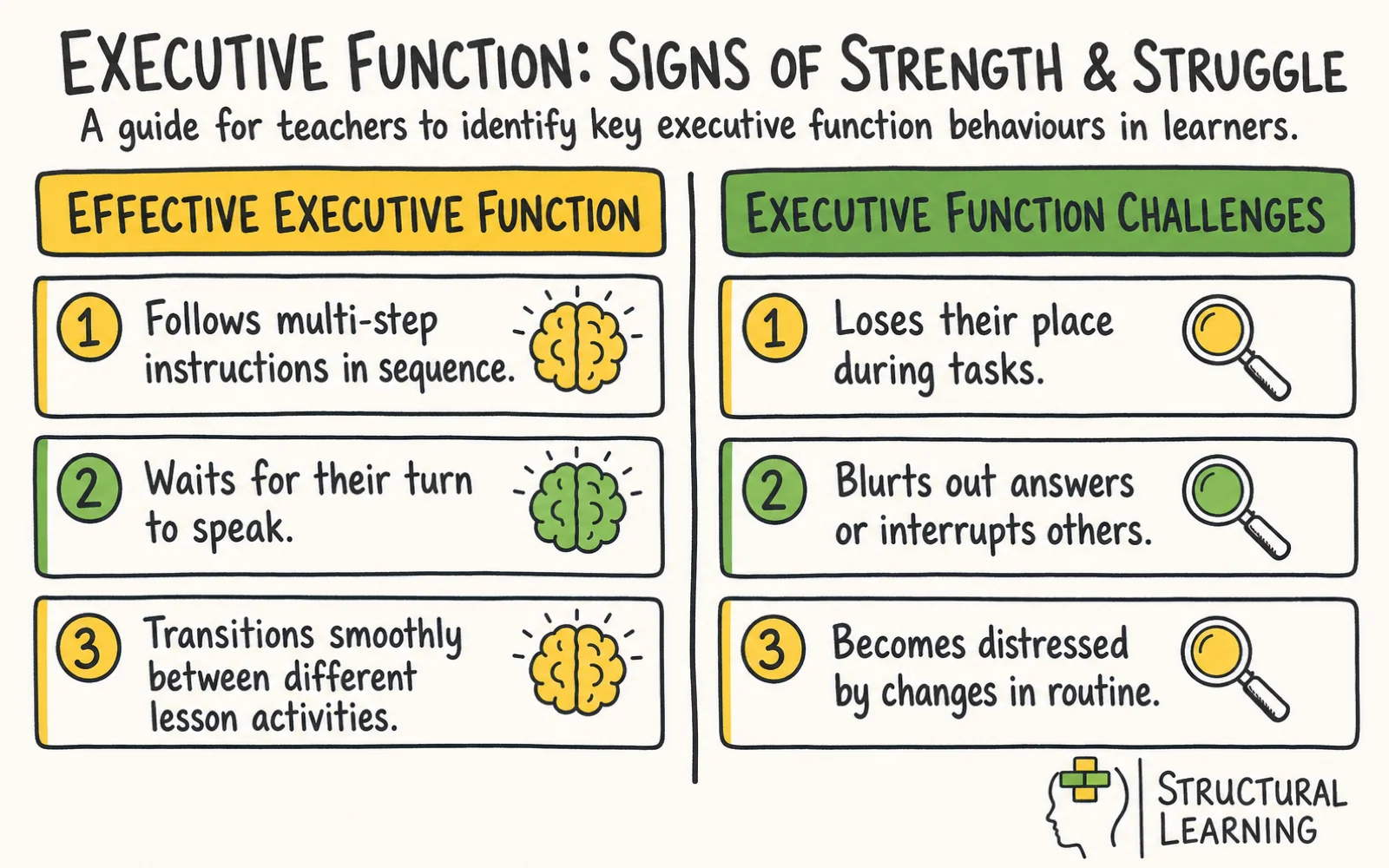
When it is working: A pupil listens to a three-step instruction, holds all three steps, and carries them out in sequence. During mental arithmetic, they hold the running total while performing the next calculation.
When it is not: A pupil completes the first step of an instruction then asks "What do I do next?" They lose their place when reading aloud. They cannot follow multi-clause sentences in teacher exposition. Cognitive load overwhelms them quickly.
Classroom example: During a maths lesson, the teacher says "Open your textbook to page 42, complete questions 3 to 7, and then swap with your partner to mark." A pupil with working memory difficulty opens the book, forgets the page number, asks a friend, finds page 42, then cannot remember which questions to do.
Strategies:
Chunk instructions into single steps. Say one instruction, wait for completion, then give the next.
Provide visual task boards showing each step with a tick box. The pupil refers back rather than relying on memory.
Use scaffolding tools such as writing frames that externalise the structure, reducing the memory load during composition.
2. Inhibition
Inhibition is the ability to stop an automatic or dominant response when it is not appropriate (Miyake et al., 2000). It includes the capacity to resist distractions, delay gratification, and think before acting.
When it is working: A pupil waits for the teacher to finish a question before answering. They resist the urge to turn around when someone drops a pencil case behind them.
When it is not: A pupil blurts out answers, grabs resources from peers, interrupts conversations, and reacts physically before thinking. In ADHD profiles, inhibition difficulty is often the most visible domain (Barkley, 1997).
Classroom example: During a whole-class discussion, the teacher poses a question and asks everyone to think for ten seconds before answering. A pupil with inhibition difficulty shouts out the answer within two seconds, then, when told to wait, begins talking to the person next to them instead.
Strategies:
Teach and rehearse "stop, think, do" routines explicitly. Practise with low-stakes tasks before applying to academic work.
Use response cards or mini whiteboards so the pupil can write their answer immediately (satisfying the impulse) while still waiting for the class reveal.
Position the pupil away from high-traffic areas and windows to reduce the number of distractions requiring inhibition.
3. Cognitive Flexibility
Cognitive flexibility is the ability to switch between tasks, rules, or mental sets (Diamond, 2013). It includes seeing things from different perspectives and adjusting behaviour when rules change.
When it is working: A pupil transitions smoothly from a maths lesson to a literacy lesson, adjusting their thinking accordingly. They can accept that their first approach to a problem is not working and try a different method.
When it is not: A pupil becomes distressed during transitions. They insist on completing a task "their way" even when shown a more effective approach. They struggle with open-ended questions that have multiple valid answers. This domain is often significantly affected in autism profiles.
Classroom example: A Year 3 teacher changes the morning routine because of a visiting speaker. Instead of starting with phonics, the class goes straight to the hall. A pupil with cognitive flexibility difficulty becomes visibly anxious, repeatedly asks "But when do we do phonics?", and is unable to engage with the speaker because they are still processing the change.
Strategies:
Give advance warning of transitions and changes. A two-minute verbal warning followed by a visual timer reduces the cognitive demand of switching.
Use "flexible thinking" language explicitly: "There is more than one way to solve this. Let's try a different route."
Provide visual timetables and flag changes in advance, ideally the day before for significant alterations.
4. Planning and Organisation
Planning and organisation involve breaking a goal into steps, sequencing those steps logically, gathering necessary materials, and managing the physical environment needed to complete the task (Zelazo, 2006).
When it is working: A pupil reads a project brief, identifies the subtasks, collects the right materials, and works through each step methodically. Their desk and bag are reasonably organised.
When it is not: A pupil starts a project without reading the brief fully. They begin writing an essay without a plan. Their bag contains crumpled worksheets from three weeks ago, and they cannot find their ruler when they need it. Their work is scattered across the page with no logical structure.
Classroom example: The teacher sets a design technology project with four stages: research, design, make, evaluate. A pupil with planning difficulty skips research, begins building immediately, runs out of materials because they did not check quantities, and has no idea how to write the evaluation because they cannot reconstruct what they did.
Strategies:
Teach planning explicitly using graphic organisers. A simple four-box planner (What do I need? What do I do first? What comes next? How will I know it is done?) makes the invisible visible.
Use formative assessment checkpoints within longer tasks so the pupil receives feedback on their plan before committing to execution.
Provide a "desk check" routine at the start of each lesson: pencil, rubber, ruler, book. This externalises the organisation demand.
5. Self-Monitoring
Self-monitoring is the ability to observe and evaluate one's own performance during and after a task (Flavell, 1979). It sits at the intersection of executive function and metacognition.
When it is working: A pupil re-reads their writing and notices a missing full stop. They recognise when they do not understand a concept and ask for help. They adjust their volume when they realise they are speaking too loudly.
When it is not: A pupil hands in work full of errors they would easily spot if prompted to check. They do not notice when their behaviour is annoying peers. They believe they have understood a concept when in fact they have a significant misconception.
Classroom example: A Year 8 pupil completes a science report and tells the teacher it is finished. The teacher asks them to read the first paragraph aloud. The pupil immediately spots three spelling errors and a sentence that does not make sense. Without the external prompt, they had no awareness these errors existed.
Strategies:
Build self-check routines into every task. Provide a "COPS" checklist (Capitals, Organisation, Punctuation, Spelling) that the pupil works through before submitting.
Use metacognitive prompting: "Before you hand this in, read it as if you are the teacher marking it. What would you notice?"
Pair self-monitoring with peer feedback so the pupil can compare their self-assessment with an external perspective.
6. Emotional Regulation
Emotional regulation is the ability to manage emotional responses in ways that allow continued engagement with tasks and social interactions (Zelazo and Cunningham, 2007). It involves recognising emotions, modulating their intensity, and recovering from emotional disruption.
When it is working: A pupil feels frustrated when they get a question wrong but takes a breath, re-reads the question, and tries again. They feel disappointed about losing a game but continue to participate.
When it is not: A pupil crumples their work after one mistake. They refuse to try again after receiving corrective feedback. They escalate from mild annoyance to full meltdown with little visible build-up. Emotional regulation difficulties appear across ADHD, autism, and SEMH profiles.
Classroom example: A Year 6 pupil receives their marked maths test back with 14 out of 20. They tear the paper in half, put their head on the desk, and refuse to engage for the rest of the lesson. Later, in a calm moment, they say "I just felt so angry that I got six wrong."
Strategies:
Teach emotion identification explicitly using a feelings thermometer or zones of regulation. The pupil needs vocabulary for their internal state before they can manage it.
Establish a pre-agreed "cool down" protocol: the pupil can move to a designated space without needing to ask, take three minutes, and return. This preserves dignity and reduces escalation.
Separate the emotional response from the academic task. Address the feeling first ("I can see you are frustrated"), then return to the task once the emotional intensity has reduced.
7. Task Initiation
Task initiation is the ability to begin a task independently without excessive prompting (Dawson and Guare, 2018). It is distinct from motivation; a pupil may want to complete a task but be unable to start it.
When it is working: A pupil hears the instruction, picks up their pen, and begins writing within a reasonable time frame. They can identify the first step and take it without needing individual prompting.
When it is not: A pupil sits in front of a blank page for extended periods. They sharpen their pencil, reorganise their desk, go to the toilet, ask irrelevant questions. They are not avoiding the task out of defiance; they genuinely do not know how to begin.
Classroom example: A teacher says "Write a persuasive letter to the headteacher about school lunches. You have 30 minutes." Twenty minutes later, a pupil has written their name and the date. When asked why, they say "I don't know where to start." They understand persuasive writing and have strong opinions about school lunches. The barrier is initiating, not capability.
Strategies:
Provide a "first sentence starter" for writing tasks. Once the pupil has the opening words, the initiation barrier drops significantly.
Use a countdown: "In three minutes you should have written your first sentence. Ready? Go." The external time pressure replaces the missing internal ignition.
Break the task into a micro-first-step: "Before you write the letter, just list three things you want to change about school lunches." This is small enough to begin.
8. Time Management
Time management is the ability to estimate how long tasks will take, allocate time appropriately across subtasks, and work within deadlines (Dawson and Guare, 2018). It requires an internal sense of time passing, which develops through childhood and adolescence.
When it is working: A pupil allocates roughly equal time to each section of a test. They notice when they have spent too long on one question and move on. They bring homework on the day it is due.
When it is not: A pupil spends 25 of their 30 minutes on the first question, leaving five minutes for the remaining four. They consistently underestimate how long tasks will take. They are surprised when the teacher says "five minutes left" because they thought they had only been working for a few minutes.
Classroom example: During a geography assessment with four sections, a Year 9 pupil writes three paragraphs for Section A (worth 5 marks) and one sentence for Section D (worth 15 marks). They ran out of time because they had no strategy for distributing effort across sections.
Strategies:
Make time visible with a classroom timer displayed on the board. Announce time remaining at intervals.
Teach explicit time allocation before tests and extended tasks. "You have 40 minutes. There are four sections. That means roughly 10 minutes each."
Use time estimation activities as a regular classroom routine. Ask "How long do you think this will take?" before starting, then compare with the actual time. This builds the internal time sense.
9. Sustained Attention
Sustained attention is the ability to maintain focus on a task over time, particularly when the task is repetitive, uninteresting, or lacks novelty (Posner and Rothbart, 2007). It differs from selective attention (filtering distractions) and divided attention (multi-tasking).
When it is working: A pupil stays on task for an age-appropriate duration. They can read a chapter without losing their place. They follow a 15-minute teacher exposition and take notes throughout.
When it is not: A pupil starts tasks well but fades after a few minutes. Their performance declines significantly in the second half of a lesson. They miss instructions given five minutes into a whole-class input because their attention has drifted.
Classroom example: During a 20-minute silent reading session, a pupil reads the first two pages with good comprehension. By page four, they are reading the words but cannot recall anything from the previous paragraph. By page six, they are staring at the page but not reading at all. They are not choosing to disengage; their attentional system has run out of fuel.
Strategies:
Break extended tasks into shorter segments with natural pauses. A 30-minute writing session becomes three 10-minute blocks with a brief stretch or discussion between each.
Use the Pomodoro technique adapted for the classroom: focused work followed by a two-minute movement break.
Place the pupil where they can see the teacher and the board directly, reducing the attentional effort needed to re-engage after a drift.
10. Goal-Directed Persistence
Goal-directed persistence is the ability to maintain effort and focus toward a goal despite obstacles, distractions, and competing interests (Dawson and Guare, 2018). It is what keeps a pupil going when the task gets difficult or boring.
When it is working: A pupil encounters a difficult maths problem, feels frustrated, but continues trying different approaches. They complete a multi-day project on schedule. They practise a skill repeatedly until they improve.
When it is not: A pupil abandons tasks at the first sign of difficulty. They start many projects but finish few. Their exercise books contain numerous half-completed pieces of work. They are easily pulled off track by more interesting alternatives. Differentiation that reduces challenge too far can mask this difficulty.
Classroom example: A Year 7 pupil begins a technology project enthusiastically. By lesson three, the novelty has worn off and they encounter a design problem. They announce "I can't do this" and ask to start a completely new project. This pattern repeats across multiple subjects and multiple terms.
Strategies:
Set interim milestones with visible progress markers. A project wall chart showing completed stages gives the pupil evidence that they are making progress even when it feels slow.
Teach the difference between "stuck" and "finished." Provide a "stuck" protocol: re-read the instructions, try one more approach, ask a peer, then ask the teacher.
Celebrate persistence explicitly. Rather than praising only finished products, acknowledge sustained effort: "You worked on that for 20 minutes without stopping, and you solved the tricky bit yourself."
11. Metacognition
Metacognition is the ability to think about one's own thinking processes, including awareness of strengths, weaknesses, and the strategies that work best for learning (Flavell, 1979). It is the executive function that oversees all the others.
When it is working: A pupil recognises that they learn better with diagrams than with text. They know that they find fractions difficult and allocate extra revision time accordingly. They can explain why they chose a particular problem-solving approach. Strong metacognition supports self-regulated learning across all subjects.
When it is not: A pupil uses the same ineffective study strategy repeatedly. They cannot explain their thinking process. They are unable to identify what they find difficult about a task, offering only "I don't get it" with no further precision.
Classroom example: A teacher asks a Year 10 pupil "What did you find hardest about that exam?" The pupil says "Everything." When prompted further, they cannot identify specific topics, question types, or skills that caused difficulty. Without metacognitive awareness, they cannot direct their revision effectively and will likely repeat the same errors.
Strategies:
Build reflection routines into every lesson. A two-minute "What did I learn? What confused me? What will I do differently next time?" exit ticket develops metacognitive habit.
Use think-alouds where the teacher models their own thinking process explicitly. "I am going to read this question twice because I know I sometimes miss key words the first time."
Teach pupils to rate their confidence before and after tasks. The gap between prediction and performance is one of the most powerful metacognitive learning tools available (Koriat, 2007).
Using the Executive Function Profiler
The interactive tool below allows you to rate a pupil across all 11 domains based on your classroom observations. For each domain, you select a rating from 1 (significant difficulty observed daily) to 5 (age-appropriate, no concerns). The profiler aggregates these ratings to produce a visual profile showing areas of strength and areas of need.
Rate each domain based on what you observe during typical classroom activities. Avoid basing your rating on a single incident. Instead, consider the pupil's typical presentation across different subjects and contexts over a period of at least two weeks.
The profiler generates two outputs. First, a radar chart showing the pupil's executive function profile at a glance, with green, amber, and red zones clearly marked. Second, a text summary using descriptive language suitable for EHCP contributions, SEND provision maps, and external referral documentation.
Executive Function Profiler
Rate each domain based on your classroom observations. The profiler generates a visual profile showing areas of strength and need, with EHCP-ready evidence output.
Executive Function Signatures: How ADHD, Autism, and DCD Differ
Reading the Profile Results
The profiler presents results using a traffic light system. Green (ratings 4 to 5) indicates age-appropriate performance with no intervention needed. Amber (rating 3) signals emerging difficulty that warrants monitoring and classroom-level adjustments. Red (ratings 1 to 2) indicates significant difficulty that requires targeted intervention and should feature in provision planning.
Look for patterns across domains rather than individual scores in isolation. A pupil with red ratings in working memory, inhibition, and sustained attention but green ratings in emotional regulation, planning, and metacognition presents a profile consistent with ADHD (Barkley, 1997). A pupil with red in cognitive flexibility, self-monitoring, and emotional regulation but amber or green in inhibition and working memory presents a pattern more commonly associated with autism (Hill, 2004).
Single-domain difficulties often resolve with classroom-level strategies. Multi-domain difficulties, particularly when three or more domains score in the red zone, indicate a need for structured intervention through the Graduated Approach and possibly external referral.
Classroom example: A SENCO reviews a Year 4 pupil's profile and sees red in working memory, task initiation, and time management, with amber in planning and sustained attention. Everything else is green. This pattern suggests the pupil's difficulties are concentrated in the "getting started and staying on track" cluster rather than the "social and emotional" cluster. The SENCO can now write specific provision: visual task boards (working memory), first-step prompts (task initiation), and visible timers (time management) rather than generic "additional adult support."
From Profile to Provision
The Executive Function Profiler produces data that feeds directly into the Assess-Plan-Do-Review cycle required by the SEND Code of Practice (2015).
Assess: Run the profiler twice, once by the class teacher and once by a teaching assistant or second adult who sees the pupil in different contexts. Compare the two profiles. Discrepancies are informative; a pupil who shows strong inhibition in a structured maths lesson but poor inhibition during group art may have context-dependent difficulty rather than a pervasive deficit.
Plan: For each red-rated domain, select one to two targeted strategies from the domain descriptions above. Write these into the Individual Support Plan or provision map with specific, measurable targets. For example: "Working memory support: visual task board provided for all multi-step tasks. Target: pupil completes 3-step instructions independently 4 out of 5 times by half-term review."
Do: Implement the strategies consistently for a minimum of six weeks. Brief all adults working with the pupil so the support is uniform. Record any adaptations needed.
Review: Re-run the profiler at the end of the cycle. Compare the two profiles to measure progress. If a domain has moved from red to amber, the strategy is working and should continue. If no change is evident after six weeks of consistent implementation, escalate to the next level of the Graduated Approach.
For EHCP annual reviews, the profiler's text output provides ready-made evidence. Instead of writing "X struggles with organisation," you can submit "X was assessed using an 11-domain executive function audit in [month/year]. Ratings of 1 (significant difficulty) were recorded in working memory, task initiation, and planning. Targeted interventions including visual task boards and first-step prompting were implemented for six weeks with the following outcomes..."
Condition-Specific EF Patterns
Different neurodevelopmental conditions produce characteristic executive function signatures. The table below summarises typical patterns. Individual pupils will vary, but these patterns help SENCOs form initial hypotheses when interpreting profile results.
EF Domain
ADHD
ASD
DCD (Dyspraxia)
Anxiety
Working Memory
Often impaired
Variable
Variable
Reduced under stress
Inhibition
Core deficit
Typically intact
Typically intact
Over-inhibited
Cognitive Flexibility
Mild difficulty
Core deficit
Typically intact
Rigid thinking
Planning/Organisation
Often impaired
Variable
Often impaired
Perfectionistic planning
Self-Monitoring
Often impaired
Often impaired
Variable
Hyper-monitoring
Emotional Regulation
Often impaired
Often impaired
Frustration-linked
Core deficit
Task Initiation
Often impaired
Demand-dependent
Motor planning linked
Avoidance-driven
Time Management
Often impaired
Variable
Often impaired
Time distortion
Sustained Attention
Core deficit
Interest-dependent
Typically intact
Worry-disrupted
Goal-Directed Persistence
Often impaired
Interest-dependent
Frustration-linked
Avoidance pattern
Metacognition
Variable
Often impaired
Variable
Biased self-assessment
Reading the table: "Core deficit" means the domain is impaired in the majority of individuals with that condition and is considered a defining feature. "Often impaired" means the domain is frequently affected but is not universal. "Variable" means some individuals are affected and others are not. "Typically intact" means the domain is usually at or near age-appropriate levels.
Note the anxiety column. Anxiety does not cause executive function deficits in the same neurological sense as ADHD or autism, but it functionally impairs performance across multiple domains. A pupil experiencing significant anxiety may score red in working memory, task initiation, and emotional regulation on the profiler, mimicking an ADHD or autism pattern. Always consider whether anxiety is a primary presentation or secondary to an unidentified condition.
From Audit to Action: The 4-Step Graduated Approach Cycle
Practical Next Steps
Pick one pupil you are currently concerned about and run the profiler this week. Complete it based on at least two weeks of classroom observation, not a single lesson. Share the visual profile with your SENCO and compare your ratings with another adult who teaches the pupil. The discrepancies and agreements will tell you more than either profile alone. Use the domain-specific strategies from this guide to write one targeted intervention into the pupil's provision by Friday.
Try the Executive Function Profiler
Use this free, interactive tool to profile a student across 11 executive function domains with classroom strategies for each. All data stays in your browser.
Executive Function Profiler
Rate a pupil across 11 domains to build an executive function profile
0 of 11
0strengths
0areas of need
0average %
Further Reading: Key Research Papers
These five papers provide the theoretical and clinical foundations for the 11-domain executive function model used in this audit.
The Unity and Diversity of Executive Functions and Their Contributions to Complex "Frontal Lobe" Tasks: A Latent Variable AnalysisView study ↗
4,800+ citations
Miyake et al. (2000)
This landmark study established that executive functions are separable but related, confirming three core components: working memory updating, inhibition, and cognitive shifting. The finding that these functions are distinct yet correlated underpins every domain-specific assessment, including the profiler in this article. For teachers, the practical takeaway is that a pupil can be strong in one executive function while significantly impaired in another.
Diamond's review in the Annual Review of Psychology synthesises decades of research into how executive functions develop from infancy through adulthood. The paper explains why EF difficulties look different at different ages and provides evidence that executive functions can be improved through targeted intervention. This is essential reading for any SENCO designing age-appropriate provision.
Behavior Rating Inventory of Executive Function (BRIEF)View study ↗
3,500+ citations
Gioia et al. (2000)
The BRIEF assessment tool transformed how clinicians and educators measure executive function by using everyday behavioural observations rather than laboratory tasks. Its eight clinical scales map closely to the 11 domains in this audit. The BRIEF demonstrates that teacher and parent ratings of executive function are valid, reliable, and clinically useful, supporting the observation-based approach used in the profiler.
The Development of Hot and Cool Executive Function in Childhood and Adolescence: Are We Getting Warmer?View study ↗
900+ citations
Zelazo (2006)
Zelazo introduces the distinction between "hot" executive functions (involving emotion and motivation) and "cool" executive functions (involving logic and abstract reasoning). This distinction is directly relevant to classroom assessment because a pupil may perform well on cool tasks such as categorisation but struggle significantly with hot tasks involving frustration tolerance or delayed gratification. The profiler captures both dimensions.
Executive Skills in Children and Adolescents: A Practical Guide to Assessment and InterventionView study ↗
Practitioner reference
Dawson and Guare (2018)
This practitioner-focused book provides the most accessible bridge between clinical executive function research and classroom practice. Dawson and Guare map 11 executive skills (matching the domains in this audit), provide age-normed developmental expectations, and offer specific intervention strategies for each skill. It is the single most useful resource for a SENCO building executive function provision into their school's SEND offer.
Executive function difficulties sit beneath nearly every SEND profile a SENCO encounters. ADHD, autism, dyspraxia, anxiety, and specific learning difficulties all involve breakdowns in executive function, yet most schools lack a structured way to assess which domains are affected. Without domain-level data, provision maps stay vague and EHCP contributions read as generic narratives rather than targeted evidence.
This audit covers all 11 executive function domains. Each domain includes observable classroom indicators, what competent performance looks like, and strategies that map directly to the Graduated Approach. The interactive profiler at the end generates a visual profile with EHCP-ready language.
Key Takeaways
Executive function is not a single skill: It comprises 11 separable domains (Miyake et al., 2000; Diamond, 2013), and a pupil may be strong in some while severely impaired in others. Profiling across all 11 reveals the specific pattern driving classroom difficulty.
Domain-level assessment transforms provision planning: Generic descriptors such as "poor concentration" tell you nothing about intervention. Identifying whether the difficulty sits in sustained attention, task initiation, or working memory changes the strategy entirely.
Different conditions produce different EF signatures: ADHD typically affects inhibition and working memory; autism affects cognitive flexibility and self-monitoring; DCD affects planning and time management. Mapping the pattern helps SENCOs distinguish overlapping presentations.
The Graduated Approach requires structured evidence: The SEND Code of Practice (2015) expects Assess-Plan-Do-Review cycles with measurable data. The Executive Function Profiler below produces exactly this, formatted for EHCP annual reviews and external referrals.
The Brain's Air Traffic Control: Understanding Core Executive Functions
What Executive Function Means for Teachers
Executive function is the set of mental processes that allow a person to plan, focus attention, remember instructions, and manage multiple tasks. Think of it as the brain's air traffic control system (Center on the Developing Child, Harvard, 2011). When executive function works well, a pupil can listen to a teacher's instructions, hold them in working memory, resist the urge to chat with a neighbour, and begin the task independently. When it does not, the same pupil might appear defiant, lazy, or disorganised when the real issue is neurological.
Miyake et al. (2000) identified three core executive functions: working memory updating, inhibition, and cognitive flexibility. Subsequent research expanded this into a broader framework. Diamond (2013) added higher-order functions including planning, reasoning, and problem-solving. Gioia et al. (2000), through developing the BRIEF assessment, mapped eight clinical domains. Drawing on this cumulative evidence, the 11-domain model used in this audit captures the full range of executive demands a pupil faces during a typical school day.
For classroom teachers, the practical implication is straightforward. A pupil who cannot start a writing task (task initiation deficit) needs a different intervention from a pupil who starts but loses track halfway through (sustained attention deficit), who in turn needs something different from a pupil who finishes but produces work riddled with unchecked errors (self-monitoring deficit). All three pupils might be labelled "struggling writers." Only domain-level assessment reveals why.
Classroom example: A Year 5 teacher asks the class to write three paragraphs about the water cycle. Pupil A stares at the blank page for twelve minutes. Pupil B writes two sentences then begins drawing on the table. Pupil C fills the page but has not answered the question. These are three different executive function profiles requiring three different responses.
The 11 Domains Explained
Each domain below includes what competent performance looks like, what difficulty looks like, a concrete classroom example, and two to three evidence-informed strategies.
1. Working Memory
Working memory is the ability to hold information in mind and manipulate it simultaneously (Baddeley, 2000). It is the most heavily researched executive function domain and the one most directly linked to academic attainment.
When it is working: A pupil listens to a three-step instruction, holds all three steps, and carries them out in sequence. During mental arithmetic, they hold the running total while performing the next calculation.
When it is not: A pupil completes the first step of an instruction then asks "What do I do next?" They lose their place when reading aloud. They cannot follow multi-clause sentences in teacher exposition. Cognitive load overwhelms them quickly.
Classroom example: During a maths lesson, the teacher says "Open your textbook to page 42, complete questions 3 to 7, and then swap with your partner to mark." A pupil with working memory difficulty opens the book, forgets the page number, asks a friend, finds page 42, then cannot remember which questions to do.
Strategies:
Chunk instructions into single steps. Say one instruction, wait for completion, then give the next.
Provide visual task boards showing each step with a tick box. The pupil refers back rather than relying on memory.
Use scaffolding tools such as writing frames that externalise the structure, reducing the memory load during composition.
2. Inhibition
Inhibition is the ability to stop an automatic or dominant response when it is not appropriate (Miyake et al., 2000). It includes the capacity to resist distractions, delay gratification, and think before acting.
When it is working: A pupil waits for the teacher to finish a question before answering. They resist the urge to turn around when someone drops a pencil case behind them.
When it is not: A pupil blurts out answers, grabs resources from peers, interrupts conversations, and reacts physically before thinking. In ADHD profiles, inhibition difficulty is often the most visible domain (Barkley, 1997).
Classroom example: During a whole-class discussion, the teacher poses a question and asks everyone to think for ten seconds before answering. A pupil with inhibition difficulty shouts out the answer within two seconds, then, when told to wait, begins talking to the person next to them instead.
Strategies:
Teach and rehearse "stop, think, do" routines explicitly. Practise with low-stakes tasks before applying to academic work.
Use response cards or mini whiteboards so the pupil can write their answer immediately (satisfying the impulse) while still waiting for the class reveal.
Position the pupil away from high-traffic areas and windows to reduce the number of distractions requiring inhibition.
3. Cognitive Flexibility
Cognitive flexibility is the ability to switch between tasks, rules, or mental sets (Diamond, 2013). It includes seeing things from different perspectives and adjusting behaviour when rules change.
When it is working: A pupil transitions smoothly from a maths lesson to a literacy lesson, adjusting their thinking accordingly. They can accept that their first approach to a problem is not working and try a different method.
When it is not: A pupil becomes distressed during transitions. They insist on completing a task "their way" even when shown a more effective approach. They struggle with open-ended questions that have multiple valid answers. This domain is often significantly affected in autism profiles.
Classroom example: A Year 3 teacher changes the morning routine because of a visiting speaker. Instead of starting with phonics, the class goes straight to the hall. A pupil with cognitive flexibility difficulty becomes visibly anxious, repeatedly asks "But when do we do phonics?", and is unable to engage with the speaker because they are still processing the change.
Strategies:
Give advance warning of transitions and changes. A two-minute verbal warning followed by a visual timer reduces the cognitive demand of switching.
Use "flexible thinking" language explicitly: "There is more than one way to solve this. Let's try a different route."
Provide visual timetables and flag changes in advance, ideally the day before for significant alterations.
4. Planning and Organisation
Planning and organisation involve breaking a goal into steps, sequencing those steps logically, gathering necessary materials, and managing the physical environment needed to complete the task (Zelazo, 2006).
When it is working: A pupil reads a project brief, identifies the subtasks, collects the right materials, and works through each step methodically. Their desk and bag are reasonably organised.
When it is not: A pupil starts a project without reading the brief fully. They begin writing an essay without a plan. Their bag contains crumpled worksheets from three weeks ago, and they cannot find their ruler when they need it. Their work is scattered across the page with no logical structure.
Classroom example: The teacher sets a design technology project with four stages: research, design, make, evaluate. A pupil with planning difficulty skips research, begins building immediately, runs out of materials because they did not check quantities, and has no idea how to write the evaluation because they cannot reconstruct what they did.
Strategies:
Teach planning explicitly using graphic organisers. A simple four-box planner (What do I need? What do I do first? What comes next? How will I know it is done?) makes the invisible visible.
Use formative assessment checkpoints within longer tasks so the pupil receives feedback on their plan before committing to execution.
Provide a "desk check" routine at the start of each lesson: pencil, rubber, ruler, book. This externalises the organisation demand.
5. Self-Monitoring
Self-monitoring is the ability to observe and evaluate one's own performance during and after a task (Flavell, 1979). It sits at the intersection of executive function and metacognition.
When it is working: A pupil re-reads their writing and notices a missing full stop. They recognise when they do not understand a concept and ask for help. They adjust their volume when they realise they are speaking too loudly.
When it is not: A pupil hands in work full of errors they would easily spot if prompted to check. They do not notice when their behaviour is annoying peers. They believe they have understood a concept when in fact they have a significant misconception.
Classroom example: A Year 8 pupil completes a science report and tells the teacher it is finished. The teacher asks them to read the first paragraph aloud. The pupil immediately spots three spelling errors and a sentence that does not make sense. Without the external prompt, they had no awareness these errors existed.
Strategies:
Build self-check routines into every task. Provide a "COPS" checklist (Capitals, Organisation, Punctuation, Spelling) that the pupil works through before submitting.
Use metacognitive prompting: "Before you hand this in, read it as if you are the teacher marking it. What would you notice?"
Pair self-monitoring with peer feedback so the pupil can compare their self-assessment with an external perspective.
6. Emotional Regulation
Emotional regulation is the ability to manage emotional responses in ways that allow continued engagement with tasks and social interactions (Zelazo and Cunningham, 2007). It involves recognising emotions, modulating their intensity, and recovering from emotional disruption.
When it is working: A pupil feels frustrated when they get a question wrong but takes a breath, re-reads the question, and tries again. They feel disappointed about losing a game but continue to participate.
When it is not: A pupil crumples their work after one mistake. They refuse to try again after receiving corrective feedback. They escalate from mild annoyance to full meltdown with little visible build-up. Emotional regulation difficulties appear across ADHD, autism, and SEMH profiles.
Classroom example: A Year 6 pupil receives their marked maths test back with 14 out of 20. They tear the paper in half, put their head on the desk, and refuse to engage for the rest of the lesson. Later, in a calm moment, they say "I just felt so angry that I got six wrong."
Strategies:
Teach emotion identification explicitly using a feelings thermometer or zones of regulation. The pupil needs vocabulary for their internal state before they can manage it.
Establish a pre-agreed "cool down" protocol: the pupil can move to a designated space without needing to ask, take three minutes, and return. This preserves dignity and reduces escalation.
Separate the emotional response from the academic task. Address the feeling first ("I can see you are frustrated"), then return to the task once the emotional intensity has reduced.
7. Task Initiation
Task initiation is the ability to begin a task independently without excessive prompting (Dawson and Guare, 2018). It is distinct from motivation; a pupil may want to complete a task but be unable to start it.
When it is working: A pupil hears the instruction, picks up their pen, and begins writing within a reasonable time frame. They can identify the first step and take it without needing individual prompting.
When it is not: A pupil sits in front of a blank page for extended periods. They sharpen their pencil, reorganise their desk, go to the toilet, ask irrelevant questions. They are not avoiding the task out of defiance; they genuinely do not know how to begin.
Classroom example: A teacher says "Write a persuasive letter to the headteacher about school lunches. You have 30 minutes." Twenty minutes later, a pupil has written their name and the date. When asked why, they say "I don't know where to start." They understand persuasive writing and have strong opinions about school lunches. The barrier is initiating, not capability.
Strategies:
Provide a "first sentence starter" for writing tasks. Once the pupil has the opening words, the initiation barrier drops significantly.
Use a countdown: "In three minutes you should have written your first sentence. Ready? Go." The external time pressure replaces the missing internal ignition.
Break the task into a micro-first-step: "Before you write the letter, just list three things you want to change about school lunches." This is small enough to begin.
8. Time Management
Time management is the ability to estimate how long tasks will take, allocate time appropriately across subtasks, and work within deadlines (Dawson and Guare, 2018). It requires an internal sense of time passing, which develops through childhood and adolescence.
When it is working: A pupil allocates roughly equal time to each section of a test. They notice when they have spent too long on one question and move on. They bring homework on the day it is due.
When it is not: A pupil spends 25 of their 30 minutes on the first question, leaving five minutes for the remaining four. They consistently underestimate how long tasks will take. They are surprised when the teacher says "five minutes left" because they thought they had only been working for a few minutes.
Classroom example: During a geography assessment with four sections, a Year 9 pupil writes three paragraphs for Section A (worth 5 marks) and one sentence for Section D (worth 15 marks). They ran out of time because they had no strategy for distributing effort across sections.
Strategies:
Make time visible with a classroom timer displayed on the board. Announce time remaining at intervals.
Teach explicit time allocation before tests and extended tasks. "You have 40 minutes. There are four sections. That means roughly 10 minutes each."
Use time estimation activities as a regular classroom routine. Ask "How long do you think this will take?" before starting, then compare with the actual time. This builds the internal time sense.
9. Sustained Attention
Sustained attention is the ability to maintain focus on a task over time, particularly when the task is repetitive, uninteresting, or lacks novelty (Posner and Rothbart, 2007). It differs from selective attention (filtering distractions) and divided attention (multi-tasking).
When it is working: A pupil stays on task for an age-appropriate duration. They can read a chapter without losing their place. They follow a 15-minute teacher exposition and take notes throughout.
When it is not: A pupil starts tasks well but fades after a few minutes. Their performance declines significantly in the second half of a lesson. They miss instructions given five minutes into a whole-class input because their attention has drifted.
Classroom example: During a 20-minute silent reading session, a pupil reads the first two pages with good comprehension. By page four, they are reading the words but cannot recall anything from the previous paragraph. By page six, they are staring at the page but not reading at all. They are not choosing to disengage; their attentional system has run out of fuel.
Strategies:
Break extended tasks into shorter segments with natural pauses. A 30-minute writing session becomes three 10-minute blocks with a brief stretch or discussion between each.
Use the Pomodoro technique adapted for the classroom: focused work followed by a two-minute movement break.
Place the pupil where they can see the teacher and the board directly, reducing the attentional effort needed to re-engage after a drift.
10. Goal-Directed Persistence
Goal-directed persistence is the ability to maintain effort and focus toward a goal despite obstacles, distractions, and competing interests (Dawson and Guare, 2018). It is what keeps a pupil going when the task gets difficult or boring.
When it is working: A pupil encounters a difficult maths problem, feels frustrated, but continues trying different approaches. They complete a multi-day project on schedule. They practise a skill repeatedly until they improve.
When it is not: A pupil abandons tasks at the first sign of difficulty. They start many projects but finish few. Their exercise books contain numerous half-completed pieces of work. They are easily pulled off track by more interesting alternatives. Differentiation that reduces challenge too far can mask this difficulty.
Classroom example: A Year 7 pupil begins a technology project enthusiastically. By lesson three, the novelty has worn off and they encounter a design problem. They announce "I can't do this" and ask to start a completely new project. This pattern repeats across multiple subjects and multiple terms.
Strategies:
Set interim milestones with visible progress markers. A project wall chart showing completed stages gives the pupil evidence that they are making progress even when it feels slow.
Teach the difference between "stuck" and "finished." Provide a "stuck" protocol: re-read the instructions, try one more approach, ask a peer, then ask the teacher.
Celebrate persistence explicitly. Rather than praising only finished products, acknowledge sustained effort: "You worked on that for 20 minutes without stopping, and you solved the tricky bit yourself."
11. Metacognition
Metacognition is the ability to think about one's own thinking processes, including awareness of strengths, weaknesses, and the strategies that work best for learning (Flavell, 1979). It is the executive function that oversees all the others.
When it is working: A pupil recognises that they learn better with diagrams than with text. They know that they find fractions difficult and allocate extra revision time accordingly. They can explain why they chose a particular problem-solving approach. Strong metacognition supports self-regulated learning across all subjects.
When it is not: A pupil uses the same ineffective study strategy repeatedly. They cannot explain their thinking process. They are unable to identify what they find difficult about a task, offering only "I don't get it" with no further precision.
Classroom example: A teacher asks a Year 10 pupil "What did you find hardest about that exam?" The pupil says "Everything." When prompted further, they cannot identify specific topics, question types, or skills that caused difficulty. Without metacognitive awareness, they cannot direct their revision effectively and will likely repeat the same errors.
Strategies:
Build reflection routines into every lesson. A two-minute "What did I learn? What confused me? What will I do differently next time?" exit ticket develops metacognitive habit.
Use think-alouds where the teacher models their own thinking process explicitly. "I am going to read this question twice because I know I sometimes miss key words the first time."
Teach pupils to rate their confidence before and after tasks. The gap between prediction and performance is one of the most powerful metacognitive learning tools available (Koriat, 2007).
Using the Executive Function Profiler
The interactive tool below allows you to rate a pupil across all 11 domains based on your classroom observations. For each domain, you select a rating from 1 (significant difficulty observed daily) to 5 (age-appropriate, no concerns). The profiler aggregates these ratings to produce a visual profile showing areas of strength and areas of need.
Rate each domain based on what you observe during typical classroom activities. Avoid basing your rating on a single incident. Instead, consider the pupil's typical presentation across different subjects and contexts over a period of at least two weeks.
The profiler generates two outputs. First, a radar chart showing the pupil's executive function profile at a glance, with green, amber, and red zones clearly marked. Second, a text summary using descriptive language suitable for EHCP contributions, SEND provision maps, and external referral documentation.
Executive Function Profiler
Rate each domain based on your classroom observations. The profiler generates a visual profile showing areas of strength and need, with EHCP-ready evidence output.
Executive Function Signatures: How ADHD, Autism, and DCD Differ
Reading the Profile Results
The profiler presents results using a traffic light system. Green (ratings 4 to 5) indicates age-appropriate performance with no intervention needed. Amber (rating 3) signals emerging difficulty that warrants monitoring and classroom-level adjustments. Red (ratings 1 to 2) indicates significant difficulty that requires targeted intervention and should feature in provision planning.
Look for patterns across domains rather than individual scores in isolation. A pupil with red ratings in working memory, inhibition, and sustained attention but green ratings in emotional regulation, planning, and metacognition presents a profile consistent with ADHD (Barkley, 1997). A pupil with red in cognitive flexibility, self-monitoring, and emotional regulation but amber or green in inhibition and working memory presents a pattern more commonly associated with autism (Hill, 2004).
Single-domain difficulties often resolve with classroom-level strategies. Multi-domain difficulties, particularly when three or more domains score in the red zone, indicate a need for structured intervention through the Graduated Approach and possibly external referral.
Classroom example: A SENCO reviews a Year 4 pupil's profile and sees red in working memory, task initiation, and time management, with amber in planning and sustained attention. Everything else is green. This pattern suggests the pupil's difficulties are concentrated in the "getting started and staying on track" cluster rather than the "social and emotional" cluster. The SENCO can now write specific provision: visual task boards (working memory), first-step prompts (task initiation), and visible timers (time management) rather than generic "additional adult support."
From Profile to Provision
The Executive Function Profiler produces data that feeds directly into the Assess-Plan-Do-Review cycle required by the SEND Code of Practice (2015).
Assess: Run the profiler twice, once by the class teacher and once by a teaching assistant or second adult who sees the pupil in different contexts. Compare the two profiles. Discrepancies are informative; a pupil who shows strong inhibition in a structured maths lesson but poor inhibition during group art may have context-dependent difficulty rather than a pervasive deficit.
Plan: For each red-rated domain, select one to two targeted strategies from the domain descriptions above. Write these into the Individual Support Plan or provision map with specific, measurable targets. For example: "Working memory support: visual task board provided for all multi-step tasks. Target: pupil completes 3-step instructions independently 4 out of 5 times by half-term review."
Do: Implement the strategies consistently for a minimum of six weeks. Brief all adults working with the pupil so the support is uniform. Record any adaptations needed.
Review: Re-run the profiler at the end of the cycle. Compare the two profiles to measure progress. If a domain has moved from red to amber, the strategy is working and should continue. If no change is evident after six weeks of consistent implementation, escalate to the next level of the Graduated Approach.
For EHCP annual reviews, the profiler's text output provides ready-made evidence. Instead of writing "X struggles with organisation," you can submit "X was assessed using an 11-domain executive function audit in [month/year]. Ratings of 1 (significant difficulty) were recorded in working memory, task initiation, and planning. Targeted interventions including visual task boards and first-step prompting were implemented for six weeks with the following outcomes..."
Condition-Specific EF Patterns
Different neurodevelopmental conditions produce characteristic executive function signatures. The table below summarises typical patterns. Individual pupils will vary, but these patterns help SENCOs form initial hypotheses when interpreting profile results.
EF Domain
ADHD
ASD
DCD (Dyspraxia)
Anxiety
Working Memory
Often impaired
Variable
Variable
Reduced under stress
Inhibition
Core deficit
Typically intact
Typically intact
Over-inhibited
Cognitive Flexibility
Mild difficulty
Core deficit
Typically intact
Rigid thinking
Planning/Organisation
Often impaired
Variable
Often impaired
Perfectionistic planning
Self-Monitoring
Often impaired
Often impaired
Variable
Hyper-monitoring
Emotional Regulation
Often impaired
Often impaired
Frustration-linked
Core deficit
Task Initiation
Often impaired
Demand-dependent
Motor planning linked
Avoidance-driven
Time Management
Often impaired
Variable
Often impaired
Time distortion
Sustained Attention
Core deficit
Interest-dependent
Typically intact
Worry-disrupted
Goal-Directed Persistence
Often impaired
Interest-dependent
Frustration-linked
Avoidance pattern
Metacognition
Variable
Often impaired
Variable
Biased self-assessment
Reading the table: "Core deficit" means the domain is impaired in the majority of individuals with that condition and is considered a defining feature. "Often impaired" means the domain is frequently affected but is not universal. "Variable" means some individuals are affected and others are not. "Typically intact" means the domain is usually at or near age-appropriate levels.
Note the anxiety column. Anxiety does not cause executive function deficits in the same neurological sense as ADHD or autism, but it functionally impairs performance across multiple domains. A pupil experiencing significant anxiety may score red in working memory, task initiation, and emotional regulation on the profiler, mimicking an ADHD or autism pattern. Always consider whether anxiety is a primary presentation or secondary to an unidentified condition.
From Audit to Action: The 4-Step Graduated Approach Cycle
Practical Next Steps
Pick one pupil you are currently concerned about and run the profiler this week. Complete it based on at least two weeks of classroom observation, not a single lesson. Share the visual profile with your SENCO and compare your ratings with another adult who teaches the pupil. The discrepancies and agreements will tell you more than either profile alone. Use the domain-specific strategies from this guide to write one targeted intervention into the pupil's provision by Friday.
Try the Executive Function Profiler
Use this free, interactive tool to profile a student across 11 executive function domains with classroom strategies for each. All data stays in your browser.
Executive Function Profiler
Rate a pupil across 11 domains to build an executive function profile
0 of 11
0strengths
0areas of need
0average %
Further Reading: Key Research Papers
These five papers provide the theoretical and clinical foundations for the 11-domain executive function model used in this audit.
The Unity and Diversity of Executive Functions and Their Contributions to Complex "Frontal Lobe" Tasks: A Latent Variable AnalysisView study ↗
4,800+ citations
Miyake et al. (2000)
This landmark study established that executive functions are separable but related, confirming three core components: working memory updating, inhibition, and cognitive shifting. The finding that these functions are distinct yet correlated underpins every domain-specific assessment, including the profiler in this article. For teachers, the practical takeaway is that a pupil can be strong in one executive function while significantly impaired in another.
Diamond's review in the Annual Review of Psychology synthesises decades of research into how executive functions develop from infancy through adulthood. The paper explains why EF difficulties look different at different ages and provides evidence that executive functions can be improved through targeted intervention. This is essential reading for any SENCO designing age-appropriate provision.
Behavior Rating Inventory of Executive Function (BRIEF)View study ↗
3,500+ citations
Gioia et al. (2000)
The BRIEF assessment tool transformed how clinicians and educators measure executive function by using everyday behavioural observations rather than laboratory tasks. Its eight clinical scales map closely to the 11 domains in this audit. The BRIEF demonstrates that teacher and parent ratings of executive function are valid, reliable, and clinically useful, supporting the observation-based approach used in the profiler.
The Development of Hot and Cool Executive Function in Childhood and Adolescence: Are We Getting Warmer?View study ↗
900+ citations
Zelazo (2006)
Zelazo introduces the distinction between "hot" executive functions (involving emotion and motivation) and "cool" executive functions (involving logic and abstract reasoning). This distinction is directly relevant to classroom assessment because a pupil may perform well on cool tasks such as categorisation but struggle significantly with hot tasks involving frustration tolerance or delayed gratification. The profiler captures both dimensions.
Executive Skills in Children and Adolescents: A Practical Guide to Assessment and InterventionView study ↗
Practitioner reference
Dawson and Guare (2018)
This practitioner-focused book provides the most accessible bridge between clinical executive function research and classroom practice. Dawson and Guare map 11 executive skills (matching the domains in this audit), provide age-normed developmental expectations, and offer specific intervention strategies for each skill. It is the single most useful resource for a SENCO building executive function provision into their school's SEND offer.
{"@context":"https://schema.org","@graph":[{"@type":"Organization","@id":"https://www.structural-learning.com/#org","name":"Structural Learning","url":"https://www.structural-learning.com/","logo":{"@type":"ImageObject","url":"https://cdn.prod.website-files.com/5b69a01ba2e409501de055d1/5b69a01ba2e40996a5e055f4_structural-learning-logo.png"}},{"@type":"Person","@id":"https://www.structural-learning.com/team/paul-main/#person","name":"Paul Main","url":"https://www.structural-learning.com/team/paul-main","jobTitle":"Founder","affiliation":{"@id":"https://www.structural-learning.com/#org"}},{"@type":"BreadcrumbList","@id":"https://www.structural-learning.com/post/executive-function-classroom-11-domain-audit#breadcrumb","itemListElement":[{"@type":"ListItem","position":1,"name":"Home","item":"https://www.structural-learning.com/"},{"@type":"ListItem","position":2,"name":"Blog","item":"https://www.structural-learning.com/blog"},{"@type":"ListItem","position":3,"name":"Executive Function in the Classroom: An 11-Domain Audit","item":"https://www.structural-learning.com/post/executive-function-classroom-11-domain-audit"}]},{"@type":"BlogPosting","@id":"https://www.structural-learning.com/post/executive-function-classroom-11-domain-audit#article","headline":"Executive Function in the Classroom: An 11-Domain Audit","description":"Assess executive function across 11 domains with this classroom audit tool. Covers working memory, inhibition, cognitive flexibility, planning, and more with EHCP-ready output for SENCOs.","author":{"@id":"https://www.structural-learning.com/team/paul-main/#person"},"publisher":{"@id":"https://www.structural-learning.com/#org"},"datePublished":"2026-02-26","dateModified":"2026-02-26","inLanguage":"en-GB"}]}