Why IEP Accommodations Fail: The Working Memory Explanation Teachers Need

Updated on  

February 26, 2026

Why IEP Accommodations Fail: The Working Memory Explanation Teachers Need

|

February 26, 2026

When IEP accommodations are implemented with fidelity but students still fail, the problem is usually mismatch, not compliance. Here is the cognitive science behind why.

Key Takeaways

  1. Capacity, not speed, is the bottleneck: Extended time is the most common IEP accommodation, but it only helps students whose bottleneck is processing speed. For students with working memory deficits, the problem is how much information they can hold at once, and more time does not change that capacity.
  2. Accommodation mismatch is common and under-diagnosed: Most IEP teams select accommodations from generic lists without first identifying the specific cognitive bottleneck driving a student's difficulties. The result is accommodations that are implemented perfectly and achieve nothing.
  3. Assessment data already tells you what to target: The WISC-V Working Memory Index, Processing Speed Index, and BRIEF-2 executive function profiles contain enough information to match accommodations to cognitive bottlenecks, but most teams do not use those scores to drive accommodation selection.
  4. Cognitive Load Theory provides the design framework: Every effective accommodation reduces extraneous load, manages intrinsic load, or supports germane load. When you cannot say which of those three things an accommodation does, it is likely a mismatch.

A student has extended time, preferential seating, and reduced assignments on their IEP. Six months later, they are still failing. The accommodations are being implemented. The problem is not fidelity. The problem is match.

This distinction matters because the entire compliance infrastructure around IEP implementation focuses on fidelity: was the accommodation offered? Was it documented? Was it used? Almost no attention goes to the prior question: does this accommodation address the actual cognitive reason the student is struggling? When it does not, you can implement with perfect fidelity for a full school year and produce no change in outcomes.

The cognitive science behind this is not complicated, but it is rarely taught in special education preparation programmes or shared at IEP meetings. This article explains the mechanism, gives you a diagnostic framework, and shows you how to use assessment data you already have to select accommodations that are more likely to work.

The Accommodation Mismatch Problem

Most IEP accommodation lists are generated the same way: a team reviews a student's disability category, consults a bank of common accommodations, selects those that seem reasonable, and documents them. The process is driven by legal frameworks, teacher instinct, and precedent, not by a systematic analysis of which cognitive processes are impaired and which accommodations would actually address those processes.

Harrison, Bunford, Evans, and Owens (2013) examined how teachers and school psychologists select accommodations and found that the most common selection method was consulting lists of accommodations associated with a disability category, rather than analysing individual assessment profiles. The result is a kind of diagnostic short-cut: dyslexia gets read-aloud, ADHD gets extended time, anxiety gets a separate room. These are not wrong in every case, but they are rarely tailored to the individual cognitive profile that explains why this particular student struggles with this particular task.

Fuchs, Fuchs, Eaton, Hamlett, and Karns (2000) demonstrated that accommodation effectiveness varies significantly across students with the same disability label, depending on the underlying cognitive profile. Two students, both with a specific learning disability in reading, may have completely different cognitive bottlenecks: one may have a phonological processing deficit that responds to text-to-speech, while the other may have a reading fluency deficit that requires repeated oral reading practice. Giving both students the same read-aloud accommodation addresses one student's problem and does nothing for the other's.

The accommodation mismatch problem has a structural cause. IEP teams are time-pressured, assessment data is often not interpreted in depth, and the connection between neuropsychological profiles and accommodation design is not consistently taught. Understanding working memory and how it affects learning is the starting point for fixing this.

How Working Memory Affects Everything

Working memory is the cognitive system that holds and manipulates information during active thinking. It is not the same as short-term memory, which is purely passive storage. Working memory is where you keep a sentence in mind while you figure out its meaning, where you hold the first three steps of a problem while executing the fourth, and where you track what you have already written while deciding what to write next.

Baddeley (2000) revised his influential model of working memory to include four components. The central executive is the attentional control system that coordinates the others. The phonological loop holds verbal and acoustic information in a kind of inner voice. The visuospatial sketchpad holds visual and spatial information. The episodic buffer integrates information from these sub-systems and from long-term memory into a coherent representation.

Cowan (2001) established through a series of experiments that the central executive can hold approximately four chunks of information in adults under optimal conditions. In children with learning difficulties, that number drops to two or three. A student who can hold two chunks in working memory at once will struggle with any task that requires simultaneously tracking more than two things: multi-step directions, reading comprehension that requires holding earlier content while processing later content, written expression that requires generating ideas, translating them to text, monitoring grammar, and managing spelling at the same time.

Gathercole and Alloway (2008) tracked children with working memory deficits through primary school and found that these children consistently underperformed on tasks requiring the integration of multiple pieces of information, that teachers frequently misidentified their failures as attention or motivation problems, and that the children themselves were often unaware of why they were struggling. This matters because misattribution leads to mismatched interventions: a student whose working memory is overwhelmed looks inattentive, and the response is often a behaviour intervention rather than a cognitive load reduction strategy.

Working memory limitations affect writing, mathematics, reading comprehension, and listening comprehension. They affect the ability to follow multi-step instructions. They affect performance on tests because retrieval requires holding partial answers in mind while searching for the rest. Understanding this dependency is foundational to understanding which accommodations can help and which are solving the wrong problem.

Extended Time: When It Helps and When It Does Not

Extended time is the most frequently listed accommodation in the United States. It is on nearly every IEP and 504 plan. It is also the accommodation most often applied without any analysis of whether it addresses the student's actual cognitive bottleneck.

Extended time helps when the bottleneck is processing speed. A student who understands the material but takes longer to decode text, generate written responses, or complete calculations benefits from more time because the constraint is temporal. Given enough time, they can demonstrate what they know.

Extended time does not help when the bottleneck is working memory capacity. Lewandowski, Lovett, Codding, and Gordon (2008) studied the effect of extended time on students with and without learning disabilities on a processing speed measure and a working memory measure. Extended time produced significant gains for students with processing speed deficits. For students with working memory deficits, the gains were small and unreliable. The reason is mechanical: if a student cannot hold four steps in working memory, giving them twice as much time to complete those four steps does not change the capacity constraint. The bottleneck is not how fast they work; it is how much information the system can hold at once.

This is a finding that most IEP teams have not systematically absorbed. When a student with extended time continues to fail, the typical response is to question fidelity: was the time actually offered? Did the student use it? A more productive question is: is this student's primary cognitive challenge a processing speed problem or a working memory capacity problem? If it is the latter, adding time is the wrong treatment.

What does help for working memory deficits? Reducing the number of items the student must hold in working memory at once. This means visual scaffolds that externalise information the student would otherwise have to track internally, chunked instructions delivered one step at a time, graphic organisers that hold partial information so the student does not have to, and worked examples that reduce the problem-solving load while the student is building procedural knowledge.

Extended time combined with these supports can be effective. Extended time alone, for a student whose bottleneck is capacity, is an accommodation that produces the appearance of support without changing the cognitive conditions that drive failure.

Matching Accommodations to Cognitive Bottlenecks

The accommodation mismatch problem has a solution: identify the specific cognitive bottleneck first, then select accommodations that reduce the load on that specific system. This requires using assessment data differently than most IEP teams currently use it.

The following table maps eight common cognitive bottlenecks to the accommodations typically chosen for them and to the accommodations that more directly address the underlying deficit.

Cognitive Bottleneck Common (Often Mismatched) Accommodation Better (Matched) Accommodation
Working memory capacity Extended time alone Graphic organisers, step-by-step written instructions, chunked tasks, visual checklists
Processing speed Reduced assignments (quantity) Extended time, untimed tests, fewer items testing the same skill
Sustained attention Preferential seating at the front Scheduled movement breaks, task segmentation with check-ins, fidget tools, timer-based work intervals
Auditory processing Preferential seating near the teacher Written instructions alongside verbal, FM system or sound-field system, pre-teaching vocabulary, paired visual supports
Visual processing Enlarged print Reduced visual clutter, high-contrast materials, text-to-speech for decoding, colour overlays, graph paper for alignment
Executive function (planning) Reduced homework Assignment notebooks, project planning templates, explicit instruction in task analysis, structured study hall with adult support
Executive function (inhibition) Separate testing room Response cost systems, self-monitoring checklists, structured social scripts, impulse regulation strategies taught explicitly
Reading fluency Read-aloud for all tasks Read-aloud for content-area tests (not reading assessments), repeated reading practice, decodable texts at instructional level, fluency-building intervention

The pattern across the table is consistent: common accommodations tend to address surface performance rather than the underlying process. They reduce the visible manifestation of the deficit without changing the cognitive conditions that produce it. The matched accommodations work because they reduce demand on the specific system that is failing, rather than simply giving the student more time or less work while the same system continues to be overwhelmed.

Five Common Mismatches in Practice

Abstract principles become clearer through specific classroom examples. The five mismatches below appear regularly in IEP documentation across the country. Each one makes intuitive sense, which is why they persist. Each one also fails to address the actual cognitive bottleneck.

Preferential Seating for Auditory Processing Disorder

A Year 4 student with an auditory processing disorder is seated at the front of the classroom, close to the teacher. The IEP team reasoned that proximity would improve the student's ability to hear instructions clearly.

Auditory processing disorder is not a hearing problem. The student's ears receive the sound normally. The deficit is in the brain's ability to discriminate, sequence, and make meaning from the auditory signal. Moving a student closer to a speaker does not change how the auditory cortex processes the signal it receives.

What does help: written instructions that accompany every verbal instruction, pre-teaching key vocabulary before a lesson so the student has a semantic scaffold to aid processing, a sound-field system that improves signal-to-noise ratio, and wait time after verbal instructions to allow the student to process. Proximity alone, without these supports, leaves the core processing deficit unaddressed.

Reduced Homework for a Student Who Cannot Read

A Year 3 student with a significant reading disability receives reduced homework as an accommodation. The team reasoned that fewer assignments would reduce stress and increase the likelihood of completion.

Homework quantity is not the problem. The student cannot access text-based homework regardless of how much of it there is. If the homework requires reading and the student decodes at a pre-primer level, three pages and one page are equally inaccessible.

What does help: homework in a format the student can access, whether that is audio, visual, or supported by a family member reading aloud, and direct reading instruction during the school day that builds the skill that makes homework accessible. Reducing quantity while leaving the access problem unsolved produces a student who completes less work but still cannot read.

A Calculator for a Student Without Number Sense

A Year 5 student with dyscalculia is provided with a calculator for all mathematics tasks. The team reasoned that the calculation tool would remove the arithmetic barrier and allow the student to demonstrate understanding.

For a student whose deficit is in procedural calculation, a calculator can work well. But dyscalculia often involves a deeper difficulty: the intuitive understanding of quantity, magnitude, and the relationships between numbers. A student who does not know whether 37 is closer to 30 or 40, who cannot estimate whether an answer is reasonable, and who does not understand what multiplication represents will not become a mathematician by pressing the right buttons. The calculator outputs a number; it does not build the number sense required to use that number meaningfully.

What does help: concrete manipulatives that build quantity understanding, number line activities that develop magnitude awareness, and number sense instruction that explicitly targets the conceptual gaps. The calculator can be appropriate as an accommodation for fluency tasks once the conceptual understanding is present.

A Separate Testing Room for Test Anxiety

A Year 7 student with test anxiety receives testing in a separate, quiet room. The team reasoned that removing the student from the social pressure of the main classroom would reduce anxiety and improve performance.

A quiet room removes one anxiety stimulus. But test anxiety is not caused by the presence of other students; it is a generalised threat response to evaluation situations. Moving the student to an empty room does not change the student's relationship to the evaluation itself. For many students with test anxiety, the separate room adds a layer of stigma and heightened awareness of their difficulties without providing any cognitive or regulatory support.

What does help: anxiety management strategies taught explicitly before and during exams, including breathing techniques and cognitive reframing, and gradual exposure to evaluation situations with support, rather than avoidance of them. A school counsellor-led programme that systematically reduces the threat response is a genuine intervention; a separate room is a workaround that leaves the anxiety intact.

Read-Aloud for a Student with Comprehension Deficits

A Year 6 student with reading comprehension difficulties receives read-aloud for all content-area tests. The team reasoned that removing the decoding burden would allow the student to demonstrate content knowledge.

This accommodation is correct for one type of comprehension difficulty: the student who decodes poorly but comprehends well when listening. But for a student whose comprehension deficit is a genuine language comprehension problem, rather than a decoding problem, hearing the text does not help. The student struggles to build a mental model of what text means, whether they encounter it visually or aurally. The words come in; the meaning does not cohere.

Distinguishing between decoding deficits and comprehension deficits is therefore prerequisite to selecting the right accommodation. The Simple View of Reading (Gough and Tunmer, 1986) provides a framework: reading comprehension equals decoding multiplied by language comprehension. A student scoring low on one dimension needs a different accommodation from a student scoring low on both. When scaffolding in education is applied to reading, the scaffold needs to target the specific failing component, not the composite output.

A Better Framework: Diagnose, Match, Monitor

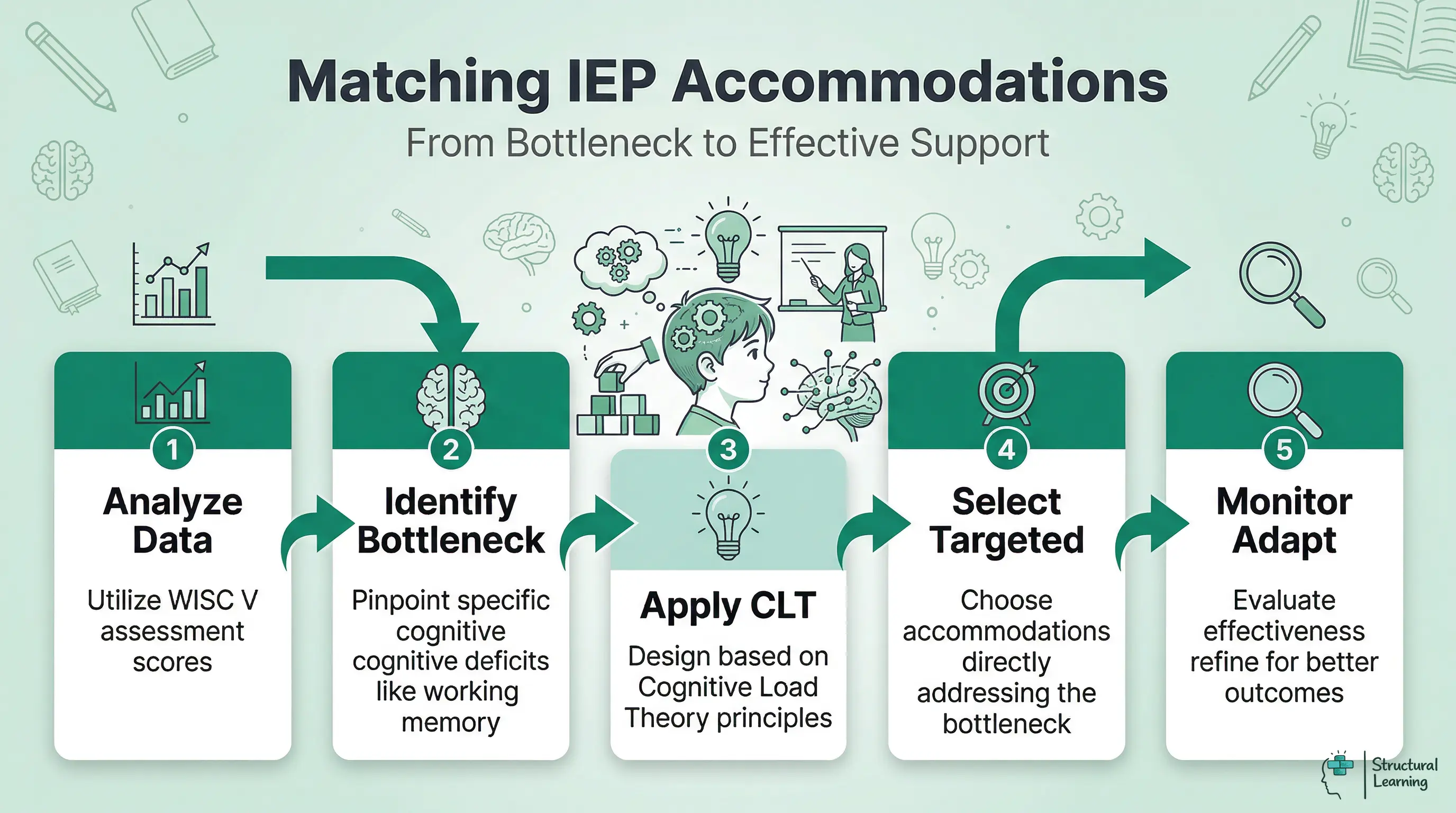
The alternative to accommodation lists is a three-step process that starts from assessment data and ends at measurable outcome monitoring.

Step 1: Identify the specific cognitive bottleneck from assessment data. Before the IEP meeting, review the psychoeducational assessment for information about working memory, processing speed, executive function, phonological processing, and language comprehension. These are not background details; they are the specifications for accommodation design. The WISC-V provides Working Memory Index and Processing Speed Index scores. The CTOPP-2 provides phonological processing profiles. The BRIEF-2 provides executive function profiles across inhibition, planning, working memory, and monitoring domains. The question to answer is: which specific cognitive process is most limiting this student's access to curriculum?

Step 2: Select accommodations that directly reduce load on the identified bottleneck. Use the diagnostic table above as a starting framework. For each accommodation proposed, ask explicitly: which cognitive process does this accommodation offload? If the team cannot answer that question, the accommodation is likely to be a mismatch. This does not require a neuropsychologist in the room; it requires the habit of connecting assessment data to accommodation logic.

Step 3: Monitor whether the accommodation changes outcomes, not just whether it is being used. Accommodation monitoring typically focuses on implementation: was the extended time offered? Did the student use the separate room? The question that matters for students is different: is the student's performance on the targeted task improving? If a student has had a working memory scaffold for two months and their performance on multi-step tasks has not changed, the scaffold is either mismatched, insufficiently intensive, or being applied inconsistently. Progress monitoring with curriculum-based measurement gives you the data to answer this question with precision rather than impression.

The cycle then repeats. New data informs revised accommodation decisions. This is closer to what the MTSS and RTI framework describes in theory: assess, intervene, monitor, adjust. In practice, IEP accommodation monitoring rarely reaches this standard.

What the Assessment Data Tells You

Most psychoeducational assessments include more information about cognitive processes than most IEP teams use. Here is how to read the scores that are most relevant to accommodation design.

The WISC-V Working Memory Index

The Working Memory Index (WMI) comprises two subtests: Digit Span and Picture Span. Digit Span asks the student to repeat sequences of numbers forwards, backwards, and in ascending order. Picture Span asks the student to remember pictures in sequence. A standard score below 85 on the WMI indicates a clinically significant working memory limitation.

Look beyond the composite score at the subtest profile. A student who scores significantly lower on Digit Span than Picture Span has a relative weakness in the phonological loop compared to the visuospatial sketchpad. This score pattern tells you to prioritise visual and spatial accommodations over verbal ones. Written instructions are more supportive than verbal instructions for this student. Diagrams and graphic organisers carry more load than oral explanations.

A student who scores low on both subtests has a generalised working memory deficit. For these students, any multi-step task presents a capacity problem, and the accommodation design should focus on externalising information across all modalities.

The WISC-V Processing Speed Index

The Processing Speed Index (PSI) comprises Coding and Symbol Search. These subtests measure the speed and accuracy of simple visual-motor tasks under timed conditions. A score below 85 on the PSI indicates a processing speed deficit.

Here is the critical clinical distinction: a student with a low WMI but average PSI is a working memory case, not a processing speed case. Extended time will not help them significantly. A student with a low PSI but average WMI is a processing speed case. Extended time is the appropriate accommodation. A student with both low WMI and low PSI needs both capacity supports and time accommodations.

Many IEP teams treat extended time as a default for any student with a low overall cognitive ability score. The indices allow you to be more precise. Check whether the PSI is the driver before writing extended time into every accommodation box.

The BRIEF-2 Executive Function Profiles

The Behavior Rating Inventory of Executive Function, Second Edition (BRIEF-2) provides teacher and parent ratings across nine executive function scales: Inhibit, Self-Monitor, Shift, Emotional Control, Initiate, Working Memory, Plan/Organize, Task-Monitor, and Organization of Materials.

The BRIEF-2 Working Memory scale specifically assesses the functional use of working memory in everyday tasks: holding instructions in mind, tracking where one is in a task, keeping track of completed work. When this scale is elevated (T-score above 65), it confirms that working memory is a functional barrier in the student's actual school life, not just a psychometric deficit in a testing room.

The Plan/Organize and Organization of Materials scales are separately relevant: a student who scores high on these scales has executive function deficits in planning and organisation, not working memory. The accommodations for these profiles differ. Planning deficits respond to external structure: provided templates, assignment tracking systems, step-by-step project guides. Organisation deficits respond to environmental accommodations: colour-coded folders, teacher-organised materials, structured storage systems. Neither profile primarily benefits from extended time.

Understanding executive function in the classroom at this level of granularity is what separates an IEP that produces change from one that produces documentation.

Cognitive Load Theory in the IEP

Sweller (1988) developed cognitive load theory to explain why some instructional designs produce learning efficiently and others overwhelm students with no learning to show for the effort. The theory has since been extended and refined substantially (Sweller, 2011), and Kennedy and Romig (2024) have articulated its specific applications to special education accommodation design.

Cognitive load theory distinguishes three types of load. Extraneous load is the cognitive effort required by the format of the task: poorly organised instructions, irrelevant information, distracting visual elements. It does not contribute to learning. Intrinsic load is the inherent complexity of the content itself: the number of interacting elements the student must understand. Germane load is the effort devoted to understanding and schema formation: the productive struggle that produces learning.

Effective instructional design, and by extension effective accommodation design, reduces extraneous load, manages intrinsic load so it does not exceed the student's capacity, and supports germane load by keeping the student engaged in productive processing rather than administrative struggle.

Each of these three principles translates directly to accommodation decisions.

Reducing extraneous load means simplifying the presentation of tasks: using clear and consistent formatting, removing irrelevant information from instructions, providing visual supports that organise rather than decorate, and delivering instructions in the modality that is most accessible for this student. For a student with a phonological loop weakness, verbal instructions in isolation create high extraneous load. Written instructions delivered simultaneously, or written instructions that replace verbal ones, reduce that load.

Managing intrinsic load means chunking content so the student encounters a manageable number of interacting elements at once. A student who cannot hold three things in working memory cannot follow a five-step process presented as a single block of text. Breaking that process into five discrete, sequential steps presented one at a time reduces intrinsic load to a level the system can manage. This is not dumbing down the task; it is presenting the task in a form the student's working memory can process. Differentiation strategies based on cognitive load principles use chunking and sequencing to manage intrinsic load without reducing the cognitive demands of the content itself.

Supporting germane load means ensuring the student has enough cognitive capacity left to actually learn, rather than using all available capacity on task management. A student with dysgraphia who spends their entire writing class managing the motor demands of letter formation has no capacity left for composition. Allowing that student to dictate removes the motor load and frees capacity for the thinking work. This is an accommodation that increases germane load by reducing extraneous load, which is exactly the goal.

Kennedy and Romig (2024) note that special education teams rarely use cognitive load theory explicitly, even though many effective evidence-based practices for students with disabilities are essentially applications of its principles. Making the framework explicit gives teams a principled basis for accommodation selection that moves beyond intuition and disability category associations.

Using the Framework at IEP Meetings

The diagnostic framework above requires a change in the sequence of the IEP conversation. Most IEP meetings begin with the accommodation list: here are the things we will put in place. The framework requires starting earlier: here is what the assessment data tells us about this student's cognitive profile, and here are the accommodations that directly address that profile.

This change in sequence encounters two practical barriers. The first is time. IEP meetings are constrained, and walking a team through a psychoeducational assessment profile takes longer than reviewing a pre-populated accommodation list. The second is expertise. General education teachers, who implement most accommodations, are not typically trained in cognitive science, and asking them to reason from working memory indices to classroom accommodations requires bridging a knowledge gap that most pre-service programmes never build.

Both barriers are real. Neither is an argument for continuing to select accommodations that are unlikely to work. For the time barrier, the solution is to do the diagnostic work before the meeting: the special education teacher or school psychologist reviews the assessment profile, identifies the two or three most significant bottlenecks, and arrives at the meeting with a targeted accommodation rationale rather than a generic list. For the knowledge gap, the solution is the kind of professional development that explains not just what to do but why, connecting the cognitive science to the practical accommodation decision.

The IEP goal bank and the frameworks used to write neurodiversity-affirming goals are only as effective as the accommodation structure supporting them. A goal targeting multi-step problem solving cannot be reached if the accommodations supporting it do not address the working memory constraints that make multi-step processing difficult. Goals and accommodations need to be designed together, from the same diagnostic foundation.

When the accommodation is correctly matched and the goal is realistic, IEP progress monitoring becomes meaningful: you can see whether the accommodation is working because you have a specific cognitive bottleneck, a specific accommodation targeting it, and a specific goal you are measuring. When the accommodation is mismatched, progress monitoring tells you nothing useful beyond the fact that the student is still failing, which you already knew.

What Functional Behaviour Assessment Adds

Some students whose accommodations are not working are not primarily experiencing cognitive bottlenecks. They are experiencing a mismatch between their behaviour needs and their accommodation plan. A student who avoids writing tasks because writing is cognitively overwhelming may have an executive function or working memory deficit driving the avoidance. But a student who avoids writing tasks because they have a history of failure, shame, and learned helplessness around writing is presenting a different problem.

A functional behaviour assessment can distinguish between these two profiles. The FBA identifies the antecedents and functions of avoidance behaviour. When the function of avoidance is escape from a cognitively overwhelming task, the intervention is accommodation redesign: reduce the cognitive load so the task is no longer overwhelming. When the function of avoidance is escape from anticipated failure, the intervention is more complex, involving both accommodation redesign and systematic confidence-building.

Teachers who see accommodation failure as purely a behaviour problem and route students to behavioural interventions without addressing the underlying cognitive mismatch will not produce lasting change. The behaviour is a symptom; the accommodation mismatch is the cause.

The Difference Between a 504 Plan and an IEP Accommodation

The cognitive science of accommodation design applies equally to 504 plans and IEP accommodations, but the diagnostic resources available differ between the two processes. IEPs are preceded by full psychoeducational assessments, which typically include the WISC-V or equivalent measures of working memory, processing speed, and processing abilities. This gives IEP teams the data to conduct the kind of diagnostic matching described in this article.

504 plans are often developed without full psychological testing, relying instead on medical documentation of a disability. A student with an ADHD diagnosis and a 504 plan may never have had working memory formally assessed. The team knows the diagnostic label but not the cognitive profile. In this situation, the 504 plan for ADHD may default to standard ADHD accommodations without analysis of which specific executive functions are most impaired for this student.

Where assessment data is absent, request it. Where it cannot be obtained, use structured teacher observation to build a functional profile: what types of tasks does this student fail on, and what is the pattern of failure? A student who consistently fails on tasks requiring the simultaneous integration of multiple pieces of information but succeeds on single-step tasks has a working memory profile. A student who consistently fails on timed tasks but performs well with unlimited time has a processing speed profile. Functional observation, systematically conducted, provides the diagnostic information needed to match accommodations, even in the absence of standardised assessment.

When Accommodations Are Correctly Matched

Correctly matched accommodations produce a specific change in the pattern of a student's performance. The student does not simply do better on everything; they do better on the specific tasks that were creating the cognitive bottleneck.

A student with a working memory deficit who receives graphic organisers and chunked instructions should show improvement on tasks requiring the integration of multiple pieces of information, while tasks that do not require working memory should show no change. If you see global improvement or no improvement, neither outcome confirms that the accommodation was correctly matched.

A student with a processing speed deficit who receives extended time should show improvement on timed tasks relative to untimed tasks, and should close the gap between their performance with and without time limits. If performance is equally low regardless of time, the bottleneck is not processing speed.

Tracking accommodation outcomes at this level of specificity is not standard practice in most schools, but it is achievable using curriculum-based measurement data and simple performance tracking across accommodation conditions. The data does not need to be complicated. It needs to answer one question: is performance on the targeted task type improving since the accommodation was implemented?

Using Accommodation Data at the Annual Review

Annual IEP reviews should include a review of accommodation effectiveness, not just accommodation implementation. The question for each accommodation should be: what evidence do we have that this accommodation changed a student outcome?

When the answer is 'we believe the student found it helpful' or 'the teacher reports it was used consistently', the evidence base is insufficient for a clinical decision. When the answer is 'the student's performance on multi-step tasks improved from X to Y over the monitoring period while their performance on single-step tasks remained stable, which is consistent with the working memory accommodation being effective', the review is based on evidence.

The annual review process for students making insufficient progress requires exactly this kind of evidence. The Endrew F. standard (2017) requires that an IEP offer more than de minimis progress, which means teams must be able to demonstrate that their approach, including their accommodation selection, is reasonably calculated to produce meaningful educational benefit. An accommodation list that is implemented with fidelity but produces no measurable change in the targeted skill is not a defensible programme.

Further Reading

Key Research Papers on Accommodations and Cognitive Science

Lewandowski, L. J., Lovett, B. J., Codding, R. S., and Gordon, M. (2008). Symptoms of ADHD and academic concerns in college students with and without ADHD diagnoses. Journal of Attention Disorders, 12(2), 156–161. This study examined how extended time interacts with different cognitive profiles, finding that processing speed deficits, not working memory deficits, drive extended time benefit. Essential reading for any team trying to decide who actually benefits from extra time. View study

Gathercole, S. E. and Alloway, T. P. (2008). Working Memory and Learning: A Practical Guide for Teachers. SAGE Publications. The definitive classroom-facing synthesis of working memory research. Gathercole and Alloway show how working memory deficits appear in the classroom and what teachers can practically do to reduce the load on impaired systems. Required reading for any educator implementing working memory accommodations. View book

Sweller, J., van Merrienboer, J. J. G., and Paas, F. (1998). Cognitive architecture and instructional design. Educational Psychology Review, 10(3), 251–296. The foundational cognitive load theory paper that underpins the accommodation design framework in this article. Sweller et al. articulate the extraneous/intrinsic/germane load distinction and show how instructional design choices interact with limited working memory capacity. View study

Fuchs, L. S., Fuchs, D., Eaton, S. B., Hamlett, C., and Karns, K. (2000). Supplementing teacher judgments of mathematics test accommodations with objective data sources. School Psychology Review, 29(1), 65–85. Fuchs and colleagues demonstrate that accommodation effectiveness varies significantly by cognitive profile, not disability label. Students with the same disability may need different accommodations depending on the specific process driving their difficulty. A direct empirical grounding for the accommodation mismatch argument. View study

Kennedy, M. J. and Romig, J. E. (2024). Cognitive load theory for students with disabilities: Applications for special educators. TEACHING Exceptional Children. SAGE Journals. The most recent and comprehensive synthesis of cognitive load theory applied directly to special education practice. Kennedy and Romig translate the theoretical framework into concrete accommodation design decisions, making this the most practically useful recent contribution to the field. View study

References

Baddeley, A. D. (2000). The episodic buffer: A new component of working memory? Trends in Cognitive Sciences, 4(11), 417–423.

Cowan, N. (2001). The magical number 4 in short-term memory: A reconsideration of mental storage capacity. Behavioral and Brain Sciences, 24(1), 87–114.

Fuchs, L. S., Fuchs, D., Eaton, S. B., Hamlett, C., and Karns, K. (2000). Supplementing teacher judgments of mathematics test accommodations with objective data sources. School Psychology Review, 29(1), 65–85.

Gathercole, S. E. and Alloway, T. P. (2008). Working Memory and Learning: A Practical Guide for Teachers. SAGE Publications.

Gough, P. B. and Tunmer, W. E. (1986). Decoding, reading, and reading disability. Remedial and Special Education, 7(1), 6–10.

Harrison, J. R., Bunford, N., Evans, S. W., and Owens, J. S. (2013). Educational accommodations for students with behavioral challenges: A systematic review of the literature. Review of Educational Research, 83(4), 551–597.

Kennedy, M. J. and Romig, J. E. (2024). Cognitive load theory for students with disabilities: Applications for special educators. TEACHING Exceptional Children. SAGE Journals.

Lewandowski, L. J., Lovett, B. J., Codding, R. S., and Gordon, M. (2008). Symptoms of ADHD and academic concerns in college students with and without ADHD diagnoses. Journal of Attention Disorders, 12(2), 156–161.

Sweller, J. (1988). Cognitive load during problem solving: Effects on learning. Cognitive Science, 12(2), 257–285.

Sweller, J. (2011). Cognitive load theory. In J. P. Mestre and B. H. Ross (Eds.), Psychology of Learning and Motivation, Volume 55 (pp. 37–76). Academic Press.

Loading audit...

Key Takeaways

  1. Capacity, not speed, is the bottleneck: Extended time is the most common IEP accommodation, but it only helps students whose bottleneck is processing speed. For students with working memory deficits, the problem is how much information they can hold at once, and more time does not change that capacity.
  2. Accommodation mismatch is common and under-diagnosed: Most IEP teams select accommodations from generic lists without first identifying the specific cognitive bottleneck driving a student's difficulties. The result is accommodations that are implemented perfectly and achieve nothing.
  3. Assessment data already tells you what to target: The WISC-V Working Memory Index, Processing Speed Index, and BRIEF-2 executive function profiles contain enough information to match accommodations to cognitive bottlenecks, but most teams do not use those scores to drive accommodation selection.
  4. Cognitive Load Theory provides the design framework: Every effective accommodation reduces extraneous load, manages intrinsic load, or supports germane load. When you cannot say which of those three things an accommodation does, it is likely a mismatch.

A student has extended time, preferential seating, and reduced assignments on their IEP. Six months later, they are still failing. The accommodations are being implemented. The problem is not fidelity. The problem is match.

This distinction matters because the entire compliance infrastructure around IEP implementation focuses on fidelity: was the accommodation offered? Was it documented? Was it used? Almost no attention goes to the prior question: does this accommodation address the actual cognitive reason the student is struggling? When it does not, you can implement with perfect fidelity for a full school year and produce no change in outcomes.

The cognitive science behind this is not complicated, but it is rarely taught in special education preparation programmes or shared at IEP meetings. This article explains the mechanism, gives you a diagnostic framework, and shows you how to use assessment data you already have to select accommodations that are more likely to work.

The Accommodation Mismatch Problem

Most IEP accommodation lists are generated the same way: a team reviews a student's disability category, consults a bank of common accommodations, selects those that seem reasonable, and documents them. The process is driven by legal frameworks, teacher instinct, and precedent, not by a systematic analysis of which cognitive processes are impaired and which accommodations would actually address those processes.

Harrison, Bunford, Evans, and Owens (2013) examined how teachers and school psychologists select accommodations and found that the most common selection method was consulting lists of accommodations associated with a disability category, rather than analysing individual assessment profiles. The result is a kind of diagnostic short-cut: dyslexia gets read-aloud, ADHD gets extended time, anxiety gets a separate room. These are not wrong in every case, but they are rarely tailored to the individual cognitive profile that explains why this particular student struggles with this particular task.

Fuchs, Fuchs, Eaton, Hamlett, and Karns (2000) demonstrated that accommodation effectiveness varies significantly across students with the same disability label, depending on the underlying cognitive profile. Two students, both with a specific learning disability in reading, may have completely different cognitive bottlenecks: one may have a phonological processing deficit that responds to text-to-speech, while the other may have a reading fluency deficit that requires repeated oral reading practice. Giving both students the same read-aloud accommodation addresses one student's problem and does nothing for the other's.

The accommodation mismatch problem has a structural cause. IEP teams are time-pressured, assessment data is often not interpreted in depth, and the connection between neuropsychological profiles and accommodation design is not consistently taught. Understanding working memory and how it affects learning is the starting point for fixing this.

How Working Memory Affects Everything

Working memory is the cognitive system that holds and manipulates information during active thinking. It is not the same as short-term memory, which is purely passive storage. Working memory is where you keep a sentence in mind while you figure out its meaning, where you hold the first three steps of a problem while executing the fourth, and where you track what you have already written while deciding what to write next.

Baddeley (2000) revised his influential model of working memory to include four components. The central executive is the attentional control system that coordinates the others. The phonological loop holds verbal and acoustic information in a kind of inner voice. The visuospatial sketchpad holds visual and spatial information. The episodic buffer integrates information from these sub-systems and from long-term memory into a coherent representation.

Cowan (2001) established through a series of experiments that the central executive can hold approximately four chunks of information in adults under optimal conditions. In children with learning difficulties, that number drops to two or three. A student who can hold two chunks in working memory at once will struggle with any task that requires simultaneously tracking more than two things: multi-step directions, reading comprehension that requires holding earlier content while processing later content, written expression that requires generating ideas, translating them to text, monitoring grammar, and managing spelling at the same time.

Gathercole and Alloway (2008) tracked children with working memory deficits through primary school and found that these children consistently underperformed on tasks requiring the integration of multiple pieces of information, that teachers frequently misidentified their failures as attention or motivation problems, and that the children themselves were often unaware of why they were struggling. This matters because misattribution leads to mismatched interventions: a student whose working memory is overwhelmed looks inattentive, and the response is often a behaviour intervention rather than a cognitive load reduction strategy.

Working memory limitations affect writing, mathematics, reading comprehension, and listening comprehension. They affect the ability to follow multi-step instructions. They affect performance on tests because retrieval requires holding partial answers in mind while searching for the rest. Understanding this dependency is foundational to understanding which accommodations can help and which are solving the wrong problem.

Extended Time: When It Helps and When It Does Not

Extended time is the most frequently listed accommodation in the United States. It is on nearly every IEP and 504 plan. It is also the accommodation most often applied without any analysis of whether it addresses the student's actual cognitive bottleneck.

Extended time helps when the bottleneck is processing speed. A student who understands the material but takes longer to decode text, generate written responses, or complete calculations benefits from more time because the constraint is temporal. Given enough time, they can demonstrate what they know.

Extended time does not help when the bottleneck is working memory capacity. Lewandowski, Lovett, Codding, and Gordon (2008) studied the effect of extended time on students with and without learning disabilities on a processing speed measure and a working memory measure. Extended time produced significant gains for students with processing speed deficits. For students with working memory deficits, the gains were small and unreliable. The reason is mechanical: if a student cannot hold four steps in working memory, giving them twice as much time to complete those four steps does not change the capacity constraint. The bottleneck is not how fast they work; it is how much information the system can hold at once.

This is a finding that most IEP teams have not systematically absorbed. When a student with extended time continues to fail, the typical response is to question fidelity: was the time actually offered? Did the student use it? A more productive question is: is this student's primary cognitive challenge a processing speed problem or a working memory capacity problem? If it is the latter, adding time is the wrong treatment.

What does help for working memory deficits? Reducing the number of items the student must hold in working memory at once. This means visual scaffolds that externalise information the student would otherwise have to track internally, chunked instructions delivered one step at a time, graphic organisers that hold partial information so the student does not have to, and worked examples that reduce the problem-solving load while the student is building procedural knowledge.

Extended time combined with these supports can be effective. Extended time alone, for a student whose bottleneck is capacity, is an accommodation that produces the appearance of support without changing the cognitive conditions that drive failure.

Matching Accommodations to Cognitive Bottlenecks

The accommodation mismatch problem has a solution: identify the specific cognitive bottleneck first, then select accommodations that reduce the load on that specific system. This requires using assessment data differently than most IEP teams currently use it.

The following table maps eight common cognitive bottlenecks to the accommodations typically chosen for them and to the accommodations that more directly address the underlying deficit.

Cognitive Bottleneck Common (Often Mismatched) Accommodation Better (Matched) Accommodation
Working memory capacity Extended time alone Graphic organisers, step-by-step written instructions, chunked tasks, visual checklists
Processing speed Reduced assignments (quantity) Extended time, untimed tests, fewer items testing the same skill
Sustained attention Preferential seating at the front Scheduled movement breaks, task segmentation with check-ins, fidget tools, timer-based work intervals
Auditory processing Preferential seating near the teacher Written instructions alongside verbal, FM system or sound-field system, pre-teaching vocabulary, paired visual supports
Visual processing Enlarged print Reduced visual clutter, high-contrast materials, text-to-speech for decoding, colour overlays, graph paper for alignment
Executive function (planning) Reduced homework Assignment notebooks, project planning templates, explicit instruction in task analysis, structured study hall with adult support
Executive function (inhibition) Separate testing room Response cost systems, self-monitoring checklists, structured social scripts, impulse regulation strategies taught explicitly
Reading fluency Read-aloud for all tasks Read-aloud for content-area tests (not reading assessments), repeated reading practice, decodable texts at instructional level, fluency-building intervention

The pattern across the table is consistent: common accommodations tend to address surface performance rather than the underlying process. They reduce the visible manifestation of the deficit without changing the cognitive conditions that produce it. The matched accommodations work because they reduce demand on the specific system that is failing, rather than simply giving the student more time or less work while the same system continues to be overwhelmed.

Five Common Mismatches in Practice

Abstract principles become clearer through specific classroom examples. The five mismatches below appear regularly in IEP documentation across the country. Each one makes intuitive sense, which is why they persist. Each one also fails to address the actual cognitive bottleneck.

Preferential Seating for Auditory Processing Disorder

A Year 4 student with an auditory processing disorder is seated at the front of the classroom, close to the teacher. The IEP team reasoned that proximity would improve the student's ability to hear instructions clearly.

Auditory processing disorder is not a hearing problem. The student's ears receive the sound normally. The deficit is in the brain's ability to discriminate, sequence, and make meaning from the auditory signal. Moving a student closer to a speaker does not change how the auditory cortex processes the signal it receives.

What does help: written instructions that accompany every verbal instruction, pre-teaching key vocabulary before a lesson so the student has a semantic scaffold to aid processing, a sound-field system that improves signal-to-noise ratio, and wait time after verbal instructions to allow the student to process. Proximity alone, without these supports, leaves the core processing deficit unaddressed.

Reduced Homework for a Student Who Cannot Read

A Year 3 student with a significant reading disability receives reduced homework as an accommodation. The team reasoned that fewer assignments would reduce stress and increase the likelihood of completion.

Homework quantity is not the problem. The student cannot access text-based homework regardless of how much of it there is. If the homework requires reading and the student decodes at a pre-primer level, three pages and one page are equally inaccessible.

What does help: homework in a format the student can access, whether that is audio, visual, or supported by a family member reading aloud, and direct reading instruction during the school day that builds the skill that makes homework accessible. Reducing quantity while leaving the access problem unsolved produces a student who completes less work but still cannot read.

A Calculator for a Student Without Number Sense

A Year 5 student with dyscalculia is provided with a calculator for all mathematics tasks. The team reasoned that the calculation tool would remove the arithmetic barrier and allow the student to demonstrate understanding.

For a student whose deficit is in procedural calculation, a calculator can work well. But dyscalculia often involves a deeper difficulty: the intuitive understanding of quantity, magnitude, and the relationships between numbers. A student who does not know whether 37 is closer to 30 or 40, who cannot estimate whether an answer is reasonable, and who does not understand what multiplication represents will not become a mathematician by pressing the right buttons. The calculator outputs a number; it does not build the number sense required to use that number meaningfully.

What does help: concrete manipulatives that build quantity understanding, number line activities that develop magnitude awareness, and number sense instruction that explicitly targets the conceptual gaps. The calculator can be appropriate as an accommodation for fluency tasks once the conceptual understanding is present.

A Separate Testing Room for Test Anxiety

A Year 7 student with test anxiety receives testing in a separate, quiet room. The team reasoned that removing the student from the social pressure of the main classroom would reduce anxiety and improve performance.

A quiet room removes one anxiety stimulus. But test anxiety is not caused by the presence of other students; it is a generalised threat response to evaluation situations. Moving the student to an empty room does not change the student's relationship to the evaluation itself. For many students with test anxiety, the separate room adds a layer of stigma and heightened awareness of their difficulties without providing any cognitive or regulatory support.

What does help: anxiety management strategies taught explicitly before and during exams, including breathing techniques and cognitive reframing, and gradual exposure to evaluation situations with support, rather than avoidance of them. A school counsellor-led programme that systematically reduces the threat response is a genuine intervention; a separate room is a workaround that leaves the anxiety intact.

Read-Aloud for a Student with Comprehension Deficits

A Year 6 student with reading comprehension difficulties receives read-aloud for all content-area tests. The team reasoned that removing the decoding burden would allow the student to demonstrate content knowledge.

This accommodation is correct for one type of comprehension difficulty: the student who decodes poorly but comprehends well when listening. But for a student whose comprehension deficit is a genuine language comprehension problem, rather than a decoding problem, hearing the text does not help. The student struggles to build a mental model of what text means, whether they encounter it visually or aurally. The words come in; the meaning does not cohere.

Distinguishing between decoding deficits and comprehension deficits is therefore prerequisite to selecting the right accommodation. The Simple View of Reading (Gough and Tunmer, 1986) provides a framework: reading comprehension equals decoding multiplied by language comprehension. A student scoring low on one dimension needs a different accommodation from a student scoring low on both. When scaffolding in education is applied to reading, the scaffold needs to target the specific failing component, not the composite output.

A Better Framework: Diagnose, Match, Monitor

The alternative to accommodation lists is a three-step process that starts from assessment data and ends at measurable outcome monitoring.

Step 1: Identify the specific cognitive bottleneck from assessment data. Before the IEP meeting, review the psychoeducational assessment for information about working memory, processing speed, executive function, phonological processing, and language comprehension. These are not background details; they are the specifications for accommodation design. The WISC-V provides Working Memory Index and Processing Speed Index scores. The CTOPP-2 provides phonological processing profiles. The BRIEF-2 provides executive function profiles across inhibition, planning, working memory, and monitoring domains. The question to answer is: which specific cognitive process is most limiting this student's access to curriculum?

Step 2: Select accommodations that directly reduce load on the identified bottleneck. Use the diagnostic table above as a starting framework. For each accommodation proposed, ask explicitly: which cognitive process does this accommodation offload? If the team cannot answer that question, the accommodation is likely to be a mismatch. This does not require a neuropsychologist in the room; it requires the habit of connecting assessment data to accommodation logic.

Step 3: Monitor whether the accommodation changes outcomes, not just whether it is being used. Accommodation monitoring typically focuses on implementation: was the extended time offered? Did the student use the separate room? The question that matters for students is different: is the student's performance on the targeted task improving? If a student has had a working memory scaffold for two months and their performance on multi-step tasks has not changed, the scaffold is either mismatched, insufficiently intensive, or being applied inconsistently. Progress monitoring with curriculum-based measurement gives you the data to answer this question with precision rather than impression.

The cycle then repeats. New data informs revised accommodation decisions. This is closer to what the MTSS and RTI framework describes in theory: assess, intervene, monitor, adjust. In practice, IEP accommodation monitoring rarely reaches this standard.

What the Assessment Data Tells You

Most psychoeducational assessments include more information about cognitive processes than most IEP teams use. Here is how to read the scores that are most relevant to accommodation design.

The WISC-V Working Memory Index

The Working Memory Index (WMI) comprises two subtests: Digit Span and Picture Span. Digit Span asks the student to repeat sequences of numbers forwards, backwards, and in ascending order. Picture Span asks the student to remember pictures in sequence. A standard score below 85 on the WMI indicates a clinically significant working memory limitation.

Look beyond the composite score at the subtest profile. A student who scores significantly lower on Digit Span than Picture Span has a relative weakness in the phonological loop compared to the visuospatial sketchpad. This score pattern tells you to prioritise visual and spatial accommodations over verbal ones. Written instructions are more supportive than verbal instructions for this student. Diagrams and graphic organisers carry more load than oral explanations.

A student who scores low on both subtests has a generalised working memory deficit. For these students, any multi-step task presents a capacity problem, and the accommodation design should focus on externalising information across all modalities.

The WISC-V Processing Speed Index

The Processing Speed Index (PSI) comprises Coding and Symbol Search. These subtests measure the speed and accuracy of simple visual-motor tasks under timed conditions. A score below 85 on the PSI indicates a processing speed deficit.

Here is the critical clinical distinction: a student with a low WMI but average PSI is a working memory case, not a processing speed case. Extended time will not help them significantly. A student with a low PSI but average WMI is a processing speed case. Extended time is the appropriate accommodation. A student with both low WMI and low PSI needs both capacity supports and time accommodations.

Many IEP teams treat extended time as a default for any student with a low overall cognitive ability score. The indices allow you to be more precise. Check whether the PSI is the driver before writing extended time into every accommodation box.

The BRIEF-2 Executive Function Profiles

The Behavior Rating Inventory of Executive Function, Second Edition (BRIEF-2) provides teacher and parent ratings across nine executive function scales: Inhibit, Self-Monitor, Shift, Emotional Control, Initiate, Working Memory, Plan/Organize, Task-Monitor, and Organization of Materials.

The BRIEF-2 Working Memory scale specifically assesses the functional use of working memory in everyday tasks: holding instructions in mind, tracking where one is in a task, keeping track of completed work. When this scale is elevated (T-score above 65), it confirms that working memory is a functional barrier in the student's actual school life, not just a psychometric deficit in a testing room.

The Plan/Organize and Organization of Materials scales are separately relevant: a student who scores high on these scales has executive function deficits in planning and organisation, not working memory. The accommodations for these profiles differ. Planning deficits respond to external structure: provided templates, assignment tracking systems, step-by-step project guides. Organisation deficits respond to environmental accommodations: colour-coded folders, teacher-organised materials, structured storage systems. Neither profile primarily benefits from extended time.

Understanding executive function in the classroom at this level of granularity is what separates an IEP that produces change from one that produces documentation.

Cognitive Load Theory in the IEP

Sweller (1988) developed cognitive load theory to explain why some instructional designs produce learning efficiently and others overwhelm students with no learning to show for the effort. The theory has since been extended and refined substantially (Sweller, 2011), and Kennedy and Romig (2024) have articulated its specific applications to special education accommodation design.

Cognitive load theory distinguishes three types of load. Extraneous load is the cognitive effort required by the format of the task: poorly organised instructions, irrelevant information, distracting visual elements. It does not contribute to learning. Intrinsic load is the inherent complexity of the content itself: the number of interacting elements the student must understand. Germane load is the effort devoted to understanding and schema formation: the productive struggle that produces learning.

Effective instructional design, and by extension effective accommodation design, reduces extraneous load, manages intrinsic load so it does not exceed the student's capacity, and supports germane load by keeping the student engaged in productive processing rather than administrative struggle.

Each of these three principles translates directly to accommodation decisions.

Reducing extraneous load means simplifying the presentation of tasks: using clear and consistent formatting, removing irrelevant information from instructions, providing visual supports that organise rather than decorate, and delivering instructions in the modality that is most accessible for this student. For a student with a phonological loop weakness, verbal instructions in isolation create high extraneous load. Written instructions delivered simultaneously, or written instructions that replace verbal ones, reduce that load.

Managing intrinsic load means chunking content so the student encounters a manageable number of interacting elements at once. A student who cannot hold three things in working memory cannot follow a five-step process presented as a single block of text. Breaking that process into five discrete, sequential steps presented one at a time reduces intrinsic load to a level the system can manage. This is not dumbing down the task; it is presenting the task in a form the student's working memory can process. Differentiation strategies based on cognitive load principles use chunking and sequencing to manage intrinsic load without reducing the cognitive demands of the content itself.

Supporting germane load means ensuring the student has enough cognitive capacity left to actually learn, rather than using all available capacity on task management. A student with dysgraphia who spends their entire writing class managing the motor demands of letter formation has no capacity left for composition. Allowing that student to dictate removes the motor load and frees capacity for the thinking work. This is an accommodation that increases germane load by reducing extraneous load, which is exactly the goal.

Kennedy and Romig (2024) note that special education teams rarely use cognitive load theory explicitly, even though many effective evidence-based practices for students with disabilities are essentially applications of its principles. Making the framework explicit gives teams a principled basis for accommodation selection that moves beyond intuition and disability category associations.

Using the Framework at IEP Meetings

The diagnostic framework above requires a change in the sequence of the IEP conversation. Most IEP meetings begin with the accommodation list: here are the things we will put in place. The framework requires starting earlier: here is what the assessment data tells us about this student's cognitive profile, and here are the accommodations that directly address that profile.

This change in sequence encounters two practical barriers. The first is time. IEP meetings are constrained, and walking a team through a psychoeducational assessment profile takes longer than reviewing a pre-populated accommodation list. The second is expertise. General education teachers, who implement most accommodations, are not typically trained in cognitive science, and asking them to reason from working memory indices to classroom accommodations requires bridging a knowledge gap that most pre-service programmes never build.

Both barriers are real. Neither is an argument for continuing to select accommodations that are unlikely to work. For the time barrier, the solution is to do the diagnostic work before the meeting: the special education teacher or school psychologist reviews the assessment profile, identifies the two or three most significant bottlenecks, and arrives at the meeting with a targeted accommodation rationale rather than a generic list. For the knowledge gap, the solution is the kind of professional development that explains not just what to do but why, connecting the cognitive science to the practical accommodation decision.

The IEP goal bank and the frameworks used to write neurodiversity-affirming goals are only as effective as the accommodation structure supporting them. A goal targeting multi-step problem solving cannot be reached if the accommodations supporting it do not address the working memory constraints that make multi-step processing difficult. Goals and accommodations need to be designed together, from the same diagnostic foundation.

When the accommodation is correctly matched and the goal is realistic, IEP progress monitoring becomes meaningful: you can see whether the accommodation is working because you have a specific cognitive bottleneck, a specific accommodation targeting it, and a specific goal you are measuring. When the accommodation is mismatched, progress monitoring tells you nothing useful beyond the fact that the student is still failing, which you already knew.

What Functional Behaviour Assessment Adds

Some students whose accommodations are not working are not primarily experiencing cognitive bottlenecks. They are experiencing a mismatch between their behaviour needs and their accommodation plan. A student who avoids writing tasks because writing is cognitively overwhelming may have an executive function or working memory deficit driving the avoidance. But a student who avoids writing tasks because they have a history of failure, shame, and learned helplessness around writing is presenting a different problem.

A functional behaviour assessment can distinguish between these two profiles. The FBA identifies the antecedents and functions of avoidance behaviour. When the function of avoidance is escape from a cognitively overwhelming task, the intervention is accommodation redesign: reduce the cognitive load so the task is no longer overwhelming. When the function of avoidance is escape from anticipated failure, the intervention is more complex, involving both accommodation redesign and systematic confidence-building.

Teachers who see accommodation failure as purely a behaviour problem and route students to behavioural interventions without addressing the underlying cognitive mismatch will not produce lasting change. The behaviour is a symptom; the accommodation mismatch is the cause.

The Difference Between a 504 Plan and an IEP Accommodation

The cognitive science of accommodation design applies equally to 504 plans and IEP accommodations, but the diagnostic resources available differ between the two processes. IEPs are preceded by full psychoeducational assessments, which typically include the WISC-V or equivalent measures of working memory, processing speed, and processing abilities. This gives IEP teams the data to conduct the kind of diagnostic matching described in this article.

504 plans are often developed without full psychological testing, relying instead on medical documentation of a disability. A student with an ADHD diagnosis and a 504 plan may never have had working memory formally assessed. The team knows the diagnostic label but not the cognitive profile. In this situation, the 504 plan for ADHD may default to standard ADHD accommodations without analysis of which specific executive functions are most impaired for this student.

Where assessment data is absent, request it. Where it cannot be obtained, use structured teacher observation to build a functional profile: what types of tasks does this student fail on, and what is the pattern of failure? A student who consistently fails on tasks requiring the simultaneous integration of multiple pieces of information but succeeds on single-step tasks has a working memory profile. A student who consistently fails on timed tasks but performs well with unlimited time has a processing speed profile. Functional observation, systematically conducted, provides the diagnostic information needed to match accommodations, even in the absence of standardised assessment.

When Accommodations Are Correctly Matched

Correctly matched accommodations produce a specific change in the pattern of a student's performance. The student does not simply do better on everything; they do better on the specific tasks that were creating the cognitive bottleneck.

A student with a working memory deficit who receives graphic organisers and chunked instructions should show improvement on tasks requiring the integration of multiple pieces of information, while tasks that do not require working memory should show no change. If you see global improvement or no improvement, neither outcome confirms that the accommodation was correctly matched.

A student with a processing speed deficit who receives extended time should show improvement on timed tasks relative to untimed tasks, and should close the gap between their performance with and without time limits. If performance is equally low regardless of time, the bottleneck is not processing speed.

Tracking accommodation outcomes at this level of specificity is not standard practice in most schools, but it is achievable using curriculum-based measurement data and simple performance tracking across accommodation conditions. The data does not need to be complicated. It needs to answer one question: is performance on the targeted task type improving since the accommodation was implemented?

Using Accommodation Data at the Annual Review

Annual IEP reviews should include a review of accommodation effectiveness, not just accommodation implementation. The question for each accommodation should be: what evidence do we have that this accommodation changed a student outcome?

When the answer is 'we believe the student found it helpful' or 'the teacher reports it was used consistently', the evidence base is insufficient for a clinical decision. When the answer is 'the student's performance on multi-step tasks improved from X to Y over the monitoring period while their performance on single-step tasks remained stable, which is consistent with the working memory accommodation being effective', the review is based on evidence.

The annual review process for students making insufficient progress requires exactly this kind of evidence. The Endrew F. standard (2017) requires that an IEP offer more than de minimis progress, which means teams must be able to demonstrate that their approach, including their accommodation selection, is reasonably calculated to produce meaningful educational benefit. An accommodation list that is implemented with fidelity but produces no measurable change in the targeted skill is not a defensible programme.

Further Reading

Key Research Papers on Accommodations and Cognitive Science

Lewandowski, L. J., Lovett, B. J., Codding, R. S., and Gordon, M. (2008). Symptoms of ADHD and academic concerns in college students with and without ADHD diagnoses. Journal of Attention Disorders, 12(2), 156–161. This study examined how extended time interacts with different cognitive profiles, finding that processing speed deficits, not working memory deficits, drive extended time benefit. Essential reading for any team trying to decide who actually benefits from extra time. View study

Gathercole, S. E. and Alloway, T. P. (2008). Working Memory and Learning: A Practical Guide for Teachers. SAGE Publications. The definitive classroom-facing synthesis of working memory research. Gathercole and Alloway show how working memory deficits appear in the classroom and what teachers can practically do to reduce the load on impaired systems. Required reading for any educator implementing working memory accommodations. View book

Sweller, J., van Merrienboer, J. J. G., and Paas, F. (1998). Cognitive architecture and instructional design. Educational Psychology Review, 10(3), 251–296. The foundational cognitive load theory paper that underpins the accommodation design framework in this article. Sweller et al. articulate the extraneous/intrinsic/germane load distinction and show how instructional design choices interact with limited working memory capacity. View study

Fuchs, L. S., Fuchs, D., Eaton, S. B., Hamlett, C., and Karns, K. (2000). Supplementing teacher judgments of mathematics test accommodations with objective data sources. School Psychology Review, 29(1), 65–85. Fuchs and colleagues demonstrate that accommodation effectiveness varies significantly by cognitive profile, not disability label. Students with the same disability may need different accommodations depending on the specific process driving their difficulty. A direct empirical grounding for the accommodation mismatch argument. View study

Kennedy, M. J. and Romig, J. E. (2024). Cognitive load theory for students with disabilities: Applications for special educators. TEACHING Exceptional Children. SAGE Journals. The most recent and comprehensive synthesis of cognitive load theory applied directly to special education practice. Kennedy and Romig translate the theoretical framework into concrete accommodation design decisions, making this the most practically useful recent contribution to the field. View study

References

Baddeley, A. D. (2000). The episodic buffer: A new component of working memory? Trends in Cognitive Sciences, 4(11), 417–423.

Cowan, N. (2001). The magical number 4 in short-term memory: A reconsideration of mental storage capacity. Behavioral and Brain Sciences, 24(1), 87–114.

Fuchs, L. S., Fuchs, D., Eaton, S. B., Hamlett, C., and Karns, K. (2000). Supplementing teacher judgments of mathematics test accommodations with objective data sources. School Psychology Review, 29(1), 65–85.

Gathercole, S. E. and Alloway, T. P. (2008). Working Memory and Learning: A Practical Guide for Teachers. SAGE Publications.

Gough, P. B. and Tunmer, W. E. (1986). Decoding, reading, and reading disability. Remedial and Special Education, 7(1), 6–10.

Harrison, J. R., Bunford, N., Evans, S. W., and Owens, J. S. (2013). Educational accommodations for students with behavioral challenges: A systematic review of the literature. Review of Educational Research, 83(4), 551–597.

Kennedy, M. J. and Romig, J. E. (2024). Cognitive load theory for students with disabilities: Applications for special educators. TEACHING Exceptional Children. SAGE Journals.

Lewandowski, L. J., Lovett, B. J., Codding, R. S., and Gordon, M. (2008). Symptoms of ADHD and academic concerns in college students with and without ADHD diagnoses. Journal of Attention Disorders, 12(2), 156–161.

Sweller, J. (1988). Cognitive load during problem solving: Effects on learning. Cognitive Science, 12(2), 257–285.

Sweller, J. (2011). Cognitive load theory. In J. P. Mestre and B. H. Ross (Eds.), Psychology of Learning and Motivation, Volume 55 (pp. 37–76). Academic Press.

SEND

Back to Blog