IEP Transition Planning: A Teacher's Guide to Post-Secondary Success

Updated on  

February 26, 2026

IEP Transition Planning: A Teacher's Guide to Post-Secondary Success

|

February 26, 2026

A practical guide to IEP transition planning under IDEA 2004: measurable postsecondary goals, age-appropriate assessments, self-advocacy skills, and compliance requirements for teachers.

Slug: iep-transition-planning-post-secondary-guide

Target audience: US secondary school teachers, transition coordinators, special education teachers

---

Transition planning is one of the most consequential responsibilities a special education teacher carries. What happens in an IEP meeting at age 16 shapes whether a student with a disability moves into adult life with a clear direction or without one. The research is unambiguous: students who receive structured, well-documented transition services are significantly more likely to achieve competitive employment, pursue post-secondary education, and live independently (Test, Mazzotti, Mustian, Fowler, Kortering, and Kohler, 2009). The legal framework exists. The challenge is implementing it well.

This guide is written for the teacher who must actually do that work: the special education teacher preparing IEP documents, coordinating with agencies, facilitating meetings, and teaching students to advocate for themselves. It covers the legal requirements, the assessment tools, the goal-writing process, the timeline, and the common compliance errors that put both students and schools at risk.

Key Takeaways

  1. Transition planning is federally required, not optional: IDEA 2004 mandates that transition services be in place by age 16 (and in many states, age 14), making this a legal compliance matter as well as a pedagogical one.
  2. Assessment must drive goals: Measurable postsecondary goals must be grounded in age-appropriate transition assessments. Goals that are not connected to assessment data are a primary compliance failure point.
  3. Student participation is non-negotiable: The student must be invited to and meaningfully involved in their transition IEP meeting. Self-determination skills developed in the classroom directly predict post-school outcomes.
  4. Agencies must be invited formally: When a student will likely need adult services upon leaving school, the relevant agency must receive a written invitation to the IEP meeting. Verbal coordination is not sufficient for compliance.

What IDEA Requires for Transition Planning

The Individuals with Disabilities Education Act (IDEA) 2004 defines transition services in Section 300.43 as a coordinated set of activities designed within a results-orientated process. The law specifies that transition planning must be focused on improving academic and functional achievement, facilitating movement from school to post-school activities. Those activities include post-secondary education, vocational education, integrated employment, continuing and adult education, adult services, independent living, and community participation.

Section 300.320(b) of IDEA requires that beginning no later than the first IEP to be in effect when the student turns 16, the IEP must include measurable postsecondary goals in three domains: education or training, employment, and where appropriate, independent living skills. Many states set the requirement earlier. In California, Colorado, and several others, transition planning begins at age 14. You need to know your state's specific threshold because the federal floor is not always the local requirement.

The phrase 'coordinated set of activities' is important. Transition planning is not a section of the IEP document. It is an ongoing process that touches instruction, related services, community experiences, and employment preparation simultaneously. A transition plan that exists only as completed boxes in a document is both legally insufficient and useless to the student.

The three required domains give you the structural framework. Every student with a disability aged 16 or above must have postsecondary goals addressing education or training and employment. The third domain, independent living, is required only 'where appropriate,' but the decision not to include it must be documented in the IEP with a clear rationale.

Age-Appropriate Transition Assessments

Transition goals must be based on age-appropriate transition assessments. This is not a suggestion: it is a specific legal requirement under IDEA, and it is one of the most frequently cited compliance issues during state monitoring visits (NTACT, 2017). An IEP that contains postsecondary goals but no corresponding assessment data will not survive a compliance review.

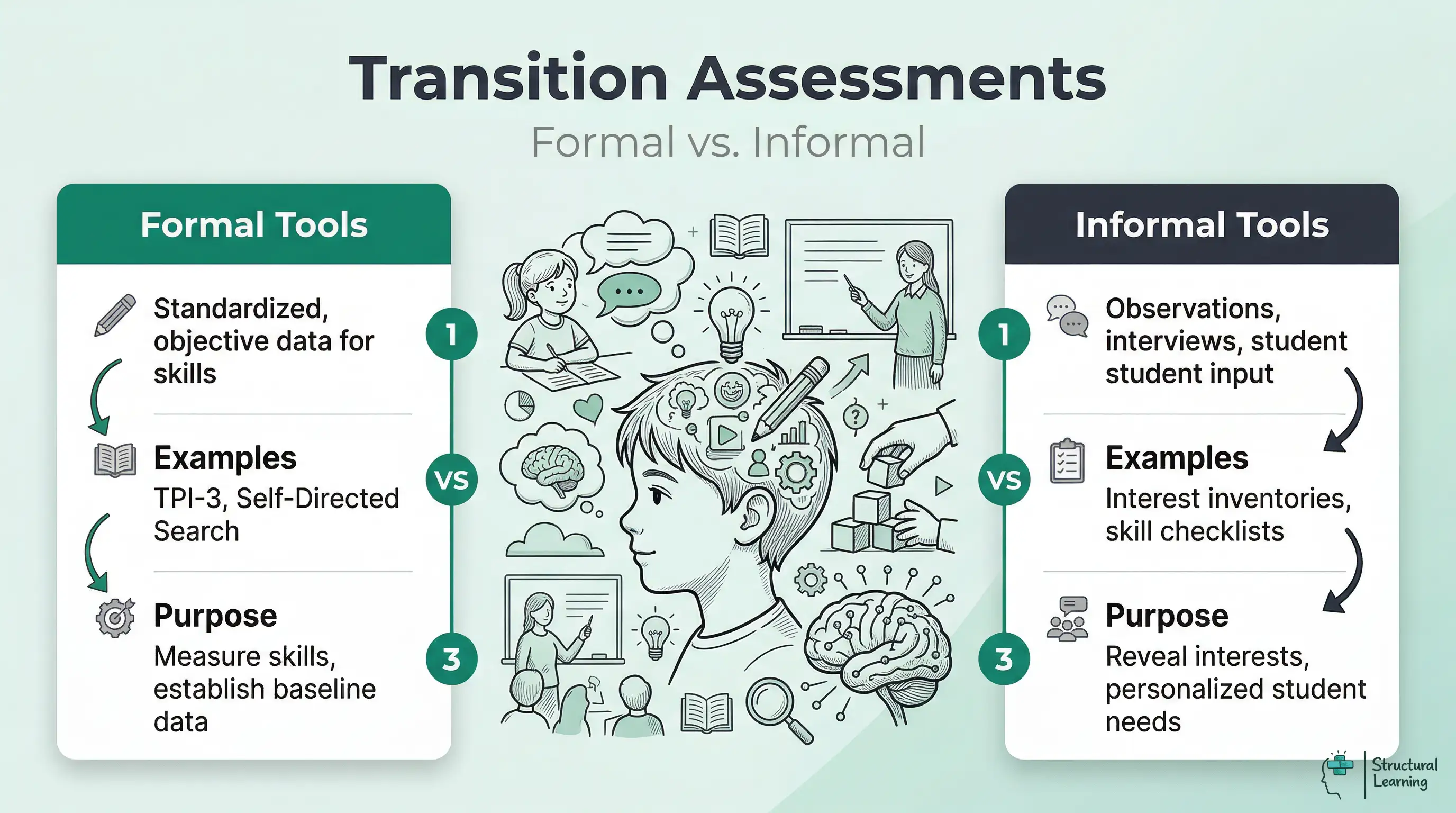
Age-appropriate transition assessments fall into two broad categories: formal and informal. Both have a place in good transition planning, and neither alone is sufficient.

Formal Assessment Tools

The Transition Planning Inventory (TPI-3) is one of the most widely used formal measures in US schools. It evaluates student strengths and needs across employment, education, daily living, health, self-determination, communication, interpersonal relationships, and community participation. The TPI-3 includes forms completed by the student, the parent, and the school professional, which makes it a strong starting point for building a complete picture.

The Self-Directed Search (SDS), developed by Holland (1985), is a career interest inventory aligned to Holland's RIASEC typology (Realistic, Investigative, Artistic, Social, Enterprising, Conventional). It is well-suited to students who can engage with a structured self-report format and provides a vocabulary for discussing career directions with the student and family. The Armed Services Vocational Aptitude Battery (ASVAB) measures aptitudes in ten areas and can help identify both academic and technical strengths, particularly for students considering military enlistment, trades, or technical programmes.

For students with more significant disabilities, the Supports Intensity Scale-Adult Version (SIS-A) provides detailed information about the level of support a student requires across life domains. This is particularly relevant when planning for students who may need adult service provision upon leaving school.

Informal Assessment Methods

Informal assessments are often more informative than formal ones, and they are always more student-centred. A structured student interview, conducted by the transition coordinator or special educator in a conversational format, can surface preferences, fears, aspirations, and strengths that no standardised tool captures. Wehmeyer and Kelchner (1995) demonstrated that students' own accounts of their interests and goals are strongly predictive of their satisfaction with post-school outcomes.

Situational assessments place the student in a real or simulated work environment to observe performance directly. A student who struggles to articulate preferences in a meeting may demonstrate clear vocational aptitudes when observed in a work experience setting. Interest inventories, functional assessments of daily living skills, and teacher-completed rating scales all contribute to the full assessment picture.

The key discipline is documentation. Every assessment used must be recorded in the IEP with the date administered, the instrument name, and the specific finding that connects to the corresponding postsecondary goal. Assessors must also pay attention to the particular challenges students face with executive function, which can affect both performance on assessments and the ability to plan independently post-school.

Writing Measurable Postsecondary Goals

The most common transition IEP error is goals that are not measurable. Statements such as 'Marcus will get a job' or 'Sofia will attend college' are aspirations, not goals. IDEA requires goals that are measurable and based on assessment data. The National Secondary Transition Technical Assistance Center (NSTTAC) provides a quality indicator framework that defines a measurable postsecondary goal as one that specifies who, will do what, under what conditions, and to what criterion.

Apply the SMART framework deliberately. Goals must be Specific (identifying a particular post-school activity), Measurable (with a clear criterion of achievement), Achievable (realistic given the student's current level and trajectory), Relevant (tied to the student's own expressed preferences and assessment data), and Time-bound (specifying when the goal will be achieved, typically within one year of graduating or leaving school).

Education and Training Goals

A compliant education goal identifies the specific type of post-secondary education or training the student will pursue. Examples:

After graduation, Marcus will enrol in an automotive technology programme at a community college.

After completing Year 12, Sofia will participate in a university-based transition programme for students with intellectual disabilities.

Notice that both goals name a specific setting and a specific activity. Neither says 'Marcus hopes to take some classes' or 'Sofia will explore her options.' The goal must be written based on the student's assessment data: if no assessment supports a community college pathway, the goal cannot credibly name one.

Employment Goals

Employment goals must specify a job area that is consistent with the student's skills, interests, and abilities as established by assessment. The following would meet IDEA's standard:

After high school, Marcus will obtain part-time competitive employment in vehicle repair or maintenance with no more than natural supports from an employer.

The phrase 'natural supports' is significant: it indicates the expected level of ongoing assistance and signals whether supported employment services will be needed. Kohler's Taxonomy for Transition Programming 2.0 (2016) identifies student-focused planning as the first of five domains, and within that domain, postsecondary goals are explicitly tied to student preferences, interests, and needs as expressed through assessment.

Independent Living Goals

When an independent living goal is appropriate, it must follow the same specificity standards:

After high school, Marcus will independently manage his weekly budget using a digital banking application, without prompting from a family member.

If you decide independent living is not an appropriate domain for a specific student, document the rationale explicitly. Leaving the domain blank without explanation is a compliance failure.

Annual IEP Goals Aligned to Postsecondary Goals

Postsecondary goals sit above the annual IEP goals in the planning hierarchy. Each annual goal must directly support progress toward a postsecondary goal. If a student's postsecondary employment goal involves working in a retail setting, annual IEP goals might address customer communication skills, money handling, punctuality, and responding to supervisory feedback. The connection between the annual goal and the postsecondary goal must be visible and logical. Supporting students' self-regulation skills through annual goals is particularly valuable here, since these underpin independent performance in post-school environments.

The Transition IEP Meeting

The transition IEP meeting is structurally similar to any other IEP meeting, with one critical difference: the student must be invited. IDEA states that the student should be included when a purpose of the meeting is to discuss transition services. If the student does not attend, the team must take other steps to ensure the student's preferences and interests are considered. In practice, that means the meeting must include documented evidence of how the student's views were gathered and incorporated.

Required team members for a transition IEP meeting include the parents or guardians, at least one regular education teacher, at least one special education teacher, a representative of the school system who can commit resources, and a person who can interpret evaluation results. When transition is on the agenda, the student is also a required participant.

Inviting Outside Agencies

If a student is likely to receive adult services following school, the school must invite a representative of the relevant agency with the parent's consent. In the US, the primary agency for most students is the state vocational rehabilitation (VR) service. Other agencies that may be appropriate include supported employment providers, county developmental disabilities services, mental health services, and housing authorities.

The invitation must be in writing, and it must be sent far enough in advance for the agency to prepare. If the agency cannot attend, the school must document this and take other steps to coordinate with the agency. Rowe, Mazzotti, Fowler, and Test (2015) found that interagency collaboration is significantly associated with improved post-school outcomes, particularly in competitive employment. Verbal coordination does not satisfy the legal requirement: the written record matters.

Student-Led IEPs

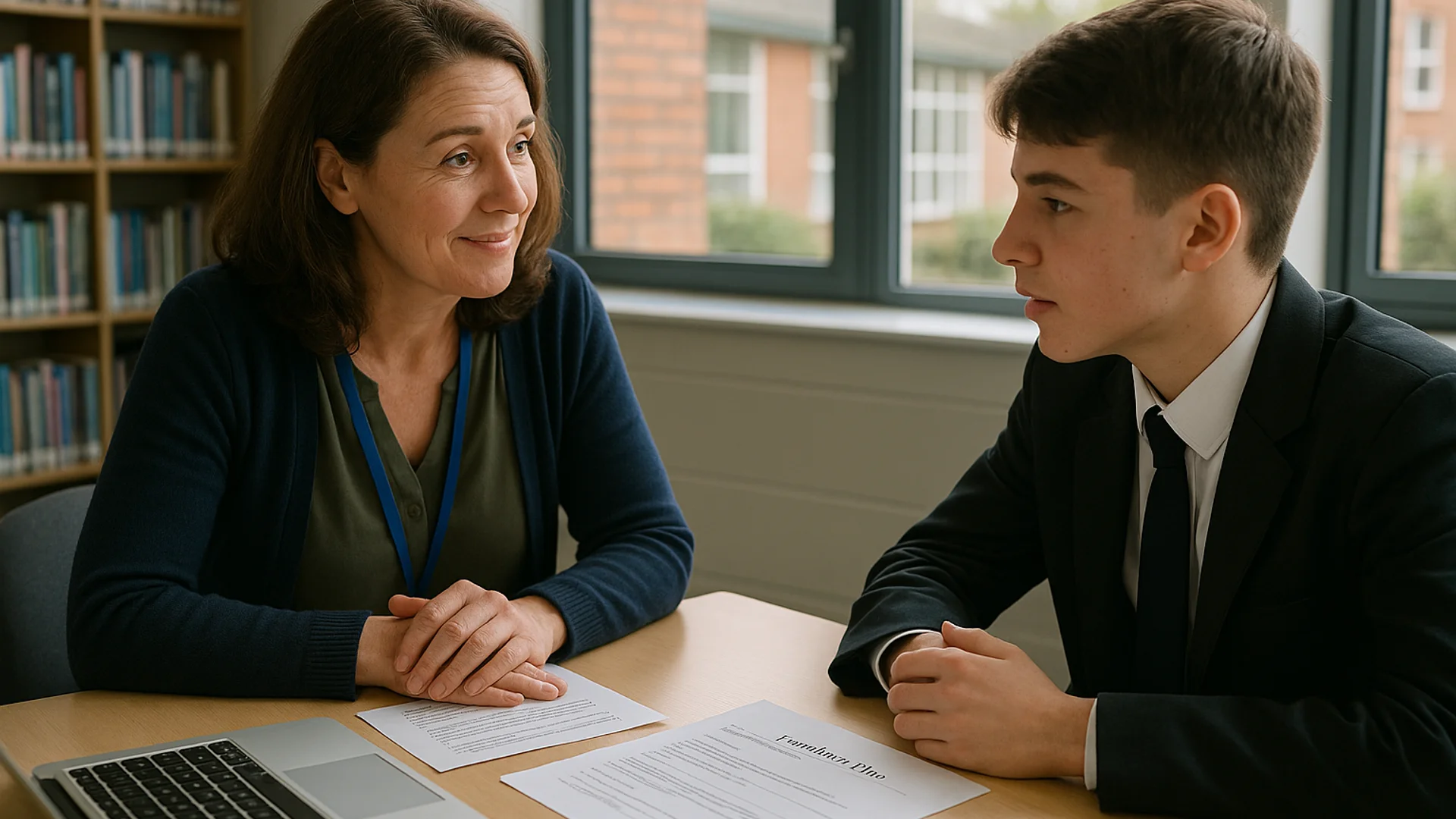
A student-led IEP is one in which the student takes an active role in presenting their own goals, progress, strengths, and needs to the team. This is distinct from simply attending the meeting. In a student-led format, the student may introduce team members, present their transition assessment results, explain their postsecondary goals, and lead discussion of their annual goals.
The evidence for student-led IEPs is strong. Martin, Van Dycke, Greene, Gardner, Christensen, Woods, and Lovett (2006) found that students in student-led IEP conditions attended more, participated more actively, and remembered the contents of their IEPs better than students in teacher-directed meetings. Preparing students to lead their own meetings is a teachable skill set, not a personality attribute. It connects directly to the self-determination research that underpins effective transition practice. Teachers who want to build these skills in their students will find the approaches described in the section on self-advocacy below directly applicable.

Transition Services by Category

IDEA specifies that transition services must include instruction, related services, community experiences, employment objectives, and where appropriate, the acquisition of daily living skills and a functional vocational evaluation. Understanding what each category means in practice helps you write IEPs that are both compliant and genuinely useful.

Instruction

Instruction covers the academic and functional curriculum the student needs to move toward postsecondary goals. For a student planning to enter a post-secondary academic programme, instruction might include advanced academic coursework, study skills development, and time management training. For a student planning to enter the workforce directly, instruction might emphasise vocational coursework, safety training, or workplace communication.

A concrete example: Sofia, a student with a learning disability who plans to study early childhood education at community college, has annual IEP goals addressing reading comprehension, written expression, and self-advocacy with professors. Her transition instruction includes coursework in child development and a school-based service learning placement in the primary school nursery. Scaffolding instruction toward independence is especially important here: Sofia needs to move from supported performance in school to autonomous performance in college.

Related Services

Related services during transition include speech and language therapy, occupational therapy, counselling, and other supports required for the student to benefit from their educational programme. In the transition context, related services should be explicitly connected to post-school goals. Speech-language therapy for a student entering a customer-facing role should address workplace communication, not the phonological skills relevant to a younger student.

Community Experiences

Community experiences are structured learning activities that take place outside the school building. Job shadows, internships, community-based instruction, and volunteer placements all qualify. These experiences give students the opportunity to test interests, build skills, and develop the social knowledge required for adult community participation. Morningstar, Knollman, Semon, and Davis (2012) found that community-based work experience is one of the strongest predictors of post-school employment.

Employment Objectives

Employment objectives describe what the student will do during school to move toward their employment goal. For Marcus, whose postsecondary goal involves automotive work, employment objectives might include completing the school's automotive technology elective, participating in a work-based learning placement at a local garage, and obtaining a workplace safety certification.

Daily Living Skills and Functional Vocational Evaluation

Daily living skills instruction is appropriate for students who need to develop competence in areas such as money management, cooking, personal care, transportation use, or home maintenance. A functional vocational evaluation (FVE) is a systematic process for observing and documenting a student's vocational abilities, interests, and behaviours in real or simulated work environments. It is particularly valuable for students with significant disabilities whose skills are difficult to assess through paper-based instruments. Connecting daily living skills instruction to the student's actual plans is essential: teaching a student to take the bus is transition-relevant only if they will actually need to use public transport in their post-school environment.

Age-by-Age Planning Timeline

Effective transition planning is not a single event at age 16. It is a cumulative process that builds year by year. The following timeline reflects federal requirements and evidence-based practice from the Taxonomy for Transition Programming 2.0 (Kohler, Gothberg, Fowler, and Coyle, 2016).

Age 14 (Where State Law Requires)

At age 14, transition-related content should begin appearing in IEP discussions even if formal transition planning is not yet required. Students should begin completing interest inventories, engaging in career exploration activities, and discussing long-term goals with their families. Many states require a transition plan to be in place by age 14, so check your state's specific requirements.

This is also the appropriate age to begin explicitly teaching metacognitive skills that support self-direction: understanding one's own learning profile, identifying strengths, and beginning to articulate needs and preferences. Students who can name what they need are significantly better positioned to self-advocate in adult settings.

Age 16 (Federal Requirement)

By the first IEP in effect when the student turns 16, the full transition planning requirements apply: measurable postsecondary goals in all appropriate domains, a statement of transition services, and documented evidence of age-appropriate transition assessments. The student must be invited to the IEP meeting.

At this stage, postsecondary goals should be increasingly specific. The student should have participated in at least one job shadow or community work experience. Vocational rehabilitation should be contacted if adult services are anticipated, and preliminary coordination should begin. Students with significant support needs may begin on a pathway toward an extended school age programme (ages 18–22) at this point.

Ages 17 to 18: Age of Majority and Transfer of Rights

At age 17, one year before the age of majority, the IEP must include a statement that the student has been informed of their rights under IDEA and that those rights will transfer to them at age 18. This is not optional. The IEP must document the date and form in which this notification occurred.

At age 18, in most states, the student legally becomes the decision-maker for their own IEP. This means the student signs consent forms, receives notices directly, and controls who else receives information. Parents may continue to participate only with the student's consent. If the student lacks capacity to make educational decisions independently, guardianship or educational power of attorney may be appropriate, but these are legal matters that require family action before the student's 18th birthday.

Preparing students for this transfer of rights is a critical transition activity that is often neglected. Students who have been building a growth mindset toward self-advocacy across their secondary years are better positioned to take on this responsibility than students who encounter it as a surprise at 17.

Ages 18 to 22: Extended School Age

Students with significant disabilities may be eligible for special education services through age 21 or 22, depending on state law. During these years, transition programming is the primary focus. IEP goals shift decisively toward the competencies required for adult life: working in a paid employment setting, using public transport independently, managing health appointments, and participating in community activities.

Summary of Performance

When a student exits special education for any reason, the school must produce a Summary of Performance (SOP). The SOP is a written document that summarises the student's academic achievement and functional performance and provides recommendations on accommodations and supports that may assist the student in meeting postsecondary goals. It is typically provided to the student and family upon graduation or ageing out of services.

The SOP is the final formal handoff document from school to adult life. A well-written SOP provides the post-secondary setting with the information it needs: what the student can do, what supports have been effective, and what accommodations have been documented. An SOP that is a form filled with checkboxes is a missed opportunity. A well-written SOP functions as a practical guide for whoever supports the student next. The connections to existing IEP and 504 documentation should be explicit.

Transition Domains: Goals, Assessments, and Services

The table below shows how the three required transition domains connect to the assessments typically used, the types of goals produced, and the transition services that follow. This is intended as a reference for IEP writing sessions.

DomainExample Postsecondary GoalAssessments UsedTransition Services
Education or TrainingAfter graduation, student will enrol in a certificate programme in culinary arts at a community collegeTPI-3 (education subscale), student interview, GPA/credit review, course completion recordsAcademic skill instruction, college preparation curriculum, ACT/SAT accommodations planning, dual enrolment courses, campus visit
EmploymentAfter high school, student will obtain part-time competitive employment in food service with natural supportsSelf-Directed Search (SDS), situational assessment at school cafeteria, job shadow records, functional vocational evaluationWork-based learning placement, vocational coursework, job coach coordination, workplace communication training
Independent LivingAfter leaving school, student will independently use the bus route from home to work without promptingDaily living skills checklist, transportation simulation assessment, occupational therapy functional reportCommunity-based instruction (bus route training), money management instruction, medical appointment management, home management curriculum

Teaching Self-Advocacy Skills

Self-determination is the strongest individual predictor of post-school outcomes for students with disabilities. Wehmeyer (2007) defines self-determination as acting as the primary causal agent in one's own life: making choices, setting goals, and pursuing them. Students who demonstrate high self-determination in secondary school are significantly more likely to achieve competitive employment and live independently than students who do not, even after controlling for disability category and cognitive ability (Wehmeyer and Palmer, 2003).

The Self-Determined Learning Model of Instruction (SDLMI), developed by Wehmeyer, Palmer, Agran, Mithaug, and Martin (2000), provides a teacher-facing framework for developing self-determination across content areas. It uses a three-phase process: helping students set a goal, helping them develop a plan, and helping them adjust the plan based on results. Critically, the SDLMI is not a discrete curriculum delivered in isolation. It is a pedagogical approach that teachers embed within existing instruction in any subject area.

Practical Classroom Strategies for Building Self-Advocacy

Self-advocacy is a skill set, not a personality trait. Students who have never been asked to identify their own needs cannot be expected to do so fluently when they enter a college disability services office or a new workplace. You build this capacity explicitly and incrementally.

Start with student self-assessment. Before each IEP meeting, have students complete a structured self-reflection tool: What are my strengths? What do I find difficult? What helps me learn? What do I want to do after school? These questions are the foundation of meaningful participation. Students with significant working memory challenges may need visual supports or a partner to complete this reflection, but the process of attempting it is itself skill-building.

Teach the language of disability explicitly. Many students reach age 16 without being able to name their diagnosis, describe how it affects their learning, or explain what accommodations they use and why. This language is essential for accessing disability services in college and accommodation requests in workplaces. Role-play conversations with professors, employers, and service providers. Practise the IEP meeting itself as a rehearsal activity in the weeks before it occurs.

Connect self-advocacy to general classroom practice. Every time you use differentiated instruction and invite students to choose between presentation formats or task structures, you are building the habit of self-directed choice. This is not incidental. Morningstar et al. (2012) note that students who have regular experience making meaningful choices in their educational programme show stronger self-advocacy in post-school settings. Every choice point in your classroom is a small transition lesson.

For students who struggle with motivation or who have internalised learned helplessness about their own futures, connecting current classroom success to a visible longer-term pathway makes a significant difference. The evidence base for developmental approaches to autonomy consistently shows that students need both the skills and the belief that their actions lead to meaningful outcomes. Building that belief is part of your job as a transition educator.

Common Compliance Errors in Transition IEPs

State monitoring data and NTACT research consistently identify the same categories of transition IEP failures. Knowing these errors in advance is the most efficient compliance safeguard available to you.

Missing or Unmeasurable Postsecondary Goals

The most frequent compliance finding is postsecondary goals that are absent, vague, or activity-focused rather than outcome-focused. 'Marcus will explore employment options' is not a postsecondary goal. 'After high school, Marcus will obtain part-time employment in the automotive sector' is. Review every postsecondary goal against the NSTTAC Quality Indicators checklist before the IEP is finalised. Each goal should pass the test: does it specify who, will do what, after leaving school?

No Evidence of Student Input

IDEA requires that goals be based on age-appropriate transition assessments that include student preferences. An IEP written entirely by adults, without documented evidence that the student's views were solicited and considered, does not meet this standard. Document the specific assessments or interviews used, the date they were conducted, and how the findings influenced the goals written. If a student declined to participate in an assessment, document that refusal. A blank section is never acceptable evidence.

Goals Not Aligned to Assessment Data

If your assessment data shows that a student has expressed strong interests in working with animals and a situational assessment shows effective performance in the school's animal care elective, but the IEP's employment goal refers to clerical work, there is a visible misalignment that will be questioned. Assessment drives goals. Goals drive services. When these elements are inconsistent with each other, the IEP fails both the compliance standard and the student.

Missing Agency Invitations

When a student may need adult services upon leaving school, the relevant agency must be invited in writing. A note in the case file saying you telephoned the VR counsellor is not sufficient. The written invitation must go out far enough in advance for the agency to prepare a representative if they are able to attend. If the agency cannot attend, document the response and the alternative steps taken to obtain their input. Rowe et al. (2015) found that schools consistently underinvite agencies and overestimate the adequacy of informal coordination.

Failing to Update Transition Services Annually

Transition services must be reviewed and updated at each annual IEP meeting. A transition plan written at age 16 that is carried forward unchanged to age 17 and 18 without revision is a compliance failure. The student's postsecondary goals may remain stable, but the transition services and annual goals should evolve to reflect the student's current level of performance and proximity to leaving school. As a student moves from age 16 to age 21, the transition plan should become progressively more specific and action-oriented. The support structures underpinned by tiered intervention frameworks can help teams think about how transition supports should intensify as the student approaches the end of school.

Graduation Without a Summary of Performance

Schools sometimes overlook the SOP requirement when a student graduates unexpectedly early or transfers schools before graduation. The SOP is required whenever a student exits special education. Build an SOP template into your school's graduation and exit procedures so that it is never an afterthought.

Further Reading

Key Research Papers on IEP Transition Planning

Test, D. W., Mazzotti, V. L., Mustian, A. L., Fowler, C. H., Kortering, L., and Kohler, P. (2009). Evidence-based secondary transition predictors for improving post-school outcomes for students with disabilities. Career Development for Exceptional Individuals, 32(3), 160–181.
A landmark synthesis that identified 16 evidence-based predictors of post-school success across employment, education, and independent living. The study confirmed that student-focused planning, work experience, self-advocacy instruction, and interagency collaboration are among the strongest predictors of positive outcomes. Essential reading for building a school's transition programme. View study

Kohler, P. D., Gothberg, J. E., Fowler, C., and Coyle, J. (2016). Taxonomy for Transition Programming 2.0: A model for planning, organizing, and evaluating transition education, services, and programs. Western Michigan University.
The definitive framework for evaluating and building transition programmes, organised around five domains: student-focused planning, student development, inter-agency collaboration, family involvement, and programme structure. The Taxonomy 2.0 update incorporated 20 years of implementation research and is widely used in state technical assistance systems. View study

Wehmeyer, M. L., and Palmer, S. B. (2003). Adult outcomes for students with cognitive disabilities three years after high school: The impact of self-determination. Education and Training in Developmental Disabilities, 38(2), 131–144.
A longitudinal study tracking post-school outcomes for students with cognitive disabilities, finding that self-determination scores in secondary school significantly predicted independent living and competitive employment outcomes three years later. This study provides the empirical foundation for incorporating self-advocacy instruction into transition IEPs. View study

Rowe, D. A., Mazzotti, V. L., Fowler, C. H., and Test, D. W. (2015). Strategies for promoting interagency collaboration for youth with disabilities. TEACHING Exceptional Children, 47(6), 310–320.
A practical research review identifying strategies that increase the quality of collaboration between schools and adult service agencies during transition. The study found that formal written invitations, dedicated liaison roles, and structured joint planning meetings produce significantly better outcomes than informal networking. Directly applicable to agency invitation practices in transition IEPs. View study

Martin, J. E., Van Dycke, J. L., Greene, B. A., Gardner, J. E., Christensen, W. R., Woods, L. L., and Lovett, D. L. (2006). Direct observation of teacher-directed IEP meetings: Establishing the need for student IEP meeting instruction. Exceptional Children, 72(2), 187–200.
A direct observation study of IEP meetings finding that students spoke for an average of only 3% of meeting time in teacher-directed formats, compared to substantially higher participation rates in student-directed formats. The study provides the empirical case for explicit student preparation for IEP meeting participation and for restructuring meetings around student voice. View study

References

Holland, J. L. (1985). Making vocational choices: A theory of vocational personalities and work environments (2nd ed.). Prentice-Hall.

Kohler, P. D., Gothberg, J. E., Fowler, C., and Coyle, J. (2016). Taxonomy for Transition Programming 2.0. Western Michigan University.

Martin, J. E., Van Dycke, J. L., Greene, B. A., Gardner, J. E., Christensen, W. R., Woods, L. L., and Lovett, D. L. (2006). Direct observation of teacher-directed IEP meetings: Establishing the need for student IEP meeting instruction. Exceptional Children, 72(2), 187–200.

Morningstar, M. E., Knollman, G., Semon, S., and Davis, L. A. (2012). Quality indicators for secondary transition: A systemic approach for improving secondary transition. University of Kansas.

NTACT (National Technical Assistance Center on Transition). (2017). Effective practices and predictors matrix. University of North Carolina Charlotte.

Rowe, D. A., Mazzotti, V. L., Fowler, C. H., and Test, D. W. (2015). Strategies for promoting interagency collaboration for youth with disabilities. TEACHING Exceptional Children, 47(6), 310–320.

Test, D. W., Mazzotti, V. L., Mustian, A. L., Fowler, C. H., Kortering, L., and Kohler, P. (2009). Evidence-based secondary transition predictors for improving post-school outcomes for students with disabilities. Career Development for Exceptional Individuals, 32(3), 160–181.

Wehmeyer, M. L. (2007). Promoting self-determination in students with developmental disabilities. Guilford Press.

Wehmeyer, M. L., and Kelchner, K. (1995). Measuring the autonomy of adolescents and adults with mental retardation: A self-report form of the Autonomous Functioning Checklist. Career Development for Exceptional Individuals, 18(1), 3–20.

Wehmeyer, M. L., and Palmer, S. B. (2003). Adult outcomes for students with cognitive disabilities three years after high school: The impact of self-determination. Education and Training in Developmental Disabilities, 38(2), 131–144.

Wehmeyer, M. L., Palmer, S. B., Agran, M., Mithaug, D. E., and Martin, J. E. (2000). Promoting causal agency: The Self-Determined Learning Model of Instruction. Exceptional Children, 66(4), 439–453.

---

Start your next transition IEP meeting by having the student complete a structured self-reflection tool and bring their answers to the table. That single shift moves the meeting from a compliance exercise into a planning conversation.

Loading audit...

Slug: iep-transition-planning-post-secondary-guide

Target audience: US secondary school teachers, transition coordinators, special education teachers

---

Transition planning is one of the most consequential responsibilities a special education teacher carries. What happens in an IEP meeting at age 16 shapes whether a student with a disability moves into adult life with a clear direction or without one. The research is unambiguous: students who receive structured, well-documented transition services are significantly more likely to achieve competitive employment, pursue post-secondary education, and live independently (Test, Mazzotti, Mustian, Fowler, Kortering, and Kohler, 2009). The legal framework exists. The challenge is implementing it well.

This guide is written for the teacher who must actually do that work: the special education teacher preparing IEP documents, coordinating with agencies, facilitating meetings, and teaching students to advocate for themselves. It covers the legal requirements, the assessment tools, the goal-writing process, the timeline, and the common compliance errors that put both students and schools at risk.

Key Takeaways

  1. Transition planning is federally required, not optional: IDEA 2004 mandates that transition services be in place by age 16 (and in many states, age 14), making this a legal compliance matter as well as a pedagogical one.
  2. Assessment must drive goals: Measurable postsecondary goals must be grounded in age-appropriate transition assessments. Goals that are not connected to assessment data are a primary compliance failure point.
  3. Student participation is non-negotiable: The student must be invited to and meaningfully involved in their transition IEP meeting. Self-determination skills developed in the classroom directly predict post-school outcomes.
  4. Agencies must be invited formally: When a student will likely need adult services upon leaving school, the relevant agency must receive a written invitation to the IEP meeting. Verbal coordination is not sufficient for compliance.

What IDEA Requires for Transition Planning

The Individuals with Disabilities Education Act (IDEA) 2004 defines transition services in Section 300.43 as a coordinated set of activities designed within a results-orientated process. The law specifies that transition planning must be focused on improving academic and functional achievement, facilitating movement from school to post-school activities. Those activities include post-secondary education, vocational education, integrated employment, continuing and adult education, adult services, independent living, and community participation.

Section 300.320(b) of IDEA requires that beginning no later than the first IEP to be in effect when the student turns 16, the IEP must include measurable postsecondary goals in three domains: education or training, employment, and where appropriate, independent living skills. Many states set the requirement earlier. In California, Colorado, and several others, transition planning begins at age 14. You need to know your state's specific threshold because the federal floor is not always the local requirement.

The phrase 'coordinated set of activities' is important. Transition planning is not a section of the IEP document. It is an ongoing process that touches instruction, related services, community experiences, and employment preparation simultaneously. A transition plan that exists only as completed boxes in a document is both legally insufficient and useless to the student.

The three required domains give you the structural framework. Every student with a disability aged 16 or above must have postsecondary goals addressing education or training and employment. The third domain, independent living, is required only 'where appropriate,' but the decision not to include it must be documented in the IEP with a clear rationale.

Age-Appropriate Transition Assessments

Transition goals must be based on age-appropriate transition assessments. This is not a suggestion: it is a specific legal requirement under IDEA, and it is one of the most frequently cited compliance issues during state monitoring visits (NTACT, 2017). An IEP that contains postsecondary goals but no corresponding assessment data will not survive a compliance review.

Age-appropriate transition assessments fall into two broad categories: formal and informal. Both have a place in good transition planning, and neither alone is sufficient.

Formal Assessment Tools

The Transition Planning Inventory (TPI-3) is one of the most widely used formal measures in US schools. It evaluates student strengths and needs across employment, education, daily living, health, self-determination, communication, interpersonal relationships, and community participation. The TPI-3 includes forms completed by the student, the parent, and the school professional, which makes it a strong starting point for building a complete picture.

The Self-Directed Search (SDS), developed by Holland (1985), is a career interest inventory aligned to Holland's RIASEC typology (Realistic, Investigative, Artistic, Social, Enterprising, Conventional). It is well-suited to students who can engage with a structured self-report format and provides a vocabulary for discussing career directions with the student and family. The Armed Services Vocational Aptitude Battery (ASVAB) measures aptitudes in ten areas and can help identify both academic and technical strengths, particularly for students considering military enlistment, trades, or technical programmes.

For students with more significant disabilities, the Supports Intensity Scale-Adult Version (SIS-A) provides detailed information about the level of support a student requires across life domains. This is particularly relevant when planning for students who may need adult service provision upon leaving school.

Informal Assessment Methods

Informal assessments are often more informative than formal ones, and they are always more student-centred. A structured student interview, conducted by the transition coordinator or special educator in a conversational format, can surface preferences, fears, aspirations, and strengths that no standardised tool captures. Wehmeyer and Kelchner (1995) demonstrated that students' own accounts of their interests and goals are strongly predictive of their satisfaction with post-school outcomes.

Situational assessments place the student in a real or simulated work environment to observe performance directly. A student who struggles to articulate preferences in a meeting may demonstrate clear vocational aptitudes when observed in a work experience setting. Interest inventories, functional assessments of daily living skills, and teacher-completed rating scales all contribute to the full assessment picture.

The key discipline is documentation. Every assessment used must be recorded in the IEP with the date administered, the instrument name, and the specific finding that connects to the corresponding postsecondary goal. Assessors must also pay attention to the particular challenges students face with executive function, which can affect both performance on assessments and the ability to plan independently post-school.

Writing Measurable Postsecondary Goals

The most common transition IEP error is goals that are not measurable. Statements such as 'Marcus will get a job' or 'Sofia will attend college' are aspirations, not goals. IDEA requires goals that are measurable and based on assessment data. The National Secondary Transition Technical Assistance Center (NSTTAC) provides a quality indicator framework that defines a measurable postsecondary goal as one that specifies who, will do what, under what conditions, and to what criterion.

Apply the SMART framework deliberately. Goals must be Specific (identifying a particular post-school activity), Measurable (with a clear criterion of achievement), Achievable (realistic given the student's current level and trajectory), Relevant (tied to the student's own expressed preferences and assessment data), and Time-bound (specifying when the goal will be achieved, typically within one year of graduating or leaving school).

Education and Training Goals

A compliant education goal identifies the specific type of post-secondary education or training the student will pursue. Examples:

After graduation, Marcus will enrol in an automotive technology programme at a community college.

After completing Year 12, Sofia will participate in a university-based transition programme for students with intellectual disabilities.

Notice that both goals name a specific setting and a specific activity. Neither says 'Marcus hopes to take some classes' or 'Sofia will explore her options.' The goal must be written based on the student's assessment data: if no assessment supports a community college pathway, the goal cannot credibly name one.

Employment Goals

Employment goals must specify a job area that is consistent with the student's skills, interests, and abilities as established by assessment. The following would meet IDEA's standard:

After high school, Marcus will obtain part-time competitive employment in vehicle repair or maintenance with no more than natural supports from an employer.

The phrase 'natural supports' is significant: it indicates the expected level of ongoing assistance and signals whether supported employment services will be needed. Kohler's Taxonomy for Transition Programming 2.0 (2016) identifies student-focused planning as the first of five domains, and within that domain, postsecondary goals are explicitly tied to student preferences, interests, and needs as expressed through assessment.

Independent Living Goals

When an independent living goal is appropriate, it must follow the same specificity standards:

After high school, Marcus will independently manage his weekly budget using a digital banking application, without prompting from a family member.

If you decide independent living is not an appropriate domain for a specific student, document the rationale explicitly. Leaving the domain blank without explanation is a compliance failure.

Annual IEP Goals Aligned to Postsecondary Goals

Postsecondary goals sit above the annual IEP goals in the planning hierarchy. Each annual goal must directly support progress toward a postsecondary goal. If a student's postsecondary employment goal involves working in a retail setting, annual IEP goals might address customer communication skills, money handling, punctuality, and responding to supervisory feedback. The connection between the annual goal and the postsecondary goal must be visible and logical. Supporting students' self-regulation skills through annual goals is particularly valuable here, since these underpin independent performance in post-school environments.

The Transition IEP Meeting

The transition IEP meeting is structurally similar to any other IEP meeting, with one critical difference: the student must be invited. IDEA states that the student should be included when a purpose of the meeting is to discuss transition services. If the student does not attend, the team must take other steps to ensure the student's preferences and interests are considered. In practice, that means the meeting must include documented evidence of how the student's views were gathered and incorporated.

Required team members for a transition IEP meeting include the parents or guardians, at least one regular education teacher, at least one special education teacher, a representative of the school system who can commit resources, and a person who can interpret evaluation results. When transition is on the agenda, the student is also a required participant.

Inviting Outside Agencies

If a student is likely to receive adult services following school, the school must invite a representative of the relevant agency with the parent's consent. In the US, the primary agency for most students is the state vocational rehabilitation (VR) service. Other agencies that may be appropriate include supported employment providers, county developmental disabilities services, mental health services, and housing authorities.

The invitation must be in writing, and it must be sent far enough in advance for the agency to prepare. If the agency cannot attend, the school must document this and take other steps to coordinate with the agency. Rowe, Mazzotti, Fowler, and Test (2015) found that interagency collaboration is significantly associated with improved post-school outcomes, particularly in competitive employment. Verbal coordination does not satisfy the legal requirement: the written record matters.

Student-Led IEPs

A student-led IEP is one in which the student takes an active role in presenting their own goals, progress, strengths, and needs to the team. This is distinct from simply attending the meeting. In a student-led format, the student may introduce team members, present their transition assessment results, explain their postsecondary goals, and lead discussion of their annual goals.

The evidence for student-led IEPs is strong. Martin, Van Dycke, Greene, Gardner, Christensen, Woods, and Lovett (2006) found that students in student-led IEP conditions attended more, participated more actively, and remembered the contents of their IEPs better than students in teacher-directed meetings. Preparing students to lead their own meetings is a teachable skill set, not a personality attribute. It connects directly to the self-determination research that underpins effective transition practice. Teachers who want to build these skills in their students will find the approaches described in the section on self-advocacy below directly applicable.

Transition Services by Category

IDEA specifies that transition services must include instruction, related services, community experiences, employment objectives, and where appropriate, the acquisition of daily living skills and a functional vocational evaluation. Understanding what each category means in practice helps you write IEPs that are both compliant and genuinely useful.

Instruction

Instruction covers the academic and functional curriculum the student needs to move toward postsecondary goals. For a student planning to enter a post-secondary academic programme, instruction might include advanced academic coursework, study skills development, and time management training. For a student planning to enter the workforce directly, instruction might emphasise vocational coursework, safety training, or workplace communication.

A concrete example: Sofia, a student with a learning disability who plans to study early childhood education at community college, has annual IEP goals addressing reading comprehension, written expression, and self-advocacy with professors. Her transition instruction includes coursework in child development and a school-based service learning placement in the primary school nursery. Scaffolding instruction toward independence is especially important here: Sofia needs to move from supported performance in school to autonomous performance in college.

Related Services

Related services during transition include speech and language therapy, occupational therapy, counselling, and other supports required for the student to benefit from their educational programme. In the transition context, related services should be explicitly connected to post-school goals. Speech-language therapy for a student entering a customer-facing role should address workplace communication, not the phonological skills relevant to a younger student.

Community Experiences

Community experiences are structured learning activities that take place outside the school building. Job shadows, internships, community-based instruction, and volunteer placements all qualify. These experiences give students the opportunity to test interests, build skills, and develop the social knowledge required for adult community participation. Morningstar, Knollman, Semon, and Davis (2012) found that community-based work experience is one of the strongest predictors of post-school employment.

Employment Objectives

Employment objectives describe what the student will do during school to move toward their employment goal. For Marcus, whose postsecondary goal involves automotive work, employment objectives might include completing the school's automotive technology elective, participating in a work-based learning placement at a local garage, and obtaining a workplace safety certification.

Daily Living Skills and Functional Vocational Evaluation

Daily living skills instruction is appropriate for students who need to develop competence in areas such as money management, cooking, personal care, transportation use, or home maintenance. A functional vocational evaluation (FVE) is a systematic process for observing and documenting a student's vocational abilities, interests, and behaviours in real or simulated work environments. It is particularly valuable for students with significant disabilities whose skills are difficult to assess through paper-based instruments. Connecting daily living skills instruction to the student's actual plans is essential: teaching a student to take the bus is transition-relevant only if they will actually need to use public transport in their post-school environment.

Age-by-Age Planning Timeline

Effective transition planning is not a single event at age 16. It is a cumulative process that builds year by year. The following timeline reflects federal requirements and evidence-based practice from the Taxonomy for Transition Programming 2.0 (Kohler, Gothberg, Fowler, and Coyle, 2016).

Age 14 (Where State Law Requires)

At age 14, transition-related content should begin appearing in IEP discussions even if formal transition planning is not yet required. Students should begin completing interest inventories, engaging in career exploration activities, and discussing long-term goals with their families. Many states require a transition plan to be in place by age 14, so check your state's specific requirements.

This is also the appropriate age to begin explicitly teaching metacognitive skills that support self-direction: understanding one's own learning profile, identifying strengths, and beginning to articulate needs and preferences. Students who can name what they need are significantly better positioned to self-advocate in adult settings.

Age 16 (Federal Requirement)

By the first IEP in effect when the student turns 16, the full transition planning requirements apply: measurable postsecondary goals in all appropriate domains, a statement of transition services, and documented evidence of age-appropriate transition assessments. The student must be invited to the IEP meeting.

At this stage, postsecondary goals should be increasingly specific. The student should have participated in at least one job shadow or community work experience. Vocational rehabilitation should be contacted if adult services are anticipated, and preliminary coordination should begin. Students with significant support needs may begin on a pathway toward an extended school age programme (ages 18–22) at this point.

Ages 17 to 18: Age of Majority and Transfer of Rights

At age 17, one year before the age of majority, the IEP must include a statement that the student has been informed of their rights under IDEA and that those rights will transfer to them at age 18. This is not optional. The IEP must document the date and form in which this notification occurred.

At age 18, in most states, the student legally becomes the decision-maker for their own IEP. This means the student signs consent forms, receives notices directly, and controls who else receives information. Parents may continue to participate only with the student's consent. If the student lacks capacity to make educational decisions independently, guardianship or educational power of attorney may be appropriate, but these are legal matters that require family action before the student's 18th birthday.

Preparing students for this transfer of rights is a critical transition activity that is often neglected. Students who have been building a growth mindset toward self-advocacy across their secondary years are better positioned to take on this responsibility than students who encounter it as a surprise at 17.

Ages 18 to 22: Extended School Age

Students with significant disabilities may be eligible for special education services through age 21 or 22, depending on state law. During these years, transition programming is the primary focus. IEP goals shift decisively toward the competencies required for adult life: working in a paid employment setting, using public transport independently, managing health appointments, and participating in community activities.

Summary of Performance

When a student exits special education for any reason, the school must produce a Summary of Performance (SOP). The SOP is a written document that summarises the student's academic achievement and functional performance and provides recommendations on accommodations and supports that may assist the student in meeting postsecondary goals. It is typically provided to the student and family upon graduation or ageing out of services.

The SOP is the final formal handoff document from school to adult life. A well-written SOP provides the post-secondary setting with the information it needs: what the student can do, what supports have been effective, and what accommodations have been documented. An SOP that is a form filled with checkboxes is a missed opportunity. A well-written SOP functions as a practical guide for whoever supports the student next. The connections to existing IEP and 504 documentation should be explicit.

Transition Domains: Goals, Assessments, and Services

The table below shows how the three required transition domains connect to the assessments typically used, the types of goals produced, and the transition services that follow. This is intended as a reference for IEP writing sessions.

DomainExample Postsecondary GoalAssessments UsedTransition Services
Education or TrainingAfter graduation, student will enrol in a certificate programme in culinary arts at a community collegeTPI-3 (education subscale), student interview, GPA/credit review, course completion recordsAcademic skill instruction, college preparation curriculum, ACT/SAT accommodations planning, dual enrolment courses, campus visit
EmploymentAfter high school, student will obtain part-time competitive employment in food service with natural supportsSelf-Directed Search (SDS), situational assessment at school cafeteria, job shadow records, functional vocational evaluationWork-based learning placement, vocational coursework, job coach coordination, workplace communication training
Independent LivingAfter leaving school, student will independently use the bus route from home to work without promptingDaily living skills checklist, transportation simulation assessment, occupational therapy functional reportCommunity-based instruction (bus route training), money management instruction, medical appointment management, home management curriculum

Teaching Self-Advocacy Skills

Self-determination is the strongest individual predictor of post-school outcomes for students with disabilities. Wehmeyer (2007) defines self-determination as acting as the primary causal agent in one's own life: making choices, setting goals, and pursuing them. Students who demonstrate high self-determination in secondary school are significantly more likely to achieve competitive employment and live independently than students who do not, even after controlling for disability category and cognitive ability (Wehmeyer and Palmer, 2003).

The Self-Determined Learning Model of Instruction (SDLMI), developed by Wehmeyer, Palmer, Agran, Mithaug, and Martin (2000), provides a teacher-facing framework for developing self-determination across content areas. It uses a three-phase process: helping students set a goal, helping them develop a plan, and helping them adjust the plan based on results. Critically, the SDLMI is not a discrete curriculum delivered in isolation. It is a pedagogical approach that teachers embed within existing instruction in any subject area.

Practical Classroom Strategies for Building Self-Advocacy

Self-advocacy is a skill set, not a personality trait. Students who have never been asked to identify their own needs cannot be expected to do so fluently when they enter a college disability services office or a new workplace. You build this capacity explicitly and incrementally.

Start with student self-assessment. Before each IEP meeting, have students complete a structured self-reflection tool: What are my strengths? What do I find difficult? What helps me learn? What do I want to do after school? These questions are the foundation of meaningful participation. Students with significant working memory challenges may need visual supports or a partner to complete this reflection, but the process of attempting it is itself skill-building.

Teach the language of disability explicitly. Many students reach age 16 without being able to name their diagnosis, describe how it affects their learning, or explain what accommodations they use and why. This language is essential for accessing disability services in college and accommodation requests in workplaces. Role-play conversations with professors, employers, and service providers. Practise the IEP meeting itself as a rehearsal activity in the weeks before it occurs.

Connect self-advocacy to general classroom practice. Every time you use differentiated instruction and invite students to choose between presentation formats or task structures, you are building the habit of self-directed choice. This is not incidental. Morningstar et al. (2012) note that students who have regular experience making meaningful choices in their educational programme show stronger self-advocacy in post-school settings. Every choice point in your classroom is a small transition lesson.

For students who struggle with motivation or who have internalised learned helplessness about their own futures, connecting current classroom success to a visible longer-term pathway makes a significant difference. The evidence base for developmental approaches to autonomy consistently shows that students need both the skills and the belief that their actions lead to meaningful outcomes. Building that belief is part of your job as a transition educator.

Common Compliance Errors in Transition IEPs

State monitoring data and NTACT research consistently identify the same categories of transition IEP failures. Knowing these errors in advance is the most efficient compliance safeguard available to you.

Missing or Unmeasurable Postsecondary Goals

The most frequent compliance finding is postsecondary goals that are absent, vague, or activity-focused rather than outcome-focused. 'Marcus will explore employment options' is not a postsecondary goal. 'After high school, Marcus will obtain part-time employment in the automotive sector' is. Review every postsecondary goal against the NSTTAC Quality Indicators checklist before the IEP is finalised. Each goal should pass the test: does it specify who, will do what, after leaving school?

No Evidence of Student Input

IDEA requires that goals be based on age-appropriate transition assessments that include student preferences. An IEP written entirely by adults, without documented evidence that the student's views were solicited and considered, does not meet this standard. Document the specific assessments or interviews used, the date they were conducted, and how the findings influenced the goals written. If a student declined to participate in an assessment, document that refusal. A blank section is never acceptable evidence.

Goals Not Aligned to Assessment Data

If your assessment data shows that a student has expressed strong interests in working with animals and a situational assessment shows effective performance in the school's animal care elective, but the IEP's employment goal refers to clerical work, there is a visible misalignment that will be questioned. Assessment drives goals. Goals drive services. When these elements are inconsistent with each other, the IEP fails both the compliance standard and the student.

Missing Agency Invitations

When a student may need adult services upon leaving school, the relevant agency must be invited in writing. A note in the case file saying you telephoned the VR counsellor is not sufficient. The written invitation must go out far enough in advance for the agency to prepare a representative if they are able to attend. If the agency cannot attend, document the response and the alternative steps taken to obtain their input. Rowe et al. (2015) found that schools consistently underinvite agencies and overestimate the adequacy of informal coordination.

Failing to Update Transition Services Annually

Transition services must be reviewed and updated at each annual IEP meeting. A transition plan written at age 16 that is carried forward unchanged to age 17 and 18 without revision is a compliance failure. The student's postsecondary goals may remain stable, but the transition services and annual goals should evolve to reflect the student's current level of performance and proximity to leaving school. As a student moves from age 16 to age 21, the transition plan should become progressively more specific and action-oriented. The support structures underpinned by tiered intervention frameworks can help teams think about how transition supports should intensify as the student approaches the end of school.

Graduation Without a Summary of Performance

Schools sometimes overlook the SOP requirement when a student graduates unexpectedly early or transfers schools before graduation. The SOP is required whenever a student exits special education. Build an SOP template into your school's graduation and exit procedures so that it is never an afterthought.

Further Reading

Key Research Papers on IEP Transition Planning

Test, D. W., Mazzotti, V. L., Mustian, A. L., Fowler, C. H., Kortering, L., and Kohler, P. (2009). Evidence-based secondary transition predictors for improving post-school outcomes for students with disabilities. Career Development for Exceptional Individuals, 32(3), 160–181.
A landmark synthesis that identified 16 evidence-based predictors of post-school success across employment, education, and independent living. The study confirmed that student-focused planning, work experience, self-advocacy instruction, and interagency collaboration are among the strongest predictors of positive outcomes. Essential reading for building a school's transition programme. View study

Kohler, P. D., Gothberg, J. E., Fowler, C., and Coyle, J. (2016). Taxonomy for Transition Programming 2.0: A model for planning, organizing, and evaluating transition education, services, and programs. Western Michigan University.
The definitive framework for evaluating and building transition programmes, organised around five domains: student-focused planning, student development, inter-agency collaboration, family involvement, and programme structure. The Taxonomy 2.0 update incorporated 20 years of implementation research and is widely used in state technical assistance systems. View study

Wehmeyer, M. L., and Palmer, S. B. (2003). Adult outcomes for students with cognitive disabilities three years after high school: The impact of self-determination. Education and Training in Developmental Disabilities, 38(2), 131–144.
A longitudinal study tracking post-school outcomes for students with cognitive disabilities, finding that self-determination scores in secondary school significantly predicted independent living and competitive employment outcomes three years later. This study provides the empirical foundation for incorporating self-advocacy instruction into transition IEPs. View study

Rowe, D. A., Mazzotti, V. L., Fowler, C. H., and Test, D. W. (2015). Strategies for promoting interagency collaboration for youth with disabilities. TEACHING Exceptional Children, 47(6), 310–320.
A practical research review identifying strategies that increase the quality of collaboration between schools and adult service agencies during transition. The study found that formal written invitations, dedicated liaison roles, and structured joint planning meetings produce significantly better outcomes than informal networking. Directly applicable to agency invitation practices in transition IEPs. View study

Martin, J. E., Van Dycke, J. L., Greene, B. A., Gardner, J. E., Christensen, W. R., Woods, L. L., and Lovett, D. L. (2006). Direct observation of teacher-directed IEP meetings: Establishing the need for student IEP meeting instruction. Exceptional Children, 72(2), 187–200.
A direct observation study of IEP meetings finding that students spoke for an average of only 3% of meeting time in teacher-directed formats, compared to substantially higher participation rates in student-directed formats. The study provides the empirical case for explicit student preparation for IEP meeting participation and for restructuring meetings around student voice. View study

References

Holland, J. L. (1985). Making vocational choices: A theory of vocational personalities and work environments (2nd ed.). Prentice-Hall.

Kohler, P. D., Gothberg, J. E., Fowler, C., and Coyle, J. (2016). Taxonomy for Transition Programming 2.0. Western Michigan University.

Martin, J. E., Van Dycke, J. L., Greene, B. A., Gardner, J. E., Christensen, W. R., Woods, L. L., and Lovett, D. L. (2006). Direct observation of teacher-directed IEP meetings: Establishing the need for student IEP meeting instruction. Exceptional Children, 72(2), 187–200.

Morningstar, M. E., Knollman, G., Semon, S., and Davis, L. A. (2012). Quality indicators for secondary transition: A systemic approach for improving secondary transition. University of Kansas.

NTACT (National Technical Assistance Center on Transition). (2017). Effective practices and predictors matrix. University of North Carolina Charlotte.

Rowe, D. A., Mazzotti, V. L., Fowler, C. H., and Test, D. W. (2015). Strategies for promoting interagency collaboration for youth with disabilities. TEACHING Exceptional Children, 47(6), 310–320.

Test, D. W., Mazzotti, V. L., Mustian, A. L., Fowler, C. H., Kortering, L., and Kohler, P. (2009). Evidence-based secondary transition predictors for improving post-school outcomes for students with disabilities. Career Development for Exceptional Individuals, 32(3), 160–181.

Wehmeyer, M. L. (2007). Promoting self-determination in students with developmental disabilities. Guilford Press.

Wehmeyer, M. L., and Kelchner, K. (1995). Measuring the autonomy of adolescents and adults with mental retardation: A self-report form of the Autonomous Functioning Checklist. Career Development for Exceptional Individuals, 18(1), 3–20.

Wehmeyer, M. L., and Palmer, S. B. (2003). Adult outcomes for students with cognitive disabilities three years after high school: The impact of self-determination. Education and Training in Developmental Disabilities, 38(2), 131–144.

Wehmeyer, M. L., Palmer, S. B., Agran, M., Mithaug, D. E., and Martin, J. E. (2000). Promoting causal agency: The Self-Determined Learning Model of Instruction. Exceptional Children, 66(4), 439–453.

---

Start your next transition IEP meeting by having the student complete a structured self-reflection tool and bring their answers to the table. That single shift moves the meeting from a compliance exercise into a planning conversation.
SEND

Back to Blog