Homework: An Evidence-Based Policy Guide for Schools

Updated on  

March 10, 2026

Homework: An Evidence-Based Policy Guide for Schools

|

March 7, 2026

What does the research actually say about homework? This evidence-based guide for school leaders and teachers covers what works, what to avoid, and how to build a policy grounded in learning science.

Key Takeaways

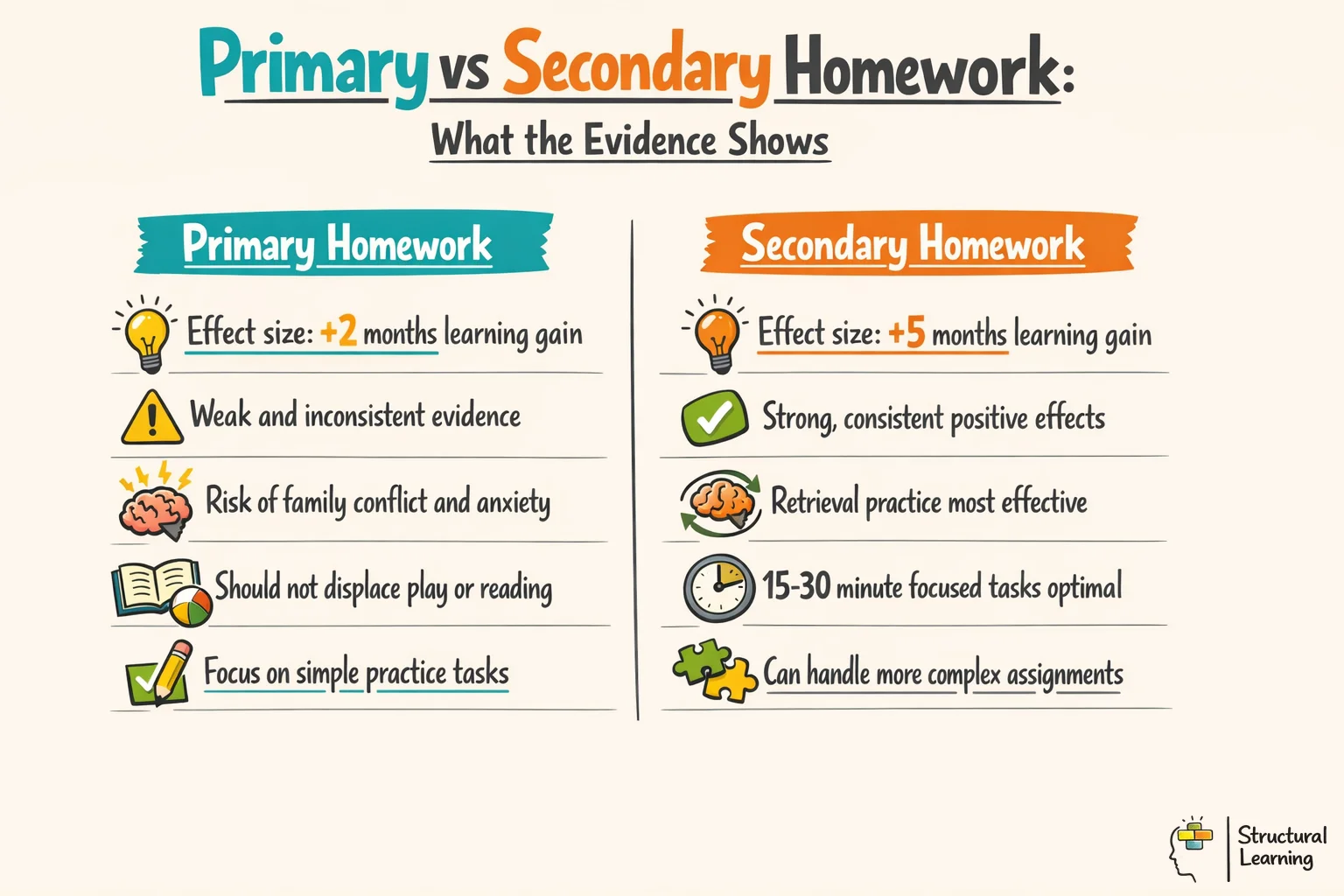
  1. Homework impact varies by age: EEF evidence shows homework has greater impact at secondary (+5 months) than primary (+2 months). The type of task matters more than the amount.
  2. Retrieval practice homework works best: Tasks that require pupils to recall previously taught material produce stronger learning gains than new content or completion exercises.
  3. Less can be more: Short, focused tasks (15-30 minutes) with clear purpose consistently outperform lengthy assignments that lead to copying or parental over-involvement.
  4. Equity matters: Not all pupils have quiet study spaces, internet access, or parental support. Effective homework policies account for these differences rather than penalising them.

Homework sits at the intersection of school policy, parental expectation, and cognitive science. For many teachers, it generates more heat than light: debates in the staffroom about how much to set, what counts as useful, and whether it is worth the marking time at all. The research base is more nuanced than either the enthusiasts or the sceptics tend to admit.

This guide sets out what the evidence actually shows, where the genuine disagreements lie, and how to design a school homework policy that is grounded in learning science rather than tradition or parent pressure. Every section includes a concrete classroom example so you can see what the principles look like in practice.

What Does the Evidence Say About Homework?

The most comprehensive meta-analysis remains Cooper, Robinson and Patall (2006), who synthesised over 60 studies and found a consistent positive relationship between homework and achievement at secondary level, but a weak and inconsistent one at primary. Effect sizes at secondary averaged around 0.60, which is substantial. At primary, the effect was close to zero or even slightly negative in some studies, particularly when homework displaced family time, reading for pleasure, or physical activity.

Hattie (2009), in his synthesis of over 800 meta-analyses, placed homework at an effect size of 0.29 overall, which he categorised as having some positive effect but below the hinge point of 0.40 that he considered typical of effective teaching. Crucially, Hattie noted that the effect was three to five times larger at secondary than primary, and that the nature of the task mattered considerably. Practice and review tasks showed stronger effects than tasks requiring new learning or extended projects completed without teacher support.

The Education Endowment Foundation (EEF) Toolkit summarises the evidence in similar terms: homework at secondary level is associated with approximately five additional months of learning per year; at primary, the figure drops to around two months, and the evidence quality is rated as moderate. The EEF is careful to note that these averages conceal enormous variation depending on task design, pupil age, and home context.

A practical example: a Year 10 science teacher sets a retrieval practice quiz each Friday covering the week's content. Pupils spend 15 minutes recalling key terms and processes without notes. When marked in class on Monday, the teacher can see at a glance which concepts need revisiting. This kind of task, grounded in retrieval practice, sits at the high end of the homework evidence base. Compare this with a Year 10 teacher who asks pupils to "research osmosis and write a page." The latter task is likely to produce a cut-and-paste summary from a website, with little to no learning occurring.

Primary vs Secondary: Different Rules Apply

The evidence gap between primary and secondary is large enough that many researchers and school leaders argue they should be treated as entirely different questions. For primary pupils, the risks of poorly designed homework are higher: anxiety, family conflict, and erosion of time that could be spent on physical play, independent reading, or creative activity. The scaffolding that makes classroom tasks manageable simply does not transfer to a home setting in the same way. Fan et al. (2017) found that at primary level, homework in mathematics was particularly likely to produce negative effects when it was perceived as burdensome or when parental involvement became a source of stress rather than support.

At secondary level, the case for homework is considerably stronger, but it is still conditional. Trautwein and Köller (2003) found that the quality of homework behaviour, whether pupils were genuinely engaging rather than copying or rushing, was a stronger predictor of achievement than the amount of homework set. In other words, a pupil who spends 20 focused minutes on a well-designed task will learn more than one who spends 60 minutes with a textbook open while simultaneously watching television.

Hallam (2004) reviewed the UK-specific evidence and noted that many secondary school homework policies are driven by tradition and parental expectation rather than pedagogical rationale. The typical recommendation of 30 minutes per subject per week at Key Stage 3, rising to 60-90 minutes at GCSE, has little direct evidential basis; it emerged from school policies that were themselves shaped by school inspection frameworks rather than learning science.

A primary classroom example: a Year 3 teacher sends home a reading record and asks parents to share a book with their child for 10 minutes each evening, discussing what happened and predicting what might come next. This is developmentally appropriate, builds oral language alongside reading, and does not require parents to teach. It aligns with the evidence that structured reading at home is one of the few primary homework activities with consistent positive effects. A secondary example: a Year 9 history teacher asks pupils to complete a five-item timeline of key events before the next lesson, which the class then uses as the raw material for a discussion about causation. The homework is short, recall-based, and directly feeds into classroom activity, so neither teacher nor pupil is left wondering why it was set.

Designing Homework That Counts

The single most important design decision is whether the task requires pupils to retrieve previously learned material or encounter new material for the first time. Research on spaced practice and retrieval consistently shows that spacing review across time, and requiring recall rather than re-reading, produces stronger long-term retention. Homework is a natural vehicle for this kind of spaced retrieval, because it creates a gap between classroom learning and the review task.

A second design principle concerns cognitive load. Homework tasks that are too complex, too novel, or that assume resources pupils may not have at home (textbooks left at school, reliable internet, a quiet workspace) are likely to generate high extraneous load. When a pupil is struggling to understand what the task even means, none of their working memory is available for the actual learning. Tasks should be designed so that the procedure is completely clear, and the cognitive demand is focused on retrieving or practising specific content rather than on decoding instructions.

Third, effective homework has a clear connection to classroom learning. When pupils do not understand how tonight's task connects to what they did in the lesson, or how it will be used in the next one, motivation drops sharply. Teachers who use strong questioning strategies in class can use the same technique to design homework prompts: the question stem that worked as an exit ticket often works equally well as a retrieval task at home. This is not about making homework feel relevant in a vague sense; it is about ensuring there is an explicit pedagogical link. "Complete questions 1-10" communicates a task. "Complete questions 1-10 so that on Thursday we can use your answers to build the model" communicates a purpose.

A practical design example: a Year 12 psychology teacher uses a retrieval pyramid. Each week, pupils complete a three-tier sheet at home: five factual recall questions from this week's content, three from last week, and one integrative question connecting a concept from this half-term to a concept from last half-term. The task takes 20 minutes, requires no textbook, and maps directly onto the metacognitive skills pupils need for examination questions. The teacher marks it in class using a visualiser, so feedback is immediate and whole-class. This is the model: short, spaced, retrieval-focused, and directly linked to what comes next.

Homework Type Comparison Table

Homework Type Evidence of Effectiveness Pupil Engagement Equity Considerations
Retrieval Practice (low-stakes quizzes, flashcard recall, brain dumps) High. Roediger and Karpicke (2006) showed retrieval tasks outperform re-reading by 50% on delayed tests. Variable initially; improves once pupils understand the mechanism. Works best with clear answer keys for self-checking. High equity: requires no internet, no parental subject knowledge, and minimal resources. Can be completed anywhere in 15-20 minutes.
Reading Tasks (structured reading with comprehension focus) Moderate to high at primary when paired with reading record and adult discussion. Lower at secondary without accountability. High for motivated readers; very low for struggling readers unless text is appropriately levelled and supported. Moderate equity: requires access to appropriate texts. Schools need to provide copies; assume nothing is available at home.
Project-Based Tasks (multi-night extended assignments, research projects) Low to moderate. Cooper et al. (2006) found extended projects often produce parental dependency and uneven outputs that reflect home advantage rather than pupil learning. Initially high due to creative freedom; often collapses without teacher scaffolding at key decision points. Low equity: strongly correlated with home resource access (craft materials, printers, parental time). Socioeconomic gap widens.
Completion Exercises (finish the worksheet, copy the diagram, complete the notes) Low. Produces compliance rather than learning. Trautwein and Köller (2003) found completion-based homework showed near-zero learning gains. Low: pupils tend to rush or copy. Does not require sustained attention. Moderate equity in access terms, but the task itself has minimal learning value regardless of circumstances.

Common Homework Pitfalls

The most common pitfall is setting homework that functions as a proxy for marking. When teachers set homework primarily because they need something to record in the markbook, or because parents expect to see written work coming home, the task design suffers. The question should always be: what learning will occur during this task, not what evidence of engagement can we show? A retrieval quiz marked in class generates far more learning than a five-paragraph essay that takes 90 minutes to set and 90 minutes to mark, and that pupils have partially copied anyway.

A related pitfall is setting homework on content that has not yet been taught, or that was taught only superficially. This is particularly common at the start of a new unit, when teachers set "pre-reading" or "background research." Without prior knowledge to anchor new information, pupils are effectively trying to learn from scratch without teacher support. The resulting homework is often surface-level and generates misconceptions that the teacher then has to unpick. New content belongs in the classroom, where misconceptions can be caught immediately. Homework belongs after teaching, as a vehicle for consolidation and retrieval.

Volume is a third pitfall. Harris, Harrison, and Pianta (2016) found that in schools with high homework loads, pupils from disadvantaged backgrounds showed greater homework-related stress and lower completion rates, while pupils from affluent backgrounds completed more homework but showed no additional learning gains compared to moderate-homework conditions. The Goldilocks zone appears to be 20-30 minutes per subject per night at secondary, with shorter tasks at primary, set deliberately rather than reflexively.

A classroom illustration of the pitfall: a Year 8 English teacher sets "write a character analysis of Scrooge" as homework before the class has completed their reading of A Christmas Carol and before any explicit teaching of how to write analytically. Half the class submits something copied from a revision website. The teacher spends a lesson addressing misconceptions about the analysis format. The same teacher, reflecting on this, redesigns the task: pupils are asked to find and copy out two quotations from the chapter they read in class, and write one sentence explaining what each one shows about Scrooge. This is retrieval-focused, based on taught content, and takes 10 minutes. The next lesson begins with pupils sharing their quotations and the class building the analysis together, using homework as the raw material rather than the finished product.

Homework for SEND and EAL Pupils

Homework policy design often overlooks the specific circumstances of pupils with special educational needs or those learning English as an additional language. For pupils with working memory difficulties, homework tasks that require holding multiple instructions in mind simultaneously are likely to fail at the first hurdle. A pupil who could complete the task if it were broken into clear steps may abandon it entirely if the instructions are presented as a paragraph of text that they cannot parse independently at home.

For pupils with SEND, the special educational needs code of practice places a responsibility on schools to ensure that homework does not disadvantage pupils who receive in-class support they cannot access at home. A pupil who uses a scribe in school cannot use one at home. A pupil who processes verbal instructions through a teaching assistant cannot do so in the kitchen at 7pm. Homework design for SEND pupils needs to consider: what support is available in school, what can reasonably be expected to transfer to a home context, and whether the task can be completed independently or requires adaptation.

For EAL pupils, the challenge is compounded by the language demand of many homework tasks. A science comprehension task that is accessible in a classroom with teacher support may be incomprehensible in a home where parents speak limited English and there is no translation resource available. Differentiation strategies that work in the classroom, such as bilingual glossaries, visual supports, or sentence frames, can and should be adapted for homework tasks. The key principle is the same as for SEND: if the pupil cannot access the task without support, the task is not a homework task; it is an in-school task that has been mislabelled.

A practical example: a Year 7 science teacher with several EAL pupils designs a retrieval homework that uses images rather than text for the recall prompts. Pupils are given a sheet with diagrams of the cell structures they have learned, and asked to label them from memory. The task requires no reading comprehension, draws on visual memory, and is self-contained. When the sheet is checked in class using a coloured pen, the teacher can see immediately which labels were correct and which need re-teaching. The EAL pupils can complete it independently, which builds both confidence and the habit of completing homework, rather than the avoidance pattern that develops when tasks are consistently inaccessible.

Building Your School Homework Policy

A school homework policy that is grounded in evidence needs to make four things explicit: what homework is for, what types of task are acceptable, how much time pupils should spend, and what happens when homework is not completed. Policies that are vague on any of these four points tend to produce inconsistency across departments, which in turn produces pupil confusion and parental frustration. "Teachers should set regular, meaningful homework" is not a policy; it is an aspiration.

On purpose: the policy should state clearly that homework functions as a vehicle for consolidation and retrieval, not for covering new content or for producing finished pieces. This single statement rules out many of the most common and most counterproductive homework types, and gives teachers a clear rationale to explain to parents and pupils why tasks look the way they do. It also simplifies the formative assessment loop: if homework is always about retrieval of taught content, then checking it in class the following lesson is a natural and low-burden process.

On task types: the policy should specify, by phase or by key stage, which types of task count as homework. A useful framework is to distinguish between retrieval tasks (always appropriate), reading tasks (appropriate with clear purpose and accessible text), and extended tasks (appropriate occasionally, never as a regular expectation). Completion exercises and new-content research should be explicitly discouraged, not as an aesthetic preference but because the evidence does not support them as learning activities.

On time: research suggests diminishing returns set in quickly at secondary when homework exceeds 60-90 minutes per night in total across all subjects. A two-hour homework load at Key Stage 4 is within the range supported by evidence; a four-hour load is not, regardless of how much content there is to cover. The policy should set a per-subject per-week expectation and ask heads of department to audit their actual homework load against it each term. At primary, 20-30 minutes total per night is the upper limit supported by evidence, with reading at the centre.

On non-completion: the most counterproductive response to non-completion is punitive. Detention for non-completion of homework tends to punish pupils whose home circumstances make completion difficult, rather than those who are choosing not to engage. A more effective approach, supported by self-regulation research, is to treat non-completion as information: find out why, and adjust either the task or the support. A homework club or a protected 15-minute period at the end of the school day for retrieval tasks can close the equity gap without requiring any home participation at all.

A policy example in practice: Pennine Secondary School revises its homework policy in Year 9. The SLT agrees that all homework will be retrieval-based, set for a maximum of 20 minutes per subject per week, and checked in class rather than marked individually. They create a shared bank of retrieval quiz templates by department, linked to the scheme of work. At parents' evening, teachers explain the rationale: "Research shows that recalling information from memory strengthens learning far more than re-reading notes. Your child's homework is designed to do exactly that." Non-completion rates drop by 40% in the first half-term, not because pupils are suddenly more motivated, but because the tasks are achievable independently and the feedback loop is immediate.

Homework and Pupil Wellbeing

The wellbeing dimension of homework is often treated as separate from the academic evidence, but it is not. Stress generated by homework that is too complex, too voluminous, or perceived as unfair has direct effects on pupil motivation and on the growth mindset attitudes that support long-term academic engagement. A pupil who repeatedly fails to complete homework, or who completes it but receives no meaningful feedback, learns that homework is an obstacle rather than a learning opportunity. That attribution becomes self-reinforcing.

The equity dimension is particularly acute. Research consistently finds that homework completion rates are strongly correlated with socioeconomic status, not because disadvantaged pupils are less diligent, but because they are more likely to have inadequate study space, shared devices, caring responsibilities, part-time work, or parents who cannot provide subject-specific support. A homework policy that treats non-completion as a behavioural problem rather than a structural one is, in effect, a policy that disadvantages pupils who are already disadvantaged.

Schools that have been most successful at closing the homework completion gap have typically done two things. First, they have reduced the complexity and volume of homework to the point where it can be completed without home resources. Second, they have provided in-school alternatives, such as a homework club, a registration period with retrieval activities, or form-time retrieval tasks, that ensure all pupils have access to spaced practice regardless of their home environment. The goal is not to remove the learning opportunity; it is to remove the structural barrier to accessing it.

A classroom example of wellbeing-aware homework design: a Year 11 English teacher notices that three pupils, all from the same block of flats where broadband access is unreliable, have stopped submitting online homework. Rather than escalating to a non-completion policy, the teacher switches the homework format to a paper retrieval sheet, printed at school, requiring no internet. Pupils are asked to write from memory: three things they know about the poem they studied that week. The task takes 10 minutes, requires no resources, and reconnects those pupils to the homework routine. Their participation in class discussions improves within a fortnight, because they are arriving at lessons having spent time recalling the content rather than having felt excluded from the task.

Further Reading: Key Papers on Homework

Further Reading

  1. Cooper, H., Robinson, J.C. & Patall, E.A. (2006). Does homework improve academic achievement? A synthesis of research, 1987-2003. Review of Educational Research, 76(1), 1-62. Read the paper
  2. Hattie, J. (2009). Visible Learning: A Synthesis of over 800 Meta-analyses Relating to Achievement. Routledge. View the book
  3. Fan, H., Xu, J., Cai, Z., He, J. & Fan, X. (2017). Homework and students' achievement in math and science: A 30-year meta-analysis, 1986-2015. Educational Research Review, 20, 35-54. Read the paper
  4. Hallam, S. (2004). Homework: The evidence. Institute of Education, University of London. Read the paper
  5. Trautwein, U. & Köller, O. (2003). The relationship between homework and achievement: Still much of a mystery. Educational Psychology Review, 15(2), 115-145. Read the paper
Loading audit...

Key Takeaways

  1. Homework impact varies by age: EEF evidence shows homework has greater impact at secondary (+5 months) than primary (+2 months). The type of task matters more than the amount.
  2. Retrieval practice homework works best: Tasks that require pupils to recall previously taught material produce stronger learning gains than new content or completion exercises.
  3. Less can be more: Short, focused tasks (15-30 minutes) with clear purpose consistently outperform lengthy assignments that lead to copying or parental over-involvement.
  4. Equity matters: Not all pupils have quiet study spaces, internet access, or parental support. Effective homework policies account for these differences rather than penalising them.

Homework sits at the intersection of school policy, parental expectation, and cognitive science. For many teachers, it generates more heat than light: debates in the staffroom about how much to set, what counts as useful, and whether it is worth the marking time at all. The research base is more nuanced than either the enthusiasts or the sceptics tend to admit.

This guide sets out what the evidence actually shows, where the genuine disagreements lie, and how to design a school homework policy that is grounded in learning science rather than tradition or parent pressure. Every section includes a concrete classroom example so you can see what the principles look like in practice.

What Does the Evidence Say About Homework?

The most comprehensive meta-analysis remains Cooper, Robinson and Patall (2006), who synthesised over 60 studies and found a consistent positive relationship between homework and achievement at secondary level, but a weak and inconsistent one at primary. Effect sizes at secondary averaged around 0.60, which is substantial. At primary, the effect was close to zero or even slightly negative in some studies, particularly when homework displaced family time, reading for pleasure, or physical activity.

Hattie (2009), in his synthesis of over 800 meta-analyses, placed homework at an effect size of 0.29 overall, which he categorised as having some positive effect but below the hinge point of 0.40 that he considered typical of effective teaching. Crucially, Hattie noted that the effect was three to five times larger at secondary than primary, and that the nature of the task mattered considerably. Practice and review tasks showed stronger effects than tasks requiring new learning or extended projects completed without teacher support.

The Education Endowment Foundation (EEF) Toolkit summarises the evidence in similar terms: homework at secondary level is associated with approximately five additional months of learning per year; at primary, the figure drops to around two months, and the evidence quality is rated as moderate. The EEF is careful to note that these averages conceal enormous variation depending on task design, pupil age, and home context.

A practical example: a Year 10 science teacher sets a retrieval practice quiz each Friday covering the week's content. Pupils spend 15 minutes recalling key terms and processes without notes. When marked in class on Monday, the teacher can see at a glance which concepts need revisiting. This kind of task, grounded in retrieval practice, sits at the high end of the homework evidence base. Compare this with a Year 10 teacher who asks pupils to "research osmosis and write a page." The latter task is likely to produce a cut-and-paste summary from a website, with little to no learning occurring.

Primary vs Secondary: Different Rules Apply

The evidence gap between primary and secondary is large enough that many researchers and school leaders argue they should be treated as entirely different questions. For primary pupils, the risks of poorly designed homework are higher: anxiety, family conflict, and erosion of time that could be spent on physical play, independent reading, or creative activity. The scaffolding that makes classroom tasks manageable simply does not transfer to a home setting in the same way. Fan et al. (2017) found that at primary level, homework in mathematics was particularly likely to produce negative effects when it was perceived as burdensome or when parental involvement became a source of stress rather than support.

At secondary level, the case for homework is considerably stronger, but it is still conditional. Trautwein and Köller (2003) found that the quality of homework behaviour, whether pupils were genuinely engaging rather than copying or rushing, was a stronger predictor of achievement than the amount of homework set. In other words, a pupil who spends 20 focused minutes on a well-designed task will learn more than one who spends 60 minutes with a textbook open while simultaneously watching television.

Hallam (2004) reviewed the UK-specific evidence and noted that many secondary school homework policies are driven by tradition and parental expectation rather than pedagogical rationale. The typical recommendation of 30 minutes per subject per week at Key Stage 3, rising to 60-90 minutes at GCSE, has little direct evidential basis; it emerged from school policies that were themselves shaped by school inspection frameworks rather than learning science.

A primary classroom example: a Year 3 teacher sends home a reading record and asks parents to share a book with their child for 10 minutes each evening, discussing what happened and predicting what might come next. This is developmentally appropriate, builds oral language alongside reading, and does not require parents to teach. It aligns with the evidence that structured reading at home is one of the few primary homework activities with consistent positive effects. A secondary example: a Year 9 history teacher asks pupils to complete a five-item timeline of key events before the next lesson, which the class then uses as the raw material for a discussion about causation. The homework is short, recall-based, and directly feeds into classroom activity, so neither teacher nor pupil is left wondering why it was set.

Designing Homework That Counts

The single most important design decision is whether the task requires pupils to retrieve previously learned material or encounter new material for the first time. Research on spaced practice and retrieval consistently shows that spacing review across time, and requiring recall rather than re-reading, produces stronger long-term retention. Homework is a natural vehicle for this kind of spaced retrieval, because it creates a gap between classroom learning and the review task.

A second design principle concerns cognitive load. Homework tasks that are too complex, too novel, or that assume resources pupils may not have at home (textbooks left at school, reliable internet, a quiet workspace) are likely to generate high extraneous load. When a pupil is struggling to understand what the task even means, none of their working memory is available for the actual learning. Tasks should be designed so that the procedure is completely clear, and the cognitive demand is focused on retrieving or practising specific content rather than on decoding instructions.

Third, effective homework has a clear connection to classroom learning. When pupils do not understand how tonight's task connects to what they did in the lesson, or how it will be used in the next one, motivation drops sharply. Teachers who use strong questioning strategies in class can use the same technique to design homework prompts: the question stem that worked as an exit ticket often works equally well as a retrieval task at home. This is not about making homework feel relevant in a vague sense; it is about ensuring there is an explicit pedagogical link. "Complete questions 1-10" communicates a task. "Complete questions 1-10 so that on Thursday we can use your answers to build the model" communicates a purpose.

A practical design example: a Year 12 psychology teacher uses a retrieval pyramid. Each week, pupils complete a three-tier sheet at home: five factual recall questions from this week's content, three from last week, and one integrative question connecting a concept from this half-term to a concept from last half-term. The task takes 20 minutes, requires no textbook, and maps directly onto the metacognitive skills pupils need for examination questions. The teacher marks it in class using a visualiser, so feedback is immediate and whole-class. This is the model: short, spaced, retrieval-focused, and directly linked to what comes next.

Homework Type Comparison Table

Homework Type Evidence of Effectiveness Pupil Engagement Equity Considerations
Retrieval Practice (low-stakes quizzes, flashcard recall, brain dumps) High. Roediger and Karpicke (2006) showed retrieval tasks outperform re-reading by 50% on delayed tests. Variable initially; improves once pupils understand the mechanism. Works best with clear answer keys for self-checking. High equity: requires no internet, no parental subject knowledge, and minimal resources. Can be completed anywhere in 15-20 minutes.
Reading Tasks (structured reading with comprehension focus) Moderate to high at primary when paired with reading record and adult discussion. Lower at secondary without accountability. High for motivated readers; very low for struggling readers unless text is appropriately levelled and supported. Moderate equity: requires access to appropriate texts. Schools need to provide copies; assume nothing is available at home.
Project-Based Tasks (multi-night extended assignments, research projects) Low to moderate. Cooper et al. (2006) found extended projects often produce parental dependency and uneven outputs that reflect home advantage rather than pupil learning. Initially high due to creative freedom; often collapses without teacher scaffolding at key decision points. Low equity: strongly correlated with home resource access (craft materials, printers, parental time). Socioeconomic gap widens.
Completion Exercises (finish the worksheet, copy the diagram, complete the notes) Low. Produces compliance rather than learning. Trautwein and Köller (2003) found completion-based homework showed near-zero learning gains. Low: pupils tend to rush or copy. Does not require sustained attention. Moderate equity in access terms, but the task itself has minimal learning value regardless of circumstances.

Common Homework Pitfalls

The most common pitfall is setting homework that functions as a proxy for marking. When teachers set homework primarily because they need something to record in the markbook, or because parents expect to see written work coming home, the task design suffers. The question should always be: what learning will occur during this task, not what evidence of engagement can we show? A retrieval quiz marked in class generates far more learning than a five-paragraph essay that takes 90 minutes to set and 90 minutes to mark, and that pupils have partially copied anyway.

A related pitfall is setting homework on content that has not yet been taught, or that was taught only superficially. This is particularly common at the start of a new unit, when teachers set "pre-reading" or "background research." Without prior knowledge to anchor new information, pupils are effectively trying to learn from scratch without teacher support. The resulting homework is often surface-level and generates misconceptions that the teacher then has to unpick. New content belongs in the classroom, where misconceptions can be caught immediately. Homework belongs after teaching, as a vehicle for consolidation and retrieval.

Volume is a third pitfall. Harris, Harrison, and Pianta (2016) found that in schools with high homework loads, pupils from disadvantaged backgrounds showed greater homework-related stress and lower completion rates, while pupils from affluent backgrounds completed more homework but showed no additional learning gains compared to moderate-homework conditions. The Goldilocks zone appears to be 20-30 minutes per subject per night at secondary, with shorter tasks at primary, set deliberately rather than reflexively.

A classroom illustration of the pitfall: a Year 8 English teacher sets "write a character analysis of Scrooge" as homework before the class has completed their reading of A Christmas Carol and before any explicit teaching of how to write analytically. Half the class submits something copied from a revision website. The teacher spends a lesson addressing misconceptions about the analysis format. The same teacher, reflecting on this, redesigns the task: pupils are asked to find and copy out two quotations from the chapter they read in class, and write one sentence explaining what each one shows about Scrooge. This is retrieval-focused, based on taught content, and takes 10 minutes. The next lesson begins with pupils sharing their quotations and the class building the analysis together, using homework as the raw material rather than the finished product.

Homework for SEND and EAL Pupils

Homework policy design often overlooks the specific circumstances of pupils with special educational needs or those learning English as an additional language. For pupils with working memory difficulties, homework tasks that require holding multiple instructions in mind simultaneously are likely to fail at the first hurdle. A pupil who could complete the task if it were broken into clear steps may abandon it entirely if the instructions are presented as a paragraph of text that they cannot parse independently at home.

For pupils with SEND, the special educational needs code of practice places a responsibility on schools to ensure that homework does not disadvantage pupils who receive in-class support they cannot access at home. A pupil who uses a scribe in school cannot use one at home. A pupil who processes verbal instructions through a teaching assistant cannot do so in the kitchen at 7pm. Homework design for SEND pupils needs to consider: what support is available in school, what can reasonably be expected to transfer to a home context, and whether the task can be completed independently or requires adaptation.

For EAL pupils, the challenge is compounded by the language demand of many homework tasks. A science comprehension task that is accessible in a classroom with teacher support may be incomprehensible in a home where parents speak limited English and there is no translation resource available. Differentiation strategies that work in the classroom, such as bilingual glossaries, visual supports, or sentence frames, can and should be adapted for homework tasks. The key principle is the same as for SEND: if the pupil cannot access the task without support, the task is not a homework task; it is an in-school task that has been mislabelled.

A practical example: a Year 7 science teacher with several EAL pupils designs a retrieval homework that uses images rather than text for the recall prompts. Pupils are given a sheet with diagrams of the cell structures they have learned, and asked to label them from memory. The task requires no reading comprehension, draws on visual memory, and is self-contained. When the sheet is checked in class using a coloured pen, the teacher can see immediately which labels were correct and which need re-teaching. The EAL pupils can complete it independently, which builds both confidence and the habit of completing homework, rather than the avoidance pattern that develops when tasks are consistently inaccessible.

Building Your School Homework Policy

A school homework policy that is grounded in evidence needs to make four things explicit: what homework is for, what types of task are acceptable, how much time pupils should spend, and what happens when homework is not completed. Policies that are vague on any of these four points tend to produce inconsistency across departments, which in turn produces pupil confusion and parental frustration. "Teachers should set regular, meaningful homework" is not a policy; it is an aspiration.

On purpose: the policy should state clearly that homework functions as a vehicle for consolidation and retrieval, not for covering new content or for producing finished pieces. This single statement rules out many of the most common and most counterproductive homework types, and gives teachers a clear rationale to explain to parents and pupils why tasks look the way they do. It also simplifies the formative assessment loop: if homework is always about retrieval of taught content, then checking it in class the following lesson is a natural and low-burden process.

On task types: the policy should specify, by phase or by key stage, which types of task count as homework. A useful framework is to distinguish between retrieval tasks (always appropriate), reading tasks (appropriate with clear purpose and accessible text), and extended tasks (appropriate occasionally, never as a regular expectation). Completion exercises and new-content research should be explicitly discouraged, not as an aesthetic preference but because the evidence does not support them as learning activities.

On time: research suggests diminishing returns set in quickly at secondary when homework exceeds 60-90 minutes per night in total across all subjects. A two-hour homework load at Key Stage 4 is within the range supported by evidence; a four-hour load is not, regardless of how much content there is to cover. The policy should set a per-subject per-week expectation and ask heads of department to audit their actual homework load against it each term. At primary, 20-30 minutes total per night is the upper limit supported by evidence, with reading at the centre.

On non-completion: the most counterproductive response to non-completion is punitive. Detention for non-completion of homework tends to punish pupils whose home circumstances make completion difficult, rather than those who are choosing not to engage. A more effective approach, supported by self-regulation research, is to treat non-completion as information: find out why, and adjust either the task or the support. A homework club or a protected 15-minute period at the end of the school day for retrieval tasks can close the equity gap without requiring any home participation at all.

A policy example in practice: Pennine Secondary School revises its homework policy in Year 9. The SLT agrees that all homework will be retrieval-based, set for a maximum of 20 minutes per subject per week, and checked in class rather than marked individually. They create a shared bank of retrieval quiz templates by department, linked to the scheme of work. At parents' evening, teachers explain the rationale: "Research shows that recalling information from memory strengthens learning far more than re-reading notes. Your child's homework is designed to do exactly that." Non-completion rates drop by 40% in the first half-term, not because pupils are suddenly more motivated, but because the tasks are achievable independently and the feedback loop is immediate.

Homework and Pupil Wellbeing

The wellbeing dimension of homework is often treated as separate from the academic evidence, but it is not. Stress generated by homework that is too complex, too voluminous, or perceived as unfair has direct effects on pupil motivation and on the growth mindset attitudes that support long-term academic engagement. A pupil who repeatedly fails to complete homework, or who completes it but receives no meaningful feedback, learns that homework is an obstacle rather than a learning opportunity. That attribution becomes self-reinforcing.

The equity dimension is particularly acute. Research consistently finds that homework completion rates are strongly correlated with socioeconomic status, not because disadvantaged pupils are less diligent, but because they are more likely to have inadequate study space, shared devices, caring responsibilities, part-time work, or parents who cannot provide subject-specific support. A homework policy that treats non-completion as a behavioural problem rather than a structural one is, in effect, a policy that disadvantages pupils who are already disadvantaged.

Schools that have been most successful at closing the homework completion gap have typically done two things. First, they have reduced the complexity and volume of homework to the point where it can be completed without home resources. Second, they have provided in-school alternatives, such as a homework club, a registration period with retrieval activities, or form-time retrieval tasks, that ensure all pupils have access to spaced practice regardless of their home environment. The goal is not to remove the learning opportunity; it is to remove the structural barrier to accessing it.

A classroom example of wellbeing-aware homework design: a Year 11 English teacher notices that three pupils, all from the same block of flats where broadband access is unreliable, have stopped submitting online homework. Rather than escalating to a non-completion policy, the teacher switches the homework format to a paper retrieval sheet, printed at school, requiring no internet. Pupils are asked to write from memory: three things they know about the poem they studied that week. The task takes 10 minutes, requires no resources, and reconnects those pupils to the homework routine. Their participation in class discussions improves within a fortnight, because they are arriving at lessons having spent time recalling the content rather than having felt excluded from the task.

Further Reading: Key Papers on Homework

Further Reading

  1. Cooper, H., Robinson, J.C. & Patall, E.A. (2006). Does homework improve academic achievement? A synthesis of research, 1987-2003. Review of Educational Research, 76(1), 1-62. Read the paper
  2. Hattie, J. (2009). Visible Learning: A Synthesis of over 800 Meta-analyses Relating to Achievement. Routledge. View the book
  3. Fan, H., Xu, J., Cai, Z., He, J. & Fan, X. (2017). Homework and students' achievement in math and science: A 30-year meta-analysis, 1986-2015. Educational Research Review, 20, 35-54. Read the paper
  4. Hallam, S. (2004). Homework: The evidence. Institute of Education, University of London. Read the paper
  5. Trautwein, U. & Köller, O. (2003). The relationship between homework and achievement: Still much of a mystery. Educational Psychology Review, 15(2), 115-145. Read the paper

No Posts found.
Back to Blog