The Testing Effect: How Retrieval Practice Strengthens LearningThe Testing Effect: How Retrieval Practice Strengthens Learning - students learning in classroom

The Testing Effect: How Retrieval Practice Strengthens Learning

|

December 29, 2025

Discover how the testing effect transforms classroom learning by using quizzes as learning tools rather than mere assessments, with evidence-based strategies for every subject.

You've just taught a brilliant lesson. Students nodded along, answered questions, and seemed to grasp the material. Yet three weeks later, during the assessment, blank faces stare back at you. What went wrong?

The answer lies in one of cognitive science's most robust findings: the testing effect. This phenomenon, also called retrieval practice or test-enhanced learning, reveals that actively pulling information from memory doesn't just measure learning; it fundamentally changes and strengthens it. When students retrieve information, they're not simply demonstrating what they know. They're making that knowledge more durable and accessible for the future.

The implications for classroom practice are profound. Every time you ask students to recall information without looking at their notes, you're not just checking understanding. You're actively building stronger memories. This insight transforms how we think about the relationship between teaching, learning, and assessment.

Testing Effect vs Traditional Re-studying infographic for teachers
Testing Effect vs Traditional Re-studying

Key Takeaways

  • Testing strengthens memory more effectively than re-reading or re-studying the same material
  • The effort required during retrieval is what produces the learning benefit
  • Low-stakes, frequent quizzing works better than high-stakes, infrequent tests
  • Feedback after testing enhances the effect but isn't always necessary

What Is the Testing Effect?

The testing effect refers to the finding that retrieving information from memory strengthens that memory more than simply re-studying the same information. When you take a test, the act of searching your memory and producing an answer creates learning, not just measurement.

This phenomenon was first demonstrated systematically by researchers in the early twentieth century, but it gained renewed attention through the work of Henry Roediger and Jeffrey Karpicke in the mid-2000s. Their experiments showed that students who practised retrieving information remembered significantly more than students who spent the same time re-reading their notes.

In one landmark study, Roediger and Karpicke (2006) had students either re-read a passage four times or read it once and then take three practice tests. When tested five minutes later, the re-reading group performed slightly better. But when tested one week later, the testing group remembered 50% more. This crossover pattern reveals something crucial: activities that feel effective in the moment often aren't, while activities that feel difficult produce lasting learning.

The testing effect connects closely to retrieval practice, which applies the same principle to classroom instruction. Both terms describe how actively recalling information strengthens memory traces and makes future retrieval more reliable.

Why Testing Beats Re-Reading

Understanding why testing works helps teachers design more effective learning activities. Several cognitive mechanisms contribute to the testing advantage.

Retrieval Strengthens Memory Traces

Every time you successfully retrieve a memory, you strengthen the neural pathways that encode it. This is fundamentally different from re-exposure, which merely reactivates the memory without requiring effortful reconstruction. The act of searching memory and producing an answer leaves the memory in a stronger state than before.

Think of it like a path through a forest. Walking the same path repeatedly makes it clearer and easier to find. But if someone carries you along the path, you don't learn the route nearly as well. Retrieval is active walking; re-reading is being carried.

Desirable Difficulties Enhance Learning

Testing is harder than re-reading, and that difficulty is precisely what makes it effective. Robert Bjork coined the term desirable difficulties to describe conditions that make learning feel harder in the moment but produce better long-term retention.

When students struggle to retrieve information, they must work harder to reconstruct the memory. This effort strengthens the memory trace and creates more elaborate retrieval routes. Easy learning often means forgettable learning.

Testing Reveals Knowledge Gaps

Re-reading creates a dangerous illusion: the material feels familiar, so students believe they know it. Testing provides honest feedback about what's actually in memory versus what merely feels familiar.

This metacognitive benefit helps students direct their study efforts more efficiently. When testing reveals gaps, students know where to focus. When re-reading creates false confidence, students study the wrong things or stop studying too early.

Retrieval Modifies Memory Organisation

Testing doesn't just strengthen existing memories; it reorganises them. During retrieval, information is reconnected with other knowledge, integrated with new understanding, and restructured for better accessibility. Each retrieval event is an opportunity for schema refinement.

Low-Stakes Testing Strategies

The power of the testing effect comes from frequent, low-stakes retrieval, not from high-stakes examinations. Here are practical strategies for embedding testing into everyday teaching.

Retrieval Starters

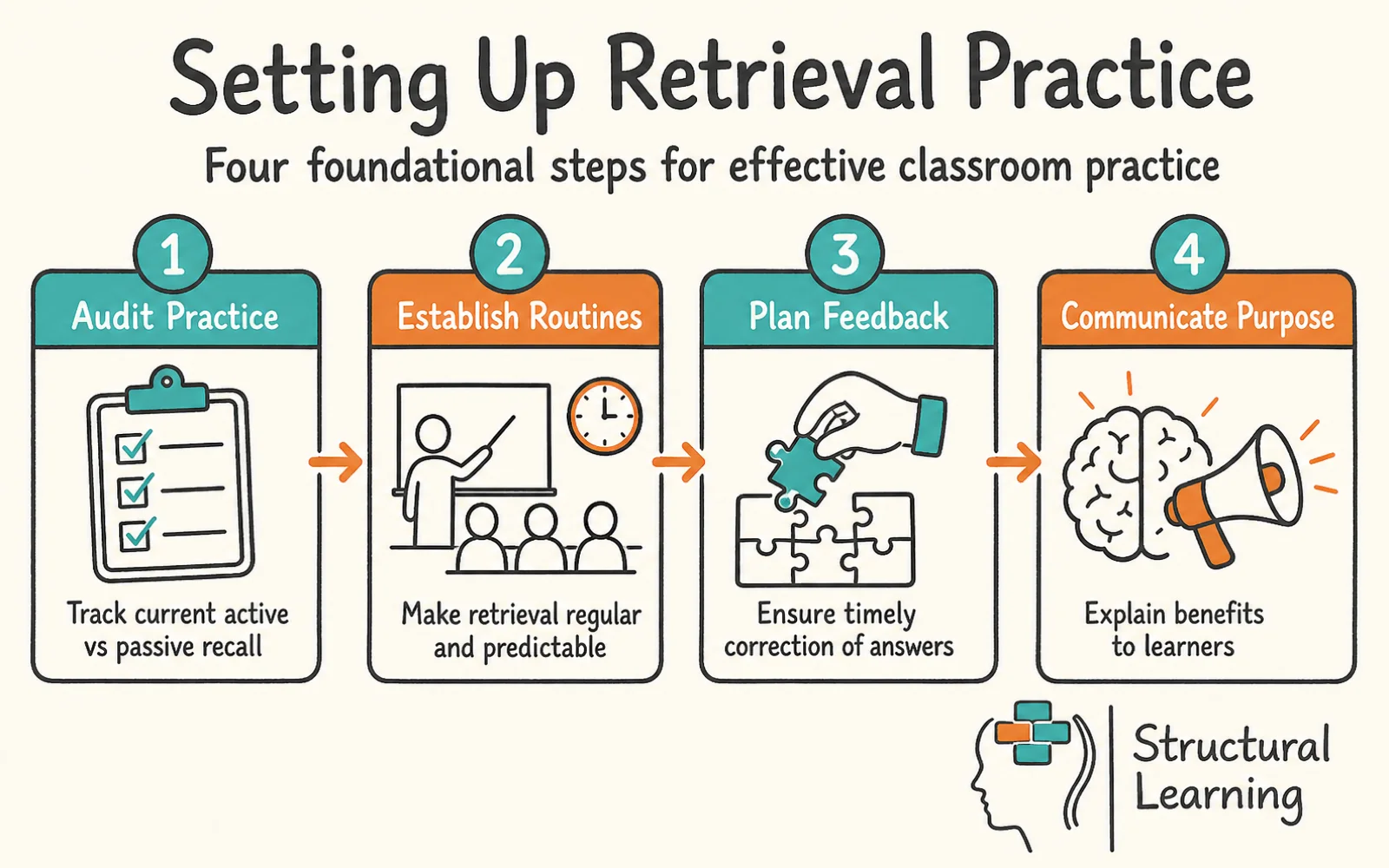
Begin each lesson with a brief retrieval activity covering previous content. This might take just three to five minutes but produces substantial benefits. Ask students to write down everything they remember about last lesson's topic, or pose three questions without allowing notes.

The key is making retrieval the default, not the exception. When students know they'll be asked to recall previous learning at the start of every lesson, they pay attention differently and think about the material between lessons.

Brain Dumps

A brain dump asks students to write down everything they can remember about a topic without looking at any resources. This simple technique reveals the true state of knowledge and identifies gaps that need addressing.

Brain dumps work particularly well before teaching new content that builds on prior learning. Students activate relevant knowledge, making new connections easier to form. Teachers also gain valuable formative assessment data about class readiness.

No-Stakes Quizzing

Regular quizzes that don't count toward grades capture the learning benefits of testing without the anxiety that can impair performance. When students know a quiz is for learning rather than evaluation, they engage more productively with the challenge.

Consider daily or weekly quizzes covering recent and older material. The combination of current content with spaced review of previous topics creates powerful learning conditions by combining the testing effect with spaced practice.

Think-Pair-Share with Retrieval Focus

The classic think-pair-share strategy becomes more powerful when focused on retrieval. Rather than asking students to discuss new ideas, ask them to recall previous learning. "What do you remember about..." prompts retrieval before discussion elaborates understanding.

This approach combines the benefits of testing with the social benefits of collaborative learning. Students who couldn't retrieve alone may succeed with peer support, and explaining to others further strengthens memory.

Flashcards and Self-Testing

Teach students to create and use flashcards effectively. The act of creating cards involves generation (another powerful learning strategy), while using them involves retrieval. For flashcards to work, students must attempt recall before looking at the answer.

Digital flashcard systems like Anki or Quizlet can add spacing algorithms that optimise review timing. However, physical cards work just as well for retrieval practice itself.

The Testing Effect Across Subjects

The testing effect applies across all subject areas, though implementation varies to suit different content types.

English and Literacy

Testing in English might involve recalling vocabulary definitions, retrieving key quotes from studied texts, or reconstructing plot sequences from memory. Before writing analytical paragraphs, ask students to retrieve relevant textual evidence without looking at the text.

For reading comprehension, retrieval questions after reading strengthen memory for content and support inference by keeping relevant information accessible.

Mathematics

Mathematics testing extends beyond practising procedures to include retrieval of conceptual understanding. Ask students to explain why procedures work, not just demonstrate them. Retrieve definitions, theorem statements, and connections between topics.

Low-stakes daily quizzes mixing current topics with spaced review of previous content combat the common problem of students forgetting earlier material by the end of the year.

Science

Science teaching benefits from testing across all three domains: retrieving factual knowledge, recalling procedures for practical work, and reconstructing conceptual explanations for phenomena. Before practical lessons, test recall of method and safety points.

Testing understanding of working memory demands in practical work by asking students to retrieve key steps before beginning helps prevent cognitive overload during complex procedures.

History and Social Studies

History testing might involve recalling events, dates, and causative relationships from memory before engaging in historical analysis. The act of retrieving historical information makes it available for the higher-order thinking that follows.

Ask students to create timelines from memory, retrieve factors contributing to historical events, or recall different historical interpretations before evaluating them.

Languages

Language learning particularly benefits from retrieval practice. Vocabulary tested repeatedly is remembered far better than vocabulary merely reviewed. Grammar rules and conjugation patterns also benefit from testing rather than just exposure.

The testing effect explains why active vocabulary instruction that requires production outperforms passive exposure. Students who must retrieve words strengthen their accessible vocabulary.

Testing and Feedback

Feedback after testing enhances learning, but its role is more nuanced than often assumed.

When Feedback Helps Most

Feedback is most valuable when students have attempted retrieval but failed or succeeded with uncertainty. In these cases, feedback corrects errors before they consolidate and confirms correct responses, strengthening confidence alongside memory.

However, even testing without feedback produces learning benefits. The retrieval attempt itself strengthens memory, regardless of whether the attempt succeeds. Feedback adds to this benefit rather than being the sole source of it.

Timing of Feedback

Immediate feedback works well for factual knowledge where quick correction prevents error consolidation. Delayed feedback may work better for conceptual understanding where students benefit from struggling with uncertainty before resolution.

In practice, providing feedback after each question or at the end of a quiz produces similar benefits. What matters most is that feedback eventually arrives and that students process it actively rather than passively noting their score.

Elaborated Feedback

Going beyond "correct" or "incorrect" to explain why answers are right or wrong produces additional learning. This elaborated feedback supports metacognition by helping students understand not just what the answer is but how to think about similar questions in future.

Why Retrieval Practice Transforms Learning infographic for teachers
Why Retrieval Practice Transforms Learning

Addressing Common Concerns

Teachers sometimes hesitate to implement testing-based strategies. Addressing common concerns helps overcome barriers to adoption.

"Testing Creates Anxiety"

High-stakes testing can indeed create anxiety that impairs performance. But low-stakes testing, framed as a learning activity rather than evaluation, typically reduces anxiety about later high-stakes assessments. Students who regularly practise retrieval feel more confident and prepared.

The solution isn't to avoid testing but to use it differently: frequently, at low stakes, and with an explicit learning purpose. Students who understand why testing helps them often embrace it.

"I Don't Have Time for Quizzes"

Retrieval practice doesn't require elaborate quiz preparation. A few oral questions, a brief written retrieval task, or a quick flashcard session takes minutes but produces substantial learning gains. The question isn't whether you can afford time for testing but whether you can afford to skip it.

Time spent on retrieval practice is often more efficient than time spent re-teaching forgotten material later. Front-loading retrieval reduces the need for revision and remediation.

"Students Just Guess Randomly"

When students can't retrieve, they often guess. This isn't failure but an opportunity. Incorrect guesses followed by feedback may actually enhance learning through a phenomenon called the hypercorrection effect: confident errors that are corrected are remembered especially well.

Encourage genuine attempts at retrieval rather than strategic guessing. The effort of trying to retrieve, even when unsuccessful, produces benefits that guessing without effort does not.

"Weaker Students Will Fail"

Students with less knowledge will find retrieval harder, but they also have the most to gain. The testing effect is often largest for students who would otherwise engage in passive, ineffective study strategies.

Scaffold retrieval for struggling learners through cued recall, recognition tasks, or collaborative retrieval. Any retrieval is better than none, and success builds confidence for more challenging retrieval later.

Testing and Long-Term Retention

The testing effect becomes more pronounced over time. This is perhaps its most important feature for education.

The Crossover Pattern

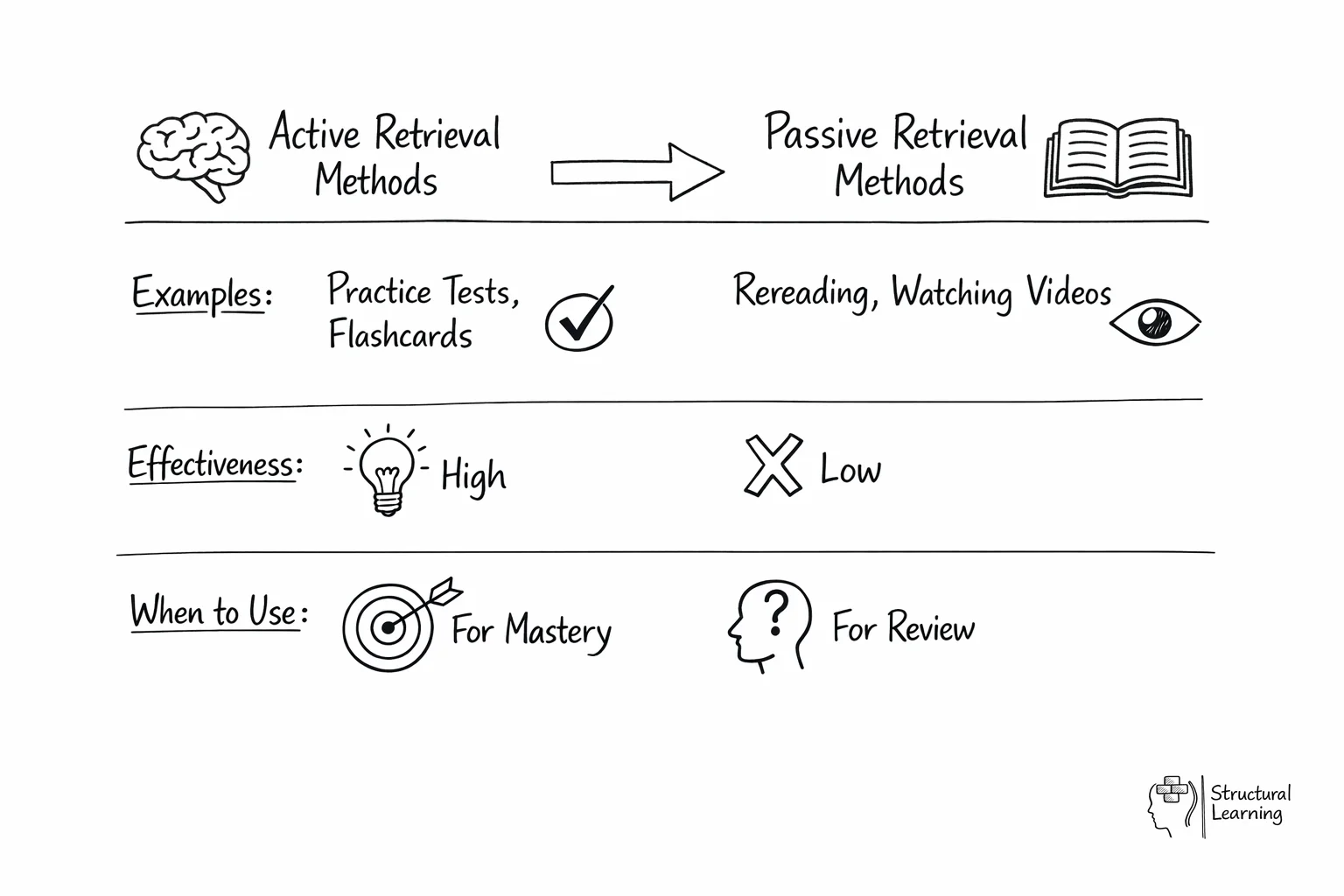
Studies consistently show that re-reading produces better immediate performance, while testing produces better delayed performance. Students who re-study score higher on tests given minutes later, but students who practise retrieval score higher on tests given days or weeks later.

This crossover pattern explains why students often prefer re-reading: it feels effective because it produces immediate fluency. But this fluency is temporary. Teachers must help students understand that difficulty now means durability later.

Implications for Revision

Traditional revision often emphasises re-reading notes and highlighting key points. The testing effect suggests revision should instead emphasise retrieval: practice questions, self-testing, and brain dumps. Students who test themselves during revision remember more in exams.

Teaching effective revision strategies is itself a valuable use of lesson time. Students who understand effective memorisation techniques based on testing effect research can apply these strategies independently.

Spaced Retrieval

Combining the testing effect with spacing produces particularly powerful learning. Retrieval that is distributed over time, with gaps between sessions, produces stronger memories than the same number of retrieval attempts massed together.

Plan curriculum and revision schedules to include regular retrieval of previously taught content. The combination of testing and spacing creates cumulative, durable learning.

The Testing Effect and Cognitive Load

Testing interacts with cognitive load theory in important ways.

Reducing Future Cognitive Load

Well-consolidated knowledge retrieved to automaticity reduces cognitive load during complex tasks. Students who can effortlessly retrieve foundational information have more working memory available for higher-order thinking.

This is why testing effect research supports thorough learning of basics before tackling complex applications. Retrieval practice builds the fluent knowledge base that enables sophisticated performance.

Managing Retrieval Load

Retrieval itself consumes cognitive resources. When retrieval is too difficult or too much is demanded at once, students may become overwhelmed. Scaffold retrieval appropriately, breaking complex topics into retrievable chunks and providing cues when needed.

The goal is challenging but achievable retrieval. If students can't retrieve anything, the task is too hard. If retrieval is effortless, it's too easy to produce much benefit.

From Research to Classroom Practice

The testing effect offers teachers a straightforward principle: make retrieval a regular, low-stakes part of learning rather than an occasional high-stakes measurement event.

Practical implementation might begin with:

  • Adding retrieval starters to every lesson
  • Converting some practice time to self-testing time
  • Teaching students about the testing effect explicitly
  • Replacing re-reading revision with retrieval practice

Small changes accumulate into significant learning benefits. Each retrieval opportunity strengthens memory more than equivalent passive review. Over a school year, these benefits compound substantially.

Further Reading: Key Papers on the Testing Effect

The following papers provide deeper exploration of the testing effect and its educational applications.

  • Test-Enhanced Learning: Taking Memory Tests Improves Long-Term Retention (Roediger & Karpicke, 2006)
  • This landmark study demonstrated the crossover pattern between testing and re-reading. Students who took practice tests remembered 50% more after one week than students who spent the same time re-reading. The paper established the testing effect as a major finding for educational practice and launched extensive follow-up research.

  • Ten Benefits of Testing and Their Applications to Educational Practice (Roediger, Putnam & Smith, 2011)
  • This comprehensive review identifies ten distinct benefits of testing beyond the direct effect on memory. Benefits include improved organisation of knowledge, better transfer to new contexts, and metacognitive improvements. The paper provides practical guidance for implementing testing in educational settings.

  • Improving Students' Learning With Effective Learning Techniques (Dunlosky et al., 2013)
  • This influential review evaluated ten learning techniques, rating practice testing as one of only two strategies with high utility across learners, materials, and contexts. The authors provide guidance on implementation and identify conditions that maximise testing benefits.

  • Retrieval Practice Produces More Learning than Elaborative Studying with Concept Mapping (Karpicke & Blunt, 2011)
  • This study compared retrieval practice with elaborative concept mapping, finding that retrieval produced better learning even for conceptual understanding. The results challenged assumptions that testing only helps factual recall, demonstrating benefits for deeper comprehension.

  • The Power of Testing Memory: Basic Research and Implications for Educational Practice (Roediger & Karpicke, 2006)
  • This review synthesises testing effect research and its implications for education. The authors discuss why testing works, when it's most effective, and how teachers can apply research findings. Essential reading for understanding the theoretical foundations of retrieval practice.

    5 Ways to Implement Low-Stakes Testing in Your Classroom infographic for teachers
    5 Ways to Implement Low-Stakes Testing in Your Classroom

    Read More

    Loading audit...

    You've just taught a brilliant lesson. Students nodded along, answered questions, and seemed to grasp the material. Yet three weeks later, during the assessment, blank faces stare back at you. What went wrong?

    The answer lies in one of cognitive science's most robust findings: the testing effect. This phenomenon, also called retrieval practice or test-enhanced learning, reveals that actively pulling information from memory doesn't just measure learning; it fundamentally changes and strengthens it. When students retrieve information, they're not simply demonstrating what they know. They're making that knowledge more durable and accessible for the future.

    The implications for classroom practice are profound. Every time you ask students to recall information without looking at their notes, you're not just checking understanding. You're actively building stronger memories. This insight transforms how we think about the relationship between teaching, learning, and assessment.

    Testing Effect vs Traditional Re-studying infographic for teachers
    Testing Effect vs Traditional Re-studying

    Key Takeaways

    • Testing strengthens memory more effectively than re-reading or re-studying the same material
    • The effort required during retrieval is what produces the learning benefit
    • Low-stakes, frequent quizzing works better than high-stakes, infrequent tests
    • Feedback after testing enhances the effect but isn't always necessary

    What Is the Testing Effect?

    The testing effect refers to the finding that retrieving information from memory strengthens that memory more than simply re-studying the same information. When you take a test, the act of searching your memory and producing an answer creates learning, not just measurement.

    This phenomenon was first demonstrated systematically by researchers in the early twentieth century, but it gained renewed attention through the work of Henry Roediger and Jeffrey Karpicke in the mid-2000s. Their experiments showed that students who practised retrieving information remembered significantly more than students who spent the same time re-reading their notes.

    In one landmark study, Roediger and Karpicke (2006) had students either re-read a passage four times or read it once and then take three practice tests. When tested five minutes later, the re-reading group performed slightly better. But when tested one week later, the testing group remembered 50% more. This crossover pattern reveals something crucial: activities that feel effective in the moment often aren't, while activities that feel difficult produce lasting learning.

    The testing effect connects closely to retrieval practice, which applies the same principle to classroom instruction. Both terms describe how actively recalling information strengthens memory traces and makes future retrieval more reliable.

    Why Testing Beats Re-Reading

    Understanding why testing works helps teachers design more effective learning activities. Several cognitive mechanisms contribute to the testing advantage.

    Retrieval Strengthens Memory Traces

    Every time you successfully retrieve a memory, you strengthen the neural pathways that encode it. This is fundamentally different from re-exposure, which merely reactivates the memory without requiring effortful reconstruction. The act of searching memory and producing an answer leaves the memory in a stronger state than before.

    Think of it like a path through a forest. Walking the same path repeatedly makes it clearer and easier to find. But if someone carries you along the path, you don't learn the route nearly as well. Retrieval is active walking; re-reading is being carried.

    Desirable Difficulties Enhance Learning

    Testing is harder than re-reading, and that difficulty is precisely what makes it effective. Robert Bjork coined the term desirable difficulties to describe conditions that make learning feel harder in the moment but produce better long-term retention.

    When students struggle to retrieve information, they must work harder to reconstruct the memory. This effort strengthens the memory trace and creates more elaborate retrieval routes. Easy learning often means forgettable learning.

    Testing Reveals Knowledge Gaps

    Re-reading creates a dangerous illusion: the material feels familiar, so students believe they know it. Testing provides honest feedback about what's actually in memory versus what merely feels familiar.

    This metacognitive benefit helps students direct their study efforts more efficiently. When testing reveals gaps, students know where to focus. When re-reading creates false confidence, students study the wrong things or stop studying too early.

    Retrieval Modifies Memory Organisation

    Testing doesn't just strengthen existing memories; it reorganises them. During retrieval, information is reconnected with other knowledge, integrated with new understanding, and restructured for better accessibility. Each retrieval event is an opportunity for schema refinement.

    Low-Stakes Testing Strategies

    The power of the testing effect comes from frequent, low-stakes retrieval, not from high-stakes examinations. Here are practical strategies for embedding testing into everyday teaching.

    Retrieval Starters

    Begin each lesson with a brief retrieval activity covering previous content. This might take just three to five minutes but produces substantial benefits. Ask students to write down everything they remember about last lesson's topic, or pose three questions without allowing notes.

    The key is making retrieval the default, not the exception. When students know they'll be asked to recall previous learning at the start of every lesson, they pay attention differently and think about the material between lessons.

    Brain Dumps

    A brain dump asks students to write down everything they can remember about a topic without looking at any resources. This simple technique reveals the true state of knowledge and identifies gaps that need addressing.

    Brain dumps work particularly well before teaching new content that builds on prior learning. Students activate relevant knowledge, making new connections easier to form. Teachers also gain valuable formative assessment data about class readiness.

    No-Stakes Quizzing

    Regular quizzes that don't count toward grades capture the learning benefits of testing without the anxiety that can impair performance. When students know a quiz is for learning rather than evaluation, they engage more productively with the challenge.

    Consider daily or weekly quizzes covering recent and older material. The combination of current content with spaced review of previous topics creates powerful learning conditions by combining the testing effect with spaced practice.

    Think-Pair-Share with Retrieval Focus

    The classic think-pair-share strategy becomes more powerful when focused on retrieval. Rather than asking students to discuss new ideas, ask them to recall previous learning. "What do you remember about..." prompts retrieval before discussion elaborates understanding.

    This approach combines the benefits of testing with the social benefits of collaborative learning. Students who couldn't retrieve alone may succeed with peer support, and explaining to others further strengthens memory.

    Flashcards and Self-Testing

    Teach students to create and use flashcards effectively. The act of creating cards involves generation (another powerful learning strategy), while using them involves retrieval. For flashcards to work, students must attempt recall before looking at the answer.

    Digital flashcard systems like Anki or Quizlet can add spacing algorithms that optimise review timing. However, physical cards work just as well for retrieval practice itself.

    The Testing Effect Across Subjects

    The testing effect applies across all subject areas, though implementation varies to suit different content types.

    English and Literacy

    Testing in English might involve recalling vocabulary definitions, retrieving key quotes from studied texts, or reconstructing plot sequences from memory. Before writing analytical paragraphs, ask students to retrieve relevant textual evidence without looking at the text.

    For reading comprehension, retrieval questions after reading strengthen memory for content and support inference by keeping relevant information accessible.

    Mathematics

    Mathematics testing extends beyond practising procedures to include retrieval of conceptual understanding. Ask students to explain why procedures work, not just demonstrate them. Retrieve definitions, theorem statements, and connections between topics.

    Low-stakes daily quizzes mixing current topics with spaced review of previous content combat the common problem of students forgetting earlier material by the end of the year.

    Science

    Science teaching benefits from testing across all three domains: retrieving factual knowledge, recalling procedures for practical work, and reconstructing conceptual explanations for phenomena. Before practical lessons, test recall of method and safety points.

    Testing understanding of working memory demands in practical work by asking students to retrieve key steps before beginning helps prevent cognitive overload during complex procedures.

    History and Social Studies

    History testing might involve recalling events, dates, and causative relationships from memory before engaging in historical analysis. The act of retrieving historical information makes it available for the higher-order thinking that follows.

    Ask students to create timelines from memory, retrieve factors contributing to historical events, or recall different historical interpretations before evaluating them.

    Languages

    Language learning particularly benefits from retrieval practice. Vocabulary tested repeatedly is remembered far better than vocabulary merely reviewed. Grammar rules and conjugation patterns also benefit from testing rather than just exposure.

    The testing effect explains why active vocabulary instruction that requires production outperforms passive exposure. Students who must retrieve words strengthen their accessible vocabulary.

    Testing and Feedback

    Feedback after testing enhances learning, but its role is more nuanced than often assumed.

    When Feedback Helps Most

    Feedback is most valuable when students have attempted retrieval but failed or succeeded with uncertainty. In these cases, feedback corrects errors before they consolidate and confirms correct responses, strengthening confidence alongside memory.

    However, even testing without feedback produces learning benefits. The retrieval attempt itself strengthens memory, regardless of whether the attempt succeeds. Feedback adds to this benefit rather than being the sole source of it.

    Timing of Feedback

    Immediate feedback works well for factual knowledge where quick correction prevents error consolidation. Delayed feedback may work better for conceptual understanding where students benefit from struggling with uncertainty before resolution.

    In practice, providing feedback after each question or at the end of a quiz produces similar benefits. What matters most is that feedback eventually arrives and that students process it actively rather than passively noting their score.

    Elaborated Feedback

    Going beyond "correct" or "incorrect" to explain why answers are right or wrong produces additional learning. This elaborated feedback supports metacognition by helping students understand not just what the answer is but how to think about similar questions in future.

    Why Retrieval Practice Transforms Learning infographic for teachers
    Why Retrieval Practice Transforms Learning

    Addressing Common Concerns

    Teachers sometimes hesitate to implement testing-based strategies. Addressing common concerns helps overcome barriers to adoption.

    "Testing Creates Anxiety"

    High-stakes testing can indeed create anxiety that impairs performance. But low-stakes testing, framed as a learning activity rather than evaluation, typically reduces anxiety about later high-stakes assessments. Students who regularly practise retrieval feel more confident and prepared.

    The solution isn't to avoid testing but to use it differently: frequently, at low stakes, and with an explicit learning purpose. Students who understand why testing helps them often embrace it.

    "I Don't Have Time for Quizzes"

    Retrieval practice doesn't require elaborate quiz preparation. A few oral questions, a brief written retrieval task, or a quick flashcard session takes minutes but produces substantial learning gains. The question isn't whether you can afford time for testing but whether you can afford to skip it.

    Time spent on retrieval practice is often more efficient than time spent re-teaching forgotten material later. Front-loading retrieval reduces the need for revision and remediation.

    "Students Just Guess Randomly"

    When students can't retrieve, they often guess. This isn't failure but an opportunity. Incorrect guesses followed by feedback may actually enhance learning through a phenomenon called the hypercorrection effect: confident errors that are corrected are remembered especially well.

    Encourage genuine attempts at retrieval rather than strategic guessing. The effort of trying to retrieve, even when unsuccessful, produces benefits that guessing without effort does not.

    "Weaker Students Will Fail"

    Students with less knowledge will find retrieval harder, but they also have the most to gain. The testing effect is often largest for students who would otherwise engage in passive, ineffective study strategies.

    Scaffold retrieval for struggling learners through cued recall, recognition tasks, or collaborative retrieval. Any retrieval is better than none, and success builds confidence for more challenging retrieval later.

    Testing and Long-Term Retention

    The testing effect becomes more pronounced over time. This is perhaps its most important feature for education.

    The Crossover Pattern

    Studies consistently show that re-reading produces better immediate performance, while testing produces better delayed performance. Students who re-study score higher on tests given minutes later, but students who practise retrieval score higher on tests given days or weeks later.

    This crossover pattern explains why students often prefer re-reading: it feels effective because it produces immediate fluency. But this fluency is temporary. Teachers must help students understand that difficulty now means durability later.

    Implications for Revision

    Traditional revision often emphasises re-reading notes and highlighting key points. The testing effect suggests revision should instead emphasise retrieval: practice questions, self-testing, and brain dumps. Students who test themselves during revision remember more in exams.

    Teaching effective revision strategies is itself a valuable use of lesson time. Students who understand effective memorisation techniques based on testing effect research can apply these strategies independently.

    Spaced Retrieval

    Combining the testing effect with spacing produces particularly powerful learning. Retrieval that is distributed over time, with gaps between sessions, produces stronger memories than the same number of retrieval attempts massed together.

    Plan curriculum and revision schedules to include regular retrieval of previously taught content. The combination of testing and spacing creates cumulative, durable learning.

    The Testing Effect and Cognitive Load

    Testing interacts with cognitive load theory in important ways.

    Reducing Future Cognitive Load

    Well-consolidated knowledge retrieved to automaticity reduces cognitive load during complex tasks. Students who can effortlessly retrieve foundational information have more working memory available for higher-order thinking.

    This is why testing effect research supports thorough learning of basics before tackling complex applications. Retrieval practice builds the fluent knowledge base that enables sophisticated performance.

    Managing Retrieval Load

    Retrieval itself consumes cognitive resources. When retrieval is too difficult or too much is demanded at once, students may become overwhelmed. Scaffold retrieval appropriately, breaking complex topics into retrievable chunks and providing cues when needed.

    The goal is challenging but achievable retrieval. If students can't retrieve anything, the task is too hard. If retrieval is effortless, it's too easy to produce much benefit.

    From Research to Classroom Practice

    The testing effect offers teachers a straightforward principle: make retrieval a regular, low-stakes part of learning rather than an occasional high-stakes measurement event.

    Practical implementation might begin with:

    • Adding retrieval starters to every lesson
    • Converting some practice time to self-testing time
    • Teaching students about the testing effect explicitly
    • Replacing re-reading revision with retrieval practice

    Small changes accumulate into significant learning benefits. Each retrieval opportunity strengthens memory more than equivalent passive review. Over a school year, these benefits compound substantially.

    Further Reading: Key Papers on the Testing Effect

    The following papers provide deeper exploration of the testing effect and its educational applications.

  • Test-Enhanced Learning: Taking Memory Tests Improves Long-Term Retention (Roediger & Karpicke, 2006)
  • This landmark study demonstrated the crossover pattern between testing and re-reading. Students who took practice tests remembered 50% more after one week than students who spent the same time re-reading. The paper established the testing effect as a major finding for educational practice and launched extensive follow-up research.

  • Ten Benefits of Testing and Their Applications to Educational Practice (Roediger, Putnam & Smith, 2011)
  • This comprehensive review identifies ten distinct benefits of testing beyond the direct effect on memory. Benefits include improved organisation of knowledge, better transfer to new contexts, and metacognitive improvements. The paper provides practical guidance for implementing testing in educational settings.

  • Improving Students' Learning With Effective Learning Techniques (Dunlosky et al., 2013)
  • This influential review evaluated ten learning techniques, rating practice testing as one of only two strategies with high utility across learners, materials, and contexts. The authors provide guidance on implementation and identify conditions that maximise testing benefits.

  • Retrieval Practice Produces More Learning than Elaborative Studying with Concept Mapping (Karpicke & Blunt, 2011)
  • This study compared retrieval practice with elaborative concept mapping, finding that retrieval produced better learning even for conceptual understanding. The results challenged assumptions that testing only helps factual recall, demonstrating benefits for deeper comprehension.

  • The Power of Testing Memory: Basic Research and Implications for Educational Practice (Roediger & Karpicke, 2006)
  • This review synthesises testing effect research and its implications for education. The authors discuss why testing works, when it's most effective, and how teachers can apply research findings. Essential reading for understanding the theoretical foundations of retrieval practice.

    5 Ways to Implement Low-Stakes Testing in Your Classroom infographic for teachers
    5 Ways to Implement Low-Stakes Testing in Your Classroom

    Read More

    Educational Technology

    Back to Blog